







Abstract
Decision-making processes heavily rely on the natural ordering structure that exists within attributes. This manuscript presents the new mathematical framework of lattice-ordered N-soft sets (LON-SS) and anti-lattice-ordered N-soft sets (A-LON-SS) that expands traditional N-soft sets (N-SSs) through attribute order relation integration. Our methodology extends the N-SS theory by resolving its limitations regarding ordered parameter handling, especially during rating and ranking situations. Further, this manuscript presents a thorough mathematical treatment and multiple examples that show how LON-SS effectively handles real-world decision problems that contain natural hierarchical parameter relationships. The examination supports that LON-SS delivers superior computational efficiency and user-friendly processing compared to traditional methods when applying the TOPSIS algorithm to decision analysis tasks. The LON-SS framework delivers substantial benefits to decision-making scenarios that need multi-valued assessments together with ordered attributes while showing potential applications in evaluation systems preference modeling and resource allocation problems. In the end, this manuscript compares the proposed concept with certain existing ones to reveal the supremacy and need of the existing theory.
Introduction
Fuzzy set (FS) (Zadeh, 1965) is a very handy technique to deal with linguistic terms. Specifically, if there occurs any order between them. But in FS the greatest difficulty is to characterize the membership grade for the elements of the set, it might be because of the absence of a parameterization tool in FSs. To overcome this difficulty, Molodtsov (1999) established the pioneer conception of the soft set (SS) which can consider the parameterization structure and provide a general framework for mathematical problems as compared to FS. The main benefit of SS is that it allows to handling of crisp and fuzzy information in a very efficient approach. The parameters of SS can be terms, sentences, numbers, mappings, and so on. There is no such difficulty in SSs which is linked with FSs, because in SSs theory a lot of parameters are available to deal with uncertainty. SS theory also preserves both crisp and fuzzy information pleasantly. Mostly, the researchers in SS models have utilized the dual evaluations either (0 or 1) or real values between 0 and 1, but in many real-life problems, we frequently see non-binary evaluations in ranking or rating systemss, for example, the rating can adopt the form of several stars (like, one star, two stars, three stars or four stars), by numbers as labels (like 0 as a label for bad, 1 for average and 2 for good). Hence clearly SS model is poor for interpretation for these conditions, therefore, Fatimah et al. (2018) extended the idea of SSs to a new model called N-soft sets (N-SSs) and they have discussed the characteristics and operations for this new model. Further, based on N-SS, many researchers have tried to find the linkage between the N-soft set and other existing theories to establish new theories. In this context, the development of N-soft sets and their extensions is a major advancement in dealing with uncertainty and DM.
Every element pair within a lattice-ordered set possesses both a supremum which represents the least upper bound and an infimum which stands for the greatest lower bound. The structure proved useful for numerous mathematical applications and computer science operations while serving logical systems. Humans use Boolean algebrato perform logic operations with the help of these structural foundations. The field of computer science makes use of lattices to create optimized compilers through data flow analysis while using them for knowledge representation in formal concept analysis. Lattices help organize complex set relationships in algebraic geometry together with topology above and beyond their roles in algebraic geometry and topology. Lattice-ordered frameworks function as a basis for creating decision models through their application in preference aggregation systems of economics. The modeling strength of lattices for hierarchies or interconnections enables their essential use between theoretical research and practical implementation.
Literature Review
SS theory has continued to attract rising research attention since its inception through various theoretical developments that extend its practical applications. The mathematical structure of SS theory received a major enhancement when Ali et al. (2009) developed new operations for the theory. Çağman & Enginoğlu (2010) demonstrated the operational research value of SS theory through their application of uni-int decision-making. Alcantud et al. (2024) performed a thorough systematic literature review of SS theory to present an extensive overview of its developments through 2024. Alcantud et al. (2019) demonstrated the effectiveness of combining fuzzy and SS theory to analyze survival rates in lung cancer resection patients for surgical decision support. SS theory serves as the focus of Herawan et al.'s (2010) research work which demonstrates its potential for dimensionality reduction data analysis and computational problem applications. Kamacı (2020) anticipated how parameter selectivity in SSs affects decision-making results through analytical studies. Researchers continue to pursue active studies about utilizing SS theory within existing decision-making methods. Zulqarnain et al. (2020) used the TOPSIS method with SSs in decision-making and Tao et al. (2020) presented basic uncertain information SSs for multi-criteria group decision-making applications. El-Shafei & Al-Shami (2021) investigated SS operators and soft-connected spaces through the use of soft somewhere dense sets. Sezgin & Çam (2025) introduced the soft theta-product and Sezgin & Şenyiğit (2025) proposed the soft star-product as new product operations for soft sets which find applications in decision-making scenarios. Ameen & Alqahtani (2023) developed Baire category SSs with symmetric local properties while Santos-García & Alcantud (2023) established ranked SSs. Herrera & Martínez (2000) developed a 2-tuple fuzzy linguistic representation model for computing with words. SS theory has received multiple theoretical expansions that integrate different types of fuzzy sets. Maji et al. (2001) developed fuzzy SS and intuitionistic fuzzy SS (Maji et al., 2004) was developed by Maji et al. (2004) as new additions to theoretical concepts. Garg & Arora (2018) developed Bonferroni mean aggregation operators for intuitionistic fuzzy SS which they applied to decision-making. Khan et al. (2020) developed an adjustable weighted soft discernibility matrix based on generalized picture fuzzy SSs for decision-making applications. Perveen et al. (2021) introduced spherical fuzzy SSs before Guleria & Bajaj (2021) developed T-spherical fuzzy SSs with aggregation operators for decision-making applications. Zheng et al. (2022) studied spherical fuzzy soft rough average aggregation operators for multi-criteria decision-making applications. A new method for bipolar SS was presented by Mahmood (2020). Abdullah et al. (2014) developed bipolar fuzzy SSs which they applied to decision-making problems. Riaz & Tehrim (2019) bipolar fuzzy soft mapping.
Ali et al. (2015) developed lattice-ordered SSs (LO-SS) which enhanced the theoretical framework of SS structures. Andika et al. (2024) analyzed the mathematical characteristics and practical uses of LO-SSs. The TOPSIS method received a new approach from Mahmood et al. (2022) who developed applications using lattice-ordered T-bipolar SSs. Sabeena Begam & Vimala (2019) demonstrated the effectiveness of lattice-ordered multi-fuzzy SSs when used for forecasting prediction models. Vimala & Reeta (2016) investigated lattice-ordered fuzzy soft groups while expanding the theory into group structures. Khan et al. (2019) introduced both lattice and anti-lattice ordered double framed SSs. Pandipriya et al. (2018) showed how lattice-ordered interval-valued hesitant fuzzy SSs work effectively in decision-making problems due to their ability to handle uncertain situations. Susanta et al. (2017) studied soft congruence relations on lattices to reveal their mathematical properties. Mahmood et al. (2018) focused on lattice-ordered intuitionistic fuzzy SSs by combining multiple mathematical concepts to improve modeling potential.
Akram et al. (2018) established fuzzy N-SSs as a new model which they applied to different domains. Ur Rehman & Mahmood (2021) expanded this work by developing picture fuzzy N-SSs which they used for decision-making. Akram et al. (2021a) established a hybrid group decision-making technique through their work on spherical fuzzy N-soft expert sets which improves the analysis of complex decision scenarios. Akram et al. (2019) developed hesitant fuzzy N-SSs as a new model that finds applications in decision-making. Mahmood et al. (2021a) developed complex fuzzy N-SSs together with a decision-making algorithm for practical applications. Akram et al. (2021b) developed a hybrid decision system that uses complex Pythagorean fuzzy N-SSs for complex decision problems. Mahmood et al. (2021b) introduced complex picture fuzzy N- SSs together with their respective decision-making algorithms. Akram & Shabir (2021) established complex T-spherical fuzzy N-SSs. Fatimah & Alcantud (2021) conducted research on multi-fuzzy N-SSs and their applications to decision-making to extend their mathematical scope. Alcantud (2022) investigated N- SS semantics while showing their practical applications and their link to three-way decision-making. Alcantud et al. (2022) analyzed OWA aggregation operators and multi-agent decisions through N-soft sets to develop collective decision frameworks. Akram et al. (2023) established an extended fuzzy N-Soft PROMETHEE method which they used to select robot butlers in practical robotic applications. The selection process for rehabilitation centers through an integrated ELECTRE method with m-polar fuzzy N-soft information was developed by Akram et al. (2022a). Akram et al. (2022b) developed complex fermatean fuzzy N-SSs as a new hybrid model which has multiple applications. Das & Granados (2023) examined IFP-intuitionistic multi-fuzzy N-SSs alongside their induced IFP-hesitant N-SSs for applications in decision-making processes. Mahmood et al. (2023) investigated TOPSIS techniques within bipolar complex fuzzy N-SSs, also see the works (Ahmmad, 2023; Hussain et al., 2023; Jaleel, 2022; Ullah et al., 2023; Ur Rehman, 2023).
Motivation and Contribution
The application of N-Soft Sets (N-SS) as a mathematical uncertainty modeling framework faces inherent restrictions during use in real-world decision-making systems that require ordered parameter assessment. The present N-SS theory lacks proper structural elements to handle hierarchical parameter relationships which is essential for practical applications that use rating and ranking systems. This manuscript fills the essential gap by developing LON-SS together with A-LON-SS which embed order relation structures within the N-SSs. This work presents the following main contributions.
A complete mathematical framework needs development for LON-SS and A-LON-SS to maintain N-SS's multiple assessment abilities while representing essential parameter hierarchy structures for modeling preference structures. The paper establishes formal definitions for theoretical properties and operational characteristics of LON-SS and A-LON-SS to create a solid framework for identifying ordered parameter relations. The LON-SS structure enables practical decision-making algorithms that produce efficient computational results for ordered attributes compared to conventional decision-making algorithms. The implementation of LON-SS shows its practical benefits through actual evaluation system deployment where ordered relationship integration leads to better decision quality while making results easier to understand. The proposed framework enters into validation mode through direct comparison with well-known decision-making approaches such as TOPSIS both to prove its theoretical strength as well as demonstrate its practical benefits.
The LON-SS framework solves particular problems that emerge when evaluation systems need multi-valued assessments and parameter ordering for effective decision-making in hierarchical systems preference models and resource allocation scenarios. Our approach through LON-SS delivers precise order relation representation capabilities to decision-makers who still need N-SS flexibility for complex practical applications. In the future, we aim to employ this invented conception in different domains (Akram et al., 2022b, 2023; Alcantud, 2022; Alcantud et al., 2022; Fatimah and Alcantud, 2021; Raja et al., 2024; Yang et al., 2023). The LON-SS is typical model that can be useful especially when we apply it on type-2 soft set (Hayat et al., 2018a) and type-2 soft graphs (Hayat et al., 2017, 2018b).
Organization of the Paper
Section 2 deals with basic notions of SSs and N-SSs. We also review some fundamental definitions of the lattice. In Section 3, we have introduced the basic notion of lattice-ordered N-soft sets and their related examples. In Section 4, we have discussed application steps for established work, and an algorithm for the TOPSIS method is given with examples. Section 5 deals with a comparative analysis of the proposed work to support the initiated work. Section 6 presents the conclusion remarks.
Preliminaries
Here, certain theories such as SSs and N-SSs are revised with related results. The definition of lattice is also part of this section.
Take a set that is
(Molodtsov, 1999) A SS over P is a pair
(Ali et al., 2009) Take two SSs that are

(Ali et al., 2009) Let

(Ali et al., 2009) Take two SSs that are

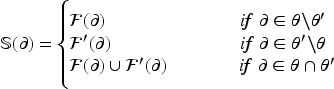
(Ali et al., 2009) Take

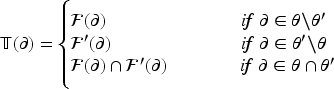
Fatimah et al. (Fatimah et al., 2018) invented N-SS which is a valuable technique to investigate the parameterization of the universe which is neither binary nor continuous and depends on a limited granularity in the view of the attributes.
(Fatimah et al., 2018) Take a set P as the universe,
(Fatimah et al., 2018) Take a N-SS
(Fatimah et al., 2018) Take a N-SS

(Fatimah et al., 2018) Take a N-SS

(Fatimah et al., 2018) Let

(Fatimah et al., 2018) Let

(Fatimah et al., 2018) Let


(Fatimah et al., 2018) Let


(Fatimah et al., 2018) Let

In day-to-day existence, there exist numerous circumstances where linguistic expressions have a specific sort of order between them along with a grading or rating system. In the accompanying, it is demonstrated that N-SSs can deal with such circumstances.
A N-SS
Let
A 6-SS can be obtained from Table 1.
Lattice of Parameters of Example 1. The Data Attained from the Real Information. Where we use i. Five stars are interpreted as a ‘Masterpiece’, ii. Four stars are interpreted ‘Excellent’ iii. Three stars are interpreted as ‘Very Good’, iv. Two stars are interpreted as ‘Good’, v. One star is interpreted as ‘Normal’, vi. Hole is interpreted ‘Poor’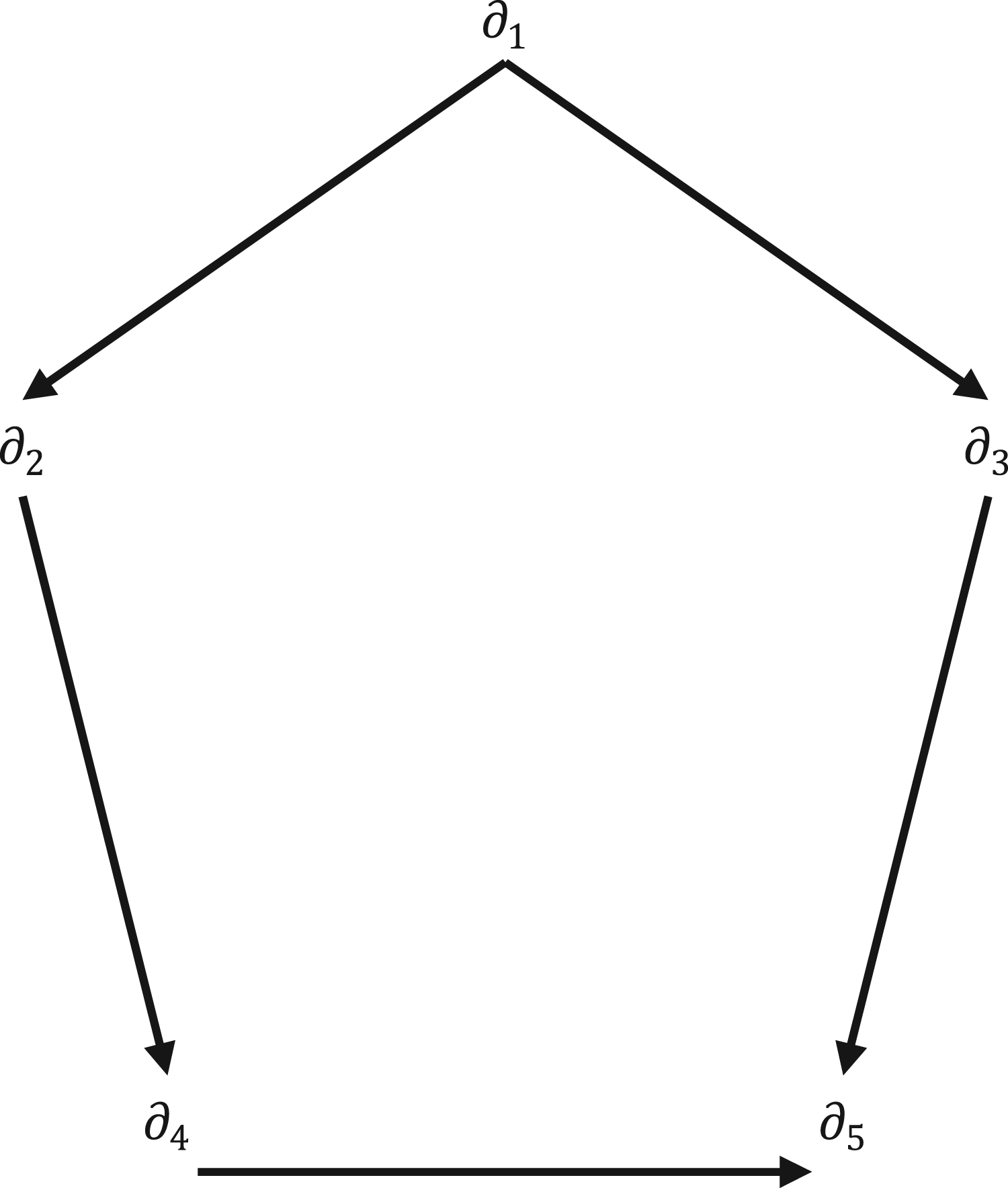
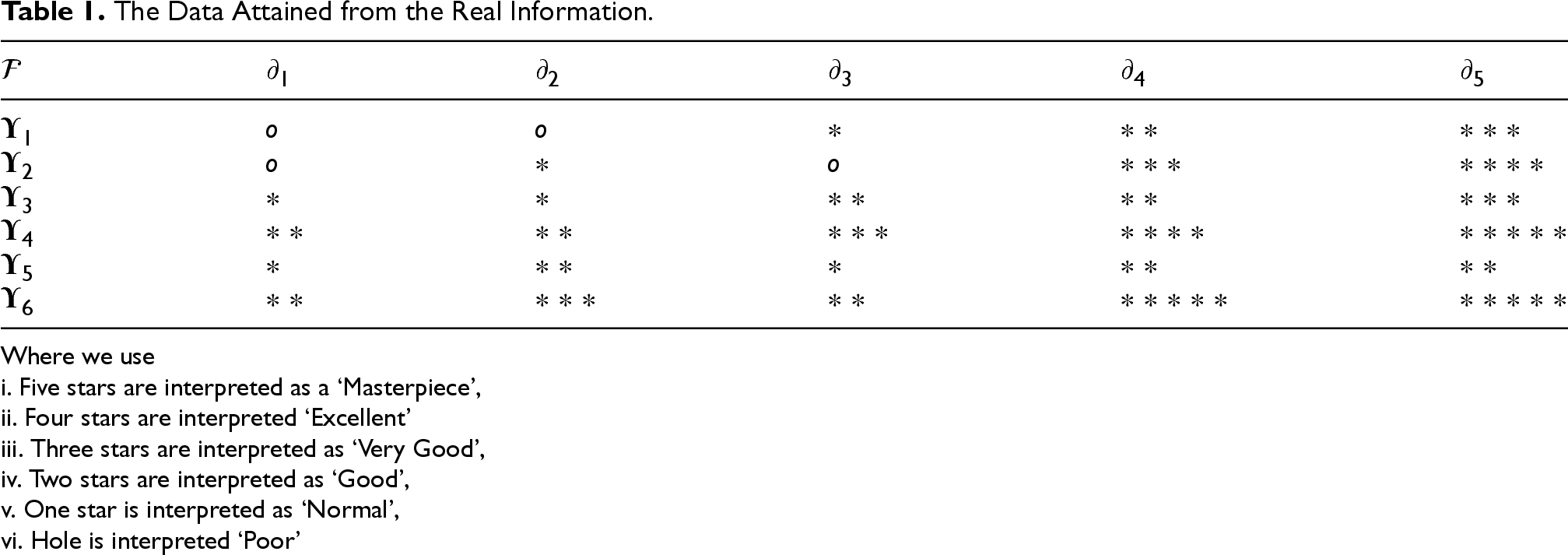
This graded assessment by stars can be easily connected to numbers as
0 symbolizes “ o ”,
1 symbolizes “
2 symbolizes “
3 symbolizes “
4 symbolizes “
5 symbolizes “
Hence a 6-SS may be presented as follows





The tabular depiction of 6-SS is presented in Table 2.
The Tabular Description of 6-SS of Example 1.
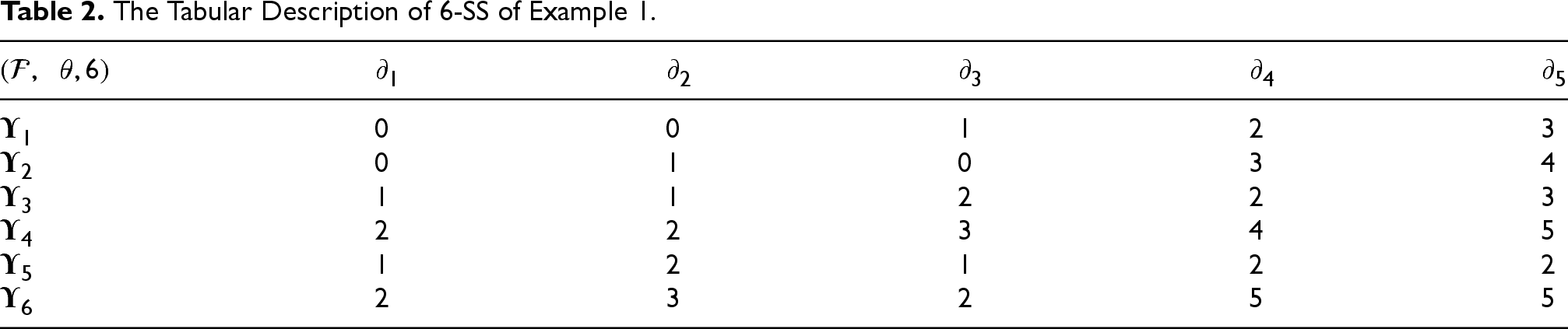
From Figure 1, we can see the order between attributes that is
A company wants to appoint an employee for the finance department. Let
This graded assessment by stars can unquestionably associated with numbers as
The Data Attained from the Real Information for Example 2.
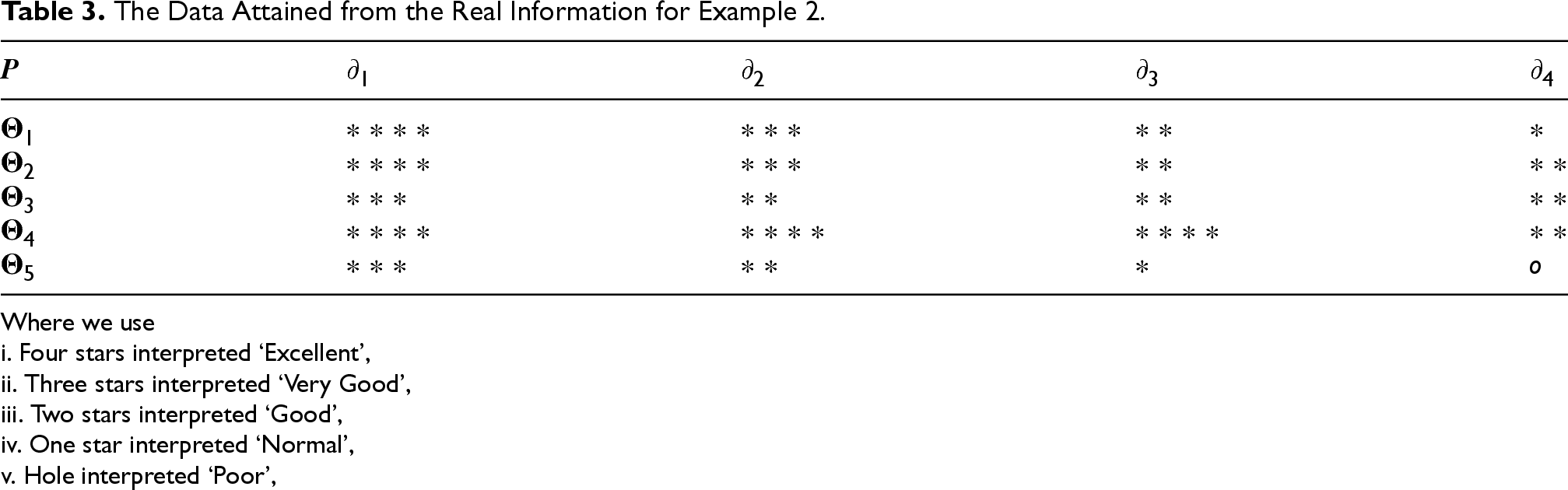
Where we use
i. Four stars interpreted ‘Excellent’,
ii. Three stars interpreted ‘Very Good’,
iii. Two stars interpreted ‘Good’,
iv. One star interpreted ‘Normal’,
v. Hole interpreted ‘Poor’,
0 symbolizes “
1 symbolizes “
2 symbolizes “
3 symbolizes “
4 symbolizes “
Hence a 5-SS may be described as follows




The tabular depiction of 5-SS is given in Table 4.
The Tabular Shape of 5-SS in Example 2.

We can see that
The following examples describe that the weak complement, top weak complement, and bottom weak complement of LON-SS may not be LON-SS.
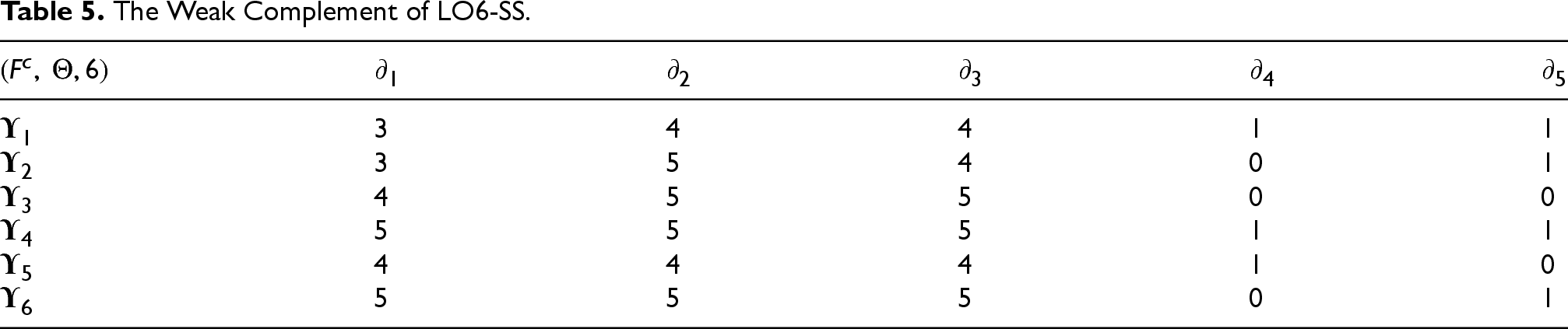
Let the LO6-SS be given in Example 1. Then, the weak complement of LO6-SS is given in Table 5.
Cleary from the Table 5, one can easily note that
The Weak Complement of LO6-SS.
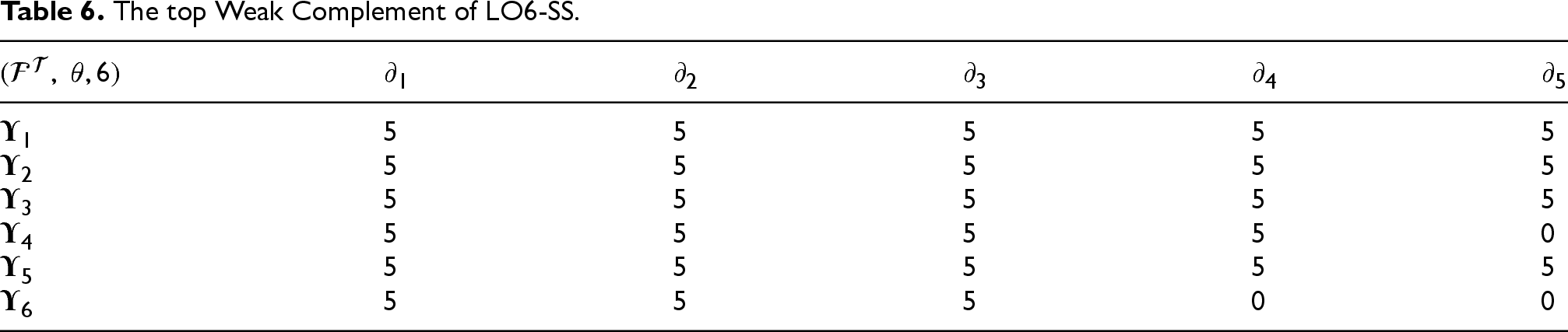
Let the LO6-SS be given in Example 1. Then the top weak complement of LO6-SS is given in Table 6.
From Table 6, one can note that
The top Weak Complement of LO6-SS.
Let the LO6-SS be given in Example 1. Then the bottom weak complement of LO6-SS is given in Table 7.
From Table 6, one can note that
The Bottom Weak Complement of LO6-SS.
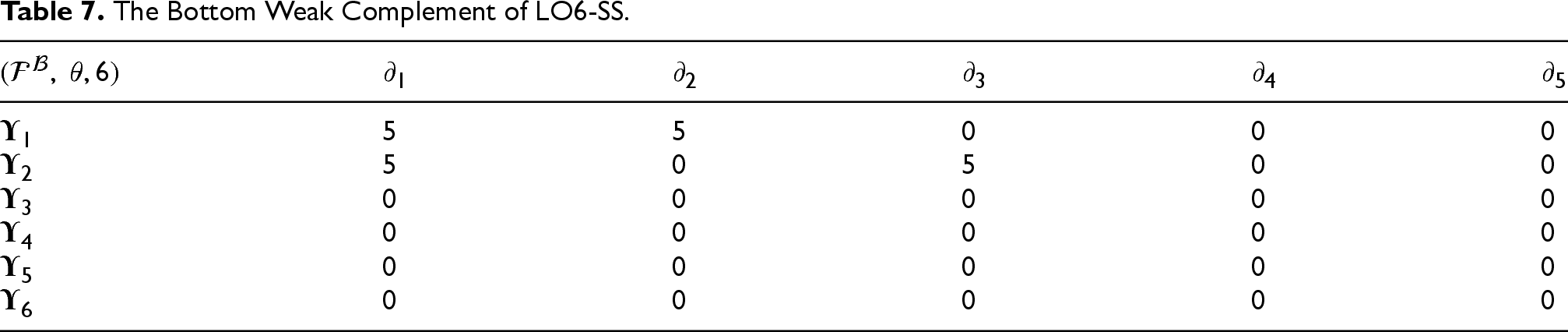
A bottom weak complement of LON-SS is an A-LON-SS. Similarly, the bottom weak complement of A-LON-SS is a LON-SS.
The weak and top complement of A-LON-SS may not be A-LON-SS. The bottom weak complement of A-LON-SS is a LON-SS.
Let
As
The above result can similarly be proven for A-LON-SS.
Let
As
The above result can similarly be proven for A-LON-SS.
The following examples describe that an extended union and the extended intersection of two LON-SS may not be a LON-SS.
Let
As Lattice Ordered Defined on the Set of Parameters in Example 6. The Tabular Interpretation of LO5-SS The Tabular Interpretation of LO5-SS The Tabular Description of the Extended Intersection 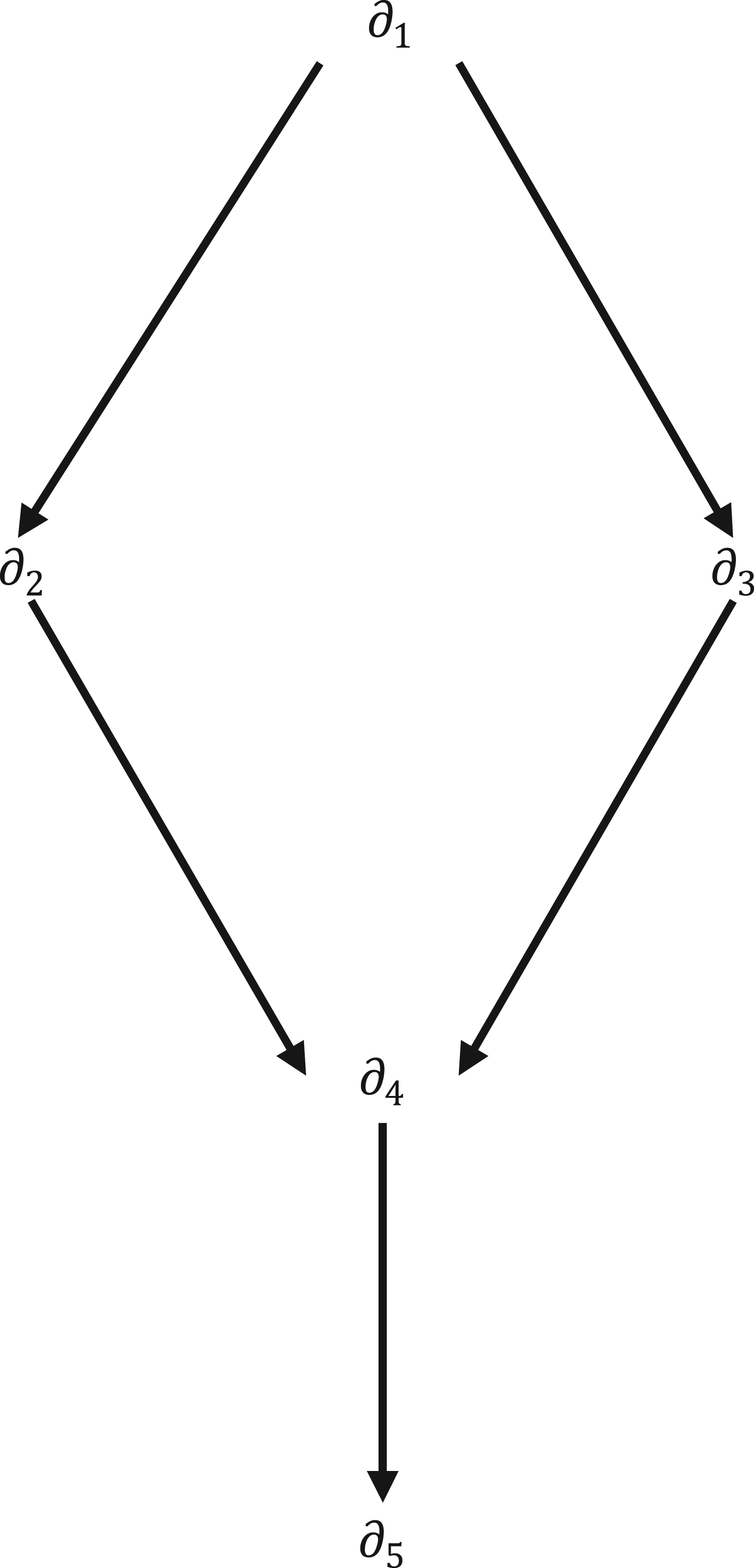



Cleary one can note from the Table 10, that
Let the two LO5-SSs be given in Tables 8 and 9 of Example 6. Then their extended union
Cleary one can note from Table 11, that
The Tabular Description of the Extended Union

The extended union and intersection of A-LON-SS may not be A-LON-SS.
Every SS associated with LON-SS is a LO-SS.
In DM problems, there is an order among the parameters which gives the conception of LON-SS. LON-SS supports us in DM problems of genuine life. In this section, we present two real-life examples of DM:
Selection of the best film of the year Purchasing of the MRI machine by the management of a hospital
Selection of the Best Film of the Year
As we all know every film industry all over the world does award shows every year to give awards to the best ones in different categories such as best actor of the year, best music of the year, and best film of the year, etc.
In this example, we will consider that the film industry wants to select the best film of the year in a few short-listed films through some media houses. Let
The selection of the best film of the year will be determined by the maximum grades of the film. We will find the maximum grades of each film given by 5 different media houses. The maximum grades are given in Table 12.
The maximum Grades of Each Film are in Example 8.
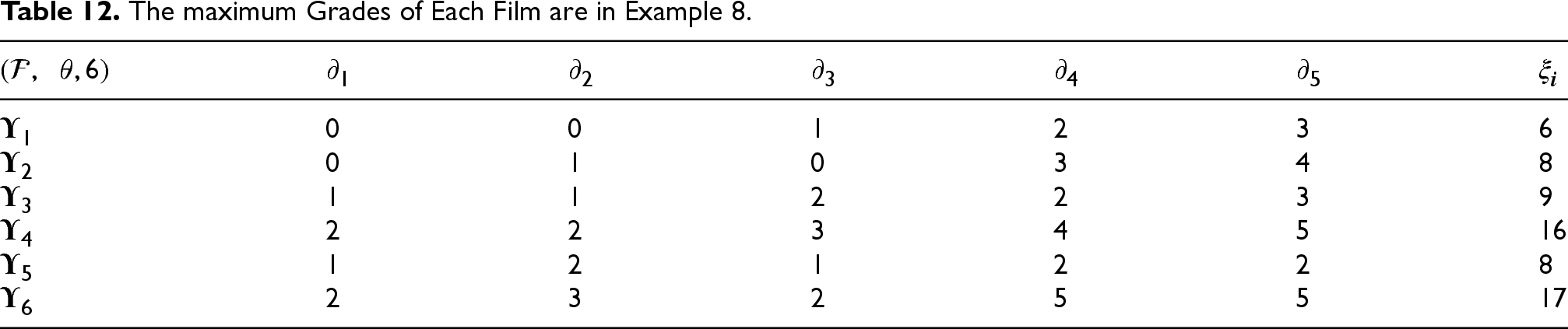
From Table 12, one can observe that the film
Hwang & Yoon (1981) defined the technique of order preference by similarity to the ideal solution (TOPSIS). The TOPSIS technique has been successfully applied to different problems. Here we apply this technique to confirm the selection of the best film of the year as given in Example 8. The algorithm of the TOPSIS is given below:
Compose a decision matrix of Normalize the decision matrix with Compose the weighted normalized decision matrix Calculate These Determine the separation measures for each alternative Determine the relative closeness to the ideal solution
Now we apply TOPSIS to Example 8, composing a matrix of 6 alternatives and 5 attributes.
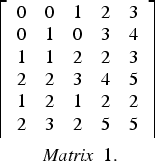
The following is the normalization of Matrix 1.
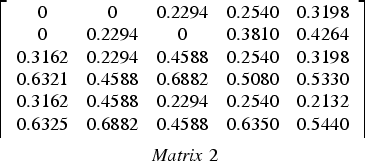
We considered in Example 8 that all attributes carry the same weight, i.e., 1 so Matrix 2 can also be considered as a weighted normalized matrix.
We find the PI and NI solutions are as follows.


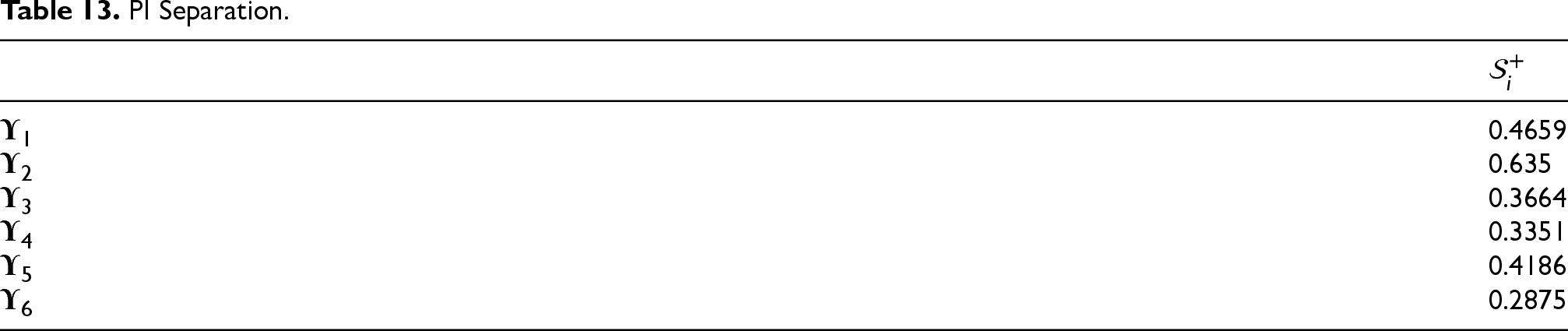
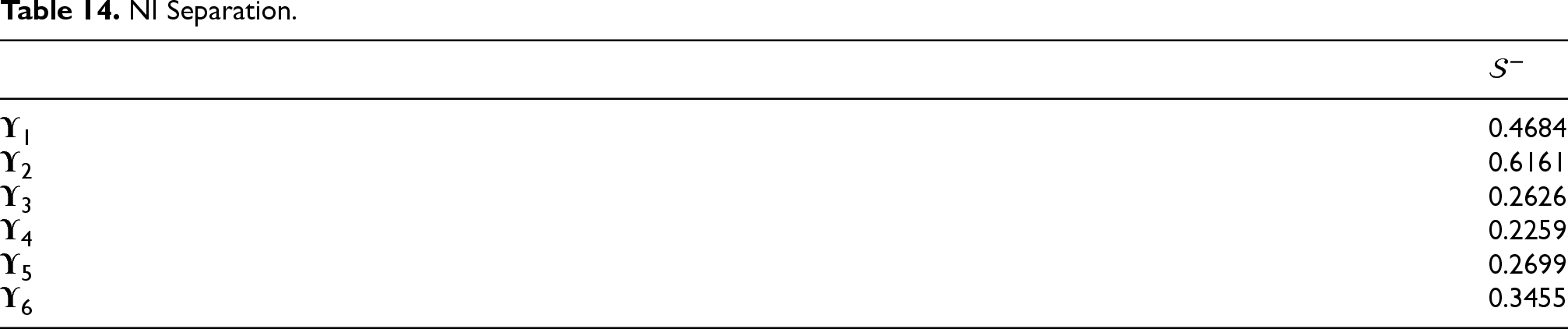
The calculated separation measures
PI Separation.
NI Separation.
Relative Closeness to the Ideal Solution.
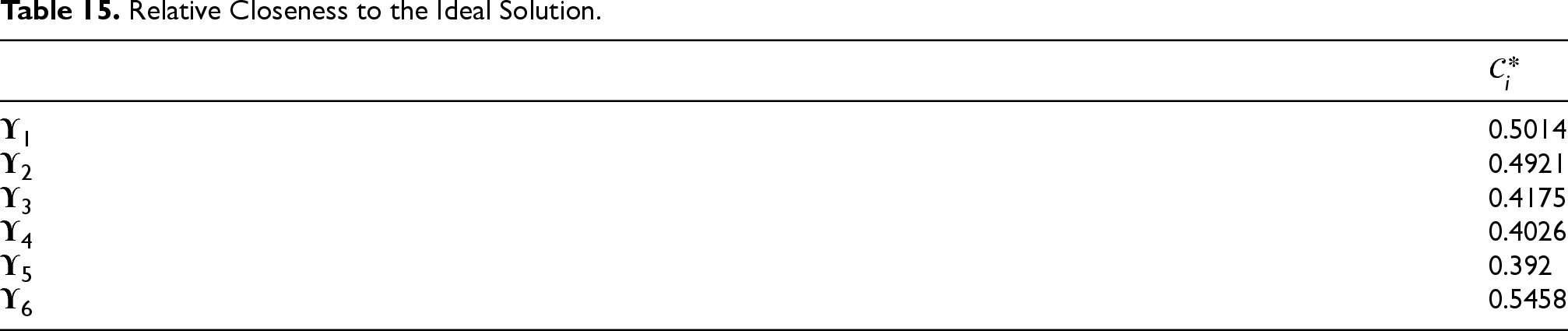
From Table 15, we see that the grade of the film
One can observe that the results given by TOPSIS and the method through which we solved Example 8 are the same. Both selected
Magnetic resonance imaging (MRI) is a medical imaging tool mostly utilized in radiology to take photos of the anatomy and the physiological processes of the body. The purchasing process of the MRI machine is a very difficult task for the management of every hospital. These machines are expensive, difficult to mechanism, and have great importance for the lives of patients.
Consider the management of a hospital that wants to purchase an MRI machine. The management of the hospital has the option of 6 different companies that make MRI machines. Let
The selection of the best MRI machine will be determined by the maximum grades of the MRI machine. We will find the maximum grades of each MRI machine. The maximum grades are given in Table 17.
The Tabular Form of LO5-SS.

The Maximum Grades of Each Film in Example 9.

From Table 17, one can observe that the MRI machine
Now we apply TOPSIS to Example 9, composing a matrix of 5 alternatives and 4 attributes.
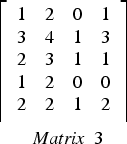
The following is the normalization of Matrix 3.
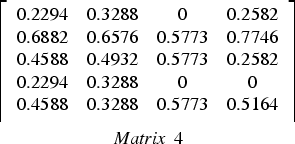
We considered in Example 9 that all attributes carry the same weight, i.e., 1 so Matrix 4 can also be considered as a weighted normalized matrix.
We find the PI and NI solutions are as follows.


The calculated separation measures
PI Separation.

NI Separation.

Relative Closeness to the Ideal Solution.

From Table 20, we see that the grade of the MRI machine
This part establishes a methodical evaluation between LON-SS and existing frameworks to show its improved decision-making abilities and practical implementation benefits. Multiple aspects of theory and computation and representation and practical use factors receive analysis in this examination.
Theoretical Comparison with Prevailing Theories
Comparison with Basic N-SSs
The N-SS theory (Fatimah et al., 2018) establishes multi-valued assessment foundations yet it does not include built-in mechanisms to manage parameter hierarchical structures. N-SSs successfully demonstrate non-binary evaluation capabilities yet they cannot represent natural parameter order relations which commonly appear in practical situations. The lack of hierarchy representation in N-SSs presents major obstacles for modeling systems that require hierarchical attribute importance structures. The LON-SS framework builds upon N-SSs through the implementation of lattice structure to establish explicit order relationships within parameters. The integration method maintains all original N-SS benefits together with solutions to their main weakness. An overview of the main theoretical distinctions exists in Table 21.
Theoretical Comparison Between N-SS and LON-SS.

Theoretical Comparison Between N-SS and LON-SS.
Ali et al. (2015) developed LO-SS to advance SS theory through parameter ordering implementation. This evaluation technique works only with two-value representations (0 and 1) or continuous number ranges from zero to one yet fails to support systems needing multi-valued scoring systems like star-based rating systems or categorical label assessments. The LON-SS framework solves the limitations of LO-SS and N-SSs by uniting their respective capabilities to order parameters with their ability to perform multi-valued assessments. The combined features of LON-SS enable it to handle diverse decision problems that require hierarchical parameters alongside multi-level evaluations. The mathematical structure of LON-SS extends LO-SS through an equivalent relationship to N-SSs which extend traditional SSs.
Computational Efficiency Analysis
Our study determines the computational speed of our method in contrast to typical processes through a performance evaluation completed with Section 4 case examples. The computational metrics of LON-SS and TOPSIS for the film selection problem appear in Table 22.
Computational Comparison among TOPSIS Approach and LON-SS Approach for Film Selection Problem.
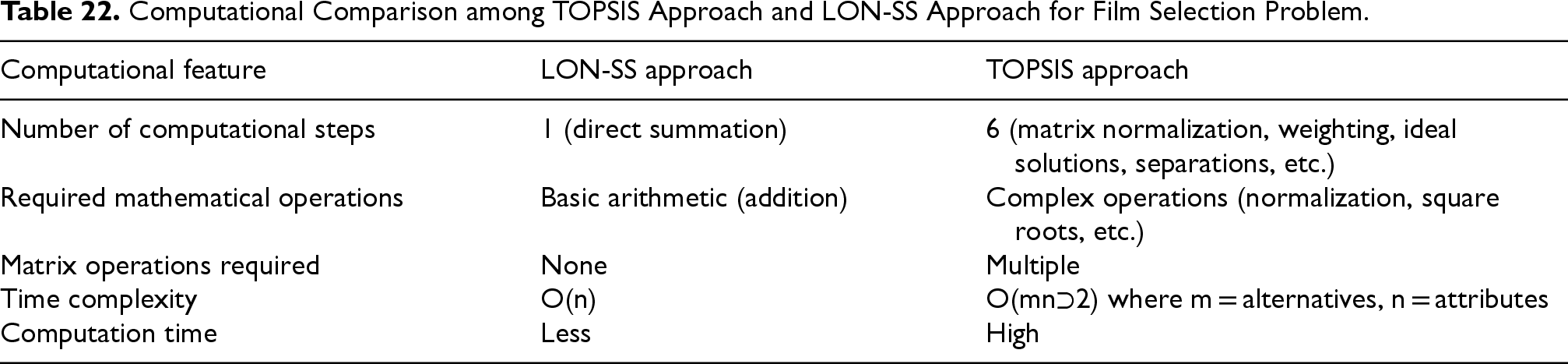
Computational Comparison among TOPSIS Approach and LON-SS Approach for Film Selection Problem.
The LON-SS analysis shows it needs much fewer computational operations to deliver equivalent decision results. Such operational efficiencies enable fast decision-making processes in cases where processing resources need to operate under real-time conditions or resource constraints.
A decision-making framework's representation capability demonstrates how well it can simulate realistic complex situations properly (Table 23).
Comparison Between the Capabilities of Representation of Various Theories.
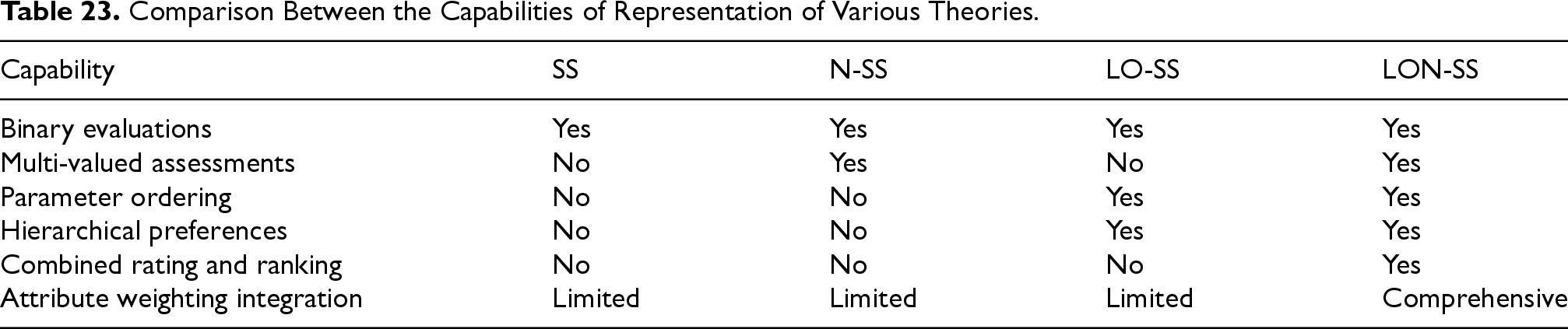
Comparison Between the Capabilities of Representation of Various Theories.
The LON-SS framework represents decision elements with superior effectiveness across all dimensions which enables it to handle complex scenarios with multiple assessment values and hierarchical parameter structures.
The LON-SS framework benefits from an algorithm that remains straightforward to understand. The algorithm presented in Section 4 delivers simple mathematical requirements for decision-making compared to conventional approaches such as TOPSIS. The method remains accessible to practitioners in different disciplines because practitioners can execute its implementation without specialization training in decision theory and advanced mathematics. The LON-SS approach generates results that match complex methods even though it remains straightforward in both the film selection and MRI machine purchasing examples. The merging of simple implementation with accurate results creates a groundbreaking improvement in practical decision-making tools.
Summary of Comparative Analysis
The extensive analysis reveals that the LON-SS framework delivers superior capabilities compared to current methodologies because it combines N-SSs’ multi-valued assessment with lattice-ordered SSs’ parameter ordering features.
The framework integrates N-SSs’ multiple assessment features with lattice-ordered SSs’ parameter-ordering properties in a unique manner. The system displays better computational performance than traditional approaches do. The method enhances decision representation capabilities to handle complex scenarios which include hierarchical parameters together with multi-level evaluation steps. The system offers basic algorithms which allow non-mathematical practitioners to use it effectively. The system needs few resources to put into practice yet produces steady decision outputs.
LON-SS stands as a beneficial addition to decision-making methods because it suits situations that require ordered parameters alongside multi-valued assessments.
Conclusion
The study established the mathematical structure of LON-SS and A-LON-SS to improve decision-making applications that involve parameter hierarchical relationships. Traditional N-SS theory faces limitations which the LON-SS framework solves through its attribute order relation system that provides strong benefits during rating and ranking situations. The applications showed that our proposed method delivers various important benefits. The LON-SS method demonstrates better computational performance than TOPSIS and other conventional methods when working with ordered parameters according to our film selection and MRI machine purchasing case studies. Through its framework, the system provides enhanced capabilities to represent hierarchical preferences which helps decision-makers develop precise models of complex real-world evaluation systems. The LON-SS methodology delivers simplified decision-making processes through its mathematical structure which enables both expert and beginner practitioners to use it effectively. The proposed work shows various strengths but it contains specific limitations. This framework has an assumption of stable parameter ordering patterns even though these patterns might change within dynamic environments with evolving preference structures. The framework faces scalability issues while handling very big parameter collections because implementation in practical big data situations requires optimization methods to keep it operational. The case examinations establish the practical usability of LON-SS for actual operational scenarios. The LON-SS approach shows reduced computational complexity compared to traditional methods because it requires simpler calculations throughout both examples. Scenarios that need frequent recalculation and real-time decision-making benefit greatly from LON-SS due to its efficiency advantage. The system's implementation does not need advanced specialized software resources which allows standard computational organizations to use it.
Footnotes

Author Contributions
All authors contributed equally to the study conception, design and writing of this article. All authors read and approved the final manuscript.
Funding
The authors disclosed receipt of the following financial support for the research, authorship, and/or publication of this article: This work was supported by the Higher Education Commission, Pakistan, Pakistan Science Foundation, (grant number 14462, 01
Declaration of Conflicting Interests
The authors declared no potential conflicts of interest with respect to the research, authorship, and/or publication of this article.