






Abstract
Implementing complex Multi-Criteria Group Decision-Making (MCGDM) models like the Fuzzy Analytic Network Process (FANP)—a key methodology within the python-based soft computing paradigm—presents inherent computational complexities, particularly regarding the attainment of structural stability and steady-state in high-order limit supermatrices. To overcome these obstacles, this study introduces a novel Python-based computational intelligence framework that automates and enhances the entire FANP workflow. This framework facilitates computational reliability by identifying the invariance of relative priorities within high-order supermatrices, a process that can be computationally intensive through manual procedures. Through four distinct FANP case studies, we validate the framework's superior efficiency and reliability. Our findings reveal an alternative principle for designing expert-driven intelligent systems. We empirically demonstrate that model stability—characterized by the structural alignment of both DEMATEL causal relationships and final FANP rankings—is achieved more effectively with a smaller, strategically diverse expert panel. This research suggests that integrating strategic stakeholder representativeness into the selection process provides a robust pathway toward structural consensus, offering a valuable complement to broad-scale data collection in complex decision environments.
Keywords
Introduction
In the context of rapid digital transformation and growing sustainability awareness, decision-makers are increasingly required to evaluate alternatives involving multiple interrelated criteria. These complex decision environments are prevalent in areas such as ESG-based planning, digital technology deployment, and Industry 4.0 strategic transformations (Abdullah et al., 2023; Li et al., 2023). Emerging research has also emphasized the intertwined nature of AI-driven ESG evaluation, sustainable manufacturing, and intelligent systems (Aljohani, 2025; Kumar & Krishna, 2025).
A critical challenge in designing computational intelligence systems for complex group decision-making is ensuring the final choice is both reliable and achieved efficiently. This is particularly difficult as such systems must process the inherent vagueness and ambiguity in expert judgments, which are often expressed linguistically rather than with crisp numbers (Pourmehdi et al., 2021). To address this, the Multi-Criteria Group Decision-Making (MCGDM) field widely utilizes fuzzy logic—a cornerstone of soft computing—to model this human-centric uncertainty. Such frameworks often employ specific fuzzy representations, such as interval type-2 fuzzy sets (Wang et al., 2012), to convert subjective expert opinions into a computable format. These fuzzy approaches aim to structure complex decision problems and guide groups toward a stable consensus by integrating their diverse perspectives to form a holistic view.
In practice, this has led to the development of hybrid computational frameworks —a common approach in soft computing—that integrate methods such as the Decision-Making Trial and Evaluation Laboratory (DEMATEL) (Drumond et al., 2022; Hsu, 2012; Muhammad & Cavus, 2017), Fuzzy Analytic Hierarchy Process (FAHP) (Büyüközkan et al., 2004; Chattham et al., 2025; Tavana et al., 2021), Fuzzy Analytic Network Process (FANP) (Elsayed et al., 2012; Huang, 2012; Sorourkhah & Edalatpanah, 2021, 2022), and VIseKriterijumska Optimizacija I Kompromisno Resenje (VIKOR) (Mohamed Nusaf & Kumaravel, 2024; Wu et al., 2022; Xie et al., 2024; Zhang et al., 2023) to model causal feedback loops, handle uncertainty, and support compromise-based solutions.
FAHP and FANP have become widely applied tools in industrial settings due to their robustness in capturing expert-based judgments under fuzziness. For example, Ghorabaee (2016) developed an advanced fuzzy MCGDM framework for robot selection, ensuring that the decision-making process accounts for both technical performance and cognitive uncertainty within intelligent systems. The problem of aggregating expert opinions has been extensively studied, with various techniques proposed to combine pairwise comparison matrices, as comparatively analyzed by Ossadnik et al. (2016) in their work on group aggregation techniques for AHP and ANP.
While robust aggregation methods are crucial, the FANP approach, popular for modeling interdependencies, has seen most empirical studies employ relatively small expert samples. For instance, Mohammadzadeh et al. (2018) used 25 experts to prioritize IoT adoption challenges; Siavashan and Khari (2013) utilized a team of 7 managers and experts to prioritize strategic alternatives via a fuzzy ANP approach; and Hii et al. (2023) incorporated 36 e-learning experts to support their fuzzy ANP modeling.
A likely reason for this modest sample size is the computational complexity and manual effort required for constructing, normalizing, and powering the supermatrix—especially in conventional Excel-based implementations. To date, the literature has offered little guidance on what constitutes enough FANP experts to ensure decision stability and model robustness. The question of how many expert inputs are needed for convergence in global weight prioritization remains largely unexplored. In addressing this gap, the current study investigates the relationship between the number of experts and the stability of causal structures and ranking outcomes across multiple cases, providing empirical insights into response sufficiency thresholds for FANP-based decision models.
This study makes two primary contributions.
Computational Breakthrough in High-Complexity Fuzzy Systems: To address the computational challenges inherent in FANP modeling, we developed a Python-based intelligent framework that ensures the attainment of structural stability and steady-state in high-order limit supermatrices. Unlike traditional spreadsheet-based tools, which often face “out-of-memory” risks when handling large-scale structures, our framework provides a robust solution for ensuring mathematical reliability. This system automates the entire hierarchical FANP workflow—from matrix normalization to 1,000 iterative self-multiplications—enabling real-time compromise ranking through the VIKOR method and overcoming the computational obstacles that previously limited the deployment of complex fuzzy intelligent systems. Establishment of the Stakeholder Representativeness Design Principle We utilize four case studies and show that both the DEMATEL causal relationships and the final FANP global priority rankings achieve a stable state of convergence rapidly with a smaller expert panel when stakeholder clusters are systematically covered early in the data collection process for group decision. Conversely, initial homogeneity in expert viewpoints can delay convergence, requiring a significantly larger sample size to overcome early bias. This finding suggests that researchers and practitioners should prioritize strategic stakeholder representativeness over sheer sample size to improve the efficiency, reliability, and validity of expert-based group decision models.
Compared to conventional Excel-based implementations, this system supported by Python programming significantly reduces manual workload, eliminates most user-induced errors, and delivers real-time results. It is particularly suited for time-sensitive, multi-criteria decision-making in industrial or policy environments where both speed and consistency are essential.
The proposed framework is validated through 4 practical cases spanning sustainability and AI-related domains:
AI and IoT integration in recycling. Sustainable technology adoption in energy storage. Recruiting Fintech talents in the banking industry using an AI platform. (Lin, 2021) AI Server Development in the Tech Manufacturing Sector.
The remainder of this study is organized as follows. Section 2 reviews the relevant literature on the application of MCGDM methods—specifically DEMATEL, FAHP, FANP, and VIKOR. Section 3 presents the evaluation model and empirical results from the first of the 4 cases. Section 4 discusses findings on the minimum number of experts required to produce decision outcomes equivalent to those obtained from the full sample. The final section presents the conclusions. The appendix provides a comparative analysis and relevant data for all 4 cases.
Literature Review
Recent trends in MCGDM reflect the growing adoption of hybrid models that integrate DEMATEL, FAHP, FANP, and VIKOR. These approaches are increasingly applied across a range of industries, offering robust tools for managing complexity, modeling interdependencies, and capturing expert judgments under uncertainty. For instance, several recent reviews document the rise of fuzzy–based and hybrid MCGDM frameworks (Kumar & Pamucar, 2025; Sahoo et al., 2025), highlighting the integration of MCGDM in domains like energy and artificial intelligence systems.
The theoretical underpinnings of these models trace back to Zadeh's (1965) work on fuzzy sets, which provided a framework for modeling the vagueness in human judgment. This was operationalized through concepts like Triangular Fuzzy Numbers (TFNs) and integrated into crisp MCGDM methods by pioneers such as Van Laarhoven and Pedrycz (1983), leading to the development of FAHP and FANP. TFNs are widely adopted due to their simplicity and computational efficiency. As a cornerstone of computational intelligence, these fuzzy approaches are crucial for decision-making in fields with inherently qualitative criteria. While recent advancements introduce complex extensions like dispersion degrees of TFNs (Zhang et al., 2024) and weighted continuous TFNs for conflict analysis (Gong & Jiang, 2024), the fundamental triangular fuzzy representation remains the established standard practice for straightforward expert elicitation in soft computing. For instance, Liu et al. (2023) effectively used FAHP to rank AI-based learning approaches against subjective criteria like ‘Sustainable’ and ‘Effective,’ demonstrating the method's value in structuring complex problems without crisp data.
In sustainable supplier/material selection, hybrid fuzzy MCGDM models are increasingly applied across a range of industries, offering robust tools for managing complexity and modeling interdependencies. Lin et al. (2014) used FANP to broadly assess green supply chain performance. Büyüközkan and Çifçi (2012) evaluated green suppliers in the automotive industry using an integrated fuzzy DEMATEL–ANP–TOPSIS model, providing an effective approach for sustainable supplier assessment. Guo and Wu (2023) utilized a fuzzy AHP–DEMATEL–VIKOR model to assess social sustainability performance in manufacturing enterprises. This exploration of advanced fuzzy sets has also extended to integrating Fermatean Fuzzy AHP and WASPAS methodologies for optimizing the selection of sustainable facade materials (Aydeniz et al., 2025).
The energy sector has extensively applied MCGDM tools for technology selection, R&D prioritization, and sustainability evaluation. Lee et al. (2009) applied FAHP to prioritize energy technologies based on expert judgments, offering a structured way to handle qualitative inputs. In a different context, Wang et al. (2019) used interval DEMATEL and interval VIKOR to assess distributed energy systems, highlighting causal interdependencies and compromise-based solution robustness. Yang (2025) extended this by integrating DEMATEL, ANP, and VIKOR into a hybrid framework tailored to digital energy business models aligned with ESG investment strategies.
In manufacturing and Industry 4.0, Kao et al. (2022) proposed a rough-Fermatean DEMATEL to assess sustainable development. This study demonstrated the model's capability in identifying optimal maintenance methods under uncertainty—such as predictive, preventive, and condition-based maintenance—thereby supporting decision-makers in enhancing operational reliability and cost-efficiency in industrial settings. Sadeghi-Niaraki (2020) developed a comprehensive hybrid framework integrating fuzzy DEMATEL, ANP, and VIKOR to evaluate Industry 4.0 development strategies.
In the digital content, hybrid MCGDM approaches have demonstrated their versatility. Chang and Tsai (2016) proposed a hybrid fuzzy multiple–criteria analysis model to evaluate e–Book business strategies, integrating qualitative expert judgments and quantitative performance data to guide platform development and market positioning. Additionally, Chang et al. (2015) developed a fuzzy-based hybrid framework for selecting and evaluating e–Book business models among Taiwanese firms, demonstrating the effective handling of uncertainty in strategy selection by combining FAHP with complementary MCGDM tools.
Across diverse industries, MCGDM techniques like DEMATEL, FAHP, FANP, and VIKOR have been effectively tailored to address sector-specific challenges. Their hybrid integration provides a structured, adaptable, and expert-driven foundation for complex decision support. Despite these advances, most implementations rely on spreadsheet-based operations that are manually intensive and prone to inconsistency when scaling across clusters and layers.
Evaluation Model and Empirical Results
To systematically address the subjective uncertainty in expert judgments, this research utilizes Triangular Fuzzy Numbers (TFNs). A TFN is represented
The methodology is presented as a multi-step process, and to provide a clear illustration of its application, the results from Case 1 (AI and IoT integration in recycling) will be used as a running empirical example throughout the description of each step. The entire computational model is implemented within a novel Python framework designed to overcome the limitations of traditional spreadsheet-based tools, and is validated through four practical cases, with basic information for all cases shown in the Appendix A. For a comprehensive modular breakdown and the pseudocode of the Python-based computational framework, please refer to Appendix B.
After establishing the evaluation framework, the procedure is as follows:
Step 1: Analyze cause-effect relationships using DEMATEL
In this study, the DEMATEL phase is implemented using crisp judgments rather than a fuzzy formulation. This methodological choice is primarily motivated by cognitive efficiency. Since the subsequent FANP phase requires experts to perform intensive fuzzy pairwise comparisons, establishing the initial structural causality through crisp judgments prevents ‘uncertainty dilution’ and reduces cognitive fatigue. This ensures a stable structural foundation is established before applying fuzzy weights to handle preference uncertainty.
To model the causal dependencies, experts assess the direct influence between criteria clusters using a crisp integer scale, such as a 4-point scale ranging from 0 (“No influence”) to 3 (“High influence”). The individual expert judgments are then aggregated (by averaging) to construct a single direct-influence matrix A, where K is the number of experts:
The normalized direct-influence matrix D is then obtained by dividing each element of A by the maximum value among the row and column sums:
The total-relation matrix T is computed as:
A column-normalized form of the total-relation matrix can be obtained:
Step 2: Deriving Global Weights using the FANP with TFNs
This step computes the final priority weights of all criteria through a fuzzy-centric process:
Step 2a. Fuzzy Pairwise Comparisons:
To determine the local weights of criteria within each cluster, experts conduct pairwise comparisons adopting Saaty's classic 9-point scale (Saaty, 1977, 1980; Saaty & Vargas, 2013). This scale utilizes linguistic terms to assess the relative importance between two criteria, corresponding to numerical values ranging from 1 (‘Equal importance’) to 9 (‘Absolute importance’). Each term on this scale is formally defined by a corresponding TFN. For instance, a judgment of ‘Moderate importance’ (with a numerical value of 3) is represented by the TFN (2, 3, 4).
Step 2b. Aggregation and Local Weight Calculation:
The crisp weight M for the triangular fuzzy number
Step 2c. Supermatrix Formation and Convergence:
Following the stable numerical foundation established via the centroid method in Step 2b, to ensure computational reliability, the weighted supermatrix is defuzzified prior to iteration. This methodological choice mitigates ‘uncertainty dilution’ during high-order fuzzy arithmetic. While absolute values within the alternative-priority submatrix may experience numerical scaling, the normalized global priority vector achieves high-precision convergence. Numerical verification across all case studies confirms that structural components reach a residual below
This high-order power iteration ensures that the decision system reaches a steady-state where the relative importance of all criteria and alternatives is mathematically fixed. The weighted supermatrix
The defuzzified local weights populate the unweighted supermatrix, and the DEMATEL total-relation matrix adjusts the interdependencies among clusters. To derive the global priority vector, the weighted supermatrix is raised to a sufficiently large power
Although the supermatrix did not converge to a strict limit matrix—particularly due to monotonic drift in the bottom-left (m + 1) × n submatrix—the dominant eigenvector stabilized after one thousand iterations while m is the number of criteria and n is the number of alternatives. Similar non-convergent or only partially convergent behaviors of ANP-type supermatrices have in fact been reported in the literature: the original ANP formulation already notes that reducible, strongly cyclic supermatrices may fail to converge and instead cycle, requiring Cesàro averaging (Saaty, 1980); later work on hybrid ANP for government data sustainability explicitly characterizes the “un-convergence” problem of sparse, reducible networks using Markov-chain and dynamical-system arguments (Xu et al., 2022); and recent FANP generalizations further motivate Drazin-inverse–based steady-state analysis precisely because traditional iterative supermatrix powers are unstable or undefined for singular/reducible fuzzy supermatrices (Huang & Chen, 2024). Following established computational practice in FANP/DEMATEL-ANP literature, the stabilized vector at

Step 3: Evaluate alternatives using the VIKOR method
Apply the VIKOR technique to rank the alternatives based on the global weights obtained in step 2. Compare these rankings with those derived from the traditional Analytic Network Process (ANP) global normalization approach, as detailed by Saaty (2005), to demonstrate the enhanced stability and consistency of this FANP-VIKOR approach.
DEMATEL has become an effective technique in decision analysis, and is particularly useful in visualizing structural models of complex problems and addressing interdependencies among factors. In this study, expert evaluations of inter-cluster influences are aggregated into a direct-relation matrix, where the degree of influence of one cluster over another is assessed on a predefined crisp integer scale. This matrix is normalized and transformed into a total-relation matrix, capturing both direct and indirect effects across clusters. The resulting matrix provides valuable insights into the strength and direction of influence within the decision network.

The normalized total relation matrix for Case 1 (AI and IoT integration in recycling):

The key methodological innovation of this study's FANP approach lies in the construction of the weighted supermatrix. Unlike the traditional ANP method, which often relies on a simple hierarchical structure, our model incorporates the interdependency weights directly from the DEMATEL total relation matrix. This integration ensures that the final global priorities reflect not only the local importance of criteria but also the underlying systemic causal structure, resulting in a more robust and context-aware representation of the decision problem.
A FAHP model is applied to handle linguistic uncertainty. Expert judgments are modeled as TFNs and aggregated using the fuzzy geometric mean. Crisp local weights are obtained via defuzzification using the centroid method. These local weights are then integrated into a networked structure using ANP (Saaty, 1996, 1999, 2005). In this traditional supermatrix method, a normalized weighted supermatrix is used for weight propagation and global priority calculation as below.
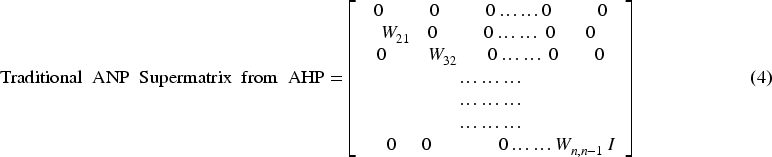
W21. W32,……, Wn,n−1 are the weighted matrices derived from local weights for AHP by normalizing each column. Table 1 shows the local weights for Case 1 (AI and IoT integration in recycling). Figure 1 reveals that Unweighted Supermatrix for Case 1 based on traditional AHP local priorities.
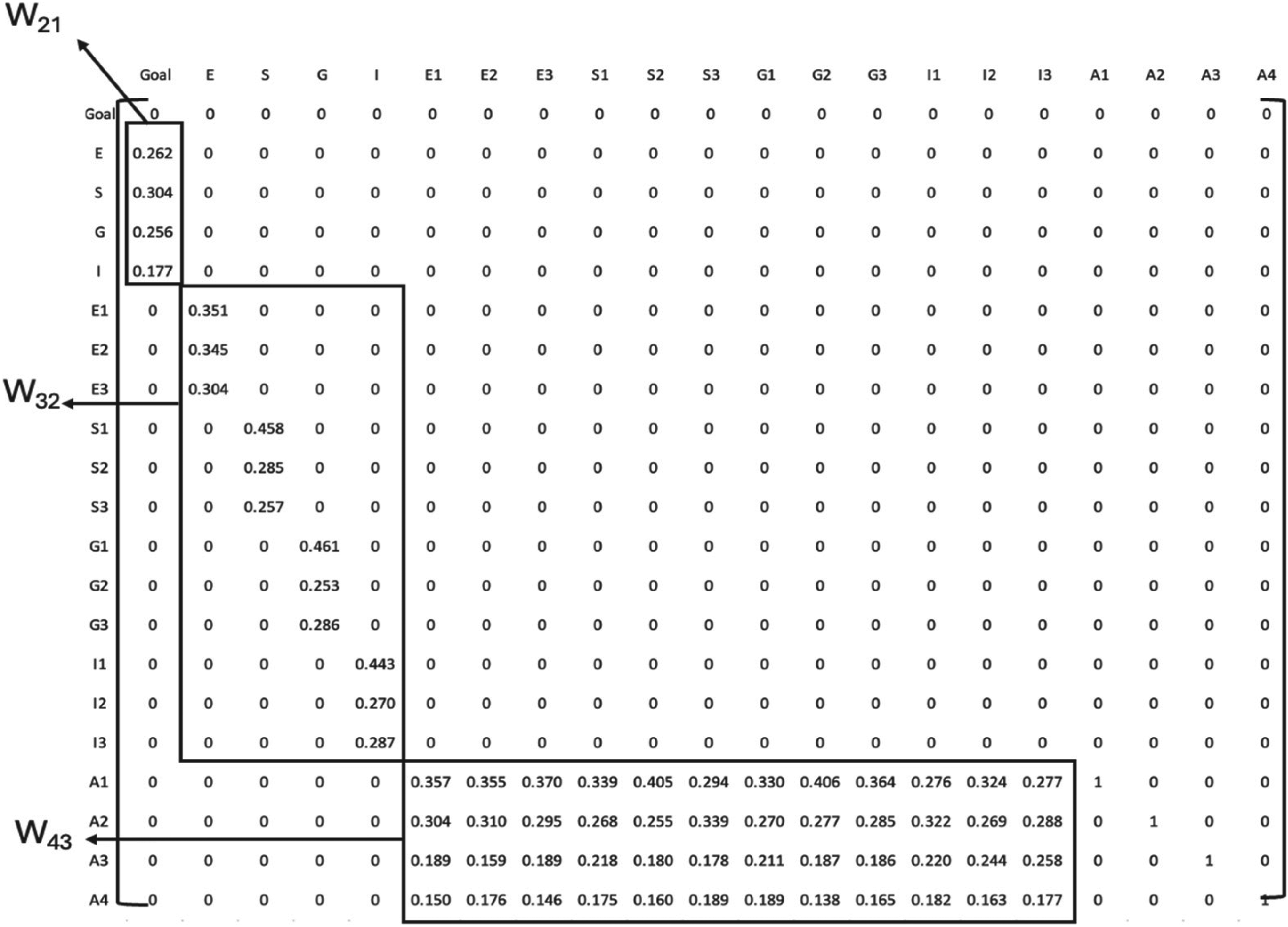
Unweighted supermatrix for case 1 based on traditional AHP local priorities.
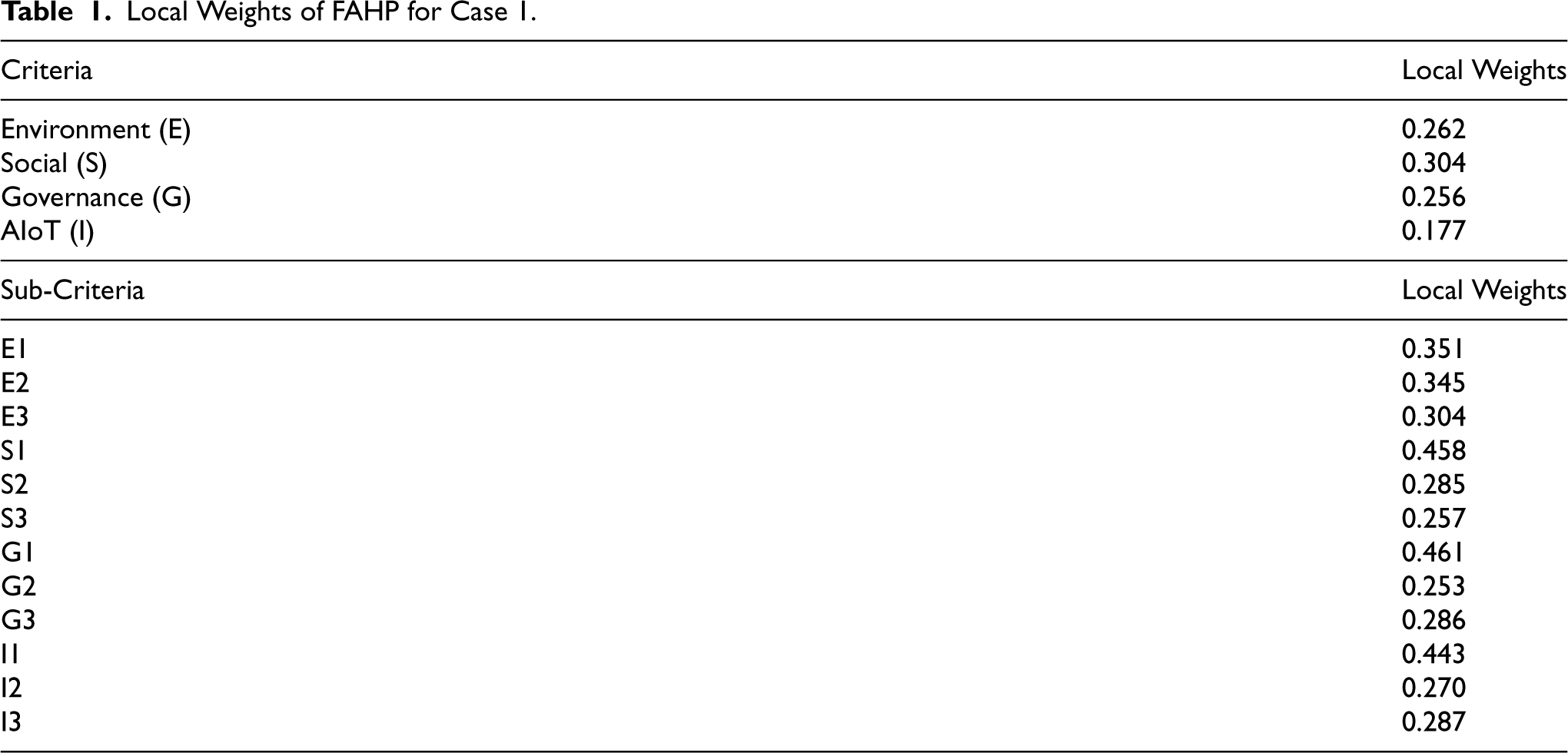
Local Weights of FAHP for Case 1.
After 4 rounds of multiplication, we obtain the limit supermatrix as in Figure 2. The ranking order is A1, A2, A3, A4.
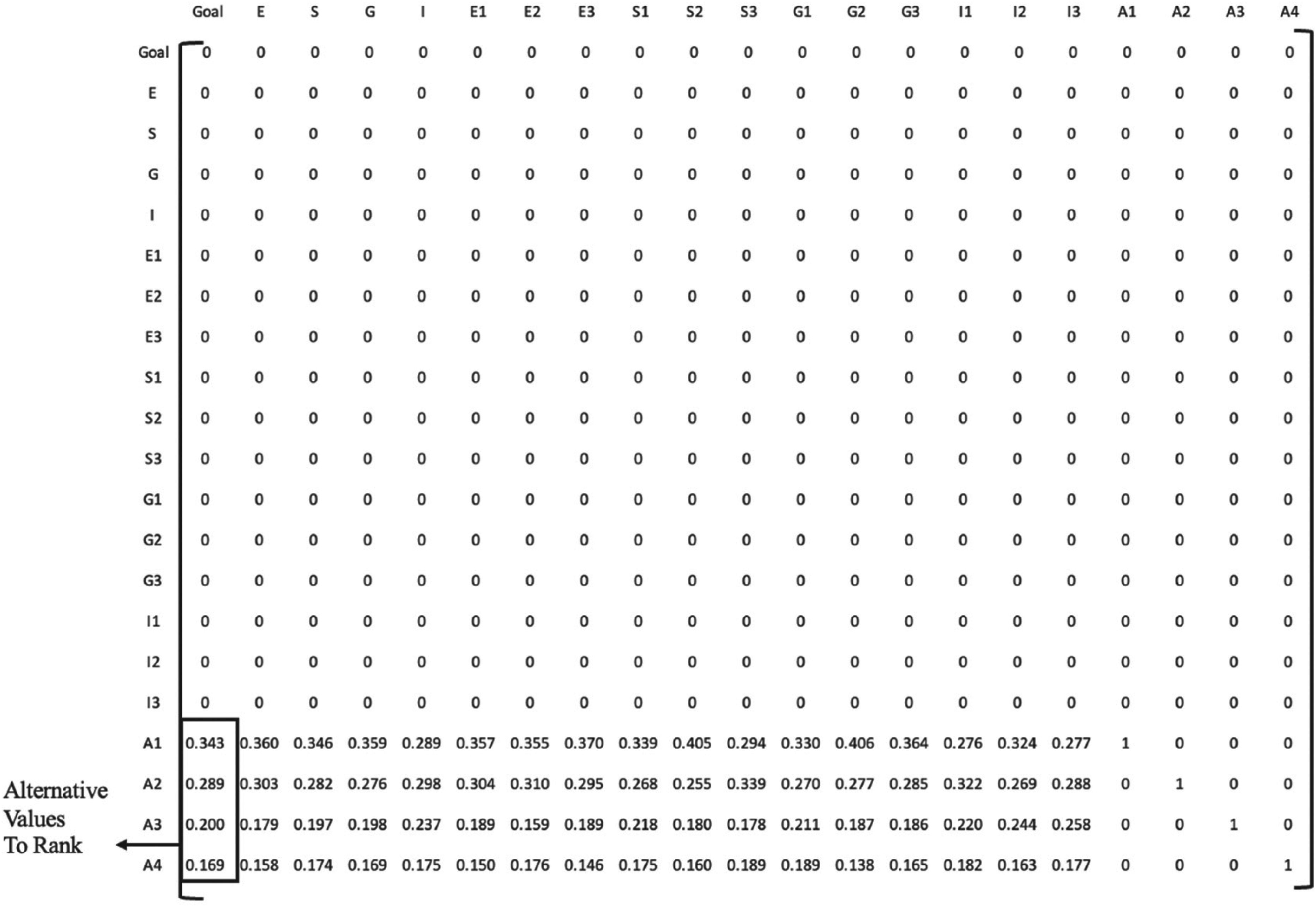
Limit supermatrix obtained after 4 rounds of multiplication.
Traditional Saaty Limit Supermatrix Alternative value:

The FANP supermatrix (Figure 3) in this study is constructed by utilizing the normalized DEMATEL total relation matrix, which defines the causal influence relationships between criteria clusters. The results are shown below.
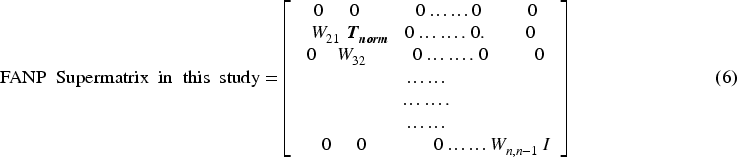
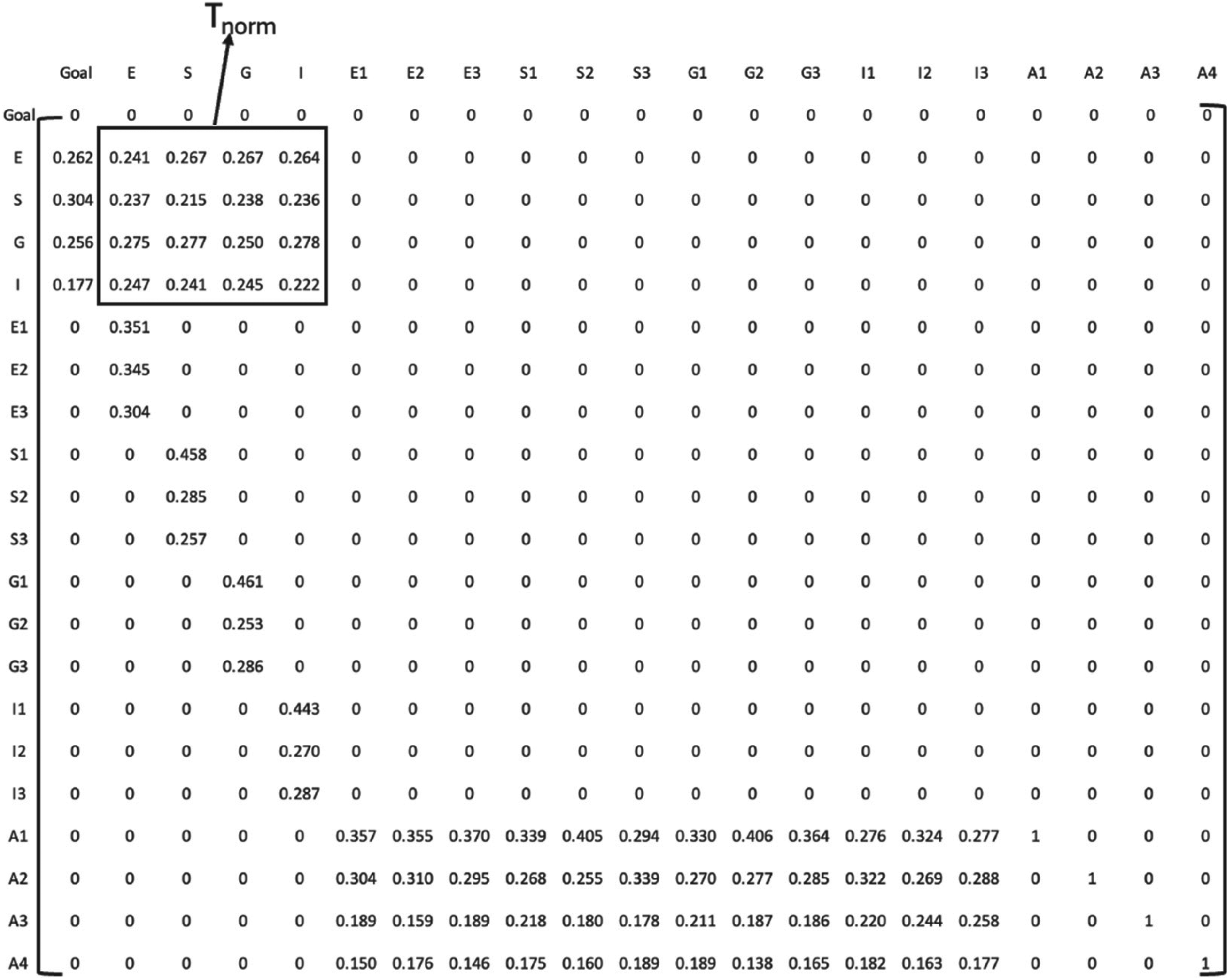
Construction of the proposed FANP supermatrix for case 1, integrating local weights with the DEMATEL total relation matrix.
After multiplying by itself iteratively for 1000 iterations, we obtain the supermatrix as shown in Figure 4. In this resulting matrix, most elements have stabilized, but the bottom-left 5 × 4 submatrix exhibits the characteristic steady growth consistent with partial non-convergence.
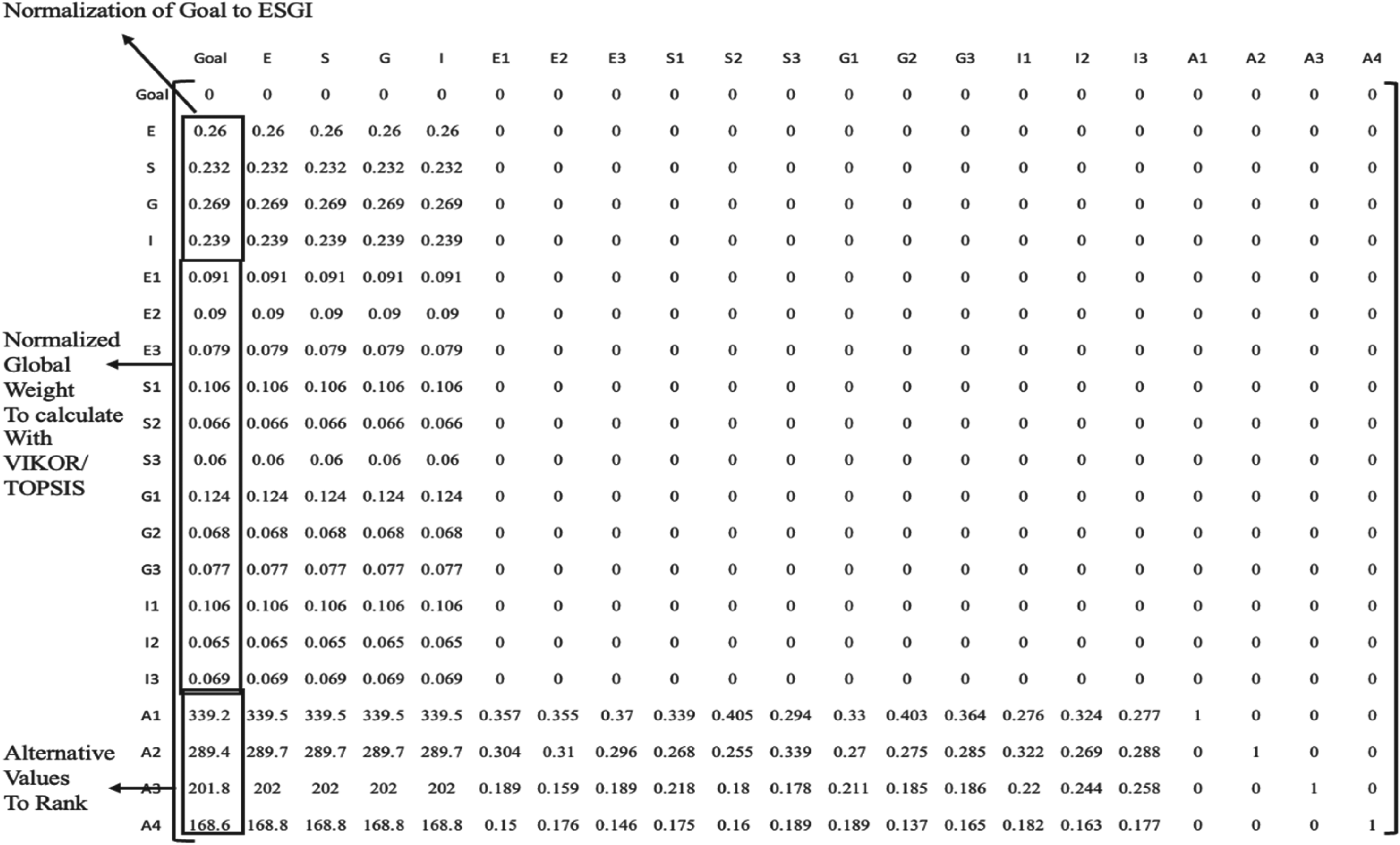
The FANP Supermatrix for Case 1 after 1000 Iterations.
The conventional global weights for the criteria are obtained by multiplying the normalized total relation matrix from DEMATEL by the local weights derived from AHP.

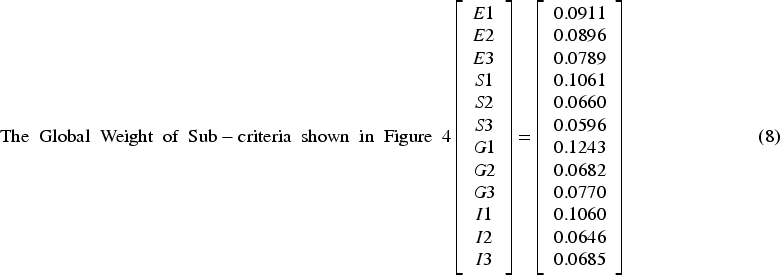
The conventional global weights for the sub-criteria are derived by modulating the AHP-derived local weights with the global weight vector of the parent criteria from Equation (7). The results are shown below.
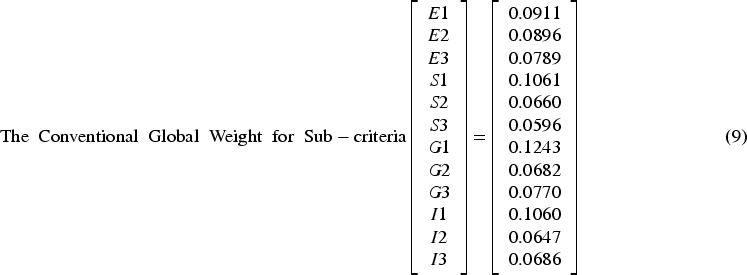
The distance between these 2 vectors above = 0.00014. The minimal weight distances (0.0024 and 0.00014) between our iterative method and the conventional one validate our framework's accuracy and confirm its robust convergence.
Four alternative values are obtained from the Supermatrix in Figure 4. The ranking order is A1, A2, A3, A4 (noted Ranking from Traditional ANP model), and the value

Following the derivation of global priority weights in Figure 4, the VIKOR method is employed to rank the decision alternatives. VIKOR is a multicriteria compromise ranking method designed to identify a solution that is closest to the ideal while also balancing conflicting stakeholder preferences (Opricovic, 1990; Opricovic & Tzeng, 2004; Tzeng & Huang, 2011). The procedure begins by defining a decision matrix where alternatives are evaluated against criteria using normalized global weights from the final Supermatrix. For this method, let
Group utility (Si) is the weighted sum of deviations from the ideal solution across all criteria:

Individual regret (Ri) is the maximum individual deviation from the ideal for any single criterion:

The Compromise Index (Qi) is a composite score combining S and R, calculated as:
Qi = v(Si—S*) / (S−—S*) + (1 − v)(Ri—R*) / (R−—R*), where
The results of VIKOR using the global weights from Equation (8) are as follows:

The ranking order is A1, A2, A3, A4 (noted Ranking from the proposed FANP-VIKOR model in this study).
The results of VIKOR using the global weights from Equation (9) are the following:

The ranking order is A1, A2, A3, A4 (noted Ranking from the Traditional ANP-VIKOR model).
To validate the robustness and consistency of the results, the VIKOR-based ranking is compared against:
-Rankings derived directly from the Limit Supermatrix of the standard ANP model (Equation (9)).
-Rankings derived from the Supermatrix after 1000 iterative self-multiplication in this study (Equation (8)).
These comparisons reveal to what extent the integration of DEMATEL, and cluster-based normalization alters the prioritization outcomes and offer insights into method sensitivity and result alignment. In practice, consistency across these models reinforces confidence in the reliability of final decisions, while divergence may highlight the impact of structural assumptions embedded in MCGDM processing.
To validate the robustness of the final rankings, Table 2 presents a comparative summary across the four cases. The rankings were derived using the following three methods:
The traditional ANP model (Saaty's approach). The proposed FANP-VIKOR model in this study (VIKOR v = 0.5). The traditional ANP-VIKOR model (VIKOR v = 0.5).
Rankings and Compromise Solutions.
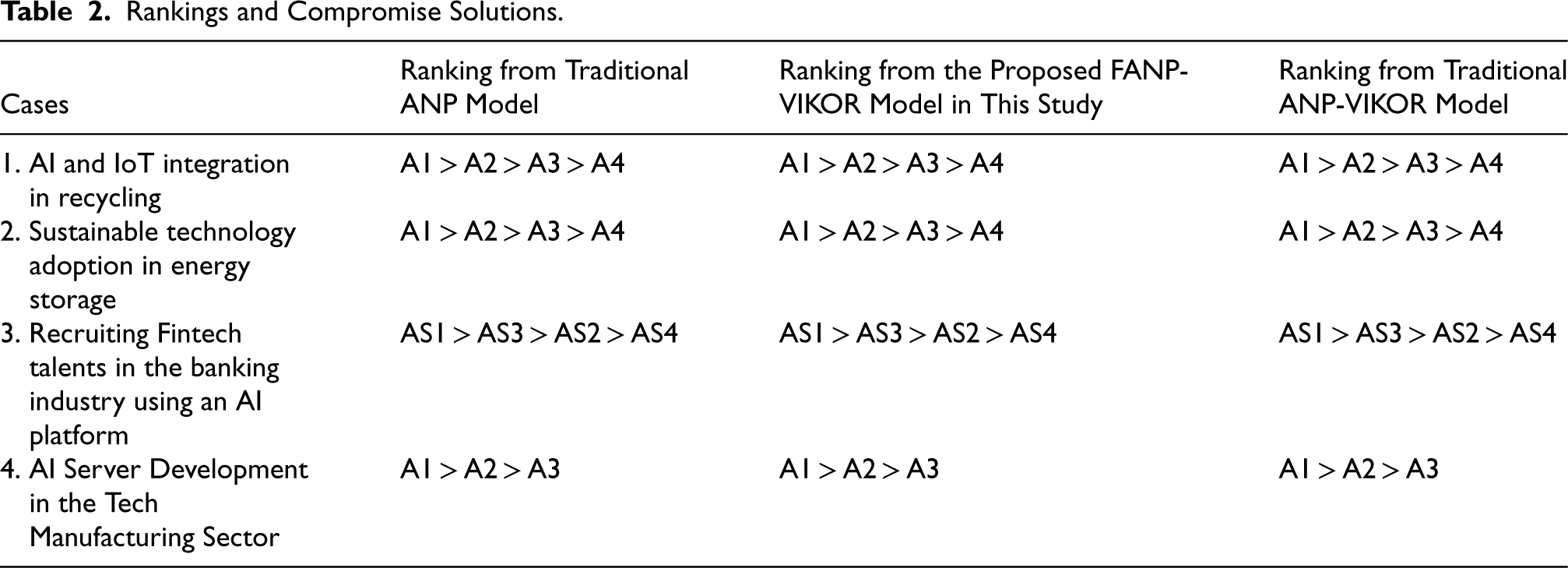
The identical rankings across all three methods in Table 2 demonstrate the decision's robustness. This consistency validates our proposed model's reliability, confirming its alignment with traditional approaches while offering deeper structural insights from the DEMATEL integration.
To ensure the reliability of the proposed ranking, the framework automatically verifies two fundamental compromise conditions for the top-ranked alternative Condition 1: Acceptable Advantage ( Condition 2: Acceptable Stability in Decision Making
If both conditions are satisfied,
To ensure the robustness of the decision output, a sensitivity analysis of the group utility weight parameter
To validate the practical benefits of the system developed using Python framework, this section compares its performance with the conventional Excel-based approach. While both implementing the same hybrid MCGDM logic, their computational behavior, scalability, flexibility, and reliability differ substantially.
Computational Efficiency and Scalability
The Python framework demonstrated superior performance, particularly in processing the large-scale supermatrix. This high performance is largely attributed to the utilization of Python's underlying scientific computing libraries, particularly NumPy (Harris et al., 2020), which is highly optimized for vectorized and matrix operations. This approach avoids the computational overhead of traditional element-wise calculations common in spreadsheet software, ensuring efficiency even as matrix dimensions increase. These findings are consistent with existing research comparing the two platforms. For example, Kelvin et al. (2024) conducted a Wilcoxon signed-rank test and found Python to be significantly more efficient than Excel in terms of resource utilization when processing data files. Similarly, Kuraś et al. (2023) specifically highlighted the advantages of Python-based tools for processing the pairwise comparison matrices central to AHP and ANP models, particularly as the matrix dimensions grow.
In our study, the Python procedure demonstrated significant real-time capability, completing the 1000 supermatrix iterations for all 4 cases in less than 10 s (as listed in Appendix Table B1). For example, in Case 1, the computation time was 7.36 s with 5 experts, increasing only marginally to 7.50 s with 19 experts. This empirically confirms the framework's excellent stability and scalability in handling large-scale matrix operations, making it a superior solution for complex, high-dimensional decision problems.
Less User Effort and Enhanced Reliability
Compared to conventional Excel-based implementations, the Python-based framework significantly reduces manual workload and eliminates most user-induced errors. Excel, while accessible, requires manual data restructuring and formula validation for each case, increasing the risk of inconsistency and reducing reproducibility. In contrast, the Python framework offers reusable components and robust error handling, enhancing the practical viability of the proposed decision model for flexible, large-scale evaluations.
To explore the relationship between the number and composition of experts and the stability of MCGDM results, this section compares how early versus later input affects model outputs—particularly causal relationships in DEMATEL and ranking of alternatives in the final supermatrix.
To establish a rigorous evaluation standard for “convergence”, this study defines it operationally as follows: the model is considered to have reached convergence when both of the following conditions are met and remain unchanged after the inclusion of data from at least three subsequent experts:
Only when both of these indicators stabilize simultaneously is the decision model considered to have achieved a reliable state of convergence.
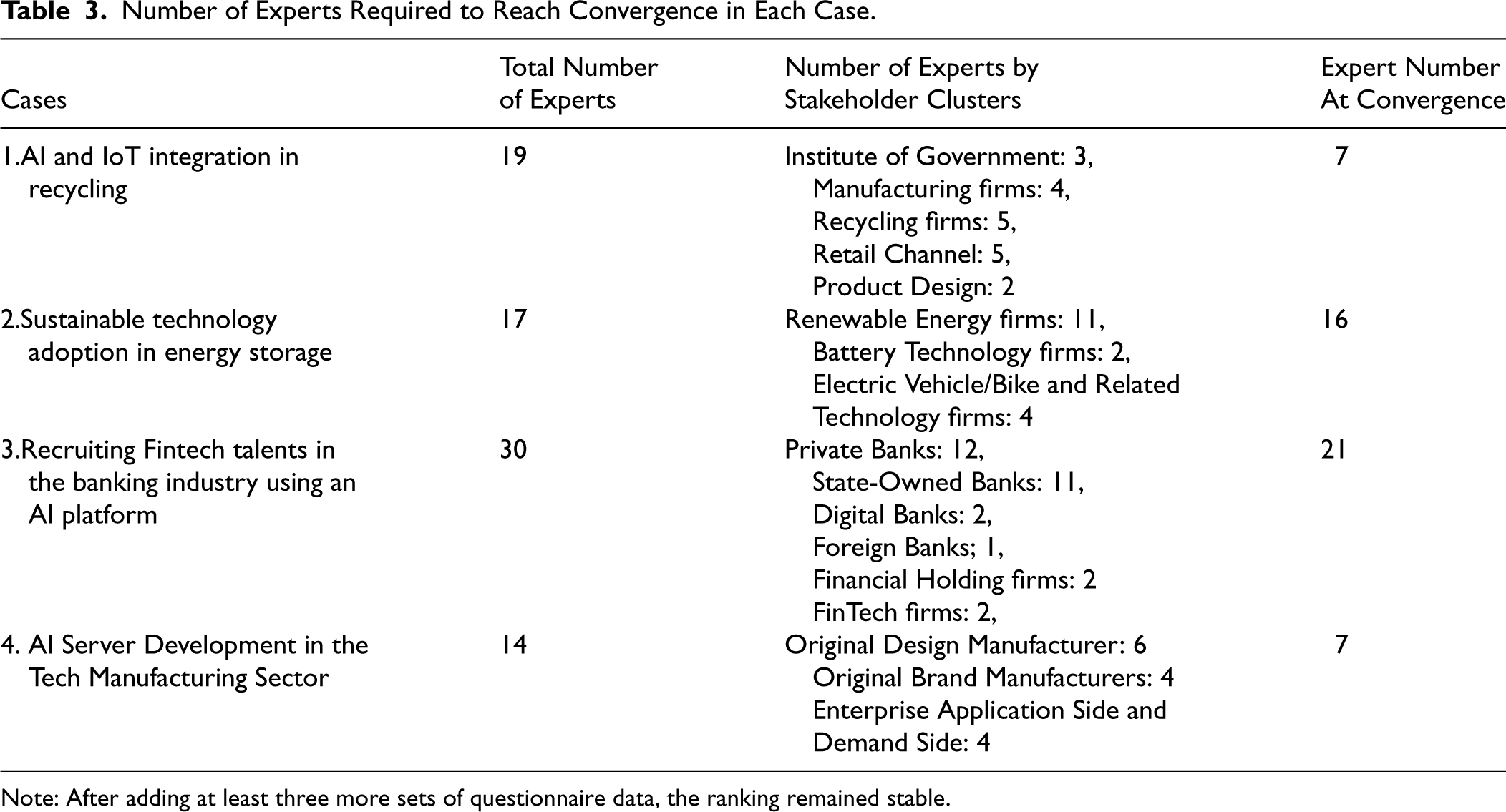
Using Case 1 as an illustrative example in Table 3, the interviews were conducted sequentially by stakeholder cluster: government, retail channels, recycling firms, product design, and manufacturing. Following the methodology in Section 3, responses from the first 5 experts were processed to compute the preliminary results. According to our convergence criteria, the model first reached a stable state upon the inclusion of the 7th expert's data:
The FANP alternative ranking stabilized as $A1 > A2 > A3 > A4$. The DEMATEL causal relationship was confirmed, with the ‘Environmental (E)’ and ‘AI + IoT (I)’ dimensions influencing the ‘Social (S)’ and ‘Governance (G)’ dimensions.
Number of Experts Required to Reach Convergence in Each Case.
Number of Experts Required to Reach Convergence in Each Case.
Note: After adding at least three more sets of questionnaire data, the ranking remained stable.
Crucially, these two core outputs remained unchanged upon the subsequent addition of data from the 8th, 9th, and up to the 19th expert. This indicates that, for Case 1, seven strategically selected experts spanning all five stakeholder clusters were sufficient to yield consistent and robust decision results.
The convergence pattern in Case 2 (sustainable technology adoption in energy storage) was slower, as shown in Table 3. The initial three interviewees were all from Delta Electronics, a single organization within the “Renewable Energy firms” stakeholder cluster (as listed in Table 3), with each representing different departments. Due to this initial concentration of viewpoints within a single organization, the early results were less representative of broader stakeholder perspectives. Following the same analysis procedure, the DEMATEL causal network and the ranking of alternatives of the final supermatrix remained unstable until the 16th expert. It was only after incorporating responses from a more diversified group of experts that the causal network and ranking priorities converged and matched the results produced using all 17 experts.
As summarized in Table 3, the convergence behavior varies significantly across cases, highlighting the impact of expert composition on result consistency. Case 3 (Fintech recruitment in banking) reached an initial ranking stability at the 21st expert. However, due to the high homogeneity within the expert pool, the system subsequently encountered ranking fluctuations between the 24th and 27th experts (detailed in the drift analysis in Appendix C.4). Following the ‘Rule of Three’ (detailed in Appendix C.3), Case 3 only achieved definitive and invariant consistency at the 28th expert. This late-stage inconsistency in Case 3 is attributed to a ‘Homogeneity Trap’ within the banking HR panel, where shared institutional biases resulted in persistent numerical drift rather than structural anchoring (detailed in Appendix C.4).
In contrast, Case 4 reached definitive stability at the 7th expert by leveraging interdisciplinary diversity (covering four different functional dimensions). This allowed the model to capture the full structural map of AI server development dynamics much earlier than the homogeneous group in Case 3. This comparison proves that strategic stakeholder diversity achieves numerical stabilization and structural consistency far more efficiently than sheer expert volume in a homogeneous group.
These 4 cases suggest that response diversity across stakeholder groups plays a more critical role than the absolute number of experts in achieving stable MCGDM outcomes. When stakeholder clusters are systematically covered early in the data collection process, convergence can occur with fewer interviews. Conversely, homogeneity in early inputs delays convergence and may require a larger expert base to balance the bias. These findings have implications for future applications of expert-based decision models: researchers and practitioners should prioritize stakeholder representativeness over sample size
This study contributes to the field of soft computing by introducing a novel Python-based computational intelligence framework that significantly enhances the efficiency and reliability of complex MCGDM models. More importantly, its application reveals a fundamental principle for the design of expert-driven intelligent systems: strategic stakeholder representativeness is a more critical driver of model efficiency and convergence of its core outputs (i.e., the causal network and final alternative rankings) than sheer expert sample size.
The central contribution of this research is the empirical validation of this new design principle. We demonstrated this through compelling cross-case evidence: in Case 1, where stakeholder clusters were systematically covered, the model stabilized with just the 7th expert. In contrast, in Case 2, where initial viewpoints were homogenous, convergence was delayed until the 16th expert. This finding challenges the conventional “more data is better” assumption in designing expert systems, suggesting that the quality and diversity of input, curated through systematic stakeholder representation, is a more efficient path to robust outcomes.
From a practical standpoint, the Python-based framework provides a powerful tool for time-sensitive decision-making. The implications of our findings are twofold: for practitioners, it offers a more resource-efficient path to reliable group decisions; for researchers in computational intelligence, it underscores the importance of integrating stakeholder analysis into the pre-deployment phase of intelligent system design.
While this study offers significant insights; its limitations suggest promising avenues for future research. Future research should focus on investigating the generalizability of this convergence principle across a broader range of industrial and social sectors. Additionally, further efforts could be directed toward developing a more modular system architecture and integrating this framework into larger enterprise systems as a real-time, embedded intelligent decision support system.
Footnotes

Ethical Considerations
Ethical approval was not required for this study in accordance with the general institutional guidelines and academic customs for low-risk research at National Taiwan University of Science and Technology. The research involved only the secondary analysis of aggregated and de-identified expert judgment data for multi-criteria decision modeling. As the study was deemed to pose no direct risk to participants, formal IRB review was not mandated. All participants were fully informed about the study's purpose and provided informed consent prior to participating in the original surveys.
Consent to Participate
The data utilized in this study for Case 1, Case 2, Case 3, and Case 4 were obtained from secondary sources based on previous research and collaborations. This data includes Published Data (2 cases), and Unpublished Data (2 cases). Informed consent to participate was obtained in Written form by the original data collectors from all individual experts included in those initial studies. The current authors were granted full permission to use this de-identified and aggregated expert judgment data for the purpose of this comparative and methodological analysis.
Funding
The authors received no financial support for the research, authorship, and/or publication of this article.
Declaration of Conflicting Interests
The authors declared no potential conflicts of interest with respect to the research, authorship, and/or publication of this article.
Data Availability
Data will be made available on request.
Appendix
Appendix B: Technical Description of the Python Computational Framework
This appendix details the Python computational framework designed to automate the Fuzzy Analytic Network Process (FANP) workflow. Its modular architecture (Figure B1) processes data sequentially through components for DEMATEL analysis, weight computation, supermatrix construction, and VIKOR ranking. This end-to-end automation enhances efficiency, scalability, and reliability over traditional spreadsheet methods by minimizing manual effort and risk of error. This diagram illustrates the modular architecture and data flow of the Python computational framework, which ensures an efficient, reliable, and repeatable analysis workflow.
Appendix C: Sensitivity Analysis and Practical Validation of the Proposed Framework
Appendix D: Mathematical Foundations of Triangular Fuzzy Numbers
Appendix E: Sensitivity Analysis of the VIKOR Ranking
To verify the robustness of the decision-making outcomes in the proposed framework, as suggested during the peer-review process, a sensitivity analysis was conducted for the VIKOR method. The group utility weight parameter
Figure E1 illustrates the sensitivity results across all four case studies (case 1 to case 4). Each subplot tracks the variation in the VIKOR score (
The analysis reveals that the optimal alternatives (A1 in Case 1, 2, 4 and AS1 in Case 3) consistently maintain their top rank (the lowest Q score) across the entire spectrum of