






Abstract
Uncertainty is a parameter in optimization problems encountered in real-world scenarios. Identifying a particular category of models for multilevel linear programming under uncertainty is challenging. The emphasis of this research is the examination of uncertainty in multilevel quadratic programming problems. The primary aim of this initiative is to address the FIVIFMQP problem, which denotes completely interval-valued intuitionistic fuzzy multilevel quadratic programming. To convert the specified quadratic objective function into an equivalent linear objective, initially employ a linearization technique on the objective function. The anticipated value function is utilized for all elements of the objective function and constraints to derive an equivalent crisp model. The crisp model is subsequently resolved utilizing an augmented fuzzy methodology grounded in the anticipated value function. Resolving the multilevel programming problem can yield a compromise solution to the FIVIFMQP challenge. A numerical example is included to enhance comprehension of the solution approach of the proposed method.
Keywords
1. Introduction
Decision-making problems in real-world applications such as engineering, economics, and management are often characterized by uncertainty, hierarchical structures, and nonlinear relationships. Traditional optimization models, particularly classical linear and quadratic programming approaches, typically assume precise data and deterministic environments. However, such assumptions are often unrealistic, as real-world data frequently involve vagueness, imprecision, and incomplete information.
To address uncertainty, various fuzzy-based approaches have been developed. In particular, intuitionistic fuzzy sets extend classical fuzzy sets by incorporating both membership and non-membership degrees, allowing for a more flexible representation of uncertainty. Furthermore, interval-valued intuitionistic fuzzy (IVIF) sets provide an additional level of generality by representing these degrees as intervals, thereby capturing hesitation and ambiguity more effectively.
In parallel, multilevel programming has emerged as an important tool for modeling hierarchical decision-making problems involving multiple decision makers with potentially conflicting objectives. These models are widely used in areas such as supply chain management, transportation systems, and economic planning. On the other hand, quadratic programming plays a crucial role in modeling nonlinear relationships, particularly in problems involving cost, risk, and resource allocation.
Despite these developments, existing studies often address only limited aspects of the problem. Many works consider fuzzy or interval uncertainty without incorporating intuitionistic characteristics, while others focus on multilevel programming structures but assume linear objective functions. Additionally, only a limited number of studies investigate quadratic programming under uncertainty, and these approaches typically do not fully utilize interval-valued intuitionistic fuzzy representations.
To the best of our knowledge, existing approaches do not provide a unified framework that simultaneously integrates interval-valued intuitionistic fuzzy representation, multilevel hierarchical decision structures, and quadratic objective functions. This limitation restricts their ability to model complex real-world problems involving uncertainty, hierarchy, and nonlinearity within a single framework.
Although real-world problems often involve hybrid uncertainty combining probabilistic and fuzzy characteristics, the present study focuses specifically on interval-valued intuitionistic fuzzy uncertainty. This choice is motivated by the ability of IVIF sets to capture multiple dimensions of uncertainty, including membership, non-membership, and hesitation, within a unified and flexible framework. Moreover, IVIF models do not require probabilistic assumptions, which may not always be available in practice. While hybrid uncertainty models may provide a more comprehensive representation, their integration within a multilevel quadratic programming framework would significantly increase model complexity and computational burden. Therefore, this study aims to strike a balance between expressive uncertainty modeling and computational tractability. Extending the proposed approach to hybrid uncertainty environments remains an important direction for future research.
To address the above research gap, this paper proposes a Fully Interval-Valued Intuitionistic Fuzzy Multilevel Quadratic Programming (FIVIFMQP) model. The main contributions of this work can be summarized as follows:
A novel formulation of a multilevel quadratic programming problem under an interval-valued intuitionistic fuzzy environment. A unified solution methodology combining linearization and expected value transformation to obtain a tractable crisp equivalent model. An integrated framework that simultaneously handles uncertainty, hierarchical decision-making, and nonlinear objective functions. A numerical example demonstrating the applicability and effectiveness of the proposed approach.
The remainder of the paper is organized as follows. Section 2 presents the basic concepts and definitions related to interval-valued intuitionistic fuzzy sets. Section 3 formulates the proposed model. Section 4 describes the solution methodology. Section 5 provides a numerical example to illustrate the proposed approach. Section 6 discusses the results and implications. Finally, Section 7 concludes the paper and outlines directions for future research.
2. Literature Review
In intuitionistic fuzzy set theory, the membership degrees of acceptance and rejection are assessed, representing an extension of classical fuzzy set theory (Atanassov, 2016). An assignment from X to closed sub-intervals of the real interval [0, 1] constitutes an interval-valued intuitionistic fuzzy (IVIF) set on the universe X (Wan & Dong, 2020). This variant of fuzzy set has been thoroughly examined, both regarding its theoretical attributes and its numerous applications (Jebadass & Balasubramaniam, 2024; Alolaiyan et al., 2024; Zhou et al., 2024; Mandal et al., 2024; Bilişik et al., 2024; Alghazzawi et al., 2024). Dong and Wan (2024) proposed a novel IVIF Best-worst technique characterized by additive consistency. In an IVIF context, Shivani and Rani (2024) examined the multi-objective, multi-item, four-dimensional green transportation problem. Malik and Gupta (2024) employed the Hamming distance concept to analyze division and subtraction operations within any set or value of IVIF. Acar et al. (2024) analyzed and evaluated four hydrogen storage solutions via the IVIF analytic hierarchy process. Singer and Özşahin (2024) introduced a framework for decision-making utilizing the IVIF analytic hierarchy approach to discover and assess the significant elements influencing customers’ decisions to purchase non-wood forest products.
When a decision-maker (DM) is assigned the responsibility of optimizing one or more objective functions at each tier of the decision-making process within a hierarchical organization, it results in a challenge referred to as multi-level (ML) programming challenges. Moreover, each decision maker separately regulates a set of decision criteria (Anandalingam, 1988; Zhang et al., 2015). In the stochastic machine learning lot sizing problem with a service level, and in a generic context where independent demand for components is conceivable, Goshu and Kassa (2024) proposed a systematic approach to evaluate the value of enhancing flexibility. Qin et al. (2024) proposed a matheuristic approach to tackle the ML capacitated lot-sizing problem including backorder and substitution. Tong et al. (2024) introduced a comprehensive machine learning complementary scheduling methodology that facilitates dynamic scheduling in shared manufacturing by employing a digital twin model grounded in information freshness to detect disturbances. Due to the detrimental environmental impact of fossil fuel-powered generation units, Fatemi et al. (2023) developed a stochastic machine learning multi-objective approach to facilitate energy market clearing across micro-grids. Yao et al. (2023) created a machine learning optimization model for the real-time operation of integrated energy systems encompassing carbon capture, energy storage, and renewable energy sources.
An effective method for utilizing limited resources is through a mathematical model known as quadratic programming (QP). This has led to the emergence of numerous practical outcomes and intriguing applications (Mahajan et al., 2024; Du et al., 2024; Shen et al., 2024; Nguyen et al., 2024). Kushwah and Sharma (2024) discussed an approach that identifies all viable methods for solving a multi-objective integer quadratic programming issue. Cuong et al. (2024) defined certain characteristics of the Proximal Difference-of-convex functions decomposition method within the context of linear constraints in indefinite quadratic programming. Mangalore et al. (2024) demonstrated a solution for addressing convex continuous optimization problems with linear constraints and quadratic cost functions using the scalable neuromorphic research device, Intel Loihi 2. Cifuentes et al. (2024) examine sensitivity analysis for Mixed Binary Quadratic Programming for diverse right-hand sides. Boudjellal and Benterki (2024) proposed and analyzed an innovative full-Newton step feasible interior point method for convex quadratic programming. Many studies utilized fuzzy approaches, neutrosophic approaches and rough approaches to programming problems, whereas some researchers adopted an Interval Valued intuitionistic fuzzy approaches that merely used a linear membership function.
However, as Table 1 demonstrates, this work provides a highly detailed and targeted literature review on the uncertainty, and certainty in multilevel quadratic programming (MQP) problems in different uncertainty environments. Able classifies previous research precisely based on the nature of uncertainty, the method of handling uncertainty, and whether the uncertainty is in parameters or variables whether it is, multilevel and Quadratic.
Research Studies Performed by Multiple Authors on MQP in various Uncertainty Environments.
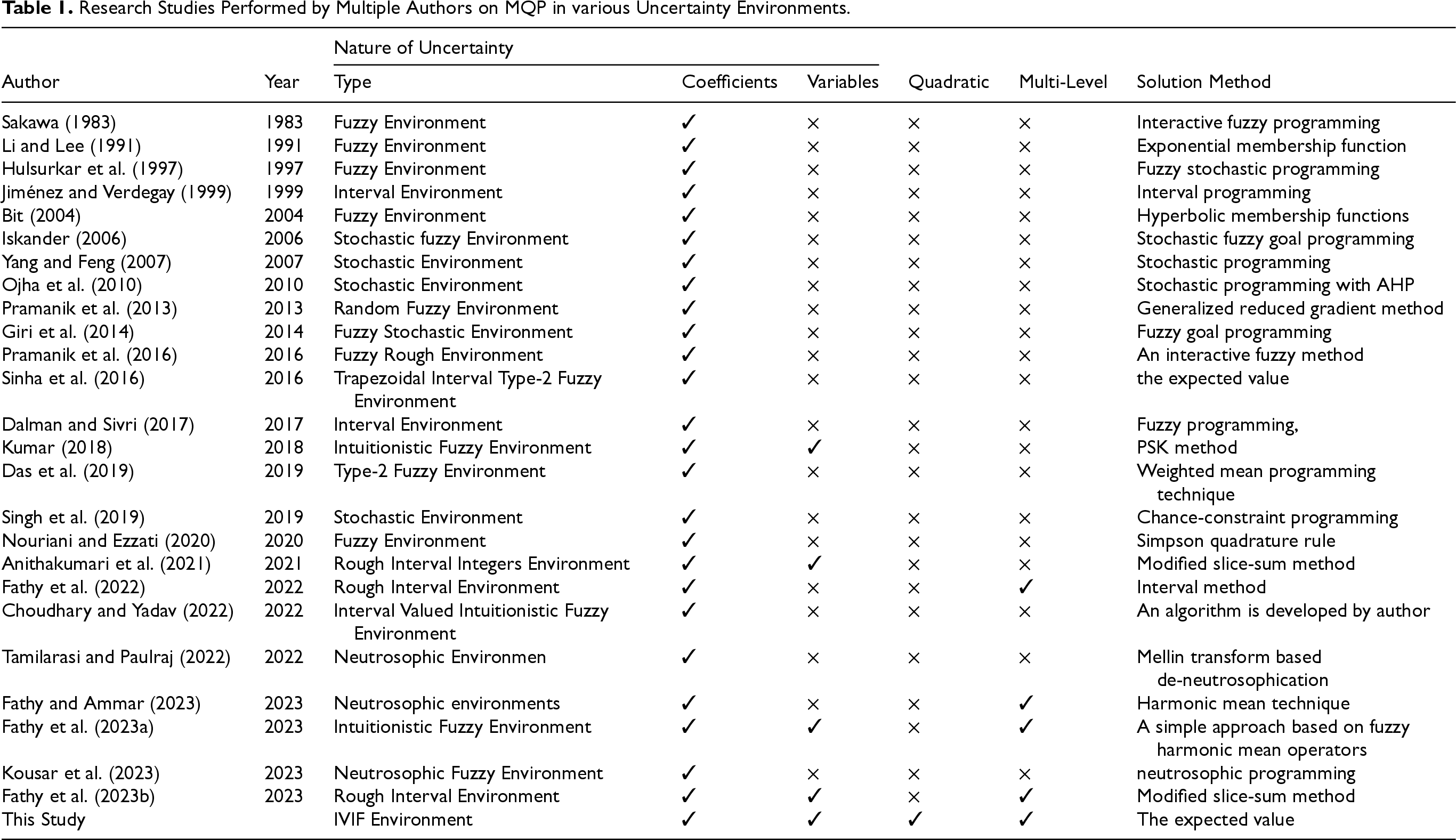
Research Studies Performed by Multiple Authors on MQP in various Uncertainty Environments.
Table 1 presents a structured comparison of existing studies based on key characteristics, including the type of uncertainty representation, problem structure, and objective function. It can be observed that most existing works focus on limited aspects of the problem. In particular, a significant portion of the literature addresses fuzzy or interval uncertainty without incorporating intuitionistic features, thereby neglecting the representation of hesitation. Moreover, several studies consider multilevel programming structures but are restricted to linear objective functions. Although a few contributions have explored intuitionistic or interval-valued fuzzy models, they do not simultaneously account for multilevel decision-making and quadratic objectives. As a result, these approaches are unable to fully capture the complexity of real-world problems involving hierarchical interactions, nonlinear relationships, and rich uncertainty structures.
Based on the comparison in Table 1, it is evident that there is a lack of models that simultaneously integrate:
Interval-valued intuitionistic fuzzy representation, Multilevel hierarchical structure, and Quadratic objective functions
within a unified optimization framework.
This limitation restricts the ability of existing approaches to effectively model complex real-world problems that involve uncertainty, hierarchy, and nonlinear relationships. To address the identified research gap, the present study proposes a Fully Interval-Valued Intuitionistic Fuzzy Multilevel Quadratic Programming (FIVIFMQP) model. Unlike existing approaches that treat these aspects separately, the proposed model integrates them within a unified framework. This integration enables a more comprehensive representation of decision-making problems by simultaneously capturing uncertainty through IVIF sets, hierarchical interactions through multilevel programming, and nonlinear relationships through quadratic objective functions.
Therefore, the contribution of this work lies not in introducing entirely new individual components, but in effectively combining multiple advanced features into a coherent and practically applicable optimization framework.
Section 2 of this study delineates the definitions of IVIF sets, their operations, and associated relations. Section 3 introduces the FIVIMQP problem. Section 4 presents the technical solution for the topic under consideration. Section 5 presents a practical example to illustrate the applicability of the proposed solution methodology. Section 6 provides a discourse. The final segment closes the work.
This section defines IVIF sets, IVIF numbers, their operations, and related relationships.
IVIF Sets, IVIF Numbers, Their Operations
(Atanassov, 1999) An IVIF set
(Atanassov, 1999) An interval-valued triangular intuitionistic fuzzy number (IVTIFN) is represented by: 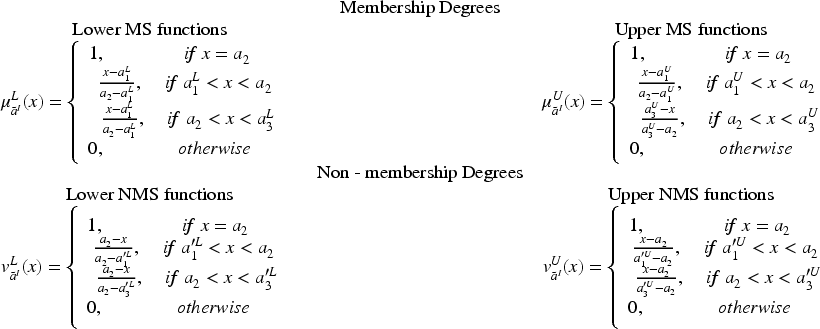
(Atanassov, 1999) Arithmetic operations can be performed between two IVTIFNs
(Atanassov, 1999) Two IVTIFNs
To facilitate computation, an expected value function is used to convert IVIF numbers into crisp values.
(Atanassov, 1999) Let 
(Atanassov, 1999) Let 

This function provides a representative crisp value by balancing the effects of membership and non-membership degrees.
It is important to note that the expected value does not eliminate uncertainty arbitrarily; rather, it aggregates the interval information into a single value while implicitly preserving the influence of hesitation and variability.
In this section, we present a well-structured formulation of the fully interval-valued intuitionistic fuzzy multilevel quadratic programming (FIVIFMQP) problem.
Notation and Preliminaries
Consider a multilevel decision-making system consisting of p hierarchical decision makers (DMs). Each decision maker
Let:
All parameters and variables are represented using IVIF numbers as defined in Section 2.
Mathematical Model
At each level i, the decision maker 
where
Subject to:
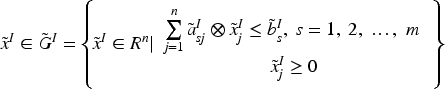
The hierarchical nature of the problem implies that:
The decision of Each level solves its own objective function while anticipating the reactions of subsequent levels
Thus, the problem follows a leader–follower structure across multiple levels.
All parameters and variables in the model are expressed as interval-valued intuitionistic fuzzy numbers (IVIFNs), which allow:
Simultaneous modeling of membership and non-membership degrees Representation of uncertainty using interval data Inclusion of hesitation margins This formulation enhances the ability of the model to represent real-world uncertainty more effectively than classical crisp or fuzzy approaches.
Methodology
The FIVIFMQP issue is addressed in three phases. Phase I involves converting the basic issue into a corresponding linear programming (FIVIFMLP) problem. Phase II tackles and transforms the FIVIFMLP issue into a definitive model. Phase III entails employing a linear MS function within the IVIF framework to adjust the fuzzy programming methodology for the optimization of the precise linear programming issue.
Let IVTIFNs, each possessing the subsequent values, represent all IVIF parameters and variables for the objective functions and constraints in equation (1). Then an FIVIFMQP problem can be organized as follows at the 
where
subject to
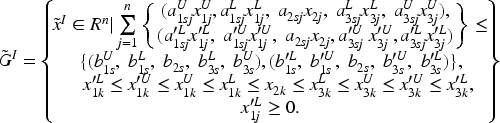
Where









A linearization technique for objective functions has been devised to address the challenges posed by the current quadratic objectives.
We utilize novel
Let
The FIVIFMLP issue with linear objective functions can thus be reformulated as follows at the 
where
subject to
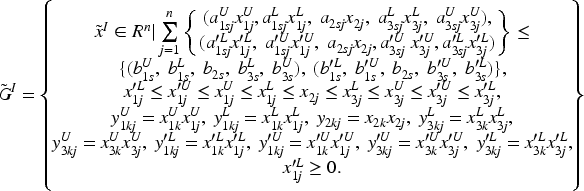
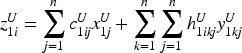
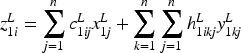
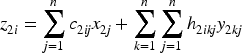
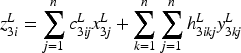
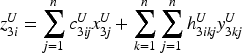
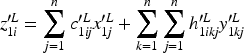
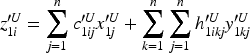
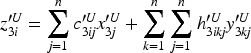
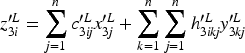
The linearization transformation defined by introducing auxiliary variables
Step 1: Original Quadratic Form
Consider the quadratic term in the objective function:
This term is nonlinear due to the product
Step 2: Introduction of auxiliary variables
Define new variables:
Substituting into the quadratic term gives:
Step 3: Equivalence via linking constraints
To ensure equivalence, the following constraints must be imposed:
These constraints guarantee that:
Every feasible solution in the original problem corresponds to a feasible solution in the transformed problem. No spurious solutions are introduced.
Step 4: Feasibility Preservation
Let
Define All constraints of the transformed problem are satisfied. Thus,
Conversely, if Substituting back yields a feasible solution of the original quadratic model.
Step 5: Objective Value Preservation
For any feasible
Thus, the objective value remains unchanged under the transformation.
Step 6: Convexity Consideration
If the matrix The original quadratic problem is convex. The linearized formulation preserves convexity through exact representation of
Conclusion
Since:
Feasibility is preserved, Objective values are unchanged, and A one-to-one correspondence exists between solutions,
The linearized model is equivalent to the original quadratic model.
Hence, the linearization is valid
The proposed linearization is exact but increases the problem size from n to
The proposed model is formulated using interval-valued intuitionistic fuzzy (IVIF) data, which incorporates membership, non-membership, and hesitation in interval form. While this representation provides a rich description of uncertainty, it is computationally challenging to solve directly. To overcome this difficulty, an expected value function (Bharati & Singh, 2018) is employed to transform the IVIF model into an equivalent crisp formulation.
The expected value serves as an aggregation measure that combines the lower and upper bounds of membership and non-membership degrees into a single representative value. It is important to note that this transformation does not arbitrarily eliminate uncertainty. Instead, it preserves the essential characteristics of IVIF data by providing a balanced representation of the underlying uncertainty structure. In particular, the effects of hesitation and interval variability are implicitly reflected in the resulting crisp model. Therefore, the use of the expected value function represents a trade-off between preserving the richness of IVIF information and ensuring computational tractability.
Employing the technique outlined in (Bharati & Singh, 2018), a FIVIFMLP problem is transformed into its crisp version, specifically the (MLP) problem, as detailed below:

where
subject to
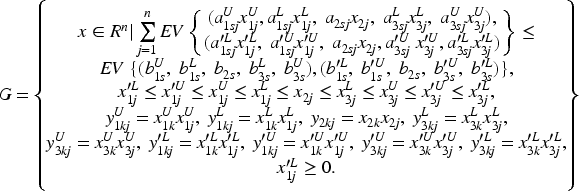
Problems (3) and (4) are equivalent.
To prove the equivalence between Problems (3) and (4), we show that both formulations yield identical feasible regions and preserve the ordering of the objective function values.
Step 1: Feasibility Preservation
Assume that
Then, by definition of the constraints, we have:
Applying the expected value operator 
Since the expected value function is monotonic (order-preserving), it follows that:

Thus, the transformed solution
Every feasible solution of Problem (3) is feasible in Problem (4).
Step 2: Objective Function Consistency
The objective function in Problem (3) is expressed in IVIF form:
By applying the expected value operator, we obtain the crisp objective function:
Since the expected value aggregates all IVIF components into a scalar while preserving their relative magnitudes, the ordering of solutions is maintained.
That is, for any two feasible solutions 
Thus, the optimization direction is preserved.
Step 3: Reverse Direction
Conversely, assume that
Then there exists a corresponding IVIF representation 
Since the expected value is derived directly from IVIF parameters, we can reconstruct a consistent IVIF solution satisfying Problem (3).
Thus every feasible solution of Problem (4) corresponds to a feasible IVIF solution in Problem (3).
Conclusion
Since:
Feasible regions are preserved, and Objective function ordering is maintained,
It follows that Problems (3) and (4) are equivalent.
Hence, the theorem is proved
Interpretation and Practical Significance of Theorem
Theorem 1 establishes the equivalence between the original IVIF multilevel quadratic programming model and its transformed crisp counterpart. This guarantees that no feasible solutions are lost and that the optimization direction is preserved. The theorem provides the theoretical foundation that justifies solving the transformed model instead of the original IVIF model, which is difficult to handle directly. Theorem 1 serves as a key step in the proposed solution framework, ensuring that the transformation process (expected value and linearization) leads to a valid and consistent optimization problem. We clarified that all numerical results presented in the paper rely on this equivalence, which ensures their correctness and reliability. Theorem 1 provides the theoretical justification for transforming the original IVIF multilevel quadratic programming problem into an equivalent crisp model. This equivalence ensures that solving the transformed problem yields solutions that are consistent with the original IVIF formulation. Therefore, the theorem plays a crucial role in enabling the practical implementation of the proposed approach.
This phase presents the solution concept for the MLP problem by adapting the fuzzy programming method (Osman et al., 2004) within an IVIF context utilizing a linear MS function. Initially,
Let 
Formulate the MS functions of the ith-LDM 
When 
Ultimately, to provide an optimal solution that meets the requirements of all decision-makers (DMs), the subsequent Tchebycheff (Tch) problems (Osman et al., 2004) will be examined:

subject to






The compromise solution represents a balanced decision that simultaneously considers the objectives of all decision makers in the multilevel structure. It is obtained by maximizing an overall satisfaction measure derived from the fuzzy programming formulation. Unlike classical optimal solutions, the compromise solution does not necessarily optimize any single objective individually. Instead, it reflects a trade-off among competing objectives, ensuring that no decision level is significantly disadvantaged. The quality of the compromise solution can be interpreted in terms of the achieved satisfaction levels, which indicate how well each objective is fulfilled. Moreover, the obtained solution depends on model parameters and may vary under different preference structures, highlighting its sensitivity to decision-making conditions. Thus, the compromise solution provides a realistic and flexible outcome for complex optimization problems involving multiple objectives and uncertainty.
Complexity Analysis
Problem size expansion:
The linearization process increases the number of variables from n to
Computational complexity:
The resulting problem becomes a large-scale linear (or fuzzy linear) programming problem.
Using standard solvers, the worst-case computational complexity grows polynomially with the number of variables and constraints.
Trade-off discussion:
We clarify that the proposed method involves a trade-off between:
Modeling accuracy (exact handling of quadratic terms), and computational cost.
Practical applicability:
The method is suitable for small- to medium-scale problems, while large-scale problems may require:
Decomposition techniques, or approximation methods.
Future work direction:
We have highlighted the development of more efficient or reduced-complexity formulations as an important direction for future research.
The subsequent stages propose a novel method to deliver an accurate fuzzy Pareto optimal solution to the FIVIFMQP problem.
A Flowchart of the Proposed Methodology
The proposed technique is illustrated in the flowchart below (Fig. 1).
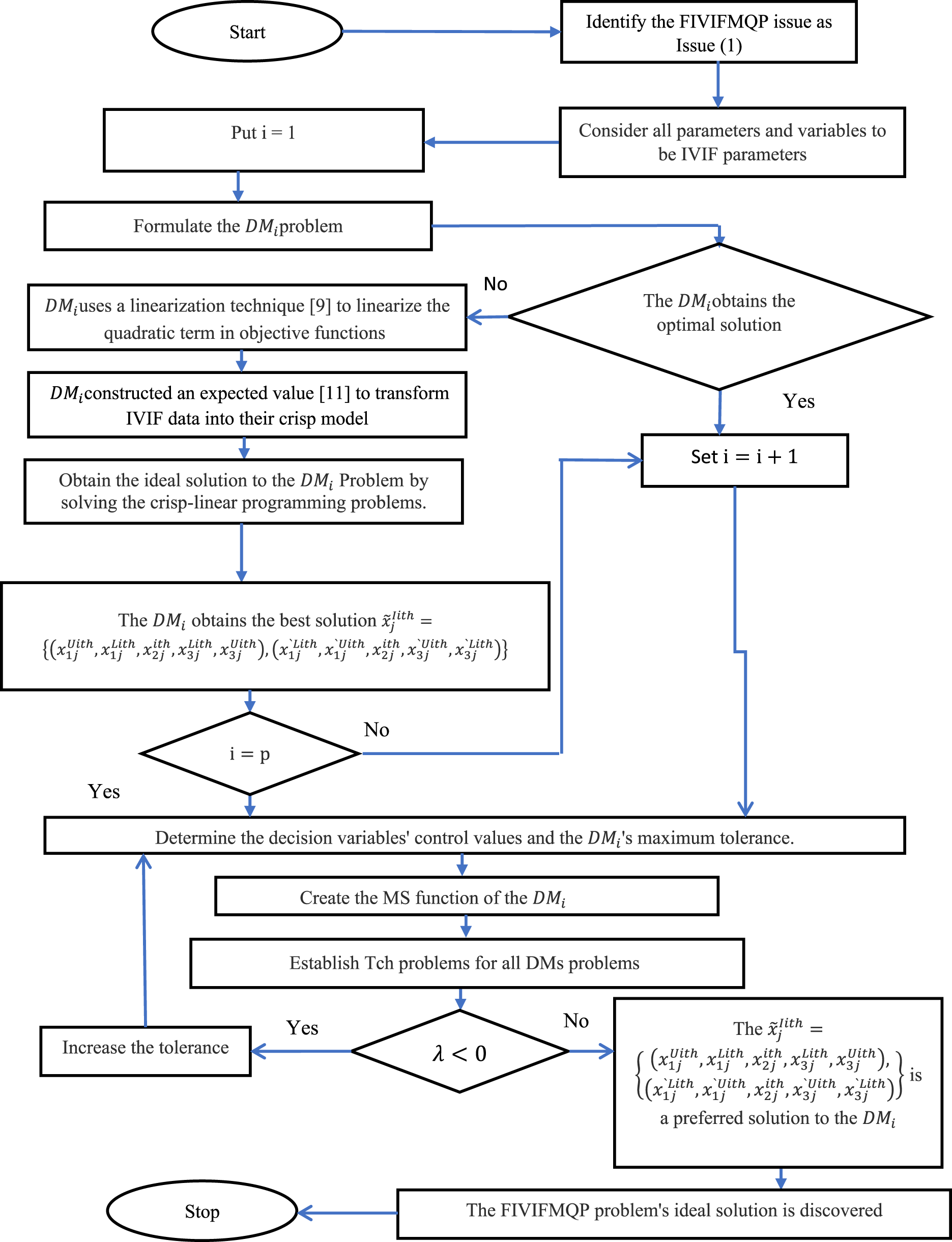
A flowchart delineates the procedure of the suggested approach.
The obtained results demonstrate that the proposed model is capable of capturing the interaction between multiple decision levels under uncertainty. In contrast, classical crisp or standard fuzzy approaches would fail to represent hesitation and interval uncertainty, leading to less informative solutions.


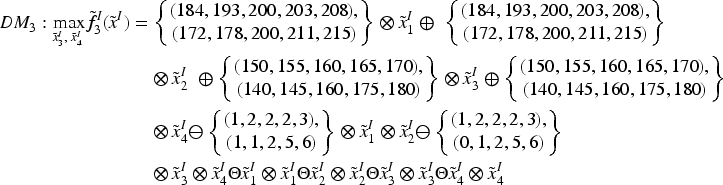
Subject to




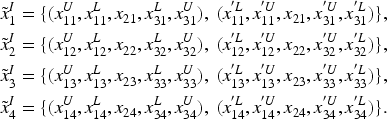
Subsequently, succinctly articulate the multilevel optimization utilizing arithmetic procedures, the linearization method, and the expected value.
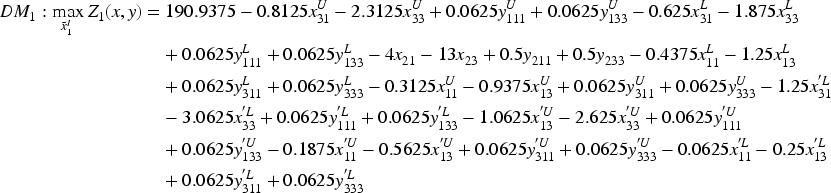
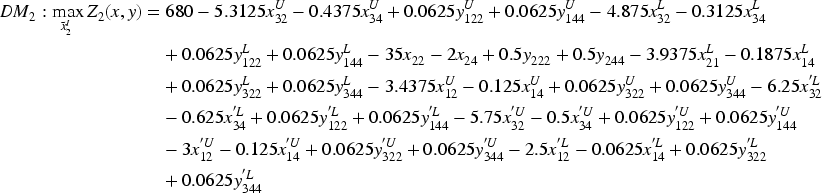
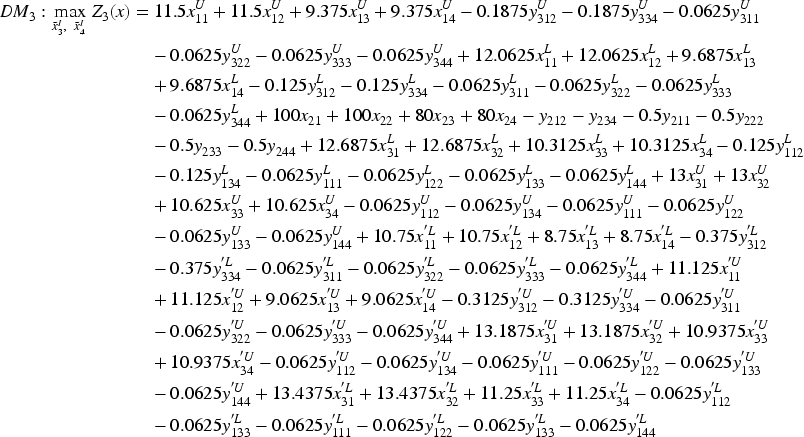












Table 2 presents the precise optimal solutions for the choice variables and objective functions at each level.
The Precise Optimal Solutions for the Objective Functions and Decision Factors.
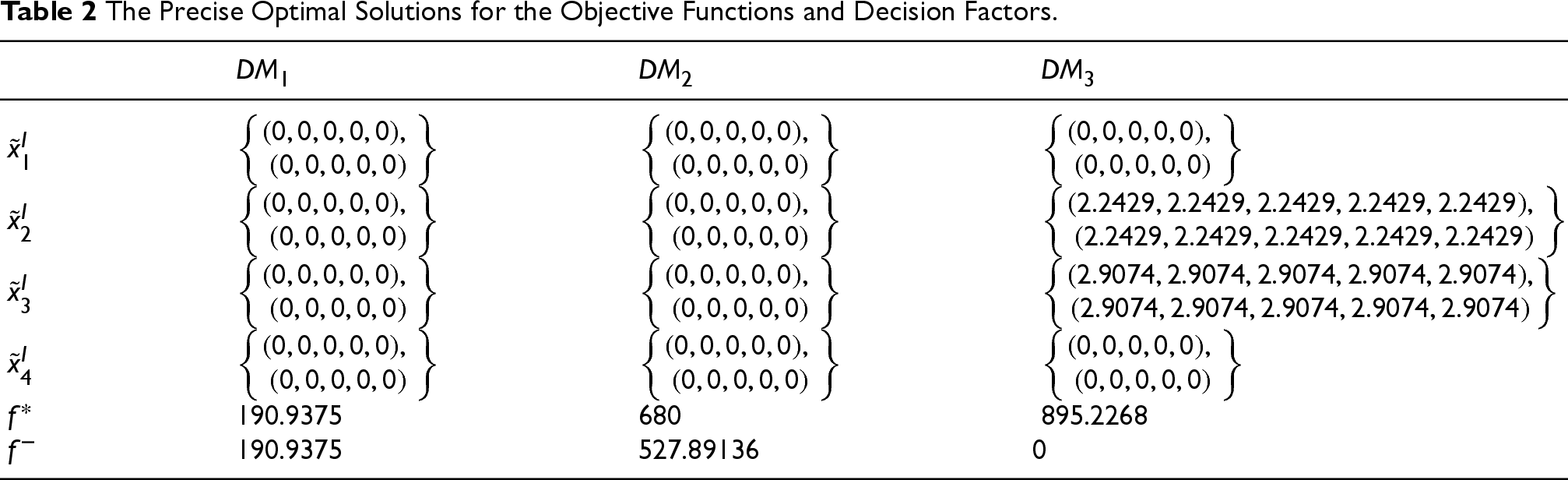
The Precise Optimal Solutions for the Objective Functions and Decision Factors.
Develop the MS function for the ith -LDM (i = 1,2,3) as delineated in problems (4)-(5) and address the Tch problem as outlined in problem (6) to achieve an acceptable solution that meets the requirements of all DMs. The preferred solution for the FIVMQP problem is
The obtained results demonstrate that the proposed model is capable of capturing the interaction between multiple decision levels under uncertainty. In contrast, classical crisp or standard fuzzy approaches would fail to represent hesitation and interval uncertainty, leading to less informative solutions.
The FIVIMQP problem is now a widely utilized method across various fields, including engineering, finance, and economics. The resolution of the FIVIMQP problem is exceedingly challenging by conventional methods due to:
The utilization of IVIF numbers for decision variables and coefficients in the objective functions and constraints. The quadratic nature of the objective functions. The decision-making framework is hierarchical and comprises distinct, often opposing tiers.
The proposed approach introduces a structured framework for solving fully interval-valued intuitionistic fuzzy multilevel quadratic programming (FIVIFMQP) problems. The method integrates three key components: linearization of quadratic terms, transformation using the expected value function, and application of fuzzy programming techniques.
One of the main strengths of the proposed method lies in its ability to simultaneously handle:
Interval-valued intuitionistic fuzzy data, Multilevel hierarchical decision structures, and Quadratic objective functions.
This integration distinguishes the model from many existing approaches that typically address these features separately.
The linearization technique enables the transformation of nonlinear quadratic terms into an equivalent linear form, which facilitates the use of standard optimization solvers. However, this transformation increases the dimensionality of the problem, leading to higher computational cost. Therefore, a trade-off exists between modeling accuracy and computational efficiency.
The use of the expected value function provides a practical way to convert IVIF data into a solvable crisp model. While this step simplifies the computational process, it also represents a balance between preserving uncertainty information and ensuring tractability.
Despite these advantages, some limitations remain. The increase in problem size due to the introduction of auxiliary variables may restrict applicability to large-scale problems. Additionally, the reliance on expected value transformation may reduce the richness of uncertainty representation.
Future research may focus on:
Developing more efficient linearization or approximation techniques, Extending the model to hybrid uncertainty environments. Applying the method to real-world large-scale optimization problems.
Conclusion
Although hybrid uncertainty models combining probabilistic and fuzzy information are important, this study focuses on IVIF uncertainty as a balance between expressive modeling and computational tractability. This work delineates a method for addressing the FIVIFMQP problem utilizing IVIF numbers for all parameters and decision factors. The author initially employed a linearization technique to convert the quadratic objective function into a linear format. Subsequently, we applied the anticipated value function to all coefficients of the objective function and constraints to convert the issue into its precise counterpart. The extended fuzzy technique simplifies the crisp issue to a singular quadratic programming problem. A compromise solution to the FIVIFMQP problem was ultimately achieved by addressing the multilevel programming issue. The author provided an example to illustrate the application of the proposed method in addressing the FIVIFMQP problem. The presented example is designed to illustrate the applicability of the proposed model. However, further validation on large-scale and real-world problems is required to fully assess the computational performance and scalability of the approach. This remains an important direction for future research. In additional this study provided a focused review of uncertainty models in multilevel quadratic programming, systematically classifying previous contributions according to the type of uncertainty, the approaches used to handle it, and whether uncertainty affects parameters or decision variables. This targeted review reinforces the manuscript's claim of novelty: to the best of our knowledge, there is no existing algorithm specifically designed for the FIVIFMQP problem. By clearly locating this gap in the literature and proposing a practical solution, the paper not only fills an important methodological void but also outlines concrete directions for future research and application. Future research may focus on extending the model to hybrid uncertainty environments, improving computational efficiency, and applying the approach to large-scale real-world problems, and applying the approach to large-scale real-world problems, and an empirical benchmarking study comparing the proposed uncertainty-handling framework against recently developed techniques in related optimization settings to further substantiate its computational and solution-quality performance.
Footnotes
Funding
The authors received no financial support for the research, authorship, and/or publication of this article.
Declaration of Conflicting Interests
The authors declared no potential conflicts of interest with respect to the research, authorship, and/or publication of this article.
Data Availability Statement
No data was used, generated, or analysed in the course of this study. Consequently, the Data Availability section is not applicable.
