







Abstract
The concept of Digital Twins (DT) has experienced a remarkable surge in popularity over the past few years. A DT is a computer system designed to monitor, simulate and predict various aspects of a specific physical object. In other words, it is like an enhanced digital counterpart of a real object. Human Digital Twins (HDT) have emerged as an evolution of this concept, where the physical object twinned is a human being. Nevertheless, the inherent complexity of human beings turns the creation of their digital representation into a challenging endeavour. In this study, a systematic literature review was conducted that aimed at clarifying the HDT concept and the different aspects a proper HDT should consider. To shed some light on how the different facets of a HDT are addressed in the literature, we delved into its fields of application, the human dimensions a HDT considers, the information handled, its underlying technological frameworks, what quality assessment processes are being applied to HDT, and lastly, those ethical and legal concerns related to HDT. As a result of this systematic literature review, a HDT research agenda is presented to fill the gaps and shortcomings identified in the literature reviewed and highlight some challenges that should be addressed in the near future.
Introduction
Despite the term Digital Twin (DT) is currently accepted as a bleeding-edge technology, its conception traces back to the Apollo Program launched by NASA in the 1970s. In the Apollo Program, at least two identical space vehicles were built to mirror their conditions during the mission.
The very first definition of DT was coined by Professor Grieves, who described the term as ‘one or a group of digital copies of a specific device that can abstract the real device and can be used as the basis for testing under real or simulated conditions’ (Shengli, 2021). According to Grieves and Vickers (2017), the conceptual model of a DT comprises three main components: A physical product from the physical space. A virtual counterpart of the physical product in the cyber space. A data and information interaction interface between the physical and the cyber spaces.
Since then, the DT concept has evolved into one of the most appealing technological approaches for researchers, because it is not just a means of communication between a physical product and its virtual counterpart, but also because it can feature simulation and prediction capabilities. The range of options the DT concept can be employed for is both vast and varied. Nowadays, DT has so far been applied in many fields such as manufacturing, product life cycle management, industry 4.0, healthcare and more (Shengli, 2021). Its widespread application is the main reason why this concept has now become a trending topic among researchers.
The growing interest in DT-related technologies has been such that research and new initiatives have been conducted to extend the technology, not only to machines but also to human beings. This is where the concept of Human Digital Twin (HDT) emerges. An HDT is a counterpart in the cyber space of a real person from the physical world (Shengli, 2021). At first, HDTs were seen as a model or database that records personal information (age, weight, sex, relatives, etc) and do some computations to provide the user with the desired feedback, but it has also greater potential. Thanks to recent advances in IoT, we can now collect and process data from a plethora of devices to feed the HDT with the required data, obtaining valuable feedback in exchange.
A defining feature of HDTs is the complexity involved in accurately modelling and representing the multifaceted nature of human beings. Unlike machine DTs, which often focus on physical properties and functional behaviours, HDTs must account for the unique dimensions of human existence. These include physical, cognitive, social, emotional, cultural and ethical aspects (Hernández-Jiménez, 2015; Miguélez, 2009). The
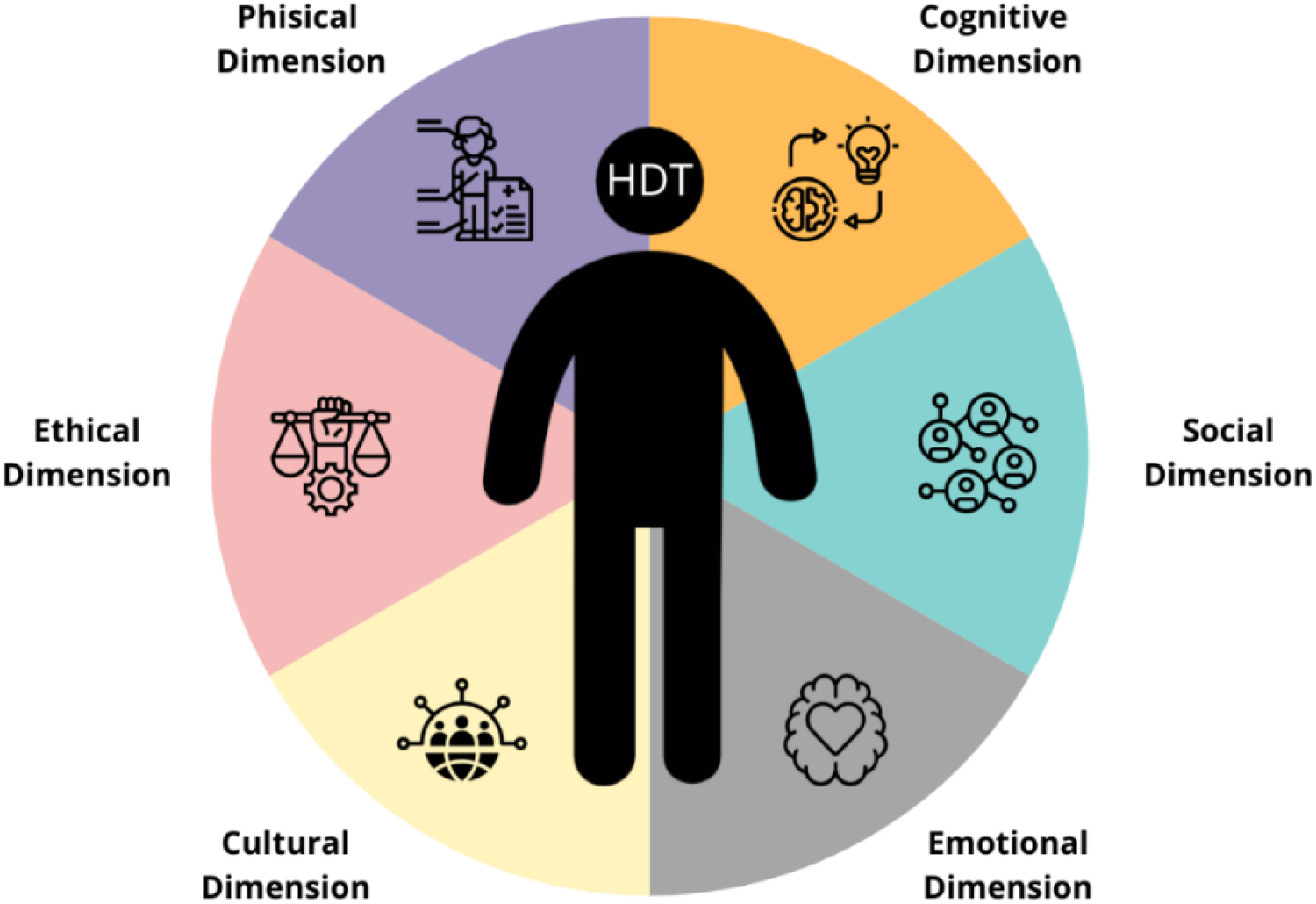
Envisioned dimensions of HDT.
Because of the complexity of this multifaceted nature, the exploration and understanding of HDTs remain in their infancy, with significant research opportunities ahead. Thus, this systematic literature review contributes to the development of this concept. We decided to address a wide range of research questions to identify their current state and future challenges. Firstly, we analysed what is considered as a HDT by the research community. As Hernández-Jiménez (2015) and Miguélez (2009) claim, there are different human dimensions that can be considered when modelling a human being. Thus, we study which ones are currently being employed in HDT. Given the assorted activities humans are involved in, it is relevant finding what are the application domains where HDT are being used. Once the application domains were identified, an interesting question arouse: which information is managed by the HDT? The next logical step was analysing how HDT are designed, that is, what architecture do they use. Regarding HDT design, it is a good starting point taking a look at how HDT are developed, with special emphasis in what frameworks and technologies are employed. After the HDT has been developed, an evaluation is required to assess the HDT meet their quality requirements. With this aim, we studied what evaluation approaches are being applied. Since HDT deal with human data, privacy and ethical issues must be taken into account, and thus thoroughly analysed.
The paper is organized as follows: Section 2 analyses related works and explains why the present study differs from the existing literature. Section 3 describes the research methodology followed to conduct the review as well as the research questions to be answered. Section 4 reports the results of the analysis of the Research Questions. Section 5 includes a discussion on the findings, and lastly, Section 6 provides some conclusions and guidelines for future work.
When conducting this search, as explained in Section 3, we found four systematic literature reviews in the set of articles. Nevertheless, these papers lacked the completeness we were looking for, either because their objective was not to conduct a systematic literature review of HDT, or because they left some aspects unexplored. These four papers are discussed below.
A recent study (Lauer-Schmaltz et al., 2022) identifies the need to investigate whether HDT would be a viable solution for improving Behaviour-Changing Therapies and rehabilitation. The authors conducted a literature review to identify proposals related to both DT and healthcare. However, this study does not focus on a specific domain, but on any paper related to HDTs, regardless of the domain it addresses.
Another related literature review (Göksoy et al., 2023) analyses various DT applications. As the authors state, this concept is applicable to assorted fields and to anything from a human being to a building. Despite dealing with humans in their review, they do not actually focus on HDTs but on DTs.
The review by Asad et al. (2023) focuses mostly on the technologies and implementation strategies for Human-Centric Digital Twins (HCDT). While it is true that HCDT recognize the human as an integral part of the virtualized environment, it is not the main focus of the monitoring or development. For instance, a production plant is modelled by Asad et al. (2023) in which humans are nothing more than agents that change the state of the warehouses and interact with robots, among other things. Similarly, among the articles we analysed are proposals for HDTs that take into account certain aspects of an individual's environment, although we consider this as a specific case among the many that exist within HDTs. Our study thus complements and extends the results presented by Asad et al. (2023).
Miller and Spatz (2022)unify the definitions of Human Digital Twins and Human Digital Twin System and explore possible use cases for these concepts. Unlike our motivation, the authors focus on how to represent some aspects of the real world while considering humans as a constituent part of it.
A systematic review is presented by Lauer-Schmaltz et al. (2022), but unfortunately, it only discusses briefly the HDT concept. Göksoy et al. (2023)studied HDT in therapeutical healthcare settings. It is important highlighting that both Asad et al. (2023) and Miller and Spatz (2022) analysed humans as a component of an HDT of an environment.
Although the findings presented in these reviews are valuable, they omitted some pivotal HDT features as they did not focus on finding the human dimensions and data reflected in HDT or the current definitions of HDT used in the literature to properly understand the concept. Additionally, they do not identify the domains the HDTs are used in or analyse the ethical and legal aspects to be considered when creating a DT. Because of these limitations, we found it necessary to conduct the present study, in which we analyse all these aspects in addition to including the technologies used to design and develop HDTs.
Research methodology
This literature review was conducted by following the guidelines proposed by Kitchenham et al. (2009) performed in three different phases, as shown in Figure 2. We first defined our Research Questions (RQ) in Phase 1, by following the Goal, Question, Metric (GQM) method (Dalton, 2019). According to GQM, RQs should be questions specific and measurable derived from the goals of our work. These RQs were as follows: RQ1. What is understood as HDT among the researchers? This question aimed to determine whether there is unanimity among researchers on the main characteristics of a system to be considered as an HDT. RQ2. How are the different human dimensions addressed when developing an HDT? Within the HDT context, considering the distinct human dimensions can be crucial to capturing the different facets the HDT should support, and understand the relevant nuances for a given use context. Moreover, as we pointed out above, representing a complex system like human beings is a difficult task. Given the vast number of variables involved and the data we generate, it is practically impossible to carry out an exhaustive HDT of a human being. It is therefore of interest to determine how the division of human beings into different dimensions is treated in the literature to simplify dealing with human complexity. This RQ aimed to identify the human dimensions considered in the literature. RQ3. What are the main domains for HDTs? This RQ aimed to identify the domains in which the HDTs were developed to show their potential. RQ4. What kind of information is gathered by HDT? This RQ served to find not only the information on the physical individual gathered by the HDT but also whether there is any type of correlation between this information and either the HDT domain or the dimensions addressed. RQ5. How is HDTs’ design currently approached? This RQ was defined to identify the methodologies and design proposals currently used for developing HDTs. RQ6. What frameworks and technologies are being used in HDT development? This RQ was to discover the frameworks and technologies employed in the HDT implementation, in addition to the approaches followed for its deployment. RQ7. What are the existing HDT evaluation processes? It is difficult to determine an HDT's quality, given the myriad factors involved. We thus need to find whether there are already existing quality assurance mechanisms in the literature, including any tools to assess the compliance of quality assurance standards. RQ8. What are the legal and ethical considerations regarding HDTs? It is imperative to consider the legal and ethical consequences of an HDT development since they can deal with sensitive information. The aim of this RQ was to identify the most common ethical problems and the main considerations of different legislations. This would allow us, for instance, to identify the information related to the cyber-security measures considered in order to protect a person's personal data and where this data is stored.
Then, we defined the search string as in the workflow shown in Figure 2, using three statements combined with an ‘OR’ operator. The final search string was ‘human digital twin’ in the title OR ‘human digital twin’ in the abstract OR ‘human digital twin’ in keywords.
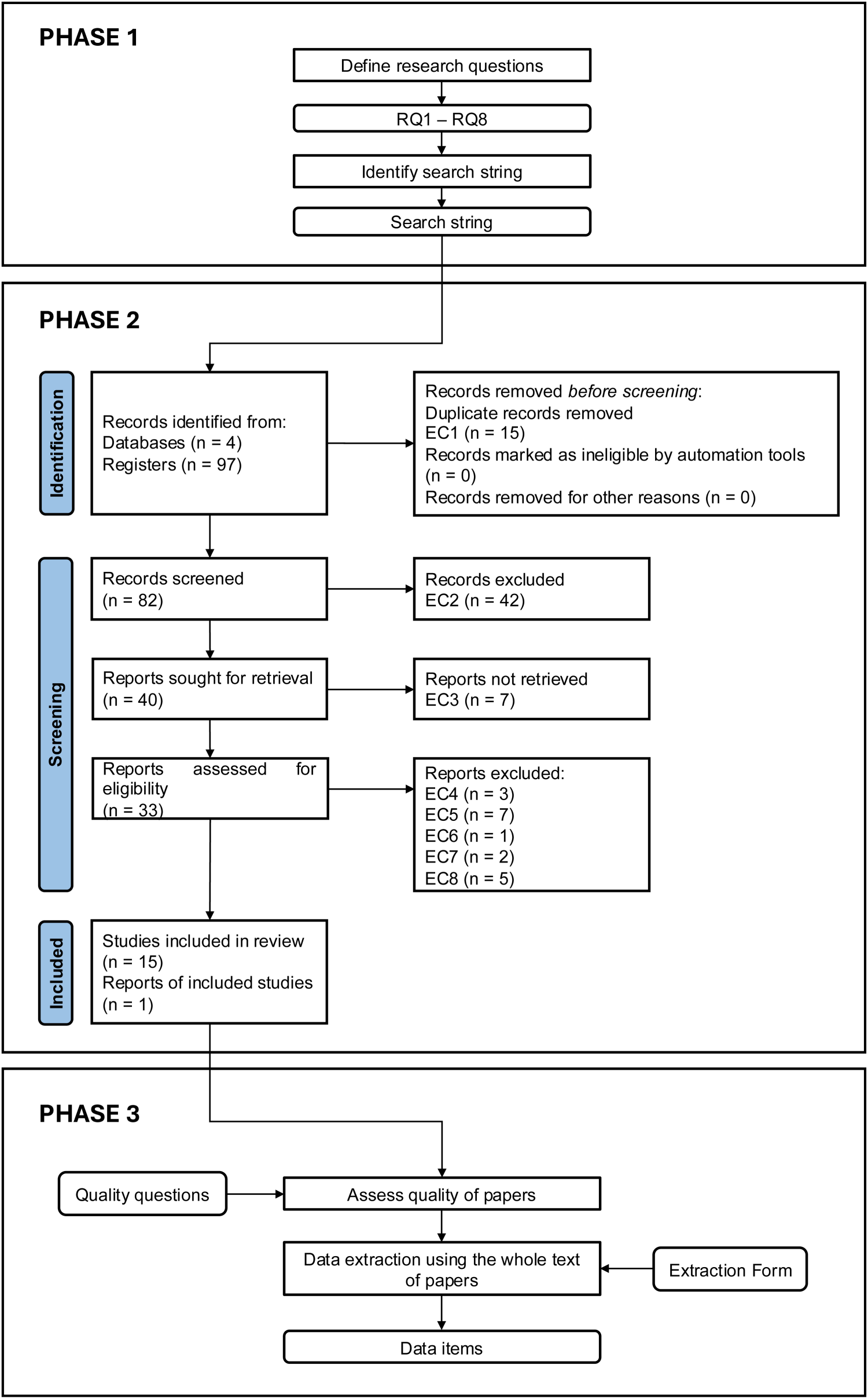
Search methodology.
At this point, we were ready to conduct Phase 2 by following the PRISMA method (Page et al., 2021), having Scopus, IEEE, ACM and Springer as search engines. The query was completed in the above search engines in December 2023. As a result, 97 papers were finally obtained after merging the query results of the different search engines. All the papers included the concept ‘human digital twin’ either in the title, abstract or keywords. As some of them appeared in more than one search engine, the duplicates were removed.
We applied some eligibility criteria (inclusion and exclusion criteria) in Phase 2 following the PRISMA method (Page et al., 2021). The papers obtained were screened according to the eligibility criteria based on their title and abstract. The selected papers had to meet all the inclusion criteria, while the non-selected papers met at least one of the exclusion criteria. The inclusion criteria (IC) were as follows:
On the other hand, the exclusion criteria (EC) were defined as follows:
Table 1 gives the number of papers discarded by the exclusion criteria. Phase 2 finished with a total of 15 papers. As pointed out by Kitchenham et al. (2009), it is necessary to assess the quality of the papers included in the review to improve the confidence in the conclusions drawn. Table 2 shows the quality questions (QQs) that were defined based on the questions proposed by Kitchenham et al. (2009), as well as their average score.
Number of papers excluded by EC.

Quality questions and their average score.

When reviewing the full text of each paper, scores were assigned to all three QQs on a scale from 0 to 1. A study received a full point (1) whenever the information included was concrete and reliable, a half-point (0.5) if the information was partially available, and no points (0) if the information sought was not provided. The score for each paper was computed as the sum of the points the paper got for each QQ. To ensure the credibility of the selected papers, we set a minimum quality threshold of 1.5. Of the total corpus of 15 papers, 5 papers got a quality equal to 2, 8 papers got a quality equal to 2.5 and 2 papers got a quality equal to 3. Since no paper got a quality score less than or equal to 1.5, all have been included in this review.
Moreover, the quality of this review was further analysed according to the quality assessment (QA) criteria proposed by Kitchenham et al. (2009):
All the necessary data required to answer the RQs previously mentioned were extracted from the 15 selected papers. With these data, a qualitative study was conducted to identify patterns relevant to the RQs. This approach allowed us to provide a detailed and contextual understanding of the different aspects related to HDT.
The different research questions designed to characterise HDT were further explored by disclosing the data extracted from the selected papers.
RQ1. What is understood as HDT among the researchers?
As a matter of fact, there was a remarkable disparity among researchers regarding the characteristics of a system considered as an HDT. As we have already mentioned in Section 1, Grieves and Vickers (2017) stated that a DT could only be considered as such if it included a physical product, its virtual counterpart and a bi-directional data flow between both.
On reviewing the literature, we realised that there were many researchers who attributed the term ‘digital twin’ to a system that does not meet all of the aforementioned conditions, in spite of the two well-known terms for this type of system (Macías et al., 2023). On one hand, a digital model is a digital representation of an object, whether or not it exists, without a data flow between its virtual representation and the physical product itself. On the other hand, a digital shadow provides an automatic flow from the physical object to the virtual counterpart, enabling actions such as monitoring and even predicting events. Finally, as aforementioned, a DT contains a bidirectional data flow between the physical and the virtual objects, such that the outputs of one affect the inputs of the other.
Table 2 gives the level of DT supported by the papers selected. Although two-thirds of the papers aligned with Professor Grieves’ definition of HDT, there was still no clear consensus on what constitutes a DT. However, we included Digital Shadows and Digital Models in the study as they are also considered a type of DT (Kritzinger et al., 2018).
RQ2. How are the different human dimensions addressed when developing an HDT?
The dimensions that should be considered when dealing with human beings have been widely discussed among psychology researchers. The human dimensions most frequently considered in the literature are physical, cognitive, social, emotional, cultural, and ethical. We established the following definitions for these dimensions from Hernández-Jiménez (2015) and Miguélez (2009): Physical dimension: Refers to the body, structure, functioning and physiological needs. Cognitive dimension: Involves mental processes and skills that allow the processing, storage and use of information and its manifestation as human behaviour. Social dimension: Pertains to interactions with other individuals or groups, including not only human communications but also social activities. Emotional dimension: Involves the ability to feel and detect emotions. Cultural dimension: Encompasses religious, linguistic, historical contexts, as well as customs and traditions. Ethical dimension: Is the human dimension that helps to distinguish between what is morally right or wrong.
During the review of the selected papers, we identified the human dimensions assessed to relate the data gathered by the HDT to these dimensions. However, we also analysed the purpose for which the data were collected, rather than the actual nature of the data. For example, an individual's emotions can be analysed by sensors distributed throughout his body, even if this analysis relies on physiological factors. Table 3 indicates the papers related to each dimension, giving both the number and percentage of the papers. Notice that since a paper can be included in more than one dimension, the percentage is computed regarding the total number of papers, and thus the sum of all the percentages in the second column will not be 100%.
Relationship between level of DT and papers.

For the sake of clarity, Figure 3 indicates the papers related to more than one dimension. For instance, the proposal of Montini et al. (2021b) is related to all the identified dimensions. Regarding the frequency with which each dimension is addressed, Table 3 and Figure 3 show that the physical dimension is most frequent, possibly because practitioners may find it easier to work with data from the physical dimension due to the availability of affordable sensors such as smartwatches or wristbands.
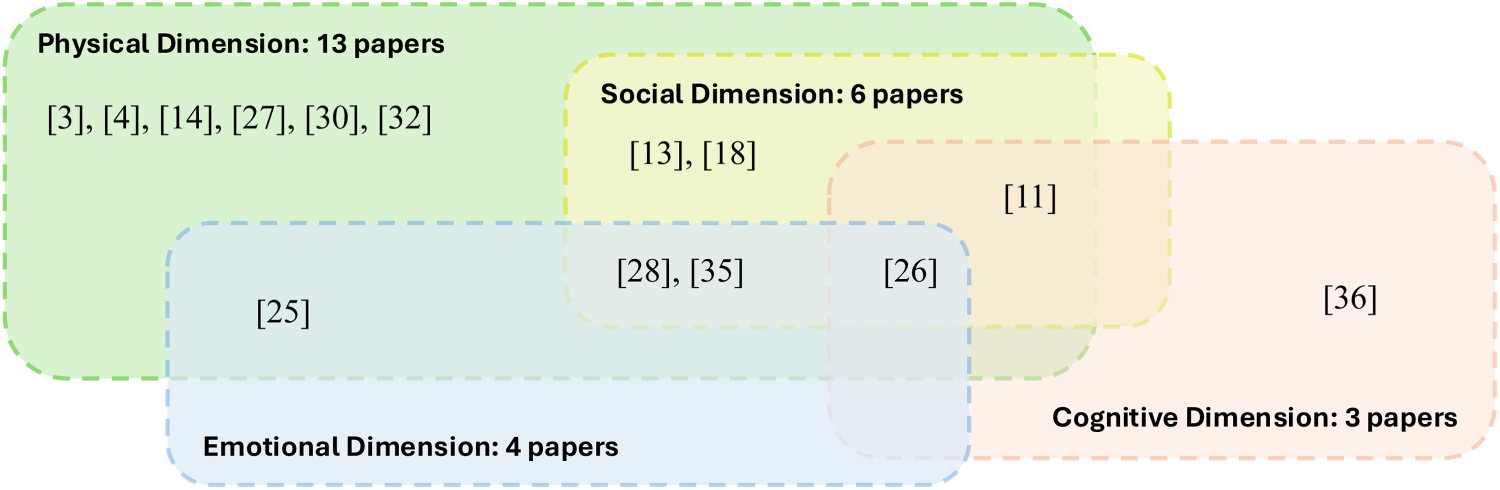
Diagram of relationship between dimensions and papers.
We were surprised not to find a single paper focusing on cultural or ethical dimension. Although some ethical issues are dealt with in the selected papers (as discussed below), we found no paper whose main aim was to analyse the ethical dimension. In terms of the cultural dimension, it was anticipated that differences in individual human behaviour would be found based on cultural backgrounds, although we identified this as an unexplored issue.
We found that all the papers in this review that focused on medical treatment were based on sensors or data related to the individual physical dimension. For example, Mourtzis et al. (2021) propose a platform for diagnosing oncology patients. In this case, the necessary biometric data are collected to reconstruct the patient's internal state through sensors that exclusively capture physical data, such as heart rate or pulmonary data. Other data, including the patient's age, years of treatment and other variables deemed necessary by experts must be considered to correctly diagnose the patient.
However, the physical dimension was not the only dimension considered in the development of HDT. For instance, Wang et al. (2022) placed more emphasis on the cognitive dimension because their main aim was to analyse drivers’ behaviour and mental processes. In this case, they only need the sequence of actions and decisions to build individual HDTs.
We detected that the emotional dimension is especially relevant due to the recurrence of methods and data used to assess individual mental states. For example, Montini et al. (2021b) and Montini et al. (2021a) employed heart rate and the galvanic skin response (GSR) to measure stress levels in industrial workers, plus other data to calculate the ergonomics of the working environment, such as fatigue, gathered through technologies like eye-trackers, and comfort levels, obtained through individual questionnaires. This revealed a research trend focused on understanding workers’ emotions to enhance their conditions or potentially aid in the development of a robotic system capable of assisting the workers.
Regarding the social dimension, we identified some papers that address certain aspects of the individual focused on their interaction with other people and the workplace. The proposal of Naudet et al. (2021) is particularly interesting as it emphasises the skills of speaking, listening and communicating to create a digital representation of a human. Hafez (2020) offered users a service to manage their appointments and tasks based on their previous activities, while Löcklin et al. (2021) proposed a method of managing resources in a hierarchical company according to the user's role.
During our systematic review we gathered the application domains in which HDTs are used. As expected, the fields of health and industry are frequently addressed to such an extent that the applications contained in all the papers can be placed in these two categories, except for Naudet et al. (2023), as shown in Table 4. This slight numerical superiority of the industrial field is possibly due to industry implementing DT before the healthcare sector.
Relationship between papers and dimensions.

Relationship between papers and dimensions.
The first use case in industry that we would like to mention is the paper on simulations to draw conclusions on a certain study. For instance, in the paper by Baskaran et al. (2019) the goal was to determine the impact of factory work on the workers’ joints, for which they used DT to simulate workers in exploring less harmful alternatives.
We also found the management of users in a system, as in the case of Wang et al. (2022). In this article, the user's HDT is part of a complete system that collects data on individual driving behaviour. It also classifies them according to the type of driver, such as aggressive, neutral, conservative, etc. The last use case is in monitoring individuals, whether customers, workers or crew members. For example, in the paper by Naudet et al. (2021), Taylor et al. (2023), Naudet et al. (2021) and Kim et al. (2022), HDTs and IoT technologies are used to gather information on individuals. These data are then processed for various purposes, such as teaching robots to collaborate with humans, as in the paper by Kim et al. (2022), or drawing conclusions on how to travel services, as in the paper by Taylor et al. (2023).
There were some subgroups in the industrial domain, for example, in transport. Wang et al. (2022) proposed a study on human driving behaviours based on the attitudes towards other drivers. Taylor et al. (2023), whose main aim is to find ways to improve the experience in the maritime sector, analyses the experience of a ship's crew to improve their overall experience.
Unlike the industrial domain, we did not find well-defined categories in healthcare, even though we did find proposals that addressed various diseases. For instance, HDTs are used by Chakshu et al. (2019) to assist in the treatment of carotid stenosis. Another example is the HDTs (Pizzolato et al., 2021) developed as a non-invasive therapy for individuals with chronic spinal cord injuries (SCI). Lastly, it is worth noting the proposal for cancer diagnosis (Mourtzis et al., 2021) that exploits an IoT platform powered by HDTs.
Only one paper was found in the General category. This was the case of Naudet et al. (2023), whose main goal was to shed light on the definition of HDT and other general aspects, but it did not propose a particular use case.
As mentioned above, the data flowing between the physical product and the virtual counterpart is a crucial component of HDT architecture. Data collection can be either automatic or manual. Automatic data refers to information collected by sensors or other monitoring strategies. This can include vital signs such as blood flow or heart rate, as well as situational data related to the individual's mood, behaviour or location. Conversely, manual data is actively provided as an input by the system user, whether it be the physical HDT counterpart or another individual. For example, in a medical consultation the doctor is responsible for gathering relevant personal data from the patient such as height, age or weight. However, this does not imply that the data is invariable, since certain data are prone to change over time, for example, the age, weight, height or address.
For the data collected by the analysed papers, we put special interest in determining a possible correlation between the collected data and the dimension or domain they belong to, as analysed below. Firstly, we deal with the data collected for each domain and then we go through each domain found in the selected paper. Table 5 details the information summed up in each paper from their conclusions.
Relationship between domain and papers.

Relationship between domain and papers.
In the realm of healthcare, the paper by Kamel Boulos and Zhang (2021) outlines a hypothetical HDT use case for monitoring patients through their mobile phones. This automatically collects data such as contacts and location, while also providing the user with the option to input symptoms and other health-related information.
On the other hand, papers by Chakshu et al. (2019) and Hafez (2020) request individuals to manually input their height, gender and weight, plus other personal data. For instance, in the paper by Hafez (2020), there is a discussion on creating an HDT that addresses various personal aspects. In addition to monitoring health aspects, this paper emphasises financial aspects by storing the user's banking activities to discern purchasing patterns and preferences. It also covers professional aspects and provides the user with the option of managing tasks through the HDT.
The previously cited paper by Pizzolato et al. (2021) explores different solutions for SCIs, including the use of HDTs to automatically collect electromyographic, electrocardiographic and electroencephalographic signals. Mourtzis et al. (2021) mention both manual and automatic collection of biometric data from the physical individual, although the type is not specified. Okegbile et al. (2022), although it falls within the health domain, does not specify the types of information, so that this paper was categorized as ‘Not disclosed.’
Industrial domain
In the industrial field we found that certain data elements did not vary significantly from the HDT application domain, fundamental for digitally reconstructing a person in any conceivable context. We here refer to personal and biographical data such as height, gender, weight, age or profession. In the selected papers, these data are input manually and are featured in the papers by Baskaran et al. (2019), Montini et al. (2021a), Montini et al. (2021b), Taylor et al. (2023), Naudet et al. (2021) and Kim et al. (2022).
However, other manually input data were more context dependent. For instance, in the paper by Wang et al. (2022), a study of drivers involves collecting certain behavioural data along with the driver type (whether aggressive, calm, neutral, etc.). On the other hand, Naudet et al. (2021) asked users to input their occupational skills before monitoring them.
What particularly caught our attention was the concern for improving employees’ working conditions, as well as ensuring they did not suffer injuries or experience high stress levels. This is evident in the paper by Baskaran et al. (2019) which automatically collects data on the workers’ risk of injury, as well as in the paper by Montini et al. (2021a) and Montini et al. (2021b), which focuses on gathering data related to worker stress and fatigue. The latter two papers agree on the data required to assess whether an individual is undergoing a challenge: heart rate and GSR. Similarly, Naudet et al. (2021) and Kim et al. (2022) also address individual comfort and ergonomics by automatic data collection.
Information according to dimensions
Another goal of this RQ was to identify the data related to each dimension. If we recall Section 4.2, most papers focus on the person's physical dimension, although some papers also address emotional, cognitive and social aspects. Below, we analyse how these dimensions are measured in the selected papers.
In the most prevalent, the physical dimension, we have already mentioned the numerous data elements that can be collected, such as position, height, weight and other personal details. However, we would like to shift our focus to the remaining dimensions. Starting with the emotional dimension, it is noteworthy how certain data can be linked to different purposes according to the context. For example, heart rate, GSR and eye-tracking can be used, as previously mentioned, to monitor patients, focusing either on their physical or emotional state.
In the only paper addressing cognitive aspect (Montini et al., 2021b), a person's skills and capabilities are collected both manually and automatically. We found that the social dimension is related to personal data such as the user's profession or tasks, as in the paper by Hafez (2020) and Taylor et al. (2023).
Summary
Table 5 was created to summarise the above information divided into four columns. The first indicates the human dimension related to the data. The second column presents all the data collected in the selected articles, while third and fourth relate associate the data to the article from which we collected the information and whether the paper belongs to the industry or health domains, respectively.
RQ5. How is HDTs’ design currently approached?
Throughout our review we identified different HDT architectural specifications. Wang et al. (2022) proposed an HDT architecture utilizing Amazon Web Services (AWS) for data storage, processing and analysis. Data is collected through an API Gateway for information related to traffic, maps and weather essentially, the HDT environment. For data collected directly from human activity, AWS IoT Core is used to manage the substantial amount of data originating from devices such as the user's mobile phone or vehicle.
Montini et al. (2021b) presented an HDT architecture for HDTs applied to industry. The authors distinguish five main layers: Sensors Layer: Facilitates data gathering from workers and production system entities. The HDT integrates agents and gateways to ensure data collection, harmonisation and accessibility from heterogeneous sources. IoT Middleware: Supports machine-to-machine (M2M) connection based on the MQTT lightweight messaging protocol. Data Persistence: Stores all the structure and core information about the HDT. Workers’ quasi-static data are also contained in this component, while the Time Series Data Storage acts as a backlog of sensor data. Orchestrator: Manages all the entities in the HDT. Worker Monitoring Modules: These modules enable collecting data from workers, contextual sensors or any system publishing data on the IoT Middleware.
Finally, Kim et al. (2022) illustrated how workers’ safety and performance data are collected. It describes the data collection through the user's mobile phone and a motion capture device. A series of evaluations are then conducted on the working environment, tools, ergonomics and the individual's fatigue.
In the context of this research question, we reviewed the frameworks and technologies used in the selected articles, along with the approaches employed for HDT deployment.
Frameworks
Special attention should be devoted to the ‘architectural framework’ presented (Okegbile et al., 2022). The authors present a conceptual framework that describes the fundamental aspects of supplying relevant patient data to the virtual twin, enabling it to perform certain tasks and store their results in a database. The authors also describe another model that describes the high-level multi-layer architecture proposed, whose most remarkable feature is the fact that it considers migration due to an individual's mobility as an essential part of HDTs. Migration, in this context, refers to an individual's movement across different geographic locations or network nodes.
Moving on to the paper by Montini et al. (2021a), its primary contribution is a meta-model for the modular composition of HDTs. From the class diagram that represents this meta-model, it can be noted that the worker's conditions, parameters and characteristics are considered in a decoupled manner, promoting extensibility. Also, it is worth mentioning that this article references the well-known software development practice of Domain-Driven Design (Millet and Tune, 2015) used to develop this meta-model.
Naudet et al. (2023) also provided a holistic systematic model for creating HDTs, the paper's main focus. This model considers some interesting properties of DTs and HDTs, such as the environment in which the HDT operates or the interactions between the HDT and the individual.
Technologies
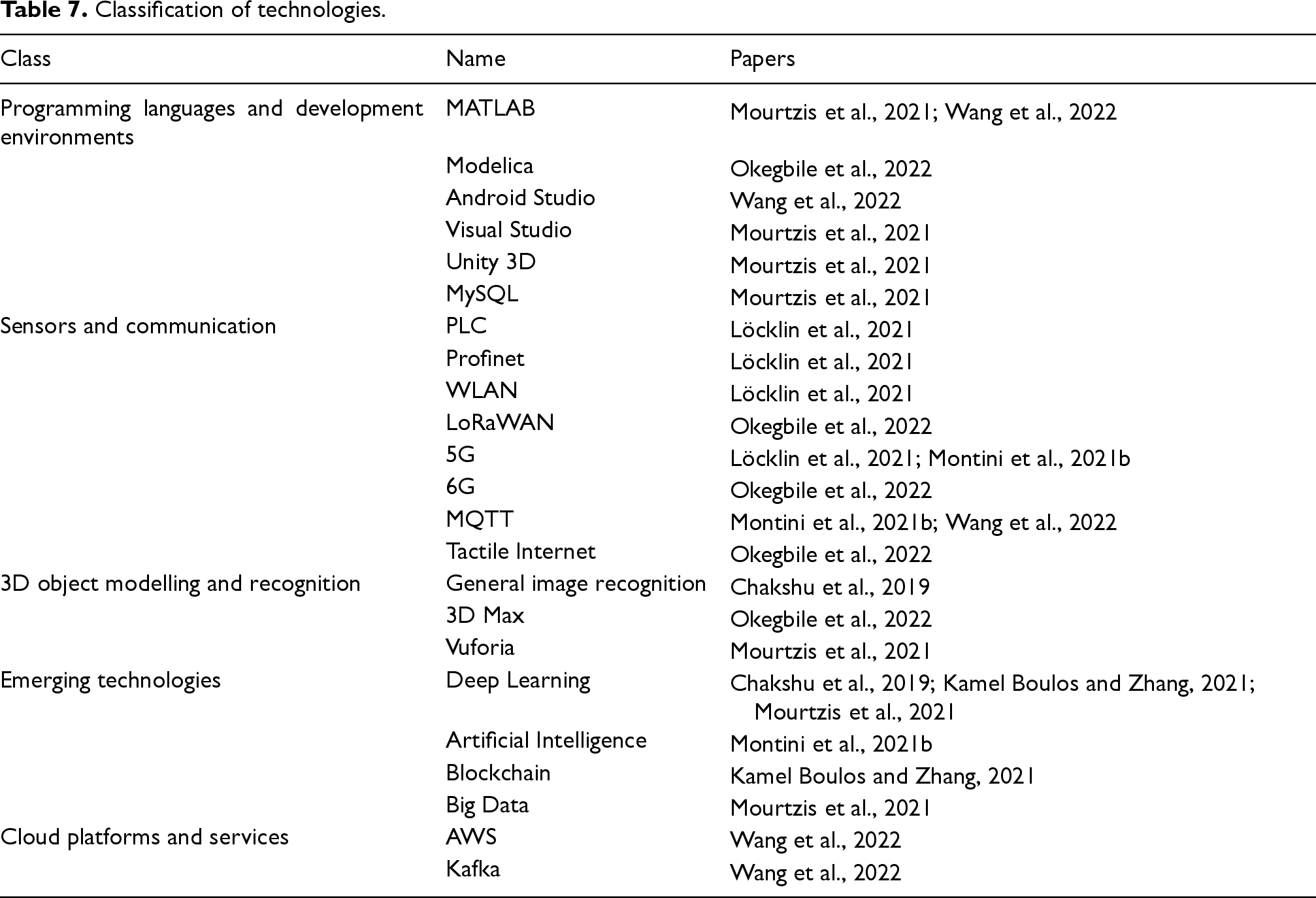
In the corpus of articles, we encountered a plethora of technologies for supporting programming, communication or data collection tasks for HDTs. Table 6 summarises these technologies used for HDT development. There are some programming languages and development environments used, nevertheless they are quite generic, such as MATLAB or Visual Studio. Regarding sensors and the way, they communicate with the HDT, the most frequently used technologies in the IoT field are also used, including networking protocol such as 5G, WLAN, etc. and message broker protocols such as MQTT. For those HDTs where 3D modelling is required to provide a visual representation of the physical counterpart 3D Max, a general-purpose 3D modelling tool, is used. Vuforia is used to enrich the physical counterpart representation with some augmented reality features. Given the vast amount of data collected by HDTs, the use of emerging technologies such as deep learning or other big data technologies are also being exploited. Lastly, cloud technologies are also used, since they can be used to cope with both the vast amount of data and the processing power required. However, only one of the selected papers (Wang et al., 2022) reports about using the cloud. This could be explained because of privacy concerns related to HDTs (Table 7).
Data per dimension and domain.
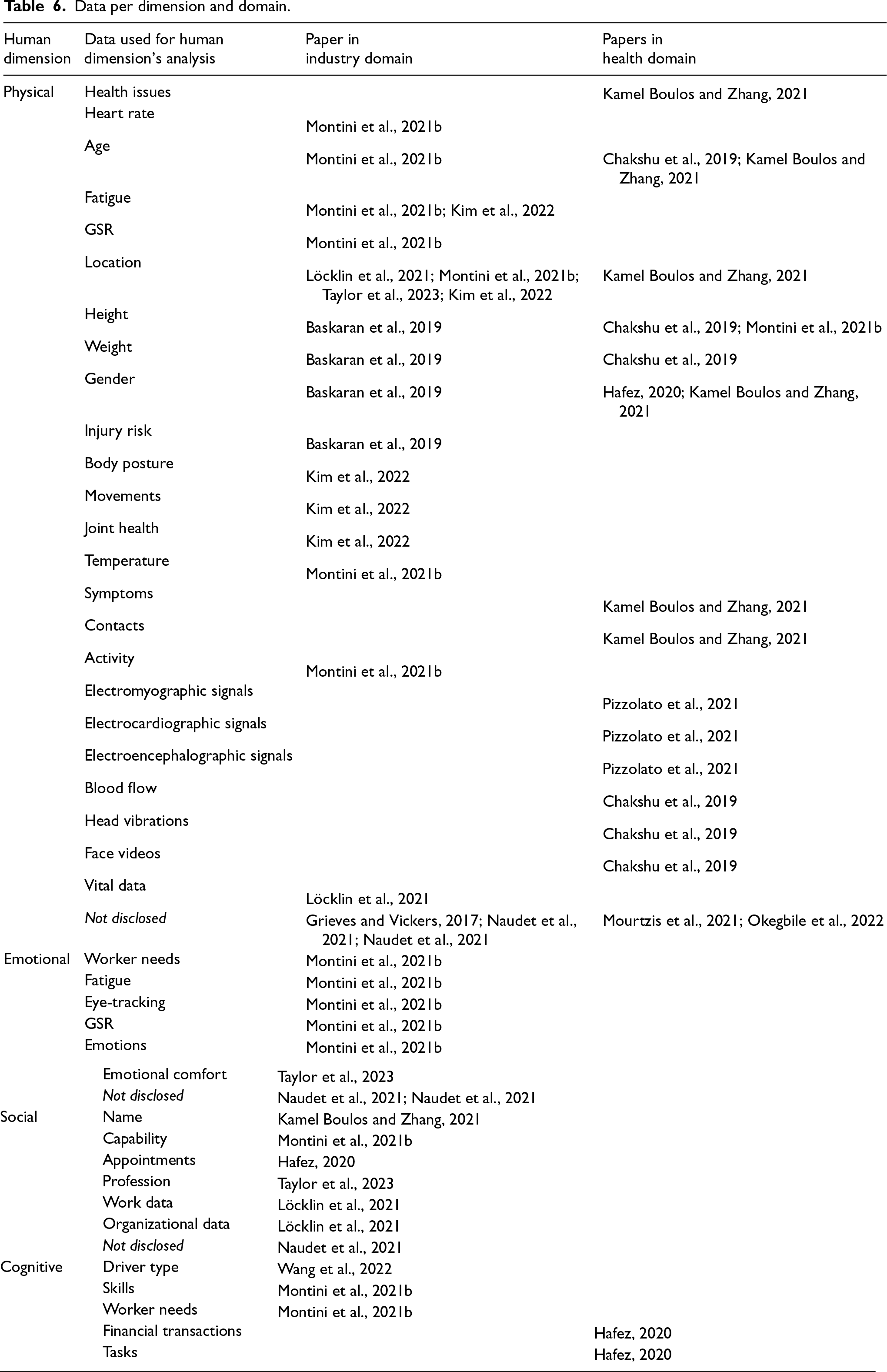
Data per dimension and domain.
Classification of technologies.
Deployment refers to the process of putting a developed application or feature into production to be accessed by end-users. The proper deployment of a system is crucial as otherwise it cannot be properly accessed by the users.
There are many strategies for deploying applications and the correct selection depends on a project's requirements. In the case of HDTs, the most popular approach logically involves choosing the Cloud to host certain computational operations and store HDT data, as mentioned in articles by Wang et al. (2022) and Mourtzis et al. (2021).
It is also advisable to combine this strategy with some Edge computing, performing the less complex computations on the devices that capture the data to avoid overloading the Cloud or adding unnecessary waiting times. This approach was exploited in papers like Okegbile et al. (2022).
RQ7. What are the existing HDT evaluation processes?
Our intention with this Research Question was to identify any papers presenting or using a quality model or tool to assess HDT quality, even though we did not find any relevant proposal addressing this aspect in the reviewed papers.
The limited progress so far made in HDT assessment could be a consequence of the novelty of this approach so that few practitioners have reached advanced software developments, that is, there have not been enough projects in the Validation and Verification stages to determine evaluation processes.
RQ8. What are the legal and ethical considerations regarding HDTs?
Throughout this systematic review, some ethical and legal issues were found in the selected papers. For instance, in the paper by Mourtzis et al. (2021), concerns are raised about the fear of potential replacement of real doctors by HDTs when this technology is sufficiently advanced to independently diagnose patients. Also, as mentioned by Kamel Boulos and Zhang (2021), this could deprive less economically favoured users of access to this potentially expensive technology due to the complex infrastructure required for comprehensive individual monitoring.
The data privacy issue is also important and of significant concern to researchers and society at large. It should be remembered that HDT architectures follow the IoT philosophy and involve a huge amounts of data traffic passing through the network in a matter of seconds. As we have highlighted throughout the present paper, this data contains personal information that in the wrong hands could be used illicitly by unscrupulous individuals. Papers by Baskaran et al. (2019) and Taylor et al. (2023) express this concern, emphasising the need to improve the security of these data to avoid this danger. For example, Baskaran et al. (2019) suggest periodically erasing local memories from all devices with personal data with the sole traceability source of a private server, an approach that would simplify security management.
Other potential measures for addressing this issue include message encryption, as in the paper by Kamel Boulos and Zhang (2021) or adopting a Private Cloud, as suggested in the paper by Wang et al. (2022).
However, these measures may not be universally effective, as mentioned in the paper by Okegbile et al. (2022) and Taylor et al. (2023). The challenge arises from the fact that HDT systems need to be mobile and capable of monitoring individuals wherever they may be.
Findings and research challenges
In this section, we explore the findings of the review, highlight some observations and examine their potential impact on future developments.
Discussion
Regarding RQ1. What is understood as HDT among the researchers? we highlight the existing disparity in the conception of the term Human Digital Twin. Some authors attribute HDT to instances that could be more precisely called Digital Shadows or Digital Model. We found some papers on the HDT concept that did not strictly follow the definition of HDT. In these papers, the feedback returned by the virtual counterpart does not directly reach the physical individual as when the returned information must be reviewed by a third party before reaching the individual involved. As mentioned in Section 4.1, this occurs when a patient is monitored for an illness that requires intense medical attention. The doctor is the one who needs to access this data to draw appropriate conclusions on the treatment. This is why we refer to it as an indirect interaction because even though the feedback from the virtual counterpart does not directly reach the patient, the patient is the final receiver. We therefore propose calling this category an Indirect Human Digital Twin, as a more appropriate name for this type of HDT. Okegbile et al. (2022) presented some HDT use cases for personalised healthcare and introduced the following scenarios: proactive disease diagnosis, personalised treatment, preparatory surgery, vaccine development and personalised preventive healthcare. In all of these, the outcome of the virtual counterpart's processing is first evaluated by a professional before reaching the individual.
With regard to RQ2. How are the different human dimensions addressed when developing an HDT?, we have seen that relatively few dimensions are considered in the proposals found in the selected articles. The physical dimension was found to be predominant, since it is easy to collect these data, thanks to the wide availability of sensors. However, this causes a slight lack of variety when reviewing the literature, showing a need to study other human dimensions. While we included articles on social, cognitive and emotional dimensions in our review, these were in a minority in comparison with the physical dimension and should be further explored to exploit the full potential of HDTs.
Regarding RQ3. What are the main domains for HDTs?, there is an evident duality in the HDT use domains. As we have seen in Section 4.3, we only found cases applied to the fields of health and industry. This is understandable since there is a clear involvement of humans in both domains, because of the need for monitoring and interacting with humans in both domains. This is also explained because of the financial support that both domains get fosters the HDT development.
With respect to RQ4. What kind of information is gathered by HDT?, as can be seen in Table 5, a wide range of personal data is used by the HDTs papers analysed, being the data related to the physical dimension the ones more frequently exploited. Another conclusion that can be drawn is that there are many data that are not continuously monitored in all the dimensions identified, such as age, height, weight, worker needs, profession, driver type, etc. Moreover, the data exploited in the two main application domains identified, namely industry and health, are mostly disjoint. The only common data used are age, weight, height, gender and location, which happen to be widely used demographics data. This difference in the set of data used for both domains is aligned with the DT principle of Representativeness and Contextualization claimed by Minerva et al. (2020), that states that a DT should only use relevant data from its physical counterpart, and since industry and health domains are quite different so should be the data they use.
About RQ5. How is HDTs’ design currently approached?, after analysing the set of selected articles, we found a lack of standardisation or guidelines for HDT design and implementation. The articles that provide a description of the HDT proposed are usually for high-level designs or only provide a vague description. The few studies on this topic show that it is still an open challenge for researchers. This aspect is a clear obstacle to HDT development due to the complexity of dealing with human systems. Also, the potential convergence of HDTs with Metaverse platforms adds another layer of complexity, requiring innovative design frameworks that balance immersion, security and interoperability (Far and Rad, 2022; Ruiu et al., 2024).
Regarding RQ6. What frameworks and technologies are being used in HDT development?, we aimed to analyse several aspects: Frameworks: We did not find any generally accepted framework specified in the analysed proposals. Surprisingly, some open-source proposals, such as Eclipse Ditto (Eclipse Foundation, 2024), or commercial proposals such as Azure Digital Twins (Microsoft, 2024) have not been used for the development of the analysed proposals again showing that HDTs are a green field regarding the development framework used. Technologies: As seen in Section 4.6, many technologies have been used. This shows that there are many options to choose from for HDT development to better adjust the system to our needs. In the context of Metaverse, integrating HDTs with advanced technologies like 6G networks, AI, and blockchain could offer seamless, end-to-end immersive services (Aloqaily et al., 2023; Hamidouche et al., 2024). Deployment: Edge-Cloud strategies predominate. This cloud hosts the lighter and more routine tasks in the data collection device and heavier ones such as data storage and analysis in the cloud.
Then, regarding RQ7. What are the existing HDT evaluation processes?, since no studies have reached these stages of software development, quality evaluation processes were not mentioned in the selected articles.
Finally, regarding RQ8. What are the legal and ethical considerations regarding HDTs?, ethical and legal issues were found in the literature should be included in HDT developments. This indicates that a series of prior considerations should be considered before creating an HDT, due to the large amount of individual personal data involved. This requires in-depth knowledge of the relevant laws of the country involved, a secure messaging system and storing the data in appropriate premises.
Above, we glimpsed certain HDT characteristics that indicate the novelty and complexity of this new technology. Below we sum up the lines of research to be explored in the near future: Considering new ways to exploit HDTs emotional, social and cognitive dimensions. As mentioned before, the physical dimensions predominate in the literature, with few studies on other dimensions, which will require more collaboration between practitioners and researchers in the IT and healthcare sectors. We can highlight the lack of HDT proposals applied, for instance, to mental health problems or assist people with disabilities. Human beings should be considered as complex, that is, more than the merely physical or social dimensions. Expanding HDT application domains. Extending HDT applications to other domains will increase the possibilities for improvement. For instance, HDTs could be used in the entertainment domain, for example, in theme parks to study the customers’ emotional states. Another option would be in the educational domain, by monitoring students to determine their learning progress. HDT, as a novel approach, still has a lot of potential for applications in new domains. HDTs could enable personalized experiences in virtual environments or serve as tools to track and enhance learning outcomes. The integration of HDTs within the Metaverse can enhance inclusivity for individuals with disabilities, creating opportunities for richer engagement in educational environments. Future work should explore these synergies and how HDTs could thrive in entertainment and education within the Metaverse context. Sharing new architecture designs that address novel issues in the sector. As seen in Section 4.5, there are no architectural design patterns or strategies for guiding DT design and development. Every proposal is basically reinventing the wheel. Standards or architectural proposals should be defined that consider all HDT aspects such as privacy, ethics, complexity, etc. Proposing frameworks to streamline HDT development. As with architectural designs, standardised frameworks would help researchers and developers to speed up HDT development with facilities such as automatic code generation. Developing an HDT evaluation process that provides a reliable quality assurance mechanism. An HDT quality evaluation process should be developed to empirically validate their advantages over other alternatives and provide quality assurance mechanisms. Applying quality standards adapted to HDT specifications. Studying how to adapt to the existing ethical and legal regulations when operating HDTs. For example, reaching a consensus on the regulations, including privacy and ethical issues in different countries would advance HDT technology.
This paper presents the results of a systematic literature review on HDT, offering an overview of the concept and addressing key research questions aimed at clarifying some of the current HDT challenges. After analysing 97 papers, and selecting 15 based on inclusion and exclusion criteria, we identified diverse possibilities and technologies for HDT development, as well as the urgent need for standardized frameworks, clear definitions and robust evaluation processes. Addressing these gaps will ensure ethical and impactful applications in domains that enhance well-being and social progress. Integrating IoT and AI technologies is critical for real-time monitoring and the continuous evolution of HDTs, enabling the exploitation of data through advanced AI techniques. We encourage researchers to further explore these issues to maximize HDT's potential benefits for society.
Footnotes
Funding
The authors disclosed receipt of the following financial support for the research, authorship, and/or publication of this article: This paper is part of the Grant PID2019-108915RB-I00 funded by MCIU/AEI/ 10.13039/501100011033 and Grant PID2022-140907OB-I00 funded by MICIU/AEI/10.13039/501100011033 and ERDF, EU. It has also been partially supported by the Junta de Comunidades de Castilla-La Mancha/ERDF (SBPLY/21/180501/000030) and (SBPLY/24/180501/000020) as well as by the University of Castilla-La Mancha (2022-GRIN-34436). Elena Pretel holds a FPU21/02679 Scholarship from Spanish Ministerio de Educación y Formación Profesional.
Declaration of Conflicting Interests
The authors declared no potential conflicts of interest with respect to the research, authorship, and/or publication of this article.
