







Abstract
Plain language summary
Celebrating the legacy of two decades of Parkinson's disease research in South Africa
Parkinson's disease (PD) has been well-studied in Western Countries, but there are far fewer studies in other parts of the world, especially in Africa. This lack of research is partly because there are insufficient neurologists in many African countries, leading to missed or incorrect diagnoses. Stigma around PD and the absence of national disease registries also make research more difficult. To help fill this gap, our team has spent the past 20 years studying PD in South Africa. We have built a collection of almost 2,000 South African participants and report our main findings here. Overall, we found only 20 PD-causing variants in our collection of 689 unrelated PD cases. Interestingly, some of these genetic findings appear to be unique to South Africans, likely due to the unique genetic composition of the country's population. Our functional studies showed how variants in genes, such as PRKN and LRRK2, disrupt the function of mitochondria. Mitochondria are tiny structures in cells that supply the energy required for the cells to function. Cells die when they do not have the necessary energy, potentially explaining why brain cells die in PD. A third part of our research focuses on curcumin, a natural compound found in turmeric known for its antioxidant and anti-inflammatory effects. Using cell models, including cells from individuals with PD, we found that curcumin can protect cells from damage caused by paraquat, a harmful chemical which has been linked to the development of PD. However, this rescue is only seen when curcumin is given before the damage occurs. This suggests that curcumin may help prevent neuronal loss in PD. In summary, our work adds to global knowledge about the genetics, disease processes, and possible treatments for PD. It also shows what a small African laboratory can achieve, despite limited personnel and resources.
Although Parkinson's disease (PD) is the fastest-growing neurological disorder worldwide, it is poorly studied in African populations. 1 To address this disparity, we began recruitment in South Africa in 2001 and established a research group in 2004 to investigate PD locally. The South African population is genetically diverse, comprising multiple ancestral groups, including people of African, European, Asian, and Mixed ancestries. As the only PD research group in the country, we adopted a holistic approach integrating three foci: genetic studies, functional investigations, and therapeutic exploration. Here, we highlight our main findings over the past two decades to promote the inclusion of South African individuals living with PD in genetics research. Information on our group's publications and theses is listed in Supplementary Table S1.
The South African PD study collection currently comprises 1985 individuals, including 689 PD probands, 470 family members, and 826 controls. Individuals were recruited between 2001 and 2022, with inclusion criteria and recruitment details described previously 2 and in Supplementary Methods. Baseline characteristics of the probands (Supplementary Table S2), and family members and controls (Supplementary Table S3) are provided. The probands are predominantly male (58.5%), with a mean age-at-onset (AAO) of 57.3 ± 12.8 years. A high proportion (24.1%) have early-onset PD, likely due to our recruitment bias toward young-onset cases. A breakdown of the self-reported ancestry is presented in Supplementary Table S2. Genotype-derived ancestry analysis indicates that the population is five-way admixed with contributions from European (56%), continental African (18.8%), Nama (an indigenous Khoisan group; 13%), continental South Asian (6.9%), and Malay (5.2%). 3 Known PD genes and other loci, including Parkinsonism genes and mitochondrial DNA (mtDNA), were screened in subsets of participants. Interestingly, known PD pathogenic variants were identified in only twenty probands (2.9%), suggesting a minor cause of PD in this study collection (Figure 1; Supplementary Table S4). Additionally, five probands in multiplex families harbored variants in other loci of interest, including MANF p.A13 V and NRNX2α p.G849D, and a 28-bp deletion in PTRHD1, identified in a family with young-onset Parkinsonism and intellectual disability. 4
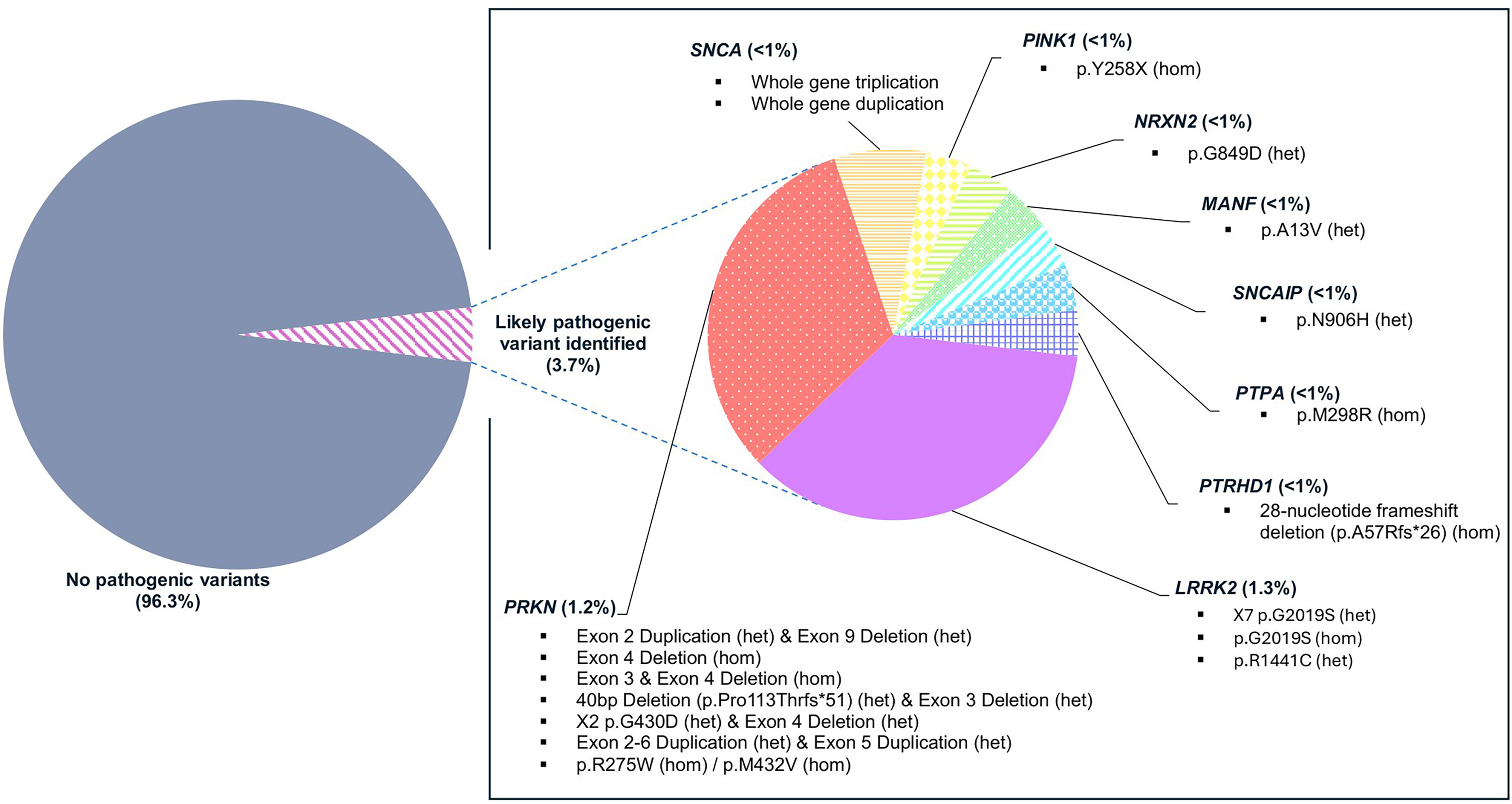
Out of 689 probands, 25 (3.6%) were found to carry a pathogenic or a likely pathogenic variant. The specific variants are provided along with their frequencies across different genes.
Case-control association studies yielded notable findings (Supplementary Table S4). An overarching trend is the genetic heterogeneity of the South African population. For example, one of our studies proposed mtDNA copy number as a minimally invasive biomarker for mitochondrial dysfunction in PD, reporting increased mtDNA copy number in PD cases. 5 However, these results contradicted findings in European and Asian populations. Another example is the LRRK2 p.M1646T variant, which exhibited no statistically significant association in the South African study collection, diverging from findings reported in other populations. 6 Overall, our genetics work emphasizes the importance of including South African individuals in PD research, as findings from other populations may not apply to ours.
Our functional studies investigated the impact of novel and previously described pathogenic variants on PD pathogenesis, with an emphasis on mitochondrial dysfunction. We showed that the NRXN2α p.G849D variant reduced cell viability and mitochondrial membrane potential. 7 Additionally, our studies on dermal fibroblasts revealed that LRRK2 p.G2019S cells displayed increased glycolysis, basal respiration and ATP-linked respiration, whereas LRRK2 p.Q2089R cells exhibited reduced ATP-coupling efficiency, glycolytic reserve and glycolytic capacity. 8 These findings align with the well-established, multidimensional role of the LRRK2 protein in the pathogenesis of PD.
Furthermore, the effect of PRKN variants on mitochondrial function has been studied extensively by our laboratory. Studies on fibroblasts from South African PD cases harboring homozygous PRKN null alleles showed increased mitochondrial reactive oxygen species production, reduced ATP levels, and a more fragmented mitochondrial network. 9 We also found higher maximal respiratory rates and cell growth compared to controls. These findings suggest compensatory mechanisms that preserve mitochondrial function in fibroblasts lacking PRKN.
Among potential PD therapeutic compounds, curcumin stands out as a powerful antioxidant that scavenges free radicals and induces the expression of antioxidant enzymes. 10 It also inhibits α-synuclein aggregation, making it a prime therapeutic candidate for PD. Along with writing several reviews on the role of curcumin as a potential PD therapy, one focus of our curcumin research involves using paraquat in cellular models to induce mitochondrial dysfunction and cell death observed in PD. In PINK1 knockdown SH-SY5Y neuroblastoma cells, we showed that curcumin pre-treatment (curcumin and then paraquat) protected cells from paraquat-induced toxicity. 11 Similarly, using fibroblasts obtained from LRRK2-mutation-positive individuals with PD, we demonstrated improved mitochondrial respiration in cells pre-treated with curcumin. 12 Overall, our results are aligned with other studies confirming that curcumin can protect neurons from apoptosis, reduce cytotoxicity, and restore cell viability. A preliminary clinical study by Donadio and colleagues found that dietary curcumin supplementation in individuals with PD improved motor and non-motor symptoms, with a tendency for reduced misfolded alpha-synuclein deposits in skin nerves. 13 Their findings suggest that curcumin can cross the blood-brain barrier to have these effects.
To address curcumin's poor pharmacokinetic properties, we explored the use of curcumin-loaded nanoparticles (CNP) in cellular models. We showed that CNP pre-treatment had a beneficial effect on toxin-induced mitochondrial dysfunction by lowering residual oxygen consumption levels and improving pyruvate-linked respiration. 14 Other groups’ studies on curcumin also report reduced mitochondrial damage and reduced reactive oxygen species levels. 15 Our findings indicate that curcumin may be most effective before toxin exposure. This has important therapeutic implications, suggesting its use as a dietary supplement early in one's life may prevent or delay the onset of PD. Although these findings show promise, further basic research and clinical trials are needed before advocating for curcumin as a PD therapeutic agent.
Our group's future research directions include using whole-genome sequencing data to generate new knowledge on the genetic etiology underlying PD in South Africa. A key challenge is recruiting individuals of non-European ancestry, largely due to limited access to neurologists, lack of knowledge about PD, and stigma surrounding the disease. Future recruitment efforts will target these populations using research nurses who speak local languages and collaborating with neurologists across the country to identify more non-European individuals with PD. Furthermore, we are studying mitochondrial-targeted nanoparticles in ex vivo models of PD. Our ongoing collaborations with international consortia, such as GP2 (https://gp2.org/) and GeoPD (https://geopd.net/), may facilitate access to disease-specific clinical trials and disease-modifying interventions tailored to South Africans with PD.
In summary, this work highlights our group's contributions over the past two decades. Despite significant challenges, including limited PD awareness and insufficient neurological healthcare resources, we recruited over 1900 study participants, demonstrated that mitochondrial dysfunction plays a key etiological role, and identified curcumin as a promising therapeutic candidate. Furthermore, we demonstrate how smaller laboratories in low-resource settings can make meaningful contributions to PD research.
Supplemental Material
sj-xlsx-1-pkn-10.1177_1877718X261457797 - Supplemental material for Celebrating the legacy of two decades of Parkinson's disease research in South Africa
Supplemental material, sj-xlsx-1-pkn-10.1177_1877718X261457797 for Celebrating the legacy of two decades of Parkinson's disease research in South Africa by Khaleila Flisher, Amy Claire Buck, Jessica Burns, Lusanda Madula, Kathryn Step, Katherine Atkinson, Debbie Acker, Riaan van Coller, Jonathan A Carr and Soraya Bardien in Journal of Parkinson's Disease
Supplemental Material
sj-docx-2-pkn-10.1177_1877718X261457797 - Supplemental material for Celebrating the legacy of two decades of Parkinson's disease research in South Africa
Supplemental material, sj-docx-2-pkn-10.1177_1877718X261457797 for Celebrating the legacy of two decades of Parkinson's disease research in South Africa by Khaleila Flisher, Amy Claire Buck, Jessica Burns, Lusanda Madula, Kathryn Step, Katherine Atkinson, Debbie Acker, Riaan van Coller, Jonathan A Carr and Soraya Bardien in Journal of Parkinson's Disease
Footnotes
Acknowledgements
Firstly, we thank the study participants for their valuable contributions, without whom these studies would not have been possible. We also acknowledge the work of several postdoctoral researchers, postgraduate students, research assistants, medical personnel and our collaborators. Finally, we thank the late Dr Rowena Keyser for her dedication and enthusiasm at the inception of this project.
Ethical considerations
Ethical approval was obtained from the Health Research Ethics Committee at Stellenbosch University (Protocol 2002C/059) with annual renewals. Study procedures were conducted in accordance with the ethical standards of the 1964 Helsinki Declaration and its subsequent amendments.
Consent to participate
Written informed consent was obtained from all the study participants.
Consent for publication
Written consent explicitly stated the publishing of anonymized data.
Author contributions
KF wrote the first draft of the manuscript and created Figure 1. ACB, JB, LM, KS and KA collated the information in  . SB conceptualized the manuscript. DA, AR, RvC and JC were responsible for recruitment and clinical assessment of the study participants. All authors reviewed, edited, and approved the final version of the manuscript.
Funding
The authors disclosed receipt of the following financial support for the research, authorship, and/or publication of this article: This work is based on the research supported by several grants from the National Research Foundation of South Africa (including grant numbers 129429 and CSUR23042095435), several grants from the South African Medical Research Council (Self-Initiated Research Grants), funding from the Faculty of Medicine and Health Sciences at Stellenbosch University and funding from the Centre for Tuberculosis Research (CTR) of the South African Medical Research Council (SAMRC). KS is supported by The Michael J. Fox Foundation and Aligning Sciences Across Parkinson's Disease Global Parkinson Genetic Program. LM is funded by the National Research Foundation (PMDS230614116948) and the Harry Crossley Foundation. ACB is funded by the National Research Foundation (PMDS22070532523). JB is funded by the National Research Foundation (PMDS2205035879).
Declaration of conflicting interests
The authors declared no potential conflicts of interest with respect to the research, authorship, and/or publication of this article.
Data availability
The data supporting the findings of this study are available on request from the corresponding author.
Supplemental material
Supplemental material for this article is available online.
References
Supplementary Material
Please find the following supplemental material available below.
For Open Access articles published under a Creative Commons License, all supplemental material carries the same license as the article it is associated with.
For non-Open Access articles published, all supplemental material carries a non-exclusive license, and permission requests for re-use of supplemental material or any part of supplemental material shall be sent directly to the copyright owner as specified in the copyright notice associated with the article.
