







Abstract
Given the recent water scarcity crisis in Iran and worldwide, the implementation of management practices such as Partial Root-zone Drying (PRD) is essential to optimize water consumption in the agricultural sector. To investigate the effect of PRD on yield, fruit quality, and water use efficiency (WUE), a study was conducted over two consecutive years (2023–2024) on 8-year-old grapevines in a trellis vineyard located in Malayer (Hamedan province, Iran). A randomized complete block design was used with two irrigation regimes (Control; irrigating both sides and PRD; alternately irrigating one side of the vine at each time)×five commercial cultivars (‘Bidaneh Sefid’, ‘Shahani Peykani’, ‘Rasha’, ‘Askari’, and ‘Fakhri’). The results showed that PRD significantly increased leaf abscisic acid concentration (38.1–77.8%) and water use efficiency (40.2–92.1%), and significantly decreased berry length (7.9–12.6%), berry diameter (6.6–11.5%), titratable acidity (6.2–10.4%), berry sugar content (5.6–12%), vegetative growth (11.3–28%), chlorophyll index (6.9–36.9%), leaf relative water content (6.6–8.6%), midday leaf water potential (5.5–6.8%), berry weight (3.8–27%), cluster weight (7.9–21.9%), vine yield (7.3–29.9%) and yield index (3.9–29.8%) compared to the control. PRD irrigation achieved a 50% reduction in water use while the highest yield reduction (in ‘Askari’ cultivar) was 29.9%, demonstrating a substantial water-saving potential with a variable yield cost that was cultivar-specific. Therefore, considering the improvement in WUE (40.2–92.1%), applying deficit irrigation by the PRD method is recommended as a water-saving strategy for vineyards, with cultivar selection being a critical factor for success.
Introduction
In a country such as Iran, which is considered one of the arid and semi-arid regions of the world 1 and faces water scarcity, undoubtedly, reforming consumption patterns and optimizing resource utilization can guarantee the continuity of food production. The average annual rainfall in Iran (around 250 mm) is less than one-third of the global average (860 mm). 2 Approximately 75% of Iran's annual precipitation falls on only 25% of its land area, with the majority of this rainfall occurring outside the agricultural season. 3 Globally, about 66% of the annual precipitation that reaches the land is lost to evapotranspiration, 4 whereas in Iran, this ratio exceeds 70%. 5 The general trend of potential evapotranspiration in Iran has been reported as increasing due to climate change, particularly the rise in temperatures over the past three decades. 6 This increase signifies a higher water requirement for plants and greater pressure on water resources. Furthermore, predictions indicate a significant increase in evaporation (up to 50%) and a much smaller increase in precipitation (up to 16%) in Iran's arid regions in the coming century, which differs from global averages. 7 This imbalance between evaporation and precipitation highlights the growing water stress in the region. Recent high-resolution projections for Iran underscore that this critical hydrological imbalance is set to intensify. While multi-model ensembles indicate a potential increase in average precipitation, this is overwhelmingly offset by a sharp rise in temperature and atmospheric demand, leading to a projected dramatic increase in the severity and frequency of droughts. 8 In such a situation, the use of management methods that can reduce water consumption in the agricultural sector is inevitable. One of the proposed strategies for better irrigation management and improved WUE is the implementation of deficit irrigation (DI) programs, which enable a significant reduction in water consumption with minimal reduction in yield and quality. 9
Deficit irrigation can be implemented in several ways, primarily through three strategies that differ in their timing, severity, and underlying physiological approach. Sustained Deficit Irrigation (SDI) applies a reduced water volume uniformly throughout the season, while Regulated Deficit Irrigation (RDI) withholds water strategically during phenological stages less sensitive to water stress. In contrast, Partial Root-zone Drying (PRD) operates on a distinct spatial and physiological principle: it involves alternately irrigating only one side of the root system while letting the other side dry. This cyclical partial drying is not merely a water-saving tactic but a technique designed to exploit the plant's own signaling pathways to induce a beneficial stress response. The core mechanism of PRD relies on generating non-hydraulic chemical signals, primarily abscisic acid (ABA), in the roots of the drying zone. This ABA is transported via the xylem to the leaves, where it triggers partial stomatal closure as a pre-emptive drought avoidance mechanism, thereby reducing transpirational water loss.10,11 Crucially, because the other half of the root system remains well-watered, it maintains adequate water and nutrient uptake, preventing a severe drop in leaf water potential that would occur under SDI or RDI. This combination of reduced transpiration (via stomatal regulation) and sustained plant water status is the key to PRD's potential to improve water use efficiency (WUE) without imposing severe hydraulic stress. 12 Additionally, the hormonal signals from drying roots can help moderate vegetative growth, which is often desirable in vineyard management for balancing vine vigor with fruit production. 13
The scientific literature on PRD application in viticulture presents a complex and sometimes contradictory picture. This variability can be attributed to interactions between the technique and multiple site- and plant-specific factors, including soil texture (which affects ABA signaling), climatic conditions (especially vapor pressure deficit), grapevine cultivar and rootstock, the timing and severity of the water deficit applied, and the specifics of irrigation management. So far, much research has been conducted on the effect of PRD on grapevines, and conflicting results have been reported. According to some reports, PRD improves vine yield and quality of berries. 14 Some other reports show that PRD does not significantly improve water relations, 15 water use efficiency, 16 yield,17–19 and fruit quality 18 compared to conventional drip irrigation with the same volume of irrigation water. There are also reports indicating a decrease in vine yield due to PRD. 20 These contradictions may be due to differences in the studied cultivars, irrigation volume, and experimental conditions. However, in addition to the impact of PRD on vine yield and WUE, applying this technique can have other beneficial aspects. For example, PRD has been shown to cause deeper water percolation and water extraction from deeper soil layers,14,21 which may be due to the deeper expansion of the vine root system. 22 It has also been reported that reduced canopy density and more exposure of cluster to sunlight due to PRD compared with full irrigation leads to an increase in the concentration of anthocyanins and other phenolic compounds of the berries.23,24
Recent research on grapevine drought tolerance continues to explore diverse strategies, from innovative approaches like alpha-lipoic acid application to reduce oxidative damage 25 and nanoparticle application to enhance physiological resilience26–28 to refining traditional water-saving techniques. Given that more than 70% of the world's extractable water is consumed in agriculture, 29 obviously, if water consumption in the agricultural sector can be saved through scientific management, drought crises can be mitigated and controlled. Partial Root-zone Drying (PRD) is an appropriate and efficient management to improve WUE in vineyards, which can reduce water consumption and maintain fruit quality under water-limited conditions. The purpose of this study was to investigate the effect of PRD on yield, fruit quality, and WUE of five Iranian grape cultivars.
Materials and methods
Plant materials and experimental site
The trial was carried out on 8-year-old vines of five native Iranian grape (Vitis vinifera L.) cultivars including ‘Bidaneh Sefid’, ‘Shahani Peykani’ (‘Khormayi’), ‘Rasha’, ‘Askari’, and ‘Fakhri’ in a commercial vineyard located in Malayer, Hamadan province, Iran (34°6′29′′ N and 48°90′15′′ E, altitude 1900 m above sea level) over two consecutive years, 2023 and 2024. According to 30-year data from the Malayer meteorological station, the average minimum and maximum annual temperatures in the region are 6.3 and 20.7°C, respectively, the average annual rainfall is 332.2 mm, the average relative humidity is 45%, and the annual potential evaporation is 2010 mm.
The vines were own-rooted, planted in north-south-oriented rows, and spaced 2.0 m within rows by 4.0 m between rows. Vines were trained on a two-wire bilateral cordon system and spur pruned to 90–100 buds per vine. The vineyard was drip-irrigated and other operations including fertilization and weed control were carried out according to the custom of the region. Prior to the experiment, samples were taken from the vineyard soil and irrigation water to determine some physical and chemical properties of them in the laboratory (Tables 1 and 2).
Some physicochemical characteristics of vineyard soil samples before the experiment.

Some chemical characteristics of water samples used for vineyard irrigation.

Experimental design and treatments
The experiment was conducted as a factorial experiment including two factors of PRD at two levels (irrigation of both sides of the vine as control, and application of PRD through periodic irrigation of one side of the vine each time) and grapevine cultivars at five levels (‘Bidaneh Sefid’, ‘Shahani Peykani’, ‘Rasha’, ‘Askari’, and ‘Fakhri’) in a randomized complete 3-block design. Each experimental unit consisted of three vines with identical conditions. Irrigation of the vineyard began in late May and continued until early October at 15-day intervals, according to regional custom. To irrigate each vine, two drippers with a flowrate of 20 L h−1 installed at a height of 25 cm above the ground and at a distance of 40 cm from the trunk on both sides of the vine were used. The vineyard custom was to provide 320 L of water for each vine with 8 h of irrigation in each irrigation session. In this experiment, the number of hours of irrigation was changed according to the calculated water requirement for each treatment. The 100% of the estimated water requirement was provided for the control vines at each irrigation. PRD irrigation was applied by alternating the wetted side of the vine with each irrigation event (approximately every 15 days).
The water requirement of vines (ETc) under non-stress conditions was calculated using a class A evaporation pan (Simab Electronics Co., Iran) based on the reference evapotranspiration (ETo) and the crop coefficient (Kc) during the season:
30

Where, Kc is the grapevine crop coefficient, considered 0.85 according to Alizadeh and Kamali.
31
The daily reference evapotranspiration rate (ETo) was estimated using a locally adjusted pan coefficient method:
In this equation, Kp is the pan coefficient (a constant value of 0.66, according to,
31
and Ep represents the daily pan evaporation values. The obtained evapotranspiration (ETc) was adjusted according to the age and shading percentage of vines using the following equation:
Where, Te is the adjusted evapotranspiration and Ps is the percentage of vegetation cover determined by measuring the shading area and planting arrangement (4 × 2 m spacing). The daily ETo values obtained from equation (2) were summed over each 15-day interval to calculate the cumulative water requirement for that period, which then served as the basis for irrigation scheduling. Gross irrigation requirement was calculated by subtracting effective rainfall from the amount of water required by the vine and considering a 90% irrigation efficiency. This value represents the high-end efficiency typical for well-managed drip irrigation systems, as supported by FAO guidelines. 30 The irrigation volume for each 15-day interval was calculated based on the cumulative crop water requirement (ETc) during that period, adjusted for irrigation efficiency. Consequently, the applied water volume varied between irrigation events according to the prevailing evapotranspiration. Overall, the total seasonal water requirement was estimated to be 4.11 and 4.04 m3 per vine for 2023 and 2024, respectively. This full volume was applied to Control vines, while PRD vines received 50% of this amount (i.e., 2.05 and 2.02 m3). A detailed breakdown of the irrigation schedule, volume per event, and total water applied for each treatment and year is provided in Supplementary Table S1.
Evaluation and measurement of traits
In late July, one day before irrigation, the total chlorophyll content (SPAD index) was measured using a portable chlorophyll meter (Model CL-01, Hansatech Ltd, UK) on mature leaves located at nodes 8–10 from the base of the canes. The leaf relative water content (RWC) was determined using the method described by Kirnak et al., 32 and the midday leaf water potential (ΨML) was measured with a pressure chamber apparatus (Zist Ideal Gostar Co., Iran). In late August, the grapes from each treatment were harvested separately, and fruit quality traits were evaluated. Berry length and diameter, and cluster length and width were measured using a digital caliper. Berry shape was calculated as the ratio of berry length to berry diameter. The weight of 20 berries, cluster weight, and vine yield were determined by weighing with a precision balance. Acidity (pH) was measured using a benchtop pH meter (Model 86502, AZ Instrument Corp., Taiwan), titratable acidity (TA) was determined by titration with 0.1 N NaOH using phenolphthalein as indicator, and berry sugar content (°Brix) was measured using a refractometer (Model LH-T80, ATC Co., China). Water use efficiency (WUE) was calculated as kilograms of fresh fruit per cubic meter of water consumed, and yield index (YI) was calculated as kilograms of fruit per square centimeter of trunk cross-sectional area. Vegetative growth (VG) was obtained by weighing the pruned canes of each vine after leaf fall in autumn.
Leaf abscisic acid (ABA) was measured using a Crystal 200 series HPLC system (ATI Unicam, Cambridge, UK) equipped with a UV-Vis detector (SPD Philips, Cambridge, UK) and a Diamonsil-C18 column (5 μm, 250 mm × 4.6 mm; Berkshire, UK) with a mobile phase of 20–75% methanol in 1% acetic acid (v/v) and a flow rate of 1.2 mL min−1. 33
Statistical analysis
The obtained data were statistically analyzed using SPSS software (version 26), and the comparison of treatment mean effects was performed using Duncan's multiple range test at a probability level of 1%. The Shapiro-Wilk test was used to examine the normality assumption of the data. The relationships between variables were evaluated using Pearson's correlation analysis.
Results and discussion
Soil texture and economic implications of PRD
The interaction between soil physical properties and PRD efficacy is a critical factor in determining fruit quality. In this study, the observed reduction in berry sugar content (°Brix) and size—contrary to some previous reports—can be attributed to the sandy loam texture of the experimental site (Table 1). Such light-textured soils possess a limited water-holding capacity, which likely accelerated the depletion of available water in the drying root zone. This rapid depletion, combined with the high evaporative demand of the Malayer region (2010 mm), likely intensified the water stress beyond the threshold required for optimal carbohydrate translocation to the berries.
From an agronomic and economic perspective, although PRD led to a yield decline in certain cultivars, this reduction must be weighed against the 50% reduction in irrigation water. In hyper-arid environments like Iran, where water availability is the primary limiting factor for agricultural expansion, a 40–92% increase in WUE provides a significant strategic advantage. Specifically, for the ‘Rasha’ cultivar, the minimal yield loss (3.7%) is of secondary concern when the primary objective is achieving massive (50%) water savings in such hyper-arid environments. However, for sensitive cultivars like ‘Askari’, a more regulated approach or a milder deficit level might be necessary to balance water conservation with marketability standards.
Berry dimensions, berry shape, and cluster dimensions
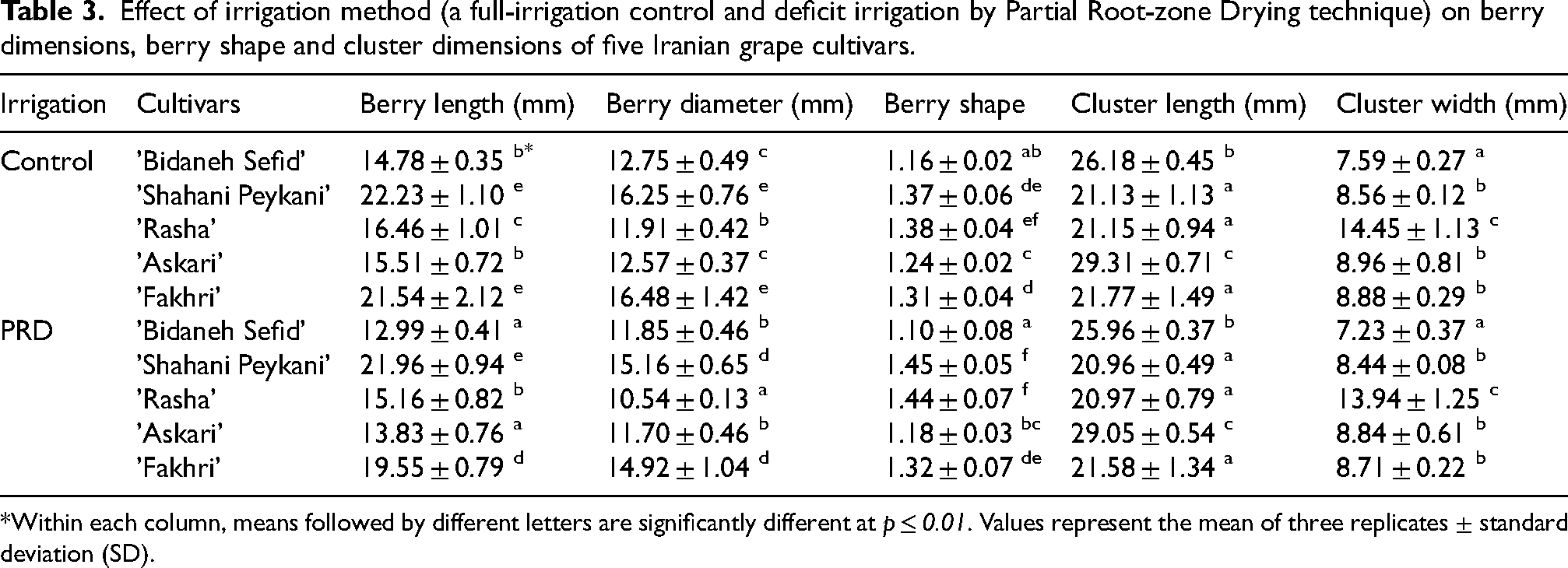
Grapevine cultivars showed significant differences in all three traits of berry length, berry diameter, and berry shape (length-to-diameter ratio). PRD reduced berry length and diameter, but had no significant effect on berry shape, cluster length, and cluster width. Reduced irrigation level did not significantly affect the berry length of ‘Shahani Peykani’ grapes, but decreased that of ‘Rasha’, ‘Fakhri’, ‘Askari’, and ‘Bidaneh Sefid’ cultivars by 7.9%, 9.2%, 10.8%, and 12.6%, respectively, compared to the control (irrigation on both sides of the vine). Berry diameter of ‘Shahani Peykani’, ‘Askari’, ‘Bidaneh Sefid’, ‘Fakhri’, and ‘Rasha’ cultivars was reduced by 6.7%, 6.9%, 7.1%, 9.5%, and 11.5%, respectively, under PRD compared to the control (Table 3). The reduction in berry size may have been a direct result of water stress, as evidenced by significant correlations between berry dimensions and plant water status indicators (leaf RWC and ΨML; Supplementary Table S2). This supports the conclusion that reduced water availability directly limited berry expansion. Previously, a meta-analysis conducted by Miras-Avalos and Intrigliolo 34 also confirmed a positive correlation between berry size and vine water status in red grapes. Consistent with these findings, a reduction in berry length and diameter due to PRD has also been reported in ‘Royal’ table grapes. 35 These findings suggest that decreased water availability to the vine during fruit development led to smaller berries. Ojeda et al., 36 investigating the growth of grape berries under water stress conditions, found that water stress does not affect cell division but only reduces fruit size due to a decrease in cell volume. On the other hand, it has been shown that sufficient water supply through irrigation, by altering the water status and photosynthetic capacity of the vine, may lead to greater sugar accumulation in the berries and an increase in their size. 37
Effect of irrigation method (a full-irrigation control and deficit irrigation by Partial Root-zone Drying technique) on berry dimensions, berry shape and cluster dimensions of five Iranian grape cultivars.
*Within each column, means followed by different letters are significantly different at p ≤ 0.01. Values represent the mean of three replicates ± standard deviation (SD).
Berry quality traits
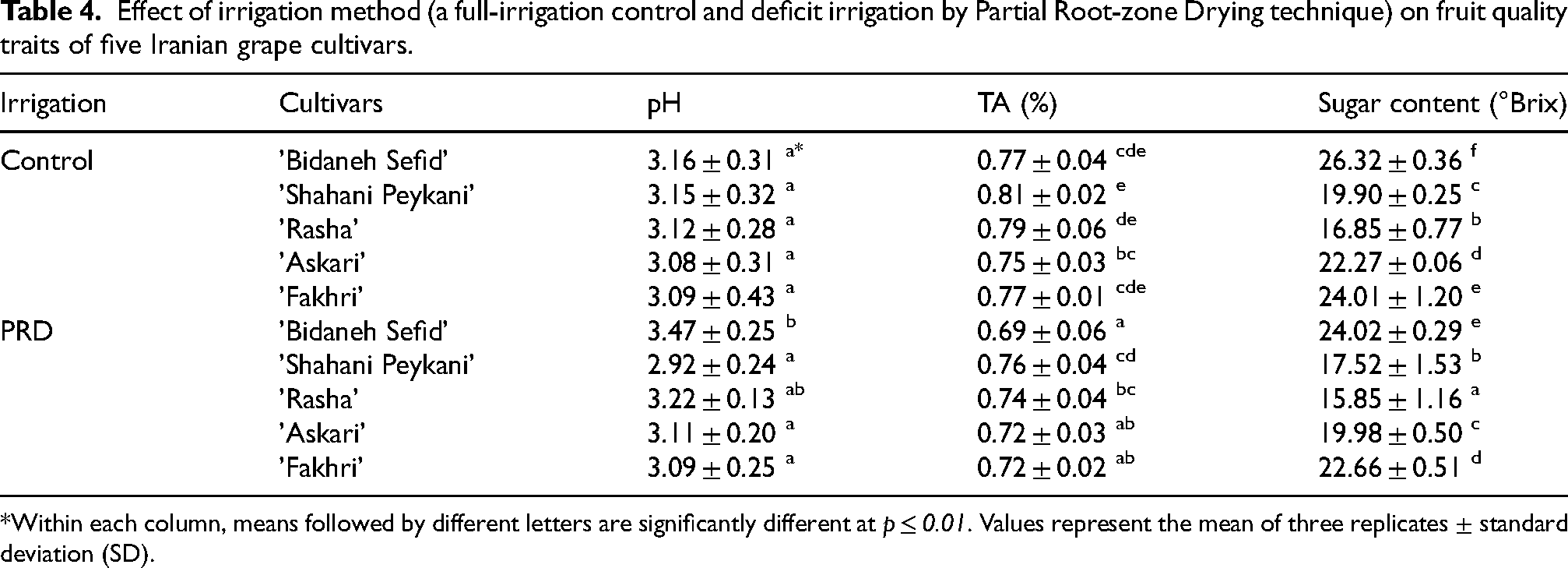
Under full irrigation conditions, no significant difference was observed between grapevine cultivars in terms of berry acidity (pH). On the other hand, while PRD significantly increased (by 9.8%) the berry pH of ‘Bidaneh Sefid’ grapes, it had no significant effect on other cultivars. PRD had no significant effect on the titratable acidity (TA) of ‘Askari’ grape berries, but reduced that of ‘Shahani Peykani’, ‘Rasha’, ‘Fakhri’, and ‘Bidaneh Sefid’ cultivars by 6.2%, 6.3%, 6.5%, and 10.4%, respectively, compared to the control (Table 4).
Effect of irrigation method (a full-irrigation control and deficit irrigation by Partial Root-zone Drying technique) on fruit quality traits of five Iranian grape cultivars.
*Within each column, means followed by different letters are significantly different at p ≤ 0.01. Values represent the mean of three replicates ± standard deviation (SD).
Under full irrigation conditions, grapevine cultivars showed significant differences in berry sugar content (°Brix). Furthermore, PRD led to a significant reduction in the sugar content of all cultivars. The average sugar content of ‘Fakhri’, ‘Rasha’, ‘Bidaneh Sefid’, ‘Askari’, and ‘Shahani Peykani’ cultivars decreased by 5.6%, 5.9%, 8.7%, 10.3%, and 12.0%, respectively, under PRD compared to the control (Table 4), which is likely due to severe water stress that can reduce leaf area and photosynthesis during fruit ripening, 38 thereby decreasing sugar translocation (efflux) from leaves and sugar accumulation in berries. 39 In this experiment, berry sugar content exhibited strong and significant correlations with indicators of vine water status (Supplementary Table S2). A negative correlation between berry soluble solids and vine water status has also been previously reported by Miras-Avalos and Intrigliolo. 34 Consistent with our findings, a reduction in berry sugar content due to PRD has also been reported in ‘Monastrell’ grapes. 40 In contrast to the findings of the present study, in ‘Superior Seedless’ grapes, a 50% reduction in irrigation volume using both PRD and sustained deficit irrigation (SDI) led to a significant increase in berry soluble solids. 41 Similarly, in ‘Royal’ grapes, PRD, SDI, and lack of irrigation all resulted in a significant increase in berry soluble solids compared to full irrigation. 35 Moreover, Gil et al. 42 showed that PRD improves the fruit quality of grapes by increasing the sugar content of the berries. A review of the available scientific literature indicates that the effect of PRD on the qualitative characteristics of grape berries depends on several factors, including cultivar-rootstock interaction, soil properties, environmental conditions during the growing season, cultivation practices, and irrigation management. 24 For example, fine-textured soils promote the transmission of non-hydraulic signals (hormonal signals such as ABA) from the roots to the aerial parts, 43 which likely makes the use of PRD more beneficial for improving berry quality. In other soil types, such as sandy soils where less signal is produced, 43 PRD may not have a significant positive effect on berry quality. 22
Physiological traits
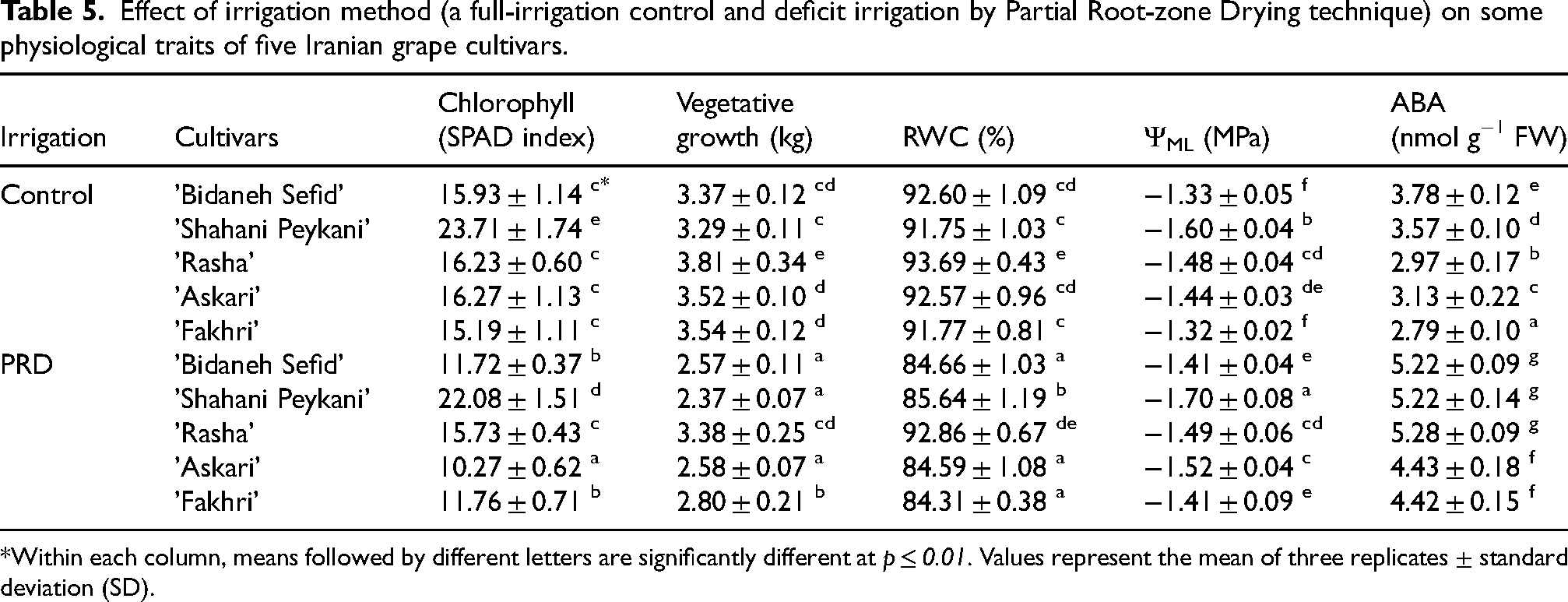
PRD had no significant effect on the leaf chlorophyll content (SPAD index) of the ‘Rasha’ cultivar, but reduced that of ‘Shahani Peykani’, ‘Fakhri’, ‘Bidaneh Sefid’, and ‘Askari’ cultivars by 6.9%, 22.6%, 26.4%, and 36.9%, respectively (Table 5). These observations indicate damage to the plant's photosynthetic apparatus due to reduced water availability, which can negatively affect vine growth and yield. In this experiment, the SPAD index was significantly correlated with multiple fruit quality and water status parameters (Supplementary Table S2), most strongly with berry morphological traits such as length and shape. Consistent with these findings, a reduction in leaf chlorophyll content due to PRD has also been reported in apples. 44 In contrast to these results, in ‘Niagara Rosada’ grapes (a native cultivar of tropical regions), PRD had no effect on SPAD index values. 45
Effect of irrigation method (a full-irrigation control and deficit irrigation by Partial Root-zone Drying technique) on some physiological traits of five Iranian grape cultivars.
*Within each column, means followed by different letters are significantly different at p ≤ 0.01. Values represent the mean of three replicates ± standard deviation (SD).
PRD reduced the vegetative growth of ‘Rasha’, ‘Fakhri’, ‘Bidaneh Sefid’, ‘Askari’, and ‘Shahani Peykani’ cultivars by 11.3%, 20.9%, 23.7%, 26.7%, and 28.0%, respectively, compared to the control (Table 5). Consistent with these findings, previous studies have reported reduced vegetative growth of PRD vines compared to Regulated Deficit Irrigation (RDI) vines with the same amount of water applied under field conditions.35,46,47 It appears that reduced root access to moisture is the cause of decreased vegetative growth in PRD vines, as a decrease in leaf relative water content and midday leaf water potential was observed in response to PRD in the present study (Table 5). In this experiment, vegetative growth displayed a very strong positive correlation with leaf relative water content (RWC) (Supplementary Table S2), underscoring the direct link between water status and biomass production. However, Romero et al. 24 suggest that the reduction in vegetative growth can be better explained by chemical signals rather than hydraulic signals. Some researchers have linked the lower growth of PRD vines to a decrease in cytokinins or an increase in ethylene.48,49 Keller 39 showed that in PRD, reduced cytokinin production in drying roots limits cell division in growing meristems. In an experiment, re-watering the dry side of pots increased the concentrations of the ethylene precursor (ACC) in the xylem and leaves, as well as ethylene production in the leaves of PRD-treated tomato plants. 50 In any case, the important point is that the reduction in vegetative growth of PRD vines can be beneficial in terms of controlling excessive growth and inducing fruit bearing. 19
PRD had no significant effect on the water status of ‘Rasha’ grapes, but it significantly reduced the leaf RWC and ΨML of the other cultivars. The RWC of ‘Shahani Peykani’, ‘Fakhri’, ‘Bidaneh Sefid’, and ‘Askari’ cultivars decreased by 6.7%, 8.1%, 8.6%, and 8.6%, respectively, under PRD compared to the control. Similarly, PRD reduced the ΨML of ‘Askari’, ‘Bidaneh Sefid’, ‘Shahani Peykani’, and ‘Fakhri’ cultivars by 5.6%, 6.0%, 6.3%, and 6.8%, respectively (Table 5). Water potential (ψ) is the suction pressure that a plant needs to absorb water from the soil. When the amount of water available in the soil decreases, the plant's water potential also decreases. Therefore, leaf and stem water potential are reliable indicators of water stress in grapevines. 19 The clear differentiation between ‘Rasha’ and the other cultivars in their RWC and ΨML responses likely reflects fundamental differences in their drought response strategies. The stability of water status in ‘Rasha’ suggests an efficient stomatal regulation and/or osmotic adjustment mechanism, which contributed to its notably lower yield reduction under PRD (3.7%, Table 6). Conversely, the significant decline in these parameters observed in cultivars like ‘Askari’ and ‘Shahani Peykani’ indicates a greater susceptibility to hydraulic disruption, which is consistent with their more substantial yield losses (approximately 30%, Table 6). This direct correlation underscores that the degree of physiological stress imposed by PRD, as captured by RWC and ΨML, is a key determinant of the final yield outcome at the cultivar level. However, scientific literature reports highly variable results regarding the effect of PRD on vine water status, indicating that the adoption of this method for vineyard water management requires further research. For example, applying PRD to potted ‘Superior Seedless’ grapevines significantly reduced leaf water potential compared to the control. 41 Diverres et al., 20 studying the response of ‘Riesling’ grapes to different deficit irrigation techniques over three years, showed that the ΨML of PRD vines was significantly lower than that of the control vines in some years, but there was no difference between irrigation regimes in other years. They reported similar results regarding the effect of PRD on leaf water potential at different phenological stages of the vine (including fruit set to veraison and veraison to harvest). On the other hand, in ‘Niagara Rosada’ grapes, PRD had no effect on leaf water potential. 45 Also, in two separate studies, PRD had no significant effect on the leaf water potential of ‘Syrah’ grapes compared to the control.42,51 These diverse results may be due to differences in the strength of chemical signaling during PRD or factors such as soil type or depth, rainfall patterns, evaporative demand, or the relative volume of irrigation water applied to each root zone.24,52 Additionally, a part of the variability in observations may arise from genetic differences in rooting patterns, abscisic acid (ABA) production or transport by the rootstock, or the response to ABA by the scion.53,54
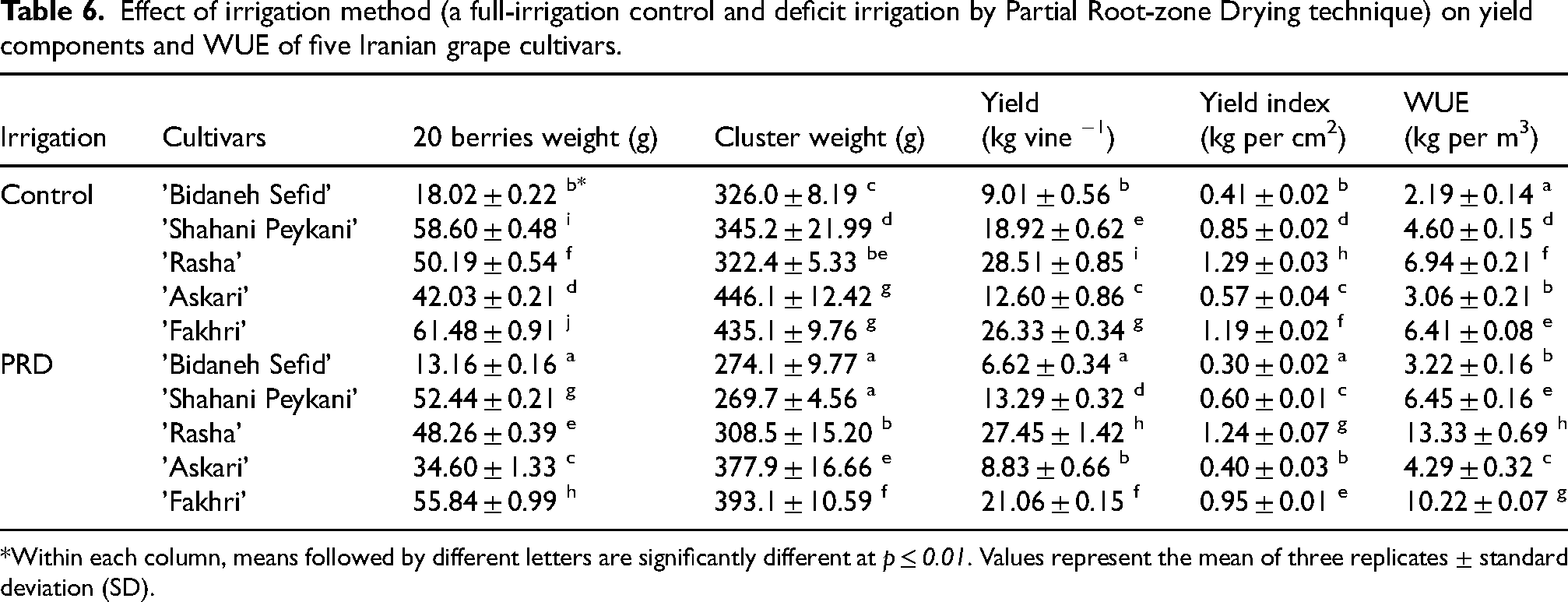
Effect of irrigation method (a full-irrigation control and deficit irrigation by Partial Root-zone Drying technique) on yield components and WUE of five Iranian grape cultivars.
*Within each column, means followed by different letters are significantly different at p ≤ 0.01. Values represent the mean of three replicates ± standard deviation (SD).
PRD led to a significant increase in the concentration of ABA in the leaves of all cultivars (by 38.1%, 41.5%, 46.2%, 58.4%, and 77.8% in ‘Bidaneh Sefid’, ‘Askari’, ‘Shahani Peykani’, ‘Fakhri’, and ‘Rasha’, respectively) (Table 5). In the present study, leaf ABA concentration was strongly and negatively correlated with both vegetative growth and leaf RWC (Supplementary Table S2), supporting its central role as a stress signal regulating growth and water conservation. This provides a direct physiological link: the PRD-induced ABA surge is the likely primary driver behind the observed reductions in vegetative growth and leaf water status. As is well established, ABA is one of the most important hormonal regulators of stomatal conductance, which increases in response to water stress. 55 The partial stomatal closure triggered by this elevated ABA would reduce transpirational water loss, explaining the improved WUE under PRD. However, it would also concurrently limit CO2 uptake for photosynthesis, which can ultimately constrain biomass production and fruit development, thereby contributing to the observed yield reductions in sensitive cultivars. Furthermore, the basis of the PRD technique depends on this molecule, as water-stressed roots produce ABA, and this signal is transported to the leaves via the xylem, where it inhibits stomatal conductance and growth rate. 52 Supporting this hypothesis and consistent with our findings, increased endogenous ABA concentrations have been reported in organs such as drying roots, 48 xylem sap,48,56 leaves,41,48,57 and berries40,41 following exposure of vines to PRD. Conesa et al. 58 found that ABA concentration in the xylem of PRD vines did not change, while their WUE decreased compared to RDI vines, possibly due to the induction of more and denser root production at greater soil depths by PRD and greater water uptake by roots in the wet part of the soil profile. In any case, it seems that ABA is not the only hormone that changes in response to PRD, as increased concentrations of free polyamines in berries 41 and decreased leaf cytokinins in grapes 57 have been reported in response to PRD. It has also been reported that PRD significantly increases the concentration of salicylic acid (SA) and significantly decreases jasmonic acid (JA) in berries. 59
Grapevine cultivars employ diverse physiological strategies to cope with water deficit, ranging from strict stomatal control to maintain hydration to maintaining gas exchange at lower leaf water potentials. 60 In our study, the observed differences in midday leaf water potential (ΨML) response to PRD suggest that such varying strategies may exist among the tested Iranian cultivars. For instance, the minimal change in ΨML for ‘Rasha’ could indicate a more conservative stomatal regulation, whereas the significant reductions observed in ‘Bidaneh Sefid’, ‘Shahani Peykani’, ‘Askari’, and ‘Fakhri’ point to a greater tolerance of lower leaf water potentials. However, definitive classification into specific drought-response phenotypes requires concurrent measurements of stomatal conductance and other physiological parameters under controlled conditions. Therefore, the physiological basis of these cultivar-specific responses remains a key question for future research.
Yield components and water use efficiency
The cultivar-specific physiological responses to water deficit, particularly in terms of water status regulation, had direct consequences on yield components and water use efficiency (WUE). The grapevines studied in this experiment showed significant differences in the average weight of 20 berries. Furthermore, PRD led to a significant reduction in berry weight in all cultivars. The average berry weight of ‘Rasha’, ‘Fakhri’, ‘Shahani Peykani’, ‘Askari’, and ‘Bidaneh Sefid’ cultivars decreased by 3.8%, 9.2%, 10.5%, 17.7%, and 27.0%, respectively, under PRD (Table 6). Berry weight was significantly correlated with most morphological and yield-related parameters (see Supplementary Table S2 for full correlation matrix). Most notably, it showed strong positive correlations with berry dimensions (length, diameter) and vine yield. PRD had no significant effect on the cluster weight of ‘Rasha’ grapes, while reduced that of ‘Fakhri’, ‘Askari’, ‘Bidaneh Sefid’, and ‘Shahani Peykani’ cultivars by 9.7%, 15.3%, 15.9%, and 21.9%, respectively, compared to the control (Table 6). Consistent with these findings, Colak and Yazar 35 reported that PRD led to a significant reduction in berry weight and cluster weight of the ‘Royal’ cultivar compared to full irrigation.
PRD led to a significant reduction in vine yield and yield index of all cultivars. Under PRD, the yield of ‘Rasha’, ‘Fakhri’, ‘Bidaneh Sefid’, ‘Shahani Peykani’, and ‘Askari’ cultivars decreased by 3.7%, 20.0%, 26.5%, 29.8%, and 29.9%, respectively, compared to the control. Similarly, PRD reduced the yield index of ‘Rasha’, ‘Fakhri’, ‘Bidaneh Sefid’, ‘Shahani Peykani’, and ‘Askari’ cultivars by 3.9%, 20.2%, 26.8%, 29.4%, and 29.8%, respectively, compared to the control (Table 6). It appears that the reduction in yield is due to decreased photosynthesis in the vines. Water stress generally reduces the photosynthetic capacity of plants, leading to a decrease in photosynthetic rate and stomatal conductance, and thereby affecting plant biomass production and yield. 61 In fact, the stomata of fully irrigated plants are fully open, and their partial closure can significantly reduce water loss while having a slight effect on photosynthesis. 62 Although PRD has had a positive effect on photosynthesis in plants such as maize 63 and potato, 64 numerous scientific reports indicate a reduction in grapevine photosynthesis due to the application of this technique.38,46,54,65 Consistent with the findings of the present study, a reduction in vine yield with the application of PRD has also been reported by Diverres et al. 20 However, there are also reports of reduced irrigation and improved WUE in PRD-treated vines without a significant reduction in their yield.17,19,53,66 Furthermore, in contrast to our findings, the application of PRD with a low volume of water (85–90 mm annually) significantly increased the yield and quality of ‘Monastrell’ grape berries. 14
PRD led to a significant increase in WUE in all grapevine cultivars. The rate of improvement in WUE of grape cultivars due to PRD was as follows: ‘Rasha’ 92.1%, ‘Fakhri’ 59.4%, ‘Bidaneh Sefid’ 47.0%, ‘Askari’ 40.2%, and ‘Shahani Peykani’ 40.2% (Table 6). In this experiment, vine WUE was strongly positively correlated with yield and its components (berry weight, yield index) (Supplementary Table S2), highlighting that under PRD, higher WUE was often linked to better yield performance within cultivars. In contrast to our findings, PRD had no effect on the WUE of ‘Niagara Rosada’ grapes. 45 It is known that the WUE of each plant is influenced by a complex interaction of environmental factors (such as air temperature and water availability) and physiological factors (including stomatal regulation, photosynthetic capacity, and leaf and plant structure). 67 Previous studies have shown that partial drying of plant roots increases WUE by keeping transpiration control mechanisms active. The part of the root located in dry soil, by reacting to dryness and sending signals to the leaves, affects the degree of stomatal opening, which in turn reduces water loss. ABA produced by the roots in the dry zone is transported to the leaves and causes partial stomatal closure. 41 Other studies have shown that partial root irrigation increases vine WUE by increasing xylem sap concentration and reducing stomatal conductance.18,68 Overall, hydraulic signals, increased ABA, altered levels of other hormones, and changes in xylem sap pH can affect shoot physiology.24,48,69 Some reports indicate that if PRD is applied throughout the growing season (from bud break to harvest), it will have a greater positive effect on vine WUE, 54 suggesting that for intensifying the vine's response, early initiation of PRD is more favorable than late initiation.
Conclusion
This study demonstrates that the application of Partial Root-zone Drying (PRD) is a viable water-management strategy for vineyards in arid and semi-arid regions of Iran, offering a substantial 50% reduction in irrigation water. However, our findings reveal that the effectiveness of this technique is highly cultivar-dependent. While PRD induces physiological stress—evidenced by increased leaf ABA concentrations and reduced vegetative growth—the impact on yield and fruit quality varies significantly across the studied genotypes. From a practical management perspective, the ‘Rasha’ cultivar stands out as the most suitable candidate for PRD implementation, as it exhibited remarkable yield stability under deficit irrigation compared to the other cultivars. In contrast, cultivars like ‘Askari’ and ‘Shahani Peykani’ showed higher sensitivity, with yield reductions approaching 30%, suggesting they require more moderate deficit levels. Furthermore, the observed reduction in berry sugar content under PRD in our sandy loam soils suggests that the intensity of water stress and soil texture must be carefully balanced to avoid compromising fruit quality. Ultimately, for viticulturists in water-scarce environments, PRD is recommended as an effective tool to significantly improve water use efficiency (WUE). Future research should focus on long-term vine longevity under PRD and the economic optimization of the trade-off between water savings and the observed changes in berry size and sugar content.
Supplemental Material
sj-docx-1-ber-10.1177_18785093261432017 - Supplemental material for Responses of five Iranian grapevine cultivars to Partial Root-zone Drying: Implications for water savings and yield
Supplemental material, sj-docx-1-ber-10.1177_18785093261432017 for Responses of five Iranian grapevine cultivars to Partial Root-zone Drying: Implications for water savings and yield by Mohamadreza Zokaee Khosroshahi and Amin Toranjian in Journal of Berry Research
Supplemental Material
sj-docx-2-ber-10.1177_18785093261432017 - Supplemental material for Responses of five Iranian grapevine cultivars to Partial Root-zone Drying: Implications for water savings and yield
Supplemental material, sj-docx-2-ber-10.1177_18785093261432017 for Responses of five Iranian grapevine cultivars to Partial Root-zone Drying: Implications for water savings and yield by Mohamadreza Zokaee Khosroshahi and Amin Toranjian in Journal of Berry Research
Footnotes
Acknowledgments
The authors would like to express their gratitude to Mr Alireza Barati, head of the Malayer Grape Research Station, for his unstinting assistance in carrying out this research.

Ethical considerations
All ethical principles are considered in this research.
Author contributions
Conceptualization; Mohamadreza Zokaee Khosroshahi; methodology: Amin Toranjian; data curation: Mohamadreza Zokaee Khosroshahi; formal analysis: Mohamadreza Zokaee Khosroshahi; Investigation: Mohamadreza Zokaee Khosroshahi; writing original draft: Mohamadreza Zokaee Khosroshahi; writing review and editing: Amin Toranjian. All authors read and approved the final manuscript.
Funding
The authors disclosed receipt of the following financial support for the research, authorship, and/or publication of this article: This work is based upon research funded by Iran National Science Foundation (INSF) under project No.4013196.
Declaration of conflicting interests
The authors declared no potential conflicts of interest with respect to the research, authorship, and/or publication of this article.
Data availability
Data will be made available on request.
Supplemental material
Supplemental material for this article is available online.
References
Supplementary Material
Please find the following supplemental material available below.
For Open Access articles published under a Creative Commons License, all supplemental material carries the same license as the article it is associated with.
For non-Open Access articles published, all supplemental material carries a non-exclusive license, and permission requests for re-use of supplemental material or any part of supplemental material shall be sent directly to the copyright owner as specified in the copyright notice associated with the article.
