






Abstract
Marine Protected Areas (MPAs) as specialized area-based management tools, are widely recognized not only as tools for biodiversity conservation but also as mechanisms for enhancing ecosystem resilience to climate change. However, in Thailand, these legal frameworks do not adequately consider how to integrate climate resilience, despite being recognized as an adaptive tool by international legal instruments. Consequently, to recommend concreting MPA measures, this article explores MPA legal measures and assesses how these measures enhance the resilience of such areas in responding to climate change. This research also examines how international instruments, including UNCLOS, CBD, UNFCCC and the Paris Agreement, require states to implement their obligations to adopt the laws. The study found that Thailand has several legal acts for MPAs that support conservation objectives, but important elements of a “climate-resilient MPA” are still missing. These include clear criteria for levels of protection, the establishment of connected networks, and binding mechanisms for cross-agency coordination. This article argues that legal reform is needed to enhance both consistency and effectiveness. It recommends that agencies such as the Department of Marine and Coastal Resources should take the lead in strengthening the adaptive capacity of Thai MPAs in line with international legal measures on climate change.
Introduction
Climate change is increasingly affecting marine ecosystems in several areas, primarily through rising ocean temperatures, acidification, and a decline in oxygen levels. 1 On the one hand, the marine environment has become a mechanism for climate change adaptation. The ocean absorbs excess carbon dioxide, serving as an essential global sink. Marine Spatial Planning (MSP), Ecosystem-based Management (EBM), and Marine Protected Areas (MPAs) are essential area-based legal tools that could promote climate resilience. 2 Thus, conservation of marine life through MPAs directly supports the health of blue carbon ecosystems, such as seagrass meadows and mangrove forests, ensuring their continued ability to store carbon and adapt to climate change. 3
MPAs have become essential tools in ocean governance, serving both biodiversity conservation and ecosystem-based climate change adaptation and mitigation. This approach safeguards carbon-dense ecosystems, including mangroves, seagrass meadows, and coral reefs, which are critical for carbon sequestration and coastal defense. The achievement of these ecological advantages depends on the legal design and implementation of MPAs frameworks at both international and national levels. International instruments, including the Convention on Biological Diversity (CBD), 4 the United Nations Convention on the Law of the Sea (UNCLOS), 5 the United Nations Framework Convention on Climate Change (UNFCCC), 6 and the Paris Agreement, 7 acknowledge the interrelation of ocean protection and climate stability. 8 UNCLOS and the CBD highlight states’ responsibilities to conserve and protect marine biodiversity, while the UNFCCC and the Paris Agreement focus on ecosystems’ functions as carbon sinks and the necessity for adaptation strategies. These regimes collectively establish a multidimensional framework necessitating that states integrate marine environmental protection with climate resilience goals.
Despite the global recognition of MPAs as an integrated solution, Thai MPA legal measures remains primarily focused on conservation rather than on the explicit integration of climate resilience, including an aquatic species sanctuary under Section 56 of the Royal Ordinance on Fisheries B.E. 2558 (2015) (ROF), 9 a marine national park under Section 6 of the National Parks Act B.E. 2562 (2019) (NPA), 10 a mangrove forest and a coastal and marine protected area under Section 18 and Section 20 of the Marine and Coastal Resources Management Promotion Act B.E. 2558 (2015) (CRMP), 11 the protected forest under the National Reservation Forest Act B.E. 2507 (1964) (NRF) 12 and protected areas under the Enhancement and Conservation of National Environmental Quality Act B.E. 2535 (1992) (NEQA). 13 Each Acts contribute to environmental conservation and resource management within its respective sectoral mission. However, none of them clearly link MPA creation or management to climate change mitigation or adaptation objectives. As a result, Thailand's MPA system is fragmented, with overlapping jurisdictions and no cohesive framework for climate-resilient marine governance.
This institutional fragmentation indicates an extensive normative gap between Thailand's domestic legal frameworks and its international commitments. UNCLOS Article 194(5) and CBD Article 8(a) both require that states should set up in situ conservation measures like MPAs. 14 However, Thai legislation and its implementing rules inadequately address this in the context of climate resilience. In the same way, the UNFCCC and the Paris Agreement recognize marine habitats as natural carbon sinks, but Thai environmental laws do not include these functions in their main provisions or policy goals. Therefore, the climatic advantages derived from MPAs are merely coincidental, not explicitly planned or designed by law or policy. States, including Thailand, face challenges in fulfilling these conflicting international obligations. It also raises the question of whether Thailand can effectively integrate maritime environmental protection measures, particularly the development of MPAs, such that they align with the goal of preserving ecosystem resilience in the face of climate change.
Accordingly, this research aims to examine the perspective of Thai law in establishing MPAs as a legal tool for ecosystem restoration and for enhancing resilience to the impacts of climate change. It evaluates how well Thailand's current MPA laws meet both conservation and climate adaptation goals. It evaluates their conformity with international standards to recommend legal reforms that enhance Thailand's ability for climate-resilient marine governance. The first part of this research article adopts a qualitative research methodology through a comprehensive review of the relevant literature, with the objective of understanding the theoretical foundations and principles of international law on marine environmental protection, as well as the principles relating to climate change mitigation and adaptation. The subsequent part of this research article conducts an in-depth legal analysis of how Thailand's domestic legal framework corresponds with international obligations and identifies specific legal provisions that can support ecosystem-based measures for addressing the impacts of climate change. This article therefore proceeds in two main steps: (1) assessing the extent to which Thailand's MPA measures align with international law in responding to climate change, and (2) analyzing the challenges and opportunities within these measures in order to propose pathways for better integration of conservation objectives with climate resilience.
Marine Protected Areas: Legal Tool for Ecosystem Protection
This section examines the relevant perspectives and obligations under international law concerning the establishment of MPAs, which constitute one of the legal duties for the protection and preservation of the marine environment. It further considers the obligations relating to the mitigation of atmospheric climate change impacts. As these two functions involve distinct legal and policy objectives in the governance of MPAs, the article therefore separates the review into two parts: first, MPAs as a legal and regulatory instrument for the protection of the marine environment; and second, MPAs as a spatial management tool for mitigating the impacts of climate change in the atmosphere. The analysis presented in this section provides the foundation for evaluating the alignment of the Thai legal framework governing MPAs, which will be further discussed in following sections.
The protection of the marine environment under international law constitutes a fundamental obligation of states, requiring them to adopt laws, regulations, or other appropriate measures to give effect to such duty, including through the establishment of MPAs. Based on the definition of MPAs, the International Union for Conservation of Nature (IUCN) has clearly defined the MPA as an area of the sea dedicated to protecting biological diversity and natural resources and to managing them through legal or other effective means. 15 Based on the MPA definition, it is significant that states must utilize legal processes to establish an MPA to ensure environmental protection from exploitation or degradation of national resources. 16 The IUCN also suggested that national measures should have four significant elements: (1) the clearly defined areas, (2) the legally recognized areas, (3) the management plan, and (4) the purpose of nature conservation. 17 Consequently, integrating these elements for establishing MPAs will not only effectively enforce national measures but also fulfill international commitment. In this regard, UNCLOS and the CBD can guide state regulations in this context. This is because both instruments require states to protect the environment and biodiversity, and their obligations can inform the design of MPAs that also contribute to climate change mitigation.
Landscape of Knowledge on MPAs
MPAs: An Instrument to Protect Marine Environment
UNCLOS primarily provides obligations to protect the marine environment, which also indirectly relates to climate change. 18 Climate-related impacts, such as ocean acidification and ocean warming, cause severe harm to marine ecosystems, which is classified as “pollution of the marine environment” under Article 1(1)(4) of UNCLOS. 19 This is because human activities, particularly the greenhouse gas (GHG) emissions into the atmosphere, intensify the ocean's natural role as a sink by driving more carbon dioxide into seawater. 20 UNCLOS may provide a core legal framework for obligating states to address the underlying causes of climate change, including greenhouse gas emissions. 21 In addressing climate effects under UNCLOS, one can interpret the obligation to protect the marine environment, particularly in Part XII, as encompassing the protection of the marine environment from the impacts of climate change. 22 According to the obligations, states should consider the obligations outlined in Articles 192 and 194 by adopting due diligence in their laws and regulations to protect the marine environment from climate change causes. 23 States are obligated to ensure effective measures or progressive contributions to address the impacts on the marine environment. 24 This includes Article 207, Article 211, and Article 212, which require states to adopt laws and regulations for addressing marine pollution, which this study will examine in another section.
On the one hand, the MPA is established for marine conservation that is provided under Article 192 and Article 194(5). The states must consider climate resilience when incorporating it into their MPA planning. For example, the mangroves and seagrass meadows are important environments to mitigate CO2 as a carbon sink. Whether Article 194 (5) UNCLOS indirectly identifies MPAs, it can be read as states’ duty to adopt instruments to conserve marine ecosystems. 25 The CBD, as a contributing convention under Article 237 of UNCLOS, reinforces this approach by requiring states to establish in situ conservation systems and allocate resources for biodiversity protection. 26 MPAs function as spatial management tools under Article 8(a) of the CBD designed to conserve ecosystems and biodiversity under state regulatory measures. 27 UNCLOS and the CBD, collectively, offer a complimentary framework. Article 194(5) of UNCLOS and Article 8(a) of the CBD are in tight alignment with regards to the recognition of MPAs as valid instruments by which states can meet their environmental duties. 28 Although climate change is not explicitly addressed in the CBD, the 11th COP decisions have emphasized the need for states to address its impacts on marine biodiversity within their jurisdictions. 29 Additionally, the 15th COP recognized the Kunming-Montreal Global Biodiversity Framework (GBF) for global ocean governance to the 30 × 30 target, demanding that states utilize climate-resilient MPAs and the other effective area-based conservation measures to safeguard 30 percent of marine ecosystems by 2030. 30 Thus, Article 8(a) can be interpreted as obliging states to establish in situ conservation systems that indirectly support adaptation to and mitigation of climate change impacts by restoring carbon-cycling ecosystems such as mangroves and seagrass meadows. 31 In this context, MPAs are recognized as a practical management tool for conserving marine ecosystems and enhancing their resilience to climate impacts. 32 Accordingly, the CBD provides a strong legal basis for considering MPAs not only as tools for biodiversity conservation but also as mechanisms for mitigation and adaptation.
Hence, according to the study, the obligations under UNCLOS can be divided into two categories. First, obligations to prevent, reduce, and control pollution, which relate to GHG emissions, are under Article 194(2) - (3), Article 207, Article 211, and Article 212. 33 Second, duties to conserve the marine environment, which are especially relevant here, are under Articles 192 and 194 (5) that clearly require states to adopt all necessary measures to protect and preserve the marine environment, including through the establishment of MPAs. 34 This demonstrates that while UNCLOS sets out general obligations for marine environmental protection, its interaction with CBD Article 8(a) provides the legal basis for interpreting MPAs as instruments that can support climate resilience. This synergy between marine conservation and climate adaptation under international law establishes a clear benchmark for evaluating domestic legal implementation.
MPAs: An Area-Based Management Tool for Climate Resilience
In the context of the climate regime, UNFCCC is recognized as the key international convention focusing on the reduction and mitigation of GHGs in the atmosphere. 35 Both UNFCCC and the Paris Agreement impose obligations on parties to reduce and control GHG emissions, and they also require states to preserve marine ecosystems as carbon sinks for climate adaptation. 36 According to Article 2 and Article 3 of UNFCCC, states are encouraged to adopt appropriate measures to minimize GHG emissions and prevent the adverse effects of human interference with the climate system while applying the precautionary principle. 37 These provisions are direct measures to address the cause of climate change and are also related to UNCLOS Articles 207 and 212, which are notable for their unqualified obligation for the capacities of state parties. 38
By taking into account relevant international rules, the UNFCCC and the Paris Agreement obviously align with UNCLOS's objective to protect the marine environment. 39 Reduction of GHGs is under the pollution from land-based sources under provisions of UNCLOS and is the ultimate goal of both the UNFCCC and the Paris Agreement. Thus, states are required to not only control and reduce GHG emissions but also to protect marine ecosystems and address pollution that could undermine these ecosystems’ ecological functions, significantly contributing to the overarching objective of the UNFCCC, which aims to achieve atmospheric stability. 40
These two climate conventions do not directly require states to adopt MPA measures for adapting to the effects of climate change, but both instruments continue a collective approach that recognizes the significance of all ecosystems, including oceans, and supports mitigation and adaptation efforts. Article 4(1)(d) of UNFCCC requires state parties to take into account the promotion of sustainable uses and conservation of marine ecosystems as carbon sinks. 41 In addition, Article 5 of the Paris Agreement reinforces Article 4(1)(d) of the UNFCCC by requiring parties to take action to maintain and enhance carbon sinks, including marine ecosystems. 42 It recognizes that marine ecosystems can serve as a sink to mitigate carbon emissions. 43 Moreover, the COP25 of UNFCCC recognized the need for ocean adaptation for climate resilience. 44
It provided ocean dialogue, which enhanced the knowledge and scientific findings between parties. This contribution encouraged further ocean-based climate action at the national level and under the UNFCCC obligations, especially the Nationally Determined Contributions (NDCs). 45 In 2025, the ocean dialogue, undertaken by the COP30, included ocean-based adaptation to integrate ecosystem-based adaptation and MPAs into NDCs. 46
Thus, these two conventions acknowledge the role of marine ecosystems in minimizing the impacts of climate change. They refer to the objective of preventing anthropogenic GHG emissions by marine ecosystems as sinks of CO2. This opens the possibility of interpreting MPAs as tools for marine adaptation and ecological rehabilitation. 47 Even though the Paris Agreement does not explicitly mention MPAs, such an interpretation aligns with the broader objectives of ecosystem-based adaptation. This means that mangroves, seagrass meadows, and coastal coral reefs can respond to carbon sequestration. 48 Although neither the UNFCCC nor the Paris Agreement explicitly requires the creation of MPAs, both frameworks emphasize the role of ecosystems as carbon sinks. This necessitates a critical integration of both the UNFCCC and the Paris Agreement's obligations into internal law of MPA's designation.
Legal Framework of MPAs in Thailand
At the outset, climate change is recognized in Thailand as a critical issue with significant impacts on ecosystems. The framework of the Strategy for Eco-Friendly Development and Growth under the National Strategy B.E. 2561-2580 (2018–2037) affirms that national development must proceed alongside ecosystem restoration and measures to address climate-related threats. 49 The strategy emphasizes restoring and conserving biodiversity, enhancing the resilience of marine ecosystems to climate change, and fulfilling commitments under the international climate regime to reduce GHG emissions. 50 This plan has been implemented together with National Communications (NCs) and Biennial Update Reports (BURs). 51 Meanwhile, they have been proceeding jointly with the Nationally Determined Contribution (NDC 3.0), which commits to the UNFCCC. 52 Doing so sets Thailand's target reduction of GHG emissions. In addition, Thailand has committed the National Adaptation Plan (NAP). 53 This plan recognized MPAs as an ABMT adaptation for climate resilience in the ocean. It committed that Thailand will conserve the marine environment, especially mangrove forests, as a carbon sink and increase the designation of protected areas. 54 They, however, are indirectly adapted to MPA measures as a consideration of blue carbon sinks under obligation to report to the Paris Agreement. 55
Furthermore, the National Biodiversity Strategy and Action Plan (NBSAP) 2023–2027, aligned with the GBF targets, is set to implement the designation of protected areas of at least 30 percent of the total land and maritime areas of the country by 2030. 56 At the same time, Thailand had decided to join with the High Ambition Coalition (HAC) for Nature and People, which aimed to contribute to GBF targets. 57 In doing so, these contributions directly relate to the National Strategy by adopting explicit measures to reduce threats to biological diversity from climate impacts. Yet, they are primarily a policy framework that sets overall objectives and guidelines for government agencies. Therefore, it is necessary to examine how Thailand's legal framework for establishing MPAs can be integrated with international obligations reviewed in Section 2, thereby positioning MPAs as instruments for climate change mitigation. MPAs are imposed in several Thai Acts, each adopting different terminology depending on the specific objectives of the designated area. This section of the article examines the legal frameworks governing MPAs under the following laws.
Marine and Coastal Resources Management Promotion Act
Firstly, the CRMP is set out for the purpose of protecting and conserving natural marine resources and biological diversity. The CRMP has provided for the establishment of MPA under Section 18 (a mangrove forest) and Section 20 (a coastal and marine protected area). 58 Sections 18 and 20 of the CRMP set different criteria for establishing MPAs, requiring consideration of specific ecosystem features and ensuring those areas have not already been designated under other laws. For example, a seagrass area protected under Section 20 cannot overlap with a national park. 59 Overall, designations under these sections aim to restore ecosystems according to their ecological characteristics.
However, the CRMP primarily serves as legislation aimed at promoting inter-agency integration, since most protected areas are designated and governed under other legal instruments. 60 Accordingly, the Department of Marine and Coastal Resources (DMCR) functions as the body responsible for collecting data and assessing risks, utilizing its authority under the CRMP as a tool to facilitate coordination and integration among relevant agencies. For example, the protection of mangrove forests under the CRMP may integrate with other legal frameworks to enhance management and conservation outcomes. Section 19 of the CRMP authorizes the Director-General of DMCR to manage mangrove forests within reserved or protected areas, aiming to resolve jurisdictional conflicts and enhance inter-agency coordination. 61 This reflects the legislative goal of promoting administrative efficiency and integrated coastal management. 62
National Reserved Forest Act
The NRF aims to protect areas legally defined as forests, which also include coastal zones. 63 In addition, the Royal Forest Department (RFD) has responsibilities to enforce and prevent illegal encroachment or destruction under specific forestry-related statutes, including national reserved forests under the NRF. Furthermore, the RFD also conducts research, strategic planning, and inter-agency coordination to implement reforestation and ecosystem rehabilitation initiatives. In the context of MPAs, the NRF is particularly relevant to the designation of coastal reserved forests, including mangroves. Section 14 of the NRF prohibits the exploitation of natural resources within reserved forests, thereby extending protection to mangrove ecosystems. 64
In most cases, the designation of both a protected area under the NRF and a marine national park under the NPA coincides with areas that can be developed as ecosystems supporting carbon sinks, namely mangrove forests, seagrass meadows, and coral reef areas. In addition, the legal framework prohibits individuals and private entities from undertaking activities that could harm natural resources and restricts access to certain zones. Accordingly, both the RFD and the Department of National Parks, Wildlife, and Plant Conservation (DNP) have the potential to complement and support the coordination with the DMCR, which exercises its functions under the CRMP.
National Parks Act
The NPA is the primary legislation governing the designation of national parks within Thailand's jurisdiction. It serves as the main legal basis for establishing marine national parks, covering both coastal and offshore areas. Under the NPA, protected areas must demonstrate a high level of natural resource richness. 65 The DNP may consider the high ecological value of these areas and the benefits of preserving their integrity, with the aim of designating them as protected habitats for biodiversity conservation and the maintenance of natural ecosystems. 66 The DNP as a responsivity agency may coordinate and contribute with the DMCR to promote MPA for conservation and to adapt MPA for climate resilience.
Royal Ordinance on Fisheries and Wild Animal Conservation and Protection Act
At the same time, the ROF provides protected areas for the conservation of marine living resources’ habitat. 67 Under Section 56 of the ROF, it mandates marine sanctuaries and prohibits human activities that impacts on the marine environment. 68 Although the ROF establishes provisions primarily for the protection of living organisms, the designation of protected areas also reflects a broader objective. These measures not only maintain ecosystems and habitats but also facilitate their effective recovery, thereby enhancing both conservation and ecological resilience. The ROF, administered by the Department of Fisheries (DOF) under the Ministry of Agriculture and Cooperatives, primarily addresses the management of illegal unreported, and unregulated fishing. Consequently, the designation of an aquatic species sanctuary under the ROF does not directly target climate change but rather focuses on sustainable fisheries management. Nevertheless, the ROF contributes to safeguarding marine living resources by prohibiting human activities that may harm critical habitats. This demonstrates their potential to be integrated with the CRMP in a manner similar to the NPA. 69
Enhancement and Conservation of National Environmental Quality Act
The NEQA provides the MPA establishment under Section 43, which considers the harmful impacts from human activities in characteristic areas such as watershed areas and unique natural ecosystems. 70 Additionally, Section 45 imposes that, in emergency, any affected areas from pollution should be immediately established protected areas, and it regulates any measures to resolve those effects. Besides, Section 44 provides that protected areas must be adopted in any measures to conserve environment in protected areas. 71 For example, Section 44 (2) sets out to require the relating authority to report seawater quality. 72 These regulations are the fundamental provisions which control pollution in the environment, such as water and air pollution. 73 The NEQA is the legal framework of protection environment that covers all national jurisdictions. Nonetheless, the NEQA overlaps between its jurisdiction and other acts, which leads to complex implementation between Thai authorities.
Conclusion: Thai MPA Laws
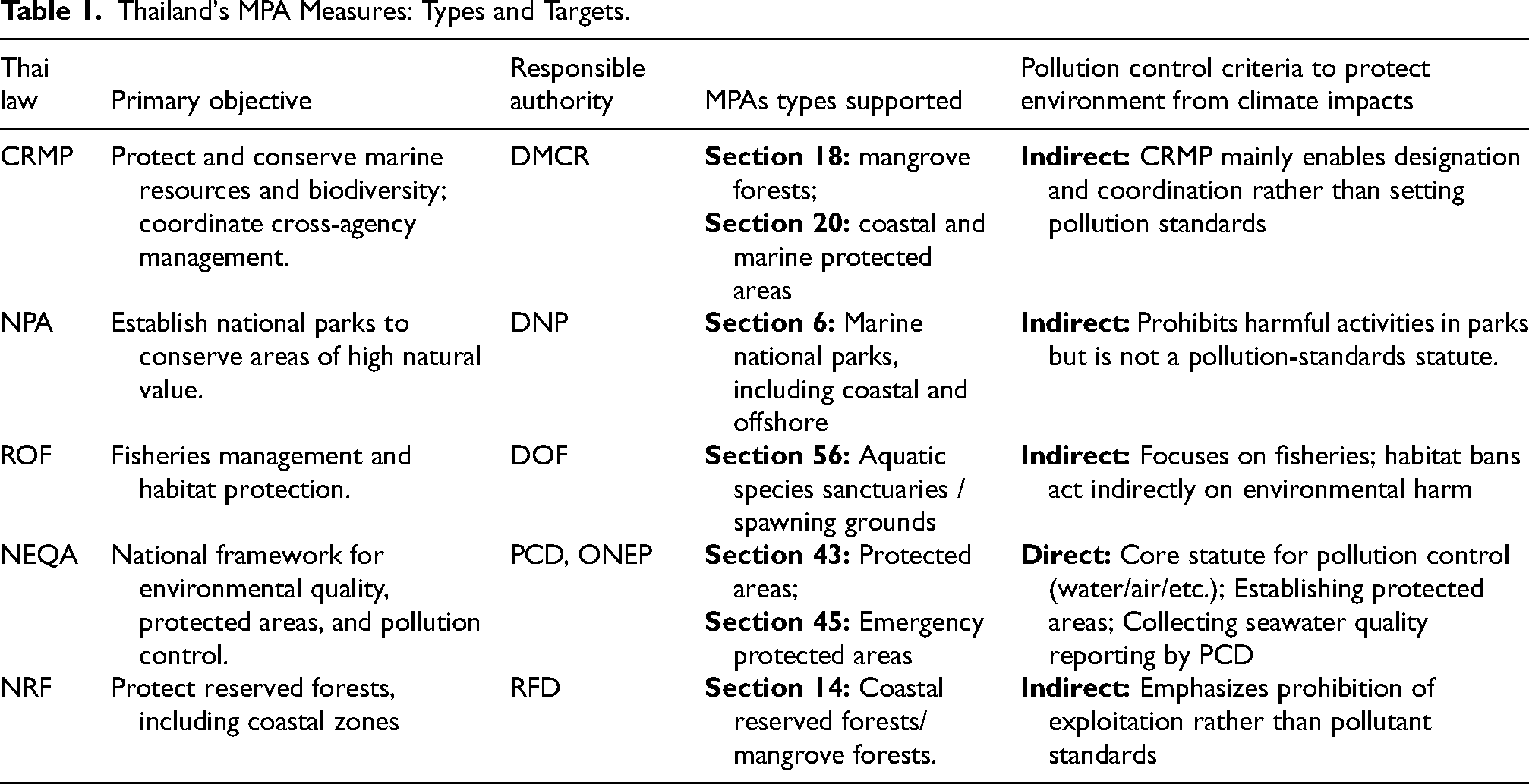
As mentioned earlier, Thailand has developed multiple legal instruments that provide the foundation for MPAs. At the same time, Thai MPA laws have implemented the international obligations, especially UNCLOS and the CBD to protect and preserve the marine environment, such as the CRMP, the NPA, the ROF and the NRF. While there is some regulation, especially the NEQA, support pollution control to protect the marine environment from the negative effects of climate change. In Table 1, Thai MPA laws remain fragmented, with overlapping jurisdictions and differing mandates across agencies. Most laws focus on their original objectives, such as biodiversity protection or fisheries management, rather than directly linking MPAs to climate change mitigation and adaptation. This limits their potential to address climate impacts effectively. Therefore, while Thailand's MPA laws are relatively strong in conservation, further analysis is needed to assess their coherence with international obligations and their capacity to support climate-resilient MPAs. Therefore, it is important to align climate-resilient measures in Thai MPAs with the international obligations mentioned in Section 2. In the next section, this research will employ comparative analysis between international obligations and Thailand's legal measures relating to the establishment of MPAs for discussion and recommendations to improve Thai MPA implementation.
Thailand's MPA Measures: Types and Targets.
Thai MPAs: Compliance With International Obligations
The MPAs are mainly ABMT for the conservation of marine ecosystems, which are marine recovery approaches or areas protected from human activities. 74 The legal integration for climate-resilient MPAs requires both the marine environmental protection approach and climate change regime. UNCLOS links these two categories, necessitating collaboration between its obligations and other international conventions. On the one hand, the CBD points out the conservation and protection provisions of marine ecosystems, which conclude that the states should implement the MPA for in situ conservation. On the other hand, the international instruments that directly address climate change causes are UNFCCC and the Paris Agreement. 75 This study found that the MPAs for climate adaptation require integration between the main components of the direct climate regime and further protection of the marine environment approach. 76 As it was mentioned, COPs of the international agreements such as the CBD and UNFCCC encouraged state parties to adopt MPAs and EBM to integrate with climate-resilient measures. Meanwhile, the marine protection approach under UNCLOS set out the clear recommendation for the states to take all necessary measures to protect the marine environment. The states not only provide adequate internal law enforcement to address the impacts of climate change but also ensure their contribution to mitigating these impacts on the marine ecosystem. Thus, this section will analyze the key obligations under international instruments, including UNCLOS, CBD, UNFCCC, and the Paris Agreement, to compare with Thai MPA laws. This part will study how Thai MPA laws are consistent with the international obligations.
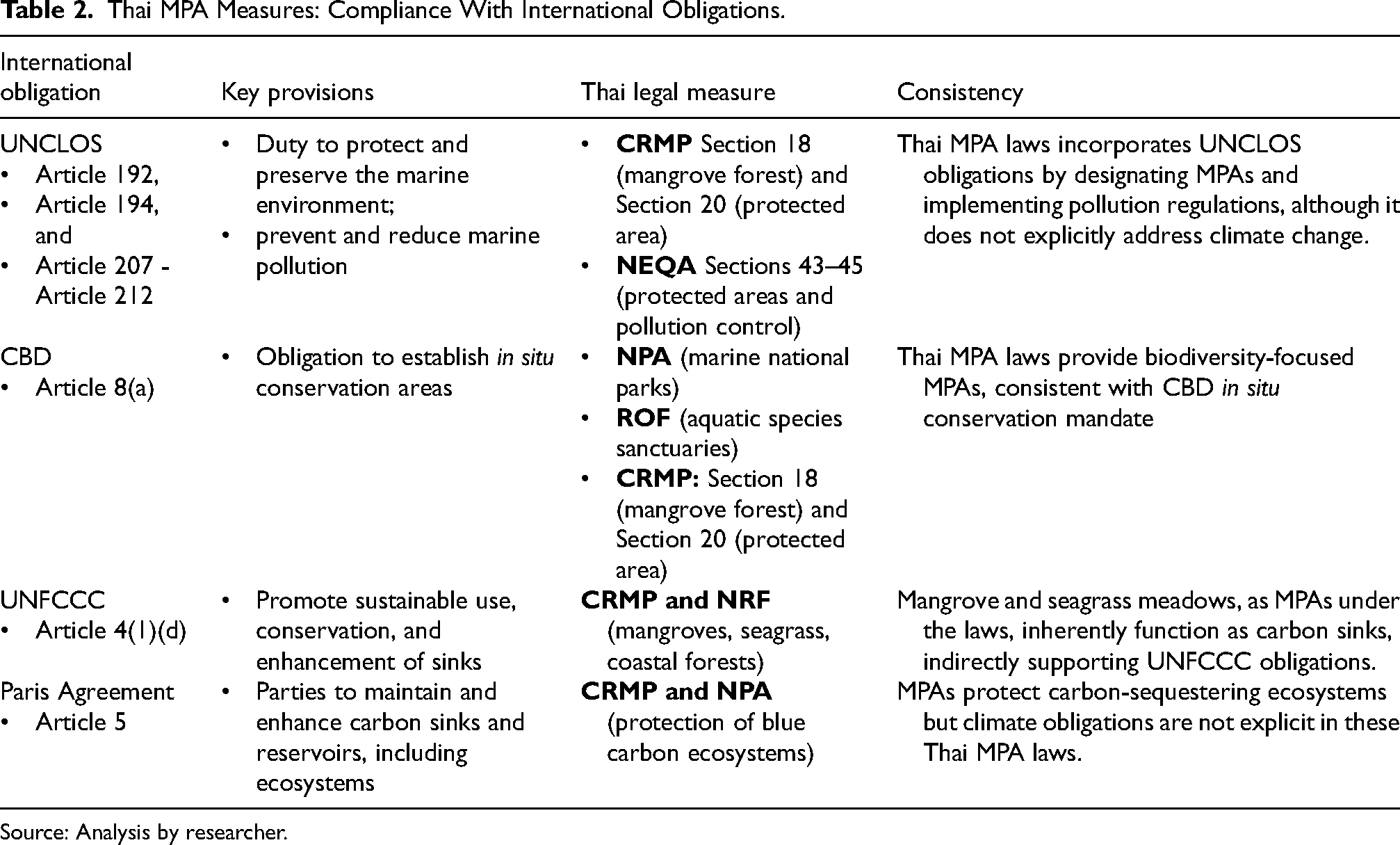
The comparison, in Table 2, demonstrates that Thailand's laws are very comparable to international obligations. The CRMP, NPA, ROF, NRF, and NEQA operate jointly to protect ecosystems, preserve biodiversity, and reduce pollution. This is in accordance with UNCLOS and CBD, which state that countries have to protect the marine environment by establishing in situ conservation mechanisms. The protection of mangroves and seagrass meadows under Thai law additionally assists the UNFCCC and Paris Agreement in achieving their climate goals by preserving natural carbon sinks.
Thai MPA Measures: Compliance With International Obligations.
Source: Analysis by researcher.
However, the alignment is mostly based on Thailand's strategies rather than the laws. Thai MPA laws do not state that adapting to or minimizing climate change is a goal of MPA designations. They stay focused on conservation, but it does not have ways to connect conservation and climate regimes. According to Thailand's national policies, they recognized oceans as a climate-resilient adaptation approach indirectly. They not only adopt climate regimes into the national plans, but they also employ marine conservation and protect biodiversity approaches through the establishment of MPAs. There, nonetheless, is inconsistency between undertaking Thai national policies and enforcement of Thai MPA laws. It is because the lack of clear coordination between Thai agencies makes it less likely that MPAs will be able to work as climate-resilient tools. To make this alignment stronger, Thailand needs to evaluate climate adaptation measures directly in MPA laws and policies. This will ensure that Thailand meets its international conservation obligations and makes global efforts to reduce and adapt to climate change.
Thai MPA Laws: Identified Gaps and Reforms
Gaps in Thai MPA Measures
As demonstrated by the legal mapping in Section 4, Thailand's MPA legal framework varies among several laws, each with an individual objective. While the NEQA emphasizes pollution control, the CRMP directly addresses the preservation and restoration of marine ecosystems. The ROF and NPA, in contrast, place a strong emphasis on conserving particular living resources and protecting biodiversity. The MPAs are mostly focused on conservation and not meant to be the only way to deal with climate change. The first gap is the absence of an overarching objective that explicitly incorporates climate change adaptation into the designation and management goals of marine protected areas, indicating that Thailand's MPA measures remain inconsistent with strategies for adapting to climate change or fail to integrate ecosystem resilience considerations adequately. Therefore, rather than being a legally required goal, climate resilience is viewed as an incidental or optional component.
Furthermore, this gap causes implementation issues to become more severe because of the overlapping mandates of key authorities. MPAs are created and governed by different authorities. For instance, the CRMP may establish MPAs, while the DMCR assumes responsibility for conducting and controlling activities within them. Meanwhile, the DNP is an authority under the NPA, and the DOF is under the ROF. There is inefficient coordination among these different authorities. For example, designating mangrove areas under the CRMP, the NPA, and the NRF may create confusion about the jurisdiction of Thai authorities because it should be carefully considered that establishing MPAs might fall under the authority of a single governmental agency, which could prevent other agencies from participating in their management or exercising regulatory authority in those areas.
Lastly, Thai legislation has not yet incorporated adaptive management strategies that specifically address the effects of climate change. Although integration, caution, and resilience are emphasized in the international frameworks, including UNCLOS, CBD, UNFCCC, and the Paris Agreement, domestic legislation is lagging behind in explicitly incorporating these principles. Therefore, to bridge this gap, the next subsection of this study will propose recommendations to identify existing shortcomings and explore potential legal reforms related to MPAs. The aim is not only to strengthen the conservation of marine ecosystems but also to develop feasible legal mechanisms within the Thai legal system that enable the effective application of MPA measures to enhance the capacity of marine ecosystems to function as climate-resilient systems and carbon sinks.
Filling Gaps and Reforms Needed for Resilient MPA
The identified fragmentation illustrates a fundamental conflict between normative alignment and operational efficacy. Thailand has implemented a strong framework for conservation, but it does not include climate change adaptation and mitigation in its MPA laws, which means there is a major gap in implementing international obligations. UNCLOS and the CBD provide a clear mandate for conservation, while the UNFCCC and the Paris Agreement stress the importance of ecosystems as carbon sinks. Thailand's MPA framework should ideally incorporate these duties, ensuring that the protection of biodiversity and the enhancement of the resilience to climate change are perceived as complementary aspects. 77
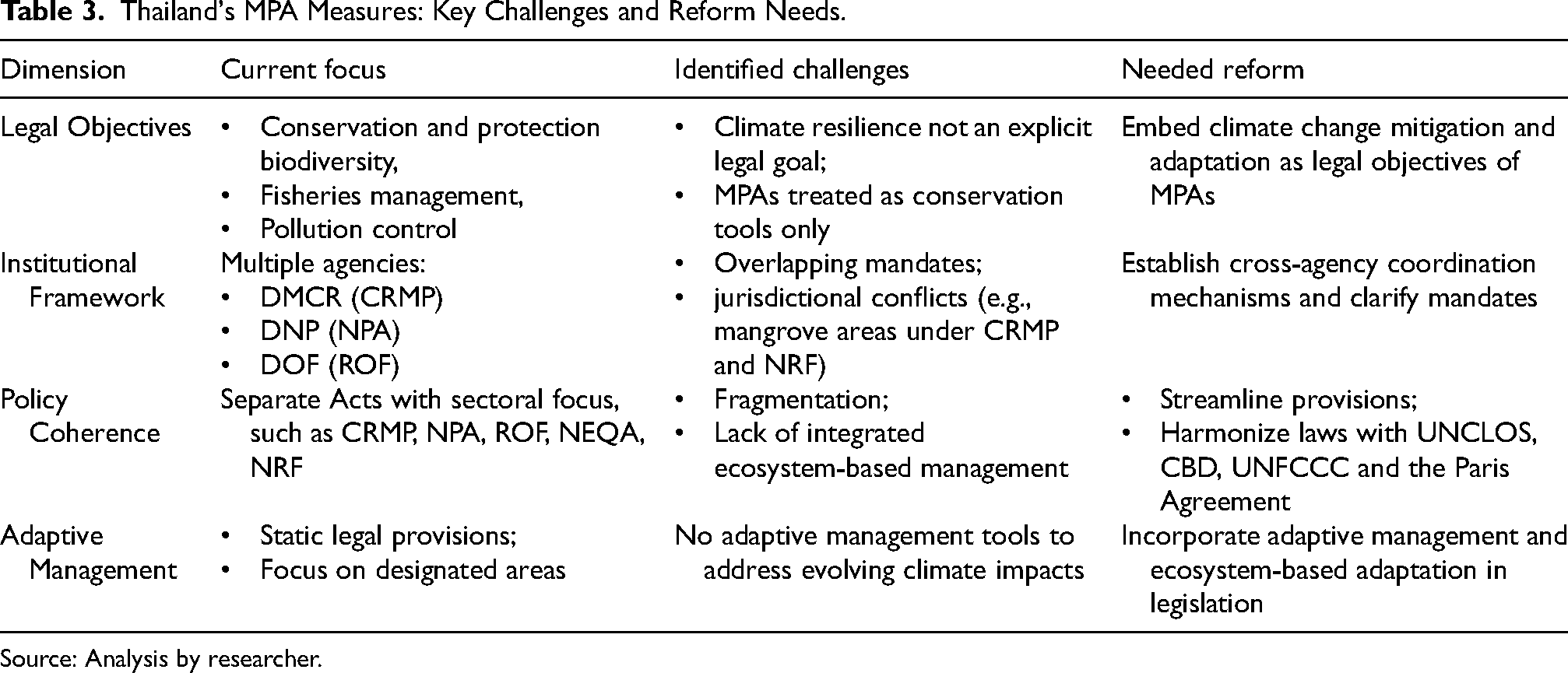
This fragmentation makes MPAs less useful for confronting climate change. Without clear plans for adapting to climate change, Thailand runs the risk of seeing climate benefits as side effects of conservation efforts instead of planned outcomes. To resolve this, Thai law needs to (1) make climate resilience a legal goal of MPAs, (2) set up ways for different agencies to work together to avoid jurisdictional overlap, and (3) use adaptive management tools that follow international rules. 78 In Table 3, this research identifies key challenges and needed reform to analyze legal mechanisms that contribute to setting MPAs in climate-resilient ways.
Thailand's MPA Measures: Key Challenges and Reform Needs.
Source: Analysis by researcher.
Thailand's MPA laws were never designed with climate resilience as a central goal. 79 Instead, the climate mitigation goal is a side effect of conserving marine ecosystems rather than an intentional outcome of the UNFCCC and the Paris Agreement. This situation reflects what the implementation of international laws is a partial compliance with international obligations. Thailand's MPA measures align well with UNCLOS and the CBD, but it falls short when measured against the climate-focused duties of the UNFCCC and the Paris Agreement. Despite Thailand committing to climate change obligations, these national plans, including NDCs, NCs, and NAPs, are still inconsistent with Thai MPA laws. Table 3 highlights four big challenges: unclear legal objectives, fragmented authority, weak policy coherence, and the absence of adaptive management. These issues make MPAs less effective in preparing ecosystems for the real impacts of climate change. Additionally, this table shows needed reforms for Thailand's MPA legal measures. In spite of the legal and policy inconsistency, Thailand may outline measures for managing climate change within the MPA legal framework. As discussed above, this research article provides some examples and points out further detail to Thailand's reform as follows.
To establish a coherent legal pathway, the Thai legal framework should be interpreted through the lens of the climate change regime. The Paris Agreement mandates states to take into account safeguarding marine ecosystems as carbon sinks. At the same time, area-based conservation measures, under the CBD and UNCLOS's provisions, are able to be adopted within climate-resilient MPA measures by considering international approach. As illustrated in Tables 2 and 3, the legal implications of current Thai MPA measures have fixed, static statutory boundaries and impacted dynamic marine ecosystems and climate resilience. 80 Due to the limited enforcement of Thailand's current legal measures, Thai agency, especially the DMCR, should establish climate-resilient MPAs by bridging the current gap between protected area management and concrete climate adaptation. According to the analysis above, Thai MPA measures must be fulfilled and reformed by concrete integration. This research article suggests the possible mechanism for current Thai MPA laws to creating genuinely climate-resilient MPAs.
Establishing a cooperative mechanism between the climate resilience approach and the marine conservation approach can be conducted through the Thai climate policies, especially by implementing carbon credit measures. For instance, there was the Thailand Voluntary Emission Reduction Program (T-VER) conducted by the Thailand Greenhouse Gas Management Organization (Public Organization) (TGO). 81 This measure allows private sectors to voluntarily reduce GHG emissions and convert those reductions into tradable carbon credits to offset their carbon footprint. 82 In this case, MPAs may be established through the planting mangrove project, which the DCRM as a facilitator undertakes in collaboration with the TGO. 83 Mangrove forests will be significantly increased by private sector contributions; however, it indirectly related to establishing MPAs on the authority of jurisprudences. On the one hand, to make inter-agency coordination mechanisms clearer, a clear legal and policy framework needs to be put in place. Doing so would reinforce the CRMP's capacity as a flexible legislative instrument that can integrate and support the objectives of other environmental laws. Furthermore, the challenges of implementing MPA climate resilience would arise from the draft of the Climate Change Act. 84 As mentioned earlier, there are no contributions from climate change law to commit to climate-resilient MPAs. This draft act will promote and cooperate with legal mechanisms.
In addition, the cooperation of relevant authorities, such as the DMCR, the DNP, and the RFD, is essential for the contribution of MPA climate resilience, especially the protection of mangrove forests and seagrass meadows. This necessity arises because MPAs often fall under overlapping legislative frameworks, including the CRMP, the NPA, and the NRF. This study finds that the opportunity to promote the adaptation of MPAs to climate is to adopt the CRMP. In particular, Section 19 of the CRMP functions as a supplementary legal authority empowering the DMCR to oversee activities within mangrove zones while facilitating forest conservation efforts with the DNP and the RFD. However, to make inter-agency coordination mechanisms clearer, especially where different legislative mandates overlap, a clear legal and policy framework needs to be put in place. This research recommends a cooperative committee between environmental agencies and the Department of Climate Change and Environment (DCCE). This committee would reinforce a flexible function that can integrate and support the objectives of climate-resilient MPA measures.
Although there are international obligations to combat climate effects on the marine environment, they still face challenges in implementing national legal mechanisms. According to the analysis above, MPAs demand forward-looking spatial planning that incorporates climate adaptation into management decisions. Authorities responsible for MPA designation should adopt EBM to assist adaptation to deleterious effects of climate change. Hence, integrating adaptive management strategies into MPA governance is still challenging, and the practical application of pertinent international instruments is still limited. As a result, legal and institutional barriers still make it hard for Thai MPAs to be used as tools for climate resilience, even though they could help lessen the effects of climate change.
Conclusion
In conclusion, Thailand faces significant legal challenges to facilitate climate adaptation into Thai MPA measures. This research article demonstrates that Thai MPA laws, such as the CRMP, NPA, ROF, NRF, and NEQA, have established a strong legal foundation for biodiversity conservation. These laws are highly consistent with obligations to protect the marine environment under UNCLOS and obligations to in situ biodiversity protection under the CBD. Furthermore, Thai policy frameworks, including the National Strategy B.E. 2561-2580, the NBSAP 2023-2027, the NDC, and the NAP, actively attempt to commit to the international climate regime.
The significant gapping paradox, however, is situated in the transition from policy to binding legislation. There is a critical lack of concrete provisions defining MPAs’ function in increasing climate resilience within the text of the laws themselves. Consequently, the protection of vital blue carbon ecosystems, such as mangrove forests and seagrass meadows under the CRMP and NRF, is achieved merely as an unplanned side effect of conservation, rather than an explicit, planned legal objective under the UNFCCC and Article 5 of the Paris Agreement. This absence of mandatory legal mechanisms for climate adaptation challenges ecosystem resilience and exacerbates institutional fragmentation among overlapping authorities, including the DMCR, DNP, RFD, and DOF.
To bridge these gaps, Thailand urgently requires comprehensive MPA legal and institutional reforms. First, climate adaptation and mitigation must be embedded as explicit, mandatory objectives within the main provisions of MPA legislation. Second, Thailand must implement adaptive management and the EBM to overcome dynamic climate impacts over static statutory boundaries. Finally, a formalized cross-agency mechanism, such as a cooperative committee linking environmental departments with the DCCE, must be established. This statutory framework should strategically leverage policy incentives, like carbon credit measures through the T-VER program and the upcoming Climate Change Act, to transform Thai MPAs into effective, legally binding tools for systematic and sustainable climate governance.
Footnotes
Acknowledgements
This research article is based on research conducted in the context of the author's research concerning “The Possibility to Addressing the Impact of Climate Change under Context of Marine Protected Area Measures in Thailand”
Ethical Approval
The study was approved the certificate of Exemption by the Ethics Committee in Human Research Walailak University, no. WUEC-24-186-01 on May 14, 2024, for study not involving humans or animals, and the authors declare no conflicts of interest which should be disclosed.
Funding
The author received no financial support for the research, authorship, and/or publication of this article.
Declaration of Conflicting Interests
The author declared no potential conflicts of interest with respect to the research, authorship, and/or publication of this article.
Data Availability Statement
No new data were created or analyzed in this study.
Transparency
The authors affirm that this manuscript presents an honest, accurate, and transparent account of the study. No essential aspects have been omitted, and any deviations from the original study plan have been fully disclosed. Furthermore, the study adhered to all ethical standards throughout the writing process.