







Abstract
Timely and contextually relevant evidence is essential for decision-making in policy domains, especially during crisis or outbreaks like the COVID-19 pandemic. While systematic reviews provide methodological rigor, their cost and duration limit their policy utility. Rapid reviews offer a pragmatic alternative but are typically static and quickly become outdated as new studies, grey literature, and local knowledge emerge, leading to duplication of effort and losing track of policy decisions and use of evidence. This paper presents a pragmatic framework for converting rapid reviews into living evidence synthesis (LES) systems within policy contexts, especially in low- and middle-income countries (LMICs). Drawing on the experience of eBASE Africa, the framework demonstrates how LES functions can be incrementally embedded within conventional rapid-review workflows. It integrates PRISMA-aligned methods with continuous evidence surveillance across academic literature, grey literature, and non-traditional evidence sources such as social media and Indigenous Ways of Knowing, treating these as structured and systematically incorporated evidence streams, supported by responsible use of artificial intelligence and digital tools with human oversight. The framework reconceptualizes rapid reviews as entry points to living evidence systems, offering a scalable pathway to improve efficiency, continuity, and policy relevance, particularly in LMIC settings.
Plain Language Summary
Good decisions in health, education, and other policy areas depend on having the right information at the right time. This became especially clear during the COVID-19 pandemic, when policymakers needed quick answers to urgent questions. Researchers often provide this information through systematic reviews, which carefully collect and analyze existing studies. While these reviews are thorough and reliable, they usually take a long time to complete and can be expensive. This makes them less useful when decisions need to be made quickly. To respond to urgent needs, many organizations use rapid reviews. These are faster versions of systematic reviews that provide timely insights for decision-makers. However, rapid reviews have an important limitation: they are usually done once and then left unchanged. As new studies, reports, and local experiences become available, the findings of these reviews can quickly become outdated. This means that policymakers may rely on information that no longer reflects the latest evidence. It can also lead to duplication of effort, as new reviews are started from scratch instead of building on existing work. This paper explores a practical way to solve this problem by transforming rapid reviews into what are called “living evidence synthesis” systems. A living evidence system is one that is continuously updated as new information becomes available. Instead of treating a review as a one-time product, it becomes an ongoing process that evolves over time. Drawing on the experience of eBASE Africa, this study presents a step-by-step framework for making this transition, particularly in low- and middle-income countries. These settings often face resource constraints, making it even more important to use time and funding efficiently. The framework shows how organizations can gradually build living evidence systems into their existing rapid review processes, rather than starting from scratch. One key feature of this approach is the use of continuous evidence monitoring. This means regularly searching for and incorporating new information from a wide range of sources. In addition to academic research, this includes grey literature such as policy reports, as well as non-traditional sources like social media and Indigenous knowledge. These sources are treated as valuable forms of evidence and are systematically included in the review process. The framework also emphasizes the careful use of digital tools and artificial intelligence to support this work. These tools can help identify new studies, organize information, and reduce the workload for researchers. However, human oversight remains essential to ensure that the information is accurate, relevant, and ethically used. Another important aspect is maintaining transparency and methodological rigor. The approach aligns with established standards such as PRISMA, ensuring that the process remains systematic and credible even as it becomes more flexible and continuous. Overall, this paper argues that rapid reviews should not be seen as final products, but as starting points for ongoing learning. By turning them into living systems, it is possible to keep evidence up to date, reduce duplication, and make better use of available resources. This approach can improve the relevance and usefulness of evidence for policymakers, especially in fast-changing situations and resource-limited settings. Thus, the proposed framework offers a practical and scalable way to ensure that evidence remains current, inclusive, and responsive to real-world needs. It highlights how combining traditional research methods with continuous updating and diverse knowledge sources can lead to better-informed decisions and more effective policies.
Background
Timely and context-relevant evidence is critical for informed decision-making, particularly in fast-moving domains such as healthcare and education (International Commission on the Futures of Education, 2021). Policymakers and practitioners within these fast domains often operate within short decision-making cycles, requiring access to evidence that is both current and actionable (Tricco et al., 2022). Both health and education systems evolve rapidly due to new technologies, changing demographics, school closures, and emerging diseases and outbreaks, leading to urgent and time-sensitive problems that require short decision cycles based on current and adaptable evidence rather than outdated evidence at the point of application (Tricco et al., 2017).
The rise in rapid reviews and need for living evidence became predominant, especially during the COVID-19 era, when evidence was urgently needed to inform responsive decision-making on prevention and treatment. This leads to why approaches like rapid reviews, living evidence, and real-time data analysis are increasingly valued (Elliott et al., 2017; Tricco et al., 2017). The timelines associated with primary research, which often do not align with these needs, can take months or years to generate new evidence, creating a persistent gap between the urgency of policy decisions and the availability of rigorously produced timely evidence.
Though systematic reviews remain the gold standard for evidence synthesis due to their methodological rigour and transparency, they are frequently time-consuming, costly, and technically demanding, limiting their usefulness for timely policy decisions, particularly in LMICs (Garritty et al., 2021). The urgency of this gap was particularly evident during the COVID-19 pandemic (Enria et al., 2021; Tikkinen et al., 2020), where policymakers were required to make high-stakes decisions in real time, often with evolving and incomplete evidence. In response, rapid reviews have emerged as a pragmatic alternative. A rapid review is a form of knowledge synthesis that accelerates the systematic review process by streamlining some methodological steps while maintaining a rigorous and transparent systematic approach (Garritty et al., 2021).
With increasing demand for timely decision-making, living evidence approaches are particularly well-suited to domains with short decision cycles, as they enable continuously updated and actionable evidence for policy and practice (Turner et al., 2023). For example, within the Youth Employment and Evidence Insights Hub funded by the Mastercard Foundation, to answer the question “What types of education, specialization, and sector-specific knowledge and training are successful in preparing young women for dignified and fulfilling work?” We conducted searches on Google, Google Scholar, and social media platforms. These searches revealed several empowerment programs aimed at providing both technical and soft skills to women in Africa.
A social media user was quoted as highlighting that school curricula in most sub-Saharan African countries were designed to “keep Africa on her knees” (African Lives, 2023; CameroonKingdomPromo, 2024). Most of the programs identified focus on empowering youth, rather than young women specifically. They primarily aim to prepare young people for the transition from tertiary education to the workplace (Naval, 2019). These views complemented the findings from peer-reviewed studies whose primary purpose is to provide timely, resource-efficient evidence to support decision-making (Haby et al., 2016).
Rapid reviews have become widely used in LMIC contexts, where institutional, financial, and technical constraints make fully systematic reviews impractical. They provide a feasible way to generate evidence within constrained timelines and limited resources, supporting short-term policy and programmed decisions (Garritty et al., 2021; Haby et al., 2016). However, despite their value, rapid reviews often become obsolete quickly as new studies, program evaluations, and grey literature emerge. This can result in duplicated effort, losing track of policy decisions and use of evidence, impaired cumulative learning, and reduced long-term policy relevance (Grimshaw et al., 2020). These inconsistencies expose a fundamental limitation of static rapid reviews: once completed, they quickly become outdated as new project reports, evaluations, and policy documents emerge.
These limitations have prompted growing calls for more adaptive approaches to evidence synthesis, such as Living Evidence Synthesis (LES), which involves continuous surveillance of new evidence and iterative updating and has emerged as a promising response (ESIC, 2023; Lavis et al., 2024; Welch & Miller, 2025). LES aims to sustain relevance over time and improve efficiency and cost (Elliott et al., 2017). With increasing global recognition, change is needed to make evidence synthesis faster, cheaper, and more useful. Initiatives such as the Evidence Synthesis Infrastructure Collaborative (ESIC) and the SHOW-ME principles call for adaptive, scalable systems that harmonize global efforts, reduce waste, and respond more effectively to decision-makers’ needs (ESIC, 2023; Lavis et al., 2024; Tricco et al., 2018; Welch & Miller, 2025). This emphasizes the importance of adopting rapid methods that support living evidence systems. The need for such approaches is particularly acute in sub-Saharan Africa due to inaccessibility of certain evidence caused by paywalls, reliance on published, or indexed works, and where important local insights may remain embedded in grey literature or traditional knowledge systems. Failure to continuously capture and update this evidence risks excluding findings critical for policy and practice.
Despite this need, most guidance on LES has been developed in healthcare and high-income settings, where stable funding, standardized reporting, trial registries, and editorial infrastructure are more readily available. As a result, there is limited practical guidance on applying LES in LMIC contexts characterized by project-based funding, heterogeneous data sources, and variable institutional capacity (ESIC, 2023; Tricco et al., 2018; Welch & Miller, 2025). Recurrent requests to update reviews on similar topics have therefore resulted in duplicated effort and inefficient use of limited resources. These challenges point to the need for a shift from one-off desk searches toward continuous evidence surveillance, a core principle of LES. These efforts point to the potential of reconceptualizing rapid reviews as foundational components of living evidence systems, yet operational methods for doing so remain underdeveloped.
This paper addresses this gap by presenting a transparent and pragmatic framework for transforming rapid reviews into living evidence. Drawing on our experience at Effective Basic Services (eBASE) Africa and lessons learned from conducting rapid reviews in LMIC contexts, we examine common constraints within rapid-review workflows and outline how LES functions can be embedded into existing processes. This approach aligns with the Campbell Collaboration’s social science evidence synthesis to remit and supports the development of sustainable, context-responsive evidence infrastructure within LMICs.
Conventional Rapid Review Approach
The framework represents a living methodological approach, developed through continuous use, reflection, and refinement, rather than a newly generated theoretical model or a post hoc conceptual commentary. The inclusion of experiential insights is therefore intentional and methodological: these insights document how the methods have been operationalized in practice, why specific adaptations were made, and what methodological challenges and solutions emerged.
Importantly, Indigenous knowledge systems and local sources of evidence are presented as methodological considerations specifically informing evidence identification, interpretation, and contextualization rather than as anecdotal or illustrative elements. Their inclusion reflects an explicit effort to broaden conventional evidence hierarchies in a transparent and systematic manner while maintaining methodological rigor. This section describes the conventional rapid review methodology used at eBASE Africa, which serves as the foundation for the integration of living evidence synthesis functions detailed in section three. Rapid reviews conducted by eBASE Africa typically begin with the development of a protocol outlining objectives, design, methodology, and procedures. However, in social development research globally, academic and business journals indexed in conventional databases capture only a portion of the relevant knowledge.
A substantial body of evidence is produced by governments, NGOs, donors, and local research organizations and disseminated through organizational websites, policy portals, project repositories, and local digital news platforms; yet this evidence is frequently overlooked or excluded from conventional rapid review processes. Following comprehensive searches, identified documents are uploaded to platforms such as EPPI Reviewer for desk-based screening and data extraction. These sources, conceptualized as local evidence, are essential for understanding implementation realities, policy dynamics, and context-specific outcomes, but they are often unstable. Documents are frequently updated, relocated, or removed without version control; meaning evidence identified in one review may soon become inaccessible, weakening institutional memory.
Expanding Sources in LMIC Contexts: Integrating Social Media Evidence
In practice, social media is treated as a legitimate and structured source of evidence, integrated within the evidence identification process where relevant to the research question. When applied, we employ a predefined and documented search strategy, specifying the platforms, keywords, and retrieval dates to ensure transparency. The search process is systematically documented, and screenshots of retrieved posts are saved in a secured saver to preserve the original content in cases where posts are subsequently edited or removed. To improve credibility and reduce the inclusion of misinformation or automated content, social media evidence undergoes additional appraisal procedures. These include assessing account authenticity (e.g., verified or long-standing accounts), evaluating consistency across independent posts or platforms, and triangulating findings with academic literature, grey literature, or other social media posts where possible.
While not all topics require consultation on social media, its inclusion is guided by the need to capture perspectives that may be under-represented in formal academic or policy literature. This is particularly important for amplifying the voices of young people who spend a substantial portion of their time online and may express experiences and viewpoints more openly in digital spaces. By documenting search procedures, preserving source material, and using social media purposively rather than indiscriminately, we aim to balance inclusivity with methodological accountability, transparency, and interpretive caution.
Social media constitutes an increasingly important, though methodologically challenging, source of evidence within rapid reviews, particularly for identifying local evidence and Indigenous Ways of Knowing (IWK), which rarely enter formal documentation. While PRISMA provides structured reporting standards for documenting evidence identification and selection, our approach extends the range of sources reported by systematically incorporating social media platforms such as X, Facebook, TikTok, and YouTube, which also function as spaces for sharing and expressing Indigenous knowledge. These platforms are treated as structured sources of evidence and are systematically searched alongside academic databases and grey literature. Their inclusion is documented and reported in alignment with PRISMA reporting standards, capturing real-time discussions, testimonies, advocacy narratives, and community reflections relevant to inclusion and transitions.
Identification, Screening and Data Management
Identification and Search Strategy
Social media searches follow predefined but flexible protocols that use combinations of keywords, hashtags, organizational accounts, geographic locations, and time filters, which are refined iteratively as themes emerge. YouTube is included to capture oral narratives and storytelling practices aligned with indigenous knowledge transmission, supporting the systematic inclusion of IWK. In addition, eBASE, in collaboration with the Pan-African Collective for Evidence (PACE), operates an online platform mechanism through the Responsive Evidence System for African Policy Needs (REAP), which they developed as a structured demand-and-response system where policymakers articulate context-specific evidence needs and researchers generate rapid evidence products.
Screening and Eligibility
Social media content identified through these searches undergoes structured screening based on predefined relevance and inclusion criteria. The screening process is transparently documented in alignment with PRISMA reporting standards, with adaptations made to accommodate non-traditional evidence types. Eligibility assessments focus on topical relevance, geographic and population alignment, source credibility, and the presence of experiential or implementation-relevant insights. Due to the transient nature of platform content, records are captured and documented at the time of screening to ensure traceability.
Data Extraction and Documentation
In line with requirements for data collection and transparency, relevant social media content is systematically documented, including platform, date accessed, content type, source account, and thematic classification. However, unlike static literature, social media content is subject to deletion, algorithmic displacement, modification, limiting reproducibility, and long-term accessibility.
Use of Artificial Intelligence and Digital Tools
eBASE Africa primarily deploys automation through EPPI Reviewer to accelerate screening, data extraction, and updating while retaining human oversight. Automation is introduced in a stepwise manner to balance efficiency with methodological rigor. During screening, human reviewers first manually screen a subset of records (approximately 10%), and these decisions are used to train a machine-learning classifier within EPPI Reviewer. This proportion is used as a pragmatic starting point for model training and quality control, informed by previous studies demonstrating the use of initial manually screened subsets to support machine learning-assisted screening (Gates et al., 2019; Pham et al., 2021). The trained classifier is then applied to the remaining records to prioritize and classify studies, after which an additional 10% of them are reviewed by human screeners to verify classifier performance.
For data extraction, large language models (LLMs) are employed within the EPPI Reviewer platform using prompts aligned with the predefined coding framework. To support responsible use of AI, a random sample of approximately 10% of LLM-generated extractions is assessed against human judgements. Agreement between AI and human coding is evaluated using a confusion matrix, allowing assessment of classification accuracy and identification of systematic errors. Evidence maps are directly linked to EPPI Reviewer reviews to make it easier to keep them up to date. And refreshed as new studies are identified, providing a visual, “living” representation of the evolving evidence base over time.
Across the workflow, AI is used to support efficiency, while human oversight is maintained at all critical decision points, including model training, validation, and final inclusion decisions. Errors from AI-assisted processes are detected through targeted human review of samples and performance monitoring and corrected through iterative refinement or replacement with human coding where necessary.
Implications for Living Evidence Synthesis
Standard systematic reviews have methodological limitations that make them less suitable in rapidly evolving fields: they capture evidence only up to a fixed search date, meaning conclusions can become outdated quickly as new studies emerge, including those that may change effect estimates, introduce safety concerns, or reverse prior conclusions. Standard reviews are also poorly equipped to manage continuous streams of evidence and lock in eligibility criteria, outcomes, and analytic approaches that may no longer reflect current research priorities or practice. These constraints delay the translation of new evidence into clinical and policy decisions, reducing the credibility and relevance of reviews in high-impact and high-uncertainty areas. LES are specifically designed to overcome these through ongoing surveillance, timely updating, and adaptive synthesis.
LES embeds ongoing surveillance, scheduled updating, and version control into the review process. Within a LES framework, social media evidence is continuously monitored, re-identified, and revalidated, with updates documented through transparent change logs and versioned synthesis outputs. These processes are reported in alignment with PRISMA reporting standards. Standardized capture protocols, metadata tagging, and periodic reassessment enable social media-derived insights to be integrated alongside academic and grey literature in a cumulative and auditable manner.
By documenting social media evidence practices in alignment with PRISMA reporting standards and operationalizing them through LES methodologies, rapid reviews can move beyond ad hoc inclusion toward a systematic, transparent, and continuously updated evidence ecosystem. This approach formalizes the role of social media as a legitimate and methodologically accountable source of evidence, particularly for capturing local, Indigenous, and context-sensitive knowledge that is often underrepresented in traditional evidence hierarchies.
Lessons Learned
AI and LLM Limitations With Data Extraction
LLMs sometimes produce incomplete outputs, particularly when extracting data from grey literature with inconsistent formatting and fragmented text. In cases where specific code sets were not reliably captured by AI, manual coding was used instead.
Platform Instability and API Restrictions in Social Media Evidence Collection
Due to the dynamic nature of social media platforms, some posts identified during searches were later deleted, relocated, or made private. To maintain traceability, screenshot-based preservation protocols were used to document content at the point of retrieval. In addition, API restrictions and pricing changes on platforms such as X limited automated evidence collection, increasing reliance on manual searching and monitoring.
Classifier Development on EPPI Reviewer
Classifier performance in EPPI Reviewer depended heavily on the agreement levels of reviewers used for the initial training set. Lower inter-rater agreement resulted in weaker classifier performance and repeated retraining. This highlighted the importance of using reviewers with high agreement levels during the initial screening phase to improve precision and reduce the need for repeated model adjustment.
Continuous Surveillance and Record Verification
Automated surveillance systems such as Google Scholar alerts and OpenAlex feeds generated high volumes of potentially relevant and duplicate records. This required additional verification and screening to confirm relevance before records re-entered the review workflow.
Methodology
The framework in Figure 1 represents a living methodological approach, developed through continuous use, reflection, and refinement across multiple rapid review projects, rather than a newly generated theoretical model or a post hoc conceptual commentary. The inclusion of experiential insights is therefore intentional and methodological: these insights document how the methods have been operationalized in practice, why specific adaptations were made, and what methodological challenges and solutions emerged. eBASE’s LES Conceptual Framework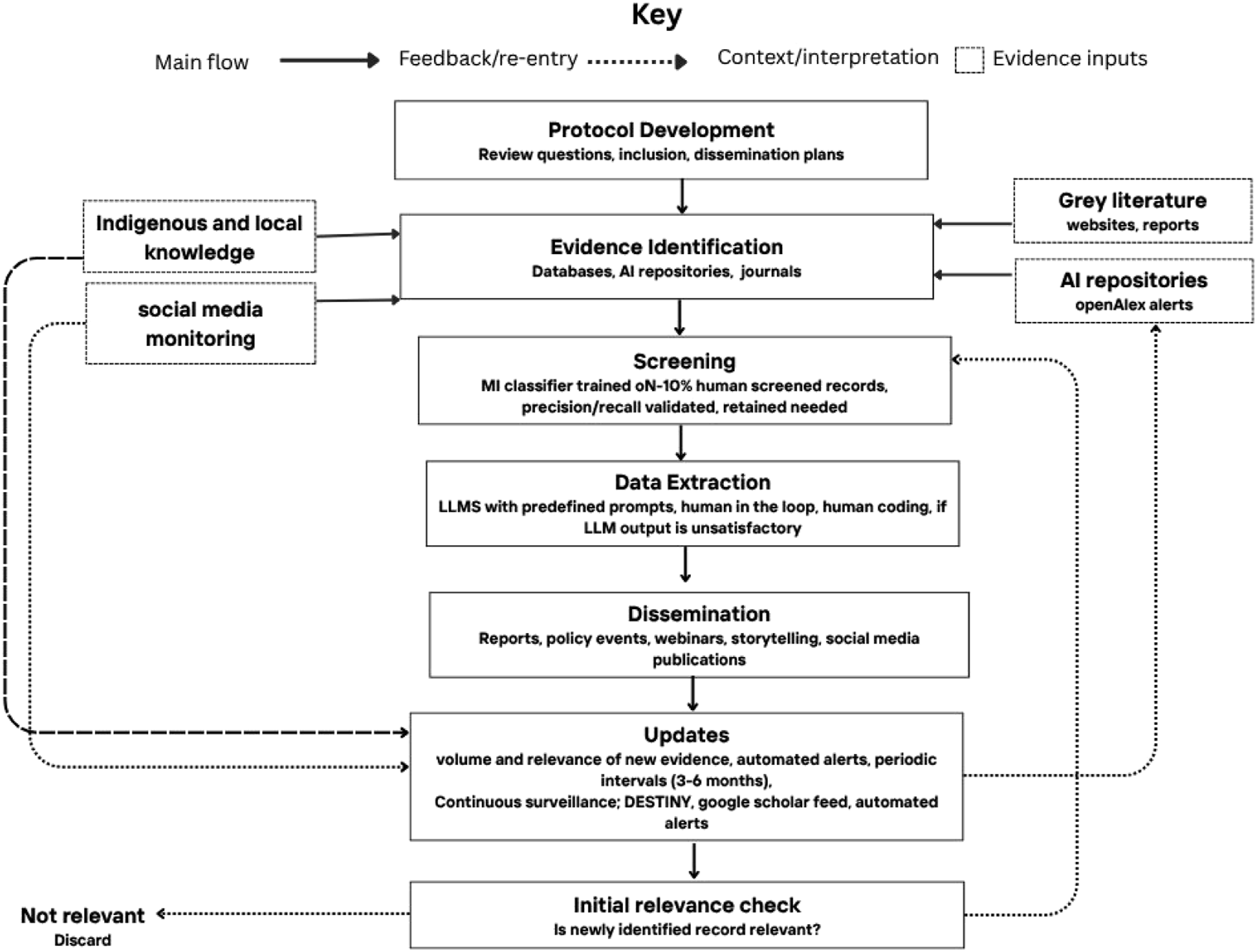
Importantly, Indigenous knowledge systems and local sources of evidence are presented as methodological considerations specifically informing evidence identification, interpretation, and contextualization rather than as anecdotal elements. Their inclusion reflects an explicit effort to broaden conventional evidence hierarchies in a transparent and systematic manner while maintaining methodological rigor. Thus, this approach gives novelty to the framework as it expands beyond the traditional rapid and systematic review framework with the inclusion of artificial intelligence, grey literature, IWK, social media, and local sources of evidence.
Based on eBASE Africa’s experience conducting rapid reviews using conventional systematic review methods alongside AI-supported workflows in EPPI Reviewer and related tools, we propose a conceptual framework for upgrading one-off rapid reviews into living evidence systems for policy. Rather than proposing a new conceptualization of LES, the framework focuses on how it can be pragmatically adapted and operationalized in LMIC contexts through a stepwise approach. The framework combines continuous surveillance with predefined time triggers (e.g., monthly or quarterly searches) through scheduled monitoring intervals, usually determined by the reviewers. For rapid and scoping reviews, evidence is continuously monitored and assessed for relevance during these update cycles. Records identified through automated alerts from Google Scholar or OpenAlex undergo human verification before re-entering the workflow at the screening stage.
As seen in Figure 1, the framework begins with the development and registration of review protocols. Review questions, inclusion criteria, coding frameworks, and dissemination plans are specified at the onset to maximize reusability across update cycles. The protocols priorities standardized search strategies, extraction templates, and clear documentation to support versioned outputs over time.
Evidence identification follows a hybrid model that combines conventional bibliographic database searches with AI-supported repositories and web-based surveillance. In practice, this includes the use of automated alerts (e.g., Google Scholar alerts, OpenAlex feeds) and predefined monitoring intervals to identify newly published or emerging evidence. These systems enable ongoing awareness between scheduled update cycles while reducing the need for repeated full searches. With living repositories such as DESTINY (DESTINY Consortium, 2024) and automated monitoring tools, the framework integrates scientific databases, targeted website scanning, and social media monitoring to maintain situational awareness between scheduled update cycles.
For screening, the framework draws on eBASE’s experience with machine-learning classifiers on EPPI Reviewer. Human reviewers initially screen a subset of citations (approximately 10%) to train the classifier (Gates et al., 2019; Pham et al., 2021). This is used as a pragmatic starting point rather than a fixed statistical threshold. To improve consistency and model performance, this initial screening is conducted by reviewers with a high inter-rater agreement. Model performance is evaluated using standard metrics such as its precision and recall, and an additional sample of records is reviewed by human screeners to validate classifier outputs. Where results are unsatisfactory, the classifier is trained again with additional manually screened records. For data extraction, LLMs are used with predefined prompts aligned to the coding framework.
A human-in-the-loop approach is used during prompt development and evaluation, involving reviewers familiar with local contexts and languages. Prompts are iteratively tested and redefined where outputs are not satisfactory. In cases where LLMs completely fail to capture sufficient information for specific codes, data extraction for those code sets is replaced by human coding. Following analysis, findings are disseminated through multiple channels, including written reports, policy events, storytelling events, webinars, academic publications, and social media engagement. This multi-modal dissemination strategy reflects accumulated experience that evidence uptake in development and policy contexts depends on diverse communication formats rather than static reports alone.
A defining feature of the framework is an explicit feedback loop for continuous updating. New evidence is identified through automated alerts and scheduled surveillance. Potentially relevant records identified through these systems undergo an initial relevance check before re-entering the workflow at the screening stage, reducing the need for repeated full searches while maintaining methodological oversight. Updates are conducted based on predefined criteria, including the volume of new evidence, its relevance to the review question, and its potential to influence conclusions. In addition, periodic updates are carried out at set intervals (e.g., every 3–6 months) based on the reviewers to ensure currency. Each update cycle generates a new version of the synthesis, with changes documented through transparent version control and change logs.
In summary, the proposed framework reimagines rapid reviews as entry points to living evidence platforms. Grounded in practical experience with AI-enabled tools, the framework offers a transferable roadmap for all seeking to transition toward LES.
Discussion
This paper demonstrates how rapid review methodologies, when deliberately redesigned, can function as gateway points to LES rather than remaining one-off, static products. Drawing on eBASE Africa’s applied experience in social policy and LMIC contexts, the methods described illustrate a pragmatic pathway for scaling from rapid reviews to living evidence systems without assuming the availability of fully resourced, high-income-country LES infrastructure.
From Static Searches to Continuous Evidence Surveillance
A central methodological contribution of this work lies in reframing evidence identification from a discrete activity to an ongoing, adaptive process. While this aligns with the principles of LES, which emphasizes continuous updating formal evidence, our approach extends this logic to include dynamic, informal, and often short-lived evidence streams. Conventional rapid reviews rely on time-bound database searches and desk reviews, which are well-suited to stable, clinical questions but less responsive to rapidly evolving social development contexts. By incorporating grey literature, targeted website scanning, and social media monitoring, this approach captures forms of knowledge that are not only continuously emerging but also highly context-dependent and transient. In this sense, continuous surveillance is not simply a mechanism for updating evidence but a means of engaging with fluid, real-time knowledge ecosystems that are typically excluded from formal synthesis.
Social Media as an Entry Point to Living Evidence
The explicit integration of social media into evidence identification represents a further step toward operationalizing LES in social policy contexts. As shown in this study, platforms such as X, Facebook, TikTok, and YouTube already function as informal living evidence streams, particularly for IWK and community-level implementation insights. However, without structured documentation, these insights remain ephemeral and difficult to validate longitudinally.
By situating social media searches within flexible but documented protocols, the method moves beyond ad hoc exploration toward repeatable, update-friendly practices. In practice, this involves defining platform-specific search strategies (e.g., keywords, hashtags, and accounts); documenting retrieval dates, capturing content through screenshots or archived links, and applying structured screening criteria aligned with the review question. These protocols are iteratively refined over the course of the review process by adjusting search terms, hashtags, accounts followed, or inclusion criteria in response to newly identified evidence gaps, recurring topics, or underrepresented perspectives emerging from earlier search rounds. This refinement process does not involve real-time thematic analysis of search outputs, but rather the progressive adaptation of the search strategy to improve the relevance and comprehensiveness of evidence retrieval.
This approach was applied in the Youth Employment and Evidence Insights Hub (Mastercard Foundation), where social media searches were conducted alongside academic and grey literature to capture community perspectives and emerging programmatic insights. These findings complemented peer-reviewed evidence and helped contextualize formal findings within lived experiences.
The Role of AI and Digital Tools in Enabling Scale
A defining addition to conventional rapid review methods in this framework is the deliberate use of AI and digital tools to enable scale without abandoning human judgement. Automation in screening, extraction, and updating implemented through Eppi Reviewer classifiers, large language models, and evidence maps reduce the time and resource burden that typically constrains LES adoption in LMIC organizations. AI is an important part of the process, but it is not a replacement or substitute for methodological oversight.
Expanding Dissemination as a Living Process
Another key contribution of the proposed method is the reconceptualization of dissemination as an interconnected, iterative system rather than a terminal output stage. Instead of treating reports as final products, the framework emphasizes multiple linked dissemination channels, including dashboards, repositories, webinars, policy dialogues, academic publications, and social media engagement. Within this system, storytelling is reframed not as a one-off dissemination activity but as a process of living narratives, where accounts of evidence are continuously updated, enriched, and recontextualized as new information emerges. These interconnected channels function both as knowledge translation pathways and as feedback loops that allow community-generated insights, including Indigenous Ways of Knowing (IWK), to re-enter and refine the evidence base over time.
Implications for Rapid Reviews and Living Evidence Synthesis
The methods presented in this paper collectively demonstrate how to design rapid reviews intentionally to evolve into living evidence systems based on the experience of conducting these reviews at eBASE Africa. The integration of AI-supported workflows, continuous surveillance time triggers, diversified evidence sources, and iterative dissemination mechanisms transforms rapid reviews from static snapshots into adaptive evidence platforms.
IWK Data Sovereignty
In living evidence approaches, where data and knowledge are continuously updated to inform real-time decision-making, integrating Indigenous Ways of Knowing (IWK) requires strong attention to Indigenous data sovereignty. Data sovereignty ensures that digitization and ongoing updates do not transfer ownership but instead uphold Indigenous authority over knowledge across its entire lifecycle. Within living evidence systems, such an approach requires adaptive and continuous governance mechanisms that enable communities to retain control over how their knowledge is incorporated, interpreted, and revised over time. Although social media content is publicly available, this will not assume unrestricted consent for its use. Where possible, account owners will be contacted via private messaging to request permission to use their posts and analyze their opinion, perspective, and knowledge. Where consent cannot be obtained, data will either be excluded or fully anonymized.
All extracted information will be paraphrased rather than quoted directly, and any potentially identifying details including usernames, handles, or contextual identifiers will be removed to ensure complete anonymity. This will be done to minimize the risk of traceability while still allowing thematic analysis of publicly expressed views.
Drawing on the works of Bagele Chilisa and African evaluation principles, Indigenous knowledge should not be treated as data to be collected and stored; rather, it is inherently relational, belonging to the community and maintained under its stewardship (Chilisa, 2020, 2024; Chilisa et al., 2025).
This means communities must determine what knowledge can be shared, how it is used, and who can access it. Grounded in African philosophical traditions such as Ubuntu, knowledge is understood as collective, relational, and embedded in social and cultural contexts rather than as an individual commodity. Consequently, protecting data sovereignty is not only a technical or legal requirement but also an ethical imperative tied to identity, culture, and self-determination. Mechanisms such as Indigenous-led governance structures and free, prior, and informed consent (FPIC) are essential to ensure accountability and respect. In addition, dynamic consent models are critical in living evidence systems, allowing communities to modify permissions or withdraw knowledge as contexts evolve. By embedding these safeguards, living evidence platforms function as ethical infrastructures that uphold Indigenous governance, positioning digital repositories as sites of stewardship rather than ownership.
Conclusion
In conclusion, this study shows that upgrading rapid reviews into living evidence systems does not require abandoning established synthesis methods. Instead, it requires the strategic addition of continuous surveillance, AI-enabled tools, diversified dissemination pathways, and explicit feedback loops. By integrating rapid review rigor with living evidence principles, the proposed method offers a scalable, context-sensitive approach to keeping evidence current, relevant, cost-effective, and genuinely living.
Footnotes
Acknowledgement
The authors acknowledge the Joanna Briggs Institute (JBI) and the Cochrane Methods Group for their standard methodological guidance on rapid reviews, which informed the approaches used in this study. We also thank colleagues and collaborators who contributed to this methodological framework. We particularly acknowledge Ms. Ntam Damaris Maih from eBASE Africa for her contribution to the development and visualization of the conceptual framework used in this paper.
Ethical Considerations
Ethics approval and informed consent were not required for this manuscript as it involves methodological workflow only and does not involve humans, animals or identifiable data.
Author Contributions
KOTT, GANO, EAW, MNY and PMO contributed to the conceptualization and design of this methods manuscript, EAW led the submission of the letter of interest, KOTT, AL, EAW and GANO led the development of the methodological framework, KOTT, GANO, AL, EAW, MMO, CFO, GJF, MNY, and PMO drafted the manuscript, and all authors critically reviewed the manuscript and approved the final version.
Funding
The authors received no financial support for the research, authorship, and/or publication of this article.
Declaration of Conflicting Interests
The authors declared no potential conflicts of interest with respect to the research, authorship, and/or publication of this article.
Data Availability Statement
No data was used in this study and therefore not required.