







Abstract
This study explores the perceived effects of political ads that appeared on social media in the 2012 presidential campaign from a third-person effect perspective. Results of a survey using a probability sample of 496 college students indicated that the respondents tend to believe that political ads on social media have a greater influence on others than on themselves. However, the more desirable they viewed such ads, the more they admitted the ads to having influenced themselves. Finally, third-person perception of political ads on social media was found to be a positive predictor of engagement in promotional social media behavior after the influences of demographics, social media use, and political attitudes were taken into consideration.
Keywords
Introduction
Over the past two decades, the political communication landscape has been transformed by the diffusion of social media platforms. For instance, the 2008 presidential campaign was the first presidential campaign in which popular social networking sites, such as Facebook, MySpace, and YouTube, were widely available to voters (Hanson, Haridakis, Cunningham, Sharma, & Ponder, 2010). As noted by Johnson and Perlmutter (2010), the communication of political messages via the sphere of social media has not replaced the traditional campaign but instead coexists with it in an “unstructured digital democracy” (p. 556). In the past few years, an increasing number of scholars have examined various social media platforms and their roles in election campaigns, including use of social networking sites (Ancu & Cozma, 2009; Fernandes, Giurcanu, Bowers, & Neely, 2010; Sweetser & Weaver-Lariscy, 2007), campaign blogs (Lawson-Borders & Kirk, 2005; Trammell, 2007; Trammell, Williams, Postelnicu, & Landreville, 2006), online political advertisement, user-generated content (Lim & Golan, 2011; Woolley, Limperos, & Oliver, 2010), social media’s potential impact on political efficacy (Kushin & Yamamoto, 2010; Lariscy, Tinkham, & Sweetser, 2011), political knowledge (Kaufhold, Valenzuela, & Gil De Züniga, 2010), and political behavior (Gil de Zuniga, Puig, & Rojas, 2009; Shah et al., 2007; Valenzuela, Park, & Kee, 2009; Zhang, Johnson, Seltzer, & Bichard, 2010).
The 2012 U.S. presidential election presents a desirable opportunity to further the burgeoning research about the role of social media in politics because $9 billion were spent on campaigns across the country; of those, $159.2 million were spent online, a 616% increase from spending in the 2008 presidential election (Franceschi-Bicchierai, 2012). President Obama's campaign spending devoted to social media totaled $47 million, 10 times more than his Republican opponent Mitt Romney (PBS, 2012). What compelled both candidates to incorporate social media into their campaigns was the perceived ability of social media to reach and lure young voters.
The primary goal of this study is to explore the perceived influence of political ads seen on social media in the 2012 presidential election and to test the effect of the perceived influence of political ads on potential behavioral outcomes. To do so, the influences of voter demographic and political background characteristics as well as their political attitudes (e.g., self-efficacy, political cynicism) were controlled. By examining the perceived influence and potential behavioral consequences of exposure to a candidate’s political advertisements during the 2012 U.S. presidential election, findings will contribute to the limited knowledge regarding political advertising on the ubiquitous social media.
Review of the Literature and Hypotheses
Third-Person Perception
The third-person effect (hereafter TPE) is one of the most widely studied media effect theories (Jennings & Miron, 2004; Perloff, 1993, 1999). The perceptual component of TPE posits that individuals will perceive others to be more influenced by socially undesirable media content than themselves. Dozens of empirical studies (Paul, Salwen, & Dupagne, 2000) have tested this prediction and found consistent support for the perceptual gap that constitutes what is called third-person perception (the self-other perceptual gap). Past studies included examination of third-person perceptions regarding a wide range of topics across media, including pornography (Gunther, 1995; Lo & Paddon, 2001; Lo & Wei, 2002), violent television content (Hoffner & Buchanan, 2002; Salwen & Dupagne, 2001), video gaming (Scharrer & Leone, 2008; Zhong, 2009), direct to consumer advertising (Huh, DeLorme, & Reid, 2004), misogynistic rap lyrics (McLeod, Eveland, & Nathanson, 1997), controversial product advertising (Price, Tewksbury, & Huang, 1998; Youn, Faber, & Shah, 2000), and political advertising (Cohen & Davis, 1991; Wei & Lo, 2007). Because the support for the perceptual component of the TPE was so consistent, some scholars suggested that TPE scholarship has moved beyond the examination of the perceptual component and refocused on testing the behavioral component of TPE (Golan & Banning, 2008; Gunther & Storey, 2003).
However, there is good reason to believe that moving beyond the perceptual component was somewhat premature; this is largely due to past research having primarily examined the TPE phenomenon as involving only traditional media or one-to-many forms of mass communication. We argue that the emergence of social media as a novel and increasingly important platform for the distribution of content may challenge widely held beliefs regarding the TPE (think about Facebook, which reached one billion users worldwide in 2012.) At the same time, social media offers a new opportunity to extend the TPE research into new domains.
Although content distributed via traditional mass communication platforms, such as television and newspapers, is selected by professional producers and editors, the content distributed via social media represents a form of online word-of-mouth distribution which can include user-generated content (Porter & Golan, 2006; Zhang & Daugherty, 2009). Social network-supported communication can thus be viewed as a form of peer-to-peer, interpersonal communication in cyberspace. One of the key predictors of third-person perception is the perceived social desirability of the given media content (Eveland & McLeod, 1999; Jensen & Hurley, 2005; Lambe & McLeod, 2005). Indeed, scholars have consistently found that the direction of the perceptual gap will be influenced by the perceived social desirability of the content (Innes & Zeitz, 1988; Golan & Day, 2008). For example, pornography is likely to yield unequivocal third-person perception, while socially desirable content, such as public service announcements, are likely to produce reverse third-person perception, often referred to as the first-person effect (Duck & Mullin, 1995; Gunther & Mundy, 1993; Gunther & Thorson, 1992, Meirick, 2005).
However, the worldwide diffusion of social media platforms, such as Facebook and Twitter, presents an opportunity to revisit widely held assertions regarding the social desirability of certain media platforms. Due to the fact that it is increasingly common for individuals to be exposed to some media content, such as advertising or controversial videos, as a result of a recommendation of a friend via a social network endorsement, it is entirely possible that content previously perceived as undesirable in the context of traditional media platforms may be perceived by individuals as desirable or less undesirable when exposed via the sphere of peer-to-peer social media (see Schweisberger, Billinson, & Chock, in press).
As such, the current study responds to the call to reexamine whether social desirability of persuasive content such as political advertising can still produce the classic third-person perceptual gap when distributed via social network platforms. In the context of the new media-driven 2012 presidential campaign, we will explore whether political campaign ads viewed as a result of a friend’s endorsement on social media will be perceived as socially undesirable. Furthermore, we explore the question whether desirable messages will be less likely to produce the third-person perceptual gap regarding political campaign ads on social media in the 2012 presidential election.
Previous studies that tested whether the TPE in the context of political advertising provides consistent support for the third-person perceptual gap (Banning, 2007; Cohen & Davis, 1991; Rucinski & Salmon, 1990; Shen, Dardis, & Edwards, 2011; Wei & Lo, 2007), as individuals tended to perceive themselves as less influenced by political advertisements than others. Such consistent findings in the existing literature are based on two critical factors: First, many of the studies examined the role of explicitly negative or attack political advertisements; second, almost all political advertisements, whether negative or not, are likely to be perceived as socially undesirable because of their persuasive nature (Golan & Banning, 2008; Gunther & Thorson, 1992). Accordingly, we predict that:
TPE and the Social Distance Corollary
Dozens of past TPE studies have found support for the role of social distance corollary as a moderator of third-person perception (Cohen, Mutz, Price, & Gunther, 1988; Meirick, 2005; Perloff, 1999; Sun, Pan, & Shen, 2008; Tewksbury, 2002; Wei & Lo, 2007). Simply put, individuals tend to perceive those in out-groups to be more susceptible to the influence of undesirable media than those individuals who belong to their in-groups (Duck, Hogg, & Terry, 1999; Scharrer, 2002).
In context of political advertising, it is not only social distance but also political social distance (political in- and out-groups) that may predict varying levels of perceived message influence on oneself in relationship to others. As such, political social distance runs along an ideological continuum with individuals perceiving those who do not share their political ideology as more susceptible to political advertising influence than individuals who share their political ideology (Hoffner & Rehkoff, 2011; Meirick, 2004). As noted by Paek, Pan, Sun, Abisaid, and Houden (2005), social distance and political social distance tend to correlate. Most recently, a study by Meirick, Nisbett, and Kim (2010) tested the relationship between social distance and political advertising and reported greater third-person perception regarding political out-groups and first-person perception regarding in-groups in the context of political advertising. Based on the large body of scholarship linking social distance to perceived media influence, it is predicted that:
The Behavioral Component of TPE
Although the TPE was traditionally examined in the context of its perceptual component, past research has identified the behavioral component as highly salient (Paul et al., 2000). As noted by Perloff (1999) and others (Xu & Gozenbach, 2008), most of the early research on the behavioral component of the TPE focused on such restrictive outcomes as support for censorship and regulation of socially undesirable media content (see Hoffner et al., 1999; Rojas, Shah, & Faber, 1996; Shah, Faber, & Youn, 1999). Many of these studies linked third-person perception to the likelihood of supporting restrictive actions based on paternalism—the need to protect others from harmful messages that may arise from undesirable media content (Chia, Lu, & McLeod, 2004; McLeod, Detenber, &Eveland, 2001). Some scholars (see Xu & Gozenbach, 2008) have identified the focus of TPE behavioral scholarship on restrictive action as a limitation that undermines theory-building efforts.
More recently, however, Sun, Pan, and Shen (2008) provided a useful taxonomy of key behavioral outcomes that may result from third-person perception. The authors noted in their study that these three categories are not exhaustive and that other potential behaviors may result from the self-other perceptual gap. According to them, the first category in the taxonomy includes the restrictive behavior in the form of support for censorships and government restrictions of media content characteristic of socially undesirable content. The second category is corrective action, such as adding more information to media content in the case of content with ambiguous social desirability. The third category includes promotional behaviors, such as advocating for socially desirable content such as public service announcements.
The above-mentioned categories provide a useful taxonomy of potential TPE behavioral outcomes but failed to account for such behavioral outcomes previously linked to third-person perception, such as residential mobility (Tsfati & Cohen, 2003), political participation (Banning, 2007; Golan, Banning, & Lundy, 2008), voting intentions (Austin & Pinkleton, 1995; Cohen & Tsfati, 2009), or supporting a charity (Golan & Banning, 2008).
Social Media Activism
One of the major limitations of past behavioral TPE studies is the fact that these studies tend to link third-person perception to hypothetical behaviors, such as supporting government action for media regulation (for more, see Perloff, 1999). But, in reality how often does an individual have the opportunity to weigh in on regulatory matters? It seems to us that one realistic and likely behavioral outcome linked to third-person perception that deals with immediate action available to most individuals is social media activism.
In one of the most recent studies on the behavioral component of the TPE, Lim and Golan (2011) tested the relationship between the perceived influence of political viral videos on others and the likelihood of engaging in corrective or promotional behaviors on social networking sites. The results of their experiment indicated that the perceived influence of political viral videos broadcast on YouTube on other people was significantly associated with the likelihood to leave a negative comment on the video page or potentially produce a countervideo. The authors supported their findings with Rojas’ (2010) research on corrective action in political communication. However, the test to analyze the potential promotional behavioral outcomes that may have resulted from perceived influence of online videos was missing from their study. Just as individuals are capable of leaving a negative comment on a YouTube page, so are they able to promote the video through social network endorsements and or microblogs, such as Twitter.
Accordingly, the current study aims at advancing TPE research by further exploring the behavior of social media activism as a potential behavioral outcome of the third-person perception. In the context of the 2012 presidential campaign, we will focus on testing both corrective and promotional outcomes in response to perceived influence of political advertisements seen on social media. Based on previous scholarship linking third-person perception to social media activism, we predict that:
Method
Sample
The hypotheses were tested using data collected from a survey with a probability sample of college students. College students were deemed an appropriate population for this study because 18- to 25-year-olds are the most active users of social media (85% of college students were found as Facebook users, see Arrington, 2005). Also, in the 2012 presidential election, both President Obama and challenger Romney targeted young voters in their campaigns. The sample was drawn from a public university in the Southeastern United States, enrolling 22,500 undergraduate students. Specifically, treating classes as the sampling unit, a simple random sampling procedure was used in drawing general-education classes with more than 200 students enrolled, and only one class from a given general education department/program was selected. A total of four classes were randomly drawn. The sample size totaled 982.
Trained undergraduates under the supervision of one of the authors assisted in administering the survey during a 2-week period in March–April 2012, when the Republican primary season was in high gear. The questionnaires assured respondents of anonymity and confidentiality. Participation was voluntary; no class credit was offered. Among the 982 students in the sample, 4,964 completed the survey, yielding a response rate of 50.51%.
Among the 496 respondents, 34.1% were males and 65.9% were females (the university population gender ratio was 46% male and 54% female in the 2011–2012 academic year). Of the sample, the average age was 20.67 years (SD = 2.23) with a range from 19 to 47. Among the respondents, 34.5% were freshmen, and 34.5% were sophomores. Juniors accounted for 22.4% and seniors 8.6% of the sample. In terms of race, 81.9% were White, 9.2% were African Americans, 4.4% were Asians, and 1.7% was Hispanics. Other (2.8%) made up the rest. Regarding political party leaning, 6.6% reported to be strong and 19.5% as moderate democrats, 19.5% as independent, and 25.95% as moderate, and 12.1% as strong republicans.
Operationalization
The measurement of media use included general use of social media and exposure to political advertising via social media in the 2012 presidential campaign.
General Social Media Use
On a 1- to 5-point scale, where 1 meant never, 3 meant sometimes, and 5 meant all the time, respondents were asked to self-report how often they used various social media platforms such as Facebook (M = 3.99, SD = 1.15), Twitter (M = 2.98, SD = 1.68), and YouTube (M = 3.03, SD = 1.15) in the past week.
Exposure to Political Ads on Social Media
To measure exposure to political ads in the 2012 campaign appearing on social media, respondents were requested to self-report how frequently they had seen such ads on Facebook, Twitter, and YouTube. The scale ranged from 1 to 5, with 1 meaning never, 2 meaning rarely, 3 meaning sometimes, 4 meaning often, and 5 meaning all the time. Principal component factor analysis with Varimax rotation resulted in a single-factor solution (eigenvalue = 1.99, explaining a total of 66.17% variance), suggesting a single underlying dimension. Accordingly, the 3 items were combined as a composite variable by using their average (M = 2.02, SD = 0.88, a = .74).
Desirability of the Political Ads Seen Via Social Media
A total of three questions were used to measure the desirability of political ads in the 2012 presidential campaign that appeared on social media. On a 5-point Likert-type scale, where 1 meant strongly disagree and 5 meant strongly agree, respondents were asked to indicate the extent to which they agreed with the statements that political ads seen on social media are (1) “informative,” (2) “beneficial to democracy,” (3) “positive,” and (4) “honest.” These items were subjected to a principal component factor analysis with Varimax rotation. A single-factor solution emerged (Eigenvalue = 2.49, explaining 62.20% of the variance). The items were combined into a composite measure of “desirability of political ads on social media” using the average (M = 2.75, SD = 0.87, a = .80).
Third-Person Perceptual Effects
The perceived influence of political ads seen via social media in the 2012 presidential election was measured by the following questions. Using a 5-point scale, where 1 meant none and 5 meant a great deal, respondents were requested to rate how influential were the political campaign ads appearing on social media on you (M = 2.21, SD = 1.06), on your friends (M = 2.70, SD = 0.97), and on general voters (M = 3.27, SD = 0.93). In addition, 2 more items were included to measure “others” in terms of those who shared “your” political views (M = 2.82, SD = 0.94) and who are did not share “your” political views (M = 3.09, SD = 1.02). The same 1- to 5-point scale was used.
Third-Person Perception
This measure was derived from calculating the difference between the measures of perceived influence of political ads seen via social media in the 2012 presidential campaign on oneself and on various others, which was based on averaging of all of the four “others” items (M = −0.75, SD = 0.93).
Interest in the 2012 Presidential Campaign
This variable was measured in a question asking respondents to report how interested they were in the 2012 presidential campaign. The scale ranged from 1 to 5, where 1 meant not interested, and 5 meant extremely interested (M = 3.19, SD = 1.16).
Political Cynicism
Political cynicism refers to a feeling of distrust in politics, politicians, and governmental institutions by the public (Strama, 1998). It has been similarly defined as a lack of confidence in the political system (Bandura, 1986; Cappella & Jamieson, 1996). Political cynicism was operationalized by using 4 items adopted from the literature (Austin & Pinkleton, 1995; Vreese & Semetko, 2002). Respondents were asked to indicate the extent to which they agree on a 5-point Likert-type scale with such statements as “the candidates are superficial in their arguments” and “the candidates are open and honest in their campaigning” (reverse wording); “politicians will say anything to please the public”; and “most politicians are trustworthy” (reverse wording). The 4 items were factor analyzed to assess dimensionality. Principal component factor analysis with Varimax rotation resulted in a single-factor solution (eigenvalue = 1.83; 45.81% of variance explained). A composite measure was created by using the average of the 4 items (M = 3.64, SD = .62, a = .60). The higher the number, the more cynical the respondents were.
Political Efficacy
The concept of political efficacy was originally introduced by Campbell, Gurin, and Miller (1954) in their first U.S. national election survey. Others have expanded the concept by distinguishing between “internal” and “external” efficacy, where the former refers to citizens’ confidence in their own political capacities, while the latter refers to citizens’ image and experience of their responsiveness of political institutions and actors (Converse, 1979; Balch, 1974). In this study, 2 items, one external and one internal efficacy, were adapted from the literature (Kenski & Stroud, 2006) to measure political efficacy: “people like me have no say over who gets to be president”; and “sometimes presidential elections seem so complicated that a person like me cannot really understand what is going on.” The 2 items were correlated significantly (r = 2.04, p < .001). They were combined to build a composite measure (M = 2.60; SD = .95).
Social Media Activism
Informed by the literature (Lim & Golan, 2011), online political activism via social media was measured in two dimensions: promotional and corrective.
Promotional Social Media Activism
This behavior was measured by asking respondents to indicate the likelihood of taking these actions in response to political ads seen via social media: (1) “posting the ad or link the ad on my social media account”; (2) “Tweet or reTweet the ad on my account”; and (3) “Like or favorite the political ad.” A single-factor solution emerged from a principal component factor analysis using Varimax rotation (Eigenvalue = 1.93, explaining 64.41% of the variance). The items were combined into a composite measure after averaging them (M = 1.70, SD = .91, a = .68).
Corrective Social Media Activism
Moreover, respondents were asked to indicate how likely they would “leave a negative comment under the campaign ad.” The same 5-point scale was used (M = 1.41, SD = .93).
Finally, demographic variables included age, gender, and race. They were used as control variables in the subsequent regression analyses because past studies indicated that these socioeconomic contingency variables were related to third-person perception and the behavioral effects of TPE (Gunther, 1995; Rojas, 2010; Wei & Lo, 2007).
Results of Hypothesis Testing
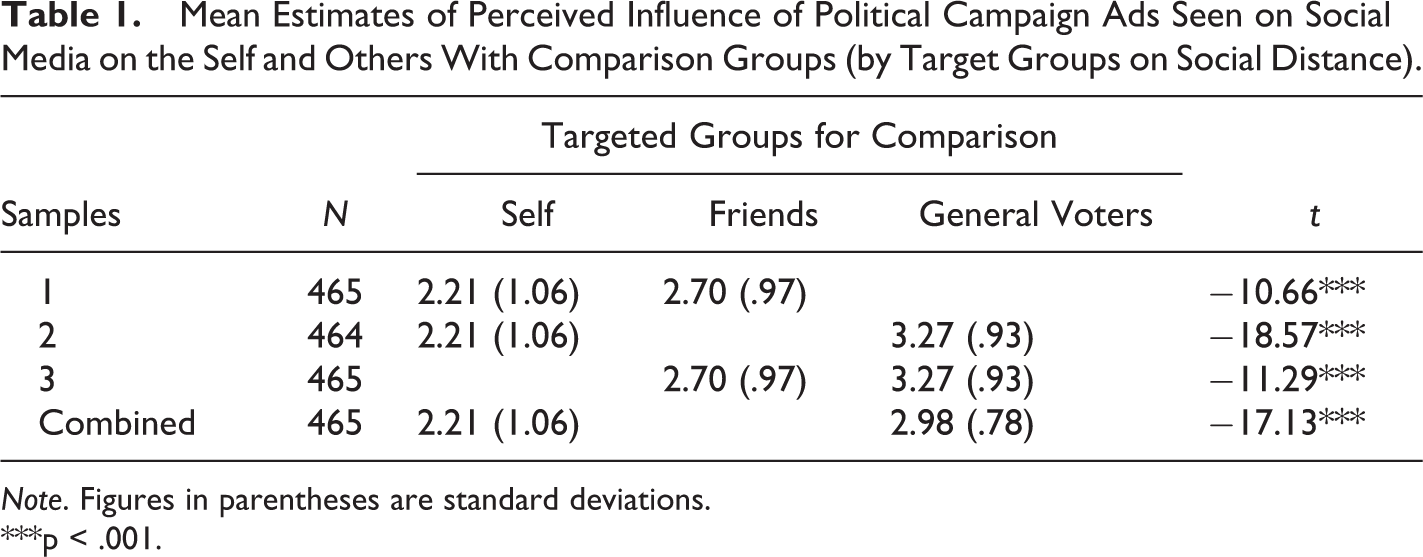
Hypothesis 1 predicted that respondents would perceive political ads seen via social media in the 2012 presidential campaign to have greater influence on others than they were. As results of paired t-tests in Table 1 show, respondents perceived others, both friends and general voters, as being more influenced by the campaign ads appearing on social than themselves (for self vs. friends, t = −11.67 at the p < .001 level; for self vs. general voters, t = −10.42 at the p < .001 level; for the self vs. the combined index of “others,” t = −17.134 at the p < .001 level). These results consistently supported Hypothesis 1. It is worth noting that the desirability of political campaigns on social media was a significant and positive predictor of perceived influence of such ads’ third-person perception on self (β = .37, p < .001) and on others (β = .17, p < .001) after controlling for the influences of demographics and political attitudes in separate regression analyses (not reported in tables). These results suggest that the more desirable they viewed political ads on social media during the 2012 campaign, the more influence they perceived such ads to have on themselves as well as others. What this means is that message desirability turned out to be a contingent factor of perceived effects of political campaign ads on social media.
Mean Estimates of Perceived Influence of Political Campaign Ads Seen on Social Media on the Self and Others With Comparison Groups (by Target Groups on Social Distance).
Note. Figures in parentheses are standard deviations.
***p < .001.
Hypothesis 2 predicted that respondents would perceive political ads seen via social media in the 2012 presidential campaign to have a greater influence on general voters than on their friends. The purpose of this hypothesis was to test the effect of social distance as a cognitive mechanism in estimating perceived influence of political campaign ads on social media. As Table 1 further shows, results of the paired t-test show that respondents perceived general voters to be more influenced by political campaign ads on social media than their friends (for friends vs. general voters, t = 15.51 at the p < .001 level). The more dissimilar the comparison others (i.e., general voters vs. friends) were to the respondents (college students), the more influenced was presumed. The results supported Hypothesis 2.
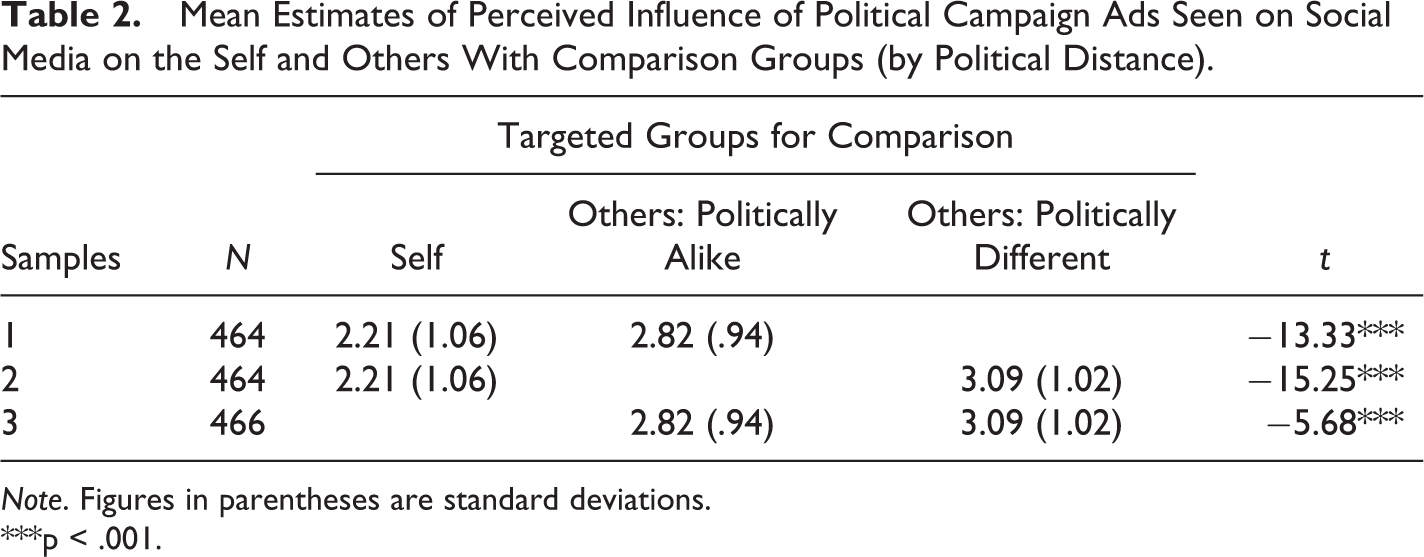
Hypothesis 3 predicted that respondents would perceive political ads in the 2012 presidential campaign appearing on social media to have a greater influence on others who do not share their political views than others who share their political views. Table 2 summarizes the results of paired t-tests, indicating that respondents perceived political ads on social media in the 2012 presidential campaign to have a greater negative effect on politically similar others than politically different others. The self-other perceptual differences were statistically significant, t(465) = −5.68, p < .05. Accordingly, Hypothesis 3 was supported.
Mean Estimates of Perceived Influence of Political Campaign Ads Seen on Social Media on the Self and Others With Comparison Groups (by Political Distance).
Note. Figures in parentheses are standard deviations.
***p < .001.
To explore the behavioral effects of political ads on social media, two hypotheses were developed to explore whether and how third-person perceived influences of political ads on social media on self versus others would predict political activism on social media. To be specific, Hypothesis 4 stated that third-person perception of the influence of political ads seen via social media in the 2012 presidential campaign would be significantly associated with the likelihood of engaging in promotional social media activism.
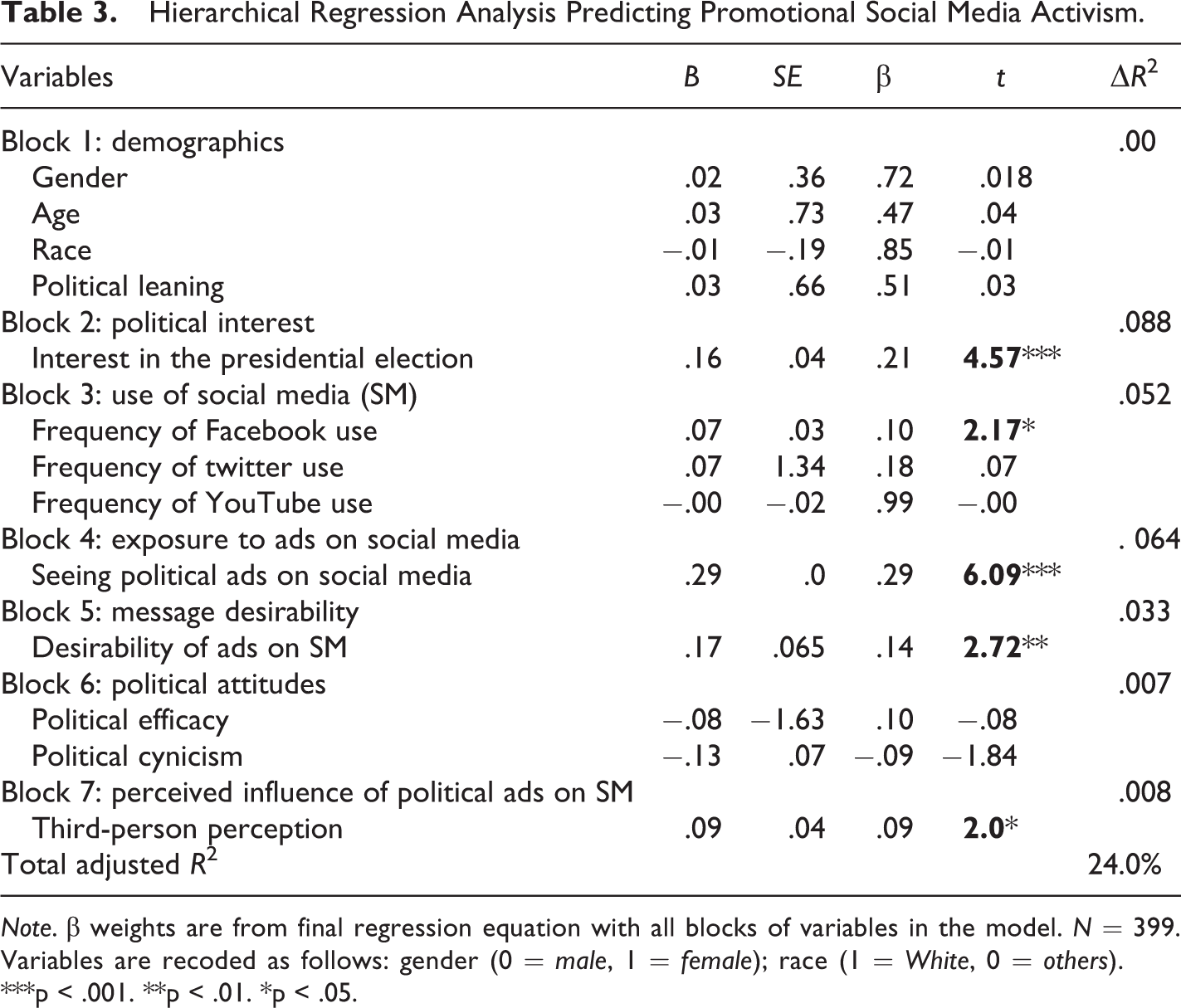
To test it, a hierarchical regression analysis was run. In the first hierarchical regression analysis (see Table 3), which treated likelihood of taking promotional measures as the dependent variable, the first block of the regression equation, entered gender, age, race, and political leaning as control variables. The second block included interest in the 2012 presidential campaign, followed by the three general social media use variables as the third block. The fourth block included the composite index of exposure to political campaign ads on social media; the fifth and sixth blocks included, respectively, message desirability and political attitudes. The final block entered third-person perception of political ads on social media.
Hierarchical Regression Analysis Predicting Promotional Social Media Activism.
Note. β weights are from final regression equation with all blocks of variables in the model. N = 399. Variables are recoded as follows: gender (0 = male, 1 = female); race (1 = White, 0 = others).
***p < .001. **p < .01. *p < .05.
Results show the equation was significant, explaining a total of 24.0% of variance (adjusted R 2) in the dependent variable, thanks to a number of significant predictors. Campaign interest, Facebook use, and exposure to political ads on social media were significantly related to the likelihood to engage in promotional social media activism. Message desirability also turned out to be a significant predictor. As expected, third-person perception was a final significant predictor of taking promotional measures. Accordingly, Hypothesis 4 was supported. These results suggest that the more others were believed to be influenced by the political ads seen via social media, the more the respondents would be likely to promote those ads via peer-to-peer communication via social media platforms.
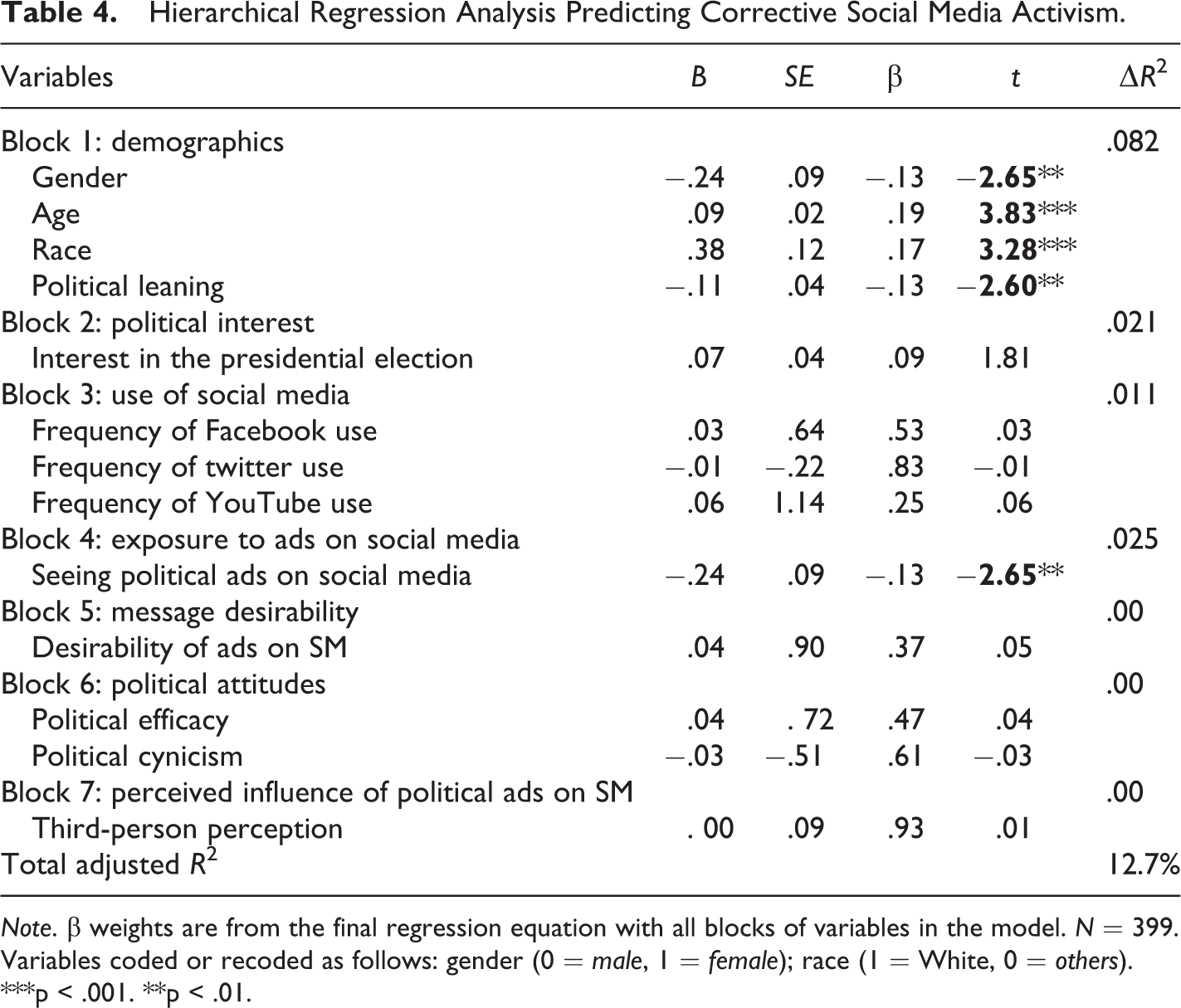
Finally, Hypothesis 5 stated that third-person perception of the influence of political ads seen via social media in the 2012 presidential campaign would be significantly associated with the likelihood of engaging in corrective social media activism. A separate hierarchical regression treating the likelihood of taking corrective action as the dependent variable was conducted to test this particular hypothesis. Similar to the earlier regression run, the first block of the equation entered gender, age, race, and political leaning as control variables. The second block included interest in the 2012 presidential campaign, followed by the three general social media use variables as the third block. The fourth block included the composite measures of exposure to political campaign ads on social media; the fifth and sixth blocks included, respectively, message desirability and political attitudes. The final block entered third-person perception of political ads on social media.
As results in Table 4 show, a number of predictors turned out to be significant, including mostly the demographics (gender, race, age, and political leaning) and exposure to political ads on social media. It appears that older respondents who were non-White males and democratic supporters were more likely to engage in corrective social media activism. Additionally, the more respondents reported viewing more political ads on social media, the less likely they were to take a corrective course of action to respond to those ads. However, third-person perception was not a significant predictor. Accordingly, Hypothesis 5 was not supported. Taken together, the equation explained a total of 12.7% of variance (adjusted R 2) in the dependent variable.
Hierarchical Regression Analysis Predicting Corrective Social Media Activism.
Note. β weights are from the final regression equation with all blocks of variables in the model. N = 399. Variables coded or recoded as follows: gender (0 = male, 1 = female); race (1 = White, 0 = others).
***p < .001. **p < .01.
Discussion of Key Findings
Political advertising is an important and at times game-changing political communication tactic in the United States (Ansolabehere & Iyengar, 1995). Although once distributed primarily through television and radio, the presidential political advertisement is often distributed via social media platforms in the new millennium. In the 2012 presidential election, several candidates distributed their election ads via social media, either by the campaign teams or by their online supporters. As such, social media platforms provide an immediate opportunity for individuals to not only be exposed to campaign messages but also take part in their distribution and interpretation. Accordingly, political advertisements distributed via social networks may play a role in the democratization of political socialization and provide voters with greater efficacy (see Lee, Shah, & McLeod, 2012).
To understand the transformative role of social networks in the distribution and interpretation of political messages requires scholars to reexamine existent generalizations regarding the perceived effects of undesirable political advertising previously tested in the context of television and other traditional media. Is it possible that political ads previously perceived as undesirable on traditional media platforms can be perceived as desirable when the ads are viewed via peer-to-peer social media? Taking advantage of a situation in which an unprecedented amount of political ads were launched on social media to target young voters in the 2012 presidential campaign, this study examined the perceived effects of such ads on social media on self in relation to others and the potential of those perceptions to lead to real-life consequences (e.g., social media activism). Informed by the robust TPE hypothesis, we explored both the perceptual and the behavioral effects of political campaign ads that appeared on social media.
The findings from the result of hypothesis testing (Hypothesis 1 to Hypothesis 3) show that respondents tended to perceive a greater influence of political ads seen via social media in the 2012 presidential campaign on others than on themselves. Furthermore, respondents perceived political campaign ads that appeared on social media to have less influence on those who are friends and politically similar to themselves than those who are strangers and are politically different from them. These findings are consistent with the literature; almost all political advertisements, whether negative or not, are likely to be perceived as socially undesirable because of their persuasive nature. As noted by Gunther and Thorson (1992), advertising is persuasive by nature and since people believe others to be gullible and easily manipulated (Perloff, 1999), they are likely to perceive advertising as socially undesirable and thus produce a TPE. Our results confirm this assumption and are consistent with past research on self-other perceptions of political advertising (Cohen & Davis, 1991; Golan, Banning, & Lundy, 2008; Wei & Lo, 2007).
Furthermore, our results indicate that message desirability was found to be a significant contingent factor. The more desirable the respondents rated such ads, the greater the influence of such ads was believed to have on them, narrowing the self-other perceptual discrepancy.
It seems that when respondents perceive ads shown on social media as socially desirable (i.e., medium not message type), they view others to be influenced more than themselves because the message type (persuasive) is not desirable. In other words, respondents view the platform of social media ads as desirable because it represents a word-of-mouth distribution channel with someone they know. However, respondents viewed the persuasive political messages distributed via these channels as socially undesirable. This finding sheds some light on the issue of presumed effects of ambiguity of social media as a form of viral communications. Our findings provide one of the first such examinations of the relationship between content desirability and content distribution. Although TPE research of the 1980s and early 1990s had no theoretical reason to predict that the medium of content delivery will impact perceived content social desirability, such word-of-mouth distribution platforms as social networks, microblogs and file-sharing websites may require a reexamination of previously established axioms. As platforms of word-of-mouth distribution of online content, social media platforms not only transformed message delivery but may also result in higher content credibility and differing assessments of social desirability based on peer recommendations.
Another contribution of our study is documenting a new behavioral effect associated with third-person perception of online political advertising. That is, the more respondents believed others to be influenced more than they are, the more likely they were to engage in social media activism. We found that respondents were able to support online political advertisements by promoting them to other users via the social sphere. As such, political advertising on social media provides individuals with the ability to engage in direct political action that is triggered by perceived influence on important political in-group and out-group. Our findings provide empirical support for the underresearched promotional outcomes of the TPE (Sun et al., 2008). While the results of our analysis did not identify a significant relationship between third-person perceptions and likelihood to engage in corrective action, we argue that such form of political social media activism is likely to be found significant in other cases. We argue for scholars invested in the TPE research to move beyond the exploration of restrictive action and toward the examination of social media activism, both promotional and corrective, as key consequences of third-person perceptions. Our findings therefore contribute to the TPE research by providing a useful behavioral outcome that is realistic and likely.
Political advertising, especially negative attack ads, was characterized as the “new political fault line” in American politics, which caused American voters to withdraw from political participation (Ansolabehere & Iyengar, 1995, p. 1). Some scholars argued that political advertisements may be related to shrinking and polarizing the electorate (Lau, Sigelman, & Rovner, 2007; Niven, 2006). Our findings suggest that political ads on social media may have some positive effects; voters seeing this type of ad might be motivated to engage not only in political discourse but also in the distribution of ads to their peers. The potential implications of social media activism on the political process may be far-reaching. Young voters who are often viewed as politically apathetic (Esser & de Vreese, 2007; Trammell, 2007) might be drawn into political behavior, thanks to the many easy-to-use promotional tools available on social network sites, allowing them to repost, comment, share, and like online content.
Findings of our study suggest that potential influence of perceived influence of political ads via social media on self may lead to attitudinal and behavioral responses. The process and mechanisms of this influence may differ from third-person perceptions. However, perceived influence on self and how the political ads influence individuals directly were not the focus of this study. The potential influence of perceived influence of political ads on self points to a new direction in future research. Our study is also limited by its use of single-item corrective measure and by the fact that we tested for correlational relationships rather than causality. Future studies should further explore the relationship between perceived influence of media content and the likelihood to engage in social media activism using better developed measures of behavior. To test causality, we recommend the use of experimental research.
Footnotes
Declaration of Conflicting Interests
The authors declared no potential conflicts of interest with respect to the research, authorship, and/or publication of this article.
Funding
The authors received no financial support for the research, authorship, and/or publication of this article.