







Abstract
Pollster Frank Luntz has built a substantial global business by shifting the terminology in public policy debates to a corporate and conservative perspective. He played a substantial role in the recent U.S. health care debate, and his approaches and terminology likely will be tried again regarding health care policy in other nations. This project searched the U.S. broadcast news transcripts to discover to what extent they reflected Luntz’s list of words for opponents of health care reform. Sixteen Luntz terms were compared to a list of 16 more neutral terms describing the actual changes being considered. The Luntz words outnumbered the “descriptor” terms on Fox News, and made up a significant percentage of the terminology hits on CNN, MSNBC, and ABC, CBS, and NBC News. This content analysis adds to the growing body of work on framing, specifically how tactical use of terminology can turn a mediated debate.
Introduction
Republican pollster and researcher Frank Luntz is well known for crafting phrases and words to steer issue terminology toward a perspective favorable to a planned outcome. He promoted the term death tax to sway public opinion against the previously popular estate/inheritance taxes. Luntz seeks effectiveness in reaction rather than accuracy in description (Begley et al, 2009; Lieberman, 1995; Lizza, 2005). Only about one quarter of 1% of estates typically owe any inheritance tax (Lapham, 2010). Calling inheritance tax a death tax would be akin to calling a chewing tobacco tax a grocery tax—solely because chewing tobacco is sold in grocery stores, but makes up a similarly small percentage of overall sales. Luntz credits his own work for changing the public debate from “drilling for oil” to “exploring for energy.” Luntz (July 2011) on his website also promotes the global reach of his efforts: Dr. Luntz has written, supervised, and conducted more than 2,000 surveys, focus groups, ad tests, and dial sessions in over two dozen countries and four continents over the past decade. Frank has become the go-to consultant when Fortune 100 companies and their CEOs need communication and language guidance … In some capacity he has helped almost 30 Fortune 100 companies navigate the economic climate and connect more closely with consumers. Luntz Global is an emerging powerhouse in the profession of message creation and image management. We have counseled Presidents and Prime Ministers, Fortune 100 CEOs and Hollywood creative teams in harnessing the power of language and visuals to change hearts, change minds and change behaviors. Our confidence comes from decades of research, polling, and consulting to the opinion elite worldwide, with proven results that withstand the test of time.
On May 7, 2009, Frank Luntz released a summary of his focus group and poll analysis of terms related to health care reform. His was a word choice-road map for Republicans, conservatives, industry spokesmen, right-wing pundits, and others opposed to the health insurance reform direction pursued by President Barack Obama.
It is hard to overstate the significance of health care and the controversy surrounding reform, a significance that warrants inspection of the word choice that framed the debate. Gostin, Jacobson, Record, and Hardcastle (2011) nicely summarized the key points: The United States spends nearly 17% of gross domestic product on health care, more than $7,000 per person annually—double the investment of any other developed country. Health reform has been a “dominant domestic political issue” from the time of the grueling Medicare debates in the 1960s until today. Critics derided modest cost-effectiveness comparisons, ones routinely accepted in other democracies, as “death panels.” Within just a few weeks of the law being signed, 20 states filed lawsuits challenging the individual mandate or other aspects. Of course, one should note the U.S. Supreme Court rejected most of those claims, holding the individual mandate was within Congress’ taxing power. The Court did, however, rule that the federal government could not coerce states into a Medicaid expansion by withholding existing funds (Liptak, 2012).
The purpose of this research was to determine whether the specific words recommended by Luntz moved into the public debate of health care by examining broadcast transcripts of the period between Luntz’s memo on how Affordable Care Act opponents can phrase their opposition and the signing of the bill. Same-length time periods before and after that period were examined for comparison purposes. The researcher also used for comparison a list of descriptive terms of the actual provisions of the act.
Literature Review
Scheufele and Tewksbury (2007) used Frank Luntz as an introductory device for an article sorting out the origins of framing, agenda setting, and priming. The researchers even credited Luntz as “the first professional pollster to systematically use the concept of framing as a campaign tool.” Thus, it seems particularly relevant to return to the influence of Luntz and his successful use of framing.
Several approaches to communication theory all claim framing as their own. Goffman (1974) used the term Frame Analysis to examine the connection between language and social reality. He stressed the question “Under what circumstances do we think things are real?” (p. 2) and enter the schemata we use to interpret the world (p. 27). Frame analysis, he argued, “recommends an analytical basis for discriminating sources of ambiguity” (p. 307). Goffman noted that spoken statements provided the examples for most of the framings he considered (p. 497). He also lamented “that once a term is introduced … it begins to have too much bearing, not merely applying to what comes [immediately] later, but reapplying in each chapter to what it has already applied to” (p. 11).
Gamson and Latch (1983) added that framing “deals with the gestalt or pattern-organizing nature of political culture” and “includes metaphors, exemplars, catchphrases, depictions, and visual images.” Ghanem (1996) declared that frames are made salient by the frequency with which topics or stock phrases are repeated. Reese, Gandy, and Grant (2001) agreed, “[W]e think choice of language is perhaps the most important framing mechanism. A careful examination of word choices and the extent of their use in news coverage can reveal much about the organizing ideas, the framing choices, of the media.”
Other researchers since have picked up on the importance of word choice in framing. Jasperson, Shah, Watts, Faber, and Fan (1998) used a computer tallying technique to determine word choice patterns in news coverage of the federal budget. Andsager (2000) analyzed competing pro-life and pro-choice terminology in newspaper coverage of abortion. Luther and Miller (2005) compared the use of pro-war and antiwar word choice in newspaper coverage of the demonstrations preceding the U.S.-led outbreak of war on Iraq.
The available literature on framing can be confusing because some authors stress the choices of message creators, finding a “second-level” agenda setting that carries for the audience not only issue salience but also attributes by which that issue should be evaluated (McCombs and Ghanem, 2001). Yet, as noted by Goffman, we also can understand the frame by looking at the message itself and how it fits the schema in audience minds. Entman (2007) ventured into the competing perspectives and inevitable extension to questions of bias. He brought in the additional term of priming, the intended goal of a speaker’s framing activities. Finally, he argued that “agenda setting, framing, and priming fit together as tools of power.”
D’Angelo (2002), however, disagreed with Entman’s approach and has argued instead that a single framing concept cannot be forced or cobbled together. Framing, he argued, is a combination of critical, constructivist, and cognitive. Scheufele (1999) also lamented theoretical and empirical vagueness in framing research. He suggested clear distinctions between media frames and audience frames. He also identified four key process areas that roughly parallel models of communication processes: frame building by various parties, frame setting, individual level processes regarding the message, and the feedback from audiences to journalists.
As Reese (2007) observed, framing has limits as a unified research domain, but great potential as a “bridging model” for bringing together quantitative and qualitative, as well as scholarly and professional, observations about communicated messages. Too often, however, the term is used merely to justify any content analysis. Greater good, he argued, could come from seeing frames under the definition he prefers—persistent and social shared organizing principles that work symbolically regarding how we mentally structure our social world.
Matthes (2009) conducted a content analysis of 131 framing studies published in 15 international journals, finding too much description and not enough quantification, insufficient reporting of reliability measures, and lack of operational precision in key definitions and procedures. Earlier he had advanced the idea that typically a cluster analysis technique was best for most framing research (Matthes & Kohring, 2008).
Recently, researchers have taken the concept of issue framing and focused precisely on what might be considered a significant framing subset, word choices that seek an optimal rhetorical strategy to win a political or public policy clash. Lakoff (2002, 2004, 2008) notes that U.S. conservatives rather consistently make word choices that reflect a “stern father” view of the world. Lakoff specifically mentions the role of Luntz in sharpening and promoting this approach; and Lakoff claims that liberals need to respond with a counter strategy of a “nurturing family” terminology and viewpoint.
The examination of word choice in health care public policy debates is well established. West (2006) looked at the Medicare prescription drug coverage debate in 2003–2004, specifically the terminology used by both news media and institutional sources such as the American Medical Association, President George W. Bush, and the American Association of Retired People. She concluded that the word choice reflected more of a consumer than citizen model, especially among the institutional sources. News media sometimes invoked both citizen and consumer framing, and at least on occasion questioned the institutional source tendency to use the words “free market” and “choice” as panaceas.
Those words may just fit certain preconceived notions, long-established cognitive frames or schema for audiences when processing health care, and other, messages. Lau and Schlesinger (2005), for example, conducted survey work regarding the 1993–1994 Clinton Administration effort at health care reform, suggesting a role at least in some circumstances for the frames of societal right, community obligation, employer responsibility, marketable commodity, and professional service.
Like Lau and Schlesinger, Jerit (2008) examined the failed Clinton Administration attempt in 1993–1994 to pass national health care reform. She conducted a content analysis of the arguments (1540 statements from proponents and opponents) that made it into Associated Press coverage. Opponents zeroed in on cost, complexity, and “big government.” Supporters tended to emphasize current flaws especially as they affect low-income people, and the desirability of universal coverage. Jerit suggested proponents might have been better off had they more often engaged the opposition points rather than sticking to their own frame. Thorpe (2007) reviewed the many failed proposals floated for health care reform and concluded, “Starting the health care reform debate around the affordability agenda, with a clear understanding of the forces driving the rise in spending, seems a more attractive approach than limiting the debate to how best to pay for including the uninsured in an underperforming health care system.”
Three research articles, all in a recent edition of Journalism & Mass Communication Quarterly, add important points about framing in general and the specific use of framing in the health care debate. Hickerson, Moy, and Dunsmore (2011) wrote about “power indexing,” the framing-related concept that the prominence of a source “is contingent on that source’s perceived ability to affect the outcome of the debate at hand” (p. 792). Members of the U.S. Congress certainly fit that criterion as they were the ones with the power to adopt, reject, or amend the Affordable Care Act. Grimm and Andsager (2011) add that “It is entirely possible that certain frames simply resonate more because of the images they conjure” (p. 782). This conjuring, of course, is not random. Frames are pushed and repeated in such public policy struggles, often with the guidance of researcher/advocates such as Luntz.
Zeroing in on the health care debate, Seltzer and Zhang (2011) crafted a national survey that triangulated party, attitudes toward health care, and exposure to various types on partisan messages on the subject. The researchers ran regressions that found some differences in effects depending on the medium for delivery, such as mediated versus interpersonal, of the message. The overall pattern, however, was clear to the researchers. They wrote, “If politics is a contact sport, then many of the hits are delivered by political parties using strategic communication to persuade citizens, frame issues, forge relationships with voters, and drive a wedge between voters and the opposition. The current study underscores the truth of this perspective” (p. 765).
Research Questions and Hypothesis
This research adds a new wrinkle to these past explorations of framing. It tracks the terms of one specific actor attempting to frame the health care debate, and how often those framing words appeared in comparison with other, more neutral, descriptors in broadcast news discussion of the health care bill. Thus, this research asked three research questions and offers one hypothesis. Research Question 1 asked which will be more numerous, the Luntz terms or more neutral Descriptors of the Affordable Care Act? Research Question 2 asked how much coverage of health care will “spike” during the period of the bill’s debate compared to equal time periods before and after the debate? Research Question 3 asked which of these news sources (network newscasts, network morning news programs, or 24/7 cable news operations), as evident in these transcripts, covers this topic most heavily?
Fox News has a documented and deserved pro-Republican and pro-conservative slant (Groeling & Baum, 2007), and conservative viewers seek it out for that reason (Iyengar & Hahn, 2009; Morris, 2005). Thus, this research also explored the hypothesis that Fox News, compared to all the other news organizations studied, will have the highest percentage of Luntz words compared to the Descriptors.
Method
The researcher used the Power Search function in the Transcripts area of Lexis/Nexis Academic to discover how extensively the Luntz terms permeated television news discussion of health care insurance reform. The “hits” were categorized automatically into the news organizations whose program was being transcribed. The researcher tallied the results for each term or phrase from Fox News, CNN, MSNBC, ABC News, CBS News, and NBC News. The terms/phrases were searched in three time periods: the 327 days from when Luntz released his list, May 7, 2009, until President Obama signed the Patient Protection and Affordable Care Act on March 30, 2010. These key dates (the 327 days from the release of the recommended terms until signing of the bill), in effect, set the stage for a consistent interval. For ease of comparison, the researcher then looked at those same terms/phrases for 327 days preceding Luntz’s memo, June 13, 2008, until May 6, 2009, and for 327 days after the bill was signed, March 31, 2010, until February 20, 2011.
Sixteen Luntz words and phrases were taken directly from the memo. Luntz has a specific section (pp. 23–25, also pp. 8, 27) on how to emphasize and explain rationing. He also declared that arguments against the Democrats’ health care plan must concentrate on politicians (pp. 1, 8, 13, 16, 17, 23) acting on behalf of lobbyists (pp. 13, 19, 24) and health care denial by a bureaucrat (pp. 1–2, 6, 8, 12, 13, 15–17, 21–28). Luntz recommended speaking in terms of Washington and government control, so Washington takeover (pp. 13, 16) and government run (pp. 1, 16, 23) were ok, but government takeover was better (pp. 1, 5, 15, 24). Rising health care costs must be addressed, but largely in terms on waste, fraud and abuse (p. 2) and ending frivolous lawsuits (p. 7).
Killing reform might be the goal of the insurance industry, but Luntz recommends tapping into another unpopular word and calling the Democratic plan a bailout for that industry (p. 7). Luntz suggests humanizing all sound bites with stories of people, describing your approach as balanced and common sense (pp. 2, 10), one that is patient centered (p. 20) and respects the relationship between you and your doctor (pp. 1, 20). The Democratic plan, usually called the Democrat Plan, should be called one size fits all (p. 12) and socialized medicine (p. 24).
No parallel liberal or Democratic memo identifying pro-reform terminology could be found. Instead, the researcher sought a comparable list of 16 terms that describe the actual goals and procedures of the proposed changes, and the problems those changes seek to address. The words largely are taken from two books: the Washington Post staff’s book (2010) about how we got to health care reform, and what it means; and David Nather’s (2010) explanatory book about the new system.
Health care reform largely involves a check on the abuses of corporate insurance, a system that denies people coverage for a pre-existing conditions, or imposes annual (or yearly) limits on coverage, as well as lifetime limits, and a high deductible. One goal is to reduce the number of uninsured and underinsured, many of whom by default must rely on the emergency room for care. Any insurance company, more broadly, the insurance industry, now faces limits on profits, imposed by mandating a certain percentage of premiums must be spent on care. Furthermore, young people may stay on a parent’s (parents’) plan/coverage/insurance until age 26. Soon states will establish an insurance exchange for easy, online, and offline comparison shopping for the best plan meeting minimal standards. These steps match the act’s name, patient protection and affordable care.
The researcher conducted a key word search for how many times the 16 Luntz terms/phrases and the 16 Descriptor terms/phrases occurred within 25 words of the phrase “health care.” This was done for the three time periods noted. The term “death panel” was not in the original Luntz memo, but the researcher also kept track of how often that term appeared in the transcripts.
The Descriptor terms occur frequently in Nather’s explanation of the new law, and Nather fairly can be described as an expert. David Nather is Politico’s health care editor. He is the author of two books on the new law, consulted on the Bipartisan Policy Center’s health care program, and has been a health care analyst for Bloomberg Government (http://www.politico.com/reporters/DavidNather.html).
The examination of linguistic frames is not new to analyses of news coverage of health care. In fact, it is grounded in several studies. Wallis and Nerlich (2005) expected that, based on past coverage of HIV/AIDS in the 1980s, major British newspapers in the spring of 2003 would use militaristic language to report on severe acute respiratory syndrome (SARS). Instead, militaristic entity and plague references largely were missing, and SARS was presented as a single, solitary killer. Rabinowitz (2010) recognized word choice, along with metaphors and visual elements, as key to coding media framing of the 1999 U.S. Patients’ Bill of Rights debate. West’s (2006) study of Medicare reform news coverage, as previously noted, tallied specific word counts related to: citizen, consumer, and patient.
The research design also should look for the partisan/political differences noted by other researchers between Fox News coverage and that of other cable or network news operations. Aday (2010) compared NBC Nightly News and Fox’s Special Report with Brit Hume on Iraq and Afghanistan war coverage, finding Fox much more sympathetic to the Bush Administration. An analysis of 2006 presidential post-debate coverage on CNN and Fox (Brubaker & Hanson, 2009) found “Fox News clearly favored the Republican candidate.”
The selected newscasts were chosen for their overall political news significance. The latest Pew State of the Media numbers (2012) indicate that the ABC, CBS, and NBC evening newscasts still deliver a combined audience of 22.5 million people on a typical day. In fact, their numbers were up 972,700 viewers, or 4.5%, over the previous year, and a nearly a quarter of that growth was in the coveted 25- to 54-year-old viewers. Morning news programs also bucked the historic trend and had an audience increase in the latest measures; on a typical day 13.1 million people watched one of the three network morning news programs.
The overall trend regarding network TV newscasts since 1980, one must admit, has been one of decline. The trend of the 24/7 cable networks has been upward, though still far behind the network newscasts. Pew describes them as organizations “whose muscles are tuned to capitalize on political fever.” Thus, those news and comment operations throughout their daily schedule were included in this analysis. Duplicate copies of transcripts were not coded. Stories repeated throughout the day were coded only once.
Findings
Regarding Research Question 1, the grand totals for this broadcast transcript analysis were 5,543 Luntz terms within 25 words of health care, compared to 7,445 bill descriptors. Thus, while the Luntz terms definitely entered the public discourse, they were outnumbered by the more neutral bill description terms.
The three time periods quantified the “spike” mentioned in Research Question 2. The period before the Luntz memo was one of relatively light attention to the health care debate. Luntz and descriptor terms combined for 1,429 mentions in the 327 days before the Luntz memo, jumped to a combined 9,521 during the 327 days between the memo and the bill signing, and fell back to 2,038 mentions over the following 327 days. These totals reflect the usual pattern of news attention to public policy only in the intense conflict immediately preceding major votes, but also presented an opportunity for the Luntz terms to elbow into the debate and try to nudge the outcome.
Answering Research Question 3, the voracious political chat appetite of the 24/7 cable news operations was evident. Fox News, CNN, and MSNBC combined for 10,736 hits of descriptors and Luntz terms connected to health care, overwhelming the tally of 1,665 for the three network evening newscasts, and only 587 for the network morning news programs. This finding documents the reasonable assumption that in the pure word count of transcripts 24/7 news operations will overwhelm others in use of political terms simply by the length of time on the air.
Regarding the hypothesis, the Luntz opposition terms, even in the period preceding his memo, were already in greater use than the Descriptor terms on Fox News. Other news organizations used the Descriptor phrases more frequently than Luntz terms by roughly a 61% to 39% margin on the ABC, CBS, and NBC flagship newscasts, and more than a 4 to 1 ratio in the morning programs. On CNN the ratio was 55% to 45%, and on MSNBC it was 54% to 46%. Clearly, even before Luntz collected and publicized his preferred terms, some opposition forces were using some of that wording and that wording found a home in the right-wing chat of Fox News. One should caution against using these relatively small numbers and percentages of pre-Luntz memo uses of the terms as some sort of baseline. It was the memo that brought these terms into a rhetorical strategy and the tallies should examine whether that strategy got those terms into the public discourse.
News discussion of health care dramatically increased in the period between the Luntz memo and the bill signing. On Fox News, the Luntz terms outpaced the Descriptors 1057 to 785. The Luntz words trailed the Descriptors on CNN, 1,762 hits compared to 2,743. On MSNBC, the Luntz hits were 552; the Descriptors had 913 hits. The three-network newscast tally was 434 Luntz to 788 Descriptors, 150 Luntz to 331 Descriptors on the morning programs. After the bill signing the overall term hits declined to less than a quarter the number of hits between the memo and bill signing. Fox, CNN, and MSNBC had similar Luntz-to-Descriptor ratios compared to the past time periods, but the network evening news tallies found Luntz and the Descriptors nearly even in mentions (Table 1).
Health Care Debate: Luntz Terms Versus Other Descriptors Over Three Time Periods and Differing Television News Sources (Lexis/Nexis Transcript Searches).
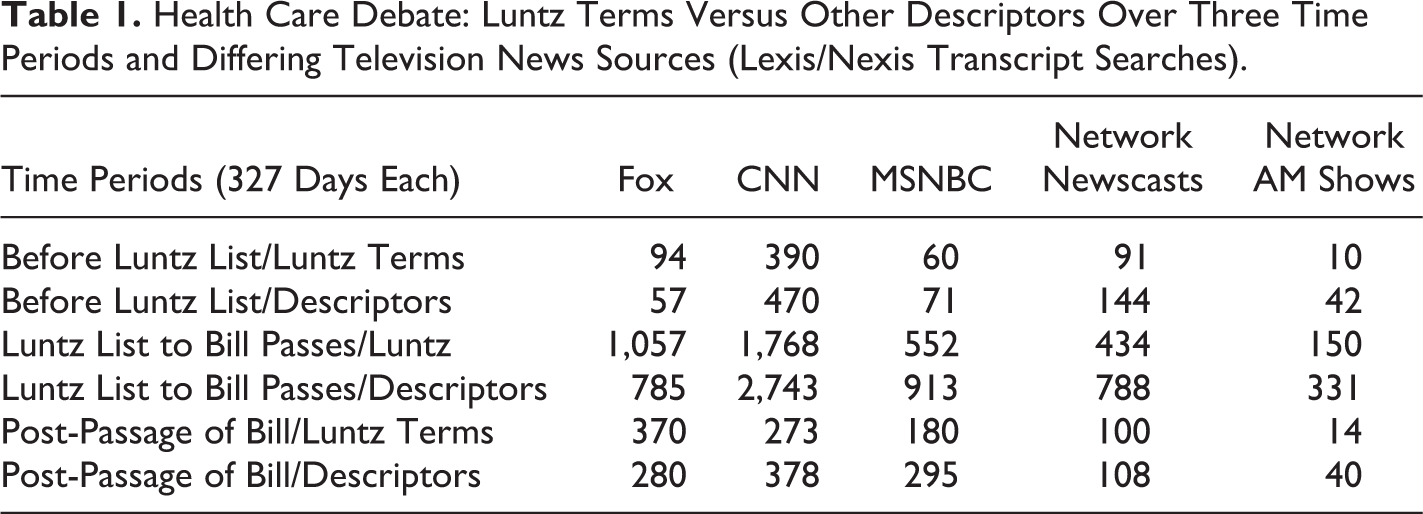
If the combined 1,521 Luntz terms and 1,122 Descriptor hits on Fox News are compared to the combined 4,022 Luntz and 6,323 Descriptor hits on all other news operations, one can create a two-by-two table for χ2 analysis. The difference was statistically significant (Fisher χ2 with Yates correction 299.173, p < .0001). Thus, the hypothesis was supported.
These results add to that growing body of literature, and the related concern that a small but significant portion of the U.S. population is relying on a news source with a fixed and predetermined approach to developments, often unconstrained by how much that approach is disconnected from fact. Two recent New Jersey polls even discovered that Fox News viewers performed worse than those who fail to follow the news in knowledge of Middle East and North African uprisings or the European debt crisis (Cassino & Woolley, 2011).
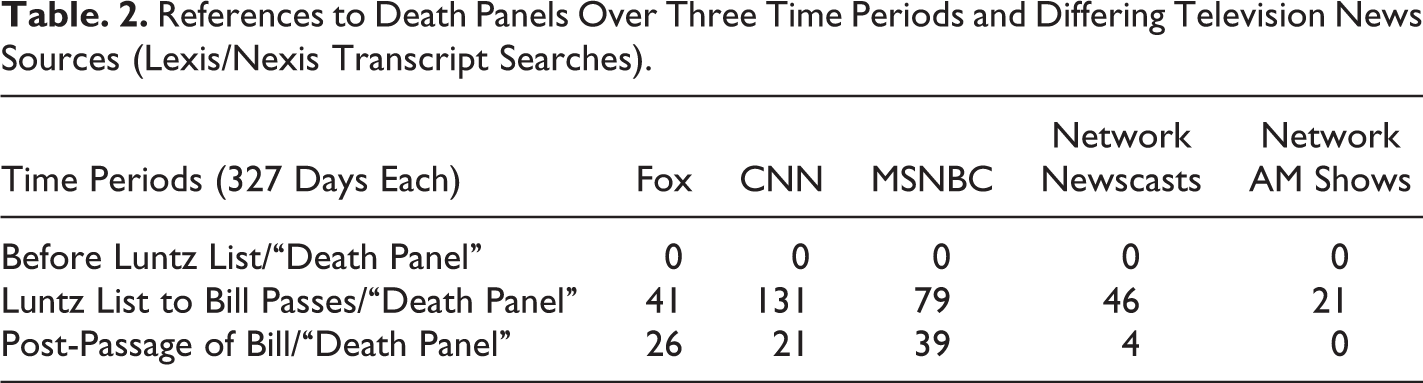
As shown in Table 2, “Death Panels” was not in use at all before Luntz put out his list. Factcheck.org (2009) traces the term to an August 7, 2009, Facebook post by former Republican vice presidential candidate Sarah Palin. She may have been echoing a town hall comment earlier in the week by Senator Charles Grassley about “a government run plan to decide when to pull the plug on grandma.” During the heat of the bill’s public debate, “Death Panels” had a flurry of activity with Fox and CNN using it, but MSNBC also used it in the course of frequent rebuttals or challenges to it. Network newscasts and morning programs quickly lost interest in the term after the bill passed.
References to Death Panels Over Three Time Periods and Differing Television News Sources (Lexis/Nexis Transcript Searches).
Discussion
One quickly must admit some limits to this research. This tally of terms can reveal on whose “terminology turf” the political battle was fought, but it cannot explain how it was fought or who did the fighting. No comprehensive attempt was made in this article to discern the context of term use, specifically how many of the uses were spent in attempting to challenge a perspective or debunk a claim. The research did not delve fully into the voice of the use, namely whether the terms were stated by journalists, sources, elected officials, pundits, and so on. It’s also certainly possible a very small fraction of the “hits” were incidental ones, instances in which an abrupt shift in topic put the Luntz or descriptor terms within 25 words of “health care” even though the former were not in a health care story.
To address these latter two concerns, however, the researcher conducted something of a “spot check” on the transcripts for the entire time period under study. Using random.org the researcher picked one “hit” at random from the dozens of hits for each of the 33 analyzed terms (16 Luntz and 16 Descriptor, plus Death Panel) for each of four news groupings: Fox, CNN, MSNBC, and ABC/CBS/NBC. In addition, for the morning news programs (Good Morning America, Today, CBS’ Morning News, and Early Show), the researcher conducted a transcript-by-transcript review of all term uses, noting the term and speaker.
Those morning news tallies showed that newscasters themselves were the primary “voice” of the health care debate in relation to the terms analyzed. Reporters spoke the analyzed terms in 39.5% of the cases, another 19.1% of the time the terms came out of the mouths of anchors. Politicians, former and current elected and appointed officials as well as spokesmen for political parties, spoke 31.5% of the terms, and another 5.4% came from politically adjacent figures such as columnists and pundits. In fewer than one in twenty cases were these terms mentioned by someone outside the traditional Washington squabbles: man or woman on the street interviews, or conversations with emergency room doctors, patients, insurance agents, or businessmen who provide for employee health coverage.
The morning news tallies also kept track of which Luntz words and which Descriptors were used within 25 words of health care and in clear reference to health care. Government Run (42%) and Government Takeover (21.3%) combined for more than six in ten Luntz terms used. The Luntz terms Rationing, Socialized Medicine, and One Size Fits All combined for 14.2%. The term Lobbyists was 10.1%. Bailout, Your Doctor, Common Sense, Politicians, Bureaucrats, or Waste, Fraud, and Abuse tallied fewer than seven mentions each.
On the Descriptor side, 41.9% of the references were to insurance companies or the insurance industry. Premiums or Deductibles were 22% of the terminology and 18.3% for uninsured or underinsured. Pre-existing conditions were 9.2% and another 4% for emergency room. Profits, Parent’s Plan, Corporations, and Insurance Exchange had fewer than 10 mentions each in connection with health care.
The 132 spot checks led to 131 inspections of transcripts because “frivolous lawsuits” for the over-the-air networks was empty. Only 10, or 7.6%, of the hits were incidental ones due to a quick shift in topic or teasing of multiple upcoming stories. Elected officials comprised the largest share of speakers uttering the terms at 34%. Hosts or anchors were 29%. Talk guests including pundits were 21%. Journalists doing field reports were 14%. Two of the “sound bites” using the studied terms were from man-on-the-street interviews.
The term uses within the spot checks also can be analyzed in a two-by-two table examining both “voice” and terms: anchor/reporter versus all external sources for voice, and Descriptor versus Luntz for terms (Table 3). The 240 external uses of terms broke down two-to-one Descriptor terms over Luntz terms. The 340 anchor/reporter uses of terms leaned slightly more heavily toward the Descriptor side, though the difference fell shy of statistical significance (Fisher χ2 p value = .0963).
Morning Show (Today Show, Good Morning America, CBS Early and Morning Shows) Health Care Terminology by Speaker.
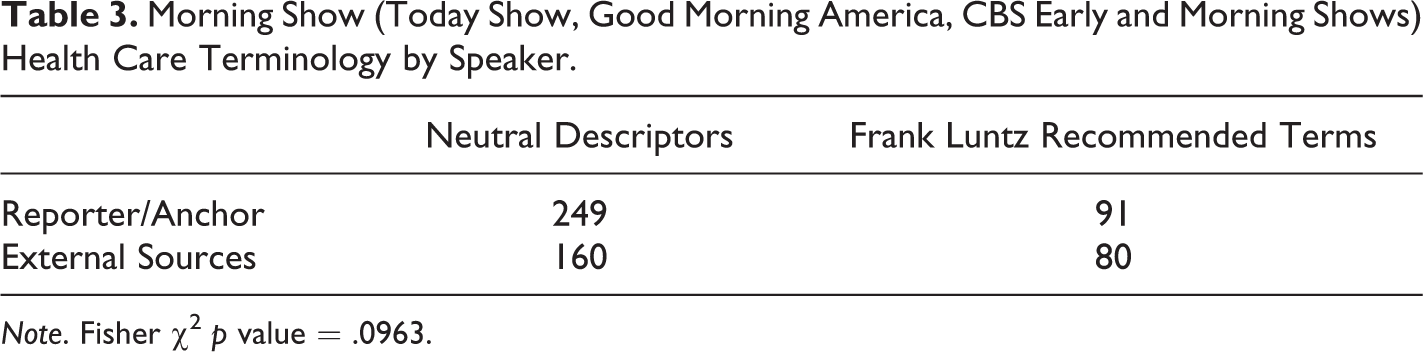
Note. Fisher χ2 p value = .0963.
Some additional qualifications should be added. Transcript searches of 24/7 cable operations, by definition, will bring up mid-day programs that resemble newscasts but also other programs with varying mixes of field reporting, commentary, interview, and chat. Searching CNN in this time frame will yield American Morning, Larry King Live, and State of the Union with John King. Fox News will produce Fox and Friends, Sean Hannity, Glenn Beck, and Your World with Neil Cavuto. MSNBC will give one Countdown, Rachel Maddow, and Morning Joe. No effort was made to classify those differing types of programs.
Future research on this question could fulfill Reese’s (2007) ambition that framing could bridge the quantitative and qualitative. Specifically, as suggested by the Matthes and Kohring (2008) embrace of cluster analysis technique, one could enter the actual transcripts of these and other programs into one of the many computer programs now offering that function. Other researchers could explore which terms and appeals “clump and connect.” This research laid the groundwork that the deliberate Luntz attempt to muscle certain terms into the debate at least partially succeeded.
Luntz has shown no hesitance in crafting terminology-based frames in attempts to weaken financial regulation reform (Stein, 2010). Luntz (March 2011) became so enamored of his own influence that he released a general list of eleven buzzwords for 2011. At the close of that year, he was advising Republicans about what terms to use when describing the Occupy Wall Street movement (Benen, 2011; Moody, 2011).
One should stress that health care reform passed, not without great difficulty and a lot of political compromise that dropped more robust changes. Even though there was some evidence that the debate was “Luntzified,” the Luntz terminology failed to derail the overall effort. Perhaps Jerit was right that some skepticism of and critical evaluation of attack terminology is needed, even if it sometimes leaves one fighting on the other side’s turf. The key may be a level of focus and balance where one can yank the debate back to demonstrable characteristics and away from the distractions.
Despite the passage of the Patient Protection and Affordable Care Act, it is clear the Luntz terminology significantly muscled into the televised health care debate, especially in the voice of politicians and political talk hosts but also in the terms picked up by anchors and reporters. One hopes that no one falls prey to the desire to balance the Luntz frames with actual description of real legislative content. Such false equivalency leads to a news philosophy that gives equal weight to a spherical versus a flat Earth.
Footnotes
Declaration of Conflicting Interests
The author declared no potential conflicts of interest with respect to the research, authorship, and/or publication of this article.
Funding
The author received no financial support for the research, authorship, and/or publication of this article.