







Abstract
Various scholars, pundits, and journalists, along with a majority of the American public believe incivility in politics is increasing. Nevertheless, the Annenberg Public Policy Center’s (APPC) baseline measure of political incivility remains relatively flat. How can these incongruous conclusions be reconciled? This article suggests that perceptions of political incivility are a function of viewing distinct genres of television news media: “hostile” cable news versus network news. Using a content and secondary data analysis, this article demonstrates that (1) cable news outlets provide more coverage of elite political incivility than do network news outlets and that (2) cable news viewers perceive politics to be more uncivil than do network news viewers. Combined with previous research, the results suggest cable news viewers may perceive more incivility in national politics than actually exists. Theoretically, this article provides support for genre-specific media cultivation effects. Implications for cultivation theory and incivility are discussed.
In April 2012, Republican Senator Chuck Grassley used the social networking site, Twitter, to call President Obama “stupid” on matters of constitutional law, the president’s area of expertise (Slack, 2012). A few weeks later, Republican Representative Allen West told constituents that a majority of his Democratic colleagues were closeted members of the communist party (Blake, 2012). And more recently, Republican House Speaker John Boehner told Democratic Senate Majority Leader Harry Reid to “go fuck [himself]” in a face-to-face confrontation that resulted in considerable national news coverage (Voorhees, 2013).
The above are just a few examples scholars, pundits, journalists, and members of the public point to as evidence for recent increases in political incivility (e.g., Jackson, 2012; Norton, 2011; Stone & Green, 2012). Based on these and other anecdotes, it is now widely suggested that American politics is entering a new era of incivility (e.g., Abdullah, 2012) characterized by the rude and offensive language of elected officials. Nevertheless, empirical evidence on Congress indicates that contemporaneous elite rhetoric is actually more courteous and polite than the rhetoric of the 20th century (Annenberg Public Policy Center [APPC], 1998, 2001, 2011a). The Annenberg Public Policy Center’s (APPC) “baseline” measure of political incivility suggests that members of the U.S. House of Representatives were more civil to each other during the 2009 “Obamacare” floor debates, for example, than during the mid-90s “Republican Revolution”-era exchanges (APPC, 2011a).
Herein lies the central contradiction explored in this article. Observers claim that political elites, especially in Congress, are increasingly uncivil (e.g., Abdullah, 2012; Jackson, 2012; Norton, 2011; Stone & Green, 2012). Conversely, the APPC’s incivility measure indicates that members of Congress are just as or more civil today than in the past. How can these disparate conclusions regarding political incivility be reconciled? This article suggests that media cultivation theory (Gerbner & Gross, 1976) presents a plausible explanation.
Using quantitative content analysis, this article examines three prominent cases of elite political incivility, exploring differences in network (ABC, CBS, and NBC) and cable (CNN, Fox, and MSNBC) television news coverage. Next, the article examines public perceptions of political incivility using a secondary data analysis of a representative sample of 844 Americans. Ultimately, the article advances a genre-specific news media cultivation effect: Frequent depictions of elite incivility on cable news are linked to heightened perceptions of incivility among cable news viewers. Network news provides less coverage of elite incivility, relating to decreased incivility perceptions among viewers who prefer the network news genre. The results imply that cable viewers may perceive a more uncivil political reality than actually exists. Before a full discussion of findings, the article reviews literature on political incivility and cable news production values, providing a rationale for media cultivation as a theoretical framework.
Literature Review
The State of Political Incivility
Numerous scholars, pundits, and journalists suggest American politics is entering into a new phase of heightened incivility, exemplified by public displays of impolite political rhetoric and behavior. There is a growing consensus, especially among scholars, that political incivility is increasing (Ahuja, 2008; Uslaner, 1993). And when asked in a recent poll, 85% of Americans also said they believe politics is increasingly uncivil (Norton, 2011). However, evidence for increases in political incivility are based primarily in contemporaneous anecdotes about uncivil acts, which assumes that what is considered “uncivil” today was also labeled “uncivil” in a historical context. Objective “baseline” indicators of incivility are lacking, with some scholars using congressional party line voting (Ahuja, 2008) or self-report measures of disregard for cordiality in the U.S. House of Representatives (Uslaner, 1993) as indirect proxies of incivility.
Another, more explicit measure of elite political incivility has been presented by researchers at the APPC. The APPC’s measure of elite incivility tracks the number of times words spoken on the floor of the House of Representatives are “taken down” or ruled out of order (see APPC, 1998, 2001, 2011a). By examining the number of times uncivil language is removed from the House record, a reliable baseline indicator of political incivility can be used to track changes in uncivil rhetoric over time. Instead of examining indicators of party line voting or self-report measures of Congressional divisiveness, the APPC project investigates actual cases of rude and often-derogatory rhetorical outbursts.
Using this method, APPC reports find that, contrary to public opinion, elite incivility is not on an upward trend. In fact, the number of uncivil rhetorical exchanges ruled out of order in the U.S. House of Representatives has remained fairly low and stable over the past 50 years. While levels of incivility in the 112th Congress were slightly elevated compared to previous years (APPC, 2011b), they are lower than several periods of the 20th century, including during election controversies of the late 1940s and the so-called Republican Revolution of the mid-1990s (APPC, 2011a). The Annenberg measure indicates that, counter to what many have proposed based on casual observation and indirect measurement, Congress appears to be distinguished by its civility in formal settings, not incivility. How is it possible to reconcile, then, scholarly and journalistic claims and widespread public perceptions that elite incivility is increasing against the APPC’s objective backdrop of low levels of incivility?
Cable and Network News Production Values
One way to reconcile conflicting accounts of political incivility is to explore recent changes in American news media. For centuries, the news media have relied on conflicts between opposing social and political forces to generate stories (Cook, 1996, 2005; Gans, 2005; Patterson, 1994). In fact, to the extent that events are even considered “news” they must involve struggle between two opposing forces (Schudson, 2011). Today’s news is no exception to the rule; it is characterized by drama and conflict. However, the differences between today’s news and major television network news and papers of the 1950s, 60s, and 70s are 3-fold.
First, cable television and the internet have altered the news media environment. News is now available on demand, at any hour of the day or night on the internet and cable. The 24/7 “news hole” leaves cable television news producers searching for content to fill time, especially during slow news cycles. More often than not the content chosen to fill the ever-widening news hole is negative, even uncivil (Forgette & Morris, 2006; Sobieraj & Berry, 2011), so as to attract and retain news audiences. Entertaining news stories, which are usually negative, tend to garner the largest audiences (Hamilton, 2004; McManus, 1994). It logically follows that cable will air more negative, conflict-heavy stories to increase ratings. Ratings, in turn, mean greater revenues from advertisers trying to reach various segments of the cable news audience.
A second major change in news media is a move toward highly ideological programming (e.g., Stroud, 2011). Whereas network television has always attempted to target their news products toward the center of the political aisle in order to reach the widest possible spectrum of viewers and advertisers, cable eschews this practice. Cable news, at least since 2003, has divided up along partisan lines (e.g., Bennett & Manheim, 2006). Fox News, for example, tends to cater to a more conservative audience, providing more programming that supports Republican political figures, Christian values, and traditional patriotism. On the other hand, MSNBC and CNN tend to cater to a more liberal audience, presenting information supportive of Democratic political figures and secular values. When partisan political figures are interviewed on a rival cable network, the result is often a highly confrontational and derisive exchange. Whereas network television news still uses low-key, hard news programming to attract moderate viewers, cable news is in the business of political niches. As such, they must give their partisan audiences their due, which is usually a combative interview with a vocal opposition political leader.
The news has also changed in presentational style, but this pertains primarily to cable. Nightly network news still possesses a straightforward format, with a soft-spoken news anchor providing approximately 30 min of dispassionate programming. Hour-long network specials and weekend programming such as CBS’s 60 Minutes or ABC’s This Week with George Stephanopoulos break with the nightly news format, but these programs still typically present news in a calm and detached manner relative to cable. Beginning in the late 1980s and 1990s, cable news went from a presentational style similar to network news to what could be called an “evening commentator format.” Today, 5 days a week on all three cable networks, the issues of the day are discussed and debated by the likes of Bill O’Reilly and Sean Hannity on Fox, and Ed Schultz and Rachel Maddow on MSNBC, all of whom present the news in a more emotional, hostile, and uncivil fashion than do network news programs (Sobieraj & Berry, 2011). Consequently, partisan niche audiences are presented with overtly emotional news that is less concerned with hard facts and more concerned with entertainment and political division.
Today’s cable and network news programs are easily distinguished. Network news is targeted toward politically moderate audiences, is dispassionate, and provides viewers with short, 30-min or 1-hr bursts of news. Conversely, cable channels purposefully target partisan audiences, possess an overtly emotional presentational style, and provide audiences large blocks of original news content. While network and cable audiences do not always make mutually exclusive channel selections, individuals who watch television news tend to self-select into a particular type of programming and spend long amounts of time with that channel (Stroud, 2011). Viewers who prefer Fox will therefore be provided with the type of lengthy, combative programming offered by Fox, whereas CBS news viewers will frequently receive shorter, relatively unemotional news programming. Even allowing for some news channel crossover, Gerbner and Gross’s (1976) media cultivation theory suggests that general adherence to one type of programming will create differing perceptions of American politics over time—straightforward and calm for network viewers, contentious and uncivil for cable viewers.
Media Cultivation Theory
Media cultivation theory refers to a gradual process by which heavy television viewers come to view objective reality as closer to the “television reality” depicted on screen (Gerbner, 1969, 1970; Gerbner & Gross, 1976). Cultivation theory suggests that, compared to light television viewers, heavy viewers are more likely to perceive real life as being more like the symbolic life portrayed on television via dramas, comedies, news, sports, and so on. Heavy TV viewers gradually become immersed in the symbolic world depicted on the television screen, becoming enculturated by its images and implicit and explicit messages. For instance, because television programming tends to portray countless more violent acts than an ordinary individual would encounter in real life, heavy television viewers tend to perceive their chances of experiencing a violent crime to be higher than do light viewers (e.g., Gerbner & Gross, 1976). Beliefs and attitudes about solutions to violent crime often follow from these perceptions, implying that cultivation is a particularly powerful force in shaping public behavior and policy.
Developed by George Gerbner and Larry Gross at the University of Pennsylvania, cultivation theory is driven by a three-tiered research approach (for a review, see, Gerbner, Gross, Morgan, Signorielli, & Shanahan, 2002; Morgan & Shanahan, 2010; Morgan, Shanahan, & Signorielli, 2009). The first part is called the “institutional process analysis,” which investigates how media messages are produced and how they flow to news audiences. The second part is the “message system analysis,” which is essentially a content analysis of television programming, and the third part is “cultivation analysis,” which surveys audiences’ perceptions about, and attitudes toward, various issues and social groups related to television programming. By linking content analysis data to survey data, researchers can draw comparisons between what is depicted on the screen and what beliefs, perceptions, and attitudes light and heavy television audiences hold. Because television viewing makes certain concepts (e.g., crime) more accessible in audiences’ memories, heavy TV viewers more readily employ these concepts when later surveyed, leading to differences in reality perceptions, beliefs, and attitudes among heavy and light viewers (Shrum, 2009). Cultivation effect sizes are small (Morgan et al., 2009), but this line of research has consistently shown that heavy television viewers are more likely to see the world through the symbolic lens of television compared to their light-viewing counterparts.
Media cultivation may seem initially to rest on the assumption of direct media effects. However, cultivation theory refers to a gradual process of enculturation by all television messages at the “global” level of TV viewing, including similar messages found in dramas, comedies, reality shows, news, sports, and other types of programming. As originally conceived by Gerbner and Gross, this definition of cultivation necessarily excludes cross-sectional investigations of specific television genre and program effects on viewer perceptions and attitudes. Nevertheless, genre- and program-specific research continues to be explored.
For example, in a genre-specific study, Romer, Jamieson, and Aday (2003) demonstrated that crime-saturated local television news related to increased fear and concern about crime among heavier local TV news viewers, independent of local crime rates. Examining the genre-specific effects of television news and programs like Cops, Goidel, Freeman, and Procopio (2006) found that increased exposure related to exaggerated perceptions of juvenile crime rates.
In terms of program-specific effects, research has shown that heavy Oprah Winfrey Show viewers are more likely than light viewers to advocate interventionist government policies in support of families (Glynn, Huge, Reineke, Hardy, & Shanahan, 2007). Because the Oprah program tended to depict families in crisis, heavy Oprah viewers appeared to be gradually influenced by these depictions, becoming stronger advocates of American families and government policies that support families. Other cultivation studies have investigated the genre- and program-specific effects of cosmetic surgery programs (Nabi, 2009), nature documentaries (Holbert, Kwak, & Shah, 2003), reality dating shows (Ferris, Smith, Greenberg, & Smith, 2007), and primetime doctor programs (Chory-Assad & Tamborini, 2003) like Grey’s Anatomy (Quick, 2009). Considering the theoretical and methodological departures from Gerbner and Gross (1976), it is critical here to ask if genre- or program-specific cultivation studies qualify as media cultivation in the global television viewing sense, or if they actually measure short-term effects of some other media process, like agenda setting? (For discussion on the debate over genre- and program-specific cultivation, see Morgan & Shanahan, 2010, p. 340.)
Genre-specific “effects,” if they can be truly considered cultivation effects, pose a theoretical challenge to cultivation. These kinds of effects conflict with the theoretical assumption that television audiences are gradually enculturated by similar messages found in television programming as a whole. Instead, these effects suggest particular genres or programs contain unique messages that don’t pervade all television programming and that cultivate attitudes and perceptions that are exclusive to specific genre or program audiences.
The current study extends media cultivation theory to network and cable television news, thereby contributing additional research to genre-specific cultivation. As detailed above, changes in American news media have resulted in cable news depicting a political environment that is highly uncivil compared to portrayals of politics on network news. If a genre-specific cultivation exists, cable news viewers should therefore be more likely than network viewers to perceive incivility in American politics. Stated formally, this article should find that,
Investigating these hypotheses involves a two-step process. First, this article uses quantitative content analysis to examine cases of political incivility portrayed in television news stories, exploring any differences in coverage frequency between network channels (ABC, CBS, and NBC) and cable channels (CNN, FOX, and MSNBC). While previous research has established that cable news provides “hostile,” uncivil programming (Sobieraj & Berry, 2011), prior research has not investigated how frequently network and cable news portray uncivil political events. A content analysis of three prominent uncivil events is therefore undertaken to determine if cable news places more emphasis on uncivil politics than does network news. Second, this article investigates public perceptions of incivility using secondary data analysis on a representative sample of 844 American adults. The survey analysis examines whether exposure to network or cable television news predict differing public perceptions of incivility. In the Discussion section, results from the analyses are compared and synthesized.
Study 1: Content Analysis
Method
An examination of recent New York Times stories discussing examples of uncivil political exchanges led to the identification of three prominent cases of political incivility. The three cases of incivility were selected using purposive sampling—a nonprobability sampling technique (Riffe, Lacy, & Fico, 2005). Each case of incivility was selected because it involved a political figure in a different formal position (a U.S. congressman, the vice president, a governor, and presidential primary challenger) and political party (one Democrat and two Republicans). In this way, biases in frequency of news coverage due to a political figure’s rank or party affiliation could be mitigated.
The first case of incivility involved Representative Joe Wilson’s (R-South Carolina) outburst during a September 2009 Presidential address to a joint session of Congress. During that address, Representative Wilson broke decorum by shouting, “you lie” at the President from his seat in the House chamber. The second case occurred in August 2011, when vice president Joe Biden allegedly called tea party Republicans “terrorists” in a closed-door meeting with Democratic congressmen. While no recordings of the event exist, and while Biden later publicly denied ever calling tea party Republicans “terrorists,” national news organizations covered the event and subsequent denials by Biden and Obama. The third case concerned an August 2011 Iowa fund-raising event, during which Republican presidential candidate and governor of Texas Rick Perry claimed it would be “treasonous” for Fed Chairman Ben Bernanke to engage in quantitative easing of the economy, or “printing money,” as Perry referred to it. Perry received additional news attention 2 days later when GOP leaders condemned his remarks.
After identifying three prominent cases of political incivility, a LexisNexis news search was conducted for each case using key words related to the event (e.g., “Joe Wilson,” “you lie”). The purpose of the search was to ascertain the intensity of television news coverage surrounding each case of political incivility. Thus, search results were limited to news transcripts published within 1 month after the event occurred by the three major networks and three cable television news channels: ABC, CBS, NBC for network; and FOX, CNN, and MSNBC for cable. The unit of analysis was the transcript. To be considered for inclusion, mentions of uncivil events in news transcripts were required to reference (1) the specific name of the individual/individuals who engaged in political incivility and (2) a contextual description of the uncivil behavior or rhetoric.
After the researcher gathered and categorized the news transcripts, two coders unfamiliar with the project analyzed transcripts. Coders entered a code of “1” if a news transcript mentioned the name of the political actor involved and provided context regarding the uncivil event. For instance, a transcript was coded “1” if it mentioned Representative Joe Wilson by name, and also mentioned how Wilson “heckled” or shouted, “you lie” at the President. Transcripts were coded “0” if they simply made passing reference to the event in question without naming Wilson or providing context. For example, a transcript was coded “0” and excluded from the results if it merely contained a commentator’s joke about yelling at the President without also identifying Representative Wilson or providing context of that particular event. A random subsample of 20% of the coded content was used to obtain a measure of intercoder reliability (κ = .97), suggesting that this procedure was satisfactory for identifying the presence of incivility in news transcripts.
Additionally, it should be noted that all available network news programming was coded for in the analysis, including, for example, Sunday morning public affairs programs like Meet the Press, and evening programs like Nightline. Because cable news has a larger daily news hole than does the 30-min nightly network news on ABC, CBS, and NBC, including transcripts from all network news programs maximized comparability across news genres.
Results
Using the approach described above yielded a total sample of (N = 218) for Joe Wilson’s “you lie” outburst, (N = 32) for Joe Biden’s allegedly calling tea party Republicans “terrorists,” and (N = 108) for Rick Perry’s “treasonous” comments directed at Fed Chairman Bernanke. To summarize news coverage of these events, all news transcripts were subsequently categorized into four different daily periods (see Table 1). The “morning” period refers to broadcasts that aired between 5:00 a.m. and 11:59 a.m., “afternoon” coverage occurred between noon and 4:59 p.m., “primetime” coverage occurred between 5 p.m. and 6:59 p.m., and “evening” coverage between 7:00 p.m. and 11:59 p.m., Eastern Standard Time.
Frequency of News Transcripts With Mentions Regarding Uncivil Political Rhetoric.
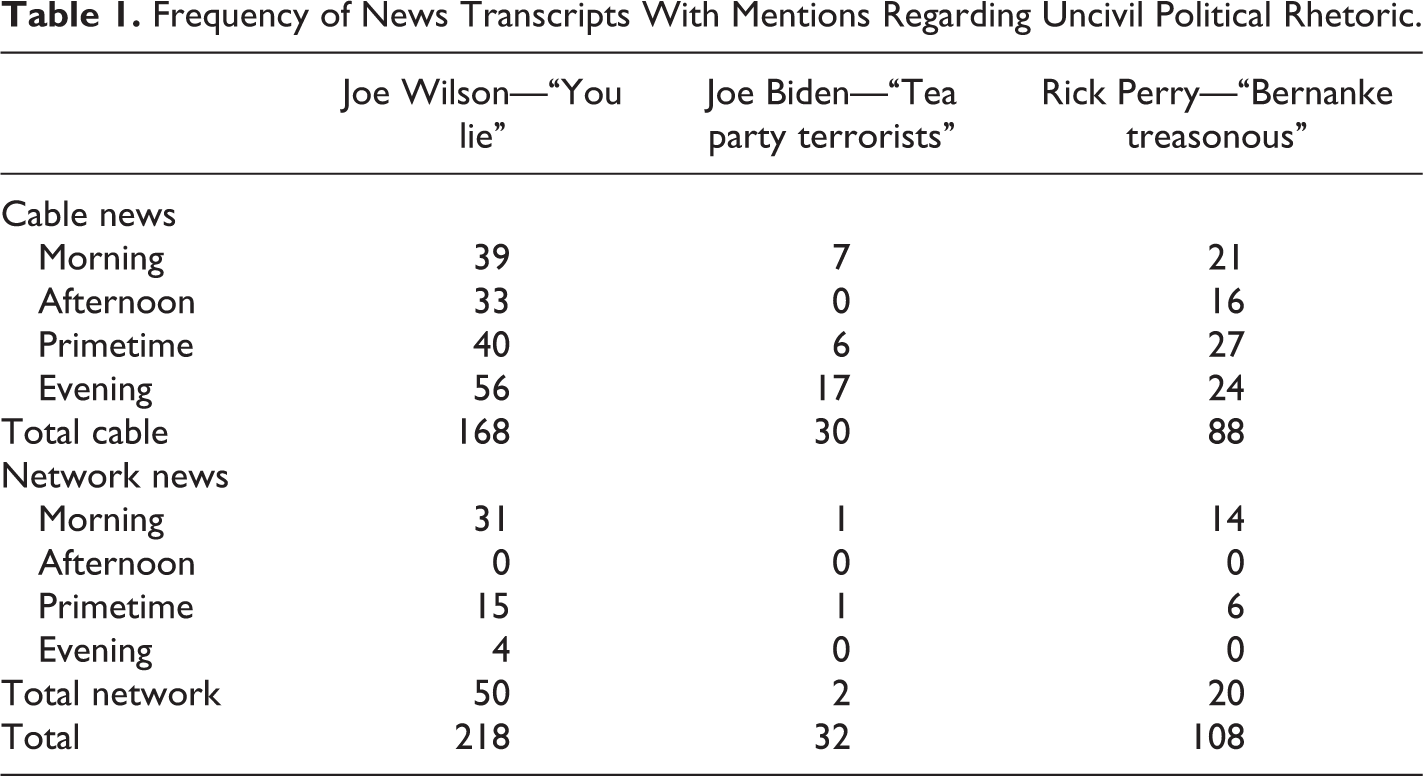
Inspecting coverage of uncivil political events by time and news genre, it is immediately apparent that the frequency of news transcripts with mentions of uncivil events differs greatly across the cable and network genres. For instance, network channels gave almost no traction to Joe Biden’s alleged comments about Republican tea party members being “terrorists.” On cable, however, mentions of Joe Biden’s alleged comments were found in 30 unique broadcast transcripts. Even accounting for all types of network news and public affairs programming, such as Nightline or CBS’ 60 Minutes, the frequency of network news transcripts that mentioned these three uncivil political events appear relatively few compared to the frequency of cable transcripts.
To determine whether there were significant mean differences in uncivil event coverage between cable and network news, a two-tailed t-test was conducted on each case of political incivility. In terms of Joe Wilson’s “you lie” outburst, there was a significant mean difference t(14.38) = 2.68, p < .05 between cable and network coverage, with cable news providing an average of more than nine transcripts with mentions of this event than did network news.
A similar result was found in the case of Joe Biden’s alleged Tea Party “terrorist” comments made in a closed door meeting with Democratic Congressmen. In this case, a two-tailed t-test demonstrated that cable channels paid significantly more attention to the event than did network news t(11.25) = 2.21, p < .05. Cable covered this instance of uncivil rhetoric more than did network news, with an average of about two more transcripts with mentions of the event.
A final t-test was conducted to determine whether there were differences in coverage between cable and network news in the case of Rick Perry’s “treasonous” comments directed at Ben Bernanke. According to results of a two-tailed test, cable also gave more coverage to this uncivil event than did network news t(14.84) = 3.73, p < .05. On average, cable news channels aired six more transcripts with mentions of Perry’s remarks than did network news.
While this analysis only examines three cases of political incivility, the findings provide support for Hypothesis 1, that cable television news will provide more coverage to uncivil political events than will network news. Cable news, which typically presents hostile programming (Sobieraj & Berry, 2011), appears to cover uncivil political events more frequently than network news. In the case of Vice President Biden’s alleged Tea Party “terrorist” remarks, cable mentioned the event 15 times more than did network news. Results for Joe Wilson and Rick Perry were similar, with cable news covering each event more frequently than network news. The second study turns to survey data to examine public perception of incivility across news genres.
Study 2: Secondary Data Analysis
Method
To assess public perceptions of incivility, data from a 2011 CBS and New York Times poll were retrieved online. The data for this cross-sectional survey were collected via telephone from January 15 through 19, 2011. Sample demographics were similar to other nationally representative surveys (see Table 2). A full methodology for this survey can be found online at http://www.icpsr.umich.edu/icpsrweb/ICPSR/studies/33483.
Descriptive Statistics.
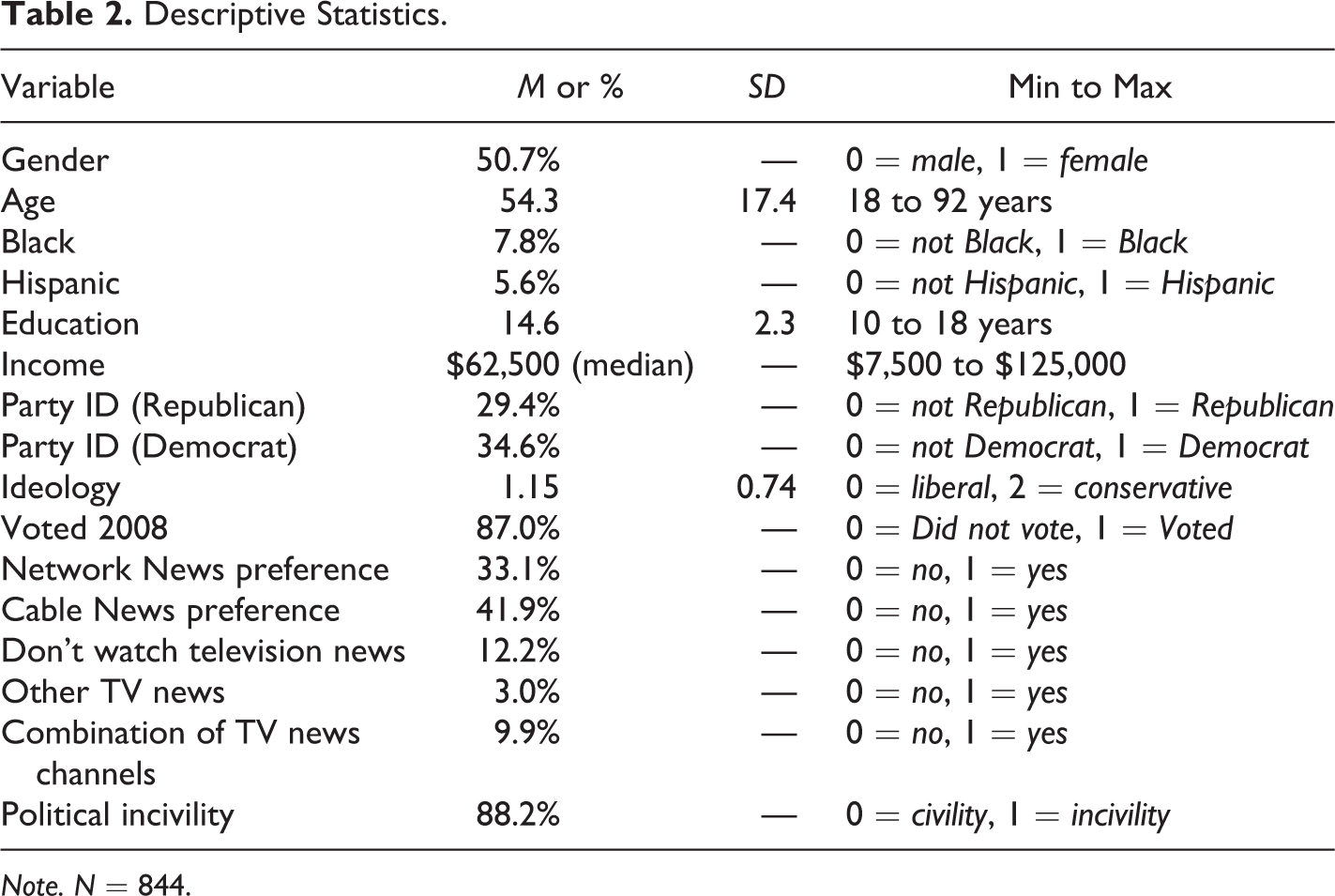
Note. N = 844.
Control Variables
A number of standard control variables were used in the following analysis to mitigate a possible spurious relationship between respondent news habits and incivility perceptions. First, respondent gender (50.7% female), age (M = 54.3, SD = 17.4), and race and ethnicity (7.8% Black, 5.6% Hispanic) were included in the model below. Formal years of education (M = 14.6, SD = 2.3) and median annual income ($62,500) were also included as standard control variables. To control for any differences in incivility perceptions that could result as a function of the respondent’s political predispositions, dummy variables for political party affiliation (29.4% Republican, 34.6% Democrat) were also included. Respondents in the excluded baseline group identified as political Independents (46.0%). Political ideology was assessed on a 3-item scale, going from liberal to conservative (M = 1.15, SD = 0.74). An additional dichotomous variable assessing whether the respondent voted in the 2008 presidential election (87.0% yes, 13.0% no) was included as a basic measure of political participation.
Independent Variable
The independent variable of interest was the respondents’ primary news source. This item was assessed by asking respondents, “Which one of the following television networks do you watch most for information about politics and current events—ABC, CBS, NBC, CNN, FOX News Channel, MSNBC, or don’t you watch television news?” Respondents could answer by picking a particular genre, including network (33.1%), CNN (14.6%), Fox (19.9%), MSNBC (6.4%), another TV news outlet not listed (3.0%), a combination of these channels, (9.9%) or by saying they do not watch news (12.2%). While cable channels clearly differ in partisan and ideological leanings (Stroud, 2011), all types of cable programming tend to be “hostile” (Sobieraj & Berry, 2011) or politically uncivil relative to network news. To make a direct comparison with network news, cable news channels were therefore combined into a single genre—“cable”—in the following analysis (40.9%).
Dependent Variable
The dependent variable of interest was public perceptions of incivility. This item was assessed by asking respondents, “How would you describe the overall tone and level of civility in politics today—would you say it is mostly positive or mostly negative?” Respondents could pick “mostly positive” (12.9%) or “mostly negative” (87.1%), indicating whether he or she perceived the overall tone of American politics as civil and positive or uncivil and negative. Because the dependent variable was dichotomous, a multivariate logistic regression procedure was employed (Long & Freese, 2005). Logistic regression assumes the dependent variable is a binary, 0 or 1 outcome. As such, logistic regression was appropriate.
Results
Results from a multivariate logistic regression procedure yielded three significant predictors of perceptions of incivility and two marginally significant predictors (Table 3). First, the B coefficient for the Black race variable was significant and negative, indicating that going from the excluded White baseline group to the African American group resulted in an increased probability that the dependent variable was coded one (perceived incivility), controlling for all other variables in the model (B = –0.81, SE = 0.23, p < .05). The Democratic party identification (ID) variable was marginally significant and negative, suggesting that going from the status of being a political Independent to a Democrat resulted in a decrease in the probability of being coded a 1 on the dependent variable, controlling for all other variables (B = –0.49, SE = 0.28, p < .10). However, this finding should be interpreted tentatively, because the coefficient for Democratic party ID is only the borderline of significance. The coefficient for the political ideology variable was also significant and negative, suggesting that with each one unit increase in ideology there was a corresponding b-unit change in the log odds ratio and the dependent variable was coded 1 (B = –0.36, SE = 0.18, p < .05). In other words, conservatives had a lower probability of perceiving incivility in American politics than their liberal-leaning counterparts.
Multivariate Logistic Regression Analysis Showing Associations Between Television News and Perceived Incivility In Politics (Perceived Incivility Coded High).
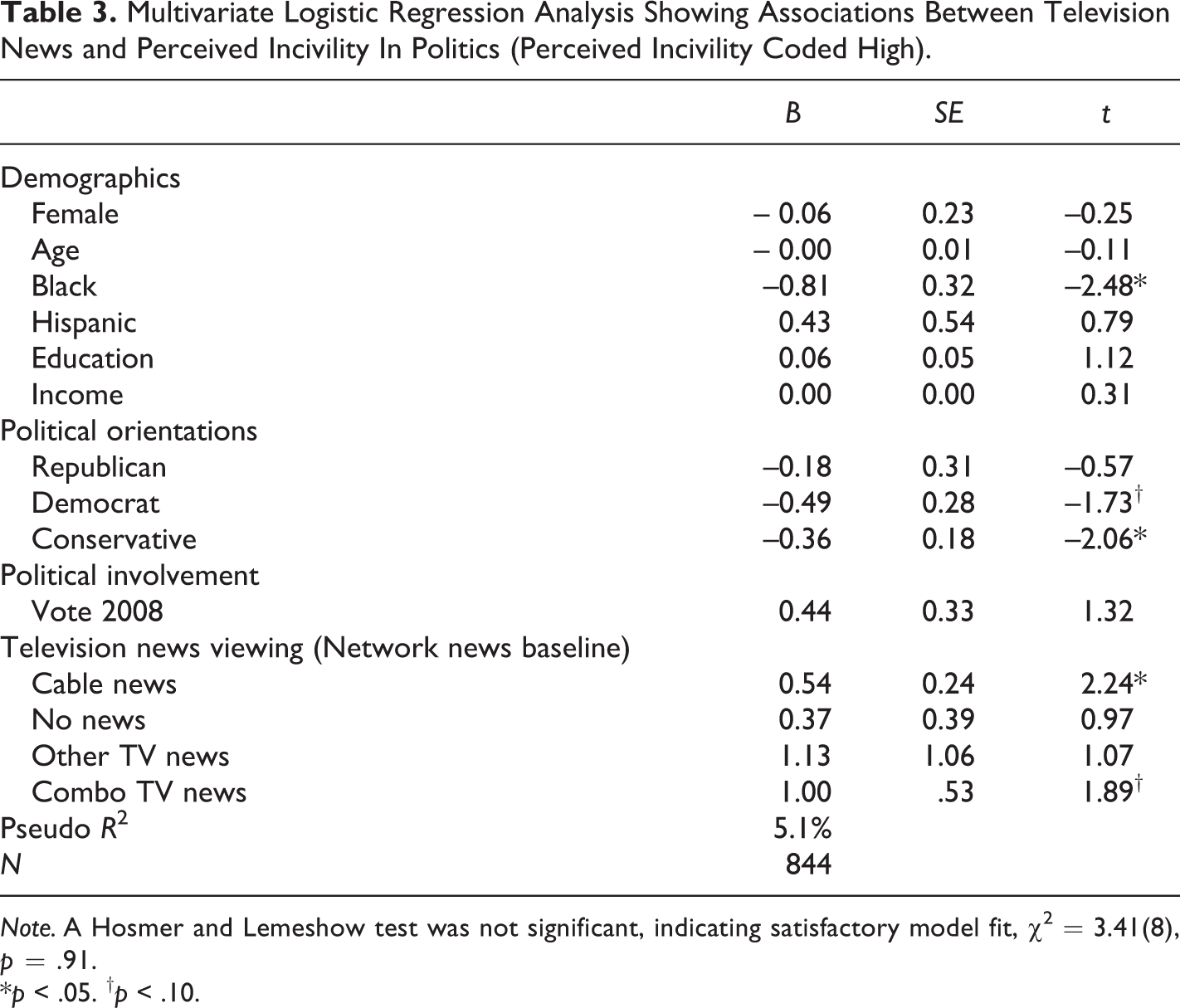
Note. A Hosmer and Lemeshow test was not significant, indicating satisfactory model fit, χ2 = 3.41(8), p = .91.
*p < .05. †p < .10.
Two primary independent variables predicted perceptions of incivility in politics. The first was the cable television news dummy variable, which indicates that those who said a cable news channel was their primary source for news had a higher probability of being coded a 1 on the dependent variable compared to the baseline network television group (B = 0.54, SE = 0.24, p < .05). That is, controlling for all other variables in the model, respondents who reported a preference for cable had a higher probability of saying that American politics was negative and uncivil. Thus, Hypothesis 2, that cable television news viewers will be more likely than network news viewers to perceive incivility in politics, receives support. Additionally, compared to respondents who preferred network news, respondents who said they watched a combination of cable, network, or other television sources had a higher probability of being coded 1 on the dependent variable, holding constant all other variables in the model (B = 1.00, SE = 0.53, p < .10). Again, this finding is on the borderline of significance and should be interpreted tentatively.
Discussion
Taken together, this article provides support for genre-specific cultivation effects. The results suggest that the hostile content (Sobieraj & Berry, 2011), strong partisan leanings (Stroud, 2011), and presentational format of cable news differs from network news to the extent cable may create a unique image of American politics that is considerably more negative and uncivil than objective reality (APPC, 1998, 2001, 2011a). Importantly, this article shows that cable news frequently covers acts of elite political incivility. Network news, which presents a relatively dispassionate vision of politics, provides comparatively little coverage of elite political incivility. As a result of differences in incivility coverage, the political reality portrayed on cable television news likely appears more uncivil to viewers than the political reality portrayed by network news.
Theoretically, these results imply that the cable news genre, not necessarily television programming as a whole, has the potential to influence public perceptions of incivility. By demonstrating that cable news channels (CNN, FOX, and MSNBC) tend to cover uncivil political events more frequently than do network channels (ABC, CBS, and NBC), and by showing that this kind of coverage corresponds with differing perceptions of incivility, this article lends theoretical evidence to the existence of genre-specific media cultivation effects. This investigation provides evidence that particular genres of television programming (cable and network news) influence perceptions of reality, not necessarily overall television viewing. In this way, this article lends additional evidence to the prospect that cultivation theory should be amended to incorporate genre- and program-specific effects instead of assuming broad messages found in all television content gradually enculturate viewer perceptions of reality over time.
Global level television viewing or viewing of multiple genres, however, should not be discounted as an explanation for heightened perceptions of incivility in politics. As shown in Study 2 of this article, survey respondents who said they watch a combination of cable and network television channels were more likely to perceive incivility in politics than were network viewers in the excluded baseline group. This finding may result from exposure to multiple TV news genres reinforcing uncivil messages. That is, “news-seeking” respondents who enjoy getting news from more than one source (Ksiazek, Malthouse, & Webster, 2010) might hold heightened perceptions of incivility via repetitious exposure to uncivil messages across news outlets. Future research could investigate additive cultivation effects of viewing news about elite incivility across multiple channels. The first step in this process would be to conduct a more comprehensive analysis of television portrayals of political incivility than was presented in this article. These depictions could then be related to public perceptions using survey analysis.
With regard to demographic variables, it is telling that conservatives are less likely to perceive incivility in the current political environment than are liberals. Because many prominent cases of political incivility have been directed at the Obama presidency (e.g., Herbst, 2010), liberals may more sensitive to incivility than are other groups. However, the fact that respondents identifying as Democrats also appear less likely to perceive incivility than Independents in the excluded baseline group does not fully mesh with this explanation. Possibly, the political ID and ideology variables are capturing the effects of strong political orientations on perceptions of incivility. Perhaps Democrats and conservatives can more easily retrieve memories of more uncivil periods in the nation’s past due to an inherent interest in and knowledge of American politics? There is in fact a rich history of American political incivility dating back to the legendary political battles of John Adams and Thomas Jefferson (Greenstein, 2006). Political rivals called Abraham Lincoln a “traitor” and a “baboon” (White, 2009), referred to Andrew Jackson as a “bloodthirsty brawler,” and while Franklin D. Roosevelt was a hero to some and was a “socialist” to others (Sutton, 2012). It could be the case that respondents with strong political orientations are simply better able to compare current levels of incivility to previous periods. Future research could examine incivility perceptions among partisan and ideological groups.
In terms of race and ethnicity, African American respondents were found to be less likely than White respondents to perceive incivility in politics. This finding makes sense in that African Americans, a group disenfranchised for centuries (e.g., Verba, Schlozman, Brady, & Nie, 1993), may not be as interested in politics as are Whites. African Americans may simply not be exposed to the same level of television news programming featuring elite incivility.
In general, the race and ethnicity variables and other demographic controls lend support to the key findings of the secondary data analysis conducted herein. By accounting for these demographic variables—by holding them constant in the analysis—it is possible to control for several confounding factors, such as political ID or political ideology, that could render the relationship between TV news exposure and perceptions of political incivility spurious.
One critical limitation of this article was its reliance on only three national level cases of incivility. These cases were sampled purposively to eliminate biases in media coverage provided to national political figures of different ranks (e.g., a governor, a congressman) and political parties (Republican and Democratic). But because a nonprobability sampling technique was employed, generalizations to the entire population of television news content cannot be made.
Another limitation of this article was that the only measure of television consumption available was a preferential measure, not a frequency measure. While research shows that Americans often spend substantial amounts of time viewing their preferred news channel (e.g., Stroud, 2011), future studies could improve on this research by including a continuous measure of news exposure for each television news genre or channel. The flip side of this limitation is that a preferential measure might demonstrate an even more robust cultivation effect. Specifically, since Gerbner and Gross’ (1976) original cultivation studies, research has shown that individuals have problems recalling how often they use news media (Prior, 2009). In this case, a preferential measure may accurately capture genre-specific effects of network and cable among both heavy and light viewers without encountering validity problems associated with a frequency metric.
A final limitation deals with alternative theoretical explanations. It is possible, for instance, that this article’s results reflect a second-level agenda-setting or framing effect (Ghanem, 1997; Scheufele, 2000), whereby news media content explicitly or implicitly emphasizes political incivility as an increasingly important problem, which primes audiences to attribute more importance to incivility (see Nelson, Clawson, & Oxley, 1997). While this article cannot rule out the possibility of second-level agenda-setting (framing) effects, future research could analyze news coverage of elite incivility over time, accounting for media frames that attach weight to the importance of incivility in American politics. In the absence of additional research, media cultivation provides the most parsimonious explanation for this article’s findings.
In conclusion, this article does not suggest a complete absence of incivility in the elite political environment. The cases analyzed in this article clearly indicate that elite incivility exits, at least insofar as it is defined as impolite rhetoric and behavior (although, see Entman, 2011, for an alternative conceptualization of incivility). Nevertheless, this article does suggest that future research on political incivility should place more emphasis on media representations of incivility. There are already competing literatures emerging on the effects of elite political incivility on the electorate, such as the effect of incivility on trust in government, with some research finding negative democratic outcomes (Mutz & Reeves, 2005) and other research finding positive outcomes (Brooks & Geer, 2007; Papacharissi, 2004). However, the debate over the effects of political incivility on the public should not precede or preclude a debate on whether claims of increases in incivility are based in the reality of American politics or are actually a perceptual artifact of viewing the increasingly uncivil political world portrayed in cable television news.
Footnotes
Declaration of Conflicting Interests
The author declared no potential conflicts of interest with respect to the research, authorship, and/or publication of this article.
Financial Disclosure/Funding
The author received no financial support for the research, authorship, and/or publication of this article.
References
Supplementary Material
Please find the following supplemental material available below.
For Open Access articles published under a Creative Commons License, all supplemental material carries the same license as the article it is associated with.
For non-Open Access articles published, all supplemental material carries a non-exclusive license, and permission requests for re-use of supplemental material or any part of supplemental material shall be sent directly to the copyright owner as specified in the copyright notice associated with the article.
