







Abstract
The 2012 presidential election cycle was marked by an increase in simultaneous media use, often known as “social TV,” particularly among young adults whose attention to TV has fragmented in the digital age. This study is one of the first to apply uses and gratifications theory to the simultaneous use of both social media and mass media. Although a low survey response rate hinders generalizability of this study, the considerable size of the sample (N = 2,727) makes this research useful for identifying motivations and political outcomes of using two screens. Findings show those who actively used social media while watching TV for sociocognitive motives were likely to have engaged with one of the 2012 presidential candidates by following them or sharing their content on Facebook or Twitter. Active social TV users also reported that they weighed the candidates’ social media presence when making voting decisions. Implications for researchers and practitioners are discussed.
The 2012 presidential election cycle may be remembered for being the first in which social media combined with TV to create a “second-screen” engagement experience between the potential voters and the candidates. Social network sites (SNS), most commonly Facebook and Twitter, served as venues for viewers to interact with each other, journalists, and candidates on a wide scale while simultaneously watching live convention coverage and candidate debates on TV (Pew Research Center, 2012a; Sasseen, Olmstead, & Mitchell, 2013). Decades of uses and gratifications (U&G) research have long assumed a goal-directed, active audience, which may not always have been the case among traditional mass media consumers (LaRose and Eastin, 2004; Kippax & Murray, 1980; Rubin, 1983; Ruggiero, 2000). This study takes U&G theory a step further by examining how certain motives for simultaneously attending to both mass and social media may lead to an engaged, “social TV” audience, particularly among young adults whose attention has been fragmenting away from TV and toward digital communication in the past decade (Rainie & Wellman, 2012). As simultaneous media use (SMU) during live news events increases, mass media scholars and practitioners must gain a better understanding of the consumer’s underlying motivations for this activity and the opportunities provided.
Although U&G theory has presumed that consumers select one medium among many that compete for their attention (Tan, 1985), the possibility now exists of a highly active media audience who purposively engages with other via social networks about what they are watching on TV. Previous researchers have found a relationship between having interpersonal discussions about mass media content and increased political and civic participation (McLeod, Scheufele, & Moy, 1999; Shah, 1998). More recent studies also have reported some relationships between social and informational motivations for social media use and political outcomes, both online and off-line (Baumgartner & Morris, 2010; Gil de Zúñiga, Jung, Valenzuela, 2012; Zhang, Johnson, Seltzer, & Bichard, 2010).
The present study seeks to explore whether a correlation existed between goal-directed SMU, to fulfill social/cognitive needs, and engagement with one of the 2012 presidential candidates on social media platforms, through liking them on Facebook, following them on Twitter, or sharing their content. Relationships between social TV motivations, civic involvement, and likelihood to vote are also explored. While the so-called second-screen activities vary (Phalen & Ducey, 2012), this study focuses specifically on the use of social media while watching TV. This study is useful for mass communication scholars and practitioners because much of the evidence thus far about the relationship between active SMU and political behaviors is anecdotal and descriptive in nature. We know, for example, that during the first presidential debate of 2012, 1 in 10 viewers dual screened the debate, with 18- to 39-year-olds reporting the highest multiscreen political activity at 22% (Pew Research Center, 2012a). Nearly one third of Americans watched election night coverage online and on TV to monitor broadcast media responses, fact check, or monitor social media (Sasseen et al., 2013). After the networks called the election, President Obama’s campaign posted a victory statement through social media that featured a photo of him hugging the first lady. Almost instantly, that post went viral, becoming the most liked Facebook post of all time and retweeted tweet ever, with 800,000 forwards—beating the previous Twitter record holder, pop singer Justin Bieber (Franceschi-Bicchierai, 2012). But how do specific motivations for second screen use relate to political involvement online or off-line?
The 2012 election is particularly interesting because social media use has nearly doubled since the last presidential election. While Barack Obama notably used social media strategies during his 2008 campaign, the use of social networks by American adults was just 35% then, compared to 60% in 2012 (Lenhart, 2009; Rainie, Smith, Schlozman, Brady, & Verba, 2012). Additionally, Obama’s opponent in 2012, Mitt Romney, utilized social media to a greater extent than the 2008 Republican nominee, John McCain (Worthman, 2012).
Young adults with some college education are the most frequent second-screen users (Rainie et al., 2012). Therefore, the target population of this study is college students. The sample is drawn from responses (N = 2,727) to a campus-wide omnibus survey conducted at a large university in the southwestern part of the United States during the 2012 presidential election season. This study is framed by the U&G theory of media attendance, with an emphasis on sociocognitive motives (LaRose & Eastin, 2004), and prior research linking social and cognitive media use gratifications with political and civic participation.
Literature Review
U&G of Mass Media
Since the birth of radio, scholars have analyzed the psychological and emotional reasons that drive people to attend to certain types of mass media over another (Blumler & Katz, 1974). Rather than assuming that mass media determine audience effects, U&G theory focuses on the motives behind consumers’ media choices. Several factors simultaneously drive media users at any given time, including psychological characteristics, social context, perceptions, and attitudes (Rubin, 1983). U&G theory takes a view that audiences actively choose among competing media in order to gratify specific needs (Blumler & Katz, 1974). Key motivations for mass media attendance have been categorized into four areas that still have some relevance today: information/surveillance, interpersonal identity, social interaction, and entertainment/diversion (Katz & Gurevithc, 1974; Swanson, 1987).
Each of these motivations may have social consequences that Shah (1998) noted could be positive or negative. Information seekers, for example, may gain knowledge about issues impacting their communities; personal identity uses could help people understand themselves and the social world they inhabit; social interaction uses may allow people to model certain behaviors that help them connect to each other. The entertainment/diversion uses may have negative social impacts, however, because the primary motivation is to distract (Katz & Gurevitch, 1974; Zillman & Bryant, 1985).
Political and Social Outcomes of Mass Media Use
Scholars, concerned with the decline of social interconnectedness, civic engagement, and voter turnout that began toward the latter half of the 20th Century, have looked to frequency of mass media use as a possible causal explanation for the downturn in public participation (Brehm & Rahn, 1997; Putnam, 1995). Putnam (1995) faulted TV for eroding social interactions by taking time away from civic activities and reinforcing a negative view of social reality. Norris (1996), however, noted that Putnam assumed only one TV experience and ignored the fact that audiences are made up of different types of people with multiple channels and programs from which to choose. Brehm and Rahn (1997) concluded that TV use was negatively related to civic engagement while the opposite was true with newspaper readership, but the authors similarly failed to differentiate between types of viewing experiences.
Subsequent research has confirmed that the motivations for using mass media, not the frequency of use, are more strongly related to participation and sociability, with surveillance and information seeking having the most positive effect rather than entertainment/diversionary motives (Gil de Zúñiga, 2009; Wellman, Haase, Witte, & Hampton, 2001; Zhang & Chia, 2006).
Extending U&G Theory Online
Scholars have argued that U&G theory needs to be updated to reflect the 21st-century interactive technologies and computer-mediated communication (LaRose and Eastin, 2004; Ruggiero, 2000). Papacharissi and Rubin (2000) determined that the most salient motive driving Internet use was active and purposive information seeking. Shah, Cho, Eveland, and Kwak (2005) found informational media use online combined with traditional media to foster political and civic participation. Other authors, however, were concerned that digital technologies were creating a more fragmented, isolated, and passive audience (Carr, 2010; Putnam, 2000; Turkle, 2011). Papacharissi and Rubin theorized that people might be spending time online as a functional alternative to face-to-face contact.
The proliferation of mobile technologies and social network sites, however, has led to increased social interactions online (Rainie & Wellman, 2012). In fact, researchers have identified the primary gratifications sought when using digital technologies as the need to connect with others (Chen, 2011) and achieve social status (LaRose & Eastin, 2004). Achieving social status leads to the production of social capital, defined by Lin (2008) as gaining resources through social networks that can be accessed or mobilized through network ties.
Researchers have found that producing social capital is a primary motivator in joining social networks, such as Facebook (Boyd & Ellison, 2007; Raacke & Bonds-Raacke, 2008). Members are interested in strengthening close ties with family and friends, known as bonding social capital, or creating opportunities and meeting new friends through connections, known as bridging social capital (Raacke & Bonds-Raacke, 2008). Gil de Zúñiga, Jung, and Valenzuela (2012) noted that social network sites could foster a sense of community and build social capital as group members exchange information, thereby increasing trust. Rainie and Wellman (2012) used the term “networked individuals” to describe a new social operating system in which digital technologies form or reinforce social ties, thereby increasing connectivity. Because of its more public nature than Facebook, Twitter has been identified as a social network that attracts news consumers, smartphone users, and those who want to share and report information (Chen, 2012; Java, Song, Finin, & Tseng, 2007; Smith & Brenner, 2012).
Political Outcomes of Using Social Media
Results of prior election studies have been mixed in identifying relationships between patterns of social media use, civic and social engagement, and political participation. Johnson, Kaye, Bichard, and Wong (2007) found blog and SNS users had a higher interest in elections. Baumgartner and Morris (2010), however, concluded that young (18- to 24-year-olds) SNS users were no more inclined to participate in politics than users of other media early in the 2008 presidential primary. Reliance on SNS has been significantly related to online and off-line political behaviors as opposed to YouTube, although use of SNS did not appear to strengthen the intent to vote (Johnson, Zhang, Bichard, & Seltzer, 2011). The same authors (Zhang et al., 2010) found reliance on SNS was positively related to civic engagement but not political participation. Vitak et al. (2009) concluded that those who used Facebook for political activity also had an increase in off-line and online political behaviors, but the amount of time spent on Facebook overall was negatively correlated with political behavior. Valenzuela, Park, and Kee (2009) disputed the idea that heavy Facebook users are more isolated off-line by showing a positive association with both intensity of Facebook use and intensity of Facebook groups use among college students and their social trust and civic and political participation.
Similar to the mass media studies described earlier, research into social media use and the 2008 presidential election points to the social and information-seeking motivations of using digital media as being more important than time spent on social media, when analyzing political outcomes. Kaye (2011) reported that the social aspect of SNS was a key motivator for political usages as opposed to less interactive websites or blogs that satisfy cognitive needs. Ancu and Cozma (2009) also concluded that social interaction was the main reason members of MySpace befriended candidates during the 2008 presidential primaries, either to meet other supporters or to find out what others are saying to candidates. They reported information seeking to be a motivator for younger audiences’ use of MySpace while older members sought to fulfill entertainment needs. Gil de Zúñiga et al. (2012) also established a positive relationship between those who used SNS for information purposes and civic engagement.
Multiscreeners as Active, Social Audiences
As accessing online technologies and social networks has become more prevalent through mobile devices, such as smartphones and tablets, the practice of multiscreening—using another device while watching TV—has also increased (Phalen & Ducey, 2012; Sasseen et al., 2013). A report commissioned by Google (2012) showed Americans are using either a smartphone or a PC/laptop while watching TV 77% on a typical day. Nielson (2012) found nearly half of 18- to 24-year-olds use their smartphones while watching TV at least once a day. The Google, Nielson, and a U.K. study (Deloitte, 2012) emphasized that the primary use of the second screen is social in nature (rather than solo activities such as search engine use), through social networking, e-mail, or texting. Almost one quarter of the time, the multiscreening activity is complementary to the content being watched on TV, particularly among young people (Deloitte) and during live broadcasts, such as political debates, and sporting events.
Media engagement has been difficult to define, but time spent, intensity of use, and sense of connectedness are factors that may play a role (Evans, 2008). Active SMU can therefore be defined as intentionally seeking specific content for social or informational purposes, rather than passively or habitually watching and surfing the second screen (Phalen & Ducey, 2012). The possibility may then exist for televised events, particularly those broadcast live, to create a sense of shared experiences, through traditional media and social networks, which could lead to greater engagement with the content (Costello & Moore, 2007; Phalen & Ducey, 2012).
Given the literature that has identified information-seeking and social motivations of media uses as positive predictors of political behavior, particularly among young adults, this study presumes that those same motivations for using social media while watching TV will relate to the following political outcomes:
Voting and Civic Outcomes of Social Media Engagement
Prior research has shown social cues received through digital media and social networks to be influential in increasing political participation and civic engagement. From a U&G perspective, Leung (2009) found a strong correlation between online content creation, civic engagement, and psychological empowerment. Velasquez (2012) found members of an online Columbian political community increased their participation based on cues from other members, whom they considered to be experts, and the speed with which the discussion took place. A study of political mobilization messages posted on Facebook during the 2010 Congressional elections in the United States showed the messages positively influenced political self-expression, information seeking, and off-line voting behavior (Bond et al., 2012).
Pew surveys also described social media users, particularly of Facebook, to be more politically active than nonusers (Hampton, Goulet, Rainie, & Purcell, 2011). During the 2012 election cycle, the Pew Internet and American Life Project reported that 66% of the social network members had used the platforms to make at least one of eight civic or political acts, such as following candidates, liking and linking to others’ content, or encouraging friends to vote. Adults between the ages of 18 and 29 years, who had some college education, were most likely to engage in these civic activities. Because of the relationship between active social media use and off-line political and civic involvement, these additional hypotheses are proposed:
Method
Data were gathered for this study through questions included in an omnibus survey made available online to all undergraduate and graduate students (N = 30,908) attending a large southwestern university during the Fall 2012 semester. Enrollment services sent an initial e-mail inviting the students to participate on October 29, 2012, and a reminder e-mail on November 11. The link was deactivated on November 17. Therefore, the survey was available 1 week prior to the presidential election and the 2 weeks after the election. To increase participation, students were offered a chance to enter a drawing to win one of two US$100 gift cards to the student bookstore.
A total of 2,727 students completed the survey, representing a response rate of 8.8%. Although not ideal, this response rate is consistent with other web-based surveys administered to college students (Valenzuela, Park, & Kee, 2009). The ethnic demographic breakdown of the sample is representative of the total population of students, according to the information provided by the university, with Caucasians making up 45% of the sample (n = 1226). Females were overrepresented in the sample at 69% compared to 58% of the student body. Gender was not found to be a significant predictor of any of the media use variables, however. Nearly 40% of the students took the survey prior to the election; the remaining 60% completed the survey after the election. No substantial differences were found between those who took the survey earlier or later.
Sample Characteristics and Survey Measures
Sociodemographic Variables
Respondents were asked to enter their age in years. Answers ranged from 18 to 65, with 91% of the sample under the age of 31 (M = 23.63, standard deviation [SD] = 6.68). The majority of the sample also represents the millennial generation, defined by the Pew Research Center as being born between the years 1981 and 2000 (Keeter and Taylor, 2009). Nine options were offered for ethnicity. For this analysis, the ethnicity variable was recoded as a binary, with a higher count (45%) of White. The gender variable also was recoded as males = 0, females = 1 (male = 31%, female = 69%). Income was measured with the question “What best describes your monthly disposable income?” Students were asked to choose from a 5-point range of US$0–US$250 per month (M = 3.15, median [Mdn] = US$25–US$100, SD = 1.3)
Social Media Use
Respondents were asked to select the social media sites they use from the following list: Facebook, Twitter, LinkedIn, and Pinterest. Facebook was used by 91% of the respondents, followed by Twitter to a lesser extent (30%), and Pinterest (22%).
SMU
Participants were asked to rate the frequency with which they used social media while watching TV on a 6-point Likert-type scale with 1 being never and 6 being several times a day. More than one third (n = 897) responded that they simultaneously used social media while watching TV several times a day; 85% of the sample reported that they did so at least one or more days per week (M = 4.03; SD = 1.8).
Motivations for SMU
Those who responded that they do engage in social media while watching TV were asked to rate the frequency with which they do so, ranging on a 4-point scale from never to very frequently. Four possible motivations, informed by updated definitions of U&G theory, were offered ranging from socially active to diversionary.
The most common motivations of using social media while watching TV were diversionary in nature with entertainment/fun first (M = 3.54, SD = 1.11), followed by “socializing with family/friends not regarding what I’m watching” (M = 3.51, SD = 1.22). Next were the sociocognitive and complementary uses: “get news and information” (M = 3.27, SD = 1.1), and “socialize with others specifically regarding what I’m watching” (M = 2.20, SD = 1.1).
Engagement With Candidate via Social Media
Respondents were asked to answer “yes” or “no” to four possible acts of engagement with any of the 2012 presidential candidates via Facebook (liking a candidate’s Facebook page or posting a comment on their page) and Twitter (following a candidate on Twitter, or retweeting/asking a question of them on Twitter). Acts of engagement with the candidates were combined (one act = 1, two acts = 2) into separate indices for Facebook and Twitter.
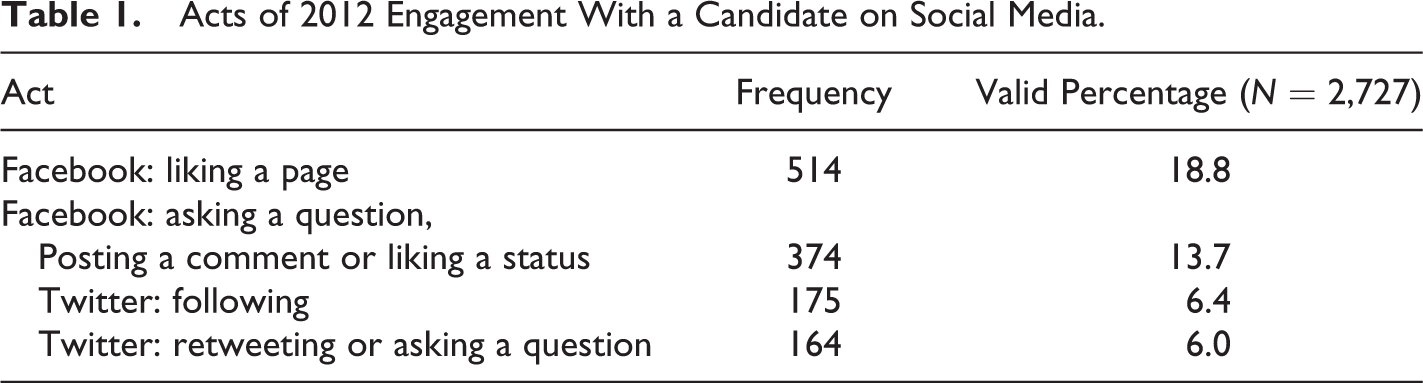
Nearly one fifth (20%) of the respondents had engaged with a candidate on Facebook by liking a candidate’s page. Following a candidate on Twitter, the lesser used platform, was lower at 6.4%. Table 1 shows the types of candidate engagement by frequency and percentage.
Acts of 2012 Engagement With a Candidate on Social Media.
Impact of Candidate’s Social Media Presence
The survey asked respondents to rank how much impact the presidential candidates’ presence on social media would have on their voting decision on a 4-point Likert-type scale ranging from no impact to a great deal of impact. Nearly half (46%) of the respondents said the social media presence would have at least some impact on their voting decision (M = .75, SD = .96).
Civic Involvement
The respondents were asked to select campus organizations with which they were associated. A list of 11 organizations was provided based on overall category (academic, arts, political, service, etc.). An index was created for civic involvement equal to the number of activities each student checked.
Likelihood to Vote
Respondents were asked how likely they were to vote in the 2012 presidential election on a 4-point Likert-type scale from not at all likely to very likely. The majority (85.7%) of the participants were somewhat or very likely to vote/had voted. The majority (60%) also supported Obama for president.
Findings
To test the hypotheses, data analysis consisted of performing multiple linear regressions with the SMU motivations as independent variables, using SPSS Version 20. Because sociodemographic variables have been shown in prior research to correlate with civic and political engagement (Gil de Zúñiga et al., 2012; Valenzuela et al., 2009), age, gender, ethnicity, and income were controlled in the first block. The four motivations for simultaneous social media and mass media use were then entered in two blocks, with the unrelated or diversionary motivations first, followed by sociocognitive motivations.
Hypothesis 1 proposed that the social/cognitive motivations for SMU, information seeking, and using social media to converse with others about what is being watched on TV would positively relate to engagement with a candidate on social media. As shown in Table 2, the active social/cognitive motivations were positively related and statistically significant to engagement with a candidate on both Facebook and Twitter. Therefore, Hypothesis 1 was supported. Socializing with others not related to what is being watched also was a significant, positive predictor of engagement with a candidate but only on Facebook. The diversionary motive of entertainment/fun, however, was negatively related to engagement with a candidate on Facebook.
Regressions Predicting Engagement With a Candidate on Social Media.
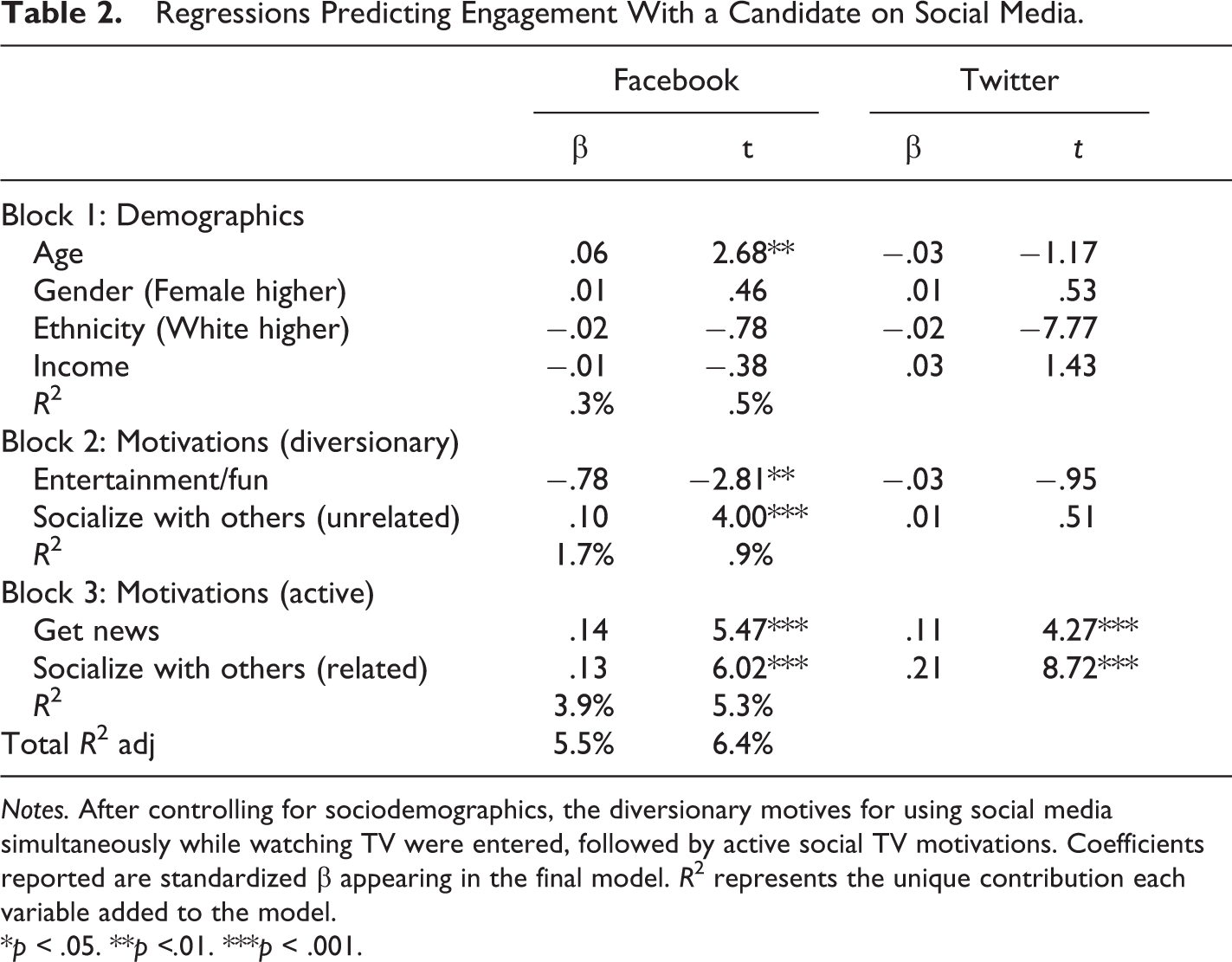
Notes. After controlling for sociodemographics, the diversionary motives for using social media simultaneously while watching TV were entered, followed by active social TV motivations. Coefficients reported are standardized β appearing in the final model. R 2 represents the unique contribution each variable added to the model.
*p < .05. **p <.01. ***p < .001.
Regarding Hypothesis 2, social/cognitive motivations for SMU were also significantly related to the degree of influence the candidate’s social media presence had on the voting decision of the respondents. Again, those who simultaneously used social media while watching mass media primarily to socialize with others regarding the content they were watching had a strong positive relationship, followed by getting news, confirming Hypothesis 2. The diversionary motives were not significantly related. Age and ethnicity were related to this outcome, with younger, non-Whites being more likely to take social media presence into consideration when making a voting decision (Table 3).
Regression Analysis of the Impact of Candidates’ Social Media Use on Voting Decisions.
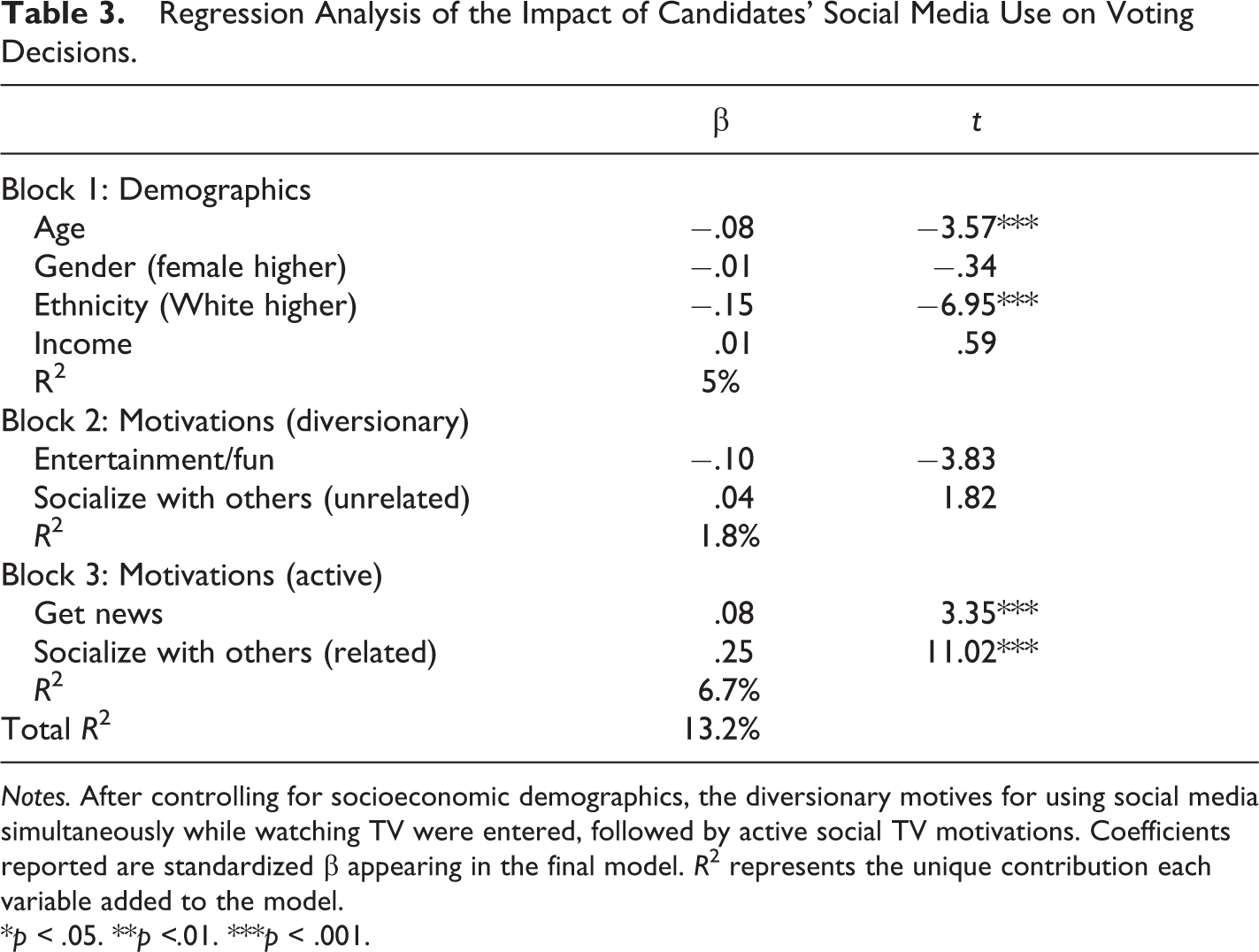
Notes. After controlling for socioeconomic demographics, the diversionary motives for using social media simultaneously while watching TV were entered, followed by active social TV motivations. Coefficients reported are standardized β appearing in the final model. R 2 represents the unique contribution each variable added to the model.
*p < .05. **p <.01. ***p < .001.
Hypothesis 3 proposed that those who simultaneously watched TV while using social media for social/cognitive motives would be more civically active. Of the media use motivations entered in the regression, only “to socialize with others not regarding what I’m watching” was a significant predictor (β = .02, p < .01). Because the social/cognitive motives were not significantly related to civic involvement, this hypothesis was not supported. Hypothesis 4 was also rejected. No media use motivations predicted voting behavior.
Post hoc analysis, however, showed a positive and noteworthy relationship between the dependent variables of engagement with a candidate through social media and civic involvement, as shown in Table 4. Engagement with a candidate was also positively related to the likelihood to vote. Having engaged with a candidate on Facebook (β = .12, p < .001) or Twitter (β = .05, p < .05) was a predictor of voting in the 2012 election. This engagement, in fact, approximately explained the same percentage (2%) of the variance in voting behavior and civic involvement as the sociodemographic block. Being older, female, and White were the positive sociodemographic predictors of voting. Age was negatively associated with civic involvement, meaning younger people were more active on campus.
Relationships Between Engagement With a Candidate on Social Media and Political Outcomes.
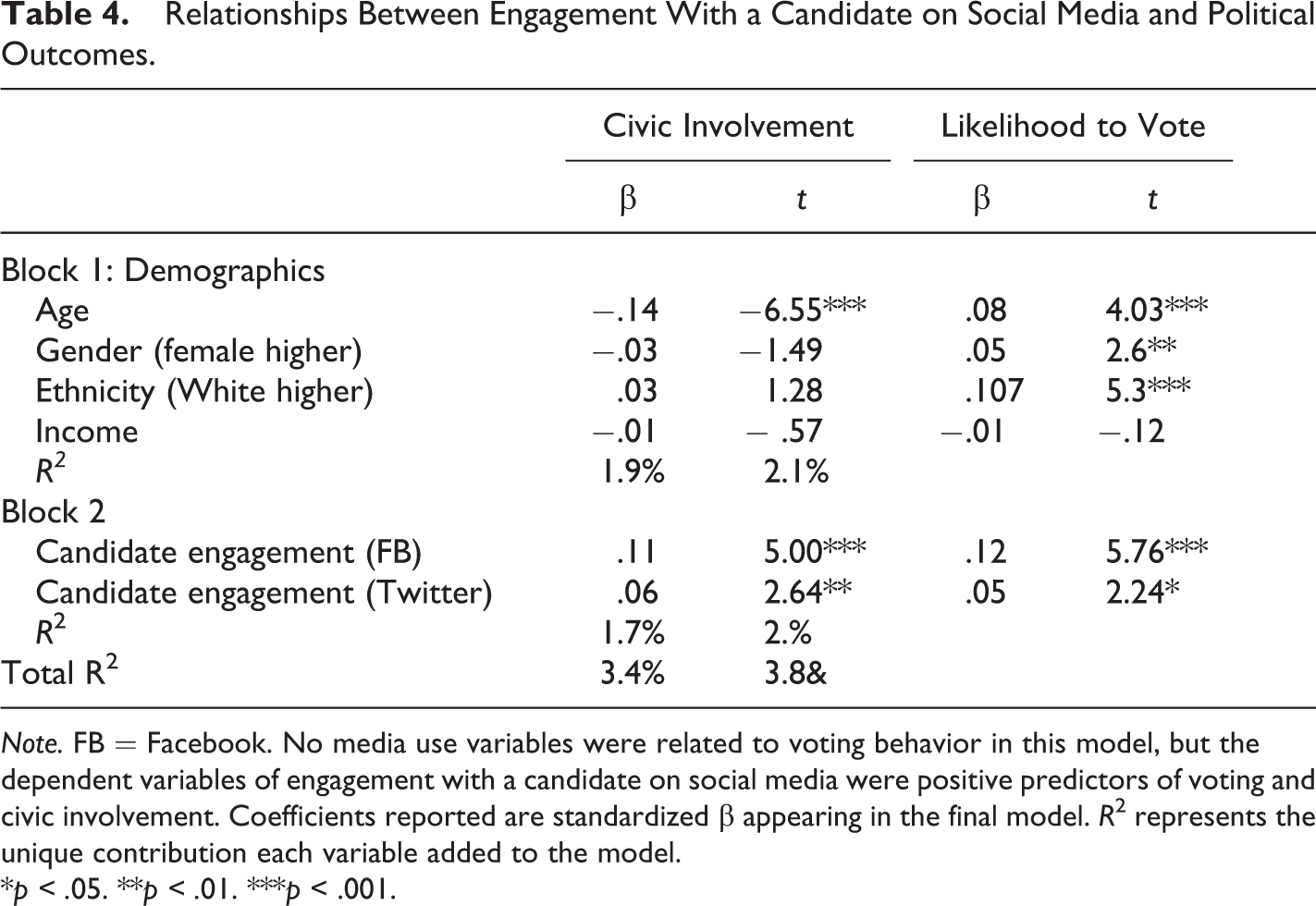
Note. FB = Facebook. No media use variables were related to voting behavior in this model, but the dependent variables of engagement with a candidate on social media were positive predictors of voting and civic involvement. Coefficients reported are standardized β appearing in the final model. R 2 represents the unique contribution each variable added to the model.
*p < .05. **p < .01. ***p < .001.
Discussion
The 2012 presidential election cycle was unique in that social media use, particularly Facebook and Twitter, had reached a much higher adoption rate among mass media audiences than in 2008. These social media forces combined with live televised events (debates, convention, and election coverage) to create a social TV experience that allowed consumers to engage with others across geographic and spatial boundaries about what they were watching and obtain further information (Sasseen et al., 2013). This study examined relationships between different motivations for using two screens: those more diversionary in nature and sociocognitive motives that are defined as more active and purposive.
The sociocognitive motivations for using a second screen while watching TV were positive predictors of having engaged with a presidential candidate through either Facebook or Twitter by following them, liking their page, asking a question of them, or sharing their content. These users are motivated by the cognitive need to seek more information or the social need to converse with others regarding what they are watching. Although social motivations of second-screen use unrelated to the content being watched also positively correlated with candidate engagement on Facebook, diversionary uses (entertainment/fun) were negatively related. The active social TV user also considered the social media presence of the candidates when making voting decisions. These findings are consistent with prior U&G research linking sociocognitive motivations for mass or social media uses with increased political participation (Ancu & Cozma, 2009; Shah, 1998; Wellman et al., 2001).
Sociocognitive second-screen uses did not predict voting behavior and civic involvement. Post hoc analysis, however, showed that having engaged with a candidate on social platforms did have a positive relationship with voting and civic involvement. Engagement with a candidate could, therefore, be a mediating variable that relates to greater civic participation and voting behavior.
Notably, the sociodemographic predictors are different for likelihood to vote and weighing the candidates’ social media presence in voting decisions. Those likely to vote were older, White, and female. Those weighing the social media presence of the candidate were younger and non-White. This demographic, often on the periphery of participation in the public process through traditional means, may be finding a voice in newer, horizontal forms of communication. Whether that expression eventually transfers into increased voting behavior remains to be seen.
One confounding variable in both 2008 and 2012 election research is Obama’s candidacy, which respondents to this study overwhelmingly supported. Although Obama’s support among younger people declined from 66% in 2008 to 60% in 2012, Pew researchers found the youth vote was critical to his success (2012b). Pew authors also noted that while voters under 30 were less engaged in the 2012 election than in 2008, their interest level and engagement increased during the campaign’s final weeks. The added social media push by the campaigns during that time, combined with mass media attention, may partially explain the additional awareness in the election among young adults.
Causal inferences cannot be made by this study, of course. Citizens who are more politically inclined may be more motivated to connect with others, including the candidates, through social media, and seek information related to what they are watching on TV, thus creating a virtuous circle of media use and political behaviors (see e.g., Gil de Zúñiga et al., 2012, and Norris, 2000). The influence of social network messages on young people cannot be ignored, however, as reported by the Bond et al’s. (2012) study of Facebook posts and increased voting behaviors. Social media messages may be bringing some younger people into the political process as well as turning their attention back toward traditional mass media. Rather than isolating themselves, some young people may be acting as networked individuals (Rainie & Wellman, 2012) who simultaneously use digital technologies to form shared social experiences regarding what they are watching on TV.
Limitations and Further Research
This study specifically examined one type of second-screen activity: social/cognitive uses of social media and potential political outcomes. Many other uses of another screen while watching TV exist (multitasking, texting, e-mailing, browsing the Internet, playing games), and some of those behaviors may indeed lead to social fragmentation or disengagement from the TV content. This study also purposively sampled young adults attending college because this population is most likely to engage in social media while watching TV. Therefore, the results and a low response rate (8.8%) do not imply generalizability to the greater population.
Studies during the next election cycle, when Obama is not a candidate, are also needed to determine whether this relationship between engagement with a candidate on social media and increased political involvement still exists with other political actors. While the relationships explored here between social/cognitive second screen use and political outcomes are small, they are significant and worthy of further research. Both quantitative and qualitative methods should be employed to determine motivations of second-screen use, implications for political communication, and behavioral outcomes.
Conclusion
Although the social isolation argument has been used to independently describe negative effects of mass media consumption (Brehm & Rahn, 1997; Putnam, 1995) and Internet use (Carr, 2010; Putnam; Turkle, 2011), the two mediums may now be converging to create a powerful, communal experience, especially for younger audiences. The social media buzz created around live TV events may motivate some young adults to watch political programs they may have previously ignored, thus reversing the trend toward apathy among younger voters.
Therefore, a goal-directed, active audience, long assumed by U&G theorists, could now be possible in certain circumstances where live TV combines with social media around major events. Despite the noted limitations and issues with generalizability, results of this study are valuable for media scholars wishing to update U&G theory as well as practitioners who fear losing audiences to the fragmented multimedia environment. By building opportunities for consumers to engage with televised content through social platforms, news organizations might be able to lure back the younger demographic that has been moving away from traditional forms of media. While preliminary, the results of this study support the idea that younger people can engage simultaneously in both mass media and social media in a complementary manner that ultimately may result in a more participatory and engaged electorate rather than a fragmented, isolated society.
Footnotes
Acknowledgements
The author gratefully appreciates David M. Dozier, Cathy Cirina-Chiu, and the Social Science Research Laboratory for their assistance with this research.
Declaration of Conflicting Interests
The author declared no potential conflicts of interest with respect to the research, authorship, and/or publication of this article.
Funding
The author received no financial support for the research, authorship, and/or publication of this article.