







Abstract
Although mental illness is a serious public health issue, little is known about the nature of national television news coverage of these medical conditions. The framing of this coverage, the subtopics discussed in stories, and the sources used to tell those stories of mental illness may have a significant impact on attitudes and behaviors tied to diagnosis, treatment, and social interactions with those with a mental illness. Through a content analysis of 18 years of coverage of anxiety and depression, we sought to gain deeper insight into the connections between source use and frames in national television news stories about mental illness. Prospect theory and Iyengar’s concepts of episodic and thematic frames formed the foundation of this content analysis. The data revealed different source use patterns in gain—versus loss-framed stories as well as in episodic—versus thematic-framed stories. Implications for researchers, news organizations, and mental health advocates are discussed.
Introduction
The stories of people dealing with mental illness were vivid and frequent among the American television news reports of the 1990s and 2000s, a time period that has included school shootings, stories of mothers who murdered their children, and tales of the impact of terrorism at home and abroad. News reports such as those are shaped, in large part, by whomever a journalist lets do the talking. As one of the five “W”s of reporting—“who,” “what,” “where,” “when,” and “why”—the answer to the question of “who” can profoundly shape both individual news reports and the larger corpus of news coverage of a topic. A systematic review of the types of voices who, through television news, told us these stories of mental illness can help illuminate patterns of television news coverage of mental illness that may be affecting audiences.
This study examines source use in television news coverage of anxiety disorders and depression, the most common forms of mental illnesses in America and which together affect 1 in 5 Americans (Centers for Disease Control and Prevention [CDC], 2008). This project quantitatively analyzes a sample of 18 years of national television news coverage in order to examine the connections between the sources used within the stories and the framing of the content. This analysis uses cognitive frames (i.e., episodic and thematic frames, see Iyengar, 1991) and affective frames (i.e., gain and loss frames, see Kahneman and Tversky, 1979, 1984) as a structure for quantifying the relationship between story citations and media frames. Based on our data, we argue that the use of certain sources in national television news stories about anxiety and depression help shape the media frames of mental illness in consequential ways.
Utilizing the macroscopic definition of media frames as the results of a public discourse influenced by the interplay between journalistic norms, operational constraints, and the influence of sources (Pan & Kosicki, 1993; Scheufele, 1999, 2000; Scheufele & Scheufele, 2010), we seek to answer important question related to citations of certain sources and news presentations of mental illness: To whom do the national television media generally give a voice to when discussing depression and anxiety and who is left out of the conversation? The answers to that question will help reveal future avenues of research into the effects of the framing of mental illness on audience perceptions. Past research has found the news media to be the American public’s most common sources of information about mental illness (Yankelovich & DYG, 1990). The news media are likely still an important source of information about mental illness, especially so for people who are not actively seeking it. Given that television is the largest source of news for Americans (Pew Research Center, 2012), this research is an important step in gaining a better understanding of the ways in which different story sources correspond to news frames of mental illness.
Literature Review
Many scholars have utilized the concept of framing to evaluate how different types and patterns of news coverage can affect audiences. Frames have been defined as a “cognitive device used in information encoding, interpreting, and retrieving” (Pan & Kosicki, 1993, p. 57) and framing as “the process by which a communication source constructs and defines a social or political issue for its audience” (Nelson, Oxley, & Clawson, 1997, p. 221). Gamson. Croteau, Hoynes, and Sasson (1992) refer to frames as a central theme of a story, which can help people make sense of an issue and shape their views on the issue. While all these slightly different definitions have led to multiple paths of framing research (see Entman, 1993), the current research focuses on frames as macrostructures that help journalists make meaning out of complex events. This public discourse approach to framing recognizes that social groups and political players are often related to specific news frames (Scheufele & Scheufele, 2010).
Frames can operate as either independent or dependent variables (Scheufele, 1999). Of concern for the present research is how frames as dependent variables may be shaped by the particular sources cited within a story. Sources are one component of the news production process and its associated values (Gans, 1979; Shoemaker & Reese, 1996). Scheufele further conceptualized a process model of framing research such that organizational pressures, ideologies, attitudes, elite actors, and contextual factors contribute to frame building. The frames built from these inputs are media frames, which in turn help influence audience frames.
One of the critical inputs in the building of news stories—and, through many news stories, the building of frames—is the sources used by journalists. Journalists employ sources to give perspective and balance to a news story (Conrad, 1999). In general, journalists depend on sources for content (Shoemaker & Reese, 1996). For health and medical stories in particular, sources may also help journalists generate story ideas (Tanner & Friedman, 2010). Because health information is often complex, journalists without adequate background in these fields frequently have to rely on sources for explanations (e.g., Corbett & Mori, 1999).
Those sources who understand the deadline pressures and need for concise quotations in news reporting are viewed favorably by health and medical journalists (Conrad, 1999). In fact, Tanner (2004) found that 60% of local television reports believed that sources often influence what health content makes it into a broadcast. Moriarty, Jensen, and Stryker (2010) found that when online cancer news stories cited medical journals or pharmaceutical companies, those stories were significantly more likely to depict clinical trials with an optimistic tone than with a neutral or balanced tone. Given that the news media serve as the sole source of health and medical information for many Americans (Roper Starch Worldwide, 1997), the frames that correspond to source usage patterns deserve further attention.
Types of sources found within a story can help create a media frame (Nelkin, 1995). The voices of people with mental illness have been mostly absent from news reports while those of medical doctors dominate in newspaper coverage of mental illness (Wahl, Wood, & Richards, 2002). Wahl (2003) postulates this pattern of sourcing has led to public skepticism about the possibility of recovery as well as greater acceptance of medication and hospitalization as the best treatments for mental illness. Petty and Cacioppo (1984) posit that audience judgments about sources help audiences decide how much attention to give a message. When audiences have little or no motivation to process information, expert and celebrity sources are more persuasive than nonexperts and average citizens, respectively.
A considerable amount of research has focused on the source attribute of credibility (see Metzger, Flanagin, Eyal, Lemus, & McCann, 2003), and this attribute, along with frames, can influence audience perceptions. For example, gain-framed information from a credible source has been found to produce higher levels of elaboration and recall of a health message by the audience than a loss-framed message from an equally credible source (Jones, Sinclair, & Courneya, 2003). Druckman (2001) found frames from credible sources than those from noncredible sources, which had more impact on audiences. These psychological effects of framing derived at least in part from the impact of sources on audience perceptions point to the importance of studying which television news sources are most prominent in which type of media frames describing mental illness to television audiences.
Another factor that can affect the power of frames is that of the relative gains or losses made salient in by a specific frame. Prospect theory, developed by Kahneman and Tversky (1979, 1984), postulates that gain frames, which emphasize benefits of an action, and loss frames, which emphasize detriments or costs of an action, have different effects on how people process information and subsequently make decisions. These affective frames provide a structure for analyzing how the public might respond emotionally to news content (Ghanem, 1997). Gain and loss frames can be considered affective in that they illicit different types of affect—positive or negative—and have psychologically significant impacts on message processing (Kahneman & Tversky, 1984). Kahneman and Tversky (1984) have demonstrated that, in general, people are more likely to take a risk when a situation is described in terms of losses, whereas people tend to be risk adverse when the same situation is described in terms of gains.
Gain and loss frames may be intensified by emotion, with emotions increasing perceptions of losses more than perceptions of gains (Druckman & McDermott, 2008). Research suggests people react more intensely to negative information than positive information (Fiske, 1992). Negative news has been shown to draw greater attention and perceptions of importance (Rozin & Royzman, 2001). This phenomenon—an attention bias toward negative information—has ramifications for affective framing of news stories about mental illness, as those stories with loss frames may be more likely to garner the attention of audiences and have greater effects on them.
In addition to the influence of affective frames on audiences, communication scholars have looked at how cognitive frames influence audiences’ attribution of causality. Iyengar (1991) demonstrated that when people are exposed to episodic news frames—those that focus on individual cases—they are significantly more likely to attribute responsibility for the problem to individuals (Iyengar). However, when people see thematic frames—those with broader context and discussion of society’s role in the issue—they are more likely to attribute responsibility to society (Iyengar). Previous research of news media coverage demonstrates that public health issues are usually framed as episodic and as individual problems that can be solved by individual action (see Dorfman, Wallack, & Woodruff, 2005; Kim & Willis, 2007; Lawrence, 2004; McManus & Dorfman, 2005; Woodruff, Dorfman, Berends, & Agron, 2003). The cognitive notions of thematic and episodic frames matter because these types of frames “[shed] light on whether the media and the audience are thinking about the problem in the same way” (Ghanem, 1997, p. 13).
When combined with episodic and thematic frames, gain and loss frames may have additional consequences. One study showed that the combined framing effects of news stories about health issues that were both thematic-framed and loss-framed lead audiences to attribute more responsibility to society than the thematic frame alone (Major, 2009). On the other hand, episodic-framed stories in that same study led audiences to attribute responsibility to individuals no matter if those stories were also gain- or loss-framed, demonstrating the power of episodic frames in news coverage to influence audience attitudes (Major, 2009).
It is necessary to determine both the affective—gain or loss—and cognitive—episodic or thematic—framing trends of television news media coverage of mental illness for a number of reasons. Affect and cognition are vital components of attitudes (Eagly & Chaiken, 1993), and affective and cognitive frames will likely influence audience attitudes about mental illness. Affective and cognitive frames have been shown to have interaction effects on audience perceptions of health issues, with thematic loss frames having a significant impact on attribution of responsibility for obesity and lung cancer (Major, 2009). In an effort to move the study of framing effects from the laboratory to the field, it is important to examine frames as they are used naturally, which means studying the presence of multiple frames and which news sources are tied to which frames.
In addition to broad frames, topics and subtopics of news stories are an important area of analysis in media research. The prevalence of certain topics in media coverage has been shown in agenda setting studies to correlate with what the public rates as the most important issue facing the nation (McCombs & Shaw, 1972). Ghanem (2007) lists subtopics as one of the primary mechanisms of framing effects. Previous studies of news coverage of mental illnesses in print media have found it to be largely negative in tone and concentrated around the subtopics of violence and crime (e.g., Angermeyer & Schulze, 2001; Nairn, Coverdale, & Claasen, 2001; Philo et al., 1994; Slopen, Watson, Garcia, & Corrigan, 2007; Wahl et al., 2002). Newspapers have generally portrayed people with mental illnesses as dangerous, unproductive, unpredictable, and unsocial, with few portrayals of recovery or accomplishment (Day & Page, 1986; Wahl, 2000; Wahl et al., 2002). Slopen, Watson, Garcia, and Corrigan (2007) found that nearly 76% of newspaper articles in their sample of print stories about mental illness discussed dangerousness and crime. Conversely, stories of recovery or accomplishment are rare in newspaper coverage of mental illness (Wahl, 2003). These findings are similar to those of studies of media coverage of racial minorities. Broadcast media have also used crime-related stereotypes to in their representations of African Americans, more so than in their portrayals of Whites (Entman, 1994). Dixon and Linz (2000) found that for local television news stories, African Americans were twice as likely as Whites to be portrayed as perpetrators of crime.
This negative media coverage portraying images of violence and crime is consequential, especially for those who have a mental illness. Research has shown that news coverage contributes to a stigma (i.e., negative attitudes and social rejection) surrounding those with mental illness (Sieff, 2003; Steadman & Cocozza, 1977–1978; Wahl, 1999; Wahl & Harman, 1989). This happens through use of negative images and frames, often associated with violence and crime. This stigma can cause those who either have or suspect they have a mental illness to deny it and not seek needed treatment (Weiss, Ramakrishna, & Somma, 2006). While print news media coverage about mental illness has been largely negative and focused on violence and crime, we know little about how national broadcast news outlets portray the topics of depression and anxiety.
Research Questions
The aforementioned literature point to the following research questions:
Method
The data set used was from a previous study on the framing of anxiety disorders and depression in television news (Co-author, 2011). The population included transcripts of Columbia Broadcasting System (CBS), American Broadcasting Company (ABC), and Cable News Network (CNN) news stories dating between January 1990 and December 2008 from the Lexis/Nexis online database. Stories from National Broadcasting Company (NBC) between January 1997—when the database began carrying stories from that network—and December 2008 were also included. The key words “anxiety & mental illness” and “depression & mental illness” were used to find relevant transcripts. All duplicated stories, long-form news shows (e.g., 20/20 or Larry King Live) and nonstories (i.e., anchor chatter included in the Lexis/Nexis database as separate stories but not containing any substantive content). Long-form television news shows are not representative of television new stories presented during a typical evening newscast and therefore were not included. Additionally, the large length differences between time allotted for a typical news story airing during traditional newscasts and a story airing in long-form program would have made comparisons between the two formats difficult. The overall sources of the sample included three networks news organizations (NBC, CBS, and ABC) and one 24-hr cable news outlet (CNN).
Of the resulting population of stories, 25% of stories from each network were selected in each decade (1990 through 1999 and 2000 through 2008) for both the anxiety and depression conditions. This process resulted in a substantive sample of 534 transcripts. In keeping with the language used by Ghanem (2007) to describe mechanisms of framing effects, we coded for subtopics in each story (the main topics of the stories being depression and/or anxiety). A preliminary examination of the articles in the sample produced an initial list of 24 coding categories for subtopics. The primary subtopic of a story was determined by how many sentences mentioned that topic. For example, if two thirds of the sentences in a story discussed diagnoses of posttraumatic stress disorder in veterans, the subtopic of the story was coded as “military.”
In this study, the cognitive dimension is defined as either thematically or episodically framed coverage. Stories were coded as thematic if two thirds of the story (by number of sentences) emphasized broader trends and social conditions. Examples of thematic stories would include a story about a new study showing that a drug may be an effective treatment for depression, or a story about how postpartum depression has been treated in different eras. The episodic news frame focuses on the experience of an individual or event and presents issues in terms of concrete instances. For example, a story profiling a person’s experience losing a job because he was suffering from depression was coded as episodic. Even if a mainly episodic story included a few contextual statements, the story was coded as episodic because the effects of exemplars on news audiences have been shown to have a strong impact on audience perceptions of health stories, often more so than statistics (see Zillmann, 2006).
Health communication scholars and those who develop health messages have typically labeled gain-framed messages as positive messages that emphasize the benefits of a choice or situation (e.g., a story of recovery or a positive study finding for treating mental illnesses). Loss-framed messages are defined as negative messages that emphasize the cost of a choice or situation (e.g., a crime committed by an individual with a mental illness or a report discussing the failures of the mental health system).
After four training sessions, three coders double-coded 20% of the stories (n = 112) to determine intercoder reliability. Stories were randomly selected from each source (ABC, NBC, CBS, & CNN), each topic (anxiety and depression), and each time period. Reliability using Kappa’s Cohen coefficient for the variables ranged from .78 to 1 with an average of .89.
Findings
To address Research Question 1, χ2 analyses revealed significant differences in source use between gain and loss frames (χ2 = 18.976, p = .002). People who experience mental illness were more likely to be cited in gain-framed stories than in loss-framed stories. However, family members and law enforcement officials were more likely to be used as sources in loss-framed stories. There were no significant differences between medical and nonmedical experts in terms of citations in gain- and loss-framed stories.
To address Research Question 2, analyses revealed significant differences between episodic- and thematic-framed stories in their use of sources (χ2 = 95.399, p <.001). People with mental health issues, family members, public officials (e.g., police and prosecuting attorneys), and defense attorneys were more likely to be used as sources in episodic stories than in thematic stories. Medical experts, nonmedical experts, and research documents were significantly more likely to be used as sources in thematic stories than in episodic stories.
To answer Research Question 3, Table 1 provides an overview of the sources used in stories featuring specific subtopics. Notably, people with mental illness were cited in 83% of all stories about entertainment or celebrities, in 78% of stories about individual experiences, and in 60% of the stories about specific treatments for mental illness. However, people with mental illness were only used as a direct source in less than a quarter of the stories about crime. Family members were used as sources in 34% of all crime stories, 39% of public policy stories, and only sparingly in stories about other subtopics. Stories discussing the theme of violent crime were significantly less likely to use people with a mental illness as source than they were to use family members and public officials (e.g., police, prosecuting attorneys, and defense attorneys) as sources (χ2 = 135.99, p < .001). As far as being episodic or thematic, violent crime stories in this sample were significantly more likely to be episodic (χ2 = 69.943, p < .001).
Sources Used in Depression and Anxiety News Coverage by Subtopic.
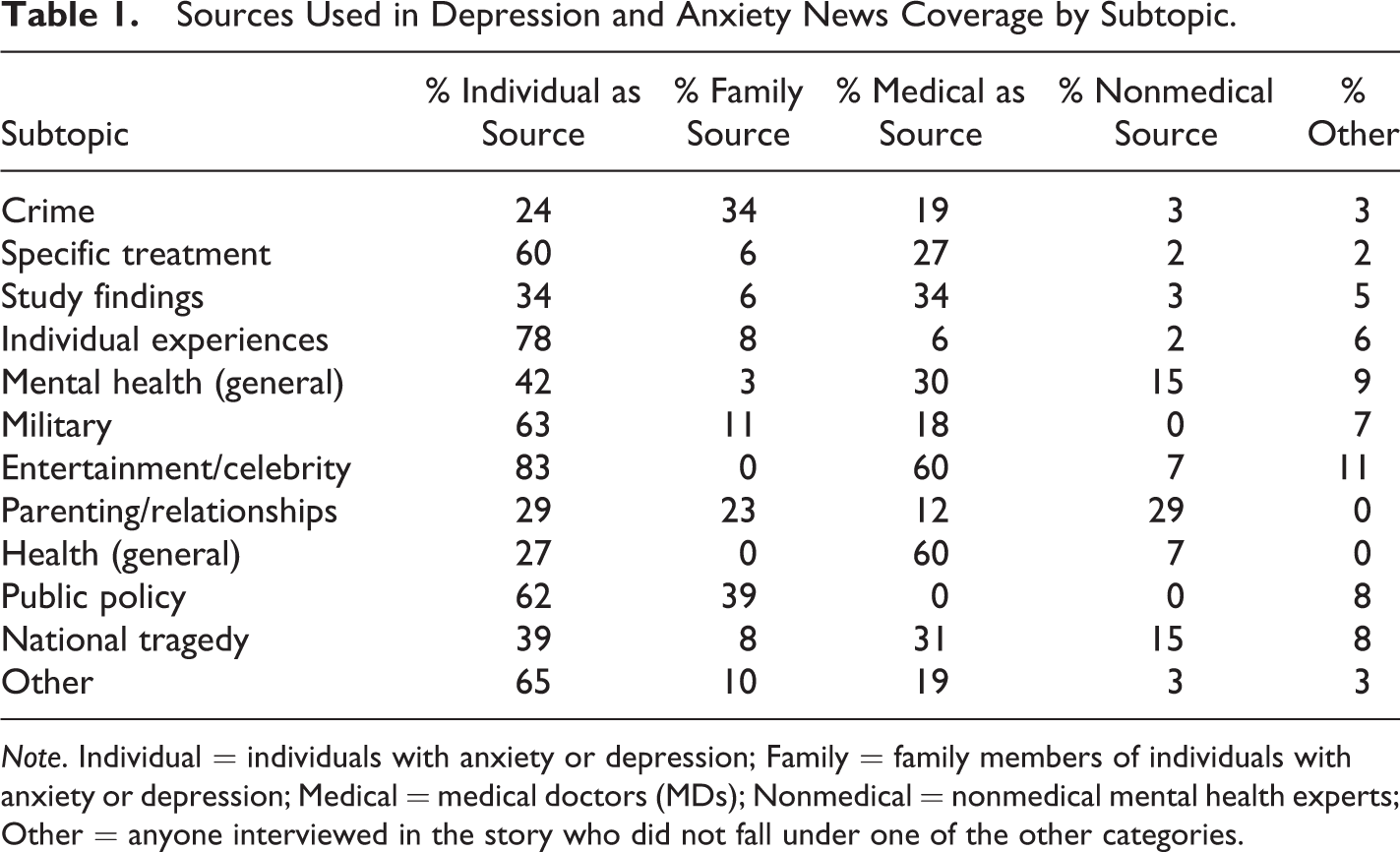
Note. Individual = individuals with anxiety or depression; Family = family members of individuals with anxiety or depression; Medical = medical doctors (MDs); Nonmedical = nonmedical mental health experts; Other = anyone interviewed in the story who did not fall under one of the other categories.
Medical experts were cited in 60% of the entertainment and celebrity stories and the general health stories as well as in nearly a third of the stories about national tragedies. Nonmedical experts highest subtopic appearance falls under the parenting and relationship category at 29% of those stories. Both medical experts and nonmedical experts are absent from stories discussing public policy. Across topics, medical professionals with an MD were significantly more likely to be cited in stories than were mental health professionals without a medical degree (χ2 = 69.943, p < .001). Medical experts appeared in 81% of the stories as opposed to an appearance in 19% of the stories for nonmedical mental health experts.
Discussion and Conclusions
These results add insight to previous content analyses about mental health news coverage by establishing a record of the frames and sources used in nearly two decades of national television reporting on the topic. The affective framing of mental health news frames differed when the media used different sources in their stories. When those with anxiety or depression were quoted in television news stories, these stories were more likely to be gain-framed than loss-framed. Our results also revealed that family members were more likely to be used as sources in loss-framed stories than in gain-framed stories. This could be because of the large quantity of coverage of Andrea Yates, a Texas mother with postpartum psychosis who drowned her five children. Much of that coverage was negative, and Yates’ husband, Rusty Yates, was a frequent source for the media and coded as a family. Additionally, it makes sense that loss-framed stories more than gain-framed sources would quote law enforcement officials, given the negative nature of crime stories and trials. The fact that there were no significant differences between medical and nonmedical experts being quoted in gain- or loss-framed stories may indicate that journalists turn to these experts to give context or counterbalance other sources, in accordance with journalistic norms of objectivity (Shoemaker & Reese, 1996).
For the cognitive dimension of framing, the data revealed that quoting people with a mental illness or their family members was more common in episodic than in thematic stories. This result makes sense as reporters doing feature stories about a person with a mental illness frequently quoted both the individual and his or her families. It is also logical that public officials were more frequent sources in episodic stories than thematic ones, as episodic crime events likely involved reporters quoting from these officials. Additionally, the definition of thematic stories aligns with the result that medical experts and nonmedical mental health experts were more likely to be used as sources in thematic than episodic stories, as those types of sources often provide background context to a story, a necessary component of a thematic frame.
It is not surprising that people with a mental illness are not used as sources in many of the crime stories as those individuals are likely told by lawyers to keep quiet or are unavailable for comment. The fact the voices of medical and nonmedical health care professionals are not heard in stories about public health and mental illness is a likely correlate of the overall lack of thematic coverage of mental health issues in television compared to episodic coverage (Co-author, 2011), as is the dearth of statistical data as a source. By not using statistics, these television stories about mental illness could have induced exemplification effects in the audience (Zillmann, 2006) such that by seeing more exemplars of mental illness without knowing the actual incidence rate, audiences are likely to overestimate their own risks (in this case, of either getting a mental illness or being the victim of a crime related to someone with a mental illness).
More medical experts were used as sources than nonmedical experts and that also supports Wahl’s (2003) notion of the medicalization of mental health news. Wahl, Wood, and Richards (2002) found in a content analysis of newspapers that almost all expert medical opinions came from psychiatrists, and, given those sources, a strong emphasis on treatments such as hospitalization and medication. Wahl (2003) argues that this focus on the “medicalization of mental illness” leads to less pubic support for other forms of treatment, such as psychosocial treatment, community intervention, and rehabilitation (Wahl, 2003, p. 1598). The medicalizing of anxiety and depression on national television news may leave out the voices of knowledgeable mental health experts who work closely with this population.
The “who” in mental health reporting is not presently answered with those perhaps closest to the issue—those with personal experience or with medical expertise. The present research demonstrates that national television news media rely on sources in ways that contribute to largely negative and episodic coverage of anxiety and depression. This coverage also continues trends of criminalizing and medicalizing mental illness, while leaving little space for the voices of those most closely affected to be heard. Given the rates of anxiety and depression in the United States, national television news coverage of these conditions has the opportunity to help shape the conversation, for better or for worse.
As a whole, these results indicate that television news coverage of mental illness does not necessarily put the issues and problems in their proper context, depending on who gets to speak about which topics and in which frame of reference. In particular, a lack of voice for those with a mental illness in television news stories about crime and violence could have consequential effects. While crime has been found to be a significant component of news media coverage of mental illness (e.g., Major, 2009, Slopen et al., 2007), research shows that mental illness is not an accurate predictor of violent behavior (Elbogen & Johnson, 2009). Wahl (1999) has shown that this sort of out-of-proportion coverage has led many individuals with a suspected mental illness to lowered self-esteem, some even avoiding treatment in order to avoid the stigma.
Commendable efforts to educate people and the press about the realities of mental illness have been successful, such as the Mental Health Reporting Project (Mental Health Reporting, 2011) and the Rosalynn Carter Fellowships for Mental Health Journalism (The Carter Center, 2011). The present findings provide fodder to mental health advocates to reach out to broadcast journalists to provide exemplars of successful treatment and recovery. Our data lend support to the argument that systematic education about the realities of mental illness are needed in light of the frames and source use found in nearly two decades of television news coverage of mental illness.
Limitations
Although useful to better understanding the nature of media coverage about mental illness, this study does have limitations. The researchers did not look at the visuals of the television coverage and therefore missed out on the visual cues that also frame the issue of mental illness. Additionally, this study only examines national coverage and not local coverage, which is also an important source of news.
Suggestions for Further Research
Future research should expand upon the findings about source use and content to see whether they do influence public opinions, attitudes, and behaviors. Additionally, research in this area could delve into the use of and impact on audiences of mixed frames, such as circle stories that start and end episodically but focus on thematic topics in the middle. Experimental research is needed to analyze psychological effects of seeing different sources in connection with different subtopics and affective or cognitive frames of mental health coverage. Additionally, tying results from this content analysis to public opinion polls or surveys regarding mental illness could demonstrate possible agenda setting effects.
Footnotes
Declaration of Conflicting Interests
The authors declared no potential conflicts of interest with respect to the research, authorship, and/or publication of this article.
Funding
The authors received no financial support for the research, authorship, and/or publication of this article.