







Abstract
This research is a systematic investigation of reporting on police use of force incidents by news organizations through social media. A sample of Tweets and Facebook posts appearing on the social media accounts of top news outlets (N = 500) over the course of a year were analyzed. Rationalizations for use of force, characterizations of police and victims, and contextual framing were examined. Results revealed medium-based differences in challenging police actions as well as demonstrated the limitations of short-form social media in communicating news on complex issues. Implications of these findings for theory and journalistic practice are discussed.
Police use of force has become a central issue in contemporary news coverage around the world. Examples include stories about policing the migrant crisis in Europe and South Africa, police responses to protests for Catalan independence, and the uptick of police use of force in U.S. coverage following the uprisings in Ferguson, Missouri, Baltimore Maryland, and elsewhere. News outlets have played an important role in shaping public opinion on police use of force incidents and in documenting the incidents more generally. In fact, both the UK’s The Guardian and the Washington Post in the United States have developed their own comprehensive databases of police shootings. The increase in news coverage of these incidents has been accompanied by frequent and passionate accusations of biased reporting from various locations on the political spectrum. Perhaps the first question that researchers in this area should ask is what specific journalistic products do users actually read and exchange? Most studies of news content focus on the full text, headlines, and main bodies of articles as well as transcripts of televised news coverage. However, a study by the Media Insight Project (2015), an initiative of the Associated Press-National Opinion Research Center (AP-NORC) Center for Public Affairs Research and the American Press Institute—reports that nearly 41% of Americans report that they had not watched, read, or heard any in-depth news stories in the last week. One contributing factor to these trends may be that the proliferation of news on social media and the availability and abundance of content through these networks has altered news consumption practices. A recent report from the Pew Research Center shows a majority of American adults consume news using social media (62%; Gottfried & Shearer, 2016).
A growing body of research, however, has suggested the increase in content and the availability of Twitter and Facebook posts of news outlets has not translated to greater consumption of full text news reports. The aforementioned Pew study found nearly three quarters (74%) of those surveyed do not click through to read the stories associated with posts from news outlets. Another study by computer scientists at Columbia University and the French National Institute found 59% of links shared on social media have never actually been clicked. In other words, most people appear to share or retweet news without ever reading it. These new patterns of news engagement have significant implications for public dialogue on a variety of important civic issues. As Dewey (2016) of Washington Post writes in a column about the study, “Worse, the study finds that these sort of blind peer-to-peer shares are really important in determining what news gets circulated and what just fades off the public radar. So your thoughtless retweets, and those of your friends, are actually shaping our shared political and cultural agendas.”
Literature Review
Social Media and News Consumption
Social media has increasingly become a key platform for disseminating news. According to Pew Research Center (Gottfried & Shearer, 2016), approximately 6 in 10 Americans get their news from social media. Kwak, Lee, Park, and Moon (2010) found that the most common topics discussed on Twitter were over 85% headlines or news information. A study by Cision (Hicken, 2016) shows that 38% of journalists are promoters of social media and utilize it most frequently for publishing and promoting content, interacting with their audiences, and monitoring.
Journalism faces new challenges with the web. Online journalism has struggled to find ways to bring in revenue while giving away content for free, and advertising has become key building income for online journalism (Kaye & Quinn, 2010). With social media and the increased use of web analytics, headlines are now being tested based on number clicks and journalists are basing their editorial decisions on stories that did well in terms of traffic and clicks. Tandoc (2014) argues that journalism is “threatened by its shrinking economic capital, is dancing to the popular music of consumer-driven logic, for it appears—at least so far—that this is the only way to survive” (p. 572). Users now have the ability to control editorial judgments about worthy stories by determining the visibility of a story through clicks, shares, and likes, which goes beyond what typical journalistic audiences have had the power to do. For example, one study found that the journalistic decision-making process is largely influenced by audience metrics and response (Tandoc, 2014). Singer (2005) suggests that audiences now serve as secondary gatekeepers in the participatory online world, providing information they deem valuable to different groups of people, therefore, making gatekeeping a complex and collaborative process.
These pressures also influence the way stories are marketed to audiences. A recent study by Kuiken, Schuth, Spitters, and Marx (2017) examined how headlines are rewritten by content producers for the digital environment when click-through rates are imperative. They were interested specifically in further understanding how headlines are reworked to be clickbait, described as “the use of questions, numbers, forward referencing, spectacularization, and negativity” (p. 12). They found headlines were indeed rewritten to include more signal words, sentiment, and questions and, in addition, that the clickbait headlines had a positive effect on reader interest.
Selective exposure of online content has become easily achievable with technology and the algorithms of social media platforms that cater to things the user likes. Garrett (2009) suggests that online news promotes control of exposure to content that supports the consumers’ beliefs and desire to reinforce one’s opinions is greater than the avoidance of differing opinions. Online platforms allow for customization of content. This control leads to segregation of beliefs creating a bias in the content that the user is exposed to and spends the most time interacting with.
Media Framing of Social Issues
According to Entman (1993), framing is “the presence or absence of certain keywords, stock phrases, stereotyped images, sources of information, and sentences that provide thematically reinforcing clusters in terms of facts or judgments,” and to frame is “to select some aspects of perceived reality and make them more salient in a communicating text” (p. 52). Frames are view points or perspectives that can influence our understanding of people, events, or ideas around us and that invite us to think about an issue in particular ways. A primary effect of framing is the cognitive responses that affect the way audiences understand, interpret, and react to certain issues (Price, Tewksbury, & Powers, 1997).
Tuchman (1978) suggested that audiences will interpret and discuss public events in different ways according to the frames of reference set by mass media. By framing, news sources can advance one interpretation while sidelining a less favored one (Oliveira & Murphy, 2009). Gitlin (1980) argued that frames organize the world for journalists who report it and for readers who consume their reports. The selection of media frames reflects societal beliefs in general and frames are shaped by factors like journalistic professional and social routines, which are formed by journalists’ norms and practices as well as the influence of interest groups (Gamson & Modigliani, 1987), or “driven by (journalists’) ideology and prejudice” (Edelman, 1993, p. 232).
Audiences can be influenced by small bits of information that subsequently frame information such as headlines. According to Pan and Kosicki (1993), the headline is one of the several structural elements in news stories with framing potential and, they argue, the most powerful framing device of the syntactical structure. Headlines, they conclude, are “the most salient cue to activate certain semantically related concepts in readers’ minds” (p. 61). Tewksbury, Jones, Peske, Raymond, and Vig (2000) found evidence of this claim by demonstrating framing effects of headlines on readers. Even when news content was kept constant, varying the headline influenced the way audiences understood the issue at hand. Similar patterns should be expected when considering the text of social media posts that accompany news stories.
Finally, episodic and thematic framing, mentioned previously, are particularly relevant for understanding how media discuss complex social issues. Iyengar (1990) in a study of media framing and poverty had participants read news stories that employed an episodic frame, which focused on a single individual facing poverty, or thematic frame, which placed poverty in a broader context rather than solely focusing on a single case. He found that when people were exposed to the episodic frame, they were more likely to assign individual responsibility to an impoverished person’s circumstances, whereas those exposed to a thematic frame were more likely to attribute responsibility to systematic causes. This finding can be applied to other social issues as well with significant implications. If the majority of posts employ episodic frames—which would not be surprising considering the constraints associated with social media—users may be encouraged to think of instances of police use of force in terms of an individuals’ actions than as a systemic issue worthy of public attention.
Media Coverage of Police Shootings
Previous research has investigated the ways police use of force incidents have been framed in news in the past. A study by Hirschfield and Simon (2010) provided a comprehensive analysis of newspaper accounts of police killing prior to and in the aftermath of the 1999 police killing of Amadou Diallo in New York City. They focused in particular on the strategies used to justify police actions, which they called “pro-strategies” and those employed to challenge police actions or “counterstrategies.” They found, overall, that pro-strategies were far more common in stories about Diallo’s killing. Among the most common pro-strategies were to rationalize the use of force (e.g., explain legal justification), anonymize the officer, describe the event in passive terms, and through expurgation of the victims. Their findings, as well as the results of other previous studies (e.g., Lawrence, 2000; Scraton & Chadwick, 1986), imply “newspaper accounts of deadly force typically lend primacy and authority to official versions of events neatly circumscribed by laws governing deadly force” (p. 175).
In recent years, due in large part to citizen journalism and the availability of video and livestreaming, heightened media attention has been given to deadly police shootings. At the same time, social media has become the primary news source for many. Therefore, in line with previous research that has examined news framing of police use of force and with consideration of social media as a unique medium, we posit the following research questions:
Method
The sample used in this study consisted of content posted to Facebook and Twitter by digital news outlets. News outlets chosen for analysis were those identified in the Pew Research Center’s (2015) State of the Media Report as the “Top Digital News Entities” in terms of their total unique visitors during the month of January 2015: Yahoo News, ABC News, CNN Network, NBC News Digital, Huffington Post, CBS News, USA Today, BuzzFeed, The New York Times, Fox News Digital Network, and Mail Online/Daily Mail (Mitchell & Holcomb, 2016). The sampling frame used to collect posts spanned the course of a year, from October 1, 2015, through September 30, 2016. Data were collected using the Radian6 social media listening software, which allows users to search specific, user-defined terms within specified time parameters. Posts that included the terms “police” or “officer” and one of the following terms were collected: shot, shots, shoot, shooting, shoots, kill, kills, killed, killing, “discharged weapon,” “discharges weapon,” “discharge weapon,” and “deadly force.” After removing retweets and unrelated posts, a total of 2,058 were collected. A random sample of those posts (n = 500) was used as the study sample.
A detailed codebook was developed to facilitate coding by two independent coders. After several rounds of coder training, 10% of the total sample (n = 50) was coded to demonstrate intercoder reliability. Krippendorf’s α ranged from 0.77 to 1.00 among variables (see Table 1).
Frequencies by Category.
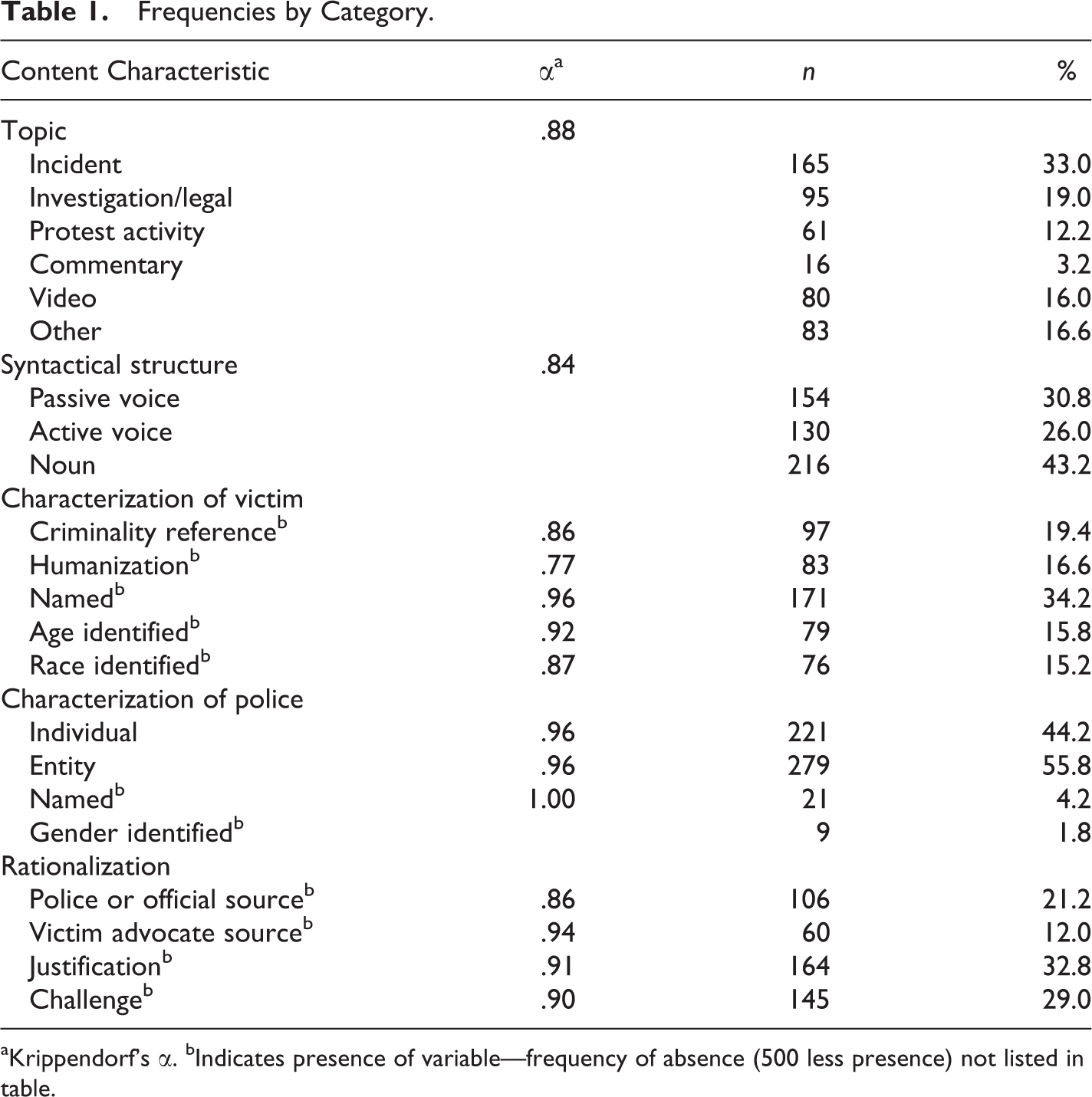
aKrippendorf’s α. bIndicates presence of variable—frequency of absence (500 less presence) not listed in table.
Variables
Hirschfield and Simon’s (2010) research on local newspaper coverage of police shootings was used as a framework for codebook development. Several variables from their study were adapted to respond to the research questions posed by the current study. Others were developed by the researchers.
Passivization/activation
A subtle frame that can influence the way information is processed concerns its syntactical structure, specifically the use of active or passive voice to describe the event. As Hirschfield and Simon (2010) note, “Situating ‘the suspect’ before ‘killed’ displaces agency onto the victim” (p. 163). Therefore, the syntactical structure of the shooting description in the post was coded; posts were categorized as activation, or using active voice (e.g., “officer shoots man”), passivization, or using passive voice (e.g., “man shot by officer”), or as a noun/object (e.g., “officer-involved shooting”).
Characterization of victim
Several variables were coded to examine the way victims of police use of force were characterized in news outlets’ social media posts. Coders indicated whether the victim was described as armed with a gun, armed with a nongun weapon (e.g., knife or sword), unarmed (e.g., explicitly identified as “unarmed” or described as having hands raised), or the possession of any weapon was not indicated. Two additional variables were developed to reflect the character of the victim implied by the post. One variable indicated whether the victim was associated with crime in the post (e.g., engaged in a criminal act, described as a suspect, mention of criminal history or arrests, etc.). Another variable captured the humanization, or lack thereof, of the victim. Posts categorized as humanizing included information about the victim’s loved ones or their involvement in their community (e.g., one victim in the sample was referred to as a “church drummer”). Identity characteristics of the victim were also recorded. Coders indicated whether a victim’s race, age, and name were explicitly reported in the post. If identity characteristics were reported, the value of that characteristic was also recorded. If race was not explicitly stated but the victim was identified by name, that information was researched and recorded.
Characterization of police
Another set of variables described the post’s characterization of the police. One variable categorized each post as referring to police as individual persons (e.g., “Suspect, 20, shot by a New York Police Department (NYPD) officer after pulling gun on three undercover detectives”) or as an entity (e.g., “Police fatally shoot fleeing suspect that a witness says was unthreatening”). Identity characteristics, including race, age, and name, of police were coded using the same method employed to describe victims’ identities described above.
Rationalization
Four variables indicated how use of force was rationalized in the post. One variable indicated the inclusion of information from police or other official sources (e.g., “The suspect in a reported shooting at a Walmart in Amarillo,TX, has been shot and killed, police say”) and another the inclusion of information on behalf of the victim (e.g., “Unarmed man killed by police near San Diego was not mentally ill, but grief-stricken, his family says”). Posts were also evaluated for justification of (e.g., altercation between victim and officer, presence of a weapon, fear of officer, etc.) and challenges to (questions police response, implies police made a mistake, critical of police, etc.) police actions.
Descriptive information about the post was also recorded, including the social network it was posted to Facebook or Twitter and from what news organization.
Results
Overall, Twitter posts (69.6%) were more than twice as frequent as Facebook posts (30.4%). Frequencies associated with each news outlet represented in our sample are presented in Table 2. To further explore potential differences in posting frequency, news outlets were categorized by medium: print, consisting of New York Times, USA Today, and Daily Mail (32.8%); broadcast, consisting of ABC News, CBS News, and NBC News (33.8%); digital news, consisting of BuzzFeed, Huffington Post, and Yahoo News (16.4%); and cable news (17.0%), consisting of CNN and Fox News. Interestingly, legacy media, specifically print and broadcast outlets, posted to their social media accounts about police shootings more frequently than did cable or digital news outlets. This might reflect a desire on the part of legacy media to make up for losses in readership and viewership by investing in attracting audiences in the social media environment.
Descriptive Information about Sample.
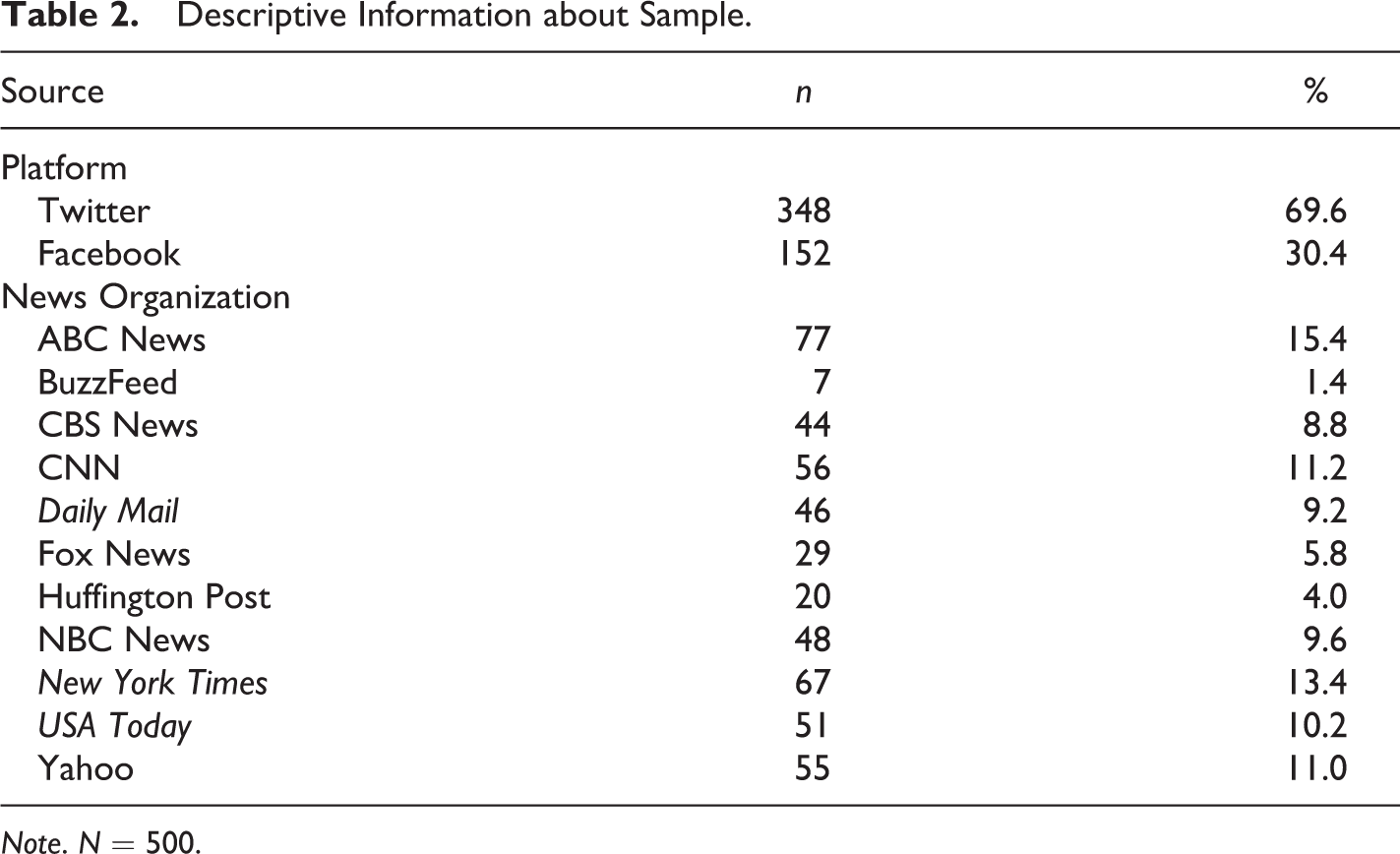
Note. N = 500.
Rationalizing Police Use of Force
The first research question sought to examine the prevalence and nature of justifications and challenges to police shootings appearing in news organizations’ social media posts about such incidents. Overall, results revealed justifications (32.8%) and challenges (29.0%) were presented relatively evenly. However, further probing of the data showed this balance did not result from individual posts presenting both perspectives but, rather, one or the other appeared in a given post and this occurred at an equitable rate. Indeed, only eight posts within the entire sample (1.6%) presented both a challenge and justification, which draws attention to the limitation of social media as a significant source of news dissemination. Medium-based differences in presenting justifications and challenges were also explored. Although no differences were revealed with regard to justifications, results did reveal differences in the frequency of posts challenging police actions, χ2(df = 3) = 8.23, p < .05, V = .13. Post hoc comparisons using Holm’s sequential Bonferroni method showed digital media outlets challenged use of force significantly more frequently (41.5%) than did broadcast outlets (24.3%). Differences for print (27.4%) and cable (29.4%) outlets were not significant when the p value was adjusted to account for multiple comparisons.
News routines also play a role in determining what perspective is validated or favored. The results of this study reinforced previous research that demonstrates the privileging of official sources in reporting on use of force. More posts cited a police or other official source (21.2%) than a source advocating on behalf of the victim (12.0%). Hirschfield and Simon (2010) argue such reliance on police sources “translates into a majority of news accounts that rationalize and normalize police violence by associating it with the performance of a legitimate institutional role” (p. 175).
Another variable relevant to rationalization was included to indicate whether the victim of use of force was armed. The data showed most posts did not include that information (72.0%) and that when it was provided, victims were described as armed (10.2%), having a nongun weapon (8.8%), or unarmed (9.0%) with similar frequency.
The syntax of posts was also examined to determine what subtleties in language might appear more or less frequently in descriptions of the shooting. Results of a single-sample χ2 test revealed more posts (43.2%) used a noun to describe the event (e.g., “A police shooting occurred”) compared to using an active verb (26.0%) or passive verb (30.8%) in its description, χ2(df = 2) = 23.63, p < .001.
Characterization of Actors
A second research question focused on characterizations of the victim and of police in news organizations’ posts. Results showed references to a victim’s criminality (19.4%) were slightly more common humanization of the victim (16.6%). Most striking, however, were differences in the extent to which victims of use of force and police were (de)personalized in posts reporting on shooting incidents. For example, one method of depersonalizing actors in shooting events lies in the language used to describe the shooter, such as anonymization (Hirschfield & Simon, 2010). In this study, posts were significantly more likely to refer to police as an entity (55.8%) than as individual officer(s) (44.2%), χ2(df = 1) = 6.73, p < .01. Moreover, victims were more likely than police officers to be identified by name (34.2% compared to 4.2%), gender (42.2% compared to 3.2%), and race (15.2% compared to 1.8%).
Contextualization
The third and final research question assessed the extent to which episodic and thematic frames were employed in posts about police shootings (Iyengar, 1990). Analysis of the posts showed only 15 posts (3.0%) mentioned other police shootings or placed the specific incident into the context of the larger debate surrounding this issue.
Discussion
The purpose of this research was to examine frames employed by news organizations on social media in their reporting of police shootings. Analysis of the data reveals patterns similar to those found in previous research (e.g., Hirschfield & Simon, 2010). Posts frequently anonymized officers both literally, by not identifying them by name or other personal characteristics, and in a more figurative sense, by referring to them as an entity, rather than as individual officer(s) who had fired a weapon at a civilian. Similarly, posts were more likely to describe such an event in passive than in active terms, and to refer to an official source than an advocate for the victim. When considering the disproportionate citing of police forces, researchers and journalists should consider what kinds of biases this may unintentionally import into coverage of these incidents. For example, the NYPD and Baltimore police unions have displayed highly partisan views on these incidents. In addition, police often approach journalists within parameters that were given to them by public relations departments and their own legal counsel. Our study of social media posts provides additional evidence of the need to diversify this sourcing of information to provide the public with more complete coverage.
However, and somewhat surprisingly, justification frames and challenge frames were essentially evenly represented in the sample. This finding is contrary to previous research examining full news stories about police use of force conducted by Hirschfield and Simon (2010), in which they found “pro-strategies” (e.g., justifications) outnumbered “counterstrategies” (e.g., challenges) by a more than 3 to 1 ratio. One explanation lies in perceptions of “newsworthy” stories. As Hirschfield and Simon note in addressing their focus on local news reports, stories from national news sources are more likely to include challenges to police actions because they present drama and conflict. Moreover, the economics of social media favor the dramatic due to the motivation to be “click-worthy” (Kaye & Quinn, 2010; Kuiken, Schuth, Spitters, & Marx, 2017; Lohtia, Donthu, & Hershberger, 2003; Tandoc, 2014).
The results of this study reveal other implications of the limitations of social media for disseminating news. First, although it is often the case that a news story will favor one perspective over others (i.e., frame the story in a particular way), social media platforms require content producers to include one view at the expense of all others due to space constraints. Whereas a perspective might be dominant in a story based on the number of quotes or amount of space it receives, with only 140 characters, as on Twitter, journalists posting to social media must choose a quote or piece of information that will consequently serve as the only source of framing. This idea was supported by the data, which found only a handful of posts (1.6%) presented both a challenge and justification to police actions.
This pattern should be considered in light of scholarship and industry analytics that show users have a strong tendency to seek out media that supports their existing view points (e.g., Garrett, 2009); when complex events must be condensed into single-frame posts, the effects of selective exposure online may be exacerbated. This is troubling when the findings from Pew Research Center that show only about a quarter of users click-through to read a full article are considered (Gottfried & Shearer, 2016). Therefore, even if justification and challenge frames are equally represented in the social media environment overall, chances are, individual users are only presented with one or the other. In an increasingly polarized political environment, where news consumers can more easily avoid news that challenges their political orientation, journalists should consider their responsibility to present material in ways that encourage critical thinking. While this work might typically happen in the body of newswriting, our research suggests that social media posts are equally vulnerable to particular patterns of coverage.
Indeed, results revealed digital (i.e., new media) platforms were more likely than the legacy platforms to present a challenge frame, which might be explained by the desire to tailor to a younger, more, diverse, and progressive audience. This may indicate digital media, with more precisely targeted demographics and related advertising funding models, may have more flexibility to raise potentially controversial critical questions, and report on critical perspectives. Explanations for medium-based difference should be further explored to uncover mechanisms that inhibit or promote journalistic freedom of expression.
In addition, only a handful of articles employed a thematic, rather than episodic, frame. On the one hand, previous research would suggest a lack of context in media reporting on police brutality might have a negative impact on support for alleviating the problem (Iyengar, 1990). However, in a new media landscape, it is possible that the social media environment provides some context for understanding single episodic frames in Tweets and Facebook posts even in the absence of explicit contextual information. Further study might examine the extent to which Twitter or Facebook themselves provide a “collective context” for understanding prominent issues in thematic terms, for example, through hashtags and trending topics.
Limitations and Future Research
There are several limitations to this research to address. First, as with any content analysis, some nuance is lost when quantifying concepts relevant to such a complex issue. Additional research that takes a qualitative perspective would contribute to a deeper understanding of journalistic practices on social media with regard to social issues. Moreover, the sample provided a snapshot of a persistent and continued issue. By sampling posts over the course of a year, we hoped to examine trends from a broad scope of reporting on a wide range of police use of force incidents. However, the current analysis was unable to capture all of the events that have garnered widespread media and public attention. Moreover, additional analyses that compare coverage over time would provide insight into how discourse surrounding significant, and often divisive, social problems. Finally, this study did not explore social media users’ responses to media reporting of police shooting incidents. An examination of the ways audiences interact with such posts and the influence of post frames on how audiences challenge or reinforce news frames would be an interesting and important next step in this line of research.
Footnotes
Declaration of Conflicting Interests
The authors declared no potential conflicts of interest with respect to the research, authorship, and/or publication of this article.
Funding
The authors received no financial support for the research, authorship, and/or publication of this article.