







Abstract
Artificial intelligence (AI) is changing journalism. New AI tools are not only changing how journalism is done, but how journalism is perceived. AI image generators will serve as meaning makers in the public understanding of who a journalist is and what a journalist looks like. Using the lens of metajournalistic discourse theory, the current study employs a content analysis of the images generated by different kinds of journalists by different AI image generators. Findings suggest AI image generators tap into sexist and racist tropes in their visualizations of different kinds of journalists. Implications of these findings and ideas for future research are discussed.
Artificial intelligence (AI) is changing journalism. Proponents of AI in journalism note the unique opportunities AI tools provide for journalists (Wu, 2024). AI tools such as Google Pinpoint can read and analyze thousands of pages of documents with incredible speed, whereas AI collaborators such as Magid Newsroom tout cutting news production time down tremendously. However, those hesitant about the role of AI and journalism cite lack of accuracy, truthfulness, and ethics, as potential downsides (Cools & Diakopoulos, 2024). Additionally, some fear AI tools will replace human jobs in the journalism field, leading to even more cutbacks in an industry that's already endured significant job loss over the past decade (Lancaster, 2025).
But what does AI say about journalism? How does artificial intelligence imagine who a journalist is, what a journalist does, and what a journalist looks like? AI image generators are quickly gaining popularity and so answers to questions such as these will carry significant implications on the culture of the newsroom and the way the public perceives journalists.
There are important conversations taking place in both journalism research and the profession about what a journalist, especially a broadcast journalist, looks like. Because the majority of broadcast newsroom leaders are white men (RTDNA, 2021), women broadcasters and broadcast journalists of color have been historically subject to the image expectations of white men, especially older white men. As such, many women broadcasters are sexualized (Demir & Ayhan, 2022; Finneman & Jenkins, 2018; Waddell, 2021) and many broadcast journalists of color feel pressures to look more “white,” and are told, for example, to straighten their hair (Castillo, 2022; Noble, 2023). As such, gendered and racialized stereotypes of what a broadcast journalist looks like have become engrained in newsroom culture and culture-at-large. It is critical, then, to see if AI image generators reify these stereotypes or push back against racist and sexist tropes that are creating challenges for marginalized populations of journalism professionals.
The current study seeks to understand and analyze how AI portrays journalists. Using the lens of metajournalistic discourse theory, Thomas and Thompson (2025) conducted a study analyzing how the AI image generator Midjourney imagined journalists by inputting generic terms such as “journalist, reporter, correspondent, and the press.” The current study was influenced by Thomas and Thompson's (2025) suggestions for future research to incorporate more AI image generators and more specialized categories of journalists. And so, the current study uses eight different AI image generators to visualize specialized journalists across 10 categories, for example sports reporter and political reporter. Findings are detailed and implications for theory and practice are discussed in the following sections.
Literature Review
Metajournalistic Discourse Theory
Carlson (2016) defines metajournalistic discourse theory as a theory of “public expressions evaluating news texts, the practices that produce them, or the conditions of their reception” (p. 350). According to Carlson (2016), the meanings of journalism are created and adjusted by forces both inside and outside of the journalism industry. As technology progresses, then, it's important to understand how technological forces influence how journalistic texts are created, disseminated, and situated in culture.
Metajournalistic discourse theory has several core principles. First, Carlson (2016) highlighted the importance of understanding “discourse” as more than just mere language but instead as cultural meaning-making, providing a “shared articulation of cultural understandings, and just as importantly constrain the range of meanings for a topic” (p. 353). This discourse is fluid, constantly morphing and changing, and so as such journalism as a field and a practice is never stagnant or stable, but molded by broader societal discourse. Carlson (2016) created three underlying premises: journalism varies in time and space, journalism is contextual, and journalism is a set of social relationships.
Next, Carlson (2016) argued that these premises exist to allow the core components of metajournalistic discourse theory to develop. These components are: metajournalistic discourse arises from journalistic and nonjournalistic actors, metajournalistic discourse occurs in journalistic and nonjournalistic sites, and the topics of metajournalistic discourse have reactive and generative origins. Carlson (2016) argued that metajournalistic discourse theory is not constrained in its origin or use to just journalism, but to cultural meaning making through a variety of media, which is why it's pertinent to new and emerging media such as AI.
AI is a new technology that will undoubtedly change the ways in which journalism is produced, interpreted, and evaluated. Using metajournalistic discourse theory as a guide, Moran and Shaikh (2022) highlighted the tension between the journalism industry, defined as newsroom leaders and funders, and individual journalists when it came to the incorporation of AI into the journalism profession. Moran and Shaikh (2022) note that “while the industry pitches [A.I.] technology as something useful and long-term, professional journalists tend to highlight more concerns surrounding A.I.” (p. 1768).
Villagrán Sánchez and López Pan (2024) used metajournalistic discourse theory as a lens by which to analyze recent research on the future of journalism. Similar to Moran and Shaikh (2022), Villagrán Sánchez and López Pan (2024) also found a tension emerging within the field of journalism. This time, between traditional journalistic values that serve the public and market-oriented values that serve the business side of the industry. As new technologies such as AI continue to be incorporated into journalism, the news industry will and must continue to change and adapt. Villagrán Sánchez and López Pan (2024) cite the importance of continued research on this topic and argue that “metajournalistic discourse theory is a valuable framework for examining journalism at a time when ideas about journalism's normative and functional duties are increasingly fluid and dynamic” (p. 174).
Thomas and Thomson (2025) used metajournalistic discourse theory to guide their research on AI images of generic terms associated with journalists (journalist, reporter, correspondent, and the press.) The researchers ran each generic term through the AI image generator Midjourney and analyzed the results. Their findings suggested that “A.I. reinforces existing biases and inequities present in journalism and its representation in popular culture” (Thomas & Thomson, 2025, p. 647). The current study is based, in part, on the suggestions for future research provided by Thomas and Thomson (2025).
AI image generation raises ethical questions about its access, use, and distribution. Simões and Caldeira (2024) investigated the ethical concerns of AI image generation and highlighted the significance of ethical guidelines and responsible practices in creating AI image generators. The authors noted the high potential for bias in AI image creation and advocated for more practices and strategies to mitigate bias in these new technologies by placing a “significant emphasis on fostering fairness, ensuring transparency in decision-making processes, fostering accountability, and prioritizing societal well-being, ultimately guiding the development and utilization of A.I. technologies (Simões & Caldeira, 2024, p. 184).
Katirai et al. (2025) discussed the real-life implications of bias in AI image generation. The authors argued that AI-generated images are being used in high-impact areas such as medical training and eyewitness accounts of crimes, and so the presence of biases in images such as these are even more harmful. Katirai et al. (2025) noted the “urgent need to critically examine the systemic inequalities that produce bias on a societal scale. Thus, critical attention is needed to image generation models as potential site for the reproduction and amplification of biases” (p. 1776).
Bendel (2025) explores ethical issues related to AI image generation, in part, copyright infringement, privacy, and false representations of real people, places, and things. More relevant to the study at hand, Bendel (2025) discussed the ethics surrounding creation of AI images that are stereotypical, discriminatory, racist, and sexist. According to Bendel (2025), AI image generators are subject to cultural bias because they are primarily based on the English language and American culture. As such, what is defined as “beautiful” or “attractive” is usually a young, thin, white woman with blonde or brown hair (Bendel, 2025). This type of stereotypical depiction reifies sexism and racism.
Sexism and Racism in the News Industry
Newsroom culture is engrained with sexism and racism and has been since its inception (Alamo-Pastrana & Hoynes, 2018; Somani & Hopkinson, 2018; Steiner, 2019). Even though women and people of color have made strides in the journalism industry, sexist and racist tropes are still ever-present in many newsrooms across the United States. This is especially evident in broadcast journalism where news presenters are seen and heard by the public and visual representation is even more critical.
Broadcast journalists are expected to look a certain way, and that look tends to reflect a white, thin, young persona. Powers (2024) conducted in-depth interviews with broadcasters about how they construct their on-air performances and appearances. She found that women journalists and journalists of color felt pressure to conform in specific ways, for example, deepening their voices, limiting body language, and dressing and doing their hair and makeup in particular styles. Powers argued that, for professional appearance in broadcast journalism, “what's deemed to be legitimate has historically reflected tastes of white male newsroom leaders and assumed tastes of audience members, who are conditioned to view familiar, conventional forms as authoritative” (Powers, 2024, p. 211).
Harris (2022) conducted focus groups with black female college students from two U.S. universities about their intentions to go into the broadcast news industry. She found that many of these students were interested in pursuing careers in broadcast news but were hesitant because of lack of representation of natural hair on television news programs. Mainly, these students routinely saw straightened hair as the “norm” on television news programs, and this was discouraging for students whose hair did not conform to this “norm” (Harris, 2022).
Jackson (2024) conducted an autoethnography reflecting on her time as a black female journalist at a newspaper in the U.S. South. She detailed her first-hand experiences with racism, bullying, and lack of support in her workplace. Jackson (2024) noted the racist, sexist, and “toxic” culture in some newsrooms, saying she “realized I was always going to be the angry Black woman in that white newsroom because support, resources and credibility was inherently given to white reporters” (p. 1361).
Cohen and Clarke (2024) studied the intersection of race and gender through in-depth interviews with women journalists of color. They found that many of these women faced similar challenges in the workplace, for example, being assigned “fluff” pieces, feeling tokenized, and feeling unsupported. Some participants in this study were hyper-award that they were the only woman of color in the room and it created an uncomfortable work environment. Many participants in this study said they formed their own social support groups and networks to try to “help women find work, learn the ropes of the industry, and navigate various microaggressions that make their jobs more difficult” (Cohen & Clarke, 2024, p. 195).
Ageism is also a continuing issue in many newsrooms. Although many times not as evident as racism or sexism, age discrimination is an obstacle for many career journalists, especially in broadcast newsrooms. Cummings (2022) found that the shift from the traditional reporter/photographer pairing to the multimedia journalist style of broadcast journalism has alienated older journalists. Cummings (2022) argued that this shift places more emphasis on physical ability and technological savvy that favors younger journalists and places older journalists at a disadvantage. Additionally, experienced reporters who had their photographers “taken away” felt they were being punished and demoted, tapping into the ageism tropes in the industry (Cummings, 2022).
Ageism is especially evident in the experiences of female broadcast journalists. Ross (2023) conducted in-depth interviews with women broadcasters to shed light on their lived experiences as “older” women media professionals. Findings showed that the women in study, once they reached their 40s, were moved from being on-air talent in front of the camera to roles that were behind the scenes, felt their career opportunities were stifled, and had their contracts cut short or not renewed to make room for younger women in the industry (Ross, 2023).
Similarly to ageism, body image discrimination is another lesser-known, but impactful challenge for broadcast journalists. Research suggests that traditionally “attractive” broadcasters, especially women, take precedent over other body types. Nitz et al. (2007) conducted a content analysis of on-air broadcasters across several television news networks. They found that 62% of all segments across networks featured broadcasters with high sex appeal, defined as physically attractive and dressed in clothing to accentuate their figures (Nitz et al., 2007). Additionally, Tran et al. (2020) conducted a survey of U.S. journalists about their views on body image and their weight-control strategies. Findings showed that on-air broadcasters, especially, felt intense pressure to be thin and many engaged in unhealthy weight-control behaviors such as binge eating and purging (Tran et al., 2020).
Research suggests that social media have intensified sexism and racism in the news industry in many ways. Davis Kempton and Connolly-Ahern (2022) conducted in-depth interviews with women broadcasters about their audience interactions on social media. They found that many women broadcasters were viewed by audiences as sexual objects and nonserious journalists, and audience focus was on the broadcasters’ appearance rather than their work. Findings suggested that “women broadcasters routinely deal with catcalling, comments on their physical appearance, unwanted sexual advances, and mockery” via social media (Davis Kempton & Connolly-Ahern, 2022, p. 7). Finneman and Jenkins (2018) presented similar findings through a qualitative survey of women broadcasters about their experience with audiences on social media. The research team argued that “little to no progress has been made in actively addressing or combatting discourse critical of broadcasters’ appearance, with social media adding another avenue for viewers to publicly ‘correct’ gender performance and maintain the status quo” (Finneman & Jenkins, 2018, p. 490).
Finneman et al. (2019) noted the harmful impacts of online harassment on women journalists. The researchers argued that such harassment can cause harm to the health, well-being, and careers of women broadcasters, especially because this type of online harassment has increased over time. Findings suggested the prevalence of gender-based harassment and “misogynistic attacks or threats of sexual violence, particularly if [women broadcasters] addressed topics associated with men, politics, feminism, immigration, and race” (Finneman et al., 2019, p. 152).
Both white women and women of color are leaving journalism at a higher rate than men, and research suggests gendered factors likely in part to blame. Mirabito et al. (2025) conducted interviews with journalists who recently left the news industry. They found that although both men and women sited low salaries and atypical schedules as reasons for leaving news, women journalists traditionally earned lower salaries than men and were less likely to obtain leadership roles, which come with better schedules. Davis Kempton (2025) also cited these gendered issues when researching why there are so few women in newsroom leadership roles.
In addition to direct impacts on journalists, racism and sexism in the news industry have impacts on news consumers. Decades of research shows the influential impacts of media messages on formation of public opinion. Sui and Paul (2017) conducted a textual analysis on thousands of articles from local newspapers across the United States. Their findings suggested that Latinos, in particular, were most likely to be represented in crime and immigration stories and associated with negative racial stereotypes. Sui and Paul (2017) argued that these findings can have real impacts on public opinion about Latinos, saying, “the negative stereotypes could become particularly pervasive…and the pattern of exposure to negative images could lead to implicit bias against Latinos, with people unconsciously associating negative traits with this particular group” (p. 286).
In a multinational experiment, Arendt and Northup (2015) found that long-term exposure to negative racial stereotypes in news media created and fostered negative implicit and explicit attitudes toward the stereotyped group. For example, the researchers found that overrepresentation of black Americans as criminals in local news media led to audience increases in negative implicit attitudes toward the black community in general (Arendt & Northup, 2015). Appel and Weber (2017) found that negative media stereotypes not only impact media consumers in general but have unique impacts on members of the negatively portrayed group. Findings suggested that being exposed to negative media stereotypes of the group to which they belong negatively influenced individuals’ ability to perform cognitive tasks (Appel & Weber, 2017).
Based on the aforementioned literature and research cited above, the following research questions are proposed for the current study:
RQ1: How do different AI image generators imagine different specialized categories of journalist? RQ2: Are there common themes across AI image generators in regard to race, gender, and age? RQ3: Are there common themes across journalist categories in regard to race, gender, and age?
Method
To create the sample used for this study, eight different AI image generators were used: Adobe Firefly, Canva, Craiyon, Flux AI, Google Image FX, Microsoft Copilot, PixelCut, and Stable Diffusion. These image generators were chosen because they are free, easy to use, and appeared on several lists of recommended AI image generators. The image generators were accessed and used between June 27 and June 28, 2025.
The current study was influenced by Thomas and Thompson's (2025) suggestions for future research to incorporate more specialized categories of journalists and so specific prompts for this study were created. Then, prompts were entered into each AI image generator. The prompt used was “generate an image of a…” then each of the following categories were inserted: news anchor, news reporter, sports reporter, weather reporter, crime reporter, political reporter, entertainment reporter, lifestyle reporter, health reporter, and breaking news reporter. Eighty images total made up the sample for this study. Because this is a new area of research, there are limited similar studies; however, the sample size for the current study is consistent with one similar study that was found (Thomas & Thompson, 2025).
Each image was downloaded and then analyzed by the research team for overall appearance and physical characteristics, including gender, race, age, and body type. To assess the reliability of coding between the coders, Cohen's kappa coefficients were calculated for each categorical variable: race, age, gender, and body type . The results indicated substantial to almost perfect agreement across categories. Specifically, agreement for race was strong (κ = 0.81), age demonstrated substantial agreement (κ = 0.76), gender showed perfect agreement (κ = 1.00), and body type showed perfect agreement (κ = 1.00). When combining all categories across the coding units, the overall Cohen's kappa was very high (κ = 0.92), indicating excellent intercoder reliability (O’Connor & Joffe, 2020).
Characteristics of each image were recorded, and common themes were analyzed. These themes are explained and detailed further in the following Findings section. Implications are discussed in the Discussion section.
Findings and Discussion
RQ1 asked: How do different AI image generators imagine different specialized categories of journalist? The following subsections detail how each category of journalist was imagined across the eight different AI image generators.
News Anchor
Most of the AI images generated of news anchors were of white men with a thin or fit build appearing in their 30s or early 40s based on hair color and facial features. Image FX, Flux, and Canva each generated an image of a woman. In all three of these instances, the woman was white, thin, and appearing in her 30s or 40s based on hair color and appearance of wrinkles. Each woman also had short hair above the shoulders and was wearing a suit jacket.
News Reporter
The majority of the AI images generated of news reporters were of white men with a thin or fit build appearing in their 30s or early 40s based on hair color and facial features. These outputs were similar to the “news anchor” prompt. Firefly generated an image of a black man with dark hair and facial hair, a fit build, and appearing to be in his 30s or 40s. Image FX and Microsoft Copilot generated images of women. The women were white, thin, and appearing in their 30s or early 40s based on hair color and facial features. Similar to the “news anchor” prompt, each woman had short hair above the shoulders and was wearing a suit jacket.
Sports Reporter
Every AI-generated image of a sports reporter was a man. Most were white men with a thin or fit build and appearing to be in their 30s or 40s based on hair color and facial features. Image FX and PixelCut depicted older white men, appearing to be in their 50s based on their “salt and pepper” hair color and slight wrinkles on their faces. Firefly portrayed a black man with dark hair and facial hair, a fit build, and appearing to be in his 30s or early 40s.
Weather Reporter
Most of the weather reporter AI images were of white men, with a thin or fit build, appearing to be in their 30s or early 40s based on hair color and facial features. Flux, Microsoft Copilot, and Canva each generated a woman. In all three instances, the woman was white with a thin build appearing to be in her 30s or early 40s based on hair color and facial features. Firefly generated a black man with dark hair and facial hair, a fit build, and appearing to be in his 30s or early 40s.
Crime Reporter
All AI-generated images of a crime reporter, except one, had the same characteristics. The image was of a white man with a thin build, appearing to be in his 30s or 40s based on hair color and facial features. Microsoft Copilot generated a white woman with a thin build appearing to be in her 30s or early 40s.
Political Reporter
Most of the images generated by AI of a political reporter were of an older man, perhaps in his 50s or 60s, with white hair, some wrinkles, and a thin or fit build. Some had glasses. Firefly generated an image of a black man with dark hair and facial hair, a fit build, appearing to be in his 30s or early 40s. Image FX and Microsoft Copilot generated women. They were white women with a thin build appearing to be in their 30s or early 40s based on hair color and facial features.
Entertainment Reporter
The entertainment reporter was the most diverse in terms of AI outputs and had the widest range of characteristics. Stable Diffusion, Flux, and Adobe Firefly generated an image of a white man with a thin or fit build appearing to be in his 30s or early 40s. Image FX generated an image of a man with a thin build and younger-looking by his hairstyle, clothes, and facial features, perhaps in his 20s. Craiyon generated an image of a black woman with dark hair, appearing to be younger by her hairstyle, clothes, and makeup, perhaps in her 20s. Canva, Microsoft Copilot, and PixelCut depicted a white woman with a thin build, appearing to be younger by her hairstyle, clothes, and makeup, perhaps in her 20s.
Lifestyle Reporter
All of the AI-generated images of lifestyle reporters were of well-dressed, white people in their 20s or early 30s. Gender varied in this category, with an even split of men and women. The lifestyle reporters were imagined in nonnews environments such as coffee shops, picturesque outdoor settings, or chic living rooms.
Health Reporter
All of the AI outputs, except one, presented the health reporter as a white person. Image FX's photo output was an image of an Asian woman with dark hair, appearing in her 30s or early 40s. The gender of the health reporter was split, with equal numbers of men and women imagined. All of the white women were thin appearing in their 30s or early 40s. All of the men outputs were white with a thin or fit build, appearing in their 30s or early 40s. Some of the AI image generators placed their subjects in lab coats, signifying “health,” but more akin to what a health professional such as a doctor would wear rather than a health reporter.
Additional Findings
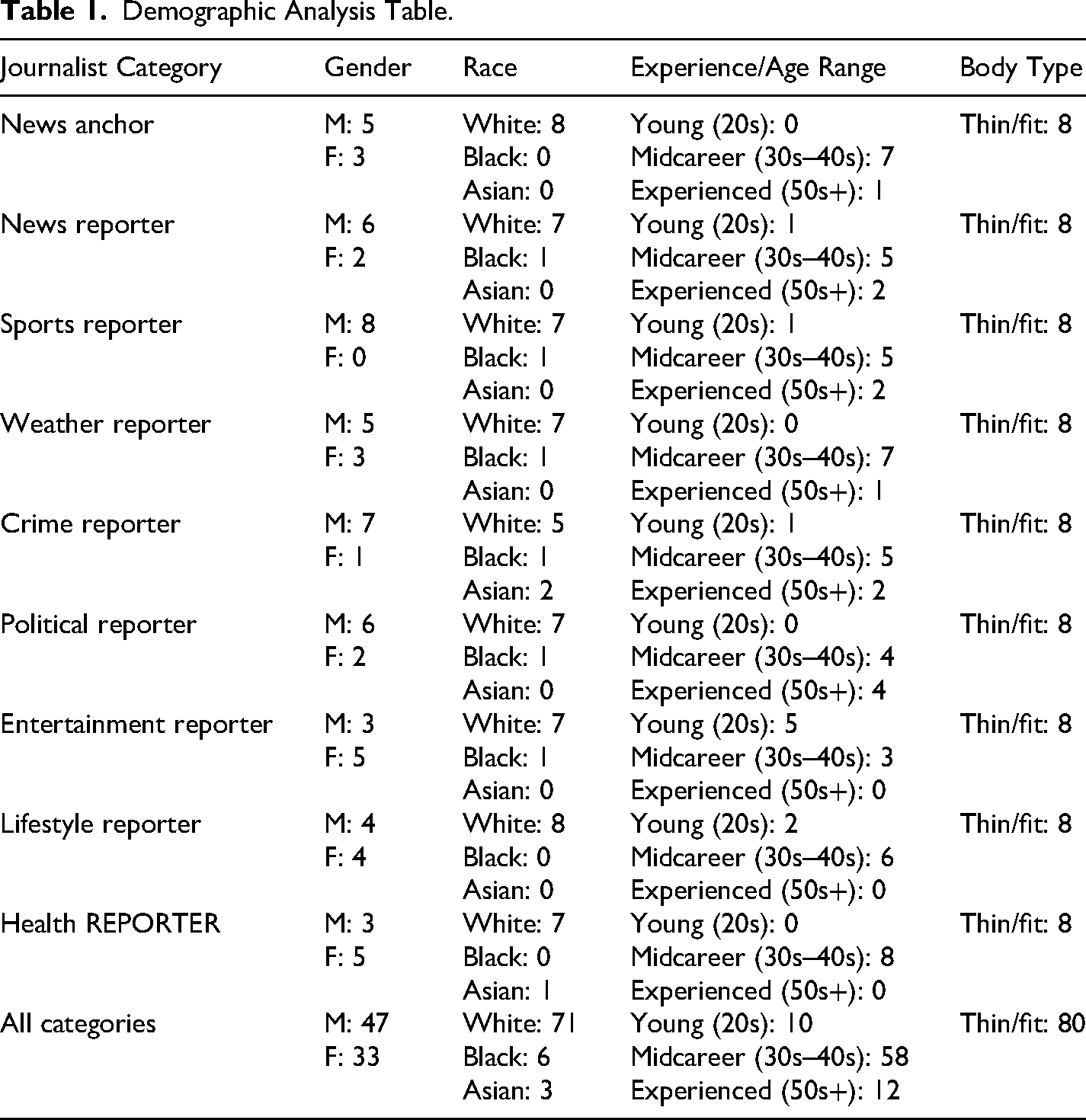
RQ2 asked: Are there common themes across AI image generators in regard to race, gender, and age? RQ3 asked: Are there common themes across journalist categories in regard to race, gender, and age? Findings suggest common themes. First, almost all of the outputs, regardless of image generator or journalist category, were of white people. The biggest outlier was the AI image generator Firefly, which provided outputs of black men across most categories. Age was fairly consistent as well, with the majority of outputs across journalist category and AI generator being of people in their 30s or early 40s, commonly understood as midcareer professionals. The lifestyle and entertainment reporters were the biggest exceptions to the age theme, with some of those outputs being of younger people, perhaps in their 20s. Political reporter outputs skewed older as well. Gender was also consistent, with men more commonly imagined across journalist category and AI generator than women. The sports journalist category outputs were all men. Every single output portrayed a thin or fit person. In general, white, thin or fit men in their 30s or early 40s were the preferred output.
Table 1 shows the details of each category broken down by each characteristic.
Demographic Analysis Table.
Discussion
Using the lens of metajournalistic discourse theory, the current study employed a content analysis of the outputs of AI image generators to explore and understand how AI envisions different types of journalists. Findings suggest that many AI generators are reifying racist and sexist ideas in the news industry. Mainly, AI is reinforcing the idea that a professional, credible journalist is a white man. Women journalists and journalists of color were afterthoughts. This was especially evident at the intersection of race and gender with only two images in the entire sample being of women of color. In addition, all of the women journalists who were generated in the “news” categories were shown with traditionally “masculine” qualities, such as having short hair and wearing suit jackets.
Findings suggest that the cultural identification of journalism as a “male-dominated” field has infiltrated AI. Research suggests that newsroom culture does favor white men. Many women journalists report facing sexism and gender discrimination, including sexual harassment, lower pay, and fewer opportunities for leadership (Knowles, 2020; North, 2016; Urbániková & Čaladi, 2024). Additionally, journalists of color, especially women of color, report their own unique experiences with both racism and sexism in newsrooms (Jackson, 2024). Although the number of women and journalists of color has increased over time, workplace challenges specific to these groups still remain a major problem in many newsrooms across the United States.
Metajournalistic discourse theory is concerned with the meaning-making of journalism, who and what are creating this meaning, and how this meaning is received by the public (Carlson, 2016). As such, it serves as a valuable lens by which to understand how the choices of AI image generators make meaning for the news industry and news consumers. AI is a meaning maker. It has the capability to produce language, images, videos, and other types of media that not only impact the individuals who use AI, but also the public who consumes AI-generated media. It is imperative, then, that these media, and their meaning, continue to be analyzed and understood over time. Findings of the current study suggest that the meaning made by AI image generators prioritize white male journalists while discrediting women journalists and journalists of color.
Many practitioners and researchers believe that AI is the future of media (De Lima-Santos & Ceron, 2021; Granados, 2024; Vrabič Dežman, 2024). Although there is some hesitation, many industries, including journalism, are embracing AI as part of the path forward. However, findings of the current study suggest AI's understanding and visualizations of journalists are stuck in the past, relying on historically sexist and racist ideas to display who a journalist is and what a journalist looks like. News media representation is critical in meaning making and holds major influence over public perception (McCombs & Valenzuela, 2020). If AI promotes journalists as white men, that could deter women and people of color from entering the field. As Harris (2022) argued, news media representation matters greatly for the future generation of journalists.
News media representations also impact how the public perceives journalists’ credibility. If AI imagery continues to favor white men as the prime examples of professional journalists, this could serve to further discredit women journalists and journalists of color. Research already shows that audiences find white men more credible than other groups, even with education and experience being equal (Boling & Walker, 2021). This is also why many women journalists are usually given “lesser” or “softer” news beats such as lifestyle and entertainment while men journalists are given “hard news” beats such as politics and crime (Santia et al., 2025). Similarly, journalists of color report being tokenized in their beat assignments (Somani & Tyree, 2021). This has been used by some news organizations as a way to justify the pay gap between white men journalists and other groups (Han & Zatepilina-Monacell, 2023). AI imagery such as the ones found in this study would serve to perpetuate these gendered and racist injustices in news culture.
When new media technologies are introduced and diffuse throughout society, they have the potential to be a boundary breaker and a change maker. For example, Hammack and Manago (2025) highlighted how social media have facilitated shifting social norms regarding gender and sexuality. AI is currently in the phase of diffusion as more and more people are starting to adopt AI usage in their daily routines. Instead of perpetuating past stereotypes of who a journalist is and what a journalist looks like, AI could serve to forge the future and make meaning that serves equality, but it seems, we aren’t there quite yet.
Limitations and Future Research
Although considerable thought was invested in the planning and execution of this study, there are limitations that should be noted. Although these limitations should be discussed, they do not invalidate the findings of this study. Rather, they should be used to better understand the findings and inform future studies. This project was done in a specific period of time. AI is constantly adapting and learning, so perhaps results would be different if this project was conducted during a different time frame.
Future research should continue to monitor AI-generated images of journalists over time. It would be interesting to see if and how these images will change as AI generators become more sophisticated and complex. It would also be useful to adapt this project to other career fields to see how AI imagines people who work in different industries, especially those that already have a cultural stereotype of workers. Representation is critical in many career fields for recruitment and retention, so this project's methodology would be useful in many different labor markets.
Footnotes
Funding
The author received no financial support for the research, authorship, and/or publication of this article.
Declaration of Conflicting Interests
The author declared no potential conflicts of interest with respect to the research, authorship, and/or publication of this article.