






Abstract
By utilizing Hallin and Mancini’s four media systems criteria as a baseline interpretive lens, this study expands understandings of how Russian global media challenge existing international institutions. It illustrates how Russia Today (RT) frames Russia's media system vis-à-vis the West to online audiences. It examines 5 years of media-related posts (prior to Meta's ban) on RT's Arabic, English, French, and Spanish Facebook pages to reveal how audience engagement and post frequency related to media circulation, political parallelism, journalistic professionalism, and state intervention frames varied across languages and world regions. The study concludes with implications of RT's Western versus global south-targeting approaches and how they relate to the Kremlin's stated goal of creating a multipolar world.
Keywords
In 2005, Russia's Federal Agency for Press and Mass Media assigned $30m annually to launch and run Rossiya Segodnya (Russia Today). Then-Minister of Press, Broadcasting and Mass Communications Mikhail Lesin announced that the goal of building an outward-facing Russian news media outlet was to create a “Moscow spin” to compete with BBC and CNN on the global stage (Boylan & Taylor, 2017, para. 48). Russia Today rebranded itself RT in 2008 and received $300m to hire hundreds of journalists and expand operations to more than 20 international bureaus in 2011 (Alpert, 2014). Prior to Russia's annexation of Crimea and hosting of the Sochi Winter Olympics, President Putin increased RT's funding by more than 30% (Elswah & Howard, 2021). From 2017 to 2022, Russia's funding of RT increased by approximately $111m (Statista Research Department, 2023). Today, RT is one of the globe's most prominent state-based media networks. Before the war with Ukraine, people in more than 100 countries consumed RT content, including more than 50 million viewers across Europe and the United States (Carter & Carter, 2021; Knoblock, 2021). RT received 200 million website visits and about three billion YouTube views (Knoblock, 2021), rendering it one of the most-watched TV channels before YouTube banned its content (Graydon, 2019).
RT uses soft power, conspiracies, and language-based targeting strategies to promote Russia as a key counterhegemonic force against the West (Kragh & Åsberg, 2017; Morales, 2022; Orttung & Nelson, 2019). Although the majority of its content centers on the Kremlin's geopolitical interests (Yang et al., 2025), RT also works to undermine Russia's rivals by alternating right- and left-leaning talking points (Yablokov, 2015), attacking U.S. politicians (Jamieson, 2018), framing the Western leaders as unethical racists (Balint et al., 2022; Miazhevich, 2018), presenting alternative worldviews (Saunders et al., 2022; Winkler et al., 2024). Viewing RT may be impactful too, as experimental studies show it prompts negative attitudes towards Ukraine (Fisher, 2020), weakens support for international systems (Elswah & Howard, 2021), negatively influences perceptions of the United States (Carter & Carter, 2021), and fuels polarization and conflict (Golovchenko et al., 2020).
This study expands on understandings of RT by demonstrating how the outlet's Facebook pages framed Russia's media system vis-à-vis the West for an online global audience prior to the platform's online takedowns. It examines post frequency and audience engagement with media system posts by frame and language. We begin by demonstrating the need to further understand RT content strategies as a supplement to deplatforming efforts. We then highlight media systems theory and its widely accepted evaluative criteria. After demonstrating how framing theory can merge with media systems evaluation criteria, we utilize media system frames as the basis of our message assessment of RT's social media posts.
Deplatforming Responses to RT: An Assessment
Deplatforming has served as a chief strategy for stemming the disinformation influence of RT's media content. In 2022, the European Union barred RT's related language-based channels from distributing content across the alliance's member states (Balint et al., 2022). Facebook, Instagram, and YouTube blocked RT across Europe, demoted its content, and/or deprived it of monetization and ad revenue (Maruf, 2022). Britain soon banned RT UK and the United States shut down RT America, before Meta expanded its RT ban globally (Lyngaas, 2024).
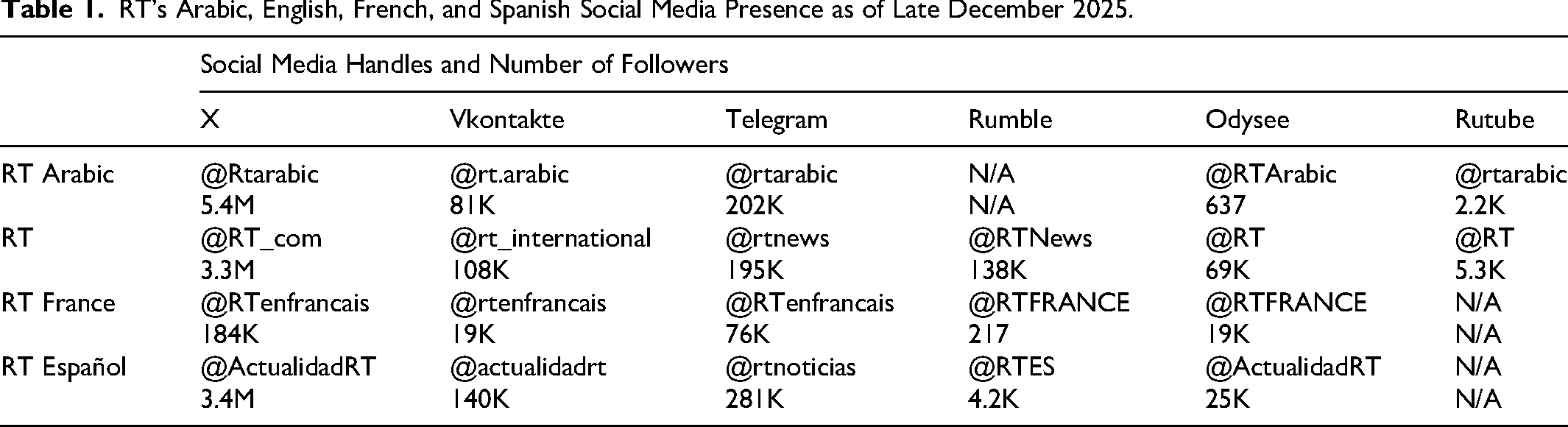
Although deplatforming diminished viewership, RT's content was still available to interested viewers. Even today, millions of viewers can openly access RT content online and via satellite (Goujard, 2022; Tuhina, 2024). RT's 24/7 livestream on Rumble alone surpassed 43 million views in 2023–2025. Further, the outlet's website and official multilingual pages on X, Rumble, RuTube, Odysee, Telegram, and Vkontakte (VK) continue to reach hundreds of thousands of followers (see Table 1). Capitalizing on European loopholes, RT disseminates content through mirror and proxy websites, platform migration, social media re-posts, virtual private networks, and open-source privacy browsers (Balint et al., 2022; How to Access RT.Com, 2022; The Cube, 2022). In short, RT's resilience reinforces the ongoing need to understand Russia's messaging and its efforts to influence global audiences.
RT's Arabic, English, French, and Spanish Social Media Presence as of Late December 2025.
Media Systems Theory
Distinguishable from select media sectors (e.g., print, radio, and TV) or individual outlets (McQuail, 1992), a media system refers to collective media “operating within a given social and political system” (Hardy, 2010, p. 5). After World War II, Siebert et al. (1956) compared media in the Soviet Union, Great Britain, and the United States to introduce a four-type, media system taxonomy: authoritarian, Soviet communist, libertarian, and social responsibility. Other media system types surfaced thereafter, including revolutionary, development, democratic-socialist, military dictatorship, and state one-party rule models (Hachten, 1981; Picard, 1985; Voltmer, 2013). Putin's media system has been labeled neo-authoritarian (Becker, 2014), neo-Soviet (Oates, 2007), and statist commercialized (Vartanova, 2012). Such taxonomies enlighten intersections between political and media contexts but lack a common analytical framework for assessing system types.
Hallin and Mancini's (2004) seminal work comparing 18 nations in Western Europe and North America filled the gap by introducing four, empirically validated, evaluative elements that cut across media system types (Hallin & Mancini, 2017; Herrero et al., 2017). Their first criterion—media markets and circulation (high vs. low)—addresses newspaper reach and TV viewership, levels of separation between sensational and quality content, and balance between local, regional, and national outlets. Their second criterion—political parallelism (high vs. low)—refers to media and political actor connections in terms of content, organizational ties, journalistic role, and media personnel engagement in politics. Their third criterion—journalistic professionalism (strong vs. weak)—assesses levels of journalistic autonomy, ethical and professional norms, and the profession's public service orientation. Finally, their fourth criterion—state intervention (strong vs. weak)—captures how governments shape media systems through funding, subsidies, and regulations. Collectively, the four criteria constitute an analytical framework useful for understanding how RT frames the media to its international audience.
Blending Media System With News Framing
Framing has long served as a foundation for international media analyses. To frame is to select and foreground certain aspects of a message to provide meaning “to an unfolding strip of events, weaving a connection among them” (Gamson & Modigliani, 1987, p. 143; see also Entman, 1993). Frame building addresses how journalists, media, and politicians establish and associate disparate information into coherent perspectives (Tewksbury & Scheufele, 2009) about items such as attacks (Entman, 2003), wars (Parry, 2011), and pandemics (Li et al., 2017), but rarely concerns media systems. The few exceptions include analyses of media's reporting on professional journalistic norms and freedom of expression (Al Mazahra, 2023; Andrade, 2013; Damanhoury et al., 2024; El-Falaky, 2019).
Frame building can be inductive or deductive. The inductive method emerges when “the selection of one set of facts or arguments over another” involves context-specific understandings and formulations of frames (Cacciatore et al., 2016, p. 10). The deductive approach concerns how different presentations of identical decision-making scenarios can “influence people's choices and their evaluations of the various options presented to them” (Scheufele & Tewksbury, 2007, p. 11). Gain versus loss and peace versus war are two dyadic examples of deductive, equivalency frames that affect audience evaluations (Cho & Boster, 2008; Fahmy & Eakin, 2014).
An outlet's framing can differ across languages (e.g., Muwafi et al., 2025). RT's frames differ across multilingual content (Matter et al., 2023), emphasizing the need to study beyond only English-language news content (Yang et al., 2025). This study fills the gap in understanding Russian media's framing of the media across multilingual audience targets. It expands on framing building literature by examining how RT frames global media outlet practices to boost its own credibility and denigrate the West. It employs a deductive approach to framing by drawing on media systems theory as key input source for building frames. Specifically, we ask,
Frame setting pertains to assessing effects on audiences’ perceptions, attitudes, and behaviors (Entman et al., 2009; Lecheler & Vreese, 2019). Frame setting studies examine schemes, narrative fidelity, and audience engagements to assess the audience's point of view and participation in two-way communication. Studies show that Russian state media attract young males’ views, likes, shares, and comments through identity grievance narratives and topics such as terrorism, U.S. domestic policies, and geopolitical tensions (Hellman, 2024; Wagnsson, 2023; Yang et al., 2025). The level of audience engagement can differ across languages, with RT's Arabic-language content garnering less views than its English output, despite the outlet's growing reach outside North America and Western Europe (Hellman, 2024). Exposure to such content can also sway audience views of rival countries (Fisher, 2020), attitudes toward foreign policy (Carter & Carter, 2021), and trust in politicians, societal institutions, and the media (Wagnsson, 2023). Yet, attentive processing can diminish such influence (Shirikov & Syunyaev, 2025). Although examining the influence of RT's news content on attitudes and trust is beyond our scope, we examine audience interactions with the various content frames across languages.
Method
This study extracted and analyzed media-related texts from an original CrowdTangle dataset of 720,329 Facebook posts between 2017 and 2022 on six RT Facebook pages: RT (hereafter RT Main), RT America, RT Arabic, RT Español, RT France, and RT UK. The final dataset included posts in their original languages, date of publication, and sum of engagement interactions per post (i.e., audience comments, shares, likes, and reactions). Based on the language and the geographic relevance of the posted content by each outlet, we classified RT America, RT France, and RT UK as accounts targeting audiences in the global north, RT Arabic and RT Español as global south-facing, and RT Main as targeting a global audience in English. We focused on Facebook due to RT's relative success on the platform in our study's timeframe (prior to the Meta-imposed ban) and the site's ranking as one of the largest social media platforms worldwide (Benton, 2022). The 5-year timeframe captures the peak of RT's funding, reach, and power, and major events such as COVID-19, global protests, political leadership changes, RT account modifications, and Russia's invasion of Ukraine.
Using BERT (Bidirectional Encoder Representations from Transformers) (Grootendorst, 2022), we first conducted topic modeling on the full extraction of CrowdTangle posts to understand the dataset's overall thematic structure. We then extracted Facebook posts based on a media dictionary lens composed of 181 search words in Arabic, English, French, and Spanish relevant to media systems criteria to refine our corpus. The terms identified names of media outlets (e.g., RT, CNN, and BBC), social media companies (e.g., Facebook, TikTok, and Instagram), words indicative of circulation (e.g., followers, shares, and views), journalism/media industry positions (e.g., journalist, correspondent, and presenter), content types (e.g., news, op-ed, and investigative report), and positive and negative media labels (e.g., truth, bias, propaganda, and mis/disinformation). This process reduced the corpus to 10,297 media-focused posts across RT America (n = 691), RT UK (413), RT Main (1,526), RT France (3,320), RT Arabic (2,440), and RT Español (1,907). For a full list of media terms and extracted posts, see Supplements A and B.
To assess RT's content regarding each media systems’ criteria, we conducted a quantitative content analysis. Six multilingual coders conducted a pilot study on 10% of the data to identify alignments and deviations from Hallin and Mancini's (2004) standard media systems criteria. The coders held follow-up discussions until intercoder reliability scores above 0.80 on Cohen's kappa emerged for each codebook category. The finalized codebook assessed the presence of each category and expanded their definitions to account for social media dynamics and societal factors that succeeded the development of the media system's criteria. For the media markets and circulation category, we moved beyond just a quantitative assessment of circulation of select outlets to also account for posts highlighting audience reach and viewership levels, the promotion of viral videos and popular conspiracy theories, and calling for audiences to follow, like, share, or visit other global media content. The decision to include self-promotion and sharing of viral content in our operationalization of circulation stems from the need to account for outlets’ push to increase their circulation in the digital sphere (Carlson, 2020). Political parallelism addressed posts that drew connections between media outlets, companies, and professionals as they aligned with politicians and broader economic movements or campaigns rampant in recent years. Journalistic professionalism posts encompassed a wide range of performance metrics and signals of journalistic norms, including enterprise and original reporting, source identification and attribution, hosting of experts, accumulation of media awards, provision of live coverage, and professionalism evaluations of media outlets. State intervention posts referred to killing and persecution of journalists, media bans, and government regulations as well as censorship by states and major tech companies. Each post in our analysis was coded as having met one or more than one media systems criterion (for the coding sheet and examples of each criterion across RT's content, see Supplement C).
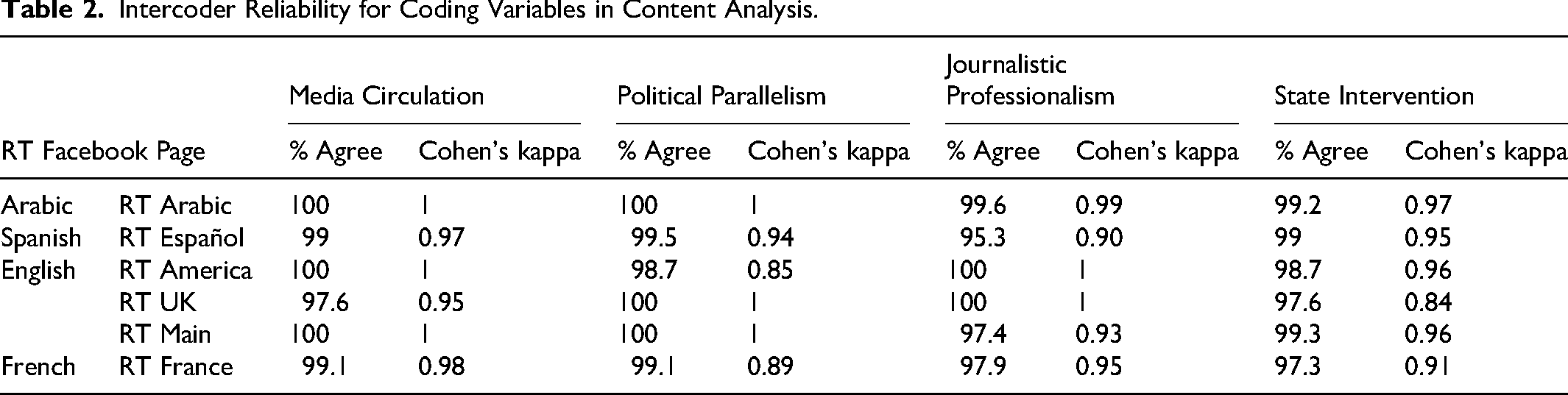
Each coder underwent extensive training on the codebook to assess post elements constituting each media systems criterion (0 = Not Present, 1 = Present). Coders fluent in Arabic, English, French, and Spanish manually analyzed all 10,297 media posts to help ensure valid results. The average intercoder reliability score across all categories and languages was 0.955 (see Table 2). A third coder resolved differences in these analyses.
Intercoder Reliability for Coding Variables in Content Analysis.
We calculated post frequency and audience interactions (sum and average of shares, likes, comments, and reactions) with each frame across media-related corpus and language pages. We cross-tabulated language by each frame and conducted chi-square tests of independence. Because the distribution of post interactions was highly skewed, we used a log 10 transformation of total interactions (log 10[interactions + 1]) and compared mean log-interactions for posts with and without each frame using independent-samples t tests. We also conducted a one-way analysis of variance (ANOVA) with log-transformed interactions and language.
We employed a qualitative textual analysis to gauge the tone of each frame. The authors used Hallin and Mancini's (2004) deductive dyads of high versus low and strong versus weak as an analytical framework to dissect and identify patterns in how RT Facebook framed the U.S./Western and Russian media operations across the Arabic, English, French, and Spanish languages.
Results
RQ1: Media Systems Frames
RT repeatedly utilized Hallin and Mancini's four frames in its media-related Facebook content. On average, approximately six media systems-related posts appeared daily throughout 2017–2022. Significant differences in proportions occurred across the four frames, Q(3, N = 10,297) = 7,221.54, p < .001. Journalistic professionalism appeared in more than half of RT's Facebook posts, followed by media markets/circulation in more than one-third of the posts, state intervention (13%), and political parallelism (4%). All four frames varied significantly across RT's multilingual Facebook pages. The media markets/circulation frame appeared most in French and English posts, and less in Arabic and Spanish, χ2(3, N = 10,297) = 1,423.09, p < .001, Cramer's V = 0.37. Political parallelism framing was infrequent overall, yet still varied significantly by language, χ2(3, N = 10,297) = 56.76, p < .001, Cramer's V = 0.07. RT used it more commonly in Spanish and French rather than in English and Arabic. Use of the journalistic professionalism frame also differed by language, χ2(3, N = 10,297) = 500.42, p < .001, Cramer's V = 0.22. The frame was most prevalent on the French and English pages. Yet, it was also relatively frequent in Spanish and Arabic posts. Finally, the state intervention frame showed a smaller but significant association with language, χ2(3, N = 10,297) = 90.71, p < .001, Cramer's V = 0.09. It was most frequently employed in French, followed by English and Arabic, and was least common in Spanish (Table 3).
The Number of RT's Media-Related Facebook Posts Between 2017 and 2022 by Frequency, Language, and Criteria.
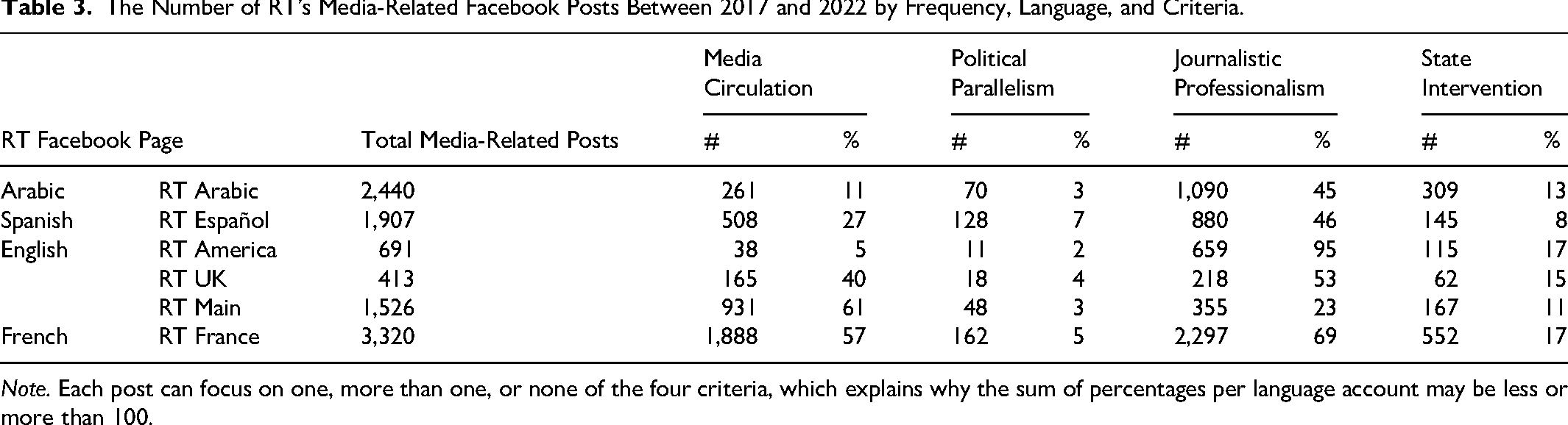
Note. Each post can focus on one, more than one, or none of the four criteria, which explains why the sum of percentages per language account may be less or more than 100.
RQ2: Dyadic Analysis
Media Markets/Circulation
The media markets/circulation frame (37% of RT's media-related Facebook multilingual posts and second highest among the four framing criteria) deemed Russian media circulation as high and U.S. circulation as low. RT encouraged circulation to predominantly its own sites by employing hyperlinks. They invited subscribers to follow RT accounts on social networking sites such as Telegram and VK—Russia's alternative to Facebook. Further, RT's Facebook posts regularly shared interviews or exclusive reports on their own website, highlighting links with words such as “MORE,” “READ MORE,” “DETAILS,” and “FULL INTERVIEW.” They also leveraged media market circulation by discussing or promoting viral videos and conspiracy theories, especially those about COVID-19 that garnered more views.
RT sought an advantage over American competitors in posts about circulation. The low media circulation frame aimed at U.S. cable channels. One RT America report commented on declining viewership and the so-called falling ratings of CNN, Fox, and MSNBC. The high frame (about half of media market posts) mentioned alternative social media platforms, with Russian Telegram and VK most frequent.
RT's media circulation framing revealed a distinct targeting pattern for language-based audiences. On average, RT's English pages (RT America, RT Main, and RT UK) utilized media markets framing in 43% of their posts, with RT Main leading at 61% while directing its audience to RT's Telegram channel in 71% of media market posts. In short, RT sought to promote Russia's media system, denigrate its Western counterparts, and evade U.S. controls over major social media companies amid recurrent deplatforming and censorship efforts. In contrast, RT Español and RT Arabic dedicated only 27% and 11% of posts, respectively, to the media markets frame. Most of these posts featured high circulation frames to promote Russian media by emphasizing omnipresent content from bureaus in South American and Arab countries against the backdrop of Russia's better relations in both regions. Reacting less to censorship pressures from the Global South, RT Arabic redirected its followers to Telegram only 23% of the time.
Political Parallelism
The political parallelism frame focused on high levels of the criterion to primarily showcase how Western media outlets and companies were closely connected to governments and politicians. One post highlighted a Trump plan to receive money from social networking sites in exchange for his subscribers (RT Arabic, May 16, 2021). High political parallelism posts further suggested the media were serving the interests of key political leaders, political movements, parties, governments, and/or regional political blocs. A post on RT France insisted that traditional media sources were siding with the Canadian government by misrepresenting support of the population for the Freedom Convoy Truckers protests (RT France, February 18, 2022). By emphasizing such alignments in the West and avoiding any reporting on similar arrangements in Russia, RT positioned the Russian network as a more credible alternative.
RT presented various states as victims of political alignments more when targeting regional and global audiences. RT Arabic, RT Español, and RT Main emphasized the role of Western and American media outlets as part of an imperialistic project that vilified and threatened Russia. Around the time of Russia's invasion of Ukraine in 2022, numerous RT Español posts presented and described Western media as “Russophobic,” steeped in the practice of reportedly spreading false information about the Ukraine war, and often discriminating against Russian media. One post even quoted Putin's questioning of Biden on “why the U.S. is deliberately providing false information to the media” on a Russia-Ukraine imminent war (RT Español, February 12, 2022). The same three Facebook pages also expanded the repercussions of high political parallelism in the West to venues beyond Russia. To illustrate, one RT Arabic post reported on President Trump listening to a journalist regarding military action against Iran (RT Arabic, June 22, 2019). In short, RT underscored the victimhood of the global south as a byproduct of political parallelism in the Western world.
Journalistic Professionalism
The posts in the third frame juxtaposed Russia's strong professionalism with weak professionalism of its Western counterparts. The strong professionalism frame exhibited RT's emphasis on source attribution, associating it with flagship news agencies such as Reuters, AFP, and AP, and language skills that enabled RT staff to diversify sources by citing local media from around the world. For instance, about one of every 10 RT Facebook posts cited Reuters’ reporting on breaking news, thus lending credibility not only to RT, but also possibly to the British news agency. The frame also foregrounded enterprise reporting that RT produced by citing the network's journalists, reporters in the field, and interviewed guests.
The less frequent weak professionalism frame denounced Western media and tech companies. Here, the posts rebuked select Western outlets for allegedly failing to provide the truth, reporting on news in a biased manner, and/or emerging as the subject of public figures’ criticisms. An RT UK post highlighted how BBC journalists provided “inaccuracies” in Radio 4's Mayday audio documentary in their coverage of the 2018 chemical attack on Douma, Syria (RT UK, September 6, 2021). Throughout, RT projected itself as a professional, truth-seeking media outlet compared to the reportedly irresponsible media industry in the United States and Western Europe.
RT's emphasis on journalistic professionalism differed across RT Facebook's language pages. RT's use of the professionalism framing posts was highest when targeting Western audiences, with almost all of RT America, 70% of RT France, and more than half of RT UK posts focused on such messaging. The three RT pages emphasized their own original reporting and made rare references to outside media competitors or agencies. They also frequently highlighted excerpts from interviewed experts, cited references to their own journalists, branded investigations into topics, and reported live from the field. When using the weak professionalism frame, RT America, RT UK, and RT France attacked and sowed distrust in several prominent news outlets in the United States, the United Kingdom, and France, including CNN, The New York Times, BBC, The Guardian, Sky News, Le Parisien, TF1, and BFM. The professionalism framing thus aimed to boost the Western audience's trust in RT, while simultaneously delegitimizing American, British, and French media, despite heavily relying on Western news agencies when targeting non-Western audiences.
In contrast, RT's Arabic and Spanish pages did not post as much content on journalistic professionalism, and they emphasized different elements when they did so. Posts appearing on RT Arabic and RT Español, while much less dependent on enterprise reporting, cited diverse sources, ranging from Western news agencies to national media outlets in the Global South. For example, RT Arabic and RT Español together cited Reuters in more than 450 posts compared to only eight times on RT's English- and French-language Facebook pages. In doing so, RT may have appeared contradictory at times, exhibiting a pattern of criticizing Western media when targeting a Western audience and heavily using reporting from flagship Western news agencies in communicating to Arab and Latin American Facebook users. At the same time, RT Arabic and Español attributed reporting to a wide range of outlets from Russia (e.g., TASS, Russia 24, and Ruptly) and the Global South, such as Saudi Arabia, Iran, Colombia, Egypt, Qatar, Turkey, and Palestine, to legitimate non-Western media. Additionally, RT's Arabic and Spanish pages rarely accused Arab and Latin American outlets of bias or of spreading disinformation. The two pages also promoted the Khaled Alkhateb award, which RT had created to honor war correspondents worldwide. In sum, when targeting Arab and Latin American audiences, RT strategically altered its approach by emphasizing itself as a “one-stop shop” for regional and international news, associating itself with reputable Western news agencies and professional evaluation that celebrated outstanding journalism worldwide.
State Intervention
The strong state intervention frame juxtaposed Russian and Western media. Most of the posts presented the United States and its European allies—alongside Western social media companies—as forces of heavy censorship and rights violations. Some of the posts criticized Facebook, Twitter, and YouTube for curbing RT's reach. Others highlighted how states were eliminating journalists and media personalities through intimidation, incarceration, and killing. RT focused most frequently on the killing of Saudi journalist Jamal Khashoggi by Saudi Arabia. Yet, RT interestingly also blamed the United States for the incident, with posts describing America as “complicit” in the murder for allowing it to happen and not imposing sanctions on Saudi Arabia in its aftermath (RT America, June 19, 2019). Viewed holistically, RT chose to elevate controversies involving Russia's Western rivals across censorship and measures against journalists.
The less recurrent weak state intervention frame often portrayed the Russian government as a positive force. RT reported on Russia only when it was lifting media bans, such as on Telegram. Posts cited examples of Russia releasing imprisoned journalists but avoided mentions of prosecutions. Moreover, posts eulogized journalists worldwide, arguably to project a Russia respectful of press freedom.
Important differences and similarities characterized the state intervention frame across RT's outlets. RT America, RT UK, and RT France were more likely to feature state intervention posts when targeting audiences in the three Western nations; other pages targeted more regional and global audiences. RT's criticisms of Western governments and companies’ interventions persisted across languages, including reporting on the prosecution of journalists, efforts to extradite Julian Assange, use of widespread surveillance, and restrictions on foreign media entities such as RT, TikTok, and WeChat. For Western audiences, RT denigrated the West and its allies as draconian and irreconcilable with democratic values of freedom.
RQ3 and RQ4: Audience Engagement
The level of audience engagement with media systems-related posts varied across RT's four frames, but none had high audience interactions. Posts that did not employ the media markets frame (M = 2.56, SD = 0.61) showed higher interaction levels than posts that did (M = 2.37, SD = 0.63), t(10,295) = 15.14, p < .001, d = 0.31. Similarly, higher interaction levels were shown for posts without the journalistic professional frame (M = 2.59, SD = 0.58) than for posts with the frame (M = 2.40, SD = 0.65), t(10,293) = 15.48, p < .001, d = 0.30. Posts with the political parallelism frame (M = 2.53, SD = 0.61) did not differ significantly from posts without it (M = 2.49, SD = 0.63), t(10,295) = −1.31, p = .191, d = −0.06. Posts without the state intervention frame had slightly higher interaction levels (M = 2.49, SD = 0.64) than posts with the frame (M = 2.44, SD = 0.56), t(1852) = 2.95, p = .003, d = 0.08, although this effect was small.
More importantly, the levels of audience engagement differed by language (see Table 4). A one-way ANOVA showed a significant effect of language on interaction levels, F(3, 10,293) = 518.06, p < .001, η2 = 0.13. Tukey’s HSD post-hoc tests indicated that all pairwise differences between languages were significant (all ps < .001): Arabic posts (M ≈ 2.86) attracted the highest interaction levels, followed by Spanish (M ≈ 2.54), English (M ≈ 2.37), and French posts (M ≈ 2.27). Overall, Arabic and Spanish posts generated more audience interactions than English and French content.
Means, Standard Deviations, and One-way ANOVA for log 10(Total Interactions + 1) by Language of RT Facebook Page.
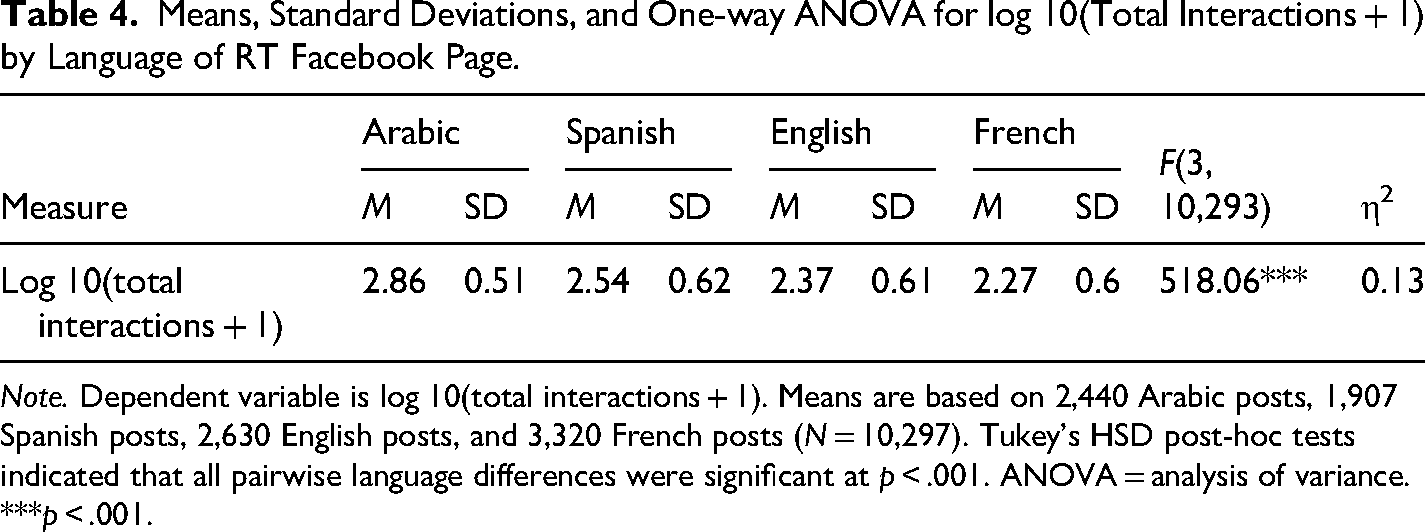
Note. Dependent variable is log 10(total interactions + 1). Means are based on 2,440 Arabic posts, 1,907 Spanish posts, 2,630 English posts, and 3,320 French posts (N = 10,297). Tukey’s HSD post-hoc tests indicated that all pairwise language differences were significant at p < .001. ANOVA = analysis of variance.
***p < .001.
A more granular look at the audience engagements reveals that the RT Español audience stood out as the most engaged in media circulation framing, with an average of 1,538 engagements per post, compared to an average of 772 interactions across languages. RT Español garnered the highest engagement (81,438 interactions) across the entire RT Facebook dataset with its post pointing to and recirculating viral videos of George Floyd, describing him as a “calm, athletic man and a good counselor” (RT Español, June 1, 2020). RT Arabic, with a smaller proportion of total media market posts, also garnered substantial audience engagement with an average of 979 interactions per post. RT America and RT UK registered significantly lower audience engagement for media market content, averaging only 145 and 415 interactions respectively.
Political parallelism posts prompted the most interactions on RT Español and RT Arabic with above-average scores of 1,010 and 1,003, respectively. The posts of the two pages receiving the most engagements typically mixed victimhood of the global south with vilification of the West. Meanwhile, the posts with the most engagements on RT America, RT UK, and RT France presented government-media “collusion” with respect to national issues. About half of RT France's 20 most engaging posts, for example, addressed local media's hostile relationship to the Yellow Vest protests, which suggested Macron's nepotism, as his family and friends reportedly held key editorial positions across various French media organizations. Posts spawning high engagement levels on RT America focused on complicity of governmental, journalistic, and social media companies to expand liberal interference with issues important to conservatives like COVID-19 vaccines.
RT Arabic and RT Español also received the highest interactions on journalistic professionalism with above-average scores of 1,943 and 1,024. Some of the most engaging posts featured negative reporting on the United States and its media, including criticisms of CNN's coverage and exclusive interviews with world leaders. U.S. journalistic professionalism framing in RT America, RT UK and RT France appeared much less successful in prompting active engagement, with below average scores. Yet, the three pages’ most engaging posts similarly espoused a negative slant against the United States, the United Kingdom, and France.
The state intervention frame did not have high levels of audience engagement on RT America and RT UK. RT Español and RT Arabic again had the highest interaction scores of 1,143 and 1,084 per state intervention post, respectively. State intervention posts harboring attacks on the West prompted more audience interactions, particularly in the two controversial cases of Khashoggi and Assange. A post receiving 3,835 interactions claimed that then-President Trump could not afford to blame Saudi Arabia for Khashoggi's murder (RT Arabic, October 19, 2018). Another on RT France with 6,698 interactions discussed President Macron's accusations against RT (February 1, 2019). Building on its content that presented Western governments as corrupt and media as unprofessional, RT's most engaging state intervention posts sought to erode trust in those institutions by foregrounding their stifling of press freedom.
Conclusion
Between 2017 and 2022, RT utilized content reinforcing media system frames to present itself as the chief evaluator of global media systems. Drawing on well-established criteria for evaluating media systems as its messaging foundation, RT employed frame repetition to position itself as a credible source of global news. RT's use of an audience targeting strategy for the frame's presentation, coupled with its high levels of repetition, produced high levels of audience engagement with select media systems content, particularly in Arabic and Spanish.
RT's framing process expanded the interpretation of media systems evaluative rubric to account for the supranational media context. First, the Russian news outlet expanded “political parallelism” from its standard internal focus on the alignment between political parties and the media to a broader emphasis on geopolitical alignments among media and transnational corporations, tech companies, and social movements. Second, it broadened the scope of “journalistic professionalism” beyond newspaper and television journalists to social media influencers now operating in the contemporary media environment. Third, RT also expanded the scope of “state intervention” to account for other institutions, such as tech companies that now regulate media and content. “Media markets/circulation” remained an apt label, but in implementation, RT placed a greater focus on social media performance, language-based reach, and audience targeting as a circulation strategy.
Overall, RT Facebook's recurrent focus on media systems evaluative rubrics as frames fostered credibility by association. Yet, the framing of each criterion contributed to that effort in unique ways. Discussions of media markets and circulation identified and mapped an intersecting network of media outlets that had the potential to share (and thereby expand) audiences for RT and other non-Western media outlets online. References to political parallelism, by contrast, diagrammed overlapping bilateral, multilateral, or regional interests that could attract viewership and engagement. Journalistic professionalism posts addressed practice-based norms that both worked to inoculate online followers against the view that RT was simply a mouthpiece for the Russian government and stressed the outlet's high standing among its global competitors for presenting fair, truthful reporting. Finally, the focus on state and tech company interventions also addressed practice-based norms of credibility, but emphasized negative attributes of institutional involvement in the decision-making of networks external to RT.
RT's framing of media systems was not uniform across its various language Facebook accounts. RT employed a Western-targeted approach hostile to the media in its accounts reaching American, British, and French audiences. This strategy involved more media markets/circulation posts to sidestep deplatforming attempts by Western governments and companies, particularly in the wake of the Ukraine war. In targeting the West, RT placed a dominant emphasis on journalistic professionalism by producing original content—a hallmark for high-quality journalism (Napoli et al., 2018)—that simultaneously denounced the lack of original reporting in many American and British news outlets. Further, RT America, RT UK, and RT France's content was often localized in ways that framed governments and media in those countries in negative terms to sow discord within American, British, and French publics, perhaps due to the tendency of audiences to pay more attention to proximate, rather than global events (Harcup & O’Neill, 2017).
RT, however, utilized a different framing when targeting the global south in RT Arabic, RT Español, and RT Main Facebook accounts. The approach denounced the West at times but generally praised other regional governments and institutions in ways that echoed the Kremlin's talking points about the need to end neo-colonialism and create a multipolar world (Gavin, 2023). Building on Chinese global media's positive reporting style and pro-government framing of non-Western states (Zhao & Xiang, 2019), RT mainly refrained from criticizing Arab and Latin American countries. A key exception was Khashoggi's murder by Saudi operatives, which RT also used to vilify the United States. RT associated Russia and the global south through a victim narrative more generally by focusing on regional and global events, often directing blame to Western governments, media, and tech giants. In RT Arabic, RT Español, and RT Main Facebook pages, the posts further represented RT as a credible, professional news outlet available to global audiences. The posts presented RT as an aggregator of news from worldwide sources (rather than simply a producer of original content) and cited a diverse range of voices, including the same outlets it aggressively criticized in Western-targeting pages to imply fairness and balance. RT also emphasized its status as arbiter of major global media organizations through posts about its global prizes for top journalists.
The levels of audience engagement varied across languages and regions. The general dominance of audience reactions to posts about aligned or misaligned interests (particularly on RT Arabic and RT Español) suggests more concern about global power relations than internal practices of media outlets. Despite state intervention posts generally having the lowest level of audience engagement, they dominated interactions targeting regional audiences in Arabic and Spanish as well as global Facebook users in English on RT Main (a centralized hub for viewers with RT language accounts banned by other states or tech companies).
The media systems framework offers a useful analytical lens for comparing state-sponsored media efforts in the contested online environment. This study's focus on Russia's primary global media arm at its peak reveals reporting patterns designed to build credibility for Russia's media apparatus, while undermining competitors. In today's post-truth society—with rampant mis/disinformation, shrinking attention spans, and increasing smartphone usage—the competition over the packaging of news for a global audience is more crucial than ever. Some states now go beyond merely promoting a favorable image of themselves and their policies; they invest in enhancing the credibility of their media systems and delegitimating those of their rivals. In this highly contested global media space, the media markets, political parallelism, journalistic professionalism, and state intervention criteria can help dissect, compare, and understand news framing in the emerging area of global media's coverage of media.
This study embodies limitations that future research can help address. First, the utilization of Hallin and Mancini's framework—developed prior to the social media boom and focused on media systems infrastructure and national contexts—in the digital world required an operationalization process that expanded the four criteria to account for contemporary approaches to push circulation and signal levels of professionalism, parallelism, and intervention on Facebook. In doing so, the application of the four criteria may not squarely fit with their original conceptions to account for their manifestations in today's digital content. Future research should build upon the media system frames and their operationalization for analyzing and comparing how RT and other state-sponsored international media outlets use content strategies to enhance credibility around the globe. Second, this study's approach of treating 5 years of RT practice as an aggregated effort would benefit from a time series analysis to assess what situational events (e.g., media bans and military action) might correspond to framing shifts to develop better understandings of when and why RT seeks to strengthen its standing vis-à-vis other global media outlets. Third, future researchers should identify criteria useful in evaluating how RT reports on other institutions beyond media systems theory and on platforms other than Facebook (where it is no longer available), to fully grasp the outlet's strategic impact. Fourth, more research should move beyond just the analyses of texts of social media posts to also dissect and compare visual messaging strategies by state-sponsored global media outlets. Lastly, the study only examined the tone of framing qualitatively. A complementary quantitative analysis would expand on how media systems were presented similarly or differently.
Supplemental Material
sj-docx-1-enx-10.1177_19312431261460448 - Supplemental material for The Moscow Spin: Assessing Russia Today's (RT) Framing of Media Systems Across Languages
Supplemental material, sj-docx-1-enx-10.1177_19312431261460448 for The Moscow Spin: Assessing Russia Today's (RT) Framing of Media Systems Across Languages by Kareem El Damanhoury, Carol Kay Winkler, Virginia Massignan, Mor Yachin, Katerina Papatheodorou and Sonny Patel in Electronic News
Footnotes

Funding
The authors received no financial support for the research, authorship, and/or publication of this article.
Declaration of Conflicting Interests
The authors declared no potential conflicts of interest with respect to the research, authorship, and/or publication of this article.
Data Availability
Supplemental Material
Supplemental material for this article is available online.
Author Biographies
References
Supplementary Material
Please find the following supplemental material available below.
For Open Access articles published under a Creative Commons License, all supplemental material carries the same license as the article it is associated with.
For non-Open Access articles published, all supplemental material carries a non-exclusive license, and permission requests for re-use of supplemental material or any part of supplemental material shall be sent directly to the copyright owner as specified in the copyright notice associated with the article.
