







Abstract
Current literature has identified a growing achievement gap experienced by students raised in poverty. However, some students from poverty can defeat the odds and succeed academically with advanced degrees. Nine graduate students self-identified as being raised in poverty participated in this study. The home-related experiences that led to their academic success were explored. Basic qualitative inquiry and constructivist narrative analysis were used as a framework for this study. Data collection methods included face-to-face and telephone interviews. Data transcriptions were coded and analyzed using the constant comparative method. Findings suggest that graduate students raised in poverty need a broad support system inside and outside the home. They also indicated that activities and routines were critical to their continued academic success and how academic work often became an escape from the chaos around them. This study calls attention to the academic importance of a broader support network for students raised in poverty.
The impact of poverty on academic achievement has been of interest to educators and policymakers for many years (Abbott & Joireman, 2001; Brooks-Gunn & Duncan, 1997; Brunner, 1948; Burney & Beilke, 2008; Crooks, 1995; Guo, 1998; Ramey & Ramey, 1990; Sirin, 2005; Smith, Brooks-Gunn, & Klebanov, 1997; White, 1982). Since the mid-1960s, socioeconomic status (SES) has been well documented as being correlated to cognitive ability and achievement during early childhood years and longer (Coleman et al., 1966). Two major meta-analytic literature reviews on SES and academic achievement (Sirin, 2005; White, 1982) both concluded that academic success is greatly influenced by the income of a students’ family. In addition, several recent national reports have highlighted the achievement gaps experienced by students raised in poverty (Aud et al., 2013; Coley & Baker, 2013; Olszewski-Kubilius & Clarenbach, 2012; Wyner, Bridgeland, & DiIulio, 2007). Though some gains have been made over the past 20 years, students from poverty still lag behind their counterparts in high school and college graduation rates (Cataldi & KewalRamani, 2009; Fitzgerald, 2004; Wirt et al., 2004). Poverty is a complex issue involving parent education levels, health and nutrition issues, family structure, and cultural issues that impact the academic success of students (Kim, 2004; Roosa, Deng, Nair, & Burrell, 2005). For the purposes of this research, poverty is being defined as low SES and both terms are used interchangeably.
Unfortunately, the family income gap continues to impact the achievement gap of students, even in college. According to Gladieux (2004), 60% of high school graduates from families earning less than $33,000 a year attend college, compared with 90% from families earning more than $88,000 a year. Within 5 years of entering college, more than 40% of students from the top income quartile of families attain a bachelor’s degree, compared with 6% of students who attain a bachelor’s degree from the lowest income quartile (Fitzgerald, 2004). The origins of the achievement gap between students raised in low SES are evident from an early age and continue through a student’s academic career. Students from higher income backgrounds do not experience the same achievement gap. Academically successful students raised in low-income environments also face additional challenges at the college level. Often, they do not understand the college environment and do not benefit from the assistance and support needed to develop self-confidence in challenging academic settings (Reyes, 2007). The struggles of students raised in poverty seem to be highlighted even more when the same students attend an elite university. Individuals from low-income backgrounds retain a stigmatized identity and experience anxieties regarding their academic fit and self-regulatory issues from managing these concerns (Johnson, 2009; Johnson, Richeson, & Finkel, 2011).
Literature Review
As a foundation for this study on home environments and academic success of graduate students from low-income households, the literature on the relationship of home environments and later academic success was examined. Special attention was given to the literature on the importance of building literacy and language skills during early childhood.
Home Environments for Academic Success
The impact that living in poverty has on academic achievement starts in early childhood and continues through years of schooling. At a very young age, children from low-income home environments have lower levels of literacy concepts and therefore reading comprehension is negatively impacted (Dyson, Hett, & Blair, 2003). Duncan and Seymour (2000) reported that when children from poverty enter school, they are behind their counterparts in letter recognition and basic literacy skills. Factors such as the length of time in poverty, family assets, and the poverty level of the family when children are younger than five all affect a child’s cognitive development and readiness for school learning (Anand & Lea, 2011; Brooks-Gunn & Duncan, 1997; Burney & Beilke, 2008).
Understanding what is happening in the households of children living in poverty will help one understand the impact that poverty has on children and their academic success. Guo and Harris (2000) suggest that a child’s early cognitive skills are related to the level of cognitive stimulation in the home during the preschool years. Their study focused on building the literacy skills and motivation for academic success. Some of the focus areas for cognitive stimulation include vocabulary development (Hart & Risley, 1995), literacy skills (Duncan & Seymour, 2000; Dyson et al., 2003), and language development.
Language development
Children raised in poverty lack the same opportunities to develop their vocabulary as their counterparts from middle class (Farkas & Beron, 2004). When examining the fluency of language in the home, Hart and Risley (1995) documented that parents in middle-class homes spoke an average of 487 statements or words each hour while their counterparts in low-income homes spoke 178 per hour. One of the main reasons for the achievement gaps seen in childhood between more and less advantaged children is the quality of language development in the home (Magnuson & Shager, 2010; Turkheimer, Haley, Waldron, D’Onofrio, & Gottesman, 2003; Tyler-Wood, 1993). Families living in low economic conditions typically communicate in more directive manners. Children in these home environments are not encouraged nor expected to engage in complex thinking (Se’n’echal & LeFevre, 2002). The home experiences, which build the language and literary skill during the preschool years, set the stage for later academic achievement (Egalite, 2016; Murnane, 2007).
Literacy skills
Children from poverty also enter school with lower levels of other literary-related skills, such as letter recognition, and comprehension (Duncan & Seymour, 2000; Dyson et al., 2003). As Chatterji (2006) explains, this difference develops as a result of the hours a child is read to during the preschool years, presence of books and other written materials in the home, and the types of conversation between parents and children.
A second possible reason comes from limited literary resources available to families and children living in poverty (Kim, 2004). Children living in poverty have fewer books available for reading enjoyment and have less educational materials at their disposal. The limited access to books in print or basic materials that would enhance their literacy is a common concern and stress for poor families (Kim, 2004; Neuman & Celano, 2001).
The lack of development of the necessary language and literacy skills needed to be successful in school impact not only the early years but adolescence and high school. Georges (2009) makes the case for the long-term effects of poverty on school achievement. He found that when children in poverty start behind, they remain behind.
Educational Attainment
Chapman, Laird, Ifill and KewalRamani (2011) report that students from poverty drop out of high school at a higher rate than those from middle class. Students living in families at the bottom 20% of the economic scale had students who were five more times likely to drop out of high school than students from the top 20% (Chapman et al., 2011). Multiple reports detail the value of secondary and postsecondary educational attainment in breaking the cycle of poverty (Aud, KewalRamani, & Frohlich, 2011; Gabe, 2013; Ryan & Siebens, 2012).
In 2012, 39.1% of 25- to 34-year-olds without a high school diploma lived in poverty, while 21.5% of those with a high school diploma lived in poverty. In contrast, only 5.6% who had a bachelor’s degree were living in poverty (Gabe, 2013). Lower levels of academic attainment results in the perpetuation of low income for families and individuals. The U.S. Department of Labor Statistics (2012) reported that an individual without a high school diploma has a median income of $24,492 compared with $33,904 for a high school diploma and $55,432 for a bachelor’s degree. That salary discrepancy has a long-term effect on society because low-income households are also related to child abuse and neglect (Ondersma, 2002), domestic crowding (Melki, Beydoun, Khogali, Tamim, & Yunis, 2004), family violence (Pearlman, Zierler, Gjelsvik, & Verhoek-Oftedahl, 2003), and increased rates of crime and incarceration (Kelly, 2000). According to Gladieux (2004), 60% of high school graduates from families earning less than $33,000 a year attend college, compared with 90% from families earning more than $88,000 a year. Within 5 years of entering college, more than 40% of students from the top income quartile of families attain a bachelor’s degree, compared with 6% of students who attain a bachelor’s degree from the lowest income quartile (Fitzgerald, 2004). The impact of the achievement gap of students raised in poverty becomes evident at an early age and continues through a student’s academic career.
Bryan and Simmons (2009) point out that all participants in their study felt pressure to succeed from parents and community members. Most of the participants spoke to someone at home at least once a day. Family members were familiar with what participants were doing at school at all times. Participants did not feel that parents understood what they were doing in school. At times, participants were hurt by families not displaying more support, but realized it was from their parents being intimidated by the college process.
Only a few studies mentioned the role of the home environment as a means to success. Cabrera and Padilla’s (2004) studied two graduates from Stanford University who came from poor backgrounds. Now in their early 20s, these participants (a man and a woman) came from home backgrounds of extreme impoverishment. Both participants attributed their academic success to the support given to them by their mothers and their personal motivation to succeed in school. In-depth interviews uncovered the challenges the two respondents faced in school, beginning in kindergarten and continuing through their graduation from Stanford. For both participants, their mothers were a basis for their academic development, even though their mothers were often limited in their ability to help with homework. Both mothers monitored homework for completeness and created more academic work for their child such as penmanship practice. These mothers also stressed the importance of education in their households.
Support Systems for Academic Success of Low-Income Students
There is a strong argument that a college student from low income needs support systems, either familial or nonfamilial, before they attend college to be successful in college. These support systems were found to be essential to academic success during both high school and college (Cabrera & Padilla, 2004; Reddick, Welton, Alsandor, Denyszyn, & Platt, 2011). Reyes (2007) explained that students who would not normally be considered “college material” can be successful when given the opportunity and appropriate support. Support systems include the relationships students have with other adults, students, families, and programs that are designed for student success. Students often mention the importance of high school teachers, counselors, college admissions personnel, and parents as key elements in the support systems needed for their academic success.
Students graduating from high poverty schools are less likely to attend college and face great challenges in accessing higher education than their wealthier counterparts. Reddick et al. (2011) suggested that this could be addressed through college support programs for new students, which include staying connected to family and peers and receiving assistance with applications and financial aid. However, Cabrera and Padilla (2004) contend that a student’s knowledge of the “culture of college” was also essential for their transition into college.
In a study that most closely aligns with the focus of this study, home environments of students obtaining academic success in graduate school, Madera (2009) studied eight Latina women who overcame adverse conditions and fulfilled their academic potential. Intensive life history interviews were conducted that probed their understanding of what has been critical in their development and academic success. Madera concluded that supportive adults, including family members, and access to financial opportunities were critical factors in their academic achievement. It seems that academic resilience, a strong supportive family, and institutional support systems go hand in hand.
Despite unfavorable odds, some students who live in poverty do succeed academically (Bausmith & France, 2012; Olsen et al., 2007). Research focusing on the home environments of students from low-SES backgrounds and their academic success through graduate school has been limited. Much of the earlier research focused on home environments and academic success in early childhood (Duncan & Seymour, 2000; Kim, 2004; Neuman & Celano, 2001). Recent research on the academic success of students in poverty has concentrated on high school students and support systems during undergraduate degrees (Aud et al., 2011; Gabe, 2013; Ryan & Siebens, 2012). This study was designed to gain an understanding of how the earlier home environments of graduate students raised in poverty affected their ability to succeed academically at the graduate school level in a major university.
Purpose of the Study
The purpose of the study is to gain an understanding of the childhood home environments of graduate students raised in poverty. This study sought to explore the extent to which their earlier home experiences impacted their later academic achievement. To understand the home environments of graduate students from poverty, qualitative methodology, specifically narrative inquiry, was used to study a group of graduate students raised in poverty from an R1 institution (The Carnegie Classification of Institutions of Higher Education, 2015) in Texas. This study will provide students, families, educators, and community service personnel with greater insight into how to better serve families and schools with children living in poverty.
Research Questions
The following questions were guided this study:
Method
Participants and Procedure
Graduate students were chosen for this study because they have accomplished one of the highest forms of academic success. Purposeful sampling (Patton, 2002) was used to select nine participants. This sampling process allowed the researcher to locate participants from different academic fields and seek gender and ethnic diversity. Purposeful sampling provides the opportunity to identify participants who can serve as typical representatives of the phenomenon of the study (Maxwell, 2008). The participants met the following criteria: (a) the participants were currently enrolled as a master’s or doctoral student at an R1 university; (b) the subjects were in the second year or beyond of their program; (c) the participants self-identified as being raised in low-income home (free or reduced lunch program) for at least 5 years of their childhood. The participants for this study were selected from current graduate students at an university in central Texas at the time of the study. Participants were either pursuing a master’s degree or a doctoral degree. Graduate-level students were chosen for this study because it was assumed that anyone admitted to a graduate program at an R1 research university (Shulman, 2001) has achieved academic success.
The participants were recruited after asking professors and advisers from different departments and colleges for names of students who might meet the above criteria. Professors and advisers were provided with an informative email, providing professors and prospective participants the contact information of the researcher, to distribute to students within their respective departments. Additional students were found using the researcher’s network of graduate students and provided the opportunity for more graduate students to participate. The snowball technique was also used to increase the pool of potential participants as needed (Merriam, 2002). That is, participants in the study were able to identify other potential participants. Of the 12 participants initially screened for the study, three did not meet the criteria for the study as outlined by the researcher. Another participant was originally thought to not fit the criteria of the study, but further analysis of the data proved that this participant met the listed criteria. One participant was out of the state after defending her dissertation and completed the interview over the phone.
The researcher scheduled eight face-to-face interviews and one phone interview. Seven of the nine participants were doctoral students at least a year into their program. The other two participants were master’s students. One participant was out of the state after defending her dissertation and completed the interview over the phone. A list of these participants is presented in Table 1.
Demographic Profile of Participants at Time of Face-to-Face Interviews.
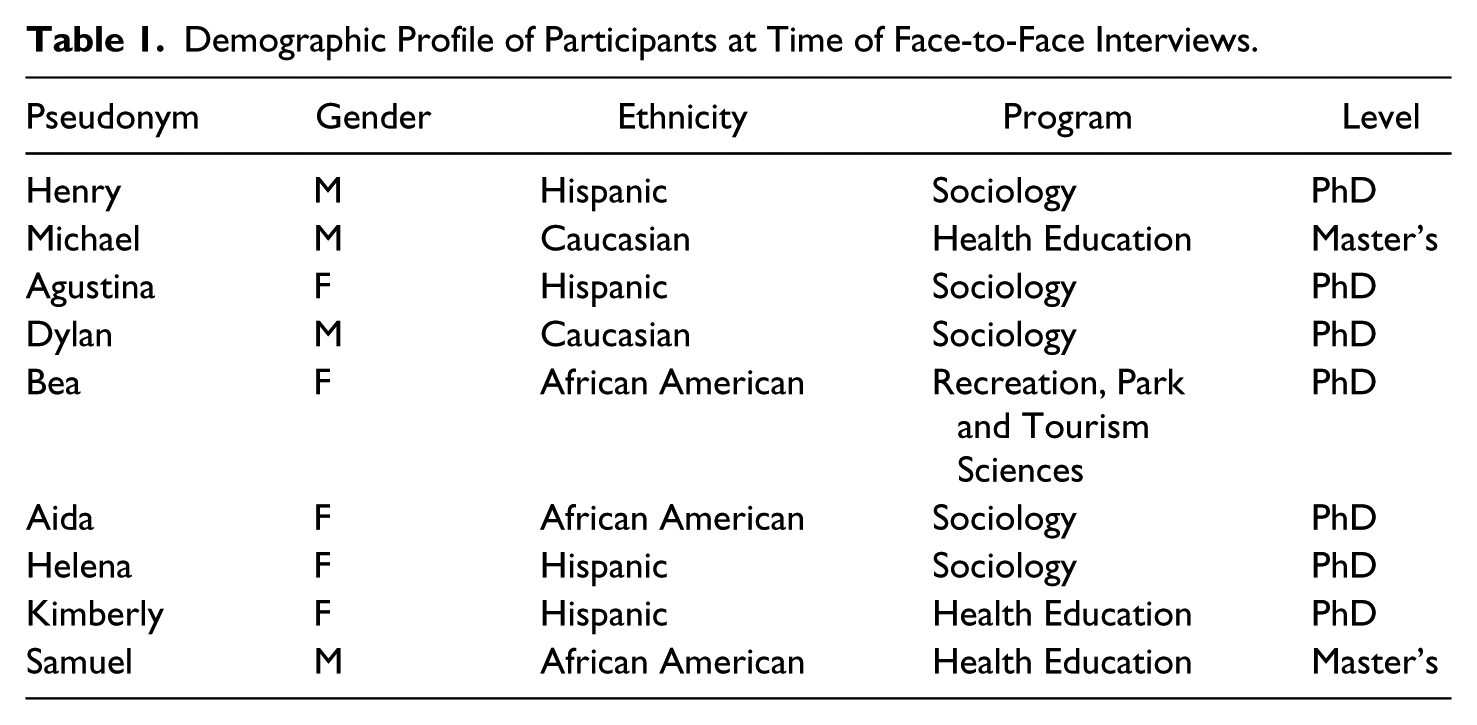
The qualitative inquiry framework allows participants the opportunity to reflect on their thoughts and attitudes concerning their home environment and its impact on their current academic success. Qualitative inquiry was the best suited for this study because it relies on the social constructions of meaning created by individuals. Qualitative inquiry research seeks answers to questions concerning how meaning and social experiences are created through the participants’ own words (Lincoln & Guba, 1985).
The primary design for this research was the narrative approach in which the researcher records the retrospective reports of another person’s experiences (Creswell, 2012). The participants’ stories reveal insights into how their home environment impacted their academic success. Data were gathered through in-depth interviews and analyzed using the constant comparative method (Glaser & Strauss, 1967; Lincoln & Guba, 1985).
This study utilized a standardized open-ended interview protocol to guide the interviews based on the methods described by Patton (2002). The wording and sequence of questions were determined before the interviews began. All the participants were asked the same questions in the same order. Questions were worded in an open-ended format (see appendix). Before the interviews, participants were asked to sign a consent form to ensure confidentiality.
The initial interviews ranged from 45 min to 1 hr and 15 min and were conducted face-to-face, except for one interview completed over the phone and all interviews were audio-recorded. Follow-up informal discussions with participants were conducted to clarify any questions that arose during the initial data analysis. The initial interviews started with a general “tell me about your background” question. The researcher then asked the questions with each of the participants, checking off questions as they were answered in the interview. Although the researcher was guided by a list of prepared questions in a sequence (structured open-ended interview), the researcher provided the opportunity for participants to share relevant information at the time they saw fit. Participants were permitted to provide information out of sequence. Participants were also allowed to extend their answers beyond the focus of the questions. The opportunity to add information to the questions is useful in obtaining complete data for each participant (Patton, 2002). The researcher scheduled the interviews at the convenience of the participants. Some interviews were conducted in conference rooms while others were conducted in participant’s homes or offices. Measures were taken to ensure the privacy for each participant. The interviews were conducted in English, audio recorded with the participants’ permission, and later transcribed verbatim by a professional transcriptionist service. The researcher used pseudonyms in lieu of the participants’ names.
Researcher’s Positionality
The primary researcher is a first-generation Latina-American born, and part of the first generation to graduate from college with an undergraduate degree, complete a master’s and doctoral degree. She grew up in an area with predominately low-income families and is a former elementary school teacher of children in Title 1 schools.
When she was younger, she knew she would attend college, but never quite understood how to achieve that goal. While navigating through the obstacles of being a graduate student from a low-income area (i.e., identifying resources and finding support systems), she often wondered what elements of her home environment truly influenced her through the years. She continues to be interested in how families and schools can support their children to complete not only their undergraduate degree, but their advanced secondary degrees as well. Her interest in initiating a study examining the home environments of graduate students raised in poverty is due to her own experiences. In pursuing this research, she attempted to be mindful of her own biases as she had the opportunity to be both insider and outsider as a researcher. As an insider, she was more sympathetic to any potential disconnect between home experiences and academic success. As an outsider, she did not have personal experience with the participants’ home environment experiences, which are unique for everyone.
The secondary researcher was born and raised in rural poverty. Her father left school after eighth grade, which was common in small farming communities at the time. Her mother was a high school graduate and wanted to further her education, but finances, geographic isolation, and the lack of valuing an education by her family and the community prevented the dream from becoming reality. All her siblings attended some college, but she was first in the family to complete an undergraduate degree. Members of the community ridiculed her parents for allowing her to attend college—especially because she was a female! Much later, she went on to attain two graduate degrees. This level of education still baffles many in her childhood community.
She is a former preschool and elementary teacher who taught inner-city children, migrant children in California, and middle and upper-class children in a suburban school district. She is grateful her parents did not bow to the pressures of the community and supported the furthering of her education. She identifies with the importance of family support as one pursues educational goals and was anxious to hear the stories of others from poverty who pursued their educational dreams. However, she was mindful of the biases from her own experience as she read and analyzed the data. The stories of the participants were their own—not hers.
Member Checking
Member checking is one of the most important aspects of building credibility in naturalistic inquiry. It allows the study’s participants to evaluate the researcher’s categories of information and interpretations gathered from interviews and to improve accuracy and credibility of the study (Erlandson, Harris, Skipper, & Allen, 1993). There was a brief member check following each interview. The researcher summarized the content of each interview as they were completed and checked for accuracy and understanding. A second member check was conducted by providing each participant with an electronic copy of the interview transcript, allowing the participant to clarify or delete any information. Participants received a cover letter along with their transcript that included directions for the member checking process as well as the transcription syntax, and use of pseudonyms, to facilitate participants’ understanding of their transcript. At this time, participants were informed of their pseudonym for the study and were given the opportunity to change it if they so desired. One participant changed her pseudonym to honor a supportive relative.
Data Analysis
The data obtained through interviews transcripts and field notes were analyzed using the constant comparative method as described by Lincoln and Guba (1985). Analysis began when the researcher initially read the interview transcripts and then developed a reflexive journal (Spradley, 1979, 1980) in which the researcher expanded on ideas, added comments and questions about the interview, and initiated analysis.
As the transcripts were read multiple times, the researcher created and applied single units of meaning (open codes) to the data using grounded theory guidelines (Charmaz, 2005; Glaser & Strauss, 1967; Strauss & Corbin, 1990). Charmaz and McMullen (2011) state, “Grounded theory leads the researcher to ask: What is most significant in these data?” (p. 170). This resulted in 1,101 cards of single units or open codes. The units were then grouped into 99 categories using descriptors drawn from the participants’ responses. Tentative definitions of each category were noted in a reflexive journal. For example, activities included all actions that were completed in the home to support academics (i.e., reading books, practicing handwriting, crafts). The units were then read repeatedly to allow for new categories to emerge and to ensure the new units would have a good fit with the other categories (Lincoln & Guba, 1985). The researcher reviewed categories 4 times for consistency and for overlap with other categories, and sought to discover relationships between and among the data.
The researchers reviewed and collapsed codes in order to identify emerging themes. This process of collapsing codes and simultaneously identifying themes lends itself to the constant comparative method, where units of data are identified and unitized and categories with similar properties are established (Lincoln & Guba, 1985). Categories were collapsed and expanded as needed to adequately account for themes that emerged from the data (Strauss & Corbin, 1994). Before emergent themes were finally recognized, five categories (potential themes) were identified. After deeper analysis, the five potential themes were collapsed into two emergent themes: (a) The importance of a broad support system and (b) Academics became an escape.
Results
This section begins with a short vignette of each participant followed by the emergent themes.
Henry
A Hispanic Sociology doctoral student in his fifth year of his program, Henry grew up in a small city in southern California. He was raised in a two-parent family. His parents were born in Mexico and came to the states during their teen years as migrant workers. He has one brother and three sisters and two of his siblings attended college as well. His mother has a junior high education and his father has completed some high school. There were six individuals in the household as he grew up, including his parents and three siblings. Henry grew up in a low-income home, and his family used unemployment benefits and welfare to assist with living expenses. Henry recalls living in a small house and sharing a room with his brother. His two sisters shared a room as well. Henry participated in the free and reduced-price lunch program at school.
Michael
In his second year of his master’s program in Health Education, Michael, a Caucasian, grew up in a midsize city in the northeastern region of the United States. He was raised by his mother and had four siblings. Michael had only one sibling attend college. His mother had a high school education, and his father only completed some middle school. Growing up, there were six individuals in the household, including his mother, himself, and his four siblings. Michael participated in the free and reduced-price lunch program at school. He recalled being raised by his single mother until she remarried when Michael was in elementary school. He considers his stepfather as his father. Michael described living in the ghetto, growing up in a rental house, and using Woman, Infant, and Children (WIC) food products in the house because of the family’s financial struggles.
Agustina
Agustina is a Hispanic Sociology doctoral student in her second year of her program. She was born in a Mexican border town. Her parents were both born in Mexico and raised her together in a household with two other siblings. Agustina explained that her aunt was always around, and her grandparents also helped to raise her. Her mother received specialized job training after completing the sixth grade, and her father has completed some college. Her two siblings also attended college. Agustina’s family moved to a Texas border town during her younger years. She received free and reduced-price lunch at a public school. Her family lived on a limited income until her father was able to acquire a full-time job. At that time, Agustina had just entered middle school. She described the house where she lived as a humble home that her family was always remodeling.
Dylan
A Caucasian third-year Sociology doctoral student, Dylan was raised in a Massachusetts city. His mother is from Germany, and he has a stepsibling through marriage. His mother had a high school education and had been offered several scholarships to college, but declined them. His father had some college education. Both of his parents and often his maternal grandparents raised him. Dylan was not sure if he qualified for free and reduced-price lunch because his grandparents often contributed to his household finances. Dylan experienced poverty in his home, as his parents struggled to maintain their living expenses throughout his child and adolescent years. Dylan explained that often his father struggled in many ways to consistently provide for the family through adulthood.
Bea
An African American Recreation, Park and Tourism Sciences doctoral student in her third year of her program, Bea was raised in a metropolitan city in Texas. She was raised by both her mother and father and has three siblings, two of whom also attended college. Her mother had some high school education completed when Bea was younger, but has since then completed her undergraduate degree and a master’s program. Her father completed high school. Bea’s family moved from a one-bedroom apartment to a three-bedroom rental house before Bea was born. Until she was 7 years old, Bea’s grandmother lived with the family until her passing.
Aida
Aida, an African American, is a third-year sociology doctoral student whose experiences in a low-income home were quite different from the other participants. Aida was born into a middle-class home with her father and mother. After her parents’ divorce, she experienced severe poverty and homelessness as she and her mother struggled to restabilize their lives. Aida’s mother completed a master’s program in the middle of these excruciating circumstances. Aida has one sibling and talks about some of the driving forces that pushed her through her childhood and adolescence. During her most difficult times, Aida’s family struggled with finding the resources that they needed to manage.
Helena
Helena, a Hispanic second-year sociology doctoral student, was born in a city in Mexico. Both her mother and father raised her in Mexico where they lived in low economic conditions with Helena’s two siblings and members of her extended family. Growing up, Helena’s family totaled seven, including her parents, two siblings, an aunt and her grandfather. It was not until Helena moved to the United States that she qualified for free and reduced-price lunch in her later adolescent years at public school because free and reduced-price lunch is not a program offered in Mexico. Helena’s mother has some technical education completed and her father has some elementary education completed.
Kimberly
Kimberly, a Hispanic Health Education doctoral student, grew up in a large city in central Texas and is in the second year of her program. She was raised by both her parents and lived with two siblings who both attended college. Her father completed high school and her mother earned her GED while Kimberly was in middle school and high school. She also participated in the free and reduced-price lunch program while in school. Kimberly lived with her family and extended family on the same residential block. She grew up with her parents and two siblings while her grandparents lived next door. Her uncles and aunts lived next to them within a one-block radius block.
Samuel
An African American second-year health education master’s student, Samuel was born in a large metropolis city in Texas. He was raised by his mother in a household of four, including one brother and two half-siblings. His brother also attended college, and his mother and father both completed some college. Several extended family members, like aunts and cousins, had also attended college. Samuel also lived with a stepfather for most of his early and adolescent years. He qualified for the free or reduced-price lunch program when he was in elementary school. Samuel grew up in a two-bedroom apartment for the first 5 years of his life. Later, during his high school years, Samuel chose to live with his father and stepmother.
Each participant was raised in a different home environment; thus, each narrative is unique, yet the stories contain similar threads. These similarities provide a context for the emergent themes and findings of this study. Two major themes emerged from this study: (a) a broad support system is essential; (b) academics became an escape.
Emergent Theme 1: The Importance of a Broad Support System
The participants in this study credited a broad-based support system for much of their later academic success. This broad-based support system included both internal and external elements.
Internal support elements
Internal support systems included the unwavering support of at least one parent or family member who provided trips to the library, helped with homework, establishing routines, and provided the participant with books to read.
Henry identified his mother as the strongest person in the family throughout his entire life:
There was always this notion that you have to succeed in school. You have to do good in school. You want to be able to get a degree, you want to be successful when you get older because- my parents never said, ‘Hey, you don’t want to live like us the rest of your life on welfare’ or whatever, but they are just like, you don’t want to be living on the street, essentially. (Participant interview, September 9, 2014)
He remembered when he told his mother he was going back to college. She was ecstatic and could not believe it. Henry often wonders if he persevered through school because it would make his mother happy.
Michael recalled when his mother would read to him and after his reading time, he was expected to read to his brothers. He and his siblings also partook in games with flash cards, multiplication tables, memory games, and so on. There was an abundance of books at home from the Golden Books series to Dr. Seuss books to a Highlights for Children magazine subscription (participant interview, September 10, 2014).
Bea’s mother had high expectations. Bea remembers having it engrained in her that there is no such thing as failing. “We don’t fail,” she insists. “That kind of achievement was instilled in us that it’s not really an option to fail. I think it still presses for me,” adds Bea (participant interview, September 26, 2014).
Upon arriving home from school, Aida’s mother wanted to see her homework. A common routine in her household was to complete homework and then her mother would provide supplementary materials like workbooks and other reading books. Her mother would also check her work. If Aida got too many problems wrong, her mother would provide more pages. During the difficult times in Aida’s life, her mother was working on her own master’s degree. Aida adds, “My mother would always say ‘Thank God for my degree.’ Because of my degree, I was able to get us out of living out of a car much quicker than a woman who only had a high school education” (participant interview, September 29, 2014).
One of the most influential things in Helena’s life was the example of discipline set forth by her mother. “The fact that I saw my mom, that she did a lot of things with her time. It made me think that it was possible for me to also organize myself and do things and get stuff done,” explains Helena (participant interview, September 30, 2014).
It was Henry’s sister, who was the first in the family to attend college and gave Henry a glimpse of a different future. He was 6 years old when she took him on a tour of her campus close by. She would talk to him about his future and about where he would be studying after high school. At the time, it did not mean much to Henry, but it is a memory that still lingers (participant interview, September 9, 2014).
Although his parents raised Dylan, he recognizes the profound impact that his grandfather had on his life. Education was very important to Dylan’s grandfather. Dylan would spend significant amounts of time with his grandfather. He remembers being pushed heavily to perform well in school. Dylan’s grandfather would talk to him about his future plans and make Dylan work hard toward different endeavors (participant interview, September 18, 2014).
External support system
Eight of the nine participants identified one or more people outside of the family who assisted them in their process of developing academically. The person most often mentioned was a teacher. Henry remembers that teachers would go out of their way to provide books for him. He recalled, “I would latch on to a teacher who would express some sort of interest in my work, whatever I was doing” (participant interview, September 9, 2014). Henry did well academically because of the rewards he would get from the teachers, and he recognized the support he received from these teachers.
Aida specifically recalls a teacher who helped her when she really needed guidance. She adds,
It’s really important to me to pay it forward because like I’ve mentioned I had this calculus professor who wouldn’t let me fail. Who was like, ‘I get it you’re going through a lot but you can do this.’ And so, I try to be that person for my students from really big on karma and paying it forward. And so that really drives me. (Participant interview, September 29, 2014)
Helena remembers an elementary teacher being key to her love of reading. She adds,
It started in elementary school with this teacher I had in fifth or sixth grade. She was really cool, and she did this exercise where each of us got a book and then we would read that book in a week and then we would write a summary for the next Monday. And then the following week, we would rotate all our books and do the same thing. By the time the year ended, I had read a lot of books and I realized that I love reading. (Participant interview, September 30, 2014)
Samuel remembers a schoolteacher that made a long-term impact on him as he prepared for his own academic success:
I remember my fourth grade English teacher. She used to have these reading groups or reading times and it was just so interesting to me. I was just so amazed. She used to pass out these Scholastic newspapers where we could buy books and stuff like that. So, I begged my mom to buy me the collection one year, and she bought it. That was my favorite reading material. (Participant interview, September 21, 2014)
Each of the nine participants identified at least one person outside of the family and one or more people within the family who assisted them in their process of developing academically. It is interesting to note that of the family members in the student’s support system, one was always the mother or stepmother. For most of the participants, academic-related support was shown by encouragement and assistance with homework and access to reading materials on a regular basis. Although these participants had immediate and extended family members who supported them and valued education, an external support system also helped most graduate students do well in school
Emergent Theme 2: Academics Became an Escape
To most of the participants, school and academic activities were often used as a means to escape their current situation and as an escape from poverty in the future. While Henry, Helena, and Agustina used academics as an escape from day-to-day life and repeating the poverty environment of their childhood, Samuel and Kimberly remember using school or reading to escape from the day-to-day stressful situations. Aida only saw education as a way to escape from repeating the fate of her mother.
Michael, Dylan, and Bea embraced school, but did not see it as an escape. Table 2 shows the participants’ perceptions of academics as an escape.
Participants’ Perception of Academics as an Escape.
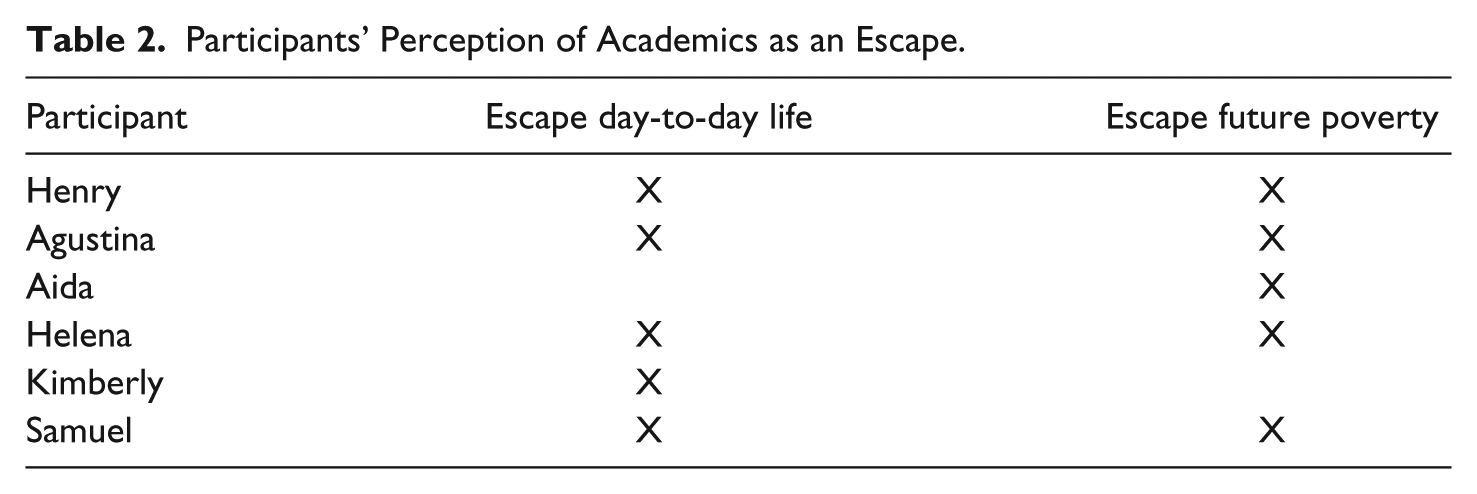
Escaping day-to-day situations
In talking about school as an escape from their current situation, Kimberly and Samuel found their escape by reading books. They would read as much as possible and would even read when they were punished. Others talked about the importance of school itself and how they would escape their day-to-day life by working on school assignments.
Agustina loved books. With books, she was able to escape. “What I really liked about them was they would take you somewhere; your imagination would come to life. I would love that about it” (participant interview, October 3, 2014).
Since being a child, Helena had a desire to escape her life situation. She knew as a young child that the situation she and her family was in was “fucked up” and she wanted to escape as quickly as possible. She calls education a survival mechanism (participant interview, September 30, 2014).
Kimberly grew up in a low-income household that included domestic violence between her parents. In seeking an escape from the everyday issues that arose from her parents, she turned to books. She adds, “I’m the reader that likes to get so engaged in the book that I think I’m in the book. I don’t really know why I liked reading. I just did” (participant interview, October 1, 2014).
As a young child, Samuel spent long periods of time in the hospital. He adds, “That’s where I picked up the love for reading. Because I didn’t have anything else to do, and they had a library. So just read a lot” (participant interview, October 21, 2014). When Samuel was punished at home, he was often confined to his bedroom and not allowed to watch television. He spent much of this time reading.
Escape future poverty
Henry, Agustina, Aida, Helena, and Helena valued their education in hopes of escaping poverty in their own future. Often, their parents would try to motivate them to seek a better future for themselves.
Henry’s parents rarely spoke about the importance of academics to him. In their eyes, it was more important to break the cycle of poverty they were experiencing. To some degree, the family was ashamed of their situation. He adds that his parents would on occasion mention, “You have to do good in school . . .you want to be successful when you get older. . .they are just like, you don’t want to be living on the street . . . ” (participant interview, September 9, 2014).
Agustina has fond memories of her family. Her parents were loving and supportive. She recalls, “Our parents always told us they believed in us and our abilities to do good in school.” Her mother would also guide Agustina. She would tell her, “Do you want to pick in the fields? Do you want to be a maid?” (participant interview, October 3, 2014).
Helena remembers education as a way to survive. She explained,
I needed something to take me out of the environment that I was in, but also sort of the only way that could pull me out of poverty. That was the route for me. I guess I always thought if I study hard enough, if I keep going to school, I’m not going to be that poor. (Participant interview, September 30, 2014)
Aida discussed escaping poverty as the only way to not repeat her parents’ situation. Early in life, Aida realized the only way she would ensure she would never be poor again was to continue with her education:
I joke about it, but I am terrified of being poor again. Like there’s nothing worse than living in a car. I mean it is just horrifying and the stigma of it and the shame and it’s just a horrible experience. (Participant interview, September 29, 2014)
Samuel also expressed thoughts about his academic success:
What impacted me and my success in school was just that I didn’t want to have to struggle. I saw a better life for myself. . .the type of life I wanted to live would not be feasible without an education.
Samuel’s stepmother was the first person who introduced him to college life. She was vital in teaching Samuel about thinking and planning ahead. “College was my ticket to getaway. I could only move out once I graduated. I ended up graduating a semester early from high school and going straight to college the next semester” (participant interview, October 21, 2014).
Although some of the participants experienced negative situations at home, all were able to identify reasons for valuing time spent pursuing academic activities. Many of the participants used academic activities to escape from their current situation. It is interesting to note that reading at home or working on that allowed them to escape their day-to-day life also served to support their future academic success.
Discussion
This study was designed to gain an understanding of the home environments of graduate students raised in poverty and to better understand which elements in the home environment contributed to their academic success. The participants in this study were selected through purposeful sampling of graduate students raised in poverty from an R1 university. In total, nine participants took part in this study.
The participants described their home environment as a mixture of chaos and structure. Elements such as increased stress from a lack of resources, domestic violence, alcoholism, mismanagement of money, and exhaustion of the parents were identified as contributing factors to the chaos. The lack of financial security became evident in all the participants home environments.
In the midst of the chaos, participants recognized there was also a sense of structure provided by routines and activities such as family meals, time for homework, and daily chores. Michael remembers evenings being structured. He would come home and relax for an hour or so, have a snack, start homework, eat dinner, and then complete homework before he went to bed. Many of the participants attributed these established routines and activities as contributing to their academic success.
The results of the current study demonstrated that, although the parents of the participants may not have fully understood what was needed to be academically successful, they supported their children by talking to them about school, discussing the importance of education, and providing opportunities for additional learning.
The participants in this study identified the vital role their mother played in their academic success. They felt encouraged by their mother or other family members, who would check finished homework and sometimes create assignments for additional practice. Two of the participants were influenced by the models of family members who attend college. Henry was able to visit a college campus with his sister at age 6 years while Aida observed her mother balancing work and studying for a master’s degree.
Several participants mentioned the availability of books and opportunities to read. There were a limited number of books in most homes, so the children were encouraged to visit the public and school libraries to expand their reading choices. Another factor was a time set aside to complete homework. As they were able, parents checked on the homework. The participants understood, from an early age, that completing the homework was an expectation in their family.
Although the participants were raised in low income, there was a continuous support system in the household, even if it provided the participants with the goal of eventually “getting out” of their current situation. These participants witnessed their parents and extended family members working very hard and would often hear comments on how their life would be so much better if they achieved a higher level of education.
Interpretation of Findings
This section presents an analysis and interpretation of the findings in relation to current literature. The findings examining the home environments from nine graduate students raised in poverty reinforce many areas of previous research and build upon other research studies.
Vocabulary and literacy skills
Duncan and Seymour (2000) argued that children from poverty enter school with lower levels of literacy skills. The participants in this study often were exposed to books, reading, and a variety of literacy skills prior to entering school. Several of the participants described using programs like Hooked on Phonics© in the home before entering school or reading constantly from an early age. The findings of this study support the importance of exposure to reading materials and related literacy activities. An interesting finding emerging from this study extending current research is that students from poverty utilize reading (getting lost in a book) to escape the chaos around them.
Kim (2004) identified limited finances as a reason why children from poverty do not have the resources needed for literary success. The participants’ families were able to acquire such resources because the sacrifice of parents or grandparents. They also accessed resources at their local school and or public library.
Family impact on academics
The findings of this study clarified those reported by Cabrera and Padilla (2004), who found that students raised in poverty often identified chaotic situations at home, but also had somebody in the household providing structure for academic activities. Madera (2009) recognized that the chaotic home environment highlighted the need for a structure in the household.
The current findings expanded on Cabrera and Padilla’s (2004) study by not only identifying the expanded role mothers played in their children’s academic success, but also identifying other supportive members in the household. The mother, father, and often a live-in grandparent were found to be a source of support for the participants. This study adds clarity to the point made by Cabrera and Padilla (2004) that a student from poverty needs to have at least one parent supportive of academic endeavors from an early age to be successful academically.
Bryan and Simmons (2009) found close-knit families and communities, separate identities, and knowledge of college procedures were factors attributing to the educational success of the students in their study. The findings of this study support and extend the Bryan and Simmons (2009) study by showing the importance of a close-knit family not only in early childhood through college, but it is also crucial to continue the support at the graduate school level. An extension of this finding was the influence of other family members who attended college and discussed the college experience with participants.
Two of nine participants were driven by the desire to make a parent proud of them despite what their family situation. This reinforces a similar finding described by Cabrera and Padilla (2004).
In this study, family members were reported to be a large source of support for the participants, as well as individuals outside of the home (i.e., neighbors, teachers, advisers). The support from family and a broader support system as contributors to academic success is consistent with research by Reddick et al. (2011).
Academic support systems
The findings reported here agree with those of Reyes (2007) that students who would typically not be considered as “college material” can find themselves in a college program if given the opportunity and the needed support. The results of this study are congruent with previous studies (Madera, 2009; Reddick et al., 2011) on the role of supportive adults for the academic success of students raised in poverty.
Limitations
There were several limitations to this study: (a) Students chosen for this study self-reported being raised in poverty. The exclusive use of self-report measures may be skewed in identifying students who truly fell into low-income households. (b) The data were collected through semistructured interviews. Interviewing the parents of the participants or family members or using other data sources and inquiry methods for triangulation would provide a broader picture of the home environments.
Generalizations to different settings and different populations are not appropriate in a qualitative study (Lincoln & Guba, 1985). The findings were not intended to generalize the experiences of all graduate students raised in poverty. However, the findings of this study could provide a greater understanding of the experiences, related to the home environment, that affect the academic success of graduate students in similar situations.
Conclusion
Students raised in poverty face challenges all through their academic journey including their pursuit of an advanced degree. People living in poverty are the least-educated demographic class group. The present study described the home environments of nine graduate students raised in poverty and the factors they recognized as necessary for their academic success. Participants reported the need for both family support and external support growing up and as they succeed through school. They recognized that family was a source of support from an early age and provided structure and resources needed for academic success. Participants also attributed some of their academic success to support outside of their family. Guidance counselors, teachers, neighbors, and later advisers guided the participants as they grew up.
They described school and learning as an escape and voiced the desire to leave the life of poverty behind. The participants would read often at home and excel in their schoolwork to avoid many of the unpleasant situations they were experiencing in the household.
This study has brought to light the complex issues of achievement of children raised in poverty as they attempt to achieve academic success at the graduate level. It is important to recognize that the home environment of a child, regardless of income, is a key building block for future academic achievement.
Footnotes
Appendix
Interview Protocol.
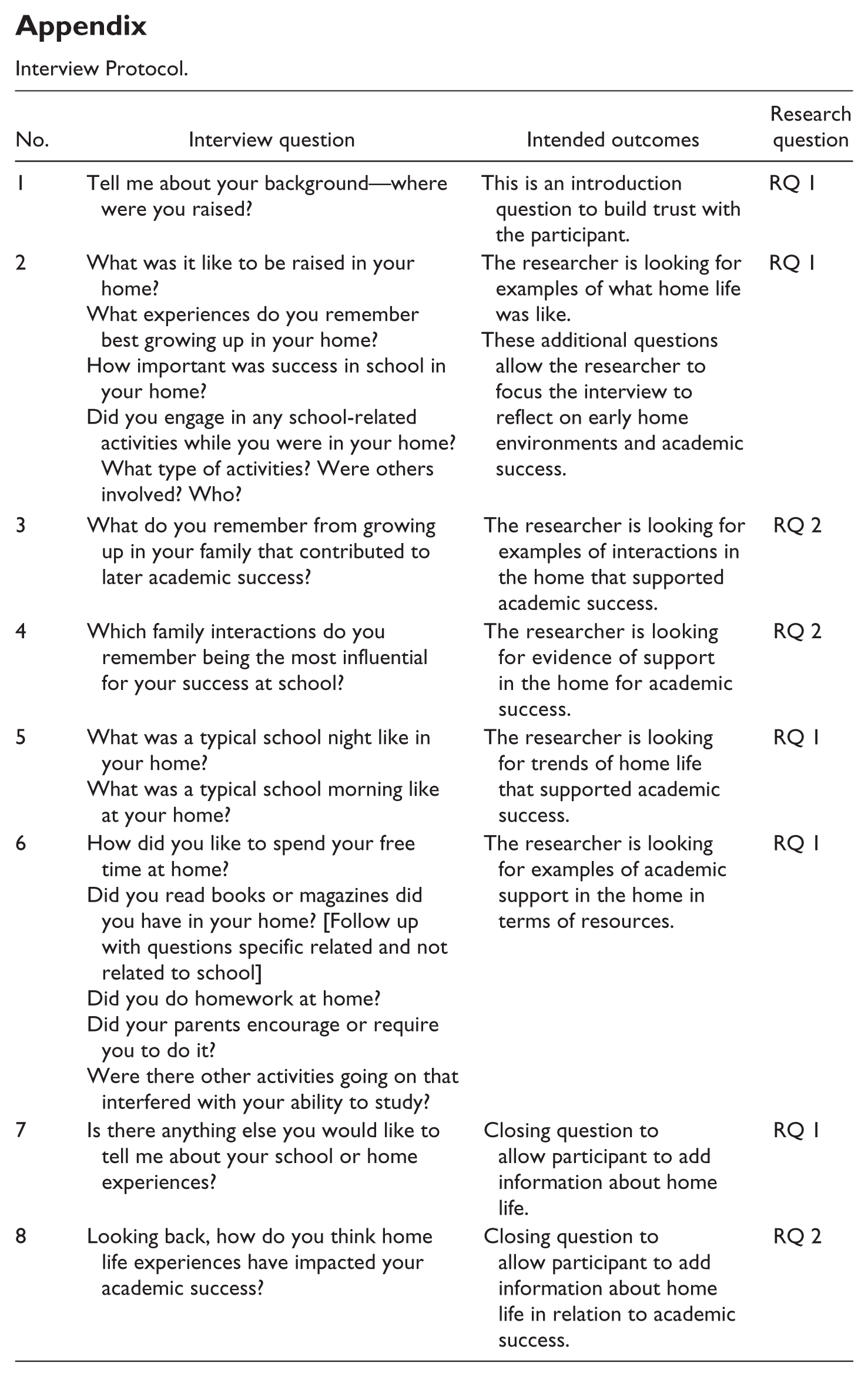
| No. | Interview question | Intended outcomes | Research question |
|---|---|---|---|
| 1 | Tell me about your background—where were you raised? | This is an introduction question to build trust with the participant. | RQ 1 |
| 2 | What was it like to be raised in your home? What experiences do you remember best growing up in your home? How important was success in school in your home? Did you engage in any school-related activities while you were in your home? What type of activities? Were others involved? Who? |
The researcher is looking for examples of what home life was like. These additional questions allow the researcher to focus the interview to reflect on early home environments and academic success. |
RQ 1 |
| 3 | What do you remember from growing up in your family that contributed to later academic success? | The researcher is looking for examples of interactions in the home that supported academic success. | RQ 2 |
| 4 | Which family interactions do you remember being the most influential for your success at school? | The researcher is looking for evidence of support in the home for academic success. | RQ 2 |
| 5 | What was a typical school night like in your home? What was a typical school morning like at your home? |
The researcher is looking for trends of home life that supported academic success. | RQ 1 |
| 6 | How did you like to spend your free time at home? Did you read books or magazines did you have in your home? [Follow up with questions specific related and not related to school] Did you do homework at home? Did your parents encourage or require you to do it? Were there other activities going on that interfered with your ability to study? |
The researcher is looking for examples of academic support in the home in terms of resources. | RQ 1 |
| 7 | Is there anything else you would like to tell me about your school or home experiences? | Closing question to allow participant to add information about home life. | RQ 1 |
| 8 | Looking back, how do you think home life experiences have impacted your academic success? | Closing question to allow participant to add information about home life in relation to academic success. | RQ 2 |
Declaration of Conflicting Interests
The authors declared no potential conflicts of interest with respect to the research, authorship, and/or publication of this article.
Funding
The authors received no financial support for the research, authorship, and/or publication of this article.
