







Abstract
This systematic review examined how the relationship between giftedness and creativity has been conceptualized in gifted education scholarship from 2005 to 2024. Across eight major journals, we analyzed 133 articles, including 13 core texts that placed the creativity–giftedness connection at the center and 120 articles that engaged it more broadly. We identified 18 recurring core concepts, spanning theoretical, developmental, and applied perspectives. The findings revealed strong continuity with foundational models that position creativity as central to giftedness, but also a tendency in much of the literature to assume, rather than explicitly articulate, this connection. The broader sample of articles emphasized applied conceptions, such as identification practices, classroom environments, and teacher beliefs, whereas the core articles highlighted creativity as a defining conceptual feature of giftedness. Although creativity remains foundational in gifted education theory, its role is inconsistently foregrounded in practice and policy. Greater clarity and explicit integration are needed to sustain creativity's place in gifted education.
Conceptual Connections of Giftedness and Creativity: A Systematic Review
Contemporary conceptions of giftedness typically frame it as a multifaceted construct that encompasses cognitive, motivational, contextual, and creative dimensions, although the relative emphasis on these dimensions varies across theoretical and applied models. While the existence of a connection between creativity and giftedness is rarely questioned, the nature of this link varies across theoretical models (Miller, 2012). In practical gifted education contexts, creativity is already embedded—often implicitly—within both identification and programming. School districts often rely on teacher rating scales, portfolio reviews, performance-based tasks, and domain-specific products to identify creative potential, even when formal creativity tests, such as the Torrance Tests of Creative Thinking (TTCT), are not administered. At the same time, gifted programs often articulate goals related to creative problem solving, innovation, or original production without explicitly clarifying how these goals align with identification criteria (Delgado-Valencia et al., 2025; Gubbins et al., 2021). That disconnect between conceptual and applied clarity motivated this review.
Some of the most explicit work about the connections between giftedness and creativity can be seen in the work of Treffinger (1995a, 1995b), Treffinger and Feldhusen (1996), and Treffinger and Reis (2004). However, over the past 20 years, the description of the underlying conceptual connections between giftedness and creativity seems, anecdotally, to have become more diverse, informal, and, at times, superficial. The lack of a coherent, explicit approach to clarifying conceptions of giftedness is at odds with the field of creativity, which has steadily moved toward clearer conceptions of creativity over those decades (Plucker et al., 2004; Puryear & Lamb, 2020). In addition, creativity scholars have spent substantial time investigating what people know about creativity (Benedek et al., 2021; Puryear & Lamb, 2024) and how implicit theories of creativity are related to practice across contexts, including education settings (Bereczki & Kárpáti, 2018; Cropley et al., 2019; Kettler et al., 2018; Mullet et al., 2016). In this work, we examined how the overlap between creativity and gifted education has been conceptualized and addressed in gifted education journals in the last 20 years. Unlike prior narrative accounts of the creativity-giftedness nexus, this review systematically maps core concepts across two decades of scholarship to quantify their prevalence and interpret implications for theory, identification, and practice.
Literature Review
Origins
The field of gifted education has its roots in the work of Lewis Terman and Leta Hollingworth (Jolly, 2018). Their work primarily focused on intelligence as the essential quality of giftedness (e.g., Hollingworth et al., 1940) and examined how intelligence interacted with other aspects of children's lives (Grossberg & Cornell, 1988). The robust exploration of the relationship between creativity and gifted education has its origins in Guilford's (1950) presidential address to the American Psychological Association. Guilford called attention to the lack of scientific inquiry into creativity and framed it as an overlooked but essential component of intelligence. His argument was urgent, aspirational, and motivated, in part, by Cold War anxieties and a growing national interest in innovation and human capital. By emphasizing creativity as a core element of intellectual functioning, rather than a peripheral trait or a disposition toward artistic flair, Guilford opened a path for researchers and educators to rethink how giftedness might be defined and cultivated.
Guilford's Structure of Intellect model (1956) played a central role in reshaping conceptions of giftedness. By identifying divergent production as one of several key operations within human cognition, he proposed that creative thinking was measurable and distinct from traditional conceptions of intelligence (Guilford, 1958; Guilford & Hoepfner, 1966). This thinking laid the groundwork for early psychometric approaches to creativity and suggested that assessments of potential should go beyond intelligence (Wallach & Kogan, 1965). As educational psychology took up this challenge, creativity gradually entered the discourse about how to identify and nurture gifted youth.
Between Guilford's foundational call to study creativity and more contemporary framings of giftedness and creativity, E. Paul Torrance played a pivotal role in translating creativity from an abstract psychological construct into an instructionally useful concept for teaching and learning (Torrance, 1984). Often referred to as the father of creativity research, Torrance developed some of the earliest and most enduring instruments for assessing creative potential, most notably the Torrance Test of Creative Thinking (TTCT, 1966). Drawing heavily on Guilford's Structure of Intellect model, Torrance operationalized creativity in terms of fluency, flexibility, originality, and elaboration. These dimensions formed the core of the TTCT, which aimed to identify children with potential, regardless of their performance on traditional intelligence tests. In doing so, Torrance provided empirical and practical tools that directly challenged the prevailing reliance on academic ability as the sole criterion of giftedness. Over the last six decades, the TTCT has routinely remained at the forefront of creativity discussions in gifted education research and practice (Alabbasi et al., 2022; Alvino et al., 1981; Hodges et al., 2018; Kim, 2006; Lee et al., 2024; Schack & Starko, 1990; Torrance, 1971, 1984).
Beyond measurement, Torrance was deeply invested in nurturing creativity as an educational imperative. He emphasized the need for learning environments that support creative risk-taking (Torrance, 1963) and recognized the psychological vulnerabilities of highly creative students, such as fear of failure and sensitivity to criticism (Torrance, 1970). Through his longitudinal studies, Torrance (1968, 1981, 1987, 1993) demonstrated that early potential, when recognized and cultivated, predicted later real-world accomplishments. His work helped frame creativity not as a rare genius trait but as a developmental capacity present to varying degrees in all individuals (Torrance, 1965). Torrance's influence ensured that creativity would no longer be treated as peripheral to gifted education but rather as central to how scholars and practitioners understood and developed human potential. Moreover, by championing creativity in both theory and practice, Torrance set the stage for later models of intelligence (Triarchic Theory of Intelligence; Sternberg, 1985) and giftedness (Three-Ring Conception of Giftedness; Renzulli, 1978) that incorporated creativity and spurred rich discussions about how these constructs ought to play out in schools, effectively challenging the nature and purpose of education (Treffinger, 1995b). Although the following sections are organized around influential theorists for clarity (i.e., Sternberg, Renzulli, Treffinger), this structure is intended to highlight overlapping conceptual contributions rather than constrain the range of topics or perspectives.
Sternberg
Much of the core connection between conceptions of creativity and conceptions of giftedness is tied to the indisputable link between research in the areas of intelligence and creativity, beginning with Robert Sternberg. In his Triarchic Theory of Intelligence (Sternberg, 1985), he pushed beyond the conception of intelligence as a solitary g factor (Spearman, 1904) limited to analytical intelligence alone. With the addition of practical intelligence and creative intelligence, Sternberg offered, in his estimation, a more well-rounded, alternative view that captured important qualities that g-based theories lacked by integrating cognitive, creative, motivational, and developmental dimensions rather than privileging any single explanatory lens. He later added complexity to his theory by proposing profiles of gifted individuals with different combinations of these intelligence components (Sternberg, 2000). Within this model, Sternberg emphasizes the interaction of analytical, creative, and practical abilities, which makes it difficult to consider creativity apart from intelligence, but raises questions about how these components are operationalized and emphasized in gifted education contexts.
Although Sternberg's work includes empirical examinations of his framework through the development of triarchic assessments and instructional interventions (Sternberg, 1993; see Sternberg, 2003a for a comprehensive response regarding the empirical work related to the triarchic theory), much of this work has been a source of critique for challenges related to operationalization and validation (e.g., Chooi et al., 2014; Gottfredson, 2003a, 2003b; Messick, 1992), and in some cases, a source of contention regarding concerns related to overinflation of findings, or multiple publication bias (Egger & Smith, 1998), some of which have been retracted or formally corrected to include statements related to the publication of duplicate work (e.g., Sternberg, 2006; Sternberg & Grigorenko, 2010). Although much of the explicit critique of Sternberg's theory has been linked to practical intelligence (Gottfredson, 2003a), the notion of creative intelligence has not been well fleshed out empirically, particularly as it relates to giftedness or gifted education, though there are exceptions (Sternberg & Lubart, 1993).
Renzulli
In Sternberg's work on intelligence, the connection to creativity is clear, but the link to gifted education requires one to make a slight leap. However, in Joseph Renzulli's (1978) Three-Ring Conception of Giftedness, creativity is integral to the definition of giftedness. In his original work and subsequent work across four decades, Renzulli included creativity alongside above-average intelligence and task commitment (Reis et al., 2021; Renzulli, 1984, 1992, 2002, 2011; Renzulli & Reis, 2018). Renzulli views creativity as inextricably linked to the production of gifted behaviors, whether those behaviors are viewed in a moment-to-moment sense or across a pipeline of talent development. Renzulli has also advocated for distinguishing schoolhouse giftedness (e.g., test-taking, consuming knowledge) from creative-productive giftedness, which is characterized by the production of new knowledge and a focus on implications for the broader world beyond lessons, classes, and schools.
Among Renzulli's many contributions to the creativity-giftedness link, he focused on creative behaviors and practical ways teachers could identify them. In Renzulli's Scales for Rating the Behavioral Characteristics of Superior Students (Renzulli Scales; Renzulli, 2021), students are rated on observable behaviors, such as imaginative thinking ability. These items provide an alternative to more context-devoid assessments, such as divergent thinking tests (e.g., TTCT). However, multiple items on the Renzulli Scales relate to factors measured on divergent thinking tests, such as fluency and originality. Multiple items on the Renzulli Scales also relate to personality factors typically associated with creativity (e.g., openness to experience). These assessments demonstrate that links between creativity and giftedness lie at the heart of the field's historical, conceptual foundations.
Treffinger
Across his career, perhaps no one made a more concerted effort to interrogate the overlap of giftedness and creativity than Donald Treffinger (Callahan & Renzulli, 2020; Treffinger & Reis, 2004). His approach included both a practical and research-oriented focus. When defining creativity, he noted the importance of sustained interest and passion (Treffinger, 1995b), which mirrored Renzulli's framework for giftedness (i.e., task commitment). He also shared Renzulli's desire to move beyond an over-reliance on intelligence testing in gifted identification (Treffinger & Renzulli, 1986). Treffinger viewed creativity as measurable but emphasized that assessment should go beyond divergent thinking assessments to include product-based assessments and cognitive style preferences (Treffinger et al., 2002; Treffinger, 2009). This approach blends well with modern efforts to create multifaceted gifted assessments and programs of identification (see Johnsen & Van Tassel-Baska, 2022, for a recent, thorough treatment of assessment in gifted education). As a matter of practice, Treffinger advocated for educational practices that provided creativity-rich environments that offer students higher-level experiences, thus allowing them to find a personally meaningful path. This perspective aligns closely with efforts to reframe gifted education as talent development (e.g., Gagné, 2004; Subotnik et al., 2011).
Beyond Foundations to More Recent Work
Over the past two decades, the fields of gifted education, creativity research, and educational psychology have become increasingly intertwined, with creativity maintaining its place as a central component in the conceptualization and development of giftedness and talent. Theoretical frameworks now describe giftedness as dynamic, contextual, and creative. One such example is Sternberg's (2024) systems theory of creative giftedness, which positions giftedness as arising from the interplay between the individual, their environment, and the creative tasks they engage in. Similarly, Dai's (2017) Evolving Complexity Theory (ECT) frames talent development as a process of adaptive growth, shaped by environmental challenges and personal choices over time. These models build on earlier work, such as Renzulli's (2011) approach, which emphasizes creative productivity alongside intelligence and task commitment. Collectively, these frameworks highlight that creativity is not merely an aspect of giftedness; it is foundational to how giftedness is expressed, nurtured, and transformed. Yet, despite such theoretical clarity, much of the applied writing in gifted education presumes these linkages rather than expanding on them, which creates tension and a lack of clarity in the field regarding the intersection of giftedness and creativity.
A similar emphasis is echoed in a growing body of empirical work that positions creativity as central to identification and assessment for gifted services. Creativity-based identification and assessment tools have gained traction as more inclusive alternatives to traditional standardized testing (Grantham, 2020; Luria et al., 2016). In addition to using standardized measures of cognitive ability, achievement, or rating scales of behavioral/emotional traits, school districts often create, use, or adapt existing figural creativity instruments to help identify gifted students from diverse linguistic and cultural backgrounds (Gray et al., 2009; Lee et al., 2024). Further innovation has come from applying natural language processing to automate scoring on the TTCT, enhancing the accessibility and efficiency of using these measurements in school-based applications (Acar et al., 2023). However, culturally related critiques have also emerged. Standard originality scoring methods on the TTCT may not adequately reflect the creative strengths of African American students, which suggests a misalignment between assessment norms and cultural expression (Acar et al., 2021). Other studies have highlighted how neurodivergent learners (e.g., students with ADHD characteristics) often demonstrate elevated creativity, despite working memory challenges (Fugate et al., 2013). Together, these findings reinforce the need for flexible, culturally responsive identification methods that recognize the diverse manifestations of creative giftedness.
In classroom practice, creativity-centered instruction has shown significant promise in promoting engagement and talent development. Creative Problem Solving (CPS) frameworks have been applied across educational settings to encourage divergent thinking, collaboration, and meaningful problem engagement. Treffinger and Isaksen (2005) documented the developmental trajectory of CPS models and their implications for teaching and learning. McCluskey, Baker and McCluskey (2005) further demonstrated how CPS can be used to support marginalized youth, including disenfranchised indigenous teens and justice-involved students, in identifying and developing their talents. Such cases highlight the power of creativity-based education to unlock potential in populations often excluded from conventional gifted programming. Other studies support creative instructional strategies within more typical classroom settings. For example, gifted high school writers gave peer feedback on creative writing that closely aligned with expert evaluations, suggesting the utility of collaborative, peer-driven learning experiences (Kaufman et al., 2005). These approaches reflect broader trends in educational psychology that emphasize inquiry, reflection, student agency, and social justice. Each of these elements is deeply connected to the development of creative capacity.
Beyond instruction and assessment, psychosocial and emotional dimensions of creativity have garnered significant attention. Traits, such as openness to experience, have emerged as empirically grounded alternatives to constructs, such as overexcitabilities, which have traditionally been associated with gifted populations. Openness, a key component of the five-factor model of personality (e.g., Costa & McCrae, 1992; Goldberg, 1990), offers a more consistent and testable explanation for the inner intensity often observed in creative individuals (Vuyk et al., 2016). Additionally, emotional and intellectual overexcitabilities tend to cluster within gifted families, suggesting both genetic and environmental contributions to heightened creative sensitivity (Tieso, 2007). Early childhood development studies also point to the importance of affective and interactive factors. Morrissey and Brown (2009) showed that toddlers who engaged in more complex pretend play with their mothers demonstrated higher IQ scores at age five. These findings echo developmental theories, such as Vygotsky's (1978), which emphasize the co-construction of cognition and emotion through social interaction. They also suggest that nurturing environments, both at home and in school, are essential for fostering the emotional depth that often accompanies creative giftedness.
Despite theoretical advancements and promising applications, systemic challenges continue to limit the full integration of creativity into gifted education. Many school-based identification processes undervalue creativity assessments and often treat creativity as a tertiary construct or ability due to resource constraints (Peters et al., 2022) or a lack of educator training (Swiatek & Lupkowski-Shoplik, 2005). Even when used, teacher ratings of creativity frequently show only moderate correlations with students’ actual creative outputs, pointing to the need for more effective evaluative tools (Kettler & Bower, 2017). Additionally, standardized curricula and testing mandates often leave little room for the kinds of open-ended, imaginative tasks that promote creative thinking. Systemic barriers can stifle the very traits commonly associated with creativity, such as originality, flexibility, tolerance for ambiguity, and willingness to engage in intellectual risk-taking (Beghetto et al., 2021; Puryear et al., 2017; Zenasi et al., 2008). Moving forward, a more equitable and effective model of gifted education will require not only the integration of creativity into identification and instruction but also a fundamental shift in how we value and structure learning so that student needs are aligned with services. In other words, creativity research has moved toward increased conceptual precision, whereas in gifted education scholarship, the connection is sometimes treated as background knowledge rather than an explicitly reasserted foundation. Embracing creativity as a core dimension of giftedness offers a path toward cultivating diverse forms of excellence, enabling students to thrive as thinkers, makers, and innovators across disciplines and communities.
Purpose and Research Questions
Given the growing body of scholarship at the intersection of gifted education and creativity, a systematic examination of how this relationship has been conceptualized is warranted. In particular, recent work on implicit theories of creativity raises questions about how explicitly the creativity–giftedness connection is articulated within gifted education journals. Research on the conceptual connections between giftedness and creativity can provide insights into the conceptual foundations of gifted education. In this work, we identified commonalities (e.g., core concepts) and themes in the literature over the past 20 years to make the connections more explicit and provide avenues for further research at the intersection of gifted education and creativity. The following Research Questions (RQ) guided this review: RQ1: Among gifted education journal articles (2005–2024) for which linking gifted education and creativity was the central purpose, what core concepts exist about the nature of that linkage? RQ2: Among gifted education journal articles (2005–2024) that explicitly link gifted education and creativity, what is the relative prevalence of the core concepts identified in Research Question 1?
Method
In this study, we employed a systematic review methodology (Gough et al., 2017) to examine how articles in gifted education journals have discussed the relationship between creativity and giftedness over the past two decades. The review process followed the Preferred Reporting Items for Systematic Reviews and Meta-Analyses (PRISMA) 2020 statement to ensure methodological rigor and transparency (Page et al., 2021). In this review, we focused on identifying recurring conceptual and practical core concepts across peer-reviewed gifted education journal articles published between 2005 and 2024. We selected this 20-year range both for manageability and because it reflects a period of devolution of clarity regarding the role of creativity in gifted education since Treffinger's later contributions, which marked a notable point of theoretical integration.
Search
We selected eight journals based on their centrality to the field of gifted education and the continuity of publication during the target period: Gifted Child Quarterly (GCQ), Journal for the Education of the Gifted (JEG), Journal of Advanced Academics (JAA; known as the Journal of Secondary Gifted Education until 2006), Gifted Child Today (GCT), Gifted Education International (GEI), Gifted and Talented International (GTI), Roeper Review (RR), and High Ability Studies (HAS). We conducted searches using publisher websites and employed the root term “creativ*” to capture a broad range of creativity-related discussions in the article abstracts. Sage's platform allowed simultaneous searches across five of the eight journals (GCQ, JEG, JAA, GCT, GEI), whereas Taylor and Francis required individual journal searches for RR, GTI, and HAS.
Screening
The publisher searches yielded a total of 348 records (see Figure 1 for the PRISMA flow diagram). Four records were excluded following a preliminary screening: one erratum, one journal announcement, one book review, and one article labeled as 2024 despite being a 2025 publication. We downloaded full texts of the remaining 344 articles for detailed screening and analysis. We reviewed abstracts and citations to determine the salience of the creativity-giftedness overlap present in each article. Rather than defining a priori categories, we inductively developed article categories early in the screening process. The initial sorting of articles was carried out by the first author. Two authors each independently screened a random selection of approximately 20% of the works to check for agreement (Heyvaert et al., 2017). We ultimately classified the articles into four categories: (a) core articles in which the overlap between giftedness and creativity was central to the paper (n = 13), (b) articles that explicitly articulated a conceptual or applied connection between creativity and giftedness in the text (n = 120), (c) articles with weak or implicit connections which referenced creativity only in passing without substantive elaboration (n = 61), and (d) articles with no identifiable overlap suggested (n = 150). All disagreements among the authors at this screening stage were in relation to the explicit (b) and implicit (c) categories. We ultimately decided on article placement via consensus and developed the conceptual boundaries of each category.
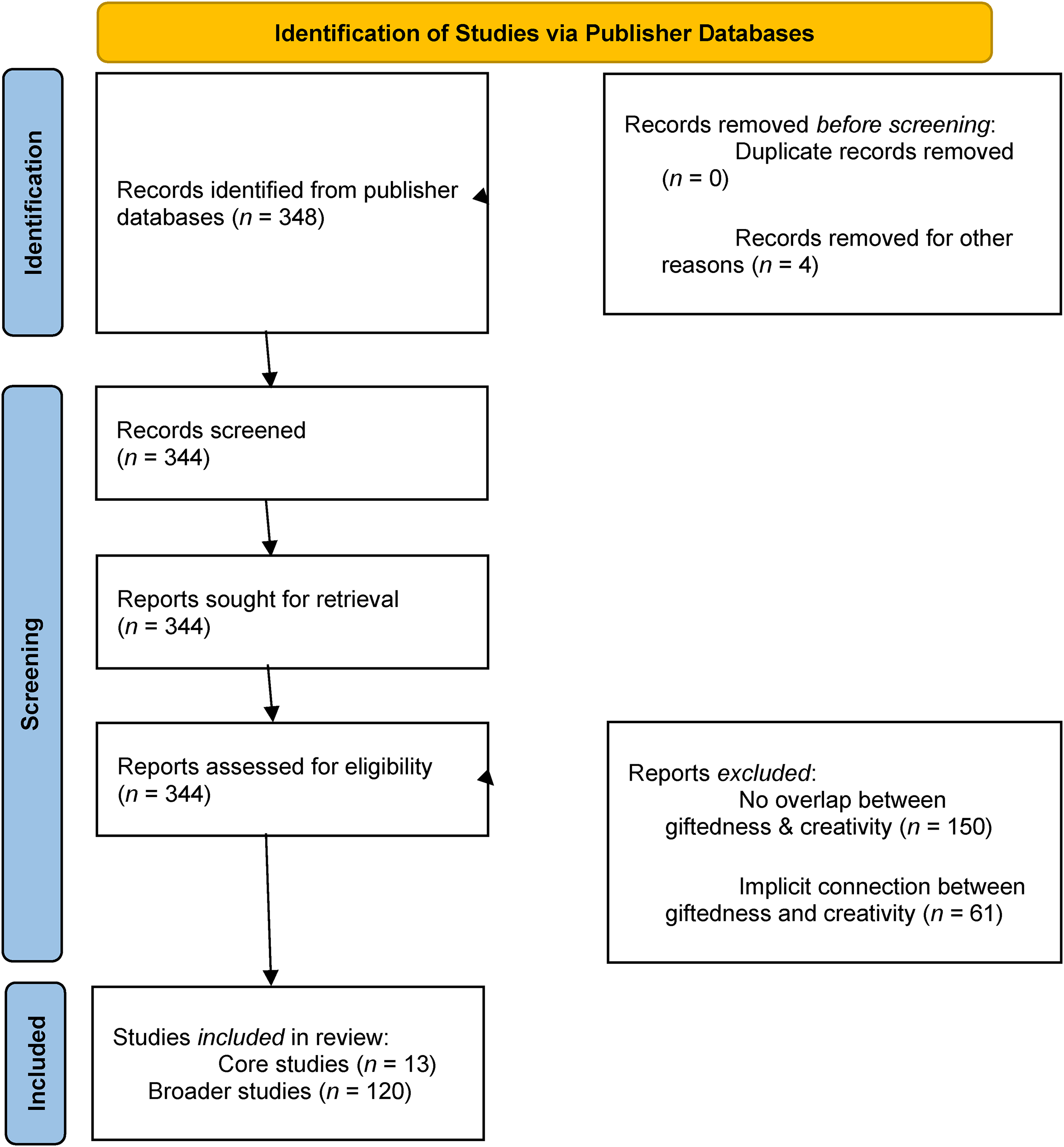
PRISMA flow diagram
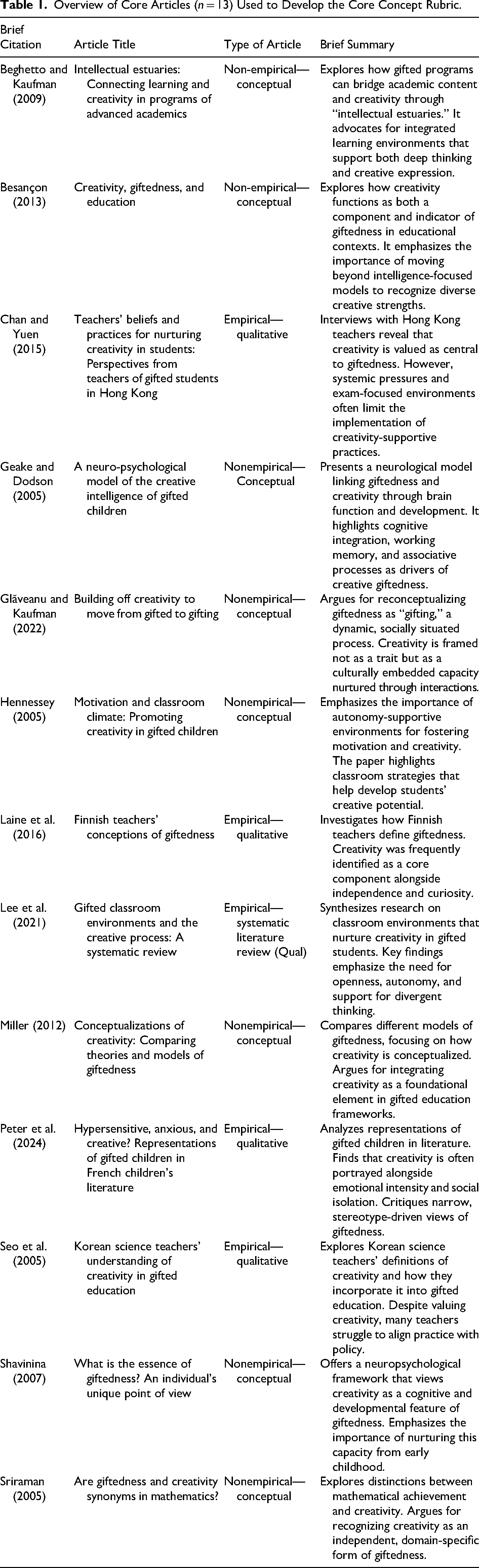
Our analysis focused on the first two categories. The key distinction between the core (n = 13) and other explicit connections (n = 120) article categories was not simply whether creativity appeared, but whether the creativity-giftedness connection was the central focus of the article (i.e., foregrounded) or whether the creativity-giftedness connection was embedded within other concerns (e.g., identification, curriculum, policy). This framing was critical in shaping the prevalence analyses that follow. Table 1 provides an overview of the 13 core articles. Table 2 shows the characteristics of all 133 articles that we reviewed.
Overview of Core Articles (n = 13) Used to Develop the Core Concept Rubric.
Summary of Article Characteristics.
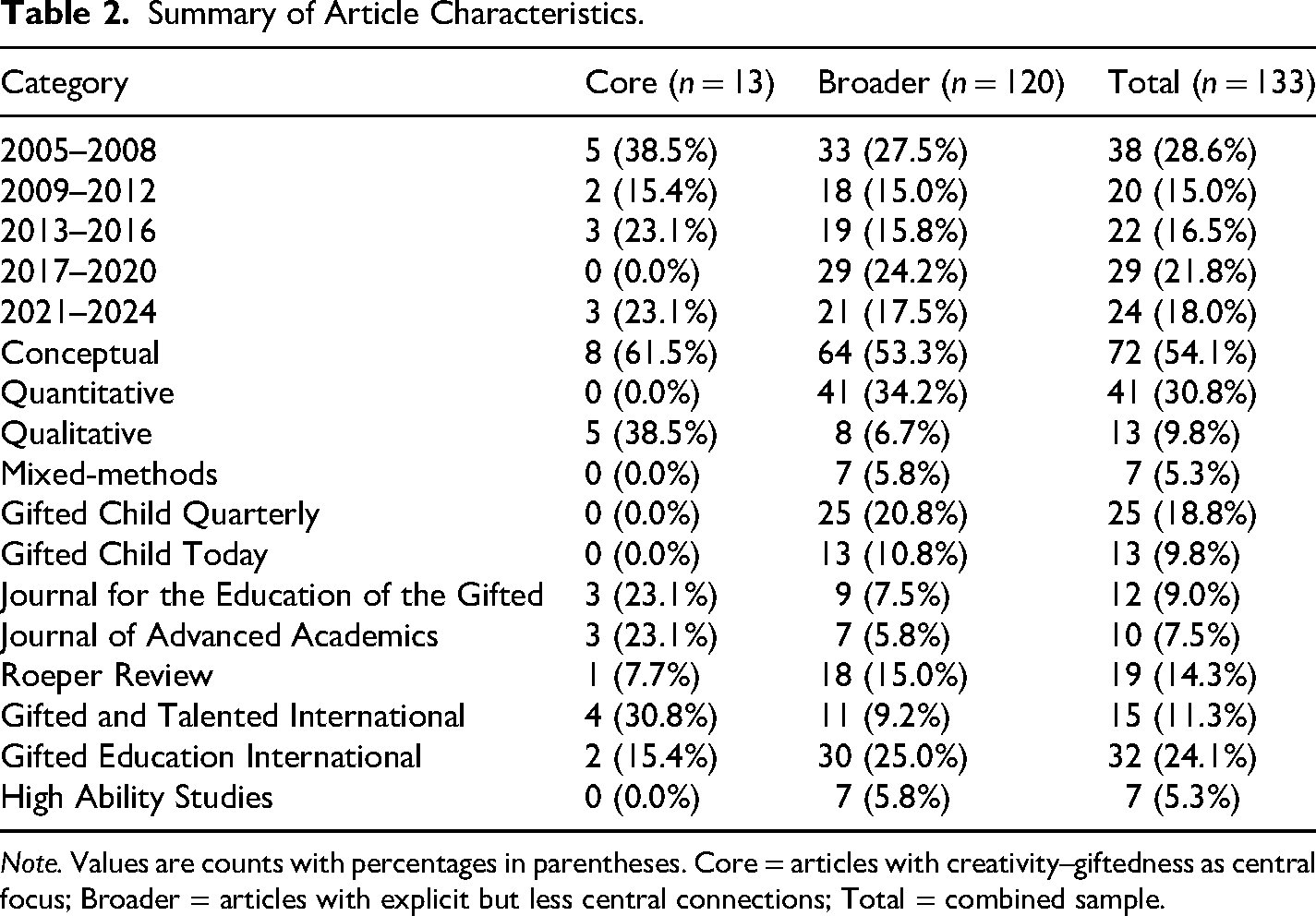
Note. Values are counts with percentages in parentheses. Core = articles with creativity–giftedness as central focus; Broader = articles with explicit but less central connections; Total = combined sample.
Because our inclusion criteria required articles to engage explicitly with giftedness, the resulting corpus necessarily reflects how creativity has been conceptualized within gifted education journals rather than within the broader creativity literature. As a result, conceptual patterns identified in this review should be interpreted as characteristic of gifted education scholarship rather than as representative of creativity research more broadly.
Core Concept Development
First, we analyzed the 13 core articles to inductively identify core concepts related to the ways creativity and giftedness were jointly conceptualized or operationalized. Three authors independently read each article, documented key ideas, and pulled representative quotations. Then, we categorized the articles by characteristics, including journal, year of publication, and research type (e.g., empirical, theoretical). We used ChatGPT (OpenAI, 2025) in a limited support capacity to align terminology across the three sets of independent coding notes because each author had taken a somewhat different approach to their note-taking in the initial coding. We reviewed the outputs critically and verified them against each author's source notes. This was the only use of generative AI in the research process. All subsequent decisions about the wording of the core concepts and their extended descriptions were made by the human authors through consensus meetings where we negotiated agreement and settled on the final wording. Through this process, we identified 18 recurring core concepts and compiled them into a coding rubric (summarized in Table 3).
Core Concept Rubric Overview Grouped by Resulting Themes.
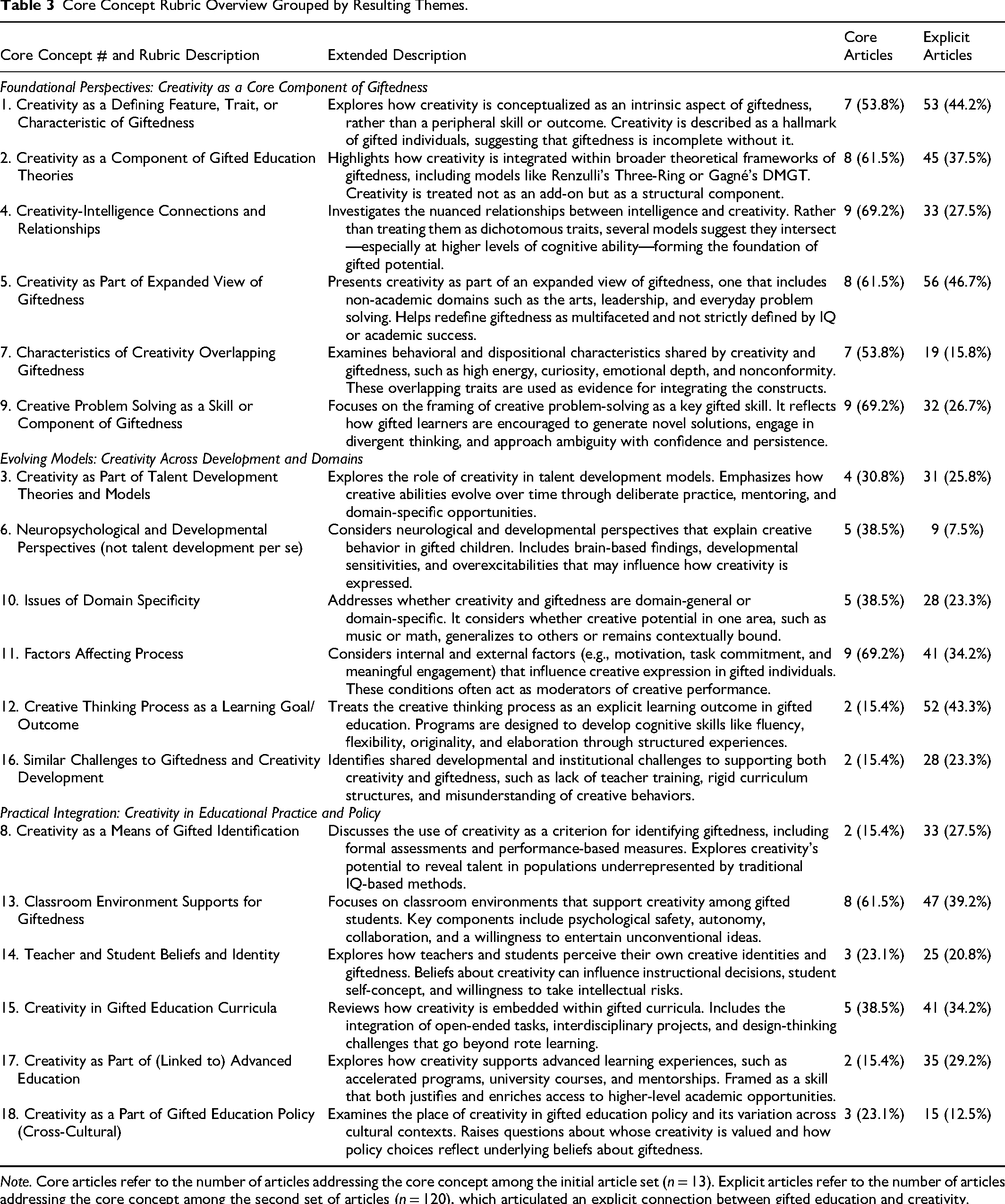
Note. Core articles refer to the number of articles addressing the core concept among the initial article set (n = 13). Explicit articles refer to the number of articles addressing the core concept among the second set of articles (n = 120), which articulated an explicit connection between gifted education and creativity.
Coding
We then applied this newly developed coding rubric containing the 18 core concepts in a second round of coding. Three authors independently applied the rubric to the 13 core articles to check for alignment. Among the cells (i.e., 18 core concepts by 13 articles), we achieved complete agreement 80% of the time (187 of 234). Calculated inter-rater reliability (Fleiss κ = 0.73) indicated substantial agreement (Landis & Koch, 1977). After establishing consistency in applying the rubric across coders, we divided the next set of 120 articles (i.e., explicit but broader giftedness-creativity connections) for coding. These data, together with the insights derived from the core set of articles, formed the basis for the broader conceptual and thematic analysis.
Thematic Analysis
In addition to the core concepts, we developed three overarching themes that were reflected across the core articles (n = 13) and the broader articles (n = 120). We used descriptive coding (Saldaňa, 2021) to create the core concepts and reflexive thematic analysis (Braun & Clarke, 2022) to develop the overarching themes. First, we identified core concepts that frequently co-occurred within the same core articles. We identified patterns across these core concepts and created three categories (e.g., theoretical perspective, developmental perspective, applied perspective). After assigning each core concept to one of the three categories, we developed three themes related to the way the overlap between giftedness and creativity was presented in the core articles. These overarching themes were also reflected in the articles in the broader sample.
Positionality
The first author teaches undergraduate foundations courses for teacher preparation, graduate courses in gifted education and research methods, and works with graduate students on theses and dissertations across educational topics. He has experience working on systematic reviews and meta-analyses in education and psychology. He views his primary areas of research as focusing on the intersection of education and creativity, as well as conceptions and understandings of creativity as a construct. The second author teaches graduate research methods, advises students conducting dissertation research studies, and has experience conducting systematic reviews of literature on topics in gifted education. The third author teaches graduate courses in gifted education and creativity, advises students conducting dissertation research studies, and has experience conducting systematic reviews and syntheses in the area of creativity. The fourth author is a methodologist specializing in gifted education and creativity. She has taught university courses in research methods, measurement, and creativity, and has conducted systematic reviews, meta-analyses, and advanced quantitative analyses related to creativity. All members of the research team are educators and scholars who examine issues related to creativity and gifted education. To guard against bias and ensure the findings were derived from the data and not our preconceived notions, we employed a systematic process for collecting and analyzing the data. In addition, we have provided our materials and data for transparency.
Findings
Data Corpus
The overall sample included 133 articles published between 2005 and 2024 across the eight major gifted education journals. As shown in Table 2, 13 of these were identified as core articles. In these core articles, the creativity-giftedness connection was central. The remaining 120 articles explicitly, but more broadly, engaged the overlap between giftedness and creativity. Methodologically, just over half of the total sample consisted of conceptual articles (n = 72), and the remaining empirical contributions included quantitative (n = 41), qualitative (n = 8), and mixed-methods (n = 7) studies. In terms of publication outlets, Gifted Education International (n = 30) and Gifted Child Quarterly (n = 25) accounted for nearly half of the broader sample, with the remaining articles distributed across the other journals. Publication was steady across the two decades, with the largest clusters occurring between 2005 and 2008 (n = 33) and 2017–2020 (n = 29), reflecting both early and more recent peaks of attention. This distribution underscores both the field's conceptual investment in theorizing the role of creativity in giftedness and the steady, if smaller, empirical attention to the topic across diverse contexts. The findings presented below are grounded directly in patterns we identified across the corpus of included articles. Although foundational theories are referenced to contextualize these patterns, our interpretive claims are anchored in the prevalence and co-occurrence of core concepts identified through systematic analysis.
RQ1: Themes in Core Articles
The first research question was: Among gifted education journal articles (2005–2024) for which linking gifted education and creativity was the central purpose, what core concepts exist about the nature of that linkage? With Research Question 1, we explored specific aspects of the overlap among giftedness, gifted education, and creativity in gifted education journals. In the 13 core articles, which were characterized as centrally focused on the overlap, we identified 18 core concepts, which in turn made up our rubric to analyze the broader articles with explicit mentions of giftedness-creativity connections for Research Question 2. A summary of the 18 core concepts and extended descriptions can be found in Table 3. Although we identified 18 distinct core concepts, these concepts consistently clustered under three broader thematic orientations—conceptual, developmental, and applied—which we used to structure the presentation of our findings.
Foundational Perspectives: Creativity as a Core Component of Giftedness
In the 13 core articles, the authors presented creativity as a deeply embedded feature of how giftedness is understood. Given the historical background of the field, it was not surprising to see so many authors mention the interplay of intelligence and creativity (Core Concept 4 [CC 4]; Beghetto & Kaufman, 2009; Besançon, 2013; Geake & Dodson, 2005; Hennessey, 2005; Miller, 2012; Peter et al., 2024; Seo et al., 2005; Shavinina, 2007). More than simply a trait or characteristic, creativity (CC 1) and creative problem-solving (CC 9) were frequently presented as constituting gifted potential (Besançon, 2013; Chan & Yuen, 2015; Geake & Dodson, 2005; Laine et al., 2016; Lee et al., 2021; Seo et al., 2005; Sriraman, 2005). Geake and Dodson (2005) captured this idea directly when they began their paper with the idea that among the most “endearing characteristics of gifted children is their ability to employ their superior intelligence creatively, as in original solutions to problems, elegant mathematical proofs, musical compositions, works of art, poetry and fiction, and an often bizarre sense of humour” (p. 6).
Although many historical conceptions of giftedness emphasized high intelligence or academic performance (e.g., Terman, Hollingworth), more recent theoretical developments emphasize a multifaceted view in which creativity plays an indispensable role (CC 2; Beghetto & Kaufman, 2009; Geake & Dodson, 2005; Hennessey, 2005; Lee et al., 2021; Miller, 2012). Renzulli's Three-Ring Model (2002) and Sternberg's Wisdom, Intelligence, Creativity, Synthesized (WICS) model (2003b) both exemplify this shift, embedding creativity alongside intelligence and other constructs, such as task commitment and wisdom, that are portrayed as fundamental dimensions of giftedness. These frameworks reflect a broader recognition that excellence or potential in any domain is not simply a matter of raw ability but also a matter of imaginative, generative capacity. As Miller (2012) noted, “several different theoretical models of giftedness cite creativity as a central component in describing giftedness across a variety of domains” (p. 94). Beghetto and Kaufman (2009) echoed this sentiment with a call to include mini-c and little-c creativity within the scope of gifted education planning, legitimizing the early developmental stages of creative thought as foundational to a modern, expanded view of gifted potential (CC 5; Geake & Dodson, 2005; Glăveanu & Kaufman, 2022; Laine et al., 2016; Lee et al., 2021; Miller, 2012; Peter et al., 2024).
Conceptual centrality also appears across cultural and practitioner-based perspectives. Through interviews with Finnish teachers, Laine and colleagues (2016) found creativity to be one of the most consistently mentioned markers of giftedness, alongside curiosity and independence (CC 7; Chan & Yuen, 2015; Geake & Dodson, 2005; Hennessey, 2005; Lee et al., 2021; Peter et al., 2024; Sriraman, 2005). The teachers in the Finnish study (Laine et al., 2016) noted that a gifted child stands out through creative problem-solving and by seeing different solutions that others miss. They also suggested that creativity often accompanies giftedness like a shadow, impossible to separate, but not always recognized as central. Similarly, Chan and Yuen (2015), in their work with Hong Kong educators, reported that teachers viewed creativity as an essential aspect of the gifted profile, although many struggled with how to prioritize it within their existing curricular structures (CC 15; Beghetto & Kaufman, 2009; Chan & Yuen, 2015; Lee et al., 2021). The international nature of these findings suggests that creativity is not only foundational to the conceptualization of giftedness but also resonates with educators’ everyday experiences, regardless of national or cultural context. Taken together, these findings point to a robust but fragile set of conceptual anchors that highlight how central creativity is to gifted and advanced education. However, these findings also raise the possibility that when creativity is not explicitly emphasized in gifted education, this connection between giftedness and creativity can be deemphasized or assumed in the broader discourse.
Despite this broad conceptual agreement, tensions emerged in how creativity is operationalized in policy (CC 18; Chan & Yuen, 2015; Lee et al., 2021; Seo et al., 2005) and identification (CC 8; Hennessey, 2005; Lee et al., 2021). Seo et al. (2005) suggested that although policy rhetoric in Korea may support creativity, “student selection is contradictory to a national agenda that embraces creativity because it is limited to academic achievement only” (p. 98). Peter et al. (2024) offered a related critique in the French context: in the literature, children were often depicted as eccentric or socially problematic. Arguably, such portrayals subtly undermine the legitimacy of creativity as a valued trait. Together, these studies suggest that even when creativity is acknowledged as a defining feature of giftedness, systemic and cultural biases often diminish its practical role. Furthermore, assessment practices implicitly signal programmatic priorities; when creativity is not meaningfully assessed, it is unlikely to be systematically cultivated through instruction. In this sense, identification and assessment practices are not neutral mechanisms but function as gatekeepers that shape which forms of giftedness and creativity are recognized, valued, and developed.
Evolving Models: Creativity Across Development and Domains
As conceptions of giftedness have shifted from fixed traits to dynamic capacities (Matthews & Dai, 2014), the role of creativity has similarly evolved from an innate characteristic to a skill that develops over time through meaningful engagement and support (CC 3 and CC 6; Beghetto & Kaufman, 2009; Geake & Dodson, 2005; Lee et al., 2021; Miller, 2012; Peter et al., 2024; Shavinina, 2007). Gagné's (2004) Differentiated Model of Giftedness and Talent (DMGT) identifies creativity as one of several key intrapersonal catalysts that convert potential into high performance. Gagné emphasized that talent development is contingent on both internal and external forces. This developmental view was mirrored in Shavinina's (2007) neuropsychological framing, which defined giftedness as a “unique point of view” (p. 36) shaped by heightened sensitivity to environmental stimuli. She argued that these sensitive periods are key to “understanding why so many gifted individuals who demonstrated extraordinary abilities in their childhood become ordinary adults who do not manifest exceptional talents and outstanding creativity” (p. 38). The critical temporal dimension introduced in these articles aligns with discussions of giftedness and creativity through the lens of talent development, which has increased in recent years.
Emphasis on development was also reinforced in pedagogical research on motivation and meaningfulness (CC 11; Geake & Dodson, 2005; Hennessey, 2005; Laine et al., 2016; Miller, 2012; Seo et al., 2005). Hennessey (2005) suggested intrinsic motivation as a key lever for creativity development among gifted students. She further noted that student motivation and creativity are closely linked with autonomy-supportive classrooms, which can produce higher levels of engagement and originality. Unfortunately, she lamented that the “killers of creativity” could just as easily be “labelled as a recipe for the typical American classroom” (p. 43). These threads were picked up by Lee and colleagues (2021) in their systematic review of classroom environments. They concluded that gifted students require opportunities to iterate, reflect, and take risks in order to develop domain-specific creative capacities (CC 12; see also Beghetto & Kaufman, 2009). One overarching theme across the articles in that review was that “integrating the creative process involves providing time for strengths-based, interest-driven investigations, encouraging creative productivity through feedback, and building a schoolwide culture for creativity” (Lee et al., 2021, p. 134).
The domain-specificity of creativity was another recurring point of integration (CC 10; Beghetto & Kaufman, 2009; Besançon, 2013; Lee et al., 2021; Sriraman, 2005). Sriraman (2005) distinguished between general academic achievement and creativity within mathematics and noted that “mathematical giftedness does not necessarily imply mathematical creativity, but the converse is certainly true” (p. 20). This insight challenges the assumption that high test performance equates to creative potential and tacitly urges educators to attend to domain-specific markers of creative thought. Besançon (2013) added the complementary concern that the tools used to assess creativity often lack the precision needed to capture its disciplinary nuances, which suggests the need for more advanced tools “based on diverse domains of expression, whereas the previous approaches of creativity measurement had rather a generalist approach” (p. 154). Nurturing creativity requires tailored supports that acknowledge both individual and contextual variation.
Sociocultural models contribute yet another dimension to the developmental narrative. Glăveanu and Kaufman (2022) critiqued traditional notions of the gifted individual and proposed a shift toward gifting, which they describe as a process that unfolds within a network of social, cultural, and institutional interactions. In their words, “people depend on each other's ideas, perspectives, and support to discover and nurture their potentialities and talents. ‘Being gifted’ should leave room in our educational system for ‘becoming gifted’ or, better yet, ‘gifting’” (p. 388). This perspective aligns with Beghetto and Kaufman's (2009) call for educators to recognize mini-c creativity to support personally meaningful interpretations of experiences as a legitimate and important form of creative expression (CC 12). Reframing giftedness in this way not only broadens the range of who is considered gifted but also expands how creativity is supported and assessed across time and contexts.
The thematic umbrella across this cluster of core concepts affirms a growing consensus in the literature that creativity is not an isolated trait but a developmental process that unfolds through the interplay of personal dispositions, domain-specific knowledge, motivation, and sociocultural support. As such, effective gifted education must be concerned not only with identifying creative potential but with cultivating it through responsive and inclusive pedagogies.
Practical Integration: Creativity in Educational Practice and Policy
Although creativity often features prominently in theoretical models and developmental frameworks, its enactment in educational settings remains uneven. Across the articles we reviewed, this cluster of core concepts focused on how creativity is supported or constrained through instruction, curriculum, teacher beliefs, and systemic factors, such as policy and identification criteria. These core concepts collectively illuminate the tensions between aspiration and implementation of creativity in gifted education.
Classroom environments play a decisive role in either enabling or hindering creative development (CC 13; Beghetto & Kaufman, 2009; Besançon, 2013; Chan & Yuen, 2015; Geake & Dodson, 2005; Hennessey, 2005; Lee et al., 2021; Seo et al., 2005; Sriraman, 2005). Lee and colleagues (2021) argued, “educators must acknowledge the interplay between various developmental systems that help shape these environments and how particular systems (i.e., classrooms, schools, school districts) influence the creative process” (p. 112). In a similar vein, Hennessey (2005) noted that “the message that (gifted) students’ own intrinsic interest, curiosity, and excitement about learning must not take a back seat to concerns about grades or the need to outperform one's peers” (p. 45). In both cases, the takeaway is clear: classrooms structured solely around efficiency or outcomes tend to inhibit rather than foster creative growth. Teachers who encourage questioning, tolerate ambiguity, and support risk-taking foster climates in which creativity can thrive.
Yet, such environments are not guaranteed. Many classrooms still emphasize correctness, conformity, and performance metrics (CC 16; Lee et al., 2021). This is critical given “gifted children appear to be particularly vulnerable to environmental influences. Too often their enthusiasm and motivation are stifled by teachers invested in seeing that students conform to accepted practices” (Hennessey, 2005, p. 44). Chan and Yuen (2015) found that classroom practices often diverged from stated beliefs about the importance of creativity. Teachers may often acknowledge its importance, but classroom pressures and accountability measures frequently steer them away from fostering it even among gifted students. One teacher in the Chan and Yuen study said, “I do think we should put in elements of creativity and higher-order thinking … but with such a busy curriculum it is not easy to do” (p. 207). This finding aligns with the broader literature on educator attitudes and practices with respect to creativity (e.g., Mullet et al., 2016; Rubenstein et al., 2018).
Underlying teacher beliefs are similarly pivotal in supporting or undermining creativity development (CC 14; Besançon, 2013; Hennessey, 2005; Lee et al., 2021). Chan and Yuen (2015) found that teachers of gifted students held mixed views about defining and characterizing creativity. Although all valued creativity as an outcome, fewer felt they knew how to support it beyond a core set of strategies. Importantly, however, among the gifted education teachers in their study, the “balanced view of creativity underpins teaching, it results in a positive impact on students, particularly the gifted” (Chan & Yuen, 2015, p. 209). Chan and Yuen (2015) further noted that teacher “beliefs about creativity and practices on how to foster creativity were…underpinned by their beliefs about gifted education…interviewed teachers believed that all students have talents, and that teachers should encourage and support students to reach their potentials” (p. 207). Linking back to CC 13 (classroom supports), no matter the teachers’ beliefs, recognizing creative behaviors is critical: “working with teachers on their attitudes towards creative behaviors in the classroom is therefore important as teachers are in a privileged position to stimulate or stifle creativity” (Besançon, 2013, p. 157).
When creativity is integrated into the curriculum, it often takes the form of structured strategies, such as SCAMPER (Substitute, Combine, Adapt, Modify, Put to other uses, Eliminate, Rearrange), mind mapping, or open-ended projects (CC 15). Such tools are useful, but their implementation is not universal. In some models, such as problem-based learning or design thinking frameworks, creativity becomes central to content learning rather than an add-on. Beghetto and Kaufman (2009) highlighted a broader philosophical integration with “intellectual estuaries” which demonstrate “alignment with the interpretive and dialogic nature of learning and creativity. In this view, the streams of students’ creative and academic potential meet with supports and opportunities that will help cultivate both capacities” (p. 332). In their systematic review, Lee and colleagues (2021) argued that creative process learning should be embedded in curriculum design, not only to stimulate student engagement, but to build the long-term habits of mind necessary for talent development (CC 17; see also Beghetto & Kaufman, 2009). In particular, “gifted students need opportunities to find authentic problems and pursue passions within a domain of interest or skill” to develop creative process skills (Lee et al., 2021, p. 125).
However, access to such curricular opportunities is often stratified, and gifted education programs may not fully realize their potential for creativity cultivation. Hennessey (2005) argued: “if gifted students are to be helped to find their creative intersection, significant and fundamental changes must be made to the way that educators think about teaching and learning” (p. 44). Additionally, the gap is not limited to programming. In gifted education identification practices, the reliance on intelligence scores and academic performance remains and can prevent the robust use of creativity assessments (CC 8). In their analysis of French children's books, Peter and colleagues (2024) highlighted how characters who embody creativity are frequently portrayed as eccentric or disruptive rather than talented. This could be symptomatic of a system that fails to link creativity and giftedness by default, suggesting that those attempting to do so may be swimming upstream.
At the policy level, national contexts are related to the degree to which creativity is formally recognized (CC 18). In South Korea, for instance, creativity has been explicitly linked to economic competitiveness in gifted Science, Technology, Engineering, and Mathematics (STEM) education (Seo et al., 2005). Despite this, their identification system remains “eclectic” and “student selection is contradictory to a national agenda that embraces creativity because it is limited to academic achievement only” (Seo et al., 2005, p. 98). Similarly, “French people, the French media, and French popular science books share broadly similar social representations of giftedness, even though these representations are often stereotypical and not consistent with research findings” (Peter et al., 2024, p. 242). Chan and Yuen (2015) highlighted cross-cultural differences in creativity support in schools. They noted that creativity is supported in Hong Kong and viewed as an “important attribute to be nurtured in all students, not only in the gifted and talented” (p. 202) which may hinder specific development in creative aspects of domains. International comparisons highlight the role of systemic norms and values on how creativity is framed and operationalized in gifted education and also reveal broader structural tensions manifested in the history of gifted education. Glăveanu and Kaufman (2022) suggested, “the notion of giftedness has served its purpose of making people, individually and collectively, much more aware of the need to cultivate creative talent and do so from early on in life” (p. 390). Furthermore, they concluded the field of gifted education still struggles with implementation and could benefit from “a proper understanding of how everyone can participate in the sharing of ‘gifts’ as a way of making them visible, useful, and growth-inspiring” (p. 390).
Bridging systemic gaps requires not only theoretical endorsement of creativity but also institutional willingness to restructure how talent is recognized, cultivated, and assessed. As the 13 core studies collectively suggested, systemic reform must involve not only policy alignment but shifts in teacher preparation, assessment practices, and curricular design. Creativity's role in gifted education remains aspirational in many settings. Whether classroom climates (CC 13), teacher beliefs (CC 14), and curriculum models (CC 15) align with a developmental view of creativity, gifted students benefit from environments that allow their creative identities to emerge and flourish. Where such alignment is absent, creativity can become either marginalized or performative. The challenge for future practice lies not in redefining creativity's value, but in reengineering systems and supports that make development possible across all levels of the education system.
RQ2: Prevalence of Core Concepts in the Broader Sample
The second research question was: Among gifted education journal articles (2005–2024) that explicitly link gifted education and creativity, what is the relative prevalence of the core concepts identified in Research Question 1? The comparison of the 13 core articles with the 120 broader articles (see Table 3) reveals both shared continuities and subtle but meaningful shifts in emphasis. Across both groups, creativity consistently appears as a central dimension of giftedness, but the nature of its treatment differs in ways that carry implications for how the field sustains its conceptual foundations. The overall pattern shows that while the broader pool is much larger (120 vs. 13), the relative distribution of certain themes provides insight into what is foregrounded and what is assumed in current scholarship.
Core Concepts With Similar Emphasis Across Both Samples
Several core concepts showed comparable prevalence in both groups, underscoring a broad agreement that creativity belongs within any serious discussion of giftedness. For instance, CC 1 (Creativity as a defining feature of giftedness) appeared in over half of the core articles (53.8%) and nearly half of the broader sample (44.2%). Similarly, CC 5 (Creativity as part of expanded views of giftedness) was coded in 61.5% of the core articles and 46.7% of the broader set. These findings point to a consistent consensus across the field, even when creativity was not the central focus of an article. Likewise, CC 3 (Creativity in talent development models) appeared in roughly one-third of the core set (30.8%) and a quarter of the broader sample (25.8%), suggesting a steady developmental orientation across both contexts.
Differences Between the Core and Broader Samples
By contrast, several foundational linkages were less visible in the broader pool. CC 4 (Creativity–intelligence connections) dropped sharply from 69.2% of core articles to just 27.5% of the broader set. CC 2 (Creativity within gifted education theories) fell from 61.5% to 37.5% respectively, and CC 6 (Neuropsychological and developmental perspectives) declined from 38.5% to only 7.5%. Similarly, CC 7 (Overlapping characteristics of giftedness and creativity) appeared in 53.8% of the core sample but just 15.8% of the broader one. These declines suggest that although theoretically or conceptually oriented work foregrounds such connections, many articles tend to proceed without explicitly revisiting the connection between giftedness and creativity.
Other core concepts were more prominent in the broader set. CC 8 (Creativity as a means of identification) appeared in 27.5% of broader articles compared to 15.4% of core articles. Core concepts linked to applied practice, including classroom climate (CC 13), teacher beliefs (CC 14), and curricular strategies (CC 15), were also noticeably more common in the broader pool. This finding highlights the degree to which much of the literature emphasizes tangible instructional and programmatic strategies over theoretical restatement.
Beyond the descriptive nature of the prevalence patterns, the observed differences suggest that when creativity–giftedness connections are not the central focus of an article, they are more likely to be treated implicitly or instrumentally rather than conceptually. This pattern has implications for how foundational assumptions are carried forward—or left unexamined—in applied gifted education scholarship.
Discussion
The core concept patterns that emerged in this review offer strong continuity with, and selective expansion of, foundational theories in the fields of creativity and gifted education. At the center is the recognition of creativity as a defining feature of giftedness (CC 1), which is deeply rooted in the legacy of Guilford's (1950) call to action. His explicit positioning of creativity, particularly divergent thinking, as a neglected yet vital component of human ability was critical. Guilford's Structure of Intellect model (1956) not only legitimized creativity as a domain of psychological inquiry but also influenced how scholars and educators began to consider its role in identifying and nurturing giftedness. Such a foundational emphasis is clearly echoed in the findings of the present review: creativity is treated as integral rather than ancillary to gifted potential. Importantly, scholars, including Guilford, did not assume these connections between giftedness and creativity; they made them explicit, often reasserting these links at the center of theories and practices. By contrast, our findings suggest that much of today's literature embeds these linkages without always rearticulating them.
Building directly on Guilford's work, Torrance provided empirical traction for integrating creativity into education. The development of the TTCT (Torrance, 1966) operationalized constructs, such as fluency, flexibility, originality, and elaboration, which remain central to how creativity is conceived in gifted education today. This is especially visible in ideas related to creativity as a learning goal (CC 12) and creative problem solving as a valued outcome of giftedness (CC 9). Moreover, Torrance's concern with identifying creative potential in underrepresented populations resonates strongly with CC 8, which explores creativity as an alternative or complementary pathway for gifted education. This is particularly relevant given that CC 8 was more prevalent in the broader sample, which suggests that applied-practical work often builds directly on Torrance's equity-oriented insights, even when the underlying rationale is not explicitly articulated. This review underscores that many contemporary perspectives continue to reflect Torrance's belief that creativity is not only measurable but also teachable and socially valuable.
The practical, developmental, and instructional perspectives offered by Treffinger further illuminate these findings. Treffinger's work (Treffinger, 1995b; Treffinger & Isaksen, 2005; Treffinger & Renzulli, 1986) emphasized not just creative performance but also the development of creative dispositions such as risk-taking, openness, and perseverance. These perspectives are seen in CC 11, which addresses the role of motivation, task commitment, and meaningfulness in fostering creative expression. They also appear in CC 14, which considers how teacher and student beliefs shape the expression of creativity in gifted contexts. Treffinger was a leading voice who asserted that creativity should be explicitly cultivated in gifted programming. This position is reinforced by findings in CC 13 and 15, which emphasize the importance of supportive environments and curricular design.
The review also demonstrates enduring alignment with Renzulli's (1978, 2011). Three-Ring Conception of Giftedness, in which creativity operates as one of three interlocking components alongside above-average ability and task commitment. CC 2 and 5, which examine creativity within gifted education theories and expanded views of giftedness, reflect this structure. Renzulli's model helped open the door to more inclusive understandings of giftedness, many of which now explicitly integrate creative behaviors and performance into definitions, services, and identification systems. Similarly, evidence of Gagné's (2004) DMGT, which conceptualizes creativity as both a natural ability and a talent that develops through systematic training and opportunity, is present in CC 3. Core concepts highlighting developmental models, environmental catalysts, and domain-specificity (i.e., CC 3, CC 10, CC 11) affirm this dynamic, talent-evolving perspective on giftedness.
In terms of broader integration, this review echoes Sternberg's (1985, 2000, 2003) view that intelligence, creativity, and wisdom coalesce in high-functioning gifted individuals. CC 4 reflects this synthesis by interrogating the creativity–intelligence relationship, which is often framed not as an either/or proposition but as complementary dimensions of adaptive cognition. Authors invoking the Investment Theory (Sternberg & Lubart, 1991) similarly suggest that creative giftedness is the result of long-term strategic engagement and domain-specific capital-building.
Finally, contemporary core concepts on policy, curriculum, and cross-cultural perspectives (CC 15–18) reflect a field that is increasingly attentive to how systems support or constrain the development of creative potential. This emphasis aligns with calls from Kaufman and Beghetto (2009) and Glăveanu (2020) to consider creativity as contextually and socially embedded. In sum, the findings of this review affirm the foundational legacies of Guilford, Torrance, and Treffinger, while also demonstrating how their insights continue to evolve in light of modern educational challenges and frameworks.
Several theoretical frameworks introduced earlier in this review, particularly personality-based perspectives on creativity such as openness to experience, were only minimally represented in the coded articles, despite their prominence in the broader creativity literature. This pattern suggests that while gifted education scholarship frequently draws on foundational giftedness theories that implicitly incorporate creativity, it is less likely to engage explicitly with contemporary creativity frameworks when articulating the creativity–giftedness relationship. The relative absence of these frameworks in the reviewed articles reinforces the central finding that creativity is often treated as an assumed attribute of giftedness rather than as a construct that is systematically theorized, operationalized, and examined within gifted education research.
Implications and Future Directions
The contrast between the core articles (n = 13) and the broader articles (n = 120) in this review does not represent a divide between conceptual versus practical scholarship. Both groups contain conceptual and applied work. Instead, the difference lies in positioning: in the core set, linking creativity and gifted education is the explicit center of gravity, whereas in the broader set, these connections are present but embedded within larger arguments about identification, curriculum, or policy.
The existence of this pattern has consequences. When the creativity-giftedness connection is assumed rather than articulated, gifted education risks losing sight of its conceptual foundations. Applied scholarship may unintentionally relegate these connections to the background, allowing terminology and surface-level references to stand in for sustained engagement. To guard against this drift, even practice-focused contributions need to continually re-engage with the fundamentals, ensuring that creativity's place in giftedness remains explicit rather than implicit.
In sum, the prevalence data from Table 2 show both stability and drift. Foundational core concepts remain visible but are less consistently present outside of theory-driven work. Meanwhile, the applied core concepts were emphasized, but those articles often assumed the traditional linkages rather than reasserting them. Moving forward, the challenge is to keep the fundamentals in clear view so that they remain part of the field's shared language and not an overlooked backdrop.
Collectively, our findings suggest that gifted education research and practice would benefit from more explicit articulation of how creativity functions within identification systems, instructional design, and program goals. For researchers, this underscores the importance of specifying whether creativity is treated as a defining feature, a developmental process, or an instructional outcome. For practitioners, the findings highlight the need for alignment: programs that value creative thinking must assess and cultivate it intentionally rather than implicitly.
Limitations
Although this review provides an exploration of the creativity-giftedness nexus in articles published in gifted education journals over a 20-year period, several limitations should be acknowledged. First, the inclusion criteria privileged articles with an explicit treatment of both constructs in the abstract, which may have excluded work where creativity or giftedness were central but not foregrounded in the abstract. Additionally, although we ultimately coded 133 articles, only 13 core texts were used to develop the core concept rubric. As such, a possible conceptual narrowing of the categories may have occurred. The iterative coding process was conducted by multiple raters, yet such ratings are inevitably shaped by some measure of subjectivity, especially when distinguishing between overlapping or co-articulated core concepts (e.g., creativity as identification vs. creativity as curriculum).
Another limitation lies in the emphasis on English-language, peer-reviewed publications from selected journals in gifted education. This scope may underrepresent culturally specific conceptions of creativity or giftedness that appear in broader education, psychology, or regional research contexts. Specifically, our work does not address how creativity researchers conceptualize or engage with giftedness. Examining creativity-focused journals represents an important direction for future research and would help clarify whether giftedness is treated as a central construct, a peripheral concern, or largely absent within the broader creativity literature. Finally, this review does not assess the empirical strength or impact of claims made across articles, and instead focuses on conceptual presence. Future research might extend this work with citation analysis or include other domains (e.g., neuroscience, arts education) where alternative views on the gifted-creativity connection might surface more prominently.
Conclusion
The story of giftedness and creativity is not one of two estranged relatives living in separate houses; it is, and always has been, a story of entanglement, sometimes messy, sometimes elegant, but always consequential. Our review demonstrates that across two decades of scholarship, the way creativity has been treated ranges broadly: from the spark that ignites gifted potential to an inconvenient guest squeezed into policy frameworks that were never designed to host it. The conceptual scaffolding is there, built by Guilford, Torrance, Renzulli, Sternberg, Treffinger, and so many others, but the field still wavers between treating creativity as central or optional, depending on who is speaking and the pressures that schools face. As noted by Miller (2012), “though giftedness and creativity are not always conceptualized as mutually exclusive, a distinction is often made between the two areas of research” (p. 99). That distinction is not just academic nitpicking. It is a fault line that continues to shape practice, policy, and identification in ways that underserve the very students in gifted education scholars and practitioners claim to champion. As this review suggests, the divide is not only about definitions, but also about foregrounding: whether creativity's role in giftedness is explicitly articulated (as in the core articles and among foundational theorists) or left implicit (as in much of the broader scholarship). This positioning shapes how visible and actionable creativity remains in the field.
Where does that leave us? In need of clarity and renewed effort, frankly. In gifted education research and practice, if we continue to sideline creativity and explore it only at a surface level, then we risk reducing gifted education's credibility among our constituents and beyond with respect to creativity. One implication is that journal editors, reviewers, and authors might encourage explicit articulation of how applied arguments rest on the creativity-giftedness link. Doing so would ensure that foundational perspectives remain central even as scholarship addresses practice, policy, and equity concerns. But if the field of gifted education fully embraces creativity, not as an add-on, but as a core, consistent, and clearly articulated feature of gifted education, then we unlock possibilities for equity, talent development, and authentic human flourishing among our highest potential students.
Footnotes

Funding
The authors received no financial support for the research, authorship, and/or publication of this article.
Declaration of Conflicting Interests
The authors declared no potential conflicts of interest with respect to the research, authorship, and/or publication of this article.