







Abstract

Keywords
Continuous glucose monitoring (CGM) has transformed the management of type 1 diabetes (T1D) and is increasingly used to support athletic performance. Although glycaemic responses to exercise have been extensively studied under controlled laboratory conditions, real-world data from elite competition remain limited, particularly in comparison with athletes without diabetes.1-3
Ten elite male futsal players with T1D competing at a European championship were compared with adult athletes without diabetes (n = 15) using anonymized CGM-derived metrics including time in range (TIR, 3.9–10.0 mmol/L), time above range (TAR), time below range (TBR), and glucose variability expressed as coefficient of variation (CV). Athletes with T1D demonstrated significantly lower TIR and greater glucose variability than athletes without diabetes (Figure 1; both P < .05). In contrast, TAR and TBR remained minimal in the healthy cohort, reflecting tightly regulated physiological glycaemia. Despite these differences, substantial inter-individual overlap was observed across all CGM metrics. No significant associations were observed between glycaemic metrics, carbohydrate intake, insulin dose, and performance outcomes.
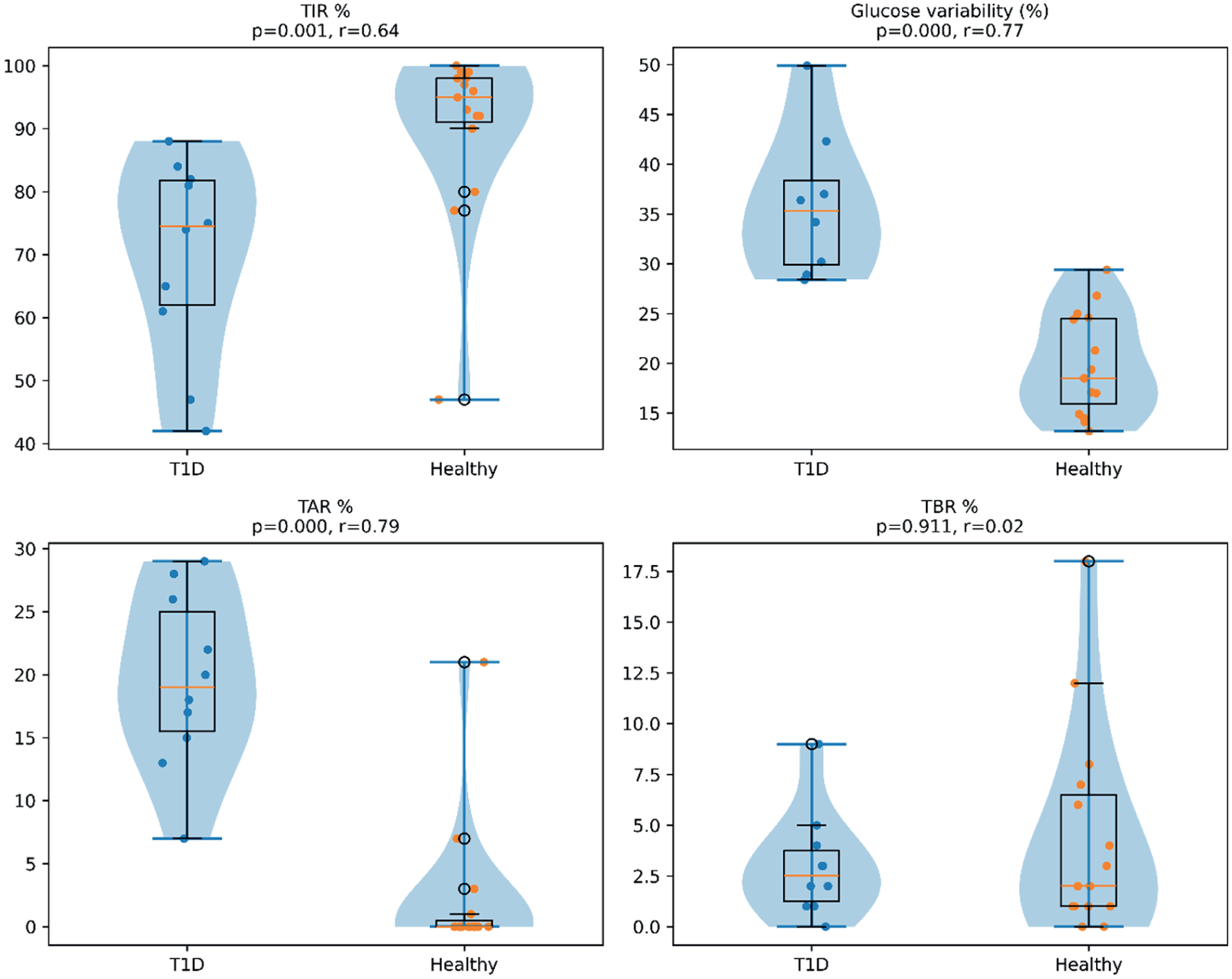
Comparison of CGM-derived metrics between athletes with type 1 diabetes (T1D; n = 10) and athletes without diabetes (n = 15).
The principal observation is the apparent dissociation between glycaemic variability and competitive performance. Despite operating outside the physiological glycaemic range observed in athletes without diabetes, players with T1D maintained performance at the highest competitive level. These findings suggest a degree of performance resilience despite greater glycaemic variability. Potential explanations include exercise-induced counterregulatory hormonal responses that increase glucose availability during physical activity, the intermittent nature of futsal with repeated recovery periods, and individualized carbohydrate and insulin adjustment strategies developed by experienced athletes.4-6 The overlap observed between groups further highlights the heterogeneity of metabolic control among athletes with T1D and suggests that optimized management strategies may allow glycaemic profiles approaching those observed in athletes without diabetes.
Although limited by the small sample size and observational design, this study provides ecologically valid insight into glycaemic management during elite competition. In conclusion, elite futsal players with T1D exhibited greater glycaemic variability and lower TIR than athletes without diabetes, yet maintained competitive performance. These findings suggest that short-term deviations from physiological glycaemic profiles do not necessarily impair sport-specific performance and support further investigation of individualized CGM targets in athletic populations.
Footnotes
Acknowledgements
The authors thank the participating athletes for their contribution and commitment during the competition period.
Abbreviations
CGM, continuous glucose monitoring; CV, coefficient of variation; T1D, type 1 diabetes mellitus; TAR, time above range; TBR, time below range; TIR, time in range.
