







Abstract
Two Chinese black cardamom oils (Amomum tsao-ko) were analyzed using GC and GC/MS and compared to 2 Indian cardamom oils from the species Amomum subulatum and Elettaria cardamomum, respectively. The main constituents of A. tsao-ko oils were eucalyptol, geranial, geraniol, trans-2,3,3A,7A-tetrahydro-1H-indene-4-carbaldehyde, (2E)-decenal, neral, and 4-indanecarbaldehyde. Special attention was given to the 1H-indene-carbaldehyes, which are frequently wrongly assigned in previous literature. A detailed odor evaluation of the oils was also carried out. In addition, composition variations of 28 main constituents of 8 E. cardamomum oils were investigated, taking various factors like origin, production methods, plant material, and drying stage into consideration.
Spices 1 and the resulting essential oils and oleoresins 2 are key components in flavor creations. Some spices, like cardamom, also play an important role in the fragrance industry. 3 Cardamom essential oil for fragrances is hydrodistilled from seeds or less frequently from whole pods of Elettaria cardamomum (L.) Maton. 4,5 However, the term cardamom is not limited to only one species. Several plants in the genera Elettaria, Amomum, and Aframomum, all belonging to the Zingiberaceae family, are also referred to as cardamom. 1 In the Encyclopedia of Herbs and Spices, 8 different cardamoms 1 are described in detail while ISO 676:1995 (Spices and Condiments—Botanical Nomenclature) lists 10 species. 6 Our Scent Expeditions to Kerala/India in 2007 and Yunnan/China in 2011, respectively, sparked our fascination for cardamom further.
Cardamom is often distinguished into true or green cardamom on one hand represented by the species E. cardamomum and false or black cardamom referring oftentimes to a variety of species. 5 The color classification is based on their dried fruit appearance. Further indexing of cardamom refers to the fruit size (eg, small or large), form (eg, round), or the historic region of origin like China and Madagascar. 1
Green, small, or true cardamom, E. cardamomum, is known as the “Queen of Spices” 4,5,7-10 . When bleached it is named as white cardamom. 8,9 Its essential oil is one of the oldest raw materials in perfumery and the third most expensive spice after vanilla and saffron. It is cultivated widely in the tropical region with Guatemala, India, and Sri Lanka as the main producer countries currently. 4,5,7-10 The biggest growing regions in India are Kerala followed by Karnataka. 10 At least 2 varieties of E. cardamomum are listed in ISO 676:1995: var. major Thwaites and var. minuscula Burkill. 6 Elettaria cardamomum var. minuscula could be better classified into 3 cultivars according to literature: Malabar, Mysore, and Vazhukka, the latter a hybrid between Malabar and Mysore. 11,12 Besides the essential oil, CO2 extracts, as well as the oleoresin, are commercially available. These products are normally obtained only from the seeds by removing the outer husk before processing.
Black, large, or false cardamom covers the species Amomum and Aframomum. 13 By far the most important species is Amomum subulatum Roxb., also known as Nepal cardamom native to the Eastern Himalayan region. 14 -17 India is the main producer followed by Nepal and Bhutan. In India, 85% of A. subulatum is cultivated in the Indian state of Sikkim but also partly the Darjeeling district in West Bengal, Assam, and Himachal Pradesh. 14 While large quantities of the spice itself are commercially available, the respective essential oil and oleoresin are hardly found.
The same applies for its Chinese relative Amomum tsao-ko Crevost & Lemarié. 13,18 However, production volumes seem to be significantly lower and the capsule fruit is bigger compared to A. subulatum. 19 It is an important spice in many parts of China and also used in traditional Chinese medicine. 18 Chinese black or tsao-ko cardamom is widely distributed in the southwestern provinces of China like Yunnan and Guangxi, but also in the northern highlands of Vietnam and Laos. 20 In China 90% of the crop has its origin in Yunnan province.
While green cardamom (E. cardamomum) 7-12,21-23 and black cardamom (A. subulatum) from India 14-17,24-31 are scientifically well investigated over the years, significantly less is published about Chinese black cardamom (A. tsao-ko). 18,32-36 In addition, most publications have been published only in Chinese 37 –48 and some compounds have been repeatedly wrongly assigned.
Here we report detailed analyses of 2 A. tsao-ko essential oils distilled from crushed whole pods originated from China and compared with 2 other cardamom essential oils from the species A. subulatum and E. cardamomum, respectively, both from India in terms of constituents and odor. In addition, E. cardamomum essential oils distilled from dried and fresh pods from India were compared with 3 commercial oils from India and Guatemala and a CO2 extract from whole dried pods regarding main constituents (>0.2%) to investigate variations in this species.
All 4 cardamom essential oils were hydrodistilled under standard lab conditions using ground dried pods (for details see Experimental section). Yields ranged from 0.7% to 1.8% for A. tsao-ko and 0.9% to 1.5% for A. subulatum and up to 5.2% for E. cardamomum. The 4 cardamom oils
Chemical Composition (Area %) of Main Constituents (>0.1%) of 4 Cardamom Oils. a
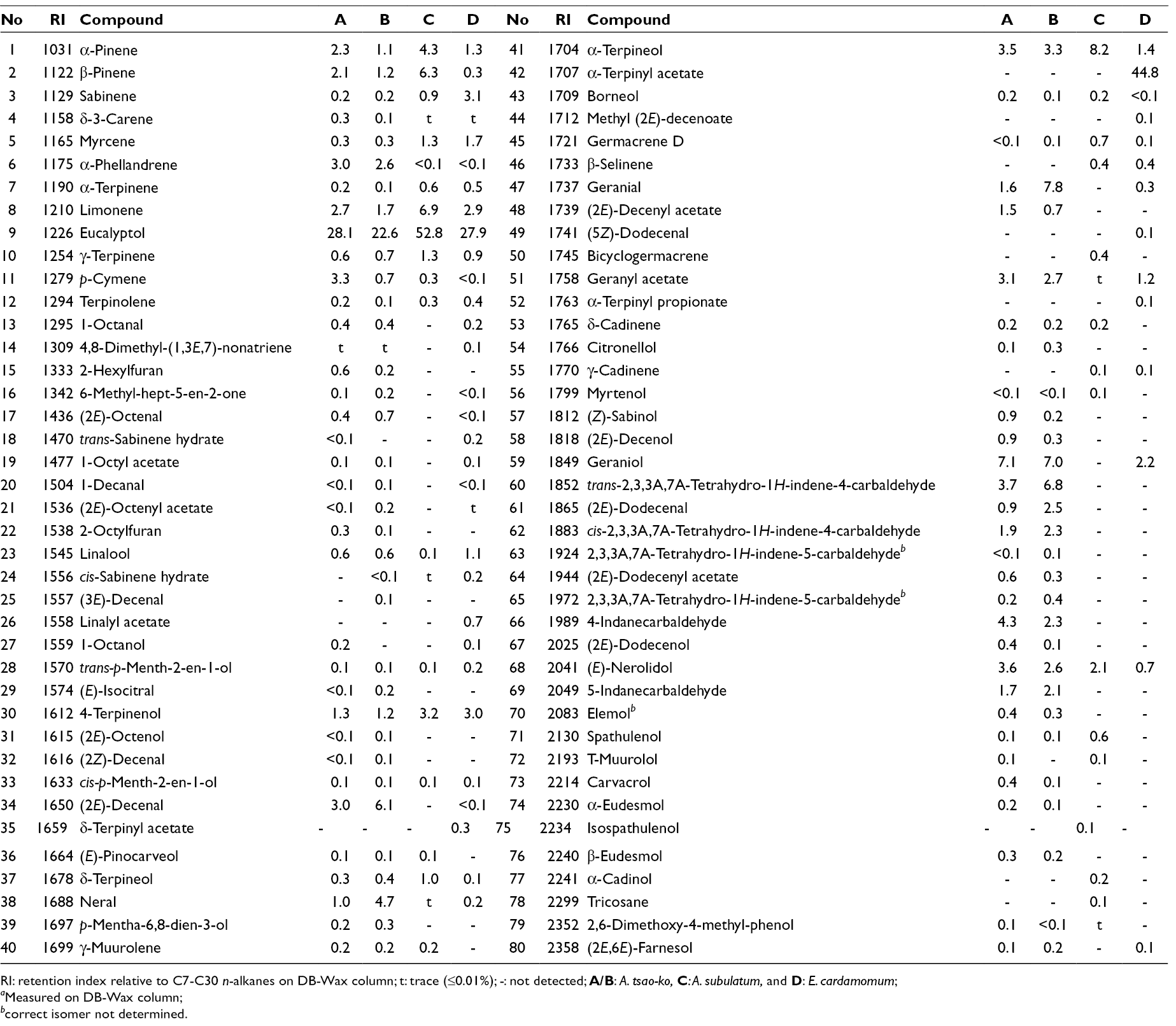
RI: retention index relative to C7-C30 n-alkanes on DB-Wax column; t: trace (≤0.01%); -: not detected;
aMeasured on DB-Wax column;
bcorrect isomer not determined.
In both A. tsao-ko oils (
Both oils contained very characteristic indane (=2,3-dihydro-1H-indene) derivatives: 4-indanecarbaldehyde (

Chemical structure of 1H-indene-carbaldehyes 1 to
The indanecarbaldehydes
The respective dihydroindane-4-carboxylaldehydes
Interestingly, to the best of our knowledge, the respective dihydroindane-5-carbaldehydes have not been described before in A. tsao-ko. Two unknown compounds showed high similarities in the mass spectra with
The indane derivatives
High levels of straight chain unsaturated aldehyde (2E)-decenal together with the presence of (2E)-decenol and (2E)-dodecenol and the corresponding acetates seem to differentiate A. tsao-ko further from the other 2 cardamom species.
The concentrations of eucalyptol, p-cymene, and indane-4-carbaldehyde (
A detailed analysis of additional minor compounds (<0.1%) from A. tsao-ko is shown in Table 2. These 88 constituents represent only 1.7% to 2.0% of the total oil content and were detected in most cases in both oils
Chemical Composition (Area %) of Minor Constituents (<0.1%) of 2 Amomum tsao-ko Oils. a

RI: retention index relative to C7-C30 n-alkanes on DB-Wax column; t: trace (≤0.01%); -: not detected;
aMeasured on DB-Wax column;
bcorrect isomer not determined.
Amomum subulatum oil (
Other than in the 2 Amomum species subulatum and tsao-ko which did not contain α-terpinyl acetate, this was the major ingredient in E. cardamomum oil
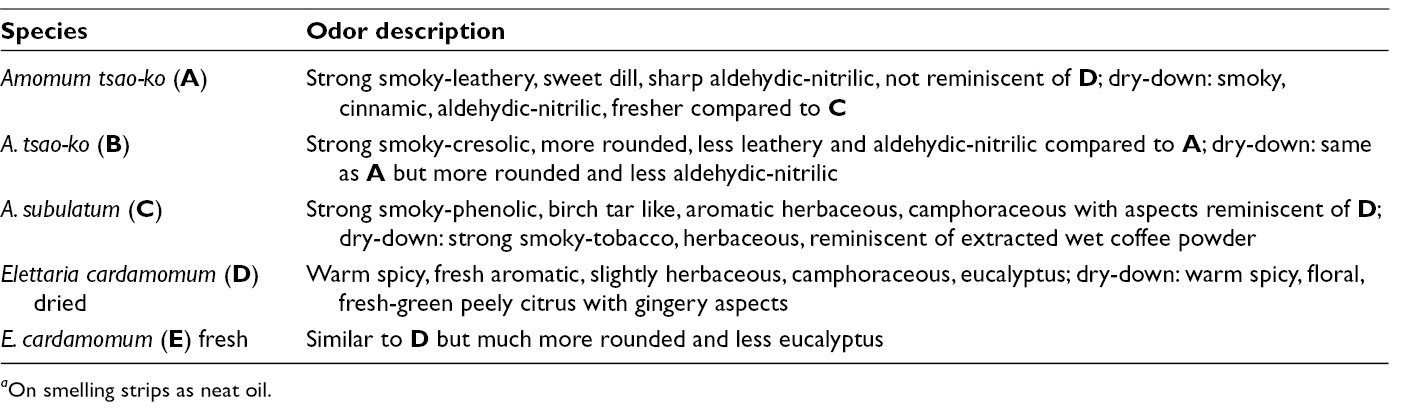
A detailed odor evaluation by our perfumers of the neat oils
Odor Description of 5 Cardamom Oils. a
aOn smelling strips as neat oil.
The oils from the 3 cardamom species gave a very characteristic odor profile. Although the A. tsao-ko oils (
Phenolic Compounds of 3 Amomum Oils. a

RI: retention index relative to C7-C30 n-alkanes on DB-Wax column; t: trace (≤0.01%); -: not detected;
aMeasured on DB-Wax column.
Chemical Composition (Mean Area %) of Major Constituents (>0.2%) of 6 Elettaria cardamomum Oils. a
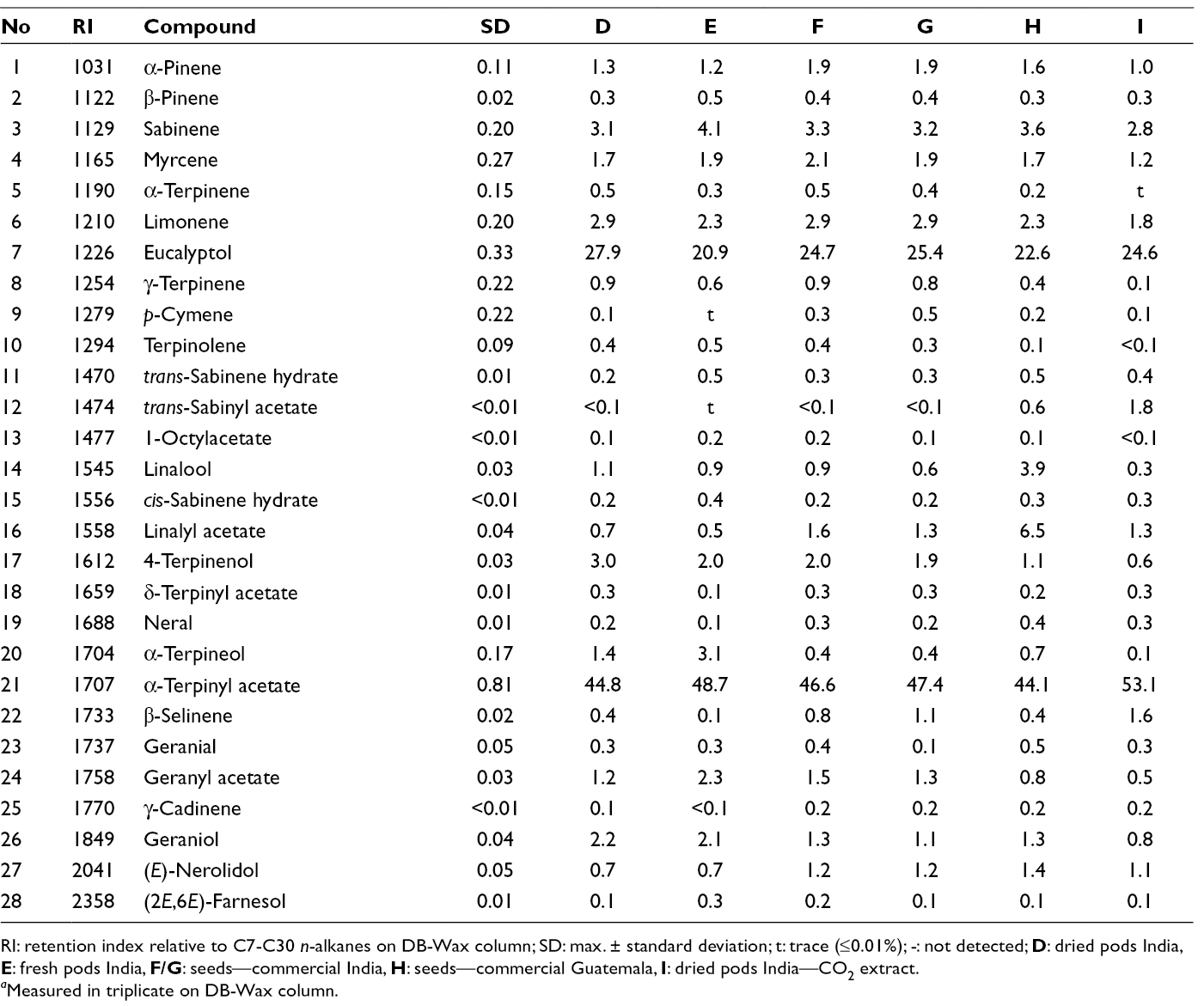
RI: retention index relative to C7-C30 n-alkanes on DB-Wax column; SD: max. ± standard deviation; t: trace (≤0.01%); -: not detected;
aMeasured in triplicate on DB-Wax column.
Such compounds can be either natural products or linked to smoky wood fires. 59 Zerihun et al describe that different wood fires gave very characteristic phenolic patterns. 59 Drying or curing in wood-fired houses is at least described for A. subulatum 17 and also for E. cardamomum. 10,60 As the same compounds were detected in both Amomum species from India and China the likelihood that all 3 samples have been dried using smoke from the same wood is minimal and therefore these compounds should be most likely considered part of the natural minor compounds spectrum in these 2 species. However, further investigation is needed to prove this theory. It is worth mentioning that most phenolic compounds described here were found in various smoke flavors before 61 but also in birch tar oil, 62 which might be the reason for the odor reminiscence. In addition phenolic compounds are linked to antioxidant properties, which were described before in literature for both Amomum species subulatum 63 and tsao-ko. 32,64
Nature sometimes harbors odor secrets even in well-known products, and smelling fresh green E. cardamomum pods during our Scent Expedition to Kerala in India was one of these moments for our perfumers. Fresh green cardamom pods are normally harvested 3 to 5 months after flowering and converted by drying into the final spice product.
11
The odor of the oil from fresh green pods
The 28 compounds listed in Table 5 represent between 94.6% (
The oil from fresh green cardamom pods
The CO2 extract
From this small study of green cardamom it can be clearly seen that many factors contribute to variations in natural products, however, to a different extent.
In summary, despite the fact that most essential oils are well investigated they still hold many secrets worthy of proper analysis and discovery. Many places in the world still harbor real treasures 70 and some Asian spices are definitively belonging in this category. 1,71 These spices, for example, both Amomum species, have not even reached the global flavor palette, 3 not to mention the fragrance industry, despite the fact that they are used as culinary ingredients in large quantities in their respective countries of origin. 1
In addition composition variations in natural products like those shown here for E. cardamomum and A. tsao-ko need to be seen more as fact than as burden. This is a neglected topic in a world targeting not only standardized synthetic aroma molecules but also standardized natural products like essential oils. If the trend for more naturalness continues as anticipated and consumers aim for real authentic natural products, education of customers and consumers is required to make them aware that such variations are a given in any natural product. 72 We should not forget that the chance for long-term survival of plants and other living organisms depends on such variations and is a prerequisite for the adaptability of a species to the environment and consecutively allows natural selection which can be the origin of new varieties and species. 73
Experimental
General
GC/MS: Agilent 6890N GC (DB-Wax: 60 m × 0.25 mm × 0.25 μm film thickness, carrier gas He, 60°C-240°C at 3°C/min) connected to Agilent 5975B quadrupole mass spectrometer, 70 eV (EI mode), mass range 25 to 550 amu. GC: Hewlett Packard 6890 with FID and sniffing port (for column and temperature program, see GC/MS). NMR spectra (δ/ppm, J/Hz) were recorded on a Bruker Avance III with 600 MHz (1H-NMR) or 151 MHz (13C-NMR) in C6D6 and using TMS as internal standard. All solvents and reagents are commercial products (Merck) and were used as received.
Plant Material
Dried pods of A. tsao-ko were purchased at a spice market in Shanghai, China, and a traditional Chinese medicine retail store in Singapore. Both samples originated from Yunnan province in China according to the suppliers. Dried A. subulatum as well as dried and fresh E. cardamomum pods were obtained from Synthite Industries Ltd, Kolenchery, Kerala, India. Black Nepal cardamom A. subulatum had its origin in the North Eastern Indian state of Sikkim, while the green cardamom was harvested in Kerala state in Southern India. Fresh green pods were collected in the Idukki district of Kerala at an age of 3 months after flowering. All 3 commercial cardamom essential oils from India and Guatemala were sourced in India and France from different suppliers on the open market. The CO2 extract was received from Ultra International Ltd, Ghaziabad, Uttar Pradesh, India.
Oil Isolation
Whole fresh and dried cardamom pods (100 g) were crushed by hand in a mortar and further ground in a commercial fruit blender followed by hydrodistillation in a Clevenger-type circulatory distillation apparatus
74
for 4 hours to yield the respective essential oils. Amomum tsao-ko
Spectral Data for 1H-Indene-Carbaldehydes 1-6
(a) 2,3-Dihydro-1H-indene-4-carbaldehyde (=4-indanecarbaldehyde) (
(b) 2,3-Dihydro-1H-indene-5-carbaldehyde (=5-indanecarbaldehyde) (
(c) trans-2,3,3A,7A-Tetrahydro-1H-indene-4-carbaldehyde (
(d) cis-2,3,3A,7A-Tetrahydro-1H-indene-4-carbaldehyde (
(e) cis- and trans-2,3,3A,7A-tetrahydro-1H-indene-4-carbaldehyde (
Footnotes
Acknowledgments
We are especially grateful to Neethu Jose, Synthite Industries Ltd, Kolenchery, India, for providing fresh and dried green and black cardamom pods. We owe a special thanks to Bhuvana Nageshwaran, for the CO2 extract and information on the drying process. Su Kay Tan expresses her sincere gratitude to Symrise Asia Pacific Pte. Ltd, Singapore, for the opportunity to carry out part of this work during her SENSE internship in 2015 in Scent & Care Innovation—Analytical. The authors are indebted to Rüdiger Wittlake, Symrise AG, Holzminden, Germany, for NMR measurements and many helpful discussions. We thank our perfumers at Symrise Asia Pacific Pte. Ltd, Singapore, with a special mention to Florin Lutz and M. Subramanian, for odor evaluation. Dedicated to Dr. Brian M. Lawrence, an esteemed colleague and expert in essential oils, on the occasion of his 80th birthday in June 2019.
Declaration of Conflicting Interests
The author(s) declared no potential conflicts of interest with respect to the research, authorship, and/or publication of this article.
Author's Note
Citations should be considered as examples and may not be limited to these publications only. In addition the wrong assignment of one ingredient should not be linked to an overall quality judgment of these papers as the 1H-indene derivativesare not common in nature. Citations for the wrong assignment of 1H-indene derivatives should be considered as examples and may not be limited to these publications only. In addition the wrong assignment of one ingredient should not be linked to an overall quality judgment of the papers as these compounds are not common in nature.
Funding
The author(s) declared no financial support for the research, authorship, and/or publication of this article.