







Abstract
In this paper, the relieving effects of Cordyceps militaris and Herba epimedii complex on chronic renal failure (CRF) induced by adenine were investigated. The CRF model with severe damage to kidney tissue and abnormality of physiological and biochemical indices was established by administrating Sprague Dawley male rats daily with adenine (250 mg/kg). After treatments with the complex, the levels of serum creatinine (P < .001), urea nitrogen (P < .001), uric acid (P < .001), and P3+ (P < .01) were significantly decreased, while the levels of estradiol (E2), luteinizing hormone (P < .001), nitrite oxide (P < .001), and Ca2+ (P < .001) were significantly increased. The damage to kidney tissue of CRF rats was obviously ameliorated. All the treatment groups showed therapeutic effects of CRF induced by adenine. The Cordyceps militaris and Herba epimedii complex showed the best effect at the dose of 10.4 + 10.4 mg/kg/d.
Introduction
Cordyceps militaris (L.) Link, a medicinal fungus of traditional Chinese medicine (TCM) belonging to the phylum Ascomycetes, is widely used as folk nourishing food in East Asia and taken as a healthy resource for relevant bioactive ingredients.1,2 C. militaris is also distributed in the United States, Germany, France, the United Kingdom, and Canada. Another well-known fungal TCM from the same family as C. militaris is C. sinensis, which has been used in China for more than 700 years 2 and has similar nutritional ingredients and medicinal functions. In nature, C. sinensis is scarce and precious, and thus C. militaris has been considered an ideal substitute. 3
The chemical constituents of C. militaris include nucleosides, polysaccharide, protein, cordycepin (deoxyadenosine), and cordyceptic acid (mannitol), 4 but the amount of each is different in different parts. For nucleosides in C. militaris for example, according to the high performance liquid chromatography (HPLC) results of Zhang et al, 5 the sequence of nucleoside content in the fruiting body was as follows: cordycepin (1.112 mg/g) > adenosine (0.520 mg/g) > uridine (0.414 mg/g) > guanosine (0.233 mg/g) > inosine (0.147 mg/g); the order in the pupa was as follows: cordycepin (0.358 mg/g) > guanosine (0.249 mg/g) > inosine (0.203 mg/g) > uridine (0.171 mg/g) > adenosine (0.148 mg/g); and in the mycorrhiza: cordycepin (0.624 mg/g) > uridine (0.554 mg/g) > adenosine (0.506 mg/g) guanosine (0.394 mg/g) > inosine (0.232 mg/g).
In China, C. militaris is often used to treat impotence, seminal emission, and infertility, as well as for invigorating kidneys and lungs. 6 Pharmacological research showed that it had immune-modulatory, anti-tumor, anti-virus, anti-oxidation, anti-aging, anti-fatigue, anti-bacterial, and procoagulant effects.7–10 In addition, it can also improve the reproductive function and repair the reproductive dysfunction of mice induced by cyclophosphamide. 11
Epimedium brevicor Maxim (Herba epimedii) is also a famous TCM and is mainly distributed in China, North Africa, northern Italy, North Korea, Japan, and Southeast Asia. Its main chemical constituents are flavonoids. Pharmacological research has shown that E. brevicor has osteoclast inhibitory activity, promotes the growth of osteoblasts, has anti-depression and enhancement of immune regulation activities, protects the cardiovascular system, and with anti-bacterial, anti-inflammation, anti-virus, anti-oxidation, anti-aging, anti-tumor, improving memory, and kidney functions.12–15
Chronic renal failure (CRF) is a common clinical syndrome, which often occurs in various chronic kidney diseases (CKDs). The resultant diminishing renal function can develop into uremia. Along with CRF, the renal parenchyma is severely damaged, which would result in a series of clinical manifestations, including nitrogen retention, water-electrolyte, and acid–base imbalance, and endocrine disorders involving multiple systems. 16 To induce toxin accumulation and metabolism disorder, resembling that of CRF in humans, adenine (6-aminopurine, a medicine for the treatment of leukopenia) is often used for creating an experimental model of CRF through long-term feeding with it at the high concentration.17,18 The purpose of this study was to investigate the effects of the combined complex of C. militaris and H. brevicor on renal function and renal histopathology for adenine-induced renal lesions in vivo.
Results
Observation of Rats During Experimental Period
The rats in the NC control group were fed with water at the same time as food intake and body weight increased. The rats in this group were full of vigor and vitality with neat and shiny fur. The rats in the CRF group were inactive, with chills in behavior, and with fluffy, dry, dull fur; their food intake was reduced, accompanied by either a slow increase or even a loss of body weight. However, water intake and urine volume were increased considerably. Compared with those of the CRF group, the appearance of the rats from positive control (PC), C. militaris (CM), low-dose group of C. militaris and H. brevicor (CM + LE), and a high-dose group of C. militaris and H. brevicor (CM + HE) groups was significantly improved.
Observation of Kidney Pathology
The kidneys of the NC group were smooth, brown, without swelling, and clear corticomedullary differentiation, while the kidneys of the CRF group showed some symptoms of swelling, a gray appearance, and dense distribution of white granules on the surface. In addition, it was difficult to separate the renal capsule from the renal parenchyma, and the corticomedullary demarcations were unclear. After corresponding treatments, the kidneys of the PC and C. militaris involved groups returned back to a brown and smooth surface, with much fewer white granules.
Results of Physiology and Biochemistry
The kidney weight and the contents of P3+, Ca2+, nitrite oxide (NO), luteinizing hormone (LH), estradiol (E2), serum creatinine (SCr), urea nitrogen (BUN), and uric acid (UA) of each group were examined and the results were listed in Tables 1 and 2.
The Effects of C. militaris on the Physiology and Biochemistry (Mean ± SD, n = 10).

Note: Compared with blank, ***P < .001, **P < .01, *P < .05; compared with CRF model, ###P < .001, ##P < .01.
Abbreviations: NO, nitrite oxide; LH, luteinizing hormone; E2, estradiol; CRF, chronic renal failure model group; PC, positive control group; CM, C. militaris group; CM + LE, low-dose group of C. militaris and H. brevicor; CM + HE high-dose group of C. militaris and H. brevicor.
Effects on the Content of Cr, BUN, and UA (Mean ± SD, n = 10).
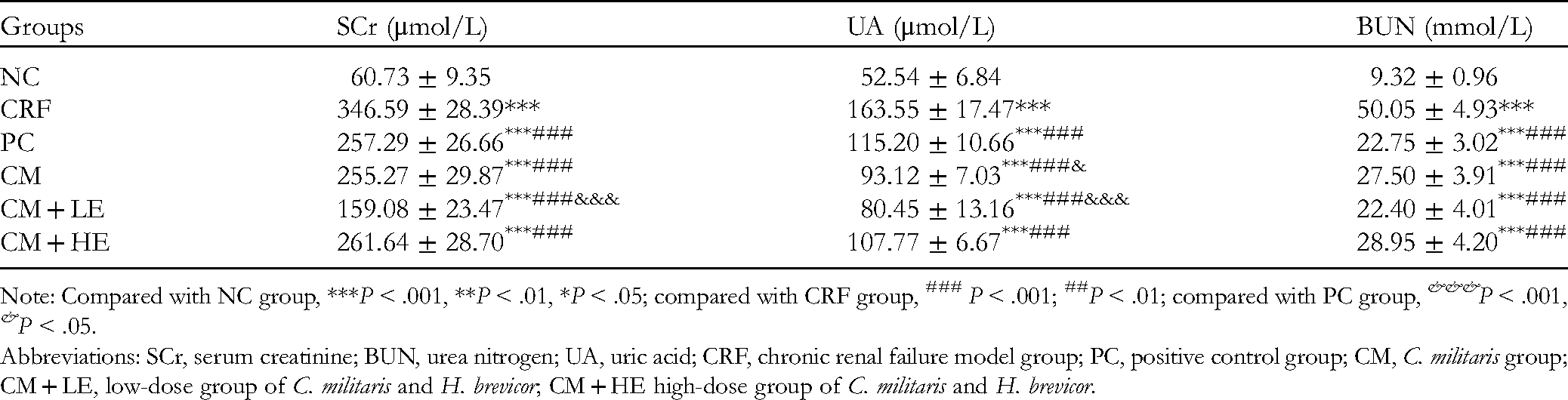
Note: Compared with NC group, ***P < .001, **P < .01, *P < .05; compared with CRF group, ### P < .001; ##P < .01; compared with PC group, &&&P < .001, &P < .05.
Abbreviations: SCr, serum creatinine; BUN, urea nitrogen; UA, uric acid; CRF, chronic renal failure model group; PC, positive control group; CM, C. militaris group; CM + LE, low-dose group of C. militaris and H. brevicor; CM + HE high-dose group of C. militaris and H. brevicor.
In Table 1, the kidney weight of rats in the CRF group was significantly higher than that of the NC group, and the kidney weights of the rats in the PC, CM, CM + LE, and CM + HE groups were significantly lower (P < .001) than those of the CRF group.
The contents of Ca2+, NO, LH, and E2 in the CRF group were all significantly lower (P < .001) than those of the NC group, and the contents of P3+ were significantly higher (P < .001), indicating the success of the CRF model establishment. After treatment with Niaoduqing granules, C. militaris, or the combination of C. militaris and H. brevicor, the indicators, including Ca2+, NO, and LH, almost recovered to the normal levels, while E2 was not affected by these compounds.
The contents of Cr, BUN, and UA in the CRF group were significantly higher than those of the NC group, indicating that treatment with only isotonic saline could not relieve the increased levels in animals with CRF. In contrast, the C. militaris and Niaoduqing granules treatments showed improvements, in comparison to the results of the PC and CM groups. Meanwhile, the effect of the addition of H. brevicor to C. militaris was not clear. The improvement effect of the addition of H. brevicor at a low dose was better than that of C. militaris alone, while that of the addition at a high dose was worse.
Pathological Examination of Kidney of CRF Rats
The kidneys of rats from different groups, stained with hematoxylin-eosin (H-E), were examined by light microscopy (Figure 1). Figure 1A reveals that the shapes of renal parenchyma were regular and the renal tubular epithelial cells were intact and arranged orderly in the NC group. The glomus, composed of the glomerulus, and other structures of renal tissue were normal, without visible damage. In the CRF group (Figure 1B), the rat kidney affected by adenine showed severe damage, including large gaps in the renal parenchyma, the occurrence of brown crystalline adenine in kidney tissues, accumulation of inflammatory cells in renal tubular and interstitial regions, degeneration or even disappearance of renal tubules, extension, and fibrosis of renal interstitial tissue, enlargement of the glomerular capsule, thickened glomerular mesangial tissue, and hyperplasia of mesangial cells. Compared with the CRP group, the severity of toxicity in the other groups (Figure 1C-F) was relieved with alleviated kidney damage and attenuated renal injury. The most obvious effect was seen in the rats of the CM + LE group. In this group (Figure 1E), the renal tubule was more orderly, the number of inflammatory cells was reduced and the glomerular capsule was thinner, compared with the CRF group. The effect of the treatment with the C. militaris relevant groups almost reached the level of the available medicine (Niaoduqing granules) for CRF. Niaoduqing granule is a publicly known medicine in China that can be used to treat CRF efficiently in the clinic.

Morphological changes in kidneys of rats with CRF: (A) PC group, (B) CRF group, (C) PC group, (D) CM group, (E) CM + LE group, and (F) CM + HE group.
Discussion
Cordyceps sinensis and C. militaris have basically the same chemical composition, 19 including many ingredients with effective pharmacological effects.20,21 The contents of some active ingredients of C. militaris are even much higher than those in C. sinensis. 22 H. brevicor is a traditional tonic medicine, which can make kidneys younger, bones stronger, and relieve rheumatism.
It is reported that high concentrations of adenine damage kidney tissue and cause the development of CRF. 23 Based on the reported findings in the relevant literature, 24 the rat model of CRF was established successfully through feeding adenine at 250 mg/kg for 2 weeks. Although the full indicators were collected 2 weeks after the feeding with adenine, the rats in the CRF group still lost weight and hair, and became chilled, and depressed. Their kidneys became swollen and white. In addition, the levels of BUN, SCr, and UA were increased, the NO, LH, and E2 levels were decreased and the metabolism of P3+ and Ca2+ were in disorder, which indicated that CRF modeling was successfully established.
Glomerular filtration is a key function of the kidney. CRF patients usually have damaged renal parenchymal and low glomerular filtration to remove UA, SCr, and BUN from the body. So, the 3 indicators in serum can reflect renal function. The decrease in these indicators after treatment with C. militaris indicated that renal function had been improved.25,26 In this experiment, the results showed that the levels of serum SCr, BUN, and UA, as well as the pathological damage to the kidney, were significantly decreased (P < .001) after gavaging with C. militaris alone, C. militaris with a low dose of H. brevicor, and C. militaris with a high dose of H. brevicor, and the effect was stronger than that in the rats fed with Niaoduqing granules. The C. militaris results were consistent with Hou's findings and might be related to Cordyceps polysaccharide, which has been reported to have a therapeutic and preventive effect in the CRF model induced by either adenine or 5/6 nephrectomy. 27 Moreover, the combination effect of C. militaris and H. brevicor at low doses was more effective than the other treatments.
NO has the role of protecting the kidney, proliferation inhibition of mesangial cells, and production decrease of the mesangial matrix, during the process of CRF. After the establishment of CRF, the decreased glomerular filtration rate can enhance the accumulation of P3+ and excretion of Ca2+. Meanwhile, CRF can also reduce the sources of estrogen, and inhibit the synthesis of E2 and LH, leading to an endocrine disorder. 28
Our results have shown that the decreased contents of NO, Ca2+, and LH, and the increase of P3+ induced by adenine were significantly relieved by treatment with C. militaris either alone or with H. brevicor. That means that using C. militaris either alone or in combination with H. brevicor could reduce damage to renal tubular epithelial cells, restore renal tubular function, enhance the synthesis of functional protein, correct the negative nitrogen balance,28,29 and hence balance the internal environment, improve renal function, and either delay or cease the progress of CRF.
Nowadays, edible mushrooms are foraged and/or cultivated worldwide and are considered to be an important component of healthy human diets,29–31 and a variety of edible fungi have been shown to have good pharmacological effects. For example, the polysaccharide of C. militaris and Flammulina velutipes have immunomodulatory effects. 32 In this study, from the pathological point of view of the kidney, C. militaris extract and its combination with H. brevicor can either delay or reverse the progress of glomerular sclerosis and reduce the degree of pathological damage to renal tissue, which was also evidenced by the positive action on the progression of CRF. C. militaris and H. brevicor are expected to be developed as dietary supplements to treat CRF.
Conclusions
The CRF model was successfully established by feeding rats with 250 mg/(kg.d) of adenine for 2 weeks, which simulated the development and characteristics of human CRF. The C. militaris extract and its combination with H. brevicor reduced the swelling of the kidney and improved the tissue of the kidney, reversed the increase in BUN, UA, and SCr, and decreased NO and LH, thus remarkably improving the effects of renal failure, and balancing the ions content (Ca2+ and P3+) significantly. Based on this, both C. militaris alone and in combination with H. brevicor are good at delaying CRF. Treatment with the combination at a dose of 10.4 + 10.4 mg/kg/d exerted the best action on the procession of CRF in the early stage.
Materials and Methods
Plant Extracts
C. militaris samples (1.9 kg) were immersed in boiling water for extraction twice for one and a half hours. The 2 extracts were combined and ethanol was added to a final concentration of 70%. After standing for a short period, the supernatant was collected. The residue was then centrifuged for 15 min at 12 000 r/min and the supernatant was added to the previous one. The combined solution was concentrated, freeze-dried, and stored at −4 °C (290 g).
Animals
Specific pathogen-free (SPF) Sprague-Dawley (SD) male rats (∼200 ± 30 g) were purchased from the Experimental Animal Center of Henan Province with the License key of SCXK (Yu) 2015-0004 (Zhengzhou, Henan, China). All animal experiments met the welfare and ethical requirements for medical experimental animals and were approved by the ethics committee of medicine and scientific research of Henan University (HUSOM-2019-087).
These standard animals were used and allowed to have free access to a standard supply of food and water during the experiment period. The rooms were kept at 25 ± 2 °C under 12 h light/12 h dark cycle.
Instruments and Reagents
The Multiskan GO multiscan spectrometer was from Thermo Electron Corporation (Waltham, MA, USA), AL-104 electronic balance from Mettler Toledo Instruments Co., Ltd (Shanghai, China), and the UV-2000 spectrophotometer from Younike Shanghai Instrument Co., Ltd (Shanghai, China).
Sodium Chloride Injection (batch number: 1603311336) was obtained from Cisen Pharmaceutical Co., Ltd (Jinan, Shandong, China), adenine (batch number: A0365257) from Beijing Zhuoanbaihe Technology Co., Ltd, (Beijing, China), Niaoduqing granules (batch number: 20151232) from Consun Pharmaceutical Co., Ltd (Tongliao, Inner Mongolia, China), and NO testing kit (batch number: 201608308), LH (batch number: 20160922), E2 (batch number: 20160922), UA testing kit (batch number: 20160920), Ca Kit (batch number: 20160826), creatinine (SCr) kit (batch number: 20160913), urea nitrogen (BUN) kit (batch number: 20160918) and phosphate (Pi) assay kit (batch number: 20160920) from Nanjing Jiancheng Bioengineering Institute (Nanjing, Jiangsu, China).
Establishment of Rat Model of CRF Caused by Adenine
Adenine (1 g) was dissolved in 40 mL of isotonic saline to produce a 2.5% solution. All SD rats were freely fed with standard food and water for 1 week. They were grouped according to their body weights and divided randomly into 2 groups: the normal control group (n = 15) (NC) and the adenine-gavaged model group (n = 55). The 2 groups were kept in different cages. The rats of the blank control group were administered with 10 mL of normal saline, while the rats of the adenine-gavaged group were gavaged with adenine suspension at a dose of 250 mg/kg, once a day for 2 weeks. At the end of this experimental stage, 5 rats were selected randomly from each of the normal control and adenine-gavaged group, kept in special cages, and anesthetized with 10% chloral hydrate after the fasting, except water for 12 h. Blood samples were taken from the abdominal aorta and then centrifuged at 3000 r/min for 15 min to obtain serum samples, which were used to test the contents of SCr and BUN.
Treatment of CRF Animals
The rats from the adenine-gavaged group were randomly divided into 5 groups: CRF model group (CRF), positive control group (PC), C. militaris group (CM), low-dose group of C. militaris, and H. brevicor (CM + LE), and a high-dose group of C. militaris and H. brevicor (CM + HE). There were 10 rats in each group. The rats of the NC group were still administered with 10 mL of normal saline daily and the CRF groups were treated the same as the NC group. The PC group was administered with Niaoduqing at a dose of 208.3 mg/kg/d, the CM group with C. militaris suspension at a dose of 10.4 mg/kg, and the CM + LE and CM + HE groups with a mixture of C. militaris and H. brevicor at doses of 10.4 + 10.4 mg/kg/d and 10.4 + 15.6 mg/kg/d, respectively.
The rats were fasted for 12 h after being treated for 2 weeks and then anesthetized with 10% chloral hydrate. Blood samples were collected from the abdominal aorta, and centrifuged at 3000 r/min, at 4 °C for 15 min, to obtain plasma, which was used to determine the contents of SCr, BUN, E2, LH, NO, Ca2+, and P3+. Meanwhile, the kidneys were taken out immediately and weighed. Then the kidney tissues were fixed in 4% paraformaldehyde, embedded in paraffin, sliced, and stained with H-E. The histopathological changes were examined under optical microscopy.
Statistical Analysis
The results are expressed as mean ± standard deviation (SD) with SPSS19.0. One-way ANOVA was utilized to conduct numerical analyses and comparisons between the groups. The data with P < .05 would be regarded as statistically significant.
Footnotes
Acknowledgments
This work was supported by Major Public Welfare Projects in Henan Province (201300110200), the Science and Technology Development Program of Henan Province (212102310354, 212102110019), and Key Scientific Research Projects of Higher Education Institutions in Henan Province (21B360001).
Declaration of Conflicting Interests
The authors declared no potential conflicts of interest with respect to the research, authorship, and/or publication of this article.
Funding
The authors received no financial support for the research, authorship, and/or publication of this article.
Ethical Approval
The animal experiments in this research were approved by the Ethics Committee of the College of Medical, Henan University, China with the license number HUSOM-2019-087.
Statements of Human and Animal Rights
All of the experimental procedures involving animals were conducted in accordance with the Experimental Animal Care Regulations of Henan University, China, and approved by the Ethics Committee of the College of Medical, Henan University, China. Humans were not involved in this study.
Statements of Informed Consent
Not applicable.
Trial Registration
Not applicable, because this article does not contain any clinical trials.