







Abstract
Introduction
In the aim to investigate the possible influence the variation of the food composition on ruminant performances, several approaches was based on medicinal plants for their beneficial effects on digestibility. Our study was oriented to determine the phytochemical screening, the antioxidant activity, and the in vitro digestibility of Crataegus azarolus leaves (CALAE) and berries (CABAE) collected from the Ain Draham region, which is located in the northwest of Tunisia.
Methods
Colorimetric analyses were used for the quantification of phenolic compounds, and the antioxidant activity of azerole extracts was evaluated using DPPH-free radical scavenging activity. The in vitro ruminal fermentation was determined using the gas production method.
Results
Leaves contained the highest levels of mineral matter, neutral detergent fibre (NDF), and nitrogen matter (TNM) when compared to those of berries. Furthermore, the DPPH assay showed that Crataegus azarolus aqueous extracts were characterized by a high antioxidant capacity, which is proportional to total phenolic concentrations. The in vitro digestibility evaluation demonstrates a significant variation in each ruminal parameter, and the highest levels of gas production, metabolizable energy (ME), and volatile fatty acids (VFA) were observed in leaves.
Conclusion
Data showed that azerole berries and leaves contained an important level of total fiber, nutrients, and mineral matter. The phytochemical analyses demonstrated a strong correlation between the richness of phenolic compounds and their antioxidant capacity. Indeed, yellow azerole berries and leaves can be recommended as an additive in goat feed rations to improve the animals’ quality.
Introduction
The field of animal nutrition has been considered as a subject of several studies that aim to improve the quality of the ration in order to increase the absorption of nutrients and optimize the productivity and quality of animal products. Indeed, the health and performance of animals have historically been managed by a variety of conventional chemical products, including antibiotics, antiparasitic and anti-inflammatory medications, and chemical food supplements. However, due to their detrimental effects and side effects, a number of these products have been outlawed in several countries. 1
In this context, the use of herbal products, rich in active substances, has shown several beneficial effects on ruminants such as improving the efficiency of nutrient use or boost milk production.2,3
Crataegus azarolus is a species belonging to the Rosaceae family that generally grows in cold and temperate climates 4 and has been used in traditional medicine since antiquity. 5
Generally, leaves, fruits, and flowers of this plant are used to treat several pathologies, such as cardio-vascular diseases including heart failure, atherosclerosis, hypertension, and hyperlipidemia. In addition, azerole extracts are characterized by antispasmodic, diuretic, and anti-diarrheal activities. 5
Phytochemical screening of the species testifies to its richness in antioxidants, especially polyphenols and flavonoids. 6
In Tunisia, Crataegus azarolus is considered as the main species of the genus; it grows in the Northwest region and more abundantly in the Jendouba and Ain Drahem regions. 7
Interestingly, leaves of several trees and shrubs have important nutritional values and can improve the poor forage quality of diets, especially during dry periods. 8 Precisely, they represent an important gazing resource in arid and semi-arid regions of the world. 8
As is known, goats have the capacity to valorize the lowest-productive forage areas; they are better suited to browsing in shrubs, trees, and scrub. They are characterized by their ability to digest woody species because their rumen is more buffered and contains more protozoa and bacteria. 9
In this context, the purpose of this research is to valorize Crataegus azarolus berries and leaves through a phytochemical study and an evaluation of their in vitro ruminal fermentation properties using the method of gas production on goats.
Results
Physiochemical Analysis
Table 1 presents the dry matter and phytochemical contents of Crataegus azarolus leaf and fruit powders. Fruit dry matter was more than twice that of the leaf, while the contents of the organic matter of both substrates were comparable. However, the contents of mineral matter, total nitrogen matter, magnesium, and calcium of the leaf powder were almost twice those of the fruit. Further, leaf powder had iron content that was three times that of the fruit.
Physicochemical parameters (%DM) of Crataegus azarolus fruits and leaves.

Data are represented as an SD means (n = 3). Means in the same column with no common index differ significantly (p < 0.05); DM, Dry matter; MM, mineral matter; OM, organic matter; TNM, total nitrogen.
Parietal Constituents and Lipid Contents in Leaves and Fruits
Table 2 presents variation in contents of parietal constituents of fruit and leaf substrates. Indeed, the leaf contained the highest contents of neutral detergent fibre, acid detergent fibre, lignin detergent acid, lignin, hemicellulose, true crude cellulose, and lipid.
Variation of Parietal Constituents and Lipid Contents (%DM) in Crataegus azarolus Fruits and Leaves.

Data are represented as mean ± SD (n = 3). ADF, Acid detergent fiber; NDF, Neutral detergent fiber; TRC, True crude cellulose; ADL, lignin detergent acid; HC, hemicellulose.
Phenolic Compounds Determination
According to Table 3, the phytochemical screening revealed the richness of Crataegus azarolus extracts in phenolic compounds. Indeed, they contain a high level of flavonoids, total tannins, and condensed tannins, with significant variations. However, CALAE had the highest concentrations as compared to CABAE.
Phytochemical Screening of Cartaegus azarolus Fruits and Leaves Aqueous Extracts.

Data are represented as mean ± SD (n = 3). Means in the same row without a common upper index differ significantly (p < 0.05). CABAE, Crataegus azarolus berries aqueous extract; CALAE, Crataegus azarolus leaves aqueous extract.
DPPH• Scavenging Activity
The antioxidant capacity test showed that CABAE and CALAE exhibited important DPPH• free radical scavenging activity (RSA), expressed by their ability to neutralize the DPPH• radical. Interestingly, the inhibition percentages of Crataegus azarolus aqueous extracts increased in a dose-dependent manner (Table 4). The inhibitory concentration 50 (IC50) values revealed that CALAE has the highest antioxidant potential (IC50 = 190.65 ± 4.16 µg/mL), but still less than BHT, used as a reference antioxidant molecule (IC50 = 23.70 ± 1.12 µg/mL).
Dose Response of Antioxidant Capacity and Determination of the Inhibitory Concentration 50 (IC50) of Crataegus azarolus berries (fruits) Aqueous Extract (CABAE), Crataegus azarolus Leaves Aqueous aqueous Extract (CALAE), and Butylated Hydroxytoluene (BHT).
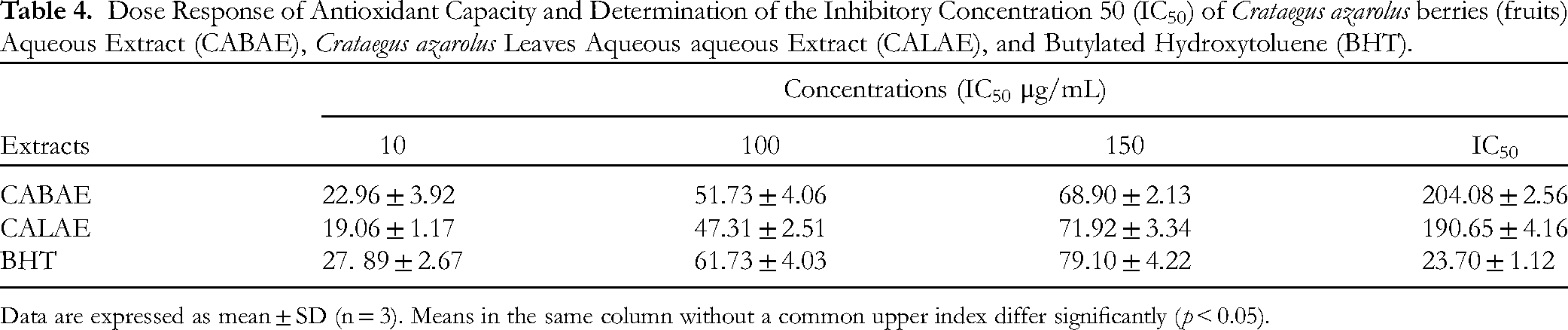
Data are expressed as mean ± SD (n = 3). Means in the same column without a common upper index differ significantly (p < 0.05).
ABTS•+ Scavenging Activity
The antioxidant capacity assessed using the ABTS method reveals that C. azarolus extracts exhibited an important scavenging activity expressed by their low inhibitory concentrations 50. Indeed, the IC50 of CABAE (126.24 ± 4.73 µg/mL) and CALDE (103.97 ± 3.92 µg/mL) were still higher than that of the BHT (17.49 ± 1.08 /mL), used as reference (Table 5).
Inhibitory Concentration 50 (IC50) and Concentration Response Effect of CABAE, CALAE, and Butylated Hydroxytoluene (BHT) Against (ABTS•+).

Data are expressed as mean ± SD (n = 3). Means in the same column without a common upper index differ significantly (p < 0.05).
In Vitro Ruminal Fermentation and Digestibility Parameters Assessment
In the present study, we further looked at the effect of Crataegus azarolus substrates on ruminal fermentation in goats according to the gas production method.
The in vitro digestibility was evaluated by determining the volume, speed, and kinetics of gas production following an exponential model. Our results showed a significant variation in kinetics and gas volume production between the two plant parts.
In fact, for both substrates, the gas production curve represents 3 phases (Figure 1). The first one, characterized by a minimum production speed (lag phase “a”), is explained by the microbiota's adaptation to the substrate. The second represents an increase in gas production level (substrate degradation phase) or exponential gas production (phase “b”) where gas production attained its maximum volume. Finally, the third one was a stationary phase where the gas production speed was constant, which constitutes the fermentation levels of phase “b” (the end of the fermentable fraction “c”).
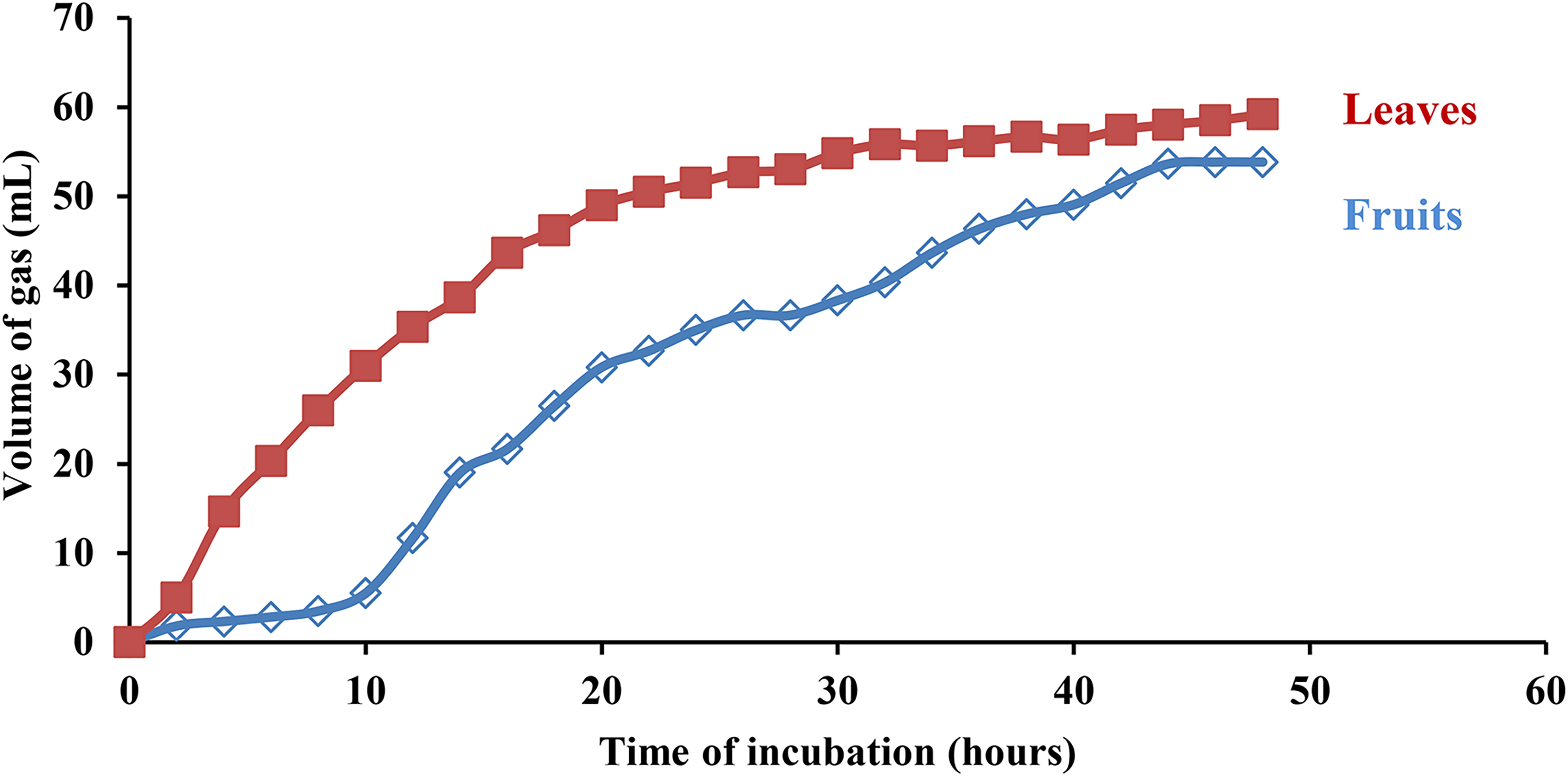
In vitro kinetics gas production (300 mg DM) of Crataegus azarolus fruits and leaves in goats.
Interestingly, gas production depends on the carbohydrate nature, the characteristics, and the degradation degree of the substrate. On the other hand, fruits were characterised by the highest variable, (“b”). Whereas, the leaves showed the highest level of fermentable fraction degradation (“c”). However, the volume of gas at 24 h (Gp) and the total volume of gas emitted (y) represents a variation depending on the substrate used. The highest volumes were observed on the leaves (51.50 ± 0.50 and 59.16 ± 0.28, respectively) (Table 6).
Effect of Crataegus azarolus Fruits and Leaves on the in Vitro Digestibility Parameters in Goats.

Data are represented as mean ± SD (n = 3). a: Volume of gas produced from the easily fermentable soluble fraction (ml); b: Volume of gas produced from the insoluble potentially fermentable fraction (ml); c: The rate of gas production(ml/hour); Gp: The gas volume production after 24 h of incubation in ml from 300 mg dry sample and Y: Volume of total gas produced
Table 7 represents the ruminal fermentation parameters results, such as digestibility of organic matter (DOM), metabolizable energy (ME), and volatile fatty acids (VFA). Importantly, the leaves were characterized by the highest DOM (83.47% ± 4.53). Likewise, for the ME and the VFA (9.55 ± 0.07 Kcal/kg DM and 1.17 ± 0.01 mmol/syringe, respectively).
Effect of Crataegus azarolus Fruits and Leaves on the Digestibility of Organic Matter (DOM), Metabolizable Energy (ME), and Concentration of Volatile Fatty Acids (VFA) in Goats.
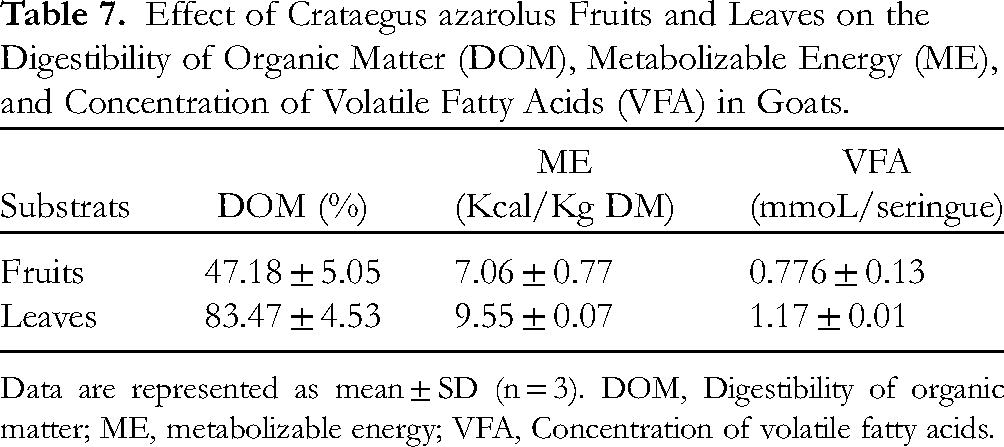
Data are represented as mean ± SD (n = 3). DOM, Digestibility of organic matter; ME, metabolizable energy; VFA, Concentration of volatile fatty acids.
Discussion
The aim of this study is to determine the chemical analysis of Crataegus azarolus leaves and berries collected from the Ain Draham region and their antioxidant capacity using the DPPH and ABTS assays. On the other hand, we evaluated their effects on in vitro ruminal fermentation in goats.
The physicochemical analyses revealed that leaves and berries contained considerable levels of mineral matter such as calcium, magnesium, iron, and nitrogen, with significant variations. In fact, our results corroborate the reports of Bouadra et al 10 and Sammari et al, 11 on Crataegus azarolus pulp, with a few discrepancies. In a comparative study, the leaves were characterized by the highest contents of mineral matter, which have already been described by San et al 12 and Nwofia et al 13 in several other plant species, such as Zizyphus jujuba Miller and Carica papaya.
The obtained results showed that the leaves were characterized by higher levels of total lipids and total nitrogen matter compared to fruits. In the same context, several studies showed that fruits were richer in non-structural carbohydrates and contained low levels of lipids and proteins. However, leaves were characterized by abundant amounts of protein.14,15
Generally, primary metabolite contents such as lipid and protein were controlled by several factors, including genetics, climate, and geography. These fluctuations can also be explained by the season, the cultivation techniques, and the fruit maturing stages.16–18
The parietal constituent's determination demonstrated that leaves were the richest in total fiber as compared to fruits, which was previously reported.13,19 Total fiber content in plants showed numerous seasonal, stationary, and genetic discrepancies. 20
The chemical analysis showed that CALAE and CABAE contained considerable concentrations of phenolic compounds, of which the leaves contained the highest level. Similarly, these findings have been described by Belkhir et al 6 and Mraihi et al. 21
The highest level of phenolic compounds observed in leaves can be explained by their exposure to several factors, such as UV rays, to ensure the protection of membranes, chlorophylls, and other sensitive organelles. 7
Several reports characterized the secondary metabolite profile of azerole fruit with a few disparities, 7 which are correlated with chemotypes and morphotype diversity. 22
The high-performance liquid chromatography coupled to electrospray ionization tandem mass spectrometry (LC-ESI-MS) analysis of the CABAE resulted in the identification of 5 phenolic compounds. which are 3 phenolic acids (quinic acid, gallic acid, and p-coumaric acid) and 2 flavonoids (quercetin and Kampherol). Additionally, quinic acid and p-coumaric acid were found to be the major compounds, while quercetin was found to be the major flavonoid. 11 The high-performance liquid chromatography (Shimadzu HPLC) analysis of Crataegus azarolus leaf aqueous extract led to the detection of the major compounds, which are hyperosides (quercetin-3-O-galactoside) and vitexin-2-O-rhamnoside. 23
Moreover, identification of phenolic compounds in several varieties of Crataegus azarolus berries obtained from Iran and Tunisia showed several differences in concentrations and in the number of the phenolic compounds identified. The Tunisian azerole berries contain epicatechin, neochlorogenic acid, chlorogenic acid, hyperosid, and isoquercitrin. However, the analysis of C. azarolus var. aronia and C. azarolus var. pontica berries led to the identification of vitexin, rutin, hyperoside, isoquercetin, and quercetin. In addition, the hyperoside represents the main component in both Iranian azerole berries, and the epicatechin has the highest concentration in the azerole obtained from Tunisia. Nevertheless, it contains in common hyperosid and isoquercetin.6,24 These discrepancies were correlated to the genetic and environmental factors. 25
Generally, the phenolic profile has also been shown to vary depending on the polarity of the extraction solvent, maturity, plant, and collection season. More importantly, the biosynthesis of polyphenols, flavonoids, and tannins has a qualitative and quantitative variation due to the variation in the physiology of the plant and the collection period. 26
The in vitro antioxidant capacities showed that azerole extracts relatively exhibited strong radical scavenging potential; CALAE was characterized by the highest antioxidant capacity, followed by CABAE. Thus, we confirmed a positive correlation between the contents of phenolic compounds and antioxidant power. Our results are in line with several previous studies.27,28
In this respect, the antioxidant capacity varies significantly depending on the active ingredient composition, species, and the analyzed part. 29 Thus, the relatively large anti-radical activity of the various extracts of the azerola tree can be explained in part by their richness in flavonoids, 30 known for their potent antioxidant activity. 31
Previously, other studies reported that Crataegus azarolus leaves were richer in polyphenols and flavonoids when compared with fruits. Furthermore, the main compounds identified, such as chlorogenic acid, quercetin-3-O-glucoside, epicatechin, rutin, delphinidin-3-O-glucoside, chlorogenic acid, vitexin, epicatechin, and procyanidin B2, are recognized for their potent antioxidant activities. 7 In addition, azerole extracts have described the presence of polysaccharides, vitamins, 22 and procyanidine oligomers, 32 which are also characterized by a high antioxidant capacity.
The effect of Crataegus azarolus fruits and leaves on in vitro ruminal fermentation in goats using the gas production technique has been investigated. Our results clearly showed that leaves and fruit digestibility levels are high, which can be attributed to the efficiency of feed use in goats. However, the volume of gas produced by leaves fermentation is higher than that obtained during fruit fermentation, thus being in agreement with the studies of Domingue et al, 33 which described the ability of goats to digest woody species.
On the other hand, the high digestibility of these substrates was correlated in part to their small particle size. In fact, ruminal feed degradation and total tract nutrient digestibility can both be accelerated by smaller pasture particles. 34 According to Thomas and Russell 35 and Stojanovic et al, 36 this effect is triggered by the increased surface area that is created by forage size reduction, which allows quicker and simpler microbial adhesion and increases cellulose degradation.
The obtained results showed that the phenolic contents of fruits and leaves enhance rumen digestibility parameters, which is in line with the reports Benchaar and Greathead. 37 In the same context, Giger-Reverdin et al 38 demonstrated that goats’ ability to graze on tannin-rich shrubs and to detoxify tannins, polyphenols, and other secondary metabolites is much greater than that of other ruminants. The highest level of digestibility identified in leaves can be explained by their richness in total fat and nitrogenous matter. In fact, the supplementation in protein and fat promotes ruminal fermentation, microbial growth, total VFA concentration, and the digestibility of nutrients.39,40 Similarly, it has been demonstrated that protein supplementation in a low-quality and poor ration can improve feed usage and productive performance in ruminants. 41
On the other hand, data indicated that leaf digestibility, which is the richest in parietal constituents, was higher than that of fruits. This can be explained by the goats’ rumens micobiota composition, characterized by type B protozoa (Epidinium and Eudiplodinium), specialized in fibre degradation. 42
Indeed, Kara et al 8 demonstrated that total in vitro gas production depends on plant species and the part used. These divergences can be attributed to the variations in NDF and ADF contents in the substrate. In general, in vitro gas production was controlled by several parameters, such as the diet composition and the effect of supplements at different doses. 43
The ruminal fermentation parameters (DOM, ME, and VFA) were predicted from the gas volume produced after 24 h of incubation. More importantly, the data analysis showed that the leaves had the highest levels of metabolizable energy, digestibility of organic matter, and volatile fatty acids. In this respect, Kara et al 8 demonstrated that Crataegus monogyna substrates also improved the in vitro digestibility.
These results may be linked in part to the composition of microflora and microbial growth at the rumen level in goats. 44 In fact, goats are characterized by their ability to digest the most woodiest plants. Thus, the digestibility of dry matter and parietal constituents in a highly lignified rationed goat is higher than that of other small ruminants. This allows the goats to maintain a maximum rate of ruminal fermentation. 45
VFA represents the main forms of energy available after digestion, representing 70% to 80% of the total energy absorbed by ruminants. 46 In addition, Crataegus azarolus leaves contain the highest levels of parietal constituents, which may explain the high levels of VFA produced as compared to that of the fruits. On the other hand, it has been proven that VFA production depends on several parameters, such as the volume and quantity of energy offered by the forage, absorption speed, and rumen microorganism activities. 47
Typically, goats are the most adaptive ruminants to various and difficult pastures. This is explained by several physiologic particularities of their digestive system, such as the large area of nutrient absorption in their intestinal epithelium, the ruminal plasticity, and the huge salivary glands, which also reinforce their capacities for digestibility. 48
Limitations and Future Perspectives
The present study demonstrated the beneficial effect of C. azarolus substrates on in vitro digestibility in goats. The in vitro digestibility technique is very well-liked due to its simplicity and affordability and does not require particular technology and limits the use of animals. Moreover, numerous protocols showed significant differences in the experimental techniques, such as the pH, duration of the various phases, amount of bile and digestive enzymes. These discrepancies represent a possible cause of the dissimilarities of the results. However, it is still necessary to determine the effects of these substrates on the production of enteric methane in ruminants, which is an important research interest. On the other hand, a comparative study between goats and sheep should be conducted to study inter-species variations in in vitro fermentation activity as well as the characteristics of different rumen fluids.
Conclusion
The current study underlines the chemical analysis of Crataegus azarolus substrates and their effect on the in vivo goat digestibility. The chemical analysis showed a variation in MM, NTM, fiber, total lipid, and phenolic contents, which depends on plant parts. Based on their corposants and their low cell wall lignification, both parts of azerole may be considered a natural product used as a food additive in goats to stimulate their digestibility and therefore their performances. However, an in vivo study should first be undertaken to ascertain efficacy and safety of fruit and leaf extracts in ruminants.
Materials and Methods
Reagents and Chemicals
The chemical reagents (Folin-ciocalteu, sodium carbonate, quercetin, aluminum trichloride, vanillin, DPPH (2,2-diphenyl-1-picrylhydrazyl), BHT (butylated hydroxytoluene), hydrochloric acid, sulfuric acid, chloroform, NaOH, KH2PO4, sodium lauryl sulfate, CuSO4, gallic acid, quercetin, tannic acid, catechin, ethanol and methanol) were purchased from Sigma Chemical Co. (Sigma-Aldrich GmbH, Steinheim, Germany).
Plant Material and Growing Area
Crataegus azarolus represents the main Crataegus species in Tunisia. Azerole grows spontaneously and is considered as a typical tree of the wooded areas of Ain Draham and Jendouba regions (North Tunisia). 6 The plant was identified by Dr Imen Bel Haj Ali, Associate Professor in the University of Jendouba. The Voucher specimens (No. CA217) were deposited with the herbarium of the Higher Institute of Biotechnology of Beja (Beja, Tunisia). The area is located in the wet climate with a moderate winter. Climatic analysis shows that the annual sum of rain is irregular on average rain sum of 989 mm of rain and more. Similarly, the average monthly rain is variable from one year to the next. At the level of the temperature data are limited to the mean values minimum and maximum which are respectively 5 °C and 43 ° C. 49
The fresh vegetal matter was washed with distilled water, and the leaves and edible parts of fruits were dried at 40 °C using an air-ventilated oven type BINDER. Then, crushed in a blender (RETSCH SK 300 type cross beater) to obtain a powder of 6 mm diameter, which was used in chemical analysis.
Mineral and Organic Matter Contents
The dry matter was determined after drying fresh samples (leaves and fruit) in a ventilated oven (Type BINDER) at 105 °C until a constant weight was reached (DM). The mineral content was obtained after calcining the DM at 550 °C in a muffle furnace (Tony Guller Orselina Zurich MOD L 51/5) for 4 h from a test portion of the sample until the white or gray. 50 The organic matter content is determined according to the following formula: % OM = 100% MM, where OM: organic matter and MM: mineral matter. Every sample was analyzed in triplicate.
Total Nitrogenous Matter Assessment
The dosage of total nitrogen has been realized according to the Kjeldahl method,
51
and samples were analyzed in three replicates. The procedure includes three steps. Firstly, the mineralization using Kjeldahl mineralizer type BEHR LABORTECHNIK, in an acidic medium by the addition of sulfuric acid with a catalyst (CuSO4). Secondly, the distillation of ammonia nitrogen (NH4+) to ammonia (NH3) by the addition of NaOH (10N) and adding it to a boric acid solution (4%) including two colored indicators (Methyl red and Bromothymol blue) using semi-automatic nitrogen distiller type VELP Scientfica. Finally, a titration with H2SO4 (0.1N) reached the end point. However, the total nitrogen matter (TNM) was determined according to the following formula:
Parietal Constituents’ Determination
The determination of fibre contents was determined using fiber test type RAYPA, according to Van Soest et al
52
Total parietal constituents, which represent the NDF fraction (Neutral Detergent Fibre), were extracted using an NDS solution. The recovered fraction represents cellulose, hemicellulose, and lignin. Likewise, the lignocellulosic fraction was determined by the addition of ADS solution. The lignin content represents the ADL fraction (Acid Detergent Lignin), and all samples were analyzed in three replicates. The other parameters were determined using the following formula:
Total Lipid Quantification
Lipid extraction was established according to the method of Bligh and Dyer. 53 Briefly, 1 g of sample powder was mixed with hot distilled water for 10 min to inactivate phostholipases. After cooling, the mixture was filtrated through Whatman filter paper, and plant material was recovered and completely crushed using a porcelain mortar and pestle. Chloroform methanol solution (2:1; v/v) was added gradually, giving a total volume of 15 ml solvent/g dry matter. Finally, the obtained homogenate was allowed to settle, and the chloroform layer containing the total lipids was recovered and placed in a Binder ventilated oven at 60 °C during 48 h. All samples were analyzed in three replicates.
Extracts Preparation
Crataegus azarolus berries and leaves were collected from the area of Ain Draham (North-West of Tunisia). The geographical coordinates are: N 36°44′04.1″, E 008°41′19.8″ and altitude = 762 m. The aqueous extracts of Crataegus azarolus fruits and leaves were prepared by maceration. In fact, a test sample of 1 g of the fruit and leaf powder of C. azarolus was mixed in 20 mL of distilled water (1/20; p/v) under magnetic stirring for 6 h. The obtained mixture was incubated in the dark at room temperature for 18 h and was then well filtered with Whatman filter paper under pressure.
For each sample, the filtrate phase was evaporated in a ventilated oven (type BINDER) at 45 °C, and its residue was mixed with 3 mL of distilled water. Indeed, Crataegus azarolus leaves aqueous extract (CALAE) and Crataegus azarolus berries aqueous extract (CABAE) were freshly prepared for the secondary metabolite's determination.
Total Polyphenol Assessment
The dosage of total polyphenols was established according to the Folin-Ciocalteu method described by Dewanto et al 54 For each assay, 100 µL of azerole extracts were mixed with 2 mL of a sodium carbonate Na2CO3 (2%) solution, freshly prepared, and incubated for 5 min. The mixture was added to 100 µL of Folin-Ciocalteu (1N) and incubated for 30 min at room temperature in the dark. The absorbance was determined using a GENESYSTM 8 Unicam benchtop visible spectrophotometer at a wavelength (λ) = 750 nm. The absorbance was read at 750 nm. The total polyphenol content was determined by a calibration curve of gallic acid used as a standard. The polyphenol concentrations were determined in milligrams of gallic acid equivalent per gram of dry matter (GAE/g DM). All samples were analyzed in three replicates.
Total Flavonoid Contents
The quantification of total flavonoids was carried out by the method of aluminum chloride (AlCl3) reported by Dawno et al 54 Briefly, an intake of 250 μL of extract was mixed with 75 μL of NaNO2 (5%) and kept in the dark for 6 min at room temperature. Then, 150 μL of AlCl3 (10%) was added to the mixture and incubated for 5 min. This preparation was added to 500 μL of NaOH (1 M), and the final volume was increased to 2.5 mL with distilled water. The absorbance was determined using a GENESYSTM 8 Unicam benchtop visible spectrophotometer at a wavelength (λ) = 510 nm. Total flavonoid contents were determined by a quercetin calibration curve, and the concentrations were expressed in milligrams of quercetin equivalent per g of dry matter (mg EQ/g DM). All samples were analyzed in three replicates.
Total Tannin Determination
The dosage of total tannins was performed by Folin-Ciocalteu, previously described by Ribarova et al 55 In fact, 100 µL of the extract was added to 500 μL of Folin-Ciocalteu, 7.5 mL of distilled water, and 1 mL of Na2CO3 (35%), and the distilled water was adjusted to 10 mL. The mixture was stirred and kept in the dark at room temperature for 30 min. Similarly, different concentrations of tannic acid were carried out under the same operating conditions as the samples used as a standard to quantify total tannins. The absorbance was determined using a GENESYSTM 8 Unicam benchtop visible spectrophotometer at a wavelength (λ) = 725 nm. The results were expressed in milligrams of tannic acid equivalent per g of dry matter (mg TAE/g DM). All samples were analyzed in three replicates.
Condensed Tannin Quantification
Condensed tannin contents were measured calorimetrically according to the method of Sun et al. 56 Briefly, for each assay, 50 μL of the extract was added to 3 mL of vanillin (4%) in methanol, including 1.5 mL of concentrated sulfuric acid. The mixture was incubated for 15 min at room temperature in the dark. The absorbance was determined at 500 nm, and all samples were analyzed in three replicates. The content of condensed tannins was determined from the linear calibration curve, using catechin as a standard at increasing concentrations (0, 10, 50, 100, 200, 400, 800, and 1000 μg/mL). The results were determined from the linear regression equation of the calibration curve: y = 0.0543x and expressed in mg EC/g DM.
All samples were analyzed in three replicates.
Free Radical-Scavenging Activity
The in vitro antioxidant activity was measured using the free radical (2,2-diphényl-1-picrylhydrazyl) DPPH• established by Ben Ammar et al
57
The procedure involved adding 1 mL of DPPH (0.06 mM) ethanolic solution (2.4 mg/100 ml) to 1 mL of each aqueous solution of extracts at varying concentrations (10, 25, 50, 100, 150, 200, 300 μg/mL). The absorbance was determined after a 30-min incubation period at room temperature using a GENESYSTM 8 Unicam benchtop visible spectrophotometer at a wavelength (λ) = 515 nm. In parallel, one milliliter of distilled water and one milliliter of the ethanolic DPPH solution were combined to create a negative control (blank). The butylated hydroxytoluene (BHT) (10, 25, 50, 100, 150, 200, 300 μg/mL) was dissolved in distilled water and mixed with 1 mL of DPPH (0.06 mM) as a positive test. The radical scavenging activity (RSA) was determined in percent using the following formula:
Antioxidant Activity by the (ABTS•+) Test
The ABTS method was used to assess the antioxidant activity of Crataegus azarolus aqueous extracts.
58
In short, 3 mL of a 7 mM (ABTS) radical solution (ABTS•+) was combined with 1 mL of diluted extract, and the mixture was incubated for 60 min at room temperature in the dark. The following formula was used to assess the antioxidant capacity of each concentration after the absorbance was measured at 734 nm:
As a positive control, BHT was produced in the same quantities as the test extracts. The extract concentration needed to scavenge 50% of the (ABTS•+) was defined as the RSA results that were shown as IC50 values (µg/mL).
In Vitro Ruminal Fermentation
The ruminal fermentation of azerole berries and leaves was performed using the in vitro gas production methods described by Makkar 59 and Belhi et al 60 The goat's ruminal contents were collected from the slaughterhouse, homogenized, and filtered through four layers of surgical gauze. The inoculum was collected and stored in anaerobiose at 39 °C in an insulating container. In such a fermentation test, a 100-mL calibrated glass syringe with a plunger and a capillary extension at either end. For all syringes, the digestibility medium was composed of 300 mg of powder plant crushed to a diameter of 6 mm,10 mL of filtered rumen juice, and 20 mL of artificial saliva. The syringes were placed in bath water at 39 °C and shaken to guarantee homogeneity. The gas volume was noted once every two hours against a control containing only the rumen juice and artificial saliva. All samples were analyzed in three replicates
Organic matter digestibility (OMD), metabolizable energy (ME), and volatile fatty acid level (VFA) were determined according to Makkar
59
and Menke et al
61
methods using the following formulas:


Statistical Analysis
The data were analyzed using statistical analysis by the variance according to the GLM procedure of the software SAS (2002)
62
and compared by the Duncan multiple rank test, and a p value of 0.05 or less was considered significant. The model used was:
For digestibility parameters, the kinetics of gas production were analyzed using non-linear regression according to the model of Orsskov and Macdonald.
51

Footnotes
Acknowledgements
The financial support of the Tunisian Ministry of Higher Education and Scientific Research and the Institution of Agricultural Research and Higher Education is acknowledged
Authors’ contributions
H.S. and S.J. performed the experiments, analyzed the data, and wrote the article. A.A. and H.S. helped in data processing and analyses. H.S. supplied materials and reagents and assisted in the planning of experiments.
Declaration of Conflicting Interests
The author(s) declared no potential conflicts of interest with respect to the research, authorship, and/or publication of this article.
Ethics Approval
Ethical approval to report this case was obtained from the “Institut Pasteur de Tunis” (JORT472001) “Comité d'Ethique Bio-medicale (CEBM)” accepted the procedure. The Tunis University local ethics committee's guidelines for the use and care of animals, as well as the National Institutes of Health's suggestion, were followed in all experimentations and sacrifice procedures.
Funding
The authors received no financial support for the research, authorship, and/or publication of this article.
Statement of Human and Animal Rights
All procedures in this study were conducted in accordance with “Comité d'Ethique Bio-medicale (CEBM)” from the Tunis Pasteur Institute (JORT472001) approved protocols.
Statement of Informed Consent
There are no human subjects in this article and informed consent is not applicable.
