







Abstract
Background/Objectives
Lycium barbarum L. (Gouqi, GQ) is a prominent component of traditional Chinese medicine with well-established medicine-food homology properties. Owing to its high nutritional profile, GQ is widely recognized for its diverse pharmacological benefits, including protective effects on the kidney. The primary objective of this study was to evaluate the anti-urolithiatic activity of GQ aqueous extract and to elucidate its underlying therapeutic mechanisms in the context of calcium oxalate (CaOx) nephrolithiasis (Kidney stone).
Methods
The anti-kidney stone activity of the GQ extract was assessed in a Drosophila melanogaster (fruit fly) model of CaOx kidney stones induced by dietary sodium oxalate (NaOx). Oxidative stress levels were quantified via dihydroethidium (DHE) staining. The expression profiles of key enzymes involved in endogenous oxalate synthesis—namely, agxt (the ortholog of human alanine-glyoxylate transaminase, AGT) and daao1/daao2 (encoding two D-amino acid oxidases, DAOs)—were analyzed using RT-qPCR technology. Excretory function was evaluated by counting fly fecal deposits. In vitro crystallization assays were performed to examine evolution of CaOx crystal morphology and explore the regulatory activity of the GQ extract during crystal formation.
Results
Our results demonstrated that the GQ extract effectively attenuated CaOx kidney stone formation through multiple interconnected mechanisms. Specifically, GQ extract mitigated NaOx-induced oxidative stress, improved urinary excretion, reduced endogenous oxalate biosynthesis, and directly altered the morphological dynamics of CaOx crystallization.
Conclusions
These findings substantiate the significant stone-preventive potential of GQ, whose therapeutic effects are mediated via a pleiotropic mode of action. Collectively, our data suggest that GQ may serve as a valuable dietary supplement or potential therapeutic agent for the prevention and management of CaOx kidney stones.

1. Introduction
Kidney stone disease (Nephrolithiasis) represents a growing global public health burden with a rapidly increasing incidence worldwide. 1 Approximately 80% of kidney stones in humans are composed of calcium oxalate (CaOx). The pathogenesis of kidney stone formation encompasses multiple sequential events: crystal nucleation, supersaturation, crystal growth and agglomeration, retention of crystals by renal tubular epithelial cells, and subsequent stone enlargement. 2
In many cases, urinary stones can pass spontaneously. Thus, during the initial clinical management, physicians mainly focus on alleviating the symptoms of urolithiasis. However, stone passage rates vary considerably based on stone size and location. Pharmacological therapy is commonly recommended to facilitate stone expulsion, including the use of anti-inflammatory drugs, calcium channel blockers, diuretics, and α-1-adrenergic receptor antagonists. These medications relieve clinical symptoms, inhibit stone growth, and facilitate stone passage.3-5 Nevertheless, owing complex stone composition, large stone burden, and unbearable pain, surgical intervention often becomes necessary, with minimally invasive procedures as the mainstream approach. Despite the advantages of minimally invasive surgery, the high costs and elevated risk of postoperative infections limit its widespread clinical application. Additionally, recurrence rates remain high following either pharmacological therapy or surgery, with studies reporting a 50% recurrence within 10 years. 6 Repeated surgical procedures may cause renal parenchymal injury and even renal failure, leading to life-threatening complications. Therefore, it is imperative to develop effective, safe, and well-tolerated oral agents for the prevention of kidney stone recurrence.
Traditional Chinese medicines (TCMs) offer an extensive experience in treating kidney stones. Currently, there is growing interest in the effectiveness and safety of TCMs and their natural products for the treatment of kidney stone disease. 7 One promising aspect of TCMs is the concept of medicine-food homology (MFH). MFH refers to a group of TCMs with nutritional value that can also serve as functional foods. The theory of the MFH was first proposed in the Chinese book “Huangdi’s Classic on Medicine”. 8 Incorporating MFH into the daily diet provides continuous, mild therapeutic effects, making it ideal for long-term support of kidney health and prevention of kidney stone recurrence post-surgery.
Gouqi (GQ) is the mature fruit of Lycium barbarum L. (Lycium; family Solanaceae), natively distributed primarily in China. In 2002, GQ was among the first TCM items included in the catalogue of medicinal foods by the National Health Commission of China, under the title ‘the List of items that are both food and medicine’. Consistent with TCM theory, GQ is recognized for its high nutritional value and diverse health-promoting effects, including nourishing the eyes, liver, and kidneys. In Chinese daily, GQ is commonly utilized as a culinary ingredient, typically employed for soaking in water, steeping in wine, or adding to stews. Current research has highlighted the diverse clinical pharmacological activities of GQ. Specifically, studies have demonstrated various beneficial properties of Lycium barbarum L., including antioxidant effects, modulation of cellular signaling pathways, antimicrobial activity, and potential neuroprotective effects against Parkinson’s disease. 9 However, research investigating the effects of GQ on kidney stone formation remains limited.
Utilizing appropriate animal models is essential for investigating the activity and mechanisms of natural products and MFH agents. Rodents, such as mice and rats, are commonly employed as model animals for studying of kidney stone disease. CaOx kidney stones can be induced in these animals either by intraperitoneal injection of sodium oxalate (NaOx) or by administering NaOx, glycolic acid, ethylene glycol, or hydroxy-L-proline via their drinking water. However, it is important to note that high breeding costs, prolonged experimental cycles, and ethical considerations constrain the development and application of rodent kidney stone models. Accumulating evidence indicates that small animals, such as fruit flies (Drosophila melanogaster), hold significant potential for addressing this demand. Fruit flies share approximately 75% of human disease-related homologous genes and possess cellular signaling and metabolic pathways analogous to those in humans. 10 Their physiological and pathological mechanisms are highly similar to those of humans. In particular, the metabolism and genetic regulation of the urinary system are evolutionarily conserved between mammals and insects. The Malpighian tubules (MTs) of insects are functionally analogous to the human kidney and can readily form CaOx crystals upon exposure to lithogenic agents such as NaOx, allowing the establishment of a reliable kidney stone model in flies. 11 Using this model, researchers have successfully evaluated the anti-nephrolithiasis effects of dozens of traditional Chinese medicines. Furthermore, the short lifespan, extensive genetic tools, low cost, and limited ethical concerns make fruit fly an ideal model for kidney stone research and high-throughput drug screening.12,13
In this work, we investigated the ameliorative effects of GQ aqueous extract on NaOx-induced CaOx kidney stone formation using a fruit fly model and further elucidated its underlying therapeutic mechanisms. Collectively, our findings aim to demonstrate that GQ exerts stone-preventive effects via multiple modes of action and provide novel insights into its potential application as a valuable dietary supplement or therapeutic agent for the prevention and management of kidney stone disease.
2. Materials and Methods
2.1. Fly Stocks and Culture Conditions
The wild-type (WT) fruit flies strain used in this study was Canton-S, kindly provided by the research group of Professor Jianzhen Zhang at Shanxi University. The UAS-dome-RNAi (THU5764) was obtained from the Tsinghua University Fly Center. The C724-Gal4, which drives stellate cell-specific expression of target genes, 14 was generously provided by Professor W. Song at Wuhan University.
The flies were reared on a standard cornmeal diet with the following composition: 294 g yeast (CAT: S26956, Angel Yeast Co., Ltd., China), 600 g corn (Jinzhou Yimu Liangtian Food Co., Ltd), 120 g agar (CAT: A6190; Beijing Solarbio Technology Co., Ltd., China), 87 g sucrose (CAT: M33414; Meryer (Shanghai) Chemical Technology Co., Ltd., China), 360 g brown sugar (Shantou Chenghai Longyu Food Factory, China), 48 mL propionic acid (CAT: M10046645; Tianjin Damao Chemical Reagent Factory, China), and 180 mL methyl 4-hydroxybenzoate (CAT: M00981; Tianjin Heowns Biochemical Technology Co., Ltd., China) (10.2% m/v in ethyl alcohol) per 12 L of sterile water (Hangzhou Wahaha Group Co., Ltd., China).
The flies were kept at 25 ± 1 °C and 60 ± 5% humidity under a 12-h light/12-h dark cycle. For all experiments, 1–2-day-old adult female flies were collected and sexed under carbon dioxide anesthesia prior to experimentation, with only female flies used in subsequent assays.
To knock down the expression of dome in stellate cells, C724-Gal4 virgin females, which drive stellate cell-specific expression, were crossed with UAS-dome-RNAi males. Their progeny, designated C724-Gal4>UAS-dome-RNAi (hereafter referred to as stellate cells>dome RNAi), specifically expressed dsRNA targeting dome in stellate cells, thereby achieving cell-specific knockdown of dome. Sibling flies (C724-Gal4, stellate cells>-) served as controls.
2.2. Prepare for GQ Aqueous Extraction
GQ (Lycium barbarum L.) was collected from Zhongwei, Ningxia, China, and purchased from Weiyuan Weiminyuan Biological Technology Co., Ltd, China. The material was authenticated as Lycium barbarum L. by Professor Tianxiang Li (Tianjin University of Traditional Chinese Medicine). A voucher specimen (No.2024WYW_1) was deposited at the Pharmaceutical Science and Technology (SPST), Tianjin University, Tianjin. Lycium barbarum polysaccharides (LBPs, ≥50% (UV)) were purchased from Shanghai yuanye Bio-Technology Co., Ltd. Potassium citrate (CAS: 6100-05-6) was purchased from Tianjin Damao chemicals reagent factory. GQ was soaked in distilled water at room temperature for 0.5 h, then extracted under reflux three times with 10-fold volumes of distilled water (2 h each). The combined aqueous extracts were concentrated to a stock solution at concentration of 1 g/mL.
2.3. Establishment of NaOx-Induced Kidney Stone Fruit Fly Model and Treatment
Based on the protocol established by Chen et al.,
15
CaOx nephrolithiasis was induced in 2–3-day-old adult female fruit flies (20 flies per group) by treatment with high doses of NaOx. During the 7-day treatment with different experimental media, the corresponding medium was replaced every 3 days to ensure freshness. After 7 days, the MTs were dissected, and stone formation in the MTs was quantified. The preparation process of the medium for different groups is described below (Figure 1). Study design protocol
2.3.1. The Control Group Medium
The normal fruit fly medium (control group) contained 2.17 g yeast, 1.31 g sucrose, 1 g agar, 6.67 g corn syrup (DAESANG, Korea), 60 μL propionic acid, 100 μL methyl 4-hydroxybenzoate, and 100 mL distilled water.
2.3.2. The NaOx-Induced Kidney Stone Model Group Medium
The lithogenic medium (model group) was identically to the control medium, with the addition of 0.1% NaOx (CAS: 62-76-0; Tianjin Heowns Biochemical Technology Co., Ltd., China).
2.3.3. The Treatment Group Medium
Potassium citrate at various concentrations (1%, 2%, 5%, and 8%) was added to the lithogenic medium to serve as the positive drug control group. The NaOx + GQ medium was prepared by adding GQ stock solution (0.1 g/mL DER, 0.2 g/mL DER, and 0.5 g/mL DER) to the lithogenic medium, while the NaOx + LBPs medium was prepared by adding LBPs stock solution (0.2 mg/mL, 0.5 mg/mL, and 1.0 mg/mL) to the lithogenic medium.
2.3.4. Dissecting and Quantifying Stone Formation in the MTs of Fruit Fly
Following seven days of treatment, flies were euthanized under CO2 anesthesia and transferred to a dissecting dish containing 1 × PBS (MA0015; Dalian Meilun Biotechnology Co., Ltd., China) using tweezers. Intact Malpighian tubules (MTs, analogous to human kidneys) were dissected under an optical dissecting table and observed using a B302 series biological microscope (Chongqing Optec Instrument Co., Ltd, China) at 100× and 400× magnification under both normal and polarized light. Stone formation was semi-quantified based on the number and size of crystals within the MTs. 13 The severity was classified as: No stone: No detectable crystals; Minor stone: Small, fragmentary crystals in MTs with no large crystals; Medium stone: Crystals exceeding half the luminal diameter, with fewer than 10 crystals across two pairs of MTs; and Severe stone: Crystals exceeding half the luminal diameter, with more than 10 crystals across two pairs of MTs.
2.4. HPLC-MS/MS Analysis of GQ
High-performance liquid chromatography (Thermo Vanquish HPLC, Thermo Fisher Scientific) and mass spectrometry (Q-Exactive HF, Thermo Fisher Scientific) were utilized to separate and identify the small-molecular constituents in the GQ aqueous extract. Chromatographic separation was performed on an Agilent Pursuit XRs 5 C18 column under the following conditions: column temperature of 30 °C, flow rate of 0.5 mL/min, and mobile phase consisting of 0.1% formic acid aqueous solution (CAS: 64-18-6; Shanghai Sigma-Aldrich Trading Co., Ltd., China) and pure acetonitrile (CAS: 75-05-8; Darmstadt Merck KGaA, Germany).
2.5. Determination of Total Flavonoid Content
The total flavonoid content was determined using the sodium nitrite-aluminum nitrate-sodium hydroxide method with minor modifications. 16 In short, the GQ water extract and rutin were mixed with a 5% (w/v) sodium nitrite solution (CAS: 7632-00-0; Fengchuan Chemical Reagent Co., Ltd., China). After standing for 6 mins, a 10% (w/v) aluminum nitrate solution (CAS: 7784-27-2; Jiangtian Chemical Technology Co., Ltd., China) was added, followed by another 6-min incubation. Then a 4% (w/v) sodium hydroxide solution (CAS: 1310-73-2; Jiangtian Chemical Technology Co., Ltd., China) was added and allowed to react for 15 mins. Finally, 200 μL of each reaction mixture was transferred into 96-well plates, and absorbance was measured at 510 nm using a microplate reader. The total flavonoid content was calculated based on the rutin standard curve.
2.6. Determination of Total Sugar Content
The total sugar content was determined by the phenol-sulfuric acid method with minor modifications. 17 Briefly, the GQ water extract and glucose were thoroughly mixed with a 5% (w/v) phenol solution (CAS: 108-95-2; Tianjin Damao Chemical Reagent Partnership Enterprise, China). Sulfuric acid (CAS: 7664-93-9; Jiangtian Chemical Technology Co., Ltd., China) was then added carefully. After the mixture reacted fully and cooled to room temperature, 200 μL of each was taken into 96-well plates and the absorbance values were measured by a microplate reader at 490 nm. The total sugar content was calculated based on the standard curve of glucose.
2.7. Determination of Total Alkaloid Content
The total alkaloid content was determined using the reinecke salt colorimetric method with minor modifications. 18 Briefly, the GQ water extract and 4-hydroxypiperidine were thoroughly mixed with 0.02 g/mL reinecke salt (CAS: 13573-16-5; Meryer (Shanghai) Chemical Technology Co., Ltd., China) and then reacted in an ice bath for 2 h. Subsequently, the mixture was centrifuged at 4000 rpm for 5 mins and the supernatant was discarded. The precipitate was wash with an appropriate amount of ultrapure water and filtered until dry. Finally, acetone (CAS: 67-64-1; Tianjin Bohua chemical reagents Co., Ltd., China) was added to dissolve the precipitate. Finally, 200 μL of each was taken into 96-well plates and the absorbance values were measured by a microplate reader at 523 nm. The total alkaloid content was calculated based on the standard curve of 4-hydroxypiperidine.
2.8. Determine the Number and Form of Fruit Fly Deposits
The protocol was adapted from Ren et al. 19 Newly enclosed female flies were fed with the respective mediums. After 6 days, the flies were transferred to the corresponding medium supplemented with 0.5% brilliant blue (Huasheng Food Ingredients Co., Ltd., China) food dye for 12 h. Flies were then randomly selected from each group and transferred to small glass vials plugged with cotton (20 fruit flies per vial). After 3 h, the deposits were counted. Subsequently, the deposits were observed and photographed under normal light using SZ680 series zoom stereo microscope (Chongqing Optec Instrument Co., Ltd, China).
2.9. Dihydroethidium Staining
To detect the level of ROS, MTs were dissected from adult flies in 1 × PBS. The dissected MTs were then stained for 5 min with a 45 μM dihydroethidium (DHE) probe (CAT: D1008; Suzhou UElandy Biotechnology Co., Ltd., China) dissolved in DMSO (CAT: D8370; Tianjin Berens Biotechnology co., Ltd, China). Following three 5-min washes with 1 × PBS, the samples were stained with 1% DAPI (CAT: DA0004; Beijing Legagene Biotechnology Co., Ltd., Chian) for 10 min, then washed three times with 1 × PBST for 15 min each. The specimens were subsequently mounted onto microscope slides (Wuhan Servicebio Technology Co., Ltd., China), and images were acquired using a fluorescence microscope (ECLIPSE 80i; Nikon, Japan). DHE fluorescence intensity was analyzed with Image J (v1.8.0; National Institutes of Health).
2.10. RT-qPCR
Total RNA was extracted from four groups, each consisting of seven female flies, using TriQuick Reagent (CAT: R1100; Beijing Solarbio Science & Technology Co., Ltd., China). cDNA synthesis was performed with Evo M-MLV RT Mix Kit with gDNA Clean for qPCR Ver.2 (AG11728; Accurate Biotechnology (Hunan) Co., Ltd., China). RT-qPCR was carried out on the medical fluorescence quantitative PCR instrument-Archimed X4 (Beijing ROCGENE Scientific Instrument Co., Ltd., China) using the SYBR Green Premix Pro Taq HS qPCR Kit (AG11701; Accurate Biotechnology (Hunan) Co., Ltd., China). mRNA transcript levels were normalized to rp49 expression in the same samples. The primers (Tianjin Geneviz Biotechnology Co., Ltd., China) used are listed in Supplemental Table S1.
2.11. Bulk Crystallization in Vitro
In vitro bulk crystallization assay was performed following the methods described by the paper.20,21 A clean coverslip (20*20 mm) was positioned at the bottom of a 10 mL glass beaker to collect crystals for inhibitory performance analysis. The GQ extract was filtered using a 0.22 μM filter membrane. Solutions containing 0.56 mM CaCl2 (CAS: 22691-02-7; Shanghai Aladdin Biochemical Technology Co., Ltd. China), 0.56 mM Na2C2O4 (CAS: 62-76-0; GENERAL-REAGENT), 150 mM NaCl (CAS:7647-14-5; Shanghai Aladdin Biochemical Technology Co., Ltd. China), and different concentrations of the inhibitor (with water used for model group) were prepared, each with a total volume of 10 mL. These solutions were placed on a heating plate (37 °C) and kept static for three days. The concentration range is 0.02-1 mg/mL DER for GQ and 0.0057-0.13 mg/mL for citric acid (Sigma Aldrich). After this period, the coverslips were carefully removed from the growth solution, rinsed with deionized water, and air-dried at room temperature for further analysis. Three replicates were carried out for each experiment. The crystal morphology was characterized using field emission scanning electron microscopy (SEM, Thermo Fisher Scientific, Apreo S LoVac).
2.12. Quantitative and Statistical Analysis
The statistical design was performed according to the principles reported by Gunawan Indrayanto 22 and Gandevia et al. 23 Data were presented as the mean ± standard deviation (SD). Statistical analysis was performed using one-way ANOVA and Student’s t-test by using Microsoft Excel 2021. Confidence intervals (95%) were calculated using Microsoft Excel 2021. Results were visualized using Graphpad Prism 9.2.0 software (P-values > 0.05 indicated no significance; *P < 0.05; **P < 0.01; ***P < 0.001). All mean gray values were quantified by Image J (v1.8.0; National Institutes of Health). Measurements represented the mean of at least three biological replicates in all graphs.
3. Results
3.1. The GQ Extract Inhibits the CaOx Stone Formation in Fruit Fly MTs
Small-molecular compounds present in the GQ water extract were identified using LC-MS technique (Supplemental Table S2). A total of 537 small-molecule compounds were identified, including 2 alkaloids, 3 flavonoids, 42 amino acids and their derivatives, 10 vitamins, and other compounds. The alkaloids detected at the highest concentration was betaine, which is recognized as a quality control marker for GQ medicinal materials specified in the 2020 edition of the Pharmacopoeia of the People’s Republic of China. In addition, we determined the total sugar content, total flavonoid content, and total alkaloid content in the GQ aqueous extract, which were 662.81 ± 10.49 mg/g, 14.33 ± 0.81 mg/g, and 143.46 ± 2.82 mg/g respectively.
To evaluate the effectiveness of GQ aqueous extract in inhibiting kidney stone formation, we established a fruit fly model of CaOx crystal accumulation in the MTs by dietary NaOx administration. Severe CaOx crystallization in the MTs (a functional analog of the mammalian kidney) was observed in nearly all fruit flies fed with NaOx-containing medium for seven days. In contrast, almost all flies in control group, which were fed with standard medium, exhibited clean MTs without any crystal deposition. Potassium citrate, utilized as a positive control, significantly attenuated stone formation, at its optimal dosage (5%), it ameliorated CaOx stones in 85% of fruit flies and eliminated most of the severe and medium stone formations induced by NaOx (Figure 2, Supplementary Figure S1). Effect of different dosages (DERs) of GQ extracts on inhibition of CaOx kidney stone formation in the MTs of fruit flies. (a) Representative images of MTs obtained from bright-field and polarized right microscopy from different groups. Scale bar: 50 μm. (b) Histogram showing the percentage of flies with different degrees of CaOx crystal deposition in the MTs from different groups (n=20)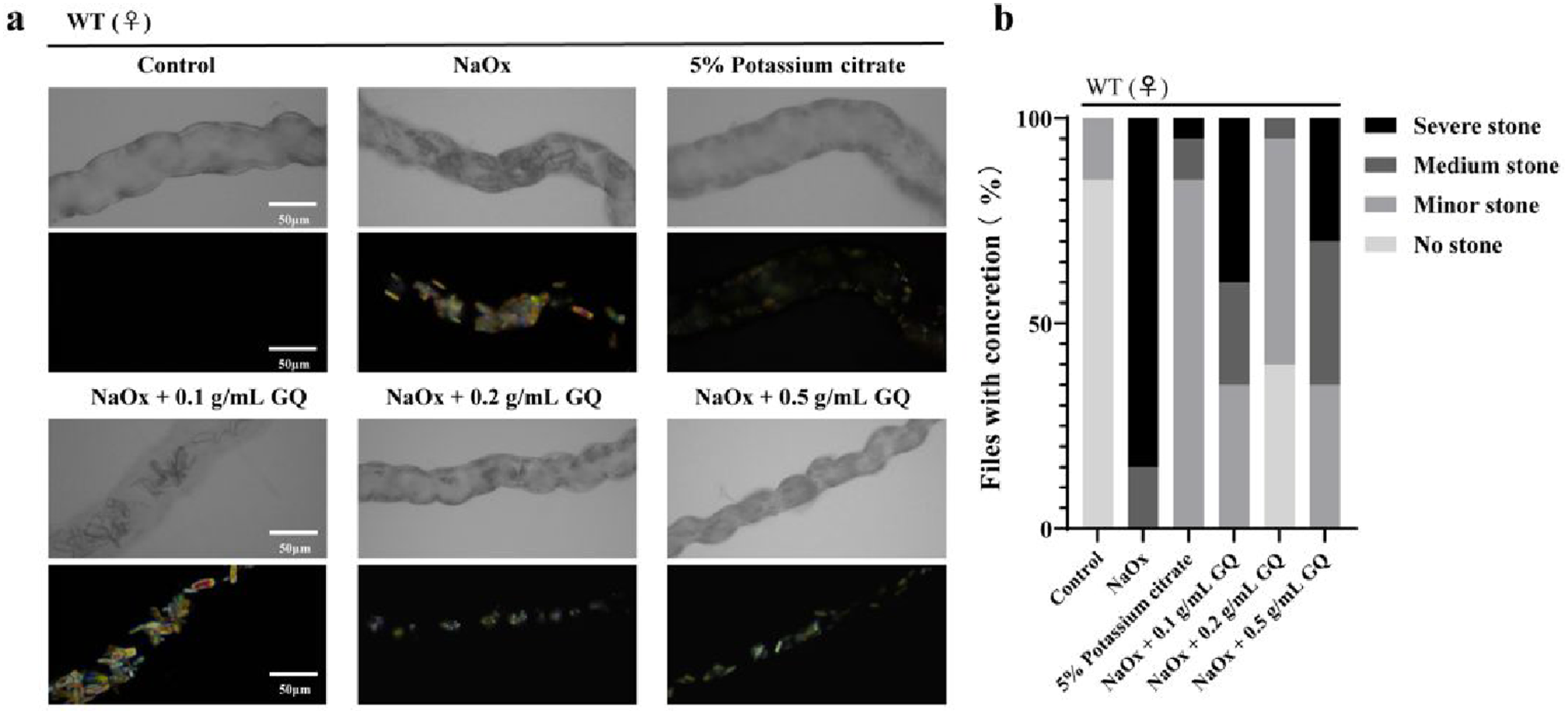
We next evaluated the efficacy of GQ aqueous extract at varying dosages using the fruit fly model. Administration of GQ extract at a drug extract ratio (DER) of 0.2 g/mL produced the optimal therapeutic effect, with 95% of flies showing no or only mild crystal deposition in the MTs, slightly exceeding the efficacy of 5% potassium citrate (Figure 2). Accordingly, the 0.2 g/mL DER dosage was chosen for subsequent experiments.
3.2. GQ Extract Increases Urination
Clinical studies have demonstrated that elevated urine output reduces kidney stone incidence by promoting crystal excretion. To investigate the effect of GQ extract on urination, fruit flies were cultured on medium containing blue dye, and the amount and morphology of excreta (a mixture of urine and feces) were quantified. The results showed that the total number of deposits was significantly increased in flies treated with GQ extract (8.67 ± 4.03, 95% confidence interval, P=0.00396) compared to the model group (Figure 3A). The morphology of excreta was largely unchanged, and slight color differences were attributed to pigments derived from GQ extract in the diet (Figure 3B). These findings indicate that GQ extract attenuates CaOx stone formation, at least in part, by enhancing urine output and excretory frequency in fruit flies. GQ extract inhibited CaOx stone formation in the fruit flies’ MTs by increasing urination. (a) Amounts of deposits of different groups (n=3). Data are represented mean ± standard deviation (Mean ± SD), and analyzed by One-Way ANOVA (n/s, p>0.05; *, p<0.05; **, p<0.01; ***, p<0.001). (b) Morphology of fly excreta. Scale bar: 100 μm
3.3. GQ Extract Inhibits Endogenous Oxalate Synthesis
Endogenous oxalate production accounts for more than 80% of total oxalate in the human body. Endogenous oxalate synthesis mainly depends on amino acid metabolism pathways. We examined the expression level of the genes encoding key enzymes involved in the endogenous oxalate synthesis, and detected a decrease in the expression levels of daao1 and daao2 in fruit flies (0.48 ± 0.17, 95% confidence interval, P=0.00208; 0.29 ± 0.25, 95% confidence interval, P=0.0350) (Figure 4B). These results suggested that GQ extract suppresses the endogenous oxalate synthesis. Subsequently, using a JAK/STAT reporter strain (10 × STAT-GFP), we observed that GQ extract administration enhanced activation of the JAK/STAT signaling pathway in the MTs (4.52 ± 2.26, 95% confidence interval, P=0.000916) (Figure 4C-D). In our previous study, activation of JAK/STAT signaling pathway in stellate cells of the MTs was shown to downregulate the expression of daao1 and daao2, thereby inhibiting downstream endogenous oxalate synthesis. On this basis, we specifically knocked down the expression of dome, which encodes the receptor for Cytokine unpaired 3 (UPD3), to inhibit JAK activation and block the JAK/STAT pathway in the stellate cells. This intervention partially abolished the protective effect of GQ extract (Figure 4E-F), suggesting that GQ extract inhibits kidney stone formation partly by reducing endogenous oxalate synthesis via modulation of the JAK/STAT signaling pathway. GQ aqueous extract inhibited CaOx stone formation in the MTs of fruit flies by suppressing endogenous oxalate synthesis. (a) Schematic of the endogenous oxalate synthesis metabolic pathway. Red text indicates key enzymes. (b) Relative mRNA expression levels of genes encoding key enzymes in the endogenous oxalate synthesis (n≥3). Ribosomal protein 49 (rp49) was used as the internal reference gene for normalization. Data were normalized to the control group, expressed as mean ± standard deviation (mean ± SD), and analyzed by Student’s t-test. (c) Fluorescence images of the MTs from 10 × STAT-GFP flies under different treatments. Green: STAT-positive cells; Blue: DAPI staining, indicates the location of the nuclei. Scale bar: 50 μm. (d) Quantification of mean GFP fluorescence intensity (n≥3). (e) Representative bright-field and polarized light micrographs of MTs from flies with stellate cell-specific dome knockdown (stellate cells > Dome-RNAi). Scale bar: 50 μm. (f) Histogram displaying the percentage of flies with different degrees of CaOx crystal deposition in MTs from different groups (n=20)
3.4. GQ Extract Reduces ROS Level in MTs
CaOx stones trigger inflammation and oxidative stress, with excessive ROS damaging tubular epithelium, leading to cell debris and scarring. These lesions serve as nucleation sites for crystal deposition and aggregation, thereby promoting stone formation. Alleviating oxidative stress is crucial for mitigating kidney stone progression. We assessed ROS levels in the MTs via DHE staining. Following NaOx treatment, ROS levels in the MTs showed a significant increase compared to the control group (48.80 ± 15.79, 95% confidence interval, P=0.0000209). The GQ treatment group showed a significant decrease in ROS levels (17.01 ± 16.01, 95% confidence interval, P=0.0391) (Figure 5A-B). GQ aqueous extract inhibits CaOx stone formation in fruit flies’ MTs by scavenging ROS. (a) DHE straining in MTs from fruit flies under different treatments. Blue: DAPI staining, indicates the location of the nuclei. Red: DHE staining, indicates the ROS level. Scale bar: 50 μm. (b) Quantification of mean DHE fluorescence intensity (n≥3). (C) Relative mRNA expression levels of sod1, sod2, and cat in response to oxidative stress (n≥3)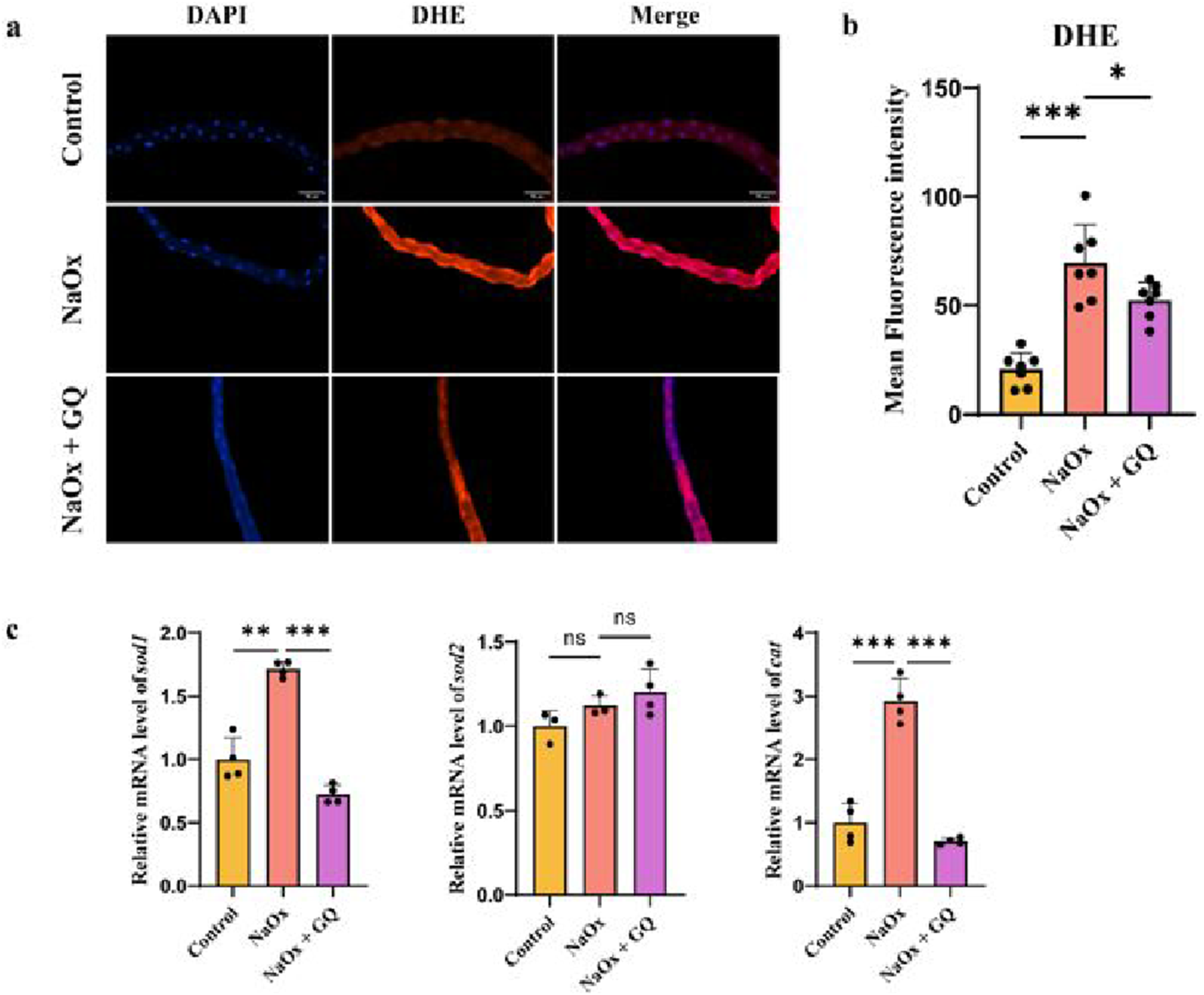
To further validate the effect of GQ extract on alleviating oxidative stress in fruit flies, we analyzed the transcription levels of three antioxidant enzyme-related genes: two encoding superoxide dismutases (sod1 for SOD1 and sod2 for SOD2) and one encoding catalase (cat for CAT). SODs and CAT play crucial roles in maintaining redox homeostasis by scavenging ROS. The expression levels of sod1, sod2, and cat are upregulated in response to elevated ROS, making them reliable biomarkers of oxidative stress. Our results showed that the NaOx group exhibited significant upregulation of sod1 and cat mRNA expression (0.72 ± 0.22, 95% confidence interval, P=0.00176; 1.93 ± 0.57, 95% confidence interval, P=0.000189), whereas the GQ treatment group restored their expression to baseline levels (0.99 ± 0.12, 95% confidence interval, P=0.00000122; 2.22 ± 0.44, 95% confidence interval, P=0.000879) (Figure 5C). Thus, reducing oxidative stress represents another pharmacological mechanism through by which GQ extract mitigates CaOx crystal formation in MTs of fruit flies.
3.5. GQ Extract Inhibits CaOx Crystallization
We performed bulk simulated crystallization experiments and compared the results with those obtained using citric acid, a known CaOx crystals inhibitor, to investigate the evolution of CaOx crystal morphology at different concentrations of GQ aqueous extract. Scanning electron microscopy (SEM) images of the CaOx crystals revealed that GQ extract exhibits significant binding specificity. In the absence of GQ aqueous extract, CaOx crystals displayed a regular hexagonal morphology. In stark contrast, the addition of citric acid induced CaOx crystals to adopt a diamond shape. When GQ extract was present, CaOx crystals exhibited an octagonal morphology. Strong interaction between the extract and the [100] plane of the CaOx crystals led to the formation of flaky crystals, resulting in blurred and serrated edges (Figure 6A). Furthermore, as the concentration of GQ extract increased, the interaction between CaOx crystals and the extract reduced the [001]/[010] aspect ratio of the crystals (Figure 6B-C), a parameter reflecting the impact of compounds on crystal morphology.
18
Thus, GQ extract may alter CaOx crystal morphology by decreasing their [001] / [010] aspect ratio, thereby inhibiting crystal growth. GQ aqueous extract inhibited CaOx crystallization. (a) Representative SEM images of crystals formed in different experimental groups. Scale bar: 10 μm. (b) Changes in [001] / [010] aspect ratio of crystals in the citric acid group (n=3). (c) Changes in [001] / [010] aspect ratio of crystals in the GQ group (n=3)
3.6. Lycium barbarum Polysaccharides (LBPs) Do Not Show Efficacy in Treating Kidney Stones
LBPs are widely recognized as key active constituents of GQ, with diverse biological activities. We evaluated the therapeutic efficacy of LBPs against CaOx kidney stones in the MTs of fruit flies. After seven days of administering different concentrations of LBPs via fruit fly medium, more than 50% of the fruit flies still exhibited medium to severe CaOx crystal deposition in the MTs (Supplementary Figure S2). These results indicate that active ingredients other than LBPs may play a crucial role in the mitigation of CaOx kidney stones.
4. Discussion
In the framework of TCM, kidney stone disease is categorized as a ‘urolithic stranguria’, which is attributed to renal dysfunction, internal accumulation of dampness, and blood stasis caused by qi stagnation. Collectively, these pathogenic factors lead to the precipitation and deposition of minerals, crystals, and metabolic wastes in the urinary system. According to TCM theory, GQ is traditionally recognized to nourish yin and tonify the kidney, suggesting its potential therapeutic value against kidney stones. GQ is rich in vitamins and various minerals, and has long been used to clear heat, detoxify the body, as well as to protect liver function. For kidney stone patients with physical weakness, GQ may improve general health status by invigorating qi and nourishing blood. To the best of our knowledge, this study is the first to verify the direct anti-nephrolithiasis efficacy of GQ extract in an in vivo animal model, thereby bridging the gap between its traditional kidney-tonifying application and modern pharmacological research on anti-lithiasis.
In 2011, Chen et al. first successfully established a CaOx kidney stone model in fruit flies, observing CaOx crystals formation in the MTs following the addition of lithogenic agents to the fly diet. 15 This model has been widely recognized as a reliable, high-throughput in vivo screening platform for anti-lithiasis drugs due to the functional homology between MTs of flies and the human renal system. 11 Notably, many clinically effective TCMs, such as Cheqianzi (Plantago asiatica), Yanhusuo (Corydalis yanhusuo), Digupi (Lycil Cortex) and Baimaogen (Imperata cylindrica), have been validated for their efficacy using this model. The active substance identified through this model have demonstrated consistent therapeutic effects in subsequent mammalian model. 13 Consistent with the classic modeling protocol, we established the nephrolithiasis model by feeding flies a high-NaOx diet, and confirmed stable stone formation in the MTs of flies, ensuring the reliability of our in vivo efficacy evaluation. At a dosage of 0.2g/mL DER, GQ extract resulted in 95% of fruit flies exhibiting no or only minor stones in the MTs (Figure 2), demonstrating an efficacy comparable to the previously reported anti-lithiasis effects of TCMs in the same Drosophila model.19,24 This strongly supports the protective effect of GQ extract against nephrolithiasis.
Currently, three primary mechanisms are employed for treating kidney stones. First, diuretics increase urine output, facilitating the expulsion of small stones from the urinary tract.25,26 Second, strategies targeting crystal formation include the use of citrate, which elevates urinary pH, thereby inhibiting the growth and aggregation of CaOx crystals. 27 Additionally, citrate can chelate calcium ions to form complexes, reducing stone formation by covering the surface of the growing crystals.28-31 Third, therapeutic interventions focus on alleviating oxidative stress and inflammation induced by CaOx stones. Oxidative stress and inflammation triggered by stones damage the renal tubular epithelium, resulting in cell debris and Randall’s plaques, which act as nucleation sites for further crystal formation.32,33 Non-steroidal anti-inflammatory drugs (NSAIDs) are widely used to mitigate this inflammation by inhibiting cyclooxygenase (COX) prostaglandin synthesis. 26 However, most existing clinical drugs target only a single mechanism, with presents obvious limitations. For example, diuretics do not inhibit crystal formation, while citrate cannot alleviate crystal-induced renal inflammatory injury. In contrast, our study demonstrated that GQ extract exerts anti-nephrolithiasis effects by simultaneously addressing all three therapeutic mechanisms, highlighting its multi-target advantage over single-target agents.
Firstly, GQ extract significantly increased urination, as evidenced by quantification of excreta in fruit flies (Figure 3). This diuretic-like effect facilitates the expulsion of small crystals from the MTs, consistent with the first therapeutic strategy for kidney stones. Secondly, we performed bulk crystallization experiments to simulate the in vivo environment and investigate the effects of GQ extract on CaOx crystal morphology at different concentrations. In the presence of citric acid, the CaOx crystals exhibited a diamond shape, an alteration likely attributed to the agent’s inhibition of crystal growth along the [001] direction, promotion of growth along the [010] direction, or a combination of both effects. In contrast, the addition of GQ extract induced an octagonal morphology in CaOx crystals, suggesting that GQ aqueous extract may interact with CaOx crystals to regulate crystal growth along different directions (either inhibition or promotion), and thus alter crystal morphology. Furthermore, we observed that as the concentration of the extract increased, the interaction between the crystals and the extract reduced the [001] / [010] aspect ratio of the crystals. We hypothesized that this reduction may result from GQ extract inhibiting crystal growth in the [001] direction or promoting growth in the [010] direction. However, given the octagonal morphology of the crystals, we speculate that the final crystal form is more likely a result of the extract’s inhibiting growth along the [001] direction (Figure 6). This finding supports our proposed second therapeutic mechanism, that GQ extract exerts a regulatory effect on CaOx crystal formation and growth. Thirdly, GQ extract effectively decreased NaOx-induced ROS levels and restored the mRNA expression levels of antioxidant enzymes to baseline levels (Figure 5), thereby alleviating oxidative stress—a key pathogenic factor in kidney stone formation. These results encompass the third therapeutic mechanism targeting oxidative stress and inflammation. Additionally, we found that GQ extract modulates the JAK/STAT signaling pathway in the stellate cells of MTs. This modulation in turn reduces endogenous oxalate synthesis, and ultimately inhibits kidney stone formation in fruit flies (Figure 4). The JAK/STAT pathway is a classic inflammatory signaling pathway, and its role in various kidney diseases, such as renal injury and fibrosis, has been extensively documented in previous studies. 34 Recent research has reported that inhibition of JAK/STAT signaling can alleviate renal tubular injury and crystal deposition in rodent nephrolithiasis models, 13 which aligns with our finding that the JAK/STAT pathway is involved in the pathological process of nephrolithiasis. In this study, we found that GQ extract activates the JAK/STAT signaling pathway in the stellate cells of the MTs in flies. Additionally, by specifically knocking down the dome in stellate cells to block the JAK/STAT signaling pathway, the anti-stone effect of GQ extract was partially inhibited. Therefore, our results indicate that the anti-lithiasis effect of GQ extract is partially dependent on the modulation of this regulatory axis. This expands the current understanding of the cell-specific role of the JAK/STAT pathway in nephrolithiasis and provides a new potential target for the prevention of kidney stones.
However, the specific active components within GQ aqueous extract responsible for these therapeutic effects remain unidentified. As demonstrated earlier, LBPs do not appear to be the primary active substances mediating the anti-nephrolithiasis effect of GQ. The primary active ingredients of GQ extract, in addition to LBPs, include flavonoids, alkaloids, and other phytochemicals, many of which have been reported to possess renal protective, antioxidant and anti-inflammatory properties. Therefore, future research should focus on isolating different components of GQ using advanced separation techniques and screening their efficacy via the fruit fly model. Identifying one or more active compounds that target distinct mechanisms will facilitate a more comprehensive understanding of the anti-CaOx stone properties of GQ.
More importantly, the findings and in vivo data presented in this study are exclusively derived from the fruit fly model, lack direct measurements of oxalate concentration, and have not been validated in vertebrate models. This represents a significant limitation of our research, which we have further elaborated on in the critical discussion from two key perspectives.
Firstly, although MTs in flies are functionally homologous to human renal tubules and have been widely used as a high-throughput preliminary screening platform for anti-lithiasis drugs, there are notable differences in their structure, cellular composition, and pathophysiological processes. The human kidney has a highly complex hierarchical structure consisting of glomeruli, proximal convoluted tubules, distal convoluted tubules, collecting ducts, and more than 20 specialized cell types, relying primarily on glomerular filtration to excrete metabolic wastes. In contrast, the renal system of fruit flies consists of two independent structures: nephrocytes and two pairs of MTs. Nephrocytes are a specialized group of cells located near the heart and esophagus of fruit flies. They filter the hemolymph in a manner analogous to the human glomerulus, effectively removing waste products. 35 Research has demonstrated that nephrocytes of fruit fly share similarities with human glomerular podocytes in terms of protein ultrafiltration and exhibit significant resemblances to human renal proximal tubules regarding protein reabsorption.36-38 The genetic composition, anatomical structure, and physiological functions of the MTs are analogous to those of the renal tubules and collecting ducts in the human kidney. MTs are primarily composed of two types of cells (principal cells and stellate cells).39,40 Secondly, human CaOx kidney stone disease is a chronic, multifactorial condition involving renal tubular epithelial cell injury, Randall’s plaque formation in the renal papilla, crystal adhesion to injured tubular epithelium, crystal aggregation, and subsequent interstitial fibrosis and chronic inflammation. However, the high-NaOx diet-induced Drosophila nephrolithiasis model used in this study primarily simulates acute CaOx crystal deposition within the lumen of MTs and cannot fully replicate the chronic inflammatory response, interstitial fibrosis, and Randall’s plaque formation that characterize human kidney stone disease. Furthermore, while both Drosophila and humans can synthesize oxalate endogenously, there are significant evolutionary divergences in their metabolic pathways. Most notably, humans lack the urate oxidase enzyme present in Drosophila, leading to substantial differences in purine metabolism and urinary composition, which may alter the solubility and crystallization behavior of CaOx in the urinary tract. 41
On the other hand, significant pharmacokinetic and bioavailability differences between fruit flies and humans remain unaddressed. The fruit fly has a simple digestive system, and drugs administered through the diet are absorbed primarily via the midgut epithelium directly into the open circulatory system (hemolymph), bypassing first-pass metabolism. In contrast, human oral drug absorption involves complex processes. Therefore, the high concentrations of GQ extract used in the fruit fly diet cannot be directly extrapolated to human oral doses, as these do not account for absorption barriers and metabolic losses present in humans.The active metabolites of GQ extract generated in humans may differ substantially from those in fruit flies, potentially leading to differences in both therapeutic efficacy and toxicity.
Although our previous studies have demonstrated that most natural products effective in treating CaOx kidney stones in the fruit fly model also exhibit significant therapeutic effects in mouse kidney stone models, mammalian models remain indispensable for clinical application—particularly for determining optimal dosages and assessing potential toxicological risks, which the fruit fly model cannot address. Therefore, to confirm the potential translational applications of these findings in humans, it is essential to validate the therapeutic efficacy of GQ and its active components in mammalian models and subsequent clinical trials. Additionally, comprehensive pharmacokinetic studies are necessary to determine their bioavailability in renal tissue, as well as to investigate their effects on human renal tubular epithelial cell injury and crystal adhesion in clinical settings.
5. Conclusion
Our findings suggest that GQ exerts a therapeutic effect on CaOx kidney stones through multiple synergistic mechanisms. This efficacy is likely attributed to the combined actions of various active components in GQ, which target different physiological processes: enhancing excretory function (diuretic effect), inhibiting endogenous oxalate synthesis, altering crystal morphology, and exerting antioxidant effects. This study establishes a solid foundation for future studies and provides a rationale for the development of GQ-based therapeutic agents and dietary interventions for prevention and management of CaOx kidney stones.
Supplemental Material
Supplemental Material - The Medicine-Food Homology Fruit Gouqi (Lycium barbarum L.) Mitigates Kidney Stone via Multiple Bioactivities
Supplemental Material for The Medicine-Food Homology Fruit Gouqi (Lycium barbarum L.) Mitigates Kidney Stone via Multiple Bioactivities by Wen Zhang, Yunuo Ren, Xiaoxi Liu, Xingmiao Liu, Weiwei Tang, Yingjie Ju1, Wei Yu, Zhimou Guo, Huanhuan Qiao, Xiaoli Yu, Suxia Ren, Tianxiang Li, Yuqing Dong, Zengyi Huang, Youxin Li, Zhiguang Yuchi, Dong Li, and Yiwen Wang in Natural Product Communications.
Footnotes

Ethical Considerations
No formal ethical approval is required for its use in experimental research under both international guidelines and the national regulations of the authors’ affiliated country. The use of fruit fly models aligns with the 3R principles by reducing the need for mammalian experiments. In addition, all experimental designs and procedures were optimized to minimize unnecessary use of flies and avoid potential distress: flies were only used for essential experiments, and for molecular biology assays requiring fly tissue collection, individuals were anesthetized with CO2 and then rapidly euthanized via liquid nitrogen flash freezing to ensure minimal discomfort.
Author Contributions
Conceptualization, Yiwen Wang; Formal analysis, Yunuo Ren, Wen Zhang, Wei Yu and Zhimou Guo; Methodology, Wen Zhang, Yingjie Ju, Yuqing Dong and Weiwei Tang; Resources, Tianxiang Li; Writing-original draft, Wen Zhang; Writing-review & editing, Wen Zhang, Yunuo Ren, Yingjie Ju, Yiwen Wang; Supervision, Xiaoli Yu, Xingmiao Liu, Dong Li, Tianxiang Li, Xiaoxi Liu, Suxia Ren, Zengyi Huang, Wei Yu, Zhimou Guo, Huanhuan Qiao, Youxin Li, Zhiguang Yuchi and Yiwen Wang; Funding acquisition, Xiaoli Yu, Xingmiao Liu, Dong Li; All authors have read and agreed to the published version of the manuscript. Wen Zhang, Yunuo Ren and Xiaoxi Liu contributed equally to this work.
Funding
The authors disclosed receipt of the following financial support for the research, authorship, and/or publication of this article: This work was funded by 2023 Tianjin Education Commission Scientific Research Project, (No. 2023YXZX22) and the Natural Science Foundation of Tianjin (No. 23JCYBJC01710 to Y.W.).
Declaration of Conflicting Interests
The authors declared no potential conflicts of interest with respect to the research, authorship, and/or publication of this article.
Data Availability Statement
The raw data supporting the conclusions of this article will be made available by the authors on request.
Supplemental Material
Supplemental material for this article is available online.
Appendix
References
Supplementary Material
Please find the following supplemental material available below.
For Open Access articles published under a Creative Commons License, all supplemental material carries the same license as the article it is associated with.
For non-Open Access articles published, all supplemental material carries a non-exclusive license, and permission requests for re-use of supplemental material or any part of supplemental material shall be sent directly to the copyright owner as specified in the copyright notice associated with the article.
