







Abstract
Background
Cartilage injuries, such as osteoarthritis (OA) and rheumatoid arthritis (RA), are prevalent globally, imposing a substantial burden on individual health, quality of life, and socioeconomic systems. The mechanisms of action of traditional chinese medicine (TCM) monomers in cartilage injury have not been fully elucidated. This study aimed to explore the research hotspots and future directions of TCM monomers in the treatment of cartilage injuries and to provide a valuable reference for subsequent studies in this field.
Methods
All literature related to TCM monomers in the treatment of cartilage injuries was retrieved from the Web of Science Core Collection (WOSCC) database, covering publications from its inception to January 6, 2026. Publication output, authors, institutions, countries, co-citations (including authors, journals, literature), and keywords were visually analyzed using VOSviewer and CiteSpace (version 6.4.R1).
Results
A total of 1006 articles were included in this analysis. An upward trend in annual publications has been observed. Shakibaei M had the most publications and the highest citation counts. Shanghai Jiao Tong University was the institution with the most publications. China demonstrated the highest publication output among all countries. China and the United States exhibit close international collaborations. Osteoarthritis and Cartilage and Annals of the Rheumatic Diseases were the most influential journals, with high citations and impact factors. Research hotspots in TCM monomers for cartilage injury treatment have gradually shifted from early focuses on articular chondrocytes, gene expression, inflammation and immunomodulation, and oxidative stress to recent emphases on network pharmacology, drug delivery, autophagy and signaling pathways, nanotechnology, efficacy evaluation, and studies on specific TCM components.
Conclusion
Research on TCM monomers for cartilage injury treatment is emerging as a new academic hotspot. This study is expected to provide research evidence to promote the development of clinical applications.
Keywords
1. Introduction
Articular cartilage is a type of connective tissue composed of highly specialized chondrocytes and an extracellular matrix (ECM) covering the bone ends. It obtains nutrients mainly through the diffusion of synovial fluid due to its lack of blood vessels, nerves, and lymphatic vessels. Due to the absence of blood supply and cellular proliferative activity, articular cartilage exhibits extremely poor self-repair capability and is highly prone to degenerative progression once injured. 1 Cartilage injuries are most commonly observed in articular cartilage disorders, such as osteoarthritis (OA) and rheumatoid arthritis (RA). OA is an age-related disease that predominantly affects the knee and hip joints and is characterized by metabolic disorders in chondrocytes, excessive degradation of the ECM, and abnormal subchondral bone remodeling, leading to progressive articular cartilage degeneration and serving as a major cause of disability. 2 RA, affecting approximately 1% of the global population, is a chronic inflammatory disease caused by autoimmune dysregulation, resulting in synovial hyperplasia and severe articular cartilage damage. 3 The ECM and chondrocytes are the main components of cartilage, with the ECM accounting for over 90% of its composition. 4 The earliest pathological changes in OA occur in the articular cartilage of joints. Excessive production of inflammatory cytokines and matrix-degrading enzymes, disorders in chondrocyte metabolism, and synergistic reduction of anabolic signaling ultimately result in the destruction of the ECM and subsequent cartilage degeneration. 5 Recent research has also indicated that the underlying mechanisms of OA are associated with autophagy, 6 which plays a critical role in preserving cartilage integrity by eliminating misfolded proteins, damaged organelles, and dysfunctional cellular components. 7
Currently, conventional treatment regimens in clinical practice are primarily limited to the use of analgesics, nonsteroidal anti-inflammatory drugs (NSAIDs), corticosteroid injections, and joint replacement,8,9 which are not considered ideal. 10 Although commonly used NSAIDs may help alleviate pain in joint lesions, their gastrointestinal and renal toxicities are not tolerable by all patients. 11 Therefore, the demand for safe and effective alternative pharmacotherapeutic options is increasing among patients with OA.
Traditional Chinese medicine (TCM) monomers are single pharmacologically active compounds purified from traditional herbal medicines and are generally regarded as the primary material responsible for the pharmacological effects of these herbs. These monomers are characterized by controllable quality, low toxicity and side effects, and clear mechanisms of action.12,13 Various known TCM monomers, such as resveratrol (Res), ginsenosides (GS), baicalin (BA), and curcumin (CC), have been identified to possess multiple pharmacological effects including anti-inflammatory, anti-tumor, and antioxidant activities. 14 For instance, plant-derived antioxidant compounds, such as flavonoids, terpenoids, quinones, catechins, alkaloids, and anthocyanins, can modulate pro-inflammatory signaling pathways. 15 Tanshinone IIA (TAN-IIA), a natural compound, enhances the expression of nuclear enriched abundant transcript 1_2 inhibited by the cytokine interleukin-1β (IL-1β) and affects the transcription of genes related to the chondrocyte phenotype, promoting cartilage regeneration in an inflammatory environment. 16 Current cutting-edge research on TCM monomers primarily focuses on nanocarrier delivery, 17 autophagy inhibition, and regulation of signaling pathways, such as nuclear factor kappaB (NF-κB) and mitogen-activated protein kinase (MAPK). However, the specific mechanisms by which most of these TCM monomers exert therapeutic effects on cartilage injury have not yet been fully elucidated. 7 While several bibliometric analyses have mapped the landscape of TCM in OA management over the past decade, these studies predominantly focus on non-pharmacological interventions, 18 broad herbal formulas, crude extracts, 19 or mechanism-specific reviews. 20 Notably, there remains a lack of dedicated bibliometric research systematically tracing the evolution, knowledge structure, and translational trajectory of isolated TCM monomers specifically in the context of cartilage injury. To address this gap, this study leverages data up to January 2026 to provide a targeted analysis of TCM monomers in cartilage injury, aiming to elucidate emerging mechanistic frontiers, delivery innovations, and future clinical translation pathways.
In this study, the current research status of TCM monomers in the treatment of cartilage injuries was reviewed using VOSviewer and CiteSpace 6.4.R1. Relevant literature from the Web of Science Core Collection (WOSCC) was included, and visualized scientific knowledge maps were generated and analyzed to identify research hotspots and development trends in this field, thereby providing support and references for further investigation. This study describes research on TCM monomers and cartilage injuries in terms of countries, institutions, scholars, highly cited literature, research theme evolution, and research directions using bibliometric methods, aiming to trace the development trajectory and current hotspots of this field to provide valuable insights for guiding clinical and basic research.
2. Materials and Methods
2.1. Data Sources and Search Strategy
A search was conducted in WOSCC database using the search terms TS=(“cartilage injury” OR “cartilage degeneration” OR “cartilage repair” OR “cartilage regeneration” OR “osteoarthritis” OR “chondral defect” and “herbal monomer” OR “TCM active ingredient” OR “natural product” OR “Chinese medicine monomer” OR “icariin” OR “berberine” OR “curcumin” OR “ginsenoside” OR “tanshinone” OR “polydatin” OR “paeoniflorin” OR “baicalin” OR “naringin” OR “resveratrol” OR”quercetin” OR “apigenin” OR “astragalin” OR “Notoginsenoside” OR “Panax Notoginseng” OR “Sanqi Panax notoginseng” OR “Astragaloside” OR “Naringin from Drynaria” OR “Drynaria Naringin” OR “Drynaria Rhizome” OR “Fortune’s Drynaria Drynaria fortunei” OR “Astragalus Root” OR “Milkvetch Root Astragalus membranaceus” OR “Shikonin” OR “Arnebia Root” OR “Lithospermum Root Arnebia euchroma” OR “Lithospermum erythrorhizon” OR “Triptolide” OR “Thunder God Vine Tripterygium wilfordii” OR “Icaritin” OR “Icariin” OR “Epimedium” OR “Horny Goat Weed Epimedium brevicornum” OR “Horny Goat Weed” OR “Epimedium” OR “Curcumin” OR “Turmeric Curcuma longa” OR “Tanshinone IIA” OR “Salvia Root” OR “Danshen Salvia miltiorrhiza” OR “Danshen” OR “Giant Knotweed Rhizome Polygonum cuspidatum”)with the literature type limited to Article from the inception of database up to January 6, 2026, yielding 1006 articles. Inclusion criteria: Articles relevant to the topic were included. The exclusion criteria were: articles unrelated to the topic, retracted articles, articles lacking authors or institutional affiliations or keywords, and clinical guidelines. The detailed search strategy is illustrated in Figure 1 and Table S1. Literature screening and analysis flowchart
Bibliometric studies rely on quantitative indicators, including citation frequencies, publication dates, and author collaboration patterns, primarily extracted from original research articles. To maintain consistency and rigor, a procedure is established in which initial screening is performed by a primary reviewer and systematic verification is conducted by a senior author. For quality control, all screening decisions are made strictly according to predefined quantitative exclusion criteria. Borderline cases are addressed through periodic spot checks and verification by the corresponding author.
2.2. Data Processing
An annual publication analysis was conducted using Microsoft Excel 2023. A visualization analysis of authors, institutions, and keywords was conducted using VOSviewer and CiteSpace 6.4.R1. VOSviewer parameter settings: Method: Association strength; Layout - Attraction: 2; Repulsion: -2; Clustering - Resolution: 1.00; Min. cluster size: 5; other parameters were kept at their default values. CiteSpace settings: Time slicing: 1; Node Types: Author, Institution, Country, Keyword, Cited Author, Cited Reference, Cited Journal; Pruning: Pathfinder, Pruning sliced networks, Pruning merged network; others remained default.
Visualizations were generated, including collaboration network maps for authors, institutions, and countries; dual-map overlays of journals; network maps of cited journals, authors, and references; and keyword maps showing co-occurrence, clusters, timelines, and bursts. In CiteSpace analysis, keywords with centrality >0.1 are considered significantly important in the research network. The keyword cluster map with Q value >0.5 and S value >0.3 indicates an effective and reliable cluster. The log-likelihood ratio (LLR) method was employed to select topic labels for each cluster, ensuring the accurate capture and presentation of each cluster’s essence. 21 Ethical approval was not necessary because the data did not contain any private information about the patients.
3. Results
3.1. Analysis of Annual Publication
An annual publication volume analysis was conducted using Microsoft Excel 2023 (Figure 2A). The figure reveals that publication growth remained in the single digits from 1995 to 2003, indicating the embryonic stage of research on the use of TCM monomers in treating cartilage injuries. From 2004 to 2010, publications showed steady growth, marking the initial development stage in this field. From 2011 to 2025, publications increased sharply, reflecting a rapid development stage, with projections indicating a continued upward trend in future research. (A): The annual number of publications. (B): Knowledge map of author collaboration. (C): Knowledge map of institution collaboration. (D): Knowledge map of country collaboration
3.2. Analysis of Authors, Institutions and Countries
VOSviewer was used to generate a collaboration map of the authors (Figure 2B). Shakibaei M ranked first in publication volume. An author collaboration cluster represented by Shakibaei M, Gu H, Wang P, Tang CH, and Zhou Y has formed. The research focus of each team can be derived by analyzing the author-related literature statistics in CiteSpace.
For instance, a research team from Germany led by Shakibaei M primarily investigated the mechanism of action of RSV and CC in the inflammatory signaling pathways of chondrocytes.22,23 The modulatory effects of CC and RSV on IL-1β-induced expression of cartilage-specific matrix and proinflammatory enzymes were partially mediated by the cartilage-specific transcription factor Sry-type high-mobility-group box 9. 24
A research team from China led by Gu H primarily investigated the mechanism of action of RSV in treating obesity-related OA. 25 A study by Wang PZ revealed that BA, icariin (ICA), and CC promote ECM synthesis in chondrocytes through distinct pathways.26-28
A research team from Taiwan, China, led by Tang CH demonstrated that the activating protein-1 inhibitors CC or TAN-IIA attenuate C-C motif chemokine ligand 2 (CCL2)and cellular communication network factor 4 stimulated the vascular cell adhesion molecule-1 expression in osteoarthritis synovial fibroblasts, where CCL2 is associated with disease status and prognosis in OA.29,30
A research team from China led by Zhou Y found that berberine (BBR) improves cartilage degeneration and exerts anti-apoptotic effects on articular cartilage. 31 BBR modulates immune responses and reduces cartilage degradation. 32 Additionally, CC exerts chondroprotective effects by regulating ECM homeostasis and inhibiting chondrocyte apoptosis. 33
VOSviewer was used to generate an institutional collaboration network map (Figure 2C), where different colors represent distinct clusters, the node size corresponds to the institutional publication volume, and the line thickness between institutions indicates the intensity of collaborative relationships. Shanghai Jiao Tong University (SJTU) led in publication volume. No large-scale collaborations between domestic and international institutions have been observed.
The Top 10 Countries in Terms of Publication Volume

3.3. Analysis of Cited Authors, Journals and References
3.3.1. Analysis of Co-Cited Authors
VOSviewer was used to create a cited author map (Figure 3A), revealing four distinct clusters represented by Shakibaei M (237 citations), Henrotin Y (170 citations), Loeser RF (130 citations), and Zhang Y (96 citations). (A): Knowledge map of co-cited author. (B): Double image overlay. (C): Knowledge map of co-cited journal. (D): Knowledge map of co-cited literature
3.3.2. Analysis of Cited Journals
The Top 10 Journals in Terms of Citation Frequency

3.3.3. Analysis of Co-Cited References
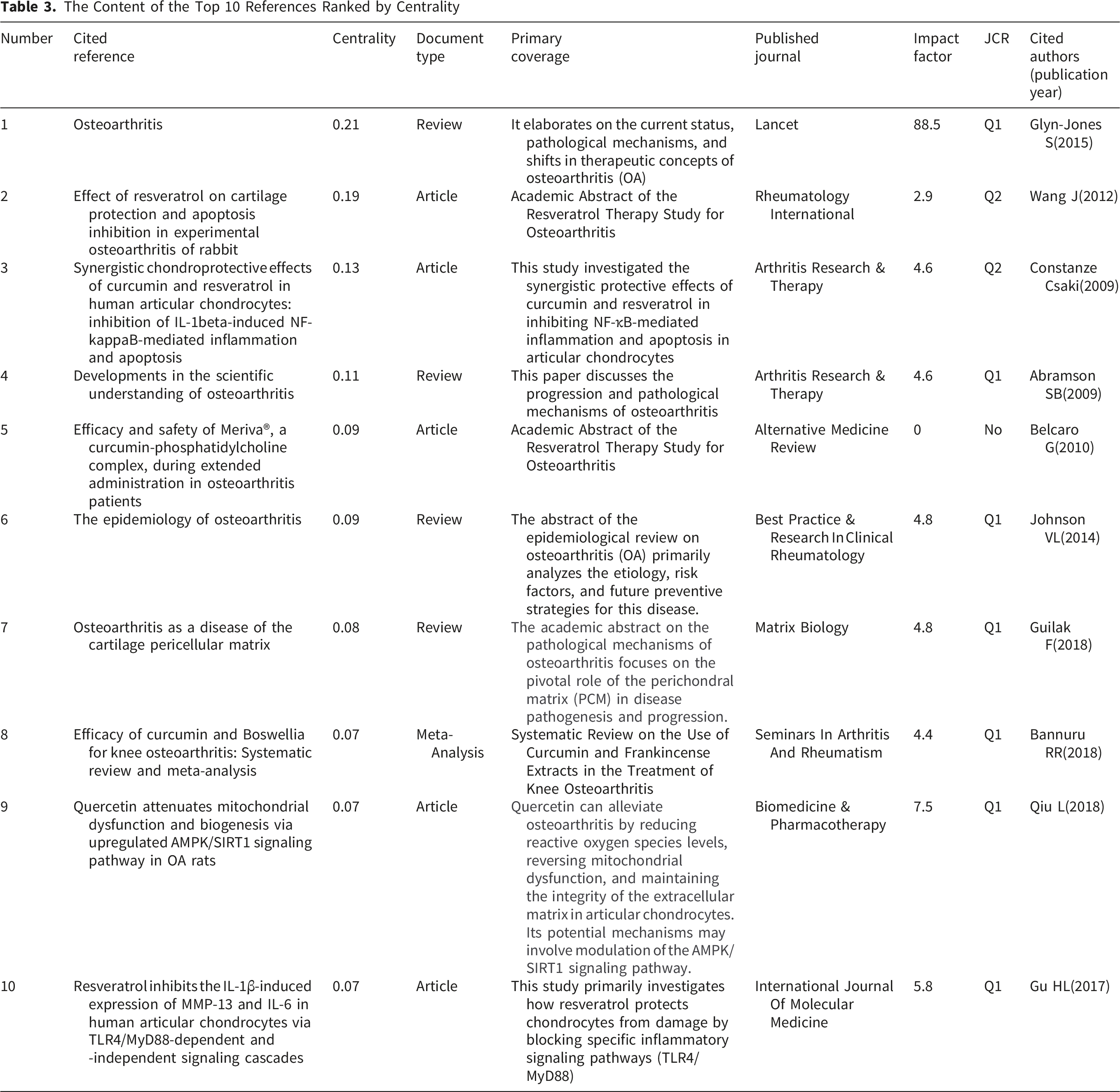
The Content of the Top 10 References Ranked by Centrality
Content of the Top 10 References Ranked by Citation Count

The most frequently cited reference was Hunter DJ’s review titled “Osteoarthritis” published in The Lancet in 2019, which primarily targeted the clinical audience by providing an update on the pathogenesis, diagnosis, management, and future research directions of OA. 36 The reference with the highest centrality was Glyn-Jones S’s review titled “Osteoarthritis” published in The Lancet in 2015, marking a shift in focus toward disease prevention and treatment of early OA. 37 An article from Wang J published in Rheumatology International in 2012 noted that RSV reduced the chondrocyte apoptosis rate in synovial fluid, 38 with a centrality of 0.19, ranking second in the entire network.
3.4. Keywords Analysis
3.4.1. Co-Occurrence of Keywords
A keyword co-occurrence map was generated using VOSviewer (Fig 4a), with Author Keywords selected as nodes, resulting in four main clusters. The red, green, yellow, and blue clusters centered on the keywords “osteoarthritis”, “resveratrol”, “network pharmacology”, and “inflammation”, respectively. These four clusters represent the primary research directions in this field.
The Top 10 Keywords in Terms of Centrality and Frequency

3.4.2. Cluster of Keywords
Each keyword cluster represents a distinct theme. The LLR algorithm was applied for keyword clustering after keyword co-occurrence analysis. The Q value was 0.7435 (Q>0.3) and the S value was 0.888 (S>0.5), indicating that this clustering was valid and reliable. CiteSpace 6.4.R1 was used to generate the keyword cluster diagram (Figure 4B) and keyword cluster table (Table 6). This clustering yielded 19 valid clusters, with the top 10 being osteoclastogenesis, oxidative stress, cartilage repair, ECM, knee OA, efficacy, activation, nitric oxide, fibroblast-like synoviocytes, and chondrogenic differentiation. These clusters represent research themes within the network, encompassing multiple dimensions of TCM monomers in treating cartilage injuries, ranging from their mechanisms of action and molecular pathways to clinical efficacy. (A): Knowledge map of keywords co-occurrence. (B): Knowledge map of keywords clusters. (C): Top 24 keywords with the strongest citation bursts. (D): Timeline view of keywords Keywords Clustering Table

3.4.3. Keywords Bursts
Keyword burst terms denote keywords exhibiting a sudden increase in citation frequency over a specific period. Research frontiers can be inferred based on the distribution of keywords with the strongest burst intensities.21 A keyword burst map is shown in Figure 4C. The blue lines in the figure indicate the period when a keyword appeared, and the red lines represent the keyword’s burst period. The burst keywords from 2000 to 2018 were “articular chondrocytes” (9.75), “gene expression” (8.37), “rheumatoid arthritis” (6.41), “human articular chondrocytes” (5.46), “NF-kappa B” (5.47), “nitric oxide” (5.2), “nitric oxide synthase” (4.3), “collagen-induced arthritis” (4.17), and “tumor necrosis factor” (4.08). These burst keywords indicate early research hotspots and trends.
In recent years (2020-2026), the strongest burst keywords were “network pharmacology” (7.64), followed by “delivery” (7.38), “autophagy” (5.44), “pathway” (5.39), “nanoparticles” (4.79), “efficacy” (4.78), “histopathology” (4.22), and “Tanshinone IIA” (3.57). These burst keywords indicate current research hotspots and trends.
Research hotspots on TCM monomers for treating cartilage injuries have gradually shifted from early focuses on articular chondrocytes, gene expression, inflammation and immunomodulation, and oxidative stress to recent emphases on network pharmacology, drug delivery, autophagy and signaling pathways, nanotechnology, efficacy evaluation, and research on specific TCM components.
3.4.4. Timeline View of Keywords
The timeline view of keywords illustrates the developmental sequence of keywords, and a keyword timeline map (Figure 4D) was generated using CiteSpace 6.4.R1, enabling researchers to investigate the temporal evolution of the research themes. In this map, the right-side cluster colors correspond to temporal points, while the left-side keywords are clustered thematically based on node size and displayed at their respective time points of emergence. For instance, in the ECM cluster, the thematic keyword “NF kappa B” first appeared in 2005 and persisted until 2025, while “cartilage” emerged in 1995 and continued through 2024.
4. Discussion
4.1. Research Status and Development Trends
In terms of publication volume, this bibliometric analysis included 1006 relevant articles on TCM monomers for treating cartilage injuries. Since 1995, the overall trend has shown an upward trajectory, with a rapid increase in publication volume over the past 15 years, indicating that this research field is currently developing. In terms of authors and institutions, Shakibaei M from Germany is the author with the highest publication volume and citation counts, recognized as an international academic leader in this field. A collaborative network has already formed around Shakibaei M, represented by authors including Gu H, Wang P, Tang CH, and Zhou Y. SJTU stands as the institution with the highest publication volume. Among the 27 countries and regions that published literature on TCM monomers for treating cartilage injuries, China had the highest publication volume, but its centrality was low (0.06), indicating its limited academic influence in this field. The USA ranks second in publication volume and demonstrates a high proportion of international collaboration, particularly strong cooperation between China and the USA. China and Germany have formed a research consortium.
Among journals publishing literature on TCM monomers for treating cartilage injuries, Osteoarthritis and Cartilage had the most citations, while Annals of the Rheumatic Diseases and Osteoarthritis and Cartilage exhibited the highest centrality and strongest influence. However, a core journal cluster has not yet emerged in this field. With publications distributed across multiple disciplines, the need for multidisciplinary collaboration in research on TCM monomers for treating cartilage injuries is highlighted. According to the top 10 articles ranked by co-citation counts, research hotspots in this field predominantly focused on OA. The publication with the highest centrality is a review by Glyn-Jones S published in The Lancet in 2015, primarily addressing disease prevention and early OA treatment. The most cited work is a review by Hunter DJ in The Lancet in 2019, which shifted the focus toward the latest advances in OA pathogenesis, diagnosis, management, and future research. This indicates that research on TCM monomers for treating cartilage injuries primarily focuses on OA and has established a substantial research foundation. Simultaneously, it reveals that research areas concerning TCM monomers for treating other cartilage injuries, such as RA, remain relatively unexplored, warranting further in-depth investigation.
Based on the systematic analysis of the top 10 high-centrality and highly cited articles listed in Tables 3 and 4, we systematically summarized the core knowledge basis and major research advances in the field of osteoarthritis. The included literature consists of authoritative reviews, clinical investigations and mechanism studies, which mainly focus on four aspects: pathological mechanisms, epidemiology and clinical management, natural product interventions, as well as signaling pathway regulation in osteoarthritis. Current evidence indicates that osteoarthritis is initiated and aggravated by inflammation, oxidative stress, apoptosis, matrix degradation and disordered chondrocyte microenvironment, with NF-κB, TLR4/MyD88 and AMPK/SIRT1 as the core regulatory pathways. Polyphenols including quercetin, curcumin and resveratrol exert chondroprotective effects through anti-inflammatory, antioxidant, anti-apoptotic and synergistic actions. The field has established an integrated system covering basic mechanisms and clinical practice, highlighting natural products, anti-aging strategies and targeted signaling regulation as promising research directions. This in-depth analysis refines the core theories and landmark progress, thereby substantially improving the depth and comprehensiveness of the results.
The keywords in the literature related to TCM monomers for treating cartilage injuries can be divided into four primary co-occurrence clusters through keyword co-occurrence analysis, centered on OA, RSV, network pharmacology, and inflammation: (1) OA-centered keyword cluster: This cluster demonstrated the highest publication volume and centrality, representing the primary research focus in this field. It mainly focused on the application of TCM monomers, including CC, quercetin (QC), BBR, and BA in the treatment of OA. CC can reverse erastin-induced chondrocyte ferroptosis, primarily by upregulating the expression of nuclear factor erythroid 2-related factor 2 (Nrf2) at both the gene and protein levels.
39
Dai et al utilized curcumin’s auto-fluorescence to design a novel carrier-free nanomedicine, CC or ICA nanoparticles, characterized by low cytotoxicity, high cellular uptake efficiency, and sustained drug release. This formulation can inhibit the secretion of inflammatory cytokines and reduce cartilage degeneration, offering a new strategy for OA treatment. Xiong et al
40
found that quercetin may inhibit IL-1β-mediated chondrocyte apoptosis and reduce the expression of SELE, MMP2, and COL1.
41
They also focused on the effects of TCM monomers on chondrocyte senescence, explored the related mechanisms involving the ECM,
42
and conducted clinical trials.
43
The aging process significantly influences the development of OA due to changes in cartilage composition, a decrease in proteoglycan content, dysregulation of growth factor signaling, and an increase in oxidative stress.
44
(2) RSV’ s effect on chondrocytes: involves the NF-κ B signaling pathway, apoptosis mechanisms, and regulation of related cytokines such as IL-1β and tumor necrosis factor-alpha (TNF-α).45-47 It also focuses on its association with the silent information regulator 1 (SIRT1) gene and the role of hyaluronic acid in this process.48,49 Studies have demonstrated that resveratrol stimulates AMP-activated protein kinase (AMPK) to regulate nicotinamide adenine dinucleotide levels, enhances SIRT1 activity, and consequently slows OA progression.
50
RSV-loaded poly (lactic-co-glycolic) acid nanoparticles suppress IL-1-induced chondrocyte apoptosis and promote autophagy.
51
Propolis treatment significantly alleviates OA severity, enhances cartilage structural integrity, and increases chondrocyte density.
44
(3) Network pharmacology approach: Combined with molecular docking technology, this methodology investigates the mechanisms of action of TCM components (ICA, CC, etc.) in the treatment of OA and RA, involving bioinformatics and multiple signaling pathways, including the MAPK. Wang et al revealed through network pharmacology and in vitro experiments that curcumin’s core targets include TNF-α, IL-1β, interleukin 6, matrix metalloproteinase 9, B-cell lymphoma 2, and caspase-3.
52
CC also alleviates knee OA-induced muscle atrophy by inhibiting apoptosis in the quadriceps through the modulation of STAT3, FOS, and PI3K/AKT signaling pathways.
53
Zhang et al employed systems biology and network pharmacology approaches to investigate RSV’s mechanism of action on chondrocytes and macrophages, discovering that hyaluronic acid-chondroitin sulfate-RSV hydrogel exhibits high cellular activity, anti-inflammatory and pro-chondrogenic capabilities.
54
Wang et al employed network pharmacology combined with in vivo and in vitro experiments and discovered that the primary active components in Baoshu Huoxue Formula are flavonoids and TAN-IIA. These components significantly impact the interleukin 17 signaling pathway in OA treatment through mechanisms including inflammation inhibition, immune function regulation, and oxidative stress resistance.
55
Aihaiti et al found that naringin exerts therapeutic effects on rheumatoid arthritis by promoting apoptosis in RA fibroblast-like synoviocytes, inhibiting the production of inflammatory factors, and modulating relevant signaling pathways.
56
(4) Investigate the roles of inflammation and oxidative stress in cartilage injury, focusing on pain generation mechanisms and the impact of relevant cytokines on articular cartilage and arthritis. Explore polyphenols and the therapeutic effects of antioxidants,
57
covering topics related to matrix metalloproteinases and herbal medicine. Oxidative stress induces chondrocyte apoptosis and ECM degradation, thereby contributing to the pathogenesis of OA.
58
Yu et al discovered that CC can suppress interleukin 11-induced apoptosis, inflammatory responses, and oxidative stress in CHON-001 cells.
59
Based on citation frequency and centrality analysis, keywords with high centrality and frequency included articular chondrocytes (articular chondrocytes, chondrocytes), indicating that research on chondrocytes constitutes the core focus of TCM for treating cartilage injuries. This encompasses processes such as activation, growth, and inhibition, along with mechanisms related to gene expression and apoptosis. For instance, betulin (BT) inhibits IL-1β-induced cyclooxygenase-2 and inducible nitric oxide synthase production, demonstrating its anti-inflammatory effects on chondrocytes. 60 SIRT1 regulates apoptosis and ECM degradation in RSV-treated OA chondrocytes via the Wnt/β-catenin signaling pathway. 61 ICA may alleviate OA symptoms by inhibiting chondrocyte ferroptosis via enhanced SLC7A11/GPX4 signaling. 62 In cellular and molecular research on TCM monomers for treating cartilage injuries, signaling pathways such as NF-κB have garnered significant attention. Investigating how TCM monomers influence chondrocyte physiology and inflammatory responses through these pathways is a critical focus of current mechanism-of-action studies.
Keyword burst analysis revealed that research hotspots on TCM monomers for treating cartilage injuries are constantly evolving. This field can be divided into two main stages: the early stage (2000-2018) featured burst keywords such as articular chondrocytes, gene expression, RA, NF-κB, nitric oxide, and its synthase, primarily focusing on the fundamental mechanisms of cartilage injury. In the recent stage (2020-2026), research on TCM monomers for treating cartilage injuries is undergoing rapid development. Studies on network pharmacology, novel drug delivery systems, and cellular molecular mechanisms (such as autophagy and pathway regulation) have rapidly become current hotspots and are gradually transitioning towards clinical applications. ICA inhibits chondrocyte apoptosis, promotes the upregulation of autophagy genes, and simultaneously inhibits the activation of the PI3K signaling pathway. 63 ICA can also induce autophagy to treat OA by regulating the PI3K/AKT/mTOR/ULK1 signaling pathway. 7 Jiang reported a novel fully silk-derived bilayer hydrogel for osteochondral tissue engineering. By hierarchically anchoring silk fibroin microspheres loaded with kartogenin and BBR within the hydrogel, long-term regulation of chondrogenesis and OA in bone mesenchymal stem cells was achieved. 64 Chen et al developed a dual-network bilayer hydrogel scaffold, with the flavonoid puerarin loaded in the upper layer and CC in the lower layer, to promote simultaneous repair of cartilage and bone. 65 These findings indicate that drug delivery systems may be a key focus of future research.
4.2. Conclusion and Significance
This study employed bibliometric analysis to analyze global literature from the past three decades on TCM monomers for treating cartilage injuries, identifying scholars, institutions, and countries that have made significant contributions to this field during this period. Compared with prior studies on TCM for OA, which primarily mapped macro-trends in acupuncture or holistic herbal formulations,18-20 this analysis delivers distinct academic incremental value by narrowing the analytical focus to pharmacologically characterized TCM monomers and their cartilage-specific regenerative mechanisms. The analysis revealed that current research on TCM for cartilage injury encompasses studies on various monomers, in-depth exploration of cellular molecular mechanisms, therapeutic investigations for diverse cartilage injury conditions, and the integrated application of multiple methodologies. These efforts aim to elucidate the efficacy and mechanisms of action of TCM monomers for treating cartilage injuries, facilitating clinical translation.
5. Limitations
While this study systematically delineates the research landscape and trends of TCM monomers for treating cartilage injuries through bibliometric analysis, certain biases may exist due to limitations in the data sources, literature screening criteria, analytical methods, and content depth. This study exclusively utilized the WOSCC as the data source. While WOSCC ensures high data quality and standardized citation linking for bibliometric mapping, it may underrepresent region-specific clinical trials, non-English publications, and studies indexed solely in regional databases. Future research should prioritize multi-database retrieval and cross-platform validation, adopt more comprehensive literature screening criteria, integrate content analysis methods, and account for the impact of technological advancements on research trends to provide a more accurate and comprehensive analysis of research trajectories.
6. Future Directions
Future research should focus on: (1) greater emphasis on interdisciplinary approaches, such as integrating bioinformatics and systems biology methodologies, to thoroughly investigate the complex mechanisms of TCM monomers for treating cartilage injuries; (2) continuous application of emerging technologies, utilizing nanotechnology to enhance the delivery efficiency and targeting precision of TCM monomers, and conducting more high-quality clinical trials to validate their efficacy and safety, thereby facilitating the clinical application of TCM monomers for treating cartilage injuries. (3) Promoting international collaboration and data sharing to enhance clinical translation efficiency and global influence.
Supplemental Material
Supplemental material - Research Hotspots and Prospects of Traditional Chinese Medicine Monomers in the Treatment of Cartilage Injuries: A Bibliometric and Visualization Analysis
Supplemental material for Research Hotspots and Prospects of Traditional Chinese Medicine Monomers in the Treatment of Cartilage Injuries: A Bibliometric and Visualization Analysis by Weibin Du, Jianyi Xie, Xuhui Chen, Huahui Hu, Yong Li, Yanghua Tang, Fuxiang Shen, Guoping Cao, Ying Fang, and Qingxia Wang in Natural Product Communications.
Supplemental Material
Supplemental material - Research Hotspots and Prospects of Traditional Chinese Medicine Monomers in the Treatment of Cartilage Injuries: A Bibliometric and Visualization Analysis
Supplemental material for Research Hotspots and Prospects of Traditional Chinese Medicine Monomers in the Treatment of Cartilage Injuries: A Bibliometric and Visualization Analysis by Weibin Du, Jianyi Xie, Xuhui Chen, Huahui Hu, Yong Li, Yanghua Tang, Fuxiang Shen, Guoping Cao, Ying Fang, and Qingxia Wang in Natural Product Communications.
Footnotes

Author Contributions
Weibin Du: Conceptualization, Data curation, Funding acquisition, Methodology, Writing-original draft. Jianyi Xie: Conceptualization, Data curation, Funding acquisition, Methodology, Writing-original draft. Xuhui Chen: Conceptualization, Data curation, Formal analysis, Writing-original draft. Huahui Hu: Formal analysis, Methodology, Validation. Yong Li: Formal analysis, Methodology, Validation. Yanghua Tang: Formal analysis, Methodology, Validation. Fuxiang Shen: Formal analysis, Methodology, Validation. Guoping Cao: Supervision, Methodology, Project administration, Writing-review & editing. Ying Fang:Supervision, Methodology, Project administration, Writing-review & editing. Qingxia Wang: Supervision, Methodology, Project administration, Writing-review & editing.
Funding
The authors disclosed receipt of the following financial support for the research, authorship, and/or publication of this article: This research was supported by Zhejiang Provincial Natural Science Foundation of China under Grant (NO. LTGY24H290006). Zhejiang Province Medical and Health Science and Technology Project (NO. 2025KY191, 2025HY0801). Hangzhou bio-medicine and health industry development support science and technology project (NO. 2023WJC243, 2023WJC249, 2023WJC234). Hangzhou Science and Technology Planning Project (NO. 20241029Y120).
Declaration of Conflicting Interests
The authors declared no potential conflicts of interest with respect to the research, authorship, and/or publication of this article.
Data Availability Statement
All data generated and/or analyzed during this study are included in this published article.
Supplemental Material
Supplemental material for this article is available online.
Appendix
References
Supplementary Material
Please find the following supplemental material available below.
For Open Access articles published under a Creative Commons License, all supplemental material carries the same license as the article it is associated with.
For non-Open Access articles published, all supplemental material carries a non-exclusive license, and permission requests for re-use of supplemental material or any part of supplemental material shall be sent directly to the copyright owner as specified in the copyright notice associated with the article.
