






Abstract
Background
Barkleyanthus salicifolius is a medicinal plant traditionally used to treat gastrointestinal conditions.
Objective
This study aimed to validate the popular ethnomedical use of Barkleyanthus salicifolius by evaluating its in vitro biological potential and characterizing its secondary metabolites.
Methods
Antioxidant activity was determined by the DPPH radical inhibition assay, and antimicrobial properties were determined by microdilution to establish the Minimum Inhibitory Concentration (MIC). The phytochemical profile of the less polar lipophilic fractions was analyzed by gas chromatography-mass spectrometry (GC-MS).
Results
The methanolic extract exhibited outstanding antioxidant capacity (87.58% DPPH inhibition at 100 ppm), comparable to quercetin, suggesting a high content of cytoprotective phenols. In the antimicrobial assays, the acetone extract showed remarkable activity against Staphylococcus aureus (MIC = 125 µg/mL). Furthermore, in conjunction with the hexane extract, it inhibited MRSA strains (MIC = 250 µg/mL). An inhibitory effect against Pseudomonas aeruginosa was also observed. GC-MS analysis revealed the presence of austricin, epiglobulol, and α-cadinol in the lipophilic fractions.
Conclusion
The findings position Barkleyanthus salicifolius as a promising source of antioxidant and antibacterial agents. These results scientifically support its traditional ethnomedical use through the identification of its main bioactive compounds.
Keywords
Introduction
Medicinal plants are a vast source of natural products (secondary metabolites) whose production is associated with defense mechanisms against different environmental, geographical, and seasonal situations and even the life cycle of species 1 ; these compounds have gained important relevance due to their diverse applications in different fields of science. For example, they are used in drug design, food preservatives, colorants, fragrances, and even in developing new materials. Secondary metabolites are classified into different categories: the most important antioxidant flavonoids, phenols, tannins, carotenoids, and flavones. 2
Their functions in plants are diverse, including protein synthesis, enzymatic activity, photosynthesis, formation of structural components, and defense against adverse environmental factors such as pathogens and insect aggression.2,3 They have been shown to capture oxygen species and reactive nitrogenous substances in different diseases. They can act in numerous intracellular signaling pathways as mediators, making them molecules for developing new products with antioxidant pharmacological properties to combat diseases produced by oxidative stress. 4 In addition, their antimicrobial, anti-inflammatory, and anticancer properties are attributed to them. 4 In this sense, the compounds can have more than one biological activity and even compounds act synergistically, enhancing the biological effect.
The biomedical relevance of plant extracts and their active principles lies in their status as multicomponent systems, refined by evolutionary pressure, which confers upon them remarkable chemical and functional diversity.5,6 Unlike single-molecule synthetic chemical entities, a standardized extract constitutes a multi-molecular phytopharmacological matrix capable of interacting with multiple biological targets simultaneously, modulating highly complex cell signaling networks through pleiotropic mechanisms—that is, inducing diverse phenotypic effects from a single biochemical perturbation.7,8
In this context, plant extracts represent a strategic source of bioactive compounds with broad therapeutic potential, as they integrate compounds with complementary pharmacological activities, including antioxidant, anti-inflammatory, antimicrobial, immunomodulatory, and selective cytotoxic effects.9-11 This intrinsic synergy not only enhances overall biological efficacy but can also help reduce adverse effects by balancing the modulation of multiple pathophysiological pathways. Therefore, plant extracts constitute an invaluable reservoir for the identification, isolation, and development of new therapeutic agents, as well as for the formulation of phytopharmaceuticals and nutraceuticals with clinical applications for complex, multifactorial diseases.12,13
Numerous plant species have been reported as a source of important bioactive compounds; however, most have not been scientifically studied; moreover, the WHO estimates that at least 80% of the world’s population uses medicinal plants to solve their health problems. 14 Therefore, it is necessary to resume the study of medicinal plants to corroborate their healing effects; one of the species used in traditional Mexican medicine is Barkleyanthus salicifolius (Kunth) H. Rob & Brettel whose synonyms are “Senecio salignus”, “Cineraria salicifolia”, “Cineraria angustifolia”, “Senecio vernus” and “Senecio xarilla”, which belongs to the Asteraceae family, grows in the states of Morelos, Mexico, Hidalgo, Puebla, and Veracruz, in traditional Mexican medicine it is popularly known as jarilla and is used to treat cultural diseases such as the “evil eye” in children, which is characterized by vomiting, diarrhea, fever. It also performs “cleansings” to treat anger, colic, waist pain, foot rheumatism, bile, and respiratory diseases 15 (cough, cold, flu, etc.), in gargles or macerated solution applied topically or in vaporizations in communities in the state of Mexico. 16 The literature reports that the species collected in Michoacán, Mexico, biosynthesizes phenolic compounds with antioxidant and antifungal properties. 17 On the other hand, the species collected between Oaxtepec and Juchitepec, located in the vicinity of Mexico City and the state of Morelos, reported its antioxidant effect in extracts of the aerial parts. 18 For this reason, scientific studies are required to validate the widespread use of the species because they can be sources of important bioactive compounds or represent a risk when consumed. Unfortunately, like many species, B. salicifolius lacks scientific studies focused on identifying the chemical molecules responsible for the biological effects attributed to it in traditional Mexican medicine. The objective of this work is to identify the extracts with antimicrobial and antioxidant effects from B. salicifolius leaves collected in Tlalpan, CDMX through reproducible assays, as well as to identify the active ingredients by gas chromatography coupled with mass spectrometry to corroborate the medicinal uses attributed to the species. Our research findings provide scientific evidence of the ethnomedical use of B. salicifolius.
Material and Methods
Plant Material
The plant species B. salicifolius was collected in its natural habitat in Tlalpan CDMX, Mexico. One specimen is in the HUMO herbarium of the Autonomous University of the State of Morelos; Av. Universidad (UAEM), whose taxonomic identification oversaw M.C. Gabriel Flores Franco and was assigned voucher number 28944.
Chemicals
All chemicals are reagent-grade: n-Hexane (JT Baker USA), acetone (JT Baker USA), and methanol (JT Baker USA). DPPH is 2,2-Diphenyl-1-picrylhydrazyl (Sigma Aldrich Germany).
Preparation of Extracts
The collected leaves were dried in the shade at room temperature (RT) below 30 °C to avoid the decomposition of thermolabile compounds and protected from sunlight and air circulation around the plant material. Then, it was crushed, and the plant material was macerated to obtain their extracts in increasing polarity. For the first extract, the pulverized leaves were macerated in n-hexane (1 L of solvent is added per 100 g of dry material) for 72 h at RT with occasional shaking, then the plant material was filtered by gravity, and the solvent was concentrated by distillation in a rotary evaporator (Büchi 11100C202) under reduced pressure at 40 °C; this procedure was performed in triplicate. The plant material was subjected to an extraction with acetone following the same method as the n-hexane extract. Finally, the third methanolic extract was obtained with the same indications as the n-hexane and acetone extracts.
Antioxidant Activity
DPPH radical scavenging assay: The 2,2-Diphenyl-1-picrylhydrazyl (DPPH) is a popular, quick, easy, and affordable approach for the measurement of antioxidant properties that includes the use of the free radicals used for assessing the potential of substances to serve as hydrogen providers or free-radical scavengers (FRS). The technique of DPPH testing is associated with the elimination of DPPH, which would be a stabilized free radical. The radical scavenging activity of natural extracts from B. salicifolius leaves was measured using a slightly modified method by Brand-Williams.19,20 It is reduced when DPPH reacts with an antioxidant compound, which can donate hydrogen. The changes in color (from deep––violet to light––yellow) were measured at 515nm on a UV/visible light spectrophotometer (Spectronic Genesys 8, Rochester, USA).
Radical scavenging activity of hexanoic, acetonic, and methanolic extracts was prepared at 10, 100, and 1000 ppm in ethanolic solution. Quercetin was used as a positive control in the same concentrations. All samples were kept in the dark for 90 min at RT, then the decrease in absorption was measured. For the control sample, absorption was measured of a blank sample containing the same amount of ethanol and DPPH. The experiment was carried out in triplicate. The following formula calculated the radical scavenging activity:

Antibacterial Activity
Bacterial Strains
The antibacterial activities of the crude extracts (hexanoic, acetonic and methanolic) of leaves were analyzed against Escherichia coli (ATCC 8739), Streptococcus pyogenes (ATCC 19615), Pseudomonas aeruginosa (clinical isolate), Staphylococcus aureus (ATCC 6538), Salmonella typhimurium (ATCC 14028) and Staphylococcus aureus-MRSA (ATCC 43300) (Dibico, Mexico). The ATCC strains were obtained from National Autonomous University of Mexico (UNAM) ceparium and Dibico, Mexico. P. aeruginosa was isolated from clinical samples.
Broth Microdilution Method
The microdilution method is based on the document M100S Performance Standards for Antimicrobial Susceptibility Testing from the Clinical Laboratory Standard Institute for microdilution testing bacteria in broth.21,22 Bacterial strains were incubated under aerobic conditions at 37 °C. Crude extracts were solubilized in DMSO and Tween 80, then diluted in Mueller Hinton broth (Difco, Detroit, MI, USA). The inoculum of each bacterium was prepared in 0.85% saline solution with adjustment to 0.5 McFarland Nephelometer to guarantee a count of 1.5 × 10⁸ CFU/mL, with further dilution to a final concentration of 5 × 10⁵ CFU/mL. Within 30 min of preparation, the inoculum should be added to the liquid media to maintain cell density. In 96-well plates, a row of wells was used as growth control, and another row was used as a sterility control. Samples were prepared with 100 mL of the bacterial inoculum plus 100 mL of the extract solution (500 µg/mL up to 31.2 µg/mL). The plates were covered and incubated for 24 h at 37 °C. Gentamicin (Sigma, St. Louis, MO, USA) was a reference antibiotic (10 µg/mL up to 0.16 µg/mL). The lowest concentration of antibacterial agent capable of inhibiting bacterial growth was defined as the minimum inhibitory concentration (MIC).
MTT Bacterial Viability Assay
The bacterial inoculum plus samples and positive control at MIC concentrations were added in 96-well plates as the method described in the protocol by Grela et al (2018). 23 After 24 h of incubation of cells with the treatments at 37 °C, 10 μL of reconstituted MTT (0.4 mg/mL) was added to each well and incubated for 4 h. Then, the absorbances at 600 nm were obtained using the Glomax Multidetection system (Promega, Madison, WI, USA). With this procedure, it was possible to check the MIC value and determine whether the antibacterial effect of the tested samples was bacteriostatic or bactericidal.
GC-MS Analysis
For each extract (n-hexane, acetone, and methanol), a 1.0 mg aliquot was diluted and dissolved with 1.0 mL of chloroform and injected into a gas chromatograph (HP Agilent Technologies 6890 gases) equipped with an MSD 5973 quadrupole mass detector HP Agilent, which is equipped with a 30 m long HP-5MS capillary column with an inner diameter of 0.25 mm and film thickness of 0.25 µM. Helium was used as carrier gas at a constant flow rate of 1 mL per minute. The inlet temperature was set at 250 °C, while the oven temperature started at 40 °C for 1 min and increased to 280 at 10 °C per minute. On the other hand, the mass spectrometer was operated in positive electron impact mode with an ionization energy of 70 eV, and the detection was performed in selective ion monitoring (SIM) mode; the peaks were identified using the NIST 1.7a library considering a similarity higher than 80%, and the relative quantification was performed considering the areas under the curve.24,25
Statistical Analysis
The results of antioxidant and antimicrobial activities were obtained from at least three independent experiments and are presented as the mean ± standard deviation. Statistical analysis was performed using a one-way analysis of variance (ANOVA), followed by Tukey’s multiple comparisons test. All statistical analyses were performed with Minitab; p-values <0.5 indicated statistical significance.
Results
Extracts
Each extract produced dark green paste. The three solvents yielded the highest extraction percentages: 15% methanolic extract, 10 % acetonic extract, and 5% hexanoic extract.
Antioxidant Activity
Antioxidant Activity of Crude Extracts
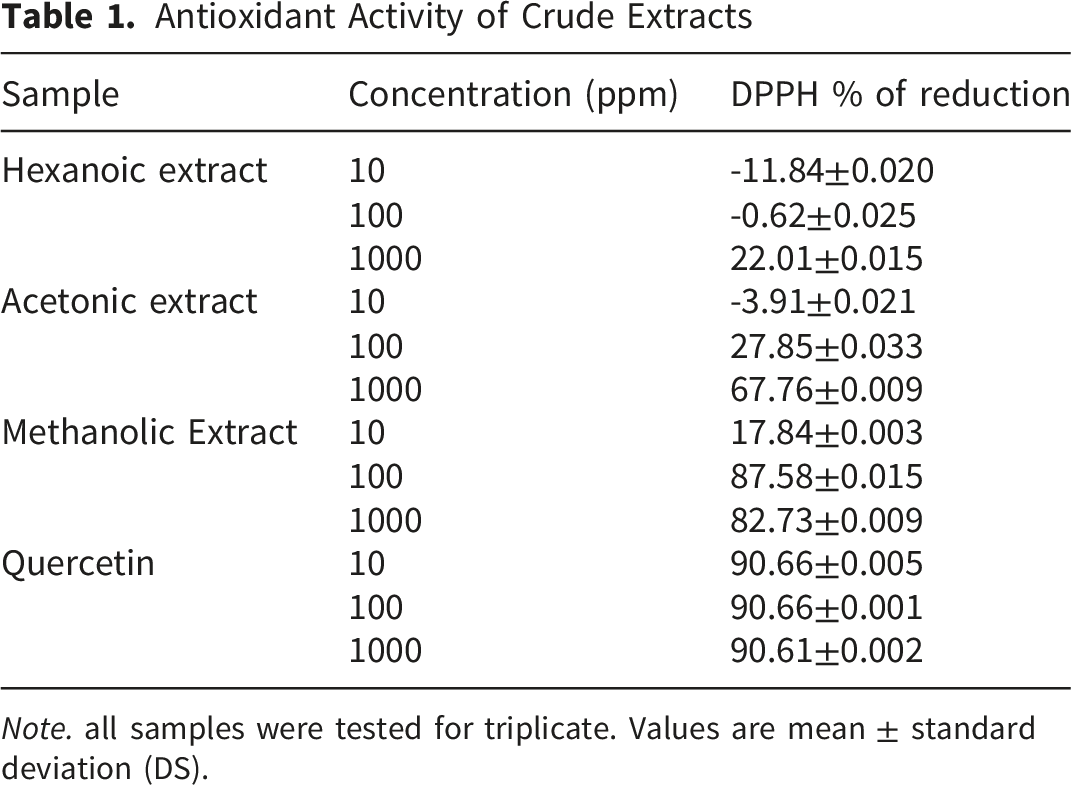
Note. all samples were tested for triplicate. Values are mean ± standard deviation (DS).
These results reveal that the methanolic extract exhibits the most significant antioxidant activity, with its extracted compounds effectively inactivating the DPPH radical. The antioxidant activity is attributed to the content of flavonoids and phenolic compounds, leading us to deduce that the methanolic extract contains a higher quantity of these compounds, thereby enhancing its antioxidant activity. Importantly, our results align with those of other authors, who have reported that the most excellent extraction of antioxidant compounds is achieved with the most polar solvents. This consistency in findings provides a strong foundation for our research. Furthermore, the novelty of our study is underscored by the absence of previous reports on these extracts, adding a unique perspective to the field.
Antibacterial Activity
Antibacterial Activity of Crude Extracts
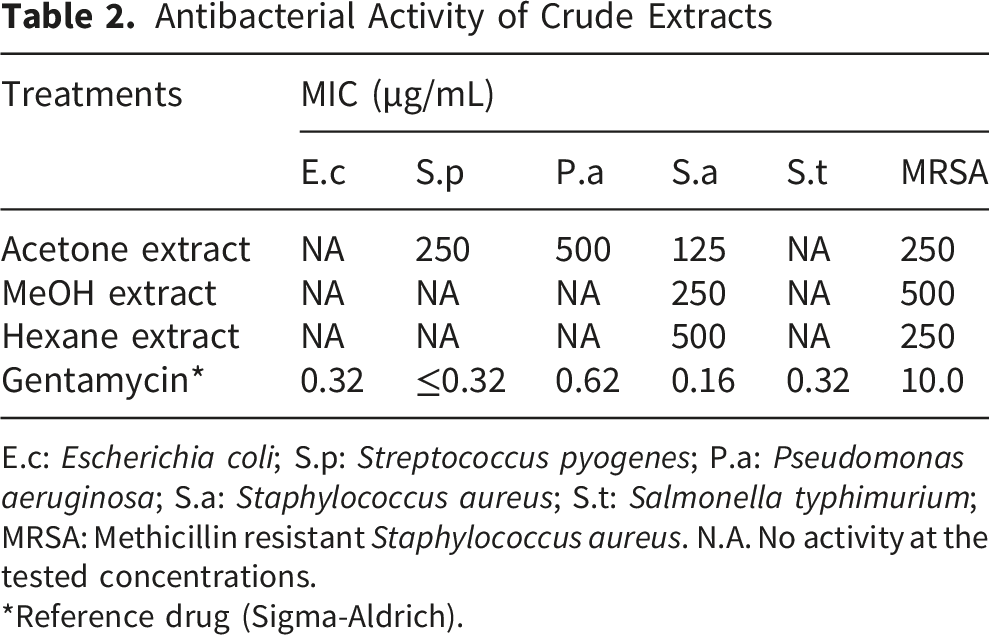
E.c: Escherichia coli; S.p: Streptococcus pyogenes; P.a: Pseudomonas aeruginosa; S.a: Staphylococcus aureus; S.t: Salmonella typhimurium; MRSA: Methicillin resistant Staphylococcus aureus. N.A. No activity at the tested concentrations.
*Reference drug (Sigma-Aldrich).
GC-MS Analysis
To identify the compounds, hexane, and acetone extracts were analyzed by gas chromatography coupled with mass spectrometry. The hexane and acetone extracts were found to contain the sesquiterpene lactone austricin ( Compounds identified in n-hexane and acetone extracts of B. salicifolius leaves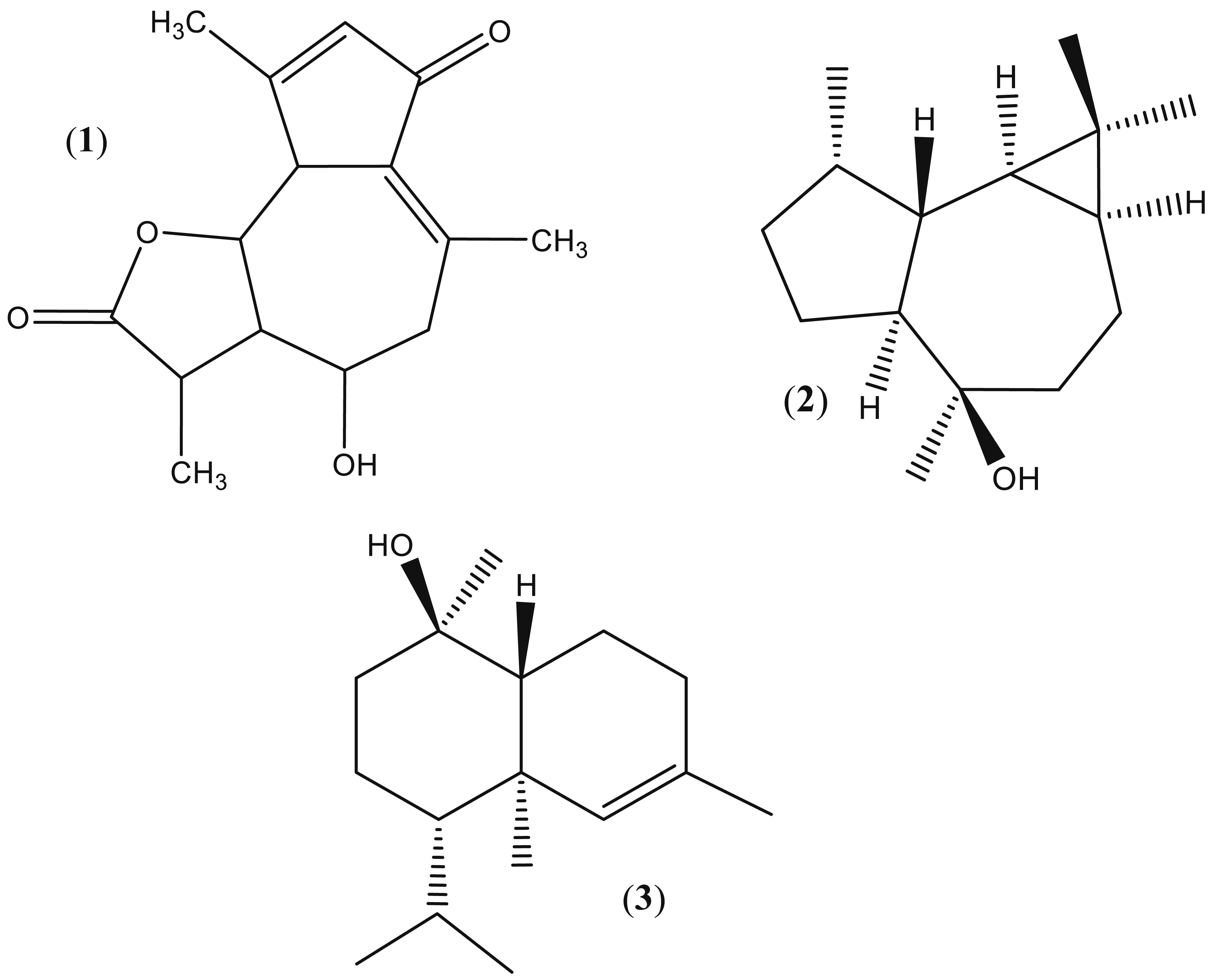
Gas chromatography coupled with mass spectrometry could not detect compounds in the methanolic extract. Therefore, other chemical analyses will be necessary to explore the chemical content.
Discussion
Antioxidant Activity
Our results reveal that the methanolic extract exhibits the most significant antioxidant activity, with its extracted compounds effectively inactivating the DPPH radical. After the chemical fractionation of the methanolic extract, the antioxidant activity was shown in all fractions. Of all of them, the activity of the most polar fraction (extracted in a hexane: acetone 7:3 system) with an inhibition percentage of 92.64% at 10 ppm, 93.22% at 100 ppm, and 96.69% at 1000 ppm. These results are competitive compared to the activity of quercetin used as a reference drug, which presents an antioxidant activity on average of 90% at those same concentrations.
This activity is attributed to the content of flavonoids and phenolic compounds, leading us to deduce that the methanolic extract contains a higher quantity of these compounds, thereby enhancing its antioxidant activity; it is important to mention that this free radical inhibition evaluation with DPPH is also a good linear correlation with the total quantification of antioxidant activity phenol. 26
Importantly, our results align with those of other authors, who have reported that the most excellent extraction of antioxidant compounds is achieved with the most polar solvents.17,26 This consistency in findings provides a strong foundation for our research. Furthermore, the novelty of our study is underscored by the absence of previous reports on these extracts, adding a unique perspective to the field.
Antibacterial Activity
The antibacterial potential (quantitative microdilution test) observed in the extracts could be due to phenolic compounds,18,27 which have been related to their use in traditional medicine for gastrointestinal ailment3,18 and their antifungal effect, 17 so we cannot rule out that these compounds, especially flavonoids already identified in the species such as quercetin,28-30 may be part of the compounds responsible for the antibacterial effect, 31 without ruling out sesquiterpenes, 29 which could well be found in the hexane extract as well as fatty acids.29,31
Bioactive Compounds in Extracts
The GC-MS results in this study revealed that the hexane and acetone extracts of B. salicifolius are sources of compounds (1-3) known and reported with diverse biological activities.
The sesquiterpene lactone austricin (compound 1) was identified in the n-hexane and acetone extracts; this compound has been isolated from the species Achillea millefolium and showed significant inhibition of nitric oxide production in RAW 264.7 macrophages induced with lipopolysaccharide (LPS), which associates it with an anti-inflammatory effect. 32 On the other hand, the antinociceptive and anti-inflammatory effect observed in in vivo model tests of the methanolic extract of leaves of the species Sphenosdeme involucrata var. Paniculata was attributed to it. 33 Additionally, it was reported as a constituent of the methanolic extract of Caragana sinica roots, whose inhibitory effect on rheumatoid arthritis was outstanding. 34 Likewise, austricin was identified in the methanolic extract of Martynia annua seeds, and an antibacterial effect was demonstrated against the Gram-positive strains S. aureus (MTCC96) and S. pyogenes (MTCC442) and the Gram-negative strains E. coli (MTCC443) and P. aeruginosa (MTCC1688). In the same study, inhibition of the enzyme alpha-amylase and alpha-glucosidase was also demonstrated. 35
The compound epiglobulol is a component of many medicinal plants; it has been attributed to antioxidant activity in the methanolic extract of leaves of Eucalyptus brevifolia F. and E. stricklandii as well as antiproliferative activity against breast, colorectal and ovarian cancer lines. 36 Another study reported that essential oils and methanolic extract of leaves of Bidens frondosa contained epiglobulol, and the antimicrobial assay exhibited outstanding activity against S. aureus, Listeria monocytogenes, Bacillus subtilis, P. aeruginosa, S. enteritidis, and Enterobacter aerogenes strains. At the same time, the antioxidant assay also showed positive results with potential applications to the food industry. 37 Likewise, essential oils of Thymus marschallianus and T. proximus showed antioxidant and antimicrobial effects against E. coli, S. aureus, B. subtilis strains, and against Rhizopus and Penicillium yeasts; these activities were attributed to the fact that the extracts contained epiglobulol.38,39 Additionally, the essential oils of Psidium guajava L. leaves in which the compound epiglobulol was identified successfully inhibited the enzymes α-amylase and α-glucosidase, and the inflammation assay exhibited a strong inhibitory effect compared to the diclofenac control, simultaneously, remarkable antioxidant activity was observed in the ABTS and DPPH assays. 39 In the leaves of Callicarpa japonica, epiglobulol was reported as a component of its essential oils, and the biological assay revealed inhibition against Bacillus cereus and S. typhimurium. 40 Similarly, the compound epiglobulol is part of the essential oils of the species Nardostachys jatamansi; the antimicrobial test showed potent inhibition against S. aureus, E. coli, Candida albicans, and Aspergillus niger. 41 Also, the compound epiglobulol was identified in the essential oils of Curcuma aromatic, and its high antimicrobial inhibition against S. aureus, L. monocytogenes, B. subtilis, P. aeruginosa, S. typhimurium, and E. coli has been reported. 42
Regarding the compound α-cadinol, it has been identified as a component of essential oils of several species, such as Annona muricata L., 43 Calendula officinalis L., 44 Ocimum basilicum L., 45 Potomorphe umbellata and Ageratina havanensis. 46 The essential oils of stems and leaves of Schisandra perulata contain a high percentage of α-cadinol, and showed an antimicrobial effect against Enterococcus feacalis and B. cereus, 47 while the methanolic extract of Xenophyllum poposum showed an important inhibitory effect of S. aureus and the effect was attributed to the compound α-cadinol 48 ; similarly, the flowers of Dispyros discolor contain α-cadinol and its biological evaluation revealed inhibition of B. cereus, S. aureus, S. epidermis, E. coli, E. aerogenes and C. albicans. 49 On the other hand, the cytotoxic evaluation of essential oils from Neolitsea variabillima leaves showed a cytotoxic effect on colon, leukemia, liver, and lung cell lines. 50 It has been reported as a nitric oxide inhibitor in RAW 264.7 macrophages stimulated with LPS, which is why it is associated with an anti-inflammatory effect; both studies argue that α-cadinol is a compound related to these effects. 51 The leaves of C. officinals L. also exhibited high concentrations of α-cadinol and showed potential antioxidant capacity with cosmetic applications. 52 On the other hand, the essential oils of Neolitsea parvigemma leaves have shown an antifungal effect against A. clavanthus, A. niger, Chaetomium globosum, Cladosporium cladosporioides, Myrothecium verrucaria, Penicillium citrinum and Trichoderma viride, as well as the fungi causing wood rot. Trametes versicolor, Phaneochaete chrysosporium, Phaeolus schweintizii, and Lenzites sulphureu, these effects were attributed to α-cadinol. 53 In addition, α-cadinol has been reported as a potential inhibitor of hypertension and also has recently been reported to be an antiviral with particular relevance against SARS-CoV-2.54,55
Therefore, the above scientific reports suggest that the compounds austricin, epiglobulol, and α-cadinol contribute to the antibacterial and antioxidant effects observed in our research. The B. salicifolius species represents a source of biologically active compounds with potential applications in developing phytomedicines. Although regular antibacterial potency was observed in the extracts, the acetone extract of B. salicifolius showed a significant spectrum of action on Gram-positive strains, especially MRSA. This indicates that there are compounds that potentiate or maintain their effect separately and can be base structures for treating infections caused by MRSA, which, given its high prevalence in terms of hospital infections and combined with the ineffectiveness of current treatments, represents a public health problem.
Further phytochemical studies are essential to gain a deeper understanding of the biological mechanisms of these extracts. This would allow for more rigorous validation of the ethnomedical applications attributed to B. salicifolius. However, this limitation presents an opportunity for future research that, from a multidisciplinary perspective, will enrich the study of natural products.
Conclusions
For the first time, it is reported that the species B. salicifolius collected in the municipality of Tlalpan in Mexico City biosynthesizes the compounds austricin, epiglobulol, and α-cadinol, which were identified by gas chromatography coupled with mass spectrometry. It should be noted that these compounds are known for their antimicrobial, antioxidant, anti-inflammatory, and cytotoxic effects. In addition to the above, the antimicrobial assays showed that the n-hexane and acetone extracts exhibited a relevant inhibitory effect on Gram-positive strains (mainly S. aureus and MRSA); this inhibition could be associated with the compounds austricin, epiglobulol and α-cadinol since they have outstanding antimicrobial reports in other species. On the other hand, the methanolic extract exhibited an antioxidant effect of 87% at 100 ppm, possibly due to polyphenolic compounds. Therefore, our findings reveal that the B. salicifolius species is a source of bioactive compounds that could solve public health problems; with a biodirected phytochemical study, we could know the active principles responsible for the biological effects observed in the present study. It is necessary to continue studying the plant species widely used in traditional Mexican medicine.
Footnotes
Acknowledgments
This work was supported by the Department of Biotechnology of the Metropolitan Autonomous University Iztapalapa and the Center of Chemistry Research of the Autonomous University of the State of Morelos, UAEM.

Author contributions
M.S.R., writing—original draft preparation and data curation; M.C.C.P., writing—review, and editing; S.M.B., formal analysis and validation; F.C.S., resources, conceptualization, and supervision; V.D., investigation, and editing. All authors have read and agreed to the published version of the manuscript.
Funding
The authors disclosed receipt of the following financial support for the research, authorship, and/or publication of this article: This work was funded through the research project “Development of new vaccine adjuvants from medicinal plant saponins, towards sovereignty in the coverage of the national vaccination scheme. Area: Public Health. within the framework of Consortia of the Call for inter-institutional collaboration projects in the State of Mexico IPN-UAM-UAEMex. Grant award numbers SIP-CC-002-2024, PE012, 7157/2024ECON
Declaration of Conflicting Interests
The authors declared the following potential conflicts of interest with respect to the research, authorship, and/or publication of this article: The authors declare that molecular structures 1, 2 and 3 were drawn using the online tool ChemDraw.