






Abstract
Objective
Sidr (Ziziphus spina-christi L.) leaves are a potential source of phenolic bioactives exhibiting promising antioxidant properties. A sustainable extraction system based on deep eutectic solvents (DESs) was developed for the recovery of bioactive-rich extract from Sidr leaves in the present study.
Methods
Six DES systems prepared from glycerol with lactic acid or propionic acid were screened. Fourier transform infrared (FTIR) spectroscopy confirmed DES formation through shifts and broadening of characteristic bands associated with hydrogen bonding interactions. Glycerol:propionic acid (1:1) was selected as the most effective solvent by principal component analysis (PCA). Extraction parameters were optimized by Box-Behnken design using immersion time, water addition and sample mass as variables.
Results
Total phenolic content (TPC) were between 10.10 mg-GAE/g-DM and 61.23 mg-GAE/g-DM, while rutin content varied from 4.69 mg/g to 32.50 mg/g. Water addition was the most influential factor for phenolic recovery. The optimized conditions were 30 min, 30% water addition and 0.948 g sample mass. Antioxidant activity correlated with TPC and total flavonoid content (TFC).
Conclusion
Antioxidant capacity of the Sidr leaf extract is mostly contributed by phenolic matrix rather than an individual compound.
Keywords
1. Introduction
Sidr (Ziziphus spina-christi L.) is a medicinal plant generally cultivated in the Middle East, North Africa and some areas of Asia. 1 It has been extensively used in traditional medicine due to therapeutic properties. 2 Sidr leaves represent a rich source of biologically active phytochemicals with potential pharmaceutical and nutraceutical applications such as phenolic compounds, flavonoids and saponins. Therefore, they have been reported to own antioxidant, antimicrobial and anti-inflammatory activities.3,4 Phenolic compounds and flavonoids are considered the main contributors to the antioxidant capacity of Sidr leaves. Their ability to neutralize free radicals and reduce oxidative stress has been associated with several health benefits such as anti-inflammatory, antimicrobial and cytoprotective activities. 3 That’s why it is a great value to recover valuable bioactive compounds from Sidr leaves.
Conventional extraction techniques commonly employ organic solvents such as methanol, ethanol, acetone or hexane to extract bioactive compounds from plant materials. Although these solvents can provide relatively high extraction yields, their use is frequently associated with several disadvantages such as toxicity, environmental hazards, solvent residues in the final products and high energy consumption during solvent recovery.5,6 These problems raise concerns regarding the sustainability and safety of conventional extraction processes. Recently, the concept of green extraction has emerged as an important strategy for the sustainable recovery of natural bioactive compounds. Green extraction approaches aim to reduce solvent toxicity, energy consumption and environmental drawbacks while enhancing extraction performance. 7 In this green concept, deep eutectic solvents (DESs) have emerged as promising green alternatives to conventional organic solvents for the extraction of natural products. DESs are made by combining a hydrogen bond acceptor (HBA) such as choline chloride with a hydrogen bond donor (HBD) like organic acids, polyols, amines or sugars. 8 The strong hydrogen bonding interactions between the components result in a eutectic mixture with a melting point lower than that of the individual components. DESs have several attractive properties (low volatility, tunable polarity, high solvation capacity and relatively low toxicity), which make them suitable for green extraction processes.9,10 Moreover, the physicochemical properties of DESs can be tailored by selecting appropriate HBAs/HBDs and adjusting the molar ratios of the components. This tunability allows DES systems to be designed specifically for the effective extraction of different classes of bioactive compounds. 11 Recent studies have further demonstrated the effectiveness of DES systems for the extraction of bioactive compounds from various natural matrices. For example, DES-assisted ultrasound extraction has been successfully applied for the recovery of trans-anethole from fennel seeds 12 and phenolic compounds from brown algae, 13 highlighting the importance of solvent composition and process optimization in maximizing extraction efficiency. These studies also emphasized that water addition plays a critical role in modifying DES viscosity, mass-transfer characteristics and extraction performance. Therefore, understanding the influence of DES composition and water content remains essential for the development of efficient and sustainable extraction processes.
The purpose of this study was to develop a sustainable extraction system based on DESs for the recovery of bioactive compounds from Sidr leaves. Different DES systems were evaluated in order to identify the most effective solvent system for the extraction of phenolic and flavonoid compounds. In addition, the extraction parameters were optimized using response surface methodology (RSM) to maximize the recovery of bioactive-rich fractions. To the best of our knowledge, no previous study has investigated the extraction of bioactive compounds from sidr leaves using glycerol-based deep eutectic solvents composed of glycerol, lactic acid and propionic acid. In addition to evaluating different DES compositions and molar ratios, this study combines multivariate solvent screening by principal component analysis (PCA) with response surface optimization to identify the most efficient extraction conditions. Therefore, the novelty of the work lies not only in the application of DES systems to an underexplored plant matrix but also in the systematic evaluation of solvent composition-extraction performance relationships for the recovery of phenolic-rich extracts.
2. Materials and Methods
2.1. Materials
Chemicals used in this study including lactic acid (90%), propionic acid (≥99%) and glycerol (≥99%) for DES preparation were procured from Merck (Darmstadt, Germany). Additional chemicals such as Folin-Ciocalteu reagent, sodium carbonate (≥99.5%), 2,2-diphenyl-1-picrylhydrazyl (DPPH, ≥95%), 2,2′-azinobis-(3-ethylbenzothiazoline-6-sulfonic acid) (ABTS, ≥98%), rutin (≥95%), ethanol (≥99.8%), methanol (≥99.9%), 6-hydroxy-2,5,7,8-tetramethylchroman-2-carboxylic acid (Trolox, ≥98%), gallic acid monohydrate (≥99%), (+)-catechin (≥98%), hydrochloric acid (37%), sodium hydroxide (≥98%), aluminium chloride (≥99%), sodium nitrite (≥97%) and potassium persulfate (≥99%) were obtained from Sigma-Aldrich (St. Louis, MO, USA).
Sidr (Ziziphus spina-christi L.) leaves were obtained from a commercial supplier in Türkiye. The desiccated leaves were ground and sieved to achieve varying particle sizes (0.5, 1.0 and 1.5 mm). The 1.5 mm particle size fraction demonstrated the highest extraction efficiency based on preliminary total phenolic content (TPC) analysis. The prepared samples were stored in airtight containers at room temperature and protected from light until extraction. No additional moisture standardization treatment was applied prior to the extraction experiments.
2.2. Extraction Procedure
Glycerol, lactic acid, and propionic acid were selected as DES constituents because of their natural origin, biodegradability, low toxicity, and previously reported effectiveness in the extraction of phenolic compounds from plant materials as described above. Different molar ratios (1:1, 1:2 and 2:1) were investigated to evaluate the influence of DES composition on hydrogen-bond interactions and extraction performance. To the best of our knowledge, the application of these glycerol-based DES systems for the extraction of bioactive compounds from sidr leaves has not been previously reported. The investigated solvent systems were prepared from naturally occurring metabolites (glycerol, lactic acid and propionic acid). According to the definition proposed for natural deep eutectic solvents, systems composed of naturally occurring primary metabolites may be classified as natural DES. Therefore, the prepared solvent systems were considered glycerol-based natural DES and were evaluated as extraction media in the present study. 14 Lactic acid/propionic acid and glycerol at molar ratios of 1:1, 1:2 and 2:1 were prepared to make natural DESs (Table S1). The components were mixed under continuous magnetic stirring at 70 °C until a homogeneous transparent liquid was obtained. After preparation, the DES systems were allowed to cool to room temperature before using as extraction solvents. Fourier transform infrared (FTIR) spectroscopy (Bruker Tensor 27, MA, USA) was employed to analyze the functional groups of glycerol, organic acids, and the prepared DESs. All spectra were recorded in the wavenumber range of 400-4000 cm-1.
Determined amount of Sidr leaf particles was mixed with the prepared DES at several solid/liquid ratio (Table S2). The extraction process was performed using an automatic solvent extraction system (SER 148/6 Solvent Extractor, VELP Scientifica, Usmate Velate, Italy). This system allows controlled temperature and automated solvent extraction cycles. In this system, the plant material is placed in cellulose extraction thimbles (single thickness, 33 mm × 80 mm, Whatman, Maidstone, UK) and immersed in the solvent. The extraction was performed under solvent boiling conditions. Since the boiling temperature depends on the DES composition and water content, the process was described as boiling extraction rather than a fixed-temperature treatment. A constant solvent volume of 80 mL was used in all experiments. Therefore, depending on the sample mass (0.4-1.2 g), the solid-to-liquid ratio varied between 1:200 and 1:66.7 (g/mL). The extraction times investigated in this study (10-30 min) correspond to the immersion stage of the automated extraction process. No separate extraction cycles were applied, and the extraction was conducted as a continuous automated operation. At the end of the process, the solvent is collected in the recovery tank and the heating system is automatically switched off to prevent overheating of the extract. This automated extraction system allows multiple extractions to be performed simultaneously with high reproducibility and reduced solvent consumption. The extracts were then collected and stored at 4 °C until further analysis. All extraction experiments were performed in triplicate. The principle and applications of automated solvent extraction systems have been previously described in the literature. 15
2.3. Determination of Total Phenolic Content
TPC of Sidr leaf extracts was determined using the Folin-Ciocalteu method with minor modifications. 16 Briefly, 20 µL of appropriately diluted extract was mixed with 2000 µL of Folin-Ciocalteu reagent (diluted ten-fold with distilled water). 1600 µL of sodium carbonate solution (0.1 N) was added to the mixture. The reaction mixture was incubated at room temperature in the dark for 30 min. The absorbance was measured at 765 nm using a UV-Vis spectrophotometer (PG Instruments, T60/Leicestershire, England). Gallic acid was used as the standard for calibration. Quantification was performed using external calibration curves prepared from gallic acid standards (Table S3). The results were expressed as mg gallic acid equivalents per gram of dry weight (mg-GAE/g-DM).
2.4. Determination of Total Flavonoid Content
Total flavonoid content (TFC) was determined according to the aluminium chloride colorimetric method. 17 In brief, 25 µL of extract was mixed with 2225 µL water. After adding 113 µL of sodium nitrite solution (5%, w/v), the sample was left for 6 min. Then, 225 µL of aluminium chloride solution (10%, w/v) was added and kept for 5 min. Subsequently, 750 µL of sodium hydroxide solution (1 M) was added. The final volume was adjusted with distilled water (412 µL). The absorbance of the mixture was measured at 510 nm. Quantification was based on calibration curves prepared with catechin standards (Table S3). Catechin was used as the calibration standard. The results were expressed as mg catechin equivalents per gram of dry weight (mg-CE/g-DM).
2.5. Determination of Antioxidant Activity
The antioxidant activity results were determined by 2 different in vitro assays (DPPH and ABTS) 16 in order to give more valid outcome. In case of DPPH radical scavenging activity, solution of DPPH in 80% methanol was prepared. 100 µL extract was mixed with 600 µL 80% methanol. Then, 3000 µL diluted DPPH was added into the final solution and incubated for 30 min. The decrease in the absorbance was measured at 517 nm. Trolox was used as the standard antioxidant. The results were expressed as mg Trolox equivalents per gram of dry weight (mg-Trolox/g-DM).
Regarding ABTS radical scavenging activity, ABTS radical cation solution was prepared one day prior to the analysis by dissolving ABTS in distilled water (7 mM) and adding potassium persulfate (2.45 mM). The mixture was vigorously shaken and kept in the dark at room temperature for 16 h to allow the formation of the ABTS radical cation. Prior to analysis, the ABTS solution was diluted with 80% methanol to obtain an absorbance of 0.70±0.02 at 734 nm. Then, 30 µL of the sample solution was mixed with 3000 µL of the diluted ABTS solution in disposable plastic cuvettes. The mixture was briefly mixed in an ultrasonic bath for 5 s, and then incubated in the dark for 5 min. The absorbance was measured at 734 nm using the UV-Vis spectrophotometer. Trolox calibration curves were used for antioxidant activity calculations (Table S3). The antioxidant activity was expressed as mg Trolox equivalents per gram of dry weight (mg-Trolox/g-DM).
2.6. Chromatographic Analysis
High-performance liquid chromatography (HPLC) analysis was performed for the determination and quantification of rutin as a marker phenolic compound in Sidr leaf extracts. The extracts were filtered through a 0.45 µm membrane filter prior to analysis. HPLC analysis was performed using a reverse-phase C18 column (250 × 4.6 mm, 5 µm). Chromatographic analysis was performed according to the method described by Toprakçı et al with minor modifications. 18 The mobile phase consisted of solvent A (0.1% formic acid in water) and solvent B (0.1% formic acid in acetonitrile) using a gradient elution program (Table S4). The flow rate was maintained at 1.8 mL/min, the column temperature was set at 40 °C. The injection volume was 5 µL. Detection was carried out at 276 nm. Identification of rutin was achieved by comparing its retention time with that of an authentic rutin standard analyzed under identical chromatographic conditions. Quantification of rutin was performed using an external calibration curve (Table S3).
2.7. Experimental Design and Statistical Analysis
RSM based on a Box-Behnken experimental design was employed to evaluate the effects of extraction parameters on the recovery of bioactive compounds from Sidr leaves. The independent variables (immersion time, water content in the DES and solid-to-liquid ratio) were evaluated at three levels as given in Table S2. These variables were selected based on preliminary extraction experiments, previous studies on DES-assisted extraction of plant phenolics18,19 and practical process considerations. Water content was included because it strongly influences the viscosity, polarity and mass transfer characteristics of DES systems, 20 whereas immersion time was selected to evaluate extraction kinetics and equilibrium behavior. The solid-to-liquid ratio was investigated due to its direct effect on solvent accessibility and extraction efficiency. 19 The investigated ranges were established according to preliminary screening tests and literature reports to ensure both effective extraction and operational feasibility. Design-Expert software (version 12, Stat-Ease Inc., Minneapolis, USA) was used for experimental design, regression analysis and optimization. The significance of the model and its terms were evaluated by analysis of variance (ANOVA) at a confidence level of 95% (p<0.05). Model adequacy was assessed by the coefficient of determination (R2), adjusted R2, predicted R2 and lack of fit tests. All experiments were carried out in triplicate. So, the results were expressed as the arithmetic mean±standard deviation.
2.8. Principal Component Analysis
Principal component analysis (PCA) is a multivariate statistical tool that transforms complex datasets into a smaller number of orthogonal components while retaining most of the original variance. 21 In this study, PCA was used as a chemometric approach to condense the TPC, DPPH and ABTS measurements into a reduced set of latent variables, and to investigate how phenolic content relates to antioxidant responses. The analysis was carried out in Minitab® (version 22.2.1, 64-bit, Minitab LLC, State College, PA, USA). The resulting score and loading plots were interpreted to compare the extraction performance of the DES systems and to identify the solvent that provided the most efficient extraction.
3. Results
3.1. FTIR Analysis of Deep Eutectic Solvents
The FTIR spectra presented in Figure 1A, B reveal the molecular characterisation of glycerol and organic acid (lactic and propionic acid) systems, as well as the interaction mechanisms between the components. FTIR spectra of glycerol, lactic acid, propionic acid, and the prepared DESs at different molar ratios: (A) glycerol-lactic acid system and (B) glycerol-propionic acid system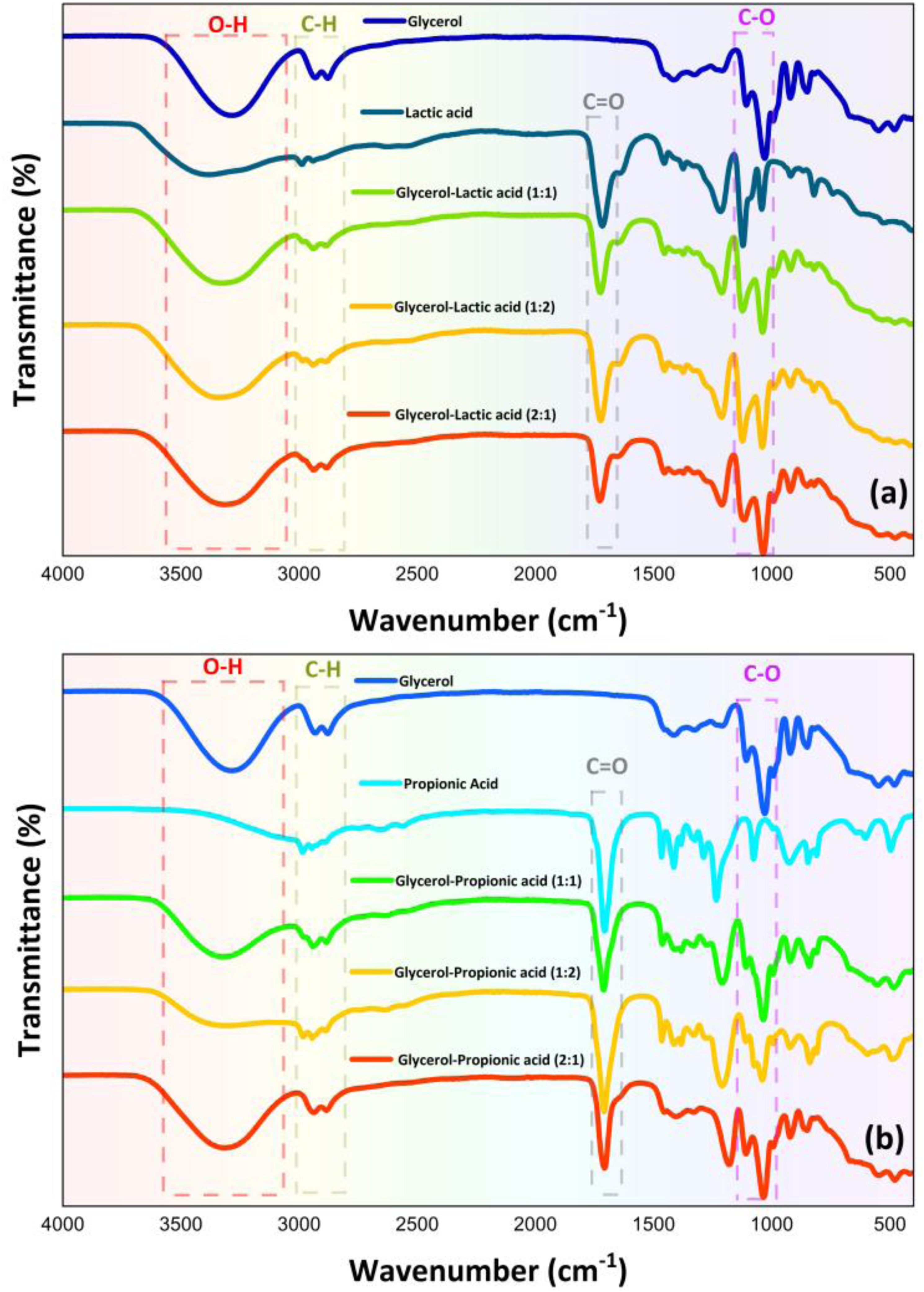
3.2. Principal Component Analysis for Screening Deep Eutectic Solvents
Principal component analysis (PCA) was applied to compare the extraction performance of the six DES systems based on TPC and antioxidant activity determined by the DPPH and ABTS assays (Figure 2). PC1 and PC2 accounted for 74.7% and 24.5% of the total variance, respectively, giving a cumulative explained variance of 99.2%, which indicates that the variability in the dataset can be reliably interpreted in the two-dimensional PCA space. The score plot (Figure 2A) revealed a clear separation of the DES systems according to their extraction characteristics. DES 4 (glycerol-propionic acid, 1:1) was located at the extreme positive side of PC1. This was associated with the highest phenolic recovery, which is in agreement with its experimentally determined TPC value (59.21 mg-GAE/g-DM), whereas DES 2 (glycerol-lactic acid, 1:2) and DES 3 (glycerol-lactic acid, 2:1) were positioned in the positive regions of both PC1 and PC2, reflecting comparatively strong antioxidant responses. In contrast, DES 1 (glycerol-lactic acid, 1:1), DES 5 (glycerol-propionic acid, 1:2) and DES 6 (glycerol-propionic acid, 2:1) clustered on the negative side of PC1, indicating lower overall extraction performance. Principal component analysis results of the deep eutectic solvent-based extracts: (A) score plot showing the distribution of DES systems and (B) biplot illustrating the relationships between DES samples and response variables (TPC, DPPH and ABTS)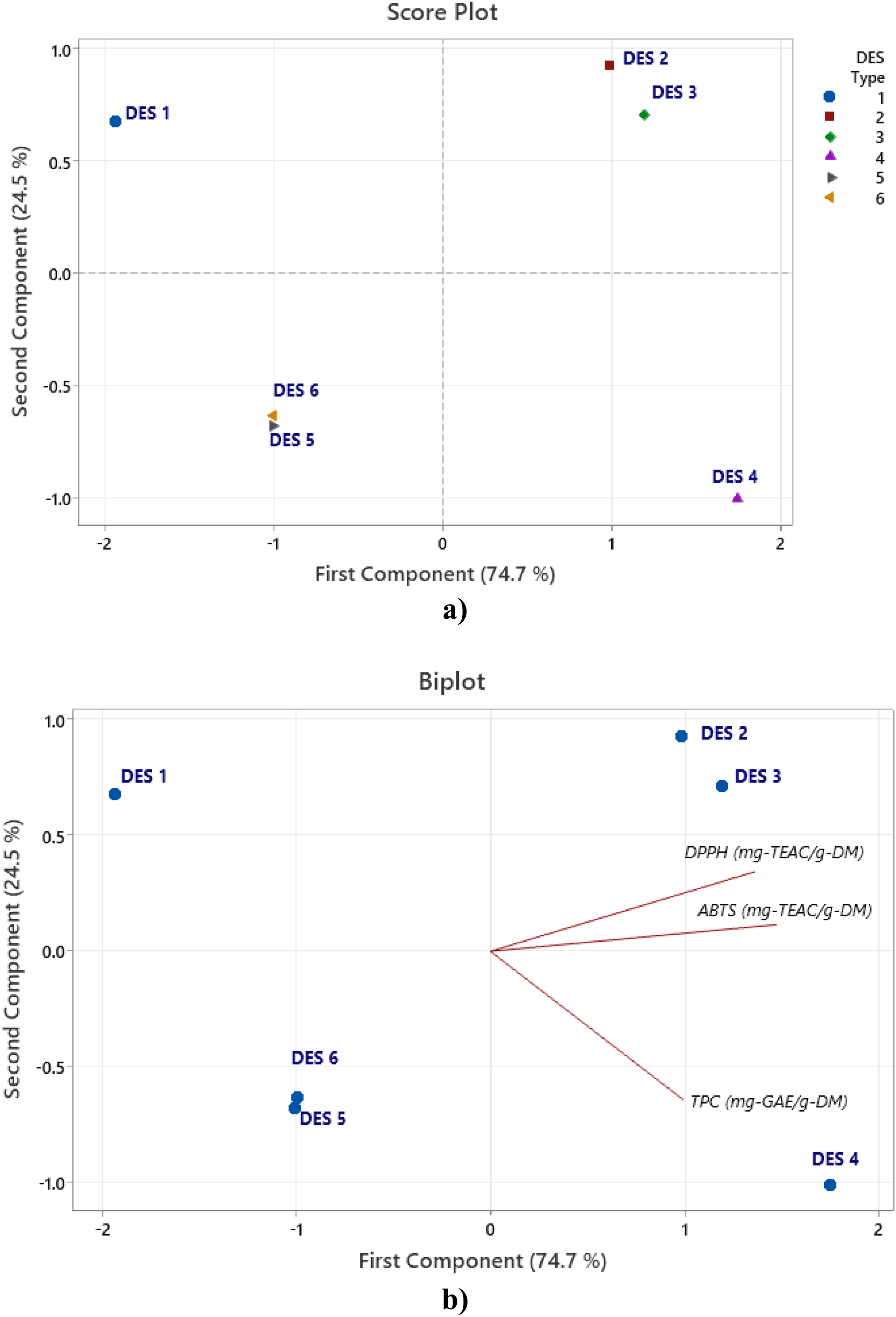
The biplot representation (Figure 2B) clarified the relationships between the DES systems and the response variables. The DPPH and ABTS loading vectors were oriented in nearly the same direction. This shows a strong positive relationship between the two antioxidant assays, which is consistent with the high correlation obtained from pairwise analysis (R2=0.88). Therefore, samples located closer to these vectors (especially DES 2 and DES 3) corresponded to extracts with higher antioxidant activity. In contrast, the TPC vector pointed in a slightly different direction, suggesting that antioxidant capacity was not determined solely by TPC but was also affected by the qualitative profile of the extracted phenolics. This separation might also reflect differences in extraction selectivity among the DES systems. These findings demonstrate that some DES systems share similar extraction behaviour, whereas DES 4 presents a distinct profile dominated by enhanced phenolic recovery. DES 4 (glycerol-propionic acid, 1:1) was selected as the solvent system for the subsequent optimization study based on this multivariate evaluation.
3.3. Extraction of Bioactive Components From Sidr Leaves
The impact of extraction conditions on the recovery of phenolic components from Sidr leaves was examined utilizing a Box-Behnken experimental design. The experimental design matrix with the responses (TPC and rutin concentration) is presented in Table S6. Rutin was selected as the major bioactive compound due to its dominant abundance and clear chromatographic resolution in the HPLC analysis (Figure S1). Therefore, chromatographic evaluation in this study focused on the quantification of rutin as a marker compound rather than on the comprehensive identification of all chromatographic peaks.
TPC values obtained from the experiments varied between 10.10 mg-GAE/g-DM and 61.23 mg-GAE/g-DM. This variety in the findings shows that extraction conditions affected phenolic recovery from the plant matrix significantly. The highest TPC was obtained in Run 1 (10 min immersion time, 70% water addition and 0.8 g sample mass). In contrast, the lowest TPC value was observed in Run 15 (10 min immersion time, 30% water addition and 0.8 g sample mass). This finding clearly shows how important water content is to the DES system. Increasing the water fraction from 30% to 70% resulted in approximately a six-fold increase in TPC, displaying that solvent composition was a dominant factor controlling the extraction efficiency.
In contrast to TPC, the highest rutin concentrations were observed under moderate solvent conditions rather than at the highest water content. The maximum rutin level (32.50 mg/g) was obtained in Run 2 (20 min immersion time, 50% water addition and 0.8 g sample mass). Similar rutin values were also obtained in Runs 3, 6 and 17, which share the same extraction conditions. These results indicate that intermediate water levels may favor the selective extraction of flavonoid glycosides, whereas higher water contents primarily enhance the overall extraction of phenolic compounds. This behavior might be attributed to the role of water in DES systems.
3.4. ANOVA and Statistical Validation of the Quadratic Model
Analysis of Variance for the Quadratic Model Describing the Effect of Process Parameters on Extraction Yield
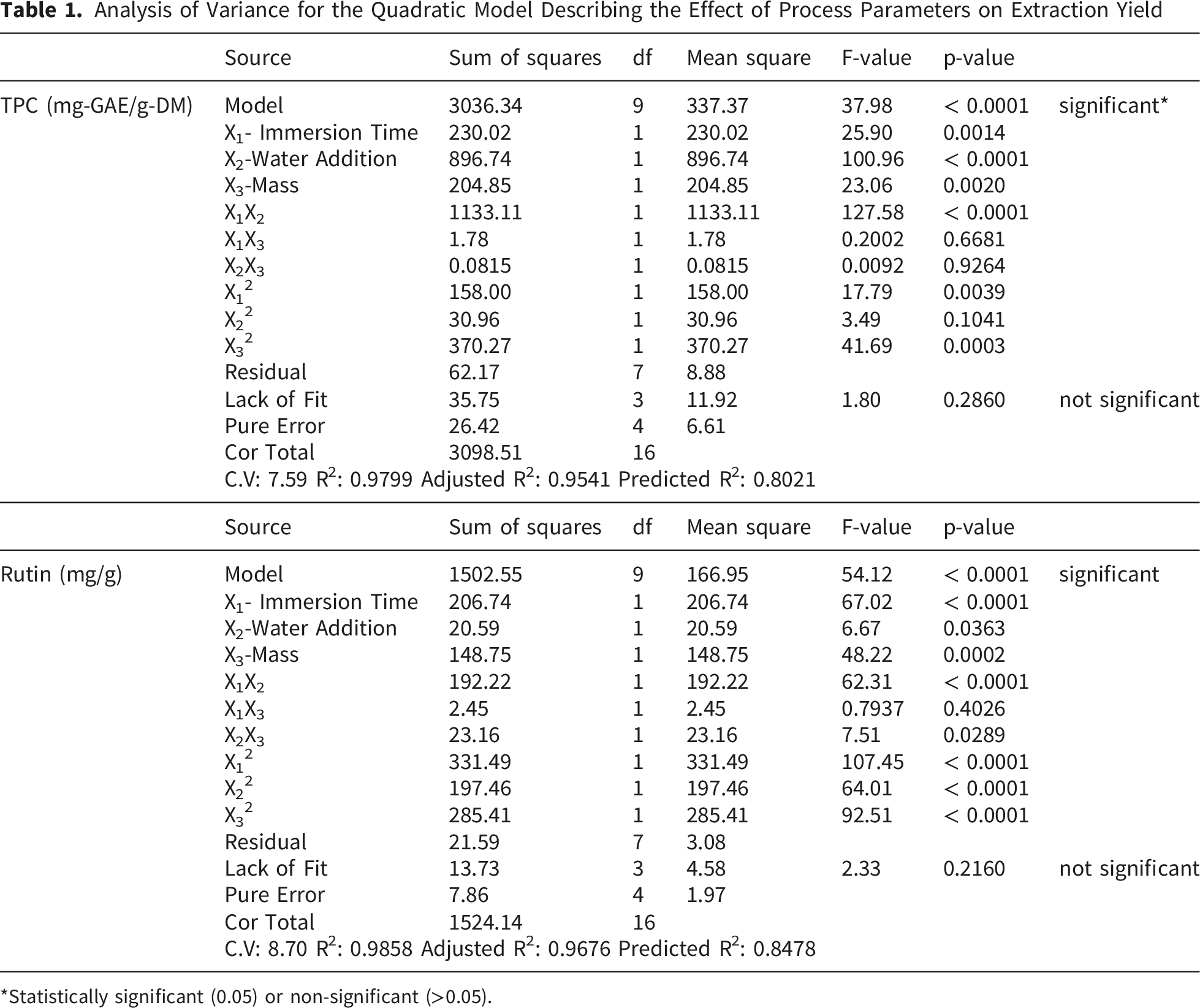
*Statistically significant (0.05) or non-significant (>0.05).
Regarding TPC, the model was highly significant (p<0.0001) with an F-value of 37.98. The coefficient of determination (0.9799) suggests that approximately 97.99% of the variability in TPC can be explained by the model. The adjusted R2 (0.9541) and predicted R2 (0.8021) values were also in acceptable agreement, demonstrating satisfactory predictive capability of the model. Water addition (X2) exhibited the strongest influence on TPC (p<0.0001), followed by immersion time (X1) and sample mass (X3). The interaction term X1X2 was also significant (p<0.0001), indicating that extraction time and solvent composition interactively affect the solubilization of phenolic compounds.
In case of rutin, the quadratic model was also statistically significant (p<0.0001) with an F-value of 54.12. The model showed highly reliable fit with R2=0.9858, suggesting that 98.58% of the variation in rutin content was explained by the model. Additionally, the lack-of-fit tests for both responses were non-significant (p>0.05), confirming that the developed models adequately describe the experimental data.
3.5. Mathematical Models Describing Extraction Responses
The relationships between the independent variables and the extraction responses were described using second order polynomial equations. Y1 represents TPC, while Y2 is the rutin concentration. X1, X2 and X3 represent immersion time, water addition and solid mass, respectively.

The positive coefficient of X2 in the TPC model shows that increasing water content in the DES improves the extraction of phenolic compounds. This behavior is consistent with the fact that moderate water addition can reduce DES viscosity and enhance mass transfer between plant tissues and the solvent phase. However, excessive water content may disrupt the hydrogen-bond network within DES systems and decrease their solvating ability, which explains the quadratic behavior observed in the model (Y2).
3.6. Optimization and Validation Studies
Multi-response optimization was performed in order to simultaneously maximize TPC and rutin recovery using the desirability function approach of the RSM model. As shown in Table S7, the optimal conditions were predicted as 30 min immersion time, 30% water addition and 0.948 g sample mass. The predicted values of TPC and rutin are 53.89 mg-GAE/g-DM and 31.00 mg/g-DM, respectively. The experimental results yielded 54.20 mg-GAE/g-DM for TPC and 30.40 mg/g-DM for rutin, which were very close to the predicted values with an error lower than 2%.
The response surface analysis indicated that the optimum water content was approximately 30%. This result suggests that moderate water addition improved extraction efficiency by reducing DES viscosity, facilitating solvent penetration into the plant matrix, and enhancing mass transfer. However, further increases in water content resulted in reduced extraction performance. This behavior may be attributed to the disruption of the hydrogen-bond network that characterizes DES systems, leading to a gradual loss of their unique solvent properties. Therefore, the results indicate that an optimal balance between viscosity reduction and preservation of the DES structure is required for efficient phenolic extraction. This indicates a trade-off between the whole phenolic recovery and selective flavonoid extraction. This tendency shows the tunable nature of DES-water systems. Consequently, the optimized conditions represents a balance favoring the effective recovery of both total phenolics and rutin.
4. Discussions
4.1. FTIR Findings
The broad O-H stretching bands observed in the 3200-3600 cm-1 range in pure glycerol and the aliphatic C-H vibrations in the 2880-2945 cm-1 region retain their characteristic features in all mixtures 22 as seen in Figure 1. With the inclusion of pure organic acids in the system, sharp and distinct C=O carbonyl stretching bands were observed around 1710-1730 cm-1. 23 Spectral variations in the width of the O-H bands and the intensity of the carbonyl peaks, resulting from changes in the mixture ratios, indicate the formation of strong intermolecular hydrogen bonds between the hydroxyl groups of glycerol and the carboxyl groups of the organic acids. Furthermore, the shifts in the C-O stretching bands observed in the fingerprint region (1000-1250 cm-1) demonstrate that the components exhibit homogeneous interaction at the molecular level. 24 These spectral changes strongly support the successful formation of a DES structure as a result of strong hydrogen bonding interactions between glycerol and organic acids.
4.2. DES Screening and PCA Interpretation
The superior performance of DES 4 might be attributed to differences in solvent-solute interactions arising from the nature of the organic acid and the DES composition. This may be associated with the balance between polarity and hydrogen-bonding capacity provided by the glycerol-propionic acid system. Phenolic compounds contain multiple hydroxyl groups that can participate in hydrogen-bond interactions with DES constituents. 25 The 1:1 molar ratio might provide a more favorable hydrogen-bond network and solvent environment for the solubilization of phenolic compounds compared with more acid-rich or glycerol-rich formulations. In addition, propionic acid possesses a slightly more hydrophobic character than lactic acid, which can improve interactions with certain phenolic constituents and contribute to enhanced extraction efficiency.
From a mechanistic perspective, the PCA results suggest that the extraction behavior of the DES systems was governed by both phenolic recovery and extraction selectivity. The close alignment of the DPPH and ABTS loading vectors indicates that both assays responded similarly to the antioxidant constituents extracted by the DES systems. In contrast, the slight separation of the TPC vector suggests that total phenolic concentration alone did not fully explain the antioxidant activity of the extracts. This observation implies that qualitative differences in the extracted phenolic profiles may contribute to radical scavenging capacity. Therefore, the PCA results indicate that DES composition influenced not only the amount of phenolics recovered but also the relative distribution of antioxidant-active compounds.
To conclude, DES 4 was selected not only because it exhibited the highest total phenolic content among the investigated systems, but also because PCA revealed a distinct extraction profile compared with the other DES formulations. The balanced composition of glycerol and propionic acid at a 1:1 molar ratio may provide a favorable combination of polarity, hydrogen-bonding capacity, and mass-transfer properties, leading to enhanced solubilization of phenolic compounds. Therefore, DES 4 was considered the most suitable candidate for further optimization studies.
4.3. Effect of Extraction Parameters and Water Addition
Previous researches examining the phenolic profile of Sidr leaves have similarly reported that rutin is a predominant phenolic ingredient that enhances the antioxidant activity of the extracts.3,26,27 Therefore, rutin concentration was used as an additional response variable in the RSM optimization to assess the impact of extraction parameters on the recovery of this bioactive molecule. Figure 3 shows the response surface plots displaying the effects of extraction parameters on TPC and rutin content. The interaction between immersion time and water addition had a pronounced effect on phenolic recovery (Figure 3A). Increasing the water proportion significantly enhanced TPC at shorter immersion times. This tendency can be attributed to the role of water in modifying the physicochemical properties of DESs as explained above.28,29 The addition of water to deep eutectic solvents is known to significantly modify their physicochemical properties. The addition of moderate amounts of water promotes the diffusion of phenolic compounds from plant tissues into the solvent phase by reducing the viscosity of solvent systems, enhancing mass transfer and modifying solvent polarity. Previous investigations on DES-assisted extraction of plant phenolics have found same findings, where inclusion of water markedly enhances phenolic recovery by reducing solvent viscosity and improving solute-solvent interactions.28,29 Response surface contour plots showing the effects of process parameters on the extraction responses. The interaction effects of immersion time (X1), water addition (X2) and sample mass (X3) on (a-c) total phenolic content and (d-f) rutin content are illustrated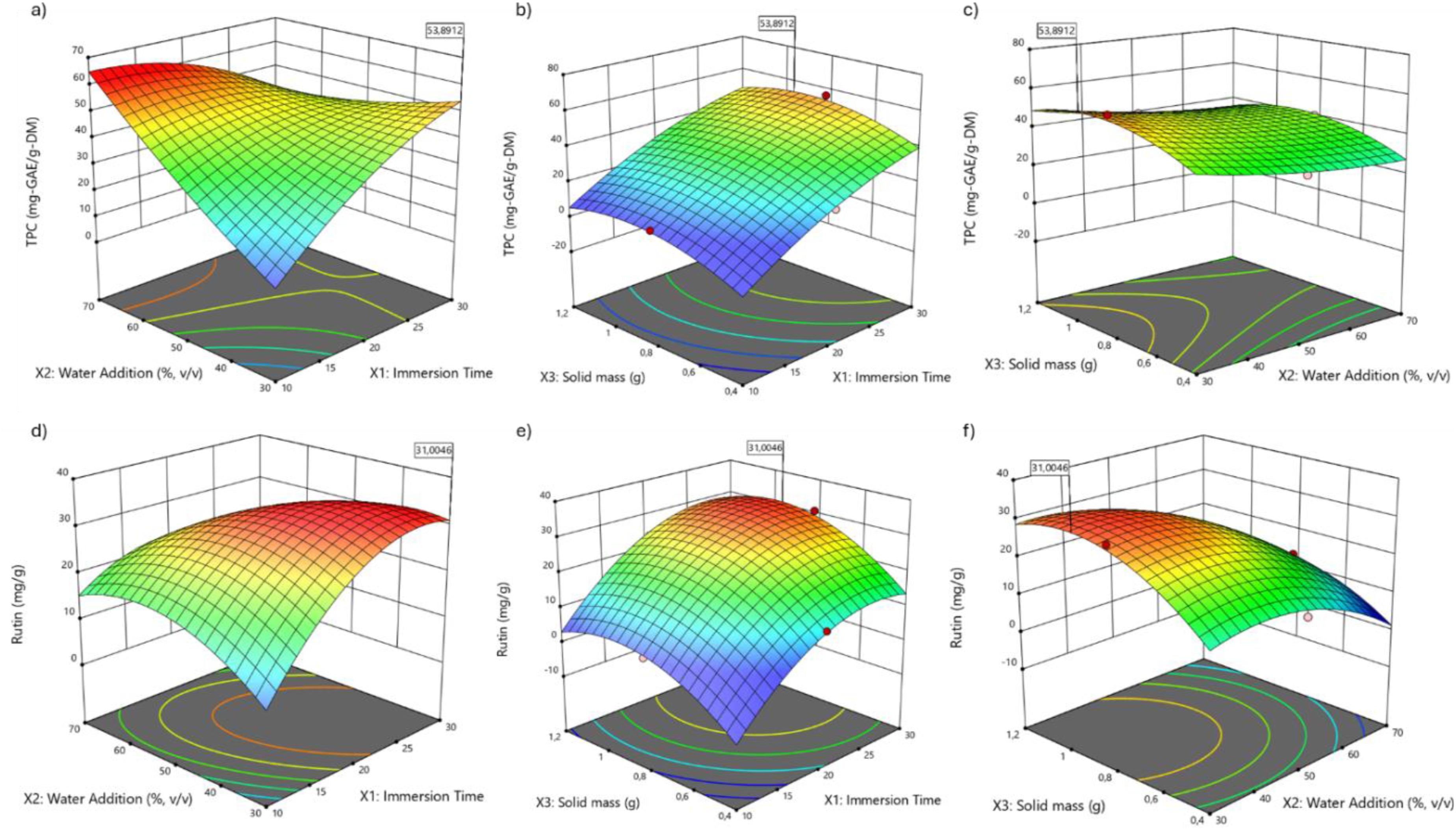
Figure 3B shows the interaction between immersion time and solid mass. Increasing immersion time generally improved phenolic recovery. Prolonged contact time enhances the diffusion of phenolic compounds into the solvent until equilibrium conditions are approached. Longer extraction times allow better penetration of the solvent into plant tissues to increase the mass transfer of phenolic compounds from the plant matrix to the extraction medium as reported in several DES-based extraction studies.30,31 However, after a certain period the extraction rate decreases as the system approaches equilibrium between the plant matrix and solvent phase.32,33
Figure 3C shows the combined effect of water addition and solid mass on TPC. The response surface indicates that higher water contents consistently resulted in increased phenolic recovery, whereas increasing the solid mass slightly decreased the extraction efficiency. This decrease might be because of the reduced solvent/solid ratio, which can limit solvent penetration and mass transfer within the plant matrix based on the transport principles. 34 The addition of water to deep eutectic solvents is known to significantly modify their physicochemical properties. The addition of moderate amounts of water promotes the diffusion of phenolic compounds from plant tissues into the solvent phase by reducing the viscosity of solvent systems, enhancing mass transfer and modifying solvent polarity. Previous investigations on DES-assisted extraction of plant phenolics have found same findings, where inclusion of water markedly enhances phenolic recovery by reducing solvent viscosity and improving solute-solvent interactions.28,29 The addition of water reduces solvent viscosity and improves mass transfer. However, excessive water can weaken the interactions between DES components and target analytes. 29
In case of rutin extraction, a different trend was observed as already explained above. As seen in Figure 3D–F, the highest rutin concentrations were obtained at moderate water contents and intermediate immersion times rather than at the highest water levels. Since viscosity might pose challenges for DES applications, the incorporation of water reduces viscosity. However, increased water content can compromise DES stability. That’s why excessive water in DES can diminish the solubility of some secondary chemicals such as rutin. 32
The obtained TPC values (10.10-61.23 mg-GAE/g-DM) were comparable with previously reported results for Sidr leaves. Previous studies have reported total phenolic contents generally ranging between 8.157 and 57.41 mg-GAE/g-DM depending on extraction method, solvent system and the origin of the plant.35,36 HPLC analysis revealed that rutin was the most abundant phenolic compound detected in the Sidr leaf extracts, with concentrations ranging between 4.69 mg/g and 32.50 mg/g depending on the extraction conditions (Table S5). Rutin (quercetin-3-O-rutinoside) is a flavonol glycoside widely reported in Ziziphus species.3,26,27 This compound is recognized for its strong antioxidant, anti-inflammatory and pharmacological properties. Due to its relatively high concentration and biological significance, rutin has been frequently used as a representative marker compound in phytochemical studies of plant extracts. 37
4.4. Antioxidant Activity of Sidr Leaf Extract and Its Relationship With Phenolic Composition
Figure 4A presents the antioxidant activities of the Sidr leaf extracts obtained under different extraction conditions. The DPPH radical scavenging activity ranged from 5.12 mg-Trolox/g-DM to 25.12 mg-Trolox/g-DM, while ABTS values varied between 2.33 mg-Trolox/g-DM and 18.15 mg-Trolox/g-DM depending on the extraction conditions (Table S6). The two antioxidant assays showed similar trends (Figure 4B), which means that the antioxidant activity findings are valid. Antioxidant activity of the extracts obtained under different experimental runs. (A) DPPH and ABTS radical scavenging capacities expressed as mg-Trolox/g-DM. (B) Correlation between DPPH and ABTS antioxidant activities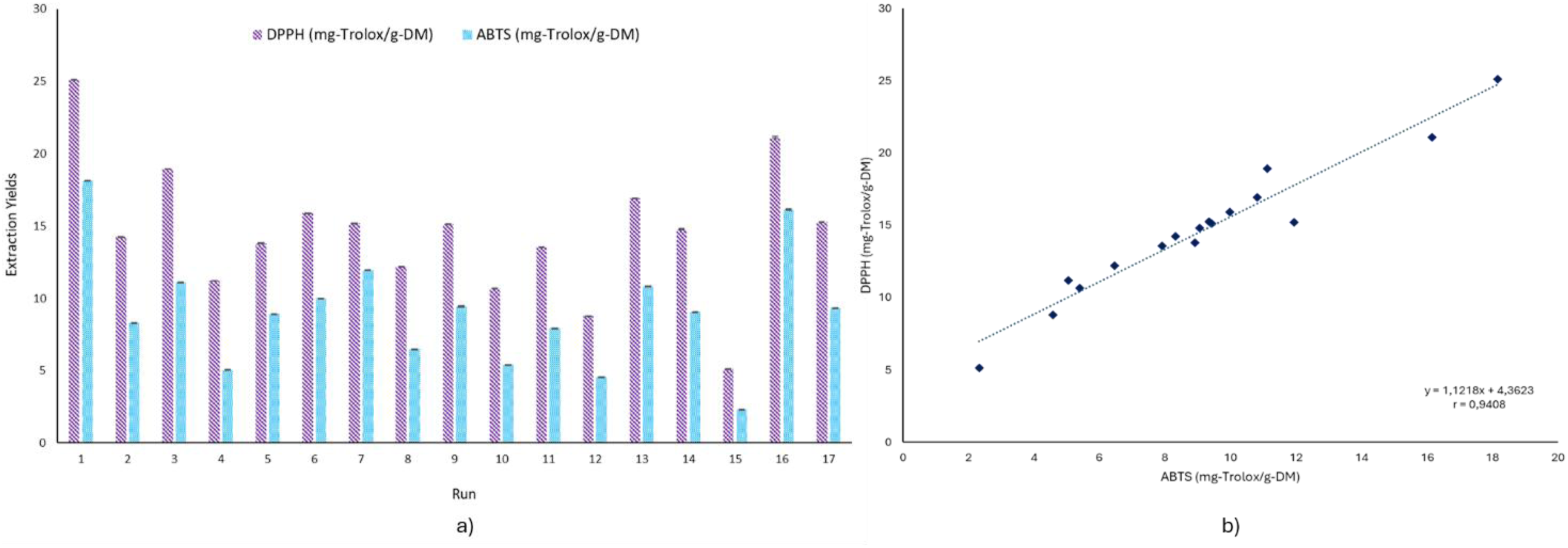
A strong positive relationship (Figure S2) was observed between TPC and antioxidant activity (R2=0.8056 for DPPH and R2=0.7817 for ABTS). These results show that the antioxidant capacity of Sidr leaf extract is mainly contributed by the phenolic concentration. Similarly, TFC also showed a positive relationship with antioxidant activity (R2=0.7236 for DPPH and R2=0.7925 for ABTS). This also means that flavonoids represent an important fraction of the phenolic pool contributing to radical scavenging capacity.
However, the individual compound rutin did not show a significant correlation with either antioxidant activity or total phenolic parameters (R2<0.20). Likewise, the relationship between rutin and TPC/TFC was negligible (<0.1). These results indicate that although rutin was the most abundant individual phenolic compound detected in the extracts, it was not the primary determinant of antioxidant activity. Instead, the antioxidant potential of Sidr leaves appears to originate from the synergistic action of multiple phenolic constituents rather than from a single main compound. Moreover, the antioxidant activity of plant extracts is often attributed to the synergistic effect of multiple phenolic constituents rather than a single compound.38-40
5. Conclusions
The present study shows that Sidr leaves can be valorized effectively through a DES-based green extraction approach. FTIR analysis confirmed the successful formation of DES systems through hydrogen bonding interactions between glycerol and the organic acids. Glycerol:propionic acid (1:1) provided the best performance through the recovery of phenolic-rich extracts with antioxidant activity. Water content in the solvent was the most effective parameter controlling the extraction behavior, where higher water levels favored total phenolic recovery, while mild conditions gave higher rutin extraction. This difference points to the selective nature of the DES-water system. This study provides the first comprehensive evaluation of glycerol-based DES systems for the extraction of bioactive compounds from Sidr leaves. The combined use of PCA and RSM enabled the identification of an extraction platform that effectively balances total phenolic recovery and rutin extraction. Although the investigated DES system demonstrated effective recovery of phenolic compounds from Sidr leaves, direct comparison with conventional organic solvent extraction methods was beyond the scope of the present study. Therefore, the sustainability advantages discussed herein are based on the established green characteristics of DES, including their low volatility, low toxicity, and biodegradability rather than on a direct experimental comparison with conventional solvents. It should be noted that the antioxidant activity reported in this study is based solely on chemical assays (DPPH and ABTS). Therefore, the results reflect the radical scavenging capacity of the extracts and should not be directly interpreted as evidence of biological or physiological antioxidant effects. Additionally, a limitation of the present study is that chromatographic analysis focused on rutin as a marker compound. Future studies should employ LC-MS or HRMS techniques to achieve a more comprehensive characterization of the phenolic composition of Sidr leaf extracts obtained using DES systems.
Supplemental Material
Supplemental Material - Designing a Sustainable Extraction Platform Using Deep Eutectic Solvents: Valorization of Sidr Leaves Into Bioactive-Rich Fractions
Supplemental Material for Designing a Sustainable Extraction Platform Using Deep Eutectic Solvents: Valorization of Sidr Leaves Into Bioactive-Rich Fractions by Selin Şahin Sevgili, Rabia Nur Bozkurt, Ebru Kurtulbaş, İrem Toprakçı in Natural Product Communications.
Footnotes

Author contributions
Selin Şahin: Conceptualization, Investigation, Project administration, Writing–review & editing. Rabia Nur Bozkurt: Methodology, Software, Formal analysis, Validation. Ebru Kurtulbaş: Methodology, Software, Formal analysis, Validation. İrem Toprakçı: Methodology, Software, Formal analysis, Validation.
Funding
The authors disclosed receipt of the following financial support for the research, authorship, and/or publication of this article: The authors received no financial support for the research, authorship, and/or publication of this article.
Declaration of conflicting interests
The authors declared no potential conflicts of interest with respect to the research, authorship, and/or publication of this article.
Data Availability Statement
The datasets generated and/or analyzed during the current study are available from the corresponding author on reasonable request.
Supplemental Material
Supplemental material for this article is available online.
References
Supplementary Material
Please find the following supplemental material available below.
For Open Access articles published under a Creative Commons License, all supplemental material carries the same license as the article it is associated with.
For non-Open Access articles published, all supplemental material carries a non-exclusive license, and permission requests for re-use of supplemental material or any part of supplemental material shall be sent directly to the copyright owner as specified in the copyright notice associated with the article.
