






Abstract
Objective
Conventional extraction methods for phenolic recovery often rely on large amounts of organic solvents and may exhibit limited efficiency. This study aimed to develop and optimize a sustainable deep eutectic solvent (DES)-assisted automatic solvent extraction (ASE) process for the recovery of phenolic compounds from Piper cubeba L.f. fruits.
Methods
Prepared DES systems were characterized by Fourier-transform infrared (FTIR) spectroscopy to confirm DES formation and investigate intermolecular hydrogen-bond interactions between their constituent components. Different DES systems were screened and compared using principal component analysis (PCA) to identify the most effective extraction medium. The selected DES system, lactic acid:ethylene glycol (2:1), was subsequently optimized using response surface methodology (RSM) based on a Box–Behnken design. Immersion time, water addition, and sample mass were evaluated as the main extraction variables.
Results
The extraction parameters significantly influenced total phenolic content (TPC), antioxidant activity, and 2-hydroxycinnamic acid recovery. TPC values ranged from 25.55 to 71.54 mg-GAE/g-DM. Antioxidant activity varied between 17.41 and 32.90 mg-TEAC/g-DM for the DPPH assay and between 8.93 and 32.51 mg-TEAC/g-DM for the ABTS assay. The content of 2-hydroxycinnamic acid ranged from 5.95 to 26.12 mg/g-DM. Optimum extraction conditions were determined as 24.95 min immersion time, 52.55% water addition, and 0.70 g sample mass, with prediction errors below 2%.
Conclusion
DES-assisted ASE enabled efficient phenolic recovery and accurate process optimization, demonstrating its potential as a sustainable alternative to conventional solvent-based extraction methods. The findings highlight the suitability of the lactic acid:ethylene glycol (2:1) DES system for enhancing the extraction of bioactive compounds from P. cubeba fruits and support its potential application in food, nutraceutical, pharmaceutical, and cosmetic formulations.
Keywords
Introduction
Cubeb pepper (Piper cubeba L.f.), a popular species of the Piperaceae family, is widely distributed in Indonesia, India, North Africa, and parts of Europe. 1 In Indonesian traditional medicine, it is used to treat asthma, kidney disorders, abdominal pain, diarrhea, enteritis, and sexually transmitted infections. 2 Furthermore, the plant and its derivatives have been reported to exhibit various biological effects, mainly antiparasitic, antimicrobial, and antioxidant activities. 3 Thanks to its volatile and aromatic properties, it serves as a deodorant in the cosmetic, pharmaceutical, and chemical industries, and as a flavoring agent in the food industry. 2 The essential oils, mainly present in its fruits, give the plant considerable economic importance. These varied biological effects are mainly due to its rich phytochemicals, such as phenolic compounds, lignans, alkaloids, and volatile oils. 1
Eco-friendly extraction methods are vital for recovering bioactive compounds in food and nutraceutical industries. However, conventional extraction techniques, such as Soxhlet and maceration, rely heavily on petrochemical and volatile organic solvents, which pose significant environmental and health risks due to toxicity and flammability. 4 These traditional methods are often characterized by high energy consumption, prolonged extraction times, and poor selectivity, which can lead to the co-extraction of impurities or the degradation of thermolabile phenolic compounds.5,6 Therefore, evaluating production processes requires considering both economic factors and environmental impacts. Recent advances in chemistry and stricter environmental regulations have driven increased interest in green extraction techniques, which are gaining recognition as sustainable and environmentally friendly alternatives.7,8 Recently, automated extraction systems have been developed in accordance with the principles of green extraction. Among these technologies, automatic solvent extraction (ASE) has attracted considerable attention as an alternative to conventional extraction methods. Compared with Soxhlet extraction, which is often associated with long extraction times, high solvent consumption, and prolonged exposure of extracts to heat, ASE provides a more efficient and automated extraction approach. Furthermore, its ability to process multiple samples simultaneously makes ASE a practical technique for both laboratory-scale and potential industrial applications.9,10 Ionic liquids and deep eutectic solvents (DESs) are among the most promising green solvent alternatives. While both share properties like low volatility and high stability, DESs differ from ionic liquids in that they are composed of non-ionic constituents. Additionally, DESs are considered safer, biodegradable, and more cost-effective than ionic liquids. 11 DESs are eutectic mixtures created through strong interactions between hydrogen bond donors (HBD) and acceptors (HBA). These interactions lead to high thermal stability, low melting points, and low volatility. Additionally, DESs can be tailored to improve solubility for water-insoluble substances, with their properties adjustable by altering their components. 12 Despite their advantages, the selection of appropriate DES components is critical, as the extraction efficiency depends heavily on the viscosity, polarity, and hydrogen-bonding capacity of the specific HBA and HBD combination.4,13 For the extraction of phenolic compounds, organic acid- and polyol-based DES systems have shown great promise due to their ability to form strong hydrogen bonds with the hydroxyl groups of phenolics, thereby increasing their solubility and stability.14-16 Lactic acid and glycerol are widely recognized as biocompatible, non-toxic, and sustainable DES components. In addition, ethylene glycol and formic acid can act as effective modifiers to reduce system viscosity and enhance mass transfer under pressurized conditions.17-19 Furthermore, recent studies have increasingly emphasized the importance of identifying and monitoring key bioactive compounds recovered from plant materials, as these constituents are often associated with important antioxidant, anti-inflammatory, and therapeutic properties and may contribute significantly to the biological activity of plant-derived products.20-24
In this study, DES systems based on lactic acid:ethylene glycol and glycerol:formic acid were employed for the extraction of phenolic compounds from P. cubeba fruits. These DES systems were selected because of their low toxicity, biodegradability, and favorable extraction properties toward phenolic compounds. To further support a sustainable extraction approach, ASE was employed as the extraction technique, and the process parameters were optimized using response surface methodology (RSM) to maximize phenolic compound recovery. To the best of our knowledge, no previous study has investigated the extraction of phenolic compounds from P. cubeba fruits using a DES-assisted ASE approach. Therefore, this study aimed to evaluate and optimize a sustainable DES-assisted ASE process for the recovery of phenolic compounds from P. cubeba fruits while highlighting the potential of integrating green solvents with advanced extraction technologies for future food, nutraceutical, and pharmaceutical applications.
Materials and Methods
Materials
Chemicals used for DESs preparation, including lactic acid (90%), formic acid (≥98%), ethylene glycol (≥99.5%), and glycerol (≥99%), were purchased from Merck (Darmstadt, Germany). Other reagents, namely Folin-Ciocalteu reagent, sodium carbonate (≥99.5%), 2,2-diphenyl-1-picrylhydrazyl (DPPH, ≥95%), 2,2′-azinobis-(3-ethylbenzothiazoline-6-sulfonic acid) (ABTS, ≥98%), methanol (≥99.9%), 6-hydroxy-2,5,7,8-tetramethylchroman-2-carboxylic acid (Trolox, ≥98%), gallic acid monohydrate (≥99%), potassium persulfate (≥99%), and o-coumaric acid (2-hydroxycinnamic acid) were obtained from Sigma-Aldrich (St. Louis, MO, USA). Deionized water was produced using a Millipore Milli-Q purification system.
P. cubeba fruits were procured from a local herbalist in Istanbul, Türkiye
The experimental work was conducted between January and March 2026 in the laboratories of Istanbul University-Cerrahpaşa (Department of Chemical Engineering, Faculty of Engineering) and Istanbul Health and Technology University (Department of Chemical Engineering, Faculty of Engineering and Natural Sciences), Istanbul, Türkiye. All extraction, analytical, and optimization experiments were carried out using the facilities available at both institutions.
Equipment
The equipment used throughout the study for DES preparation and characterization, extraction procedures, and analytical measurements is described below. DES preparation was carried out using a magnetic stirrer with heating capability (MSH-20D, DAIHAN Scientific Co. Ltd., South Korea). Fourier Transform Infrared Spectroscopy (FTIR) measurements were performed using an FTIR spectrometer (Bruker Tensor 27, MA, USA) over the spectral range of 4000-400 cm-1 to verify DES formation and evaluate characteristic functional-group shifts associated with intermolecular interactions. Extraction experiments were conducted using an automatic solvent extraction (ASE) system (VELP Scientifica, Usmate, Italy) equipped with extraction cartridges (33 mm × 80 mm; Whatman, Maidstone, UK). Total phenolic content (TPC), DPPH, and ABTS analyses were performed using a UV-Vis spectrophotometer (T60, PG Instruments, Leicestershire, UK). Chromatographic analyses were carried out using a high-performance liquid chromatography (HPLC) system (UV-Tech HPLC 1511, UVTech Inc., Beijing, China) equipped with a Luster C18 column (250 × 4.6 mm, 5 μm).
DES Preparation
DESs were prepared according to previously reported methods. 25 The components were mixed and heated at 80 °C under continuous magnetic stirring for 30-60 min, depending on the miscibility and melting behavior of the constituents. To prevent any potential thermal degradation, the heating profiles and stirring periods were strictly monitored and regulated throughout the preparation process. Stirring was continued until a clear and homogeneous liquid was obtained. DESs composed of lactic acid:ethylene glycol and glycerol:formic acid were prepared at molar ratios of 1:1, 1:2, and 2:1 (Table S1).
Extraction Procedure
Prior to extraction, P. cubeba fruits were ground and sieved to obtain a particle size below 0.5 mm, which was used in all experiments. Extraction of P. cubeba fruits was carried out using an ASE system. 9 The samples were placed into extraction cartridges, followed by the addition of 80 mL of extraction solvent. Extraction parameters, including temperature, washing time, immersion time, removal time, and recovery time, were adjusted via the device interface according to the solvent used. The obtained extracts were collected and stored at 4 °C until further analysis. All experiments were performed in triplicate.
Determination of Total Phenolic Content
The TPC was determined using the Folin-Ciocalteau method. 26 A 20 µL sample of the P. cubeba extract was mixed with 380 µL of pure water. Subsequently, 2000 µL of Folin-Ciocalteau reagent and 1600 µL of sodium carbonate solution were added. The samples were kept in the dark for 30 minutes, and their absorbance was measured at 765 nm with a UV-Vis spectrophotometer. Calibration curves were created using appropriate solvents based on pure gallic acid, and the results are expressed as milligrams of gallic acid per gram of dry matter (mg-GAE/g-DM).
Determination of Antioxidant Capacity by DPPH Method
The antioxidant activity of the P. cubeba extracts was evaluated using the DPPH assay. 27 A DPPH solution was prepared by dissolving 0.0079 g of DPPH in 40 mL of 80% (v/v) methanol. Subsequently, 100 µL of the sample solution was mixed with 600 µL of 80% (v/v) methanol and 3000 µL of the diluted DPPH solution. The mixture was then incubated in the dark for 30 min. The antioxidant activity was measured spectrophotometrically at 517 nm using the DPPH method. Calibration curves were constructed using Trolox in appropriate solvents, and the results were expressed as milligrams of Trolox equivalent antioxidant capacity per gram of dry matter (mg-TEAC/g-DM).
Determination of Antioxidant Capacity by ABTS Method
The radical scavenging activity of the P. cubeba extracts was also evaluated using the ABTS spectrophotometric assay at 734 nm. 28 Initially, the ABTS radical solution was prepared by dissolving 0.129 g of ABTS and 0.0331 g of potassium persulfate in 50 mL of distilled water. The resulting solution was covered with aluminum foil and stored at 4 °C for 16 h to allow radical formation. Prior to analysis, the ABTS solution was diluted by mixing 800 µL of the stock solution with 80 mL of 80% (v/v) methanol to obtain an absorbance of approximately 0.7. For the assay, 3000 µL of the diluted ABTS solution was added to 30 µL of the extract. The mixture was incubated in the dark at room temperature for 5 min.The results were expressed as milligrams of Trolox equivalent antioxidant capacity per gram of dry matter (mg-TEAC/g-DM).
Chromatographic Analysis
HPLC was used to analyze the phenolic composition of P. cubeba extracts. 29 Prior to analysis, the samples were filtered through a 0.45 µm membrane filter. Chromatographic separation was performed on the reverse-phase C18 column. The mobile phase consisted of solvent A (water containing 0.1% formic acid) and solvent B (acetonitrile containing 0.1% formic acid), using a gradient elution program (Table S2). The flow rate was maintained at 1.8 mL/min, and the column temperature was set to 40°C. The injection volume was 5 µL, and detection was performed at 276 nm. 2-Hydroxycinnamic acid was identified by comparing its retention time with that of an external standard (Fig. S1), and its concentration was measured using a calibration curve prepared from the corresponding standard. The results were expressed in mg/g-DM. For process optimization purposes, 2-hydroxycinnamic acid was selected as a representative phenolic marker compound to monitor extraction performance and selectivity.
Experimental Design and Statistical Analysis
RSM with a Box–Behnken design (BBD) was used to study how extraction parameters influence the recovery of phenolic compounds from P. cubeba fruits. The study focused on three independent variables—immersion time (10–40 min), water content in the DES (20–60%, v/v), and sample mass (0.7-1.3 g)—each tested at three levels (−1, 0, +1), as shown in Table S3. Design-Expert software (version 12, Stat-Ease Inc., Minneapolis, USA) was utilized for experimental design, regression analysis, and process optimization. The importance of the model and its terms was evaluated using analysis of variance (ANOVA) at a 95% confidence level (p < 0.05). Model adequacy was evaluated using the coefficient of determination (R2), adjusted R2, predicted R2, and lack-of-fit tests. All experiments were performed in triplicate, with results reported as mean ± standard deviation.
The relationship between the independent variables and the response was described by a second-order polynomial model, as shown in Eq. (1)
30
:

Principal Component Analysis
Principal component analysis (PCA) was applied as a chemometric method to summarise the data for TPC, DPPH and ABTS into a limited number of latent variables and to elucidate the relationships between phenolic content and antioxidant responses. 31 PCA was conducted using Minitab® (version 22.2.1, 64-bit, Minitab LLC, State College, PA, USA), and the resulting score and loading plots were used to compare the performance of the DESs and to determine the solvent providing the most efficient extraction.
Results
FTIR Analysis of DES Systems
FTIR spectroscopy was employed to investigate intermolecular interactions, particularly hydrogen-bond interactions, and to confirm the formation of the glycerol:formic acid and lactic acid:ethylene glycol DES systems. The FTIR spectra of HBD (ethylene glycol, glycerol), HBA (formic acid, lactic acid) and DESs synthesized at different molar ratios (1:1, 1:2, 2:1) are shown in Figures 1A and 1B. FTIR spectra of lactic acid:ethylene glycol (A) and glycerol:formic acid (B) DES systems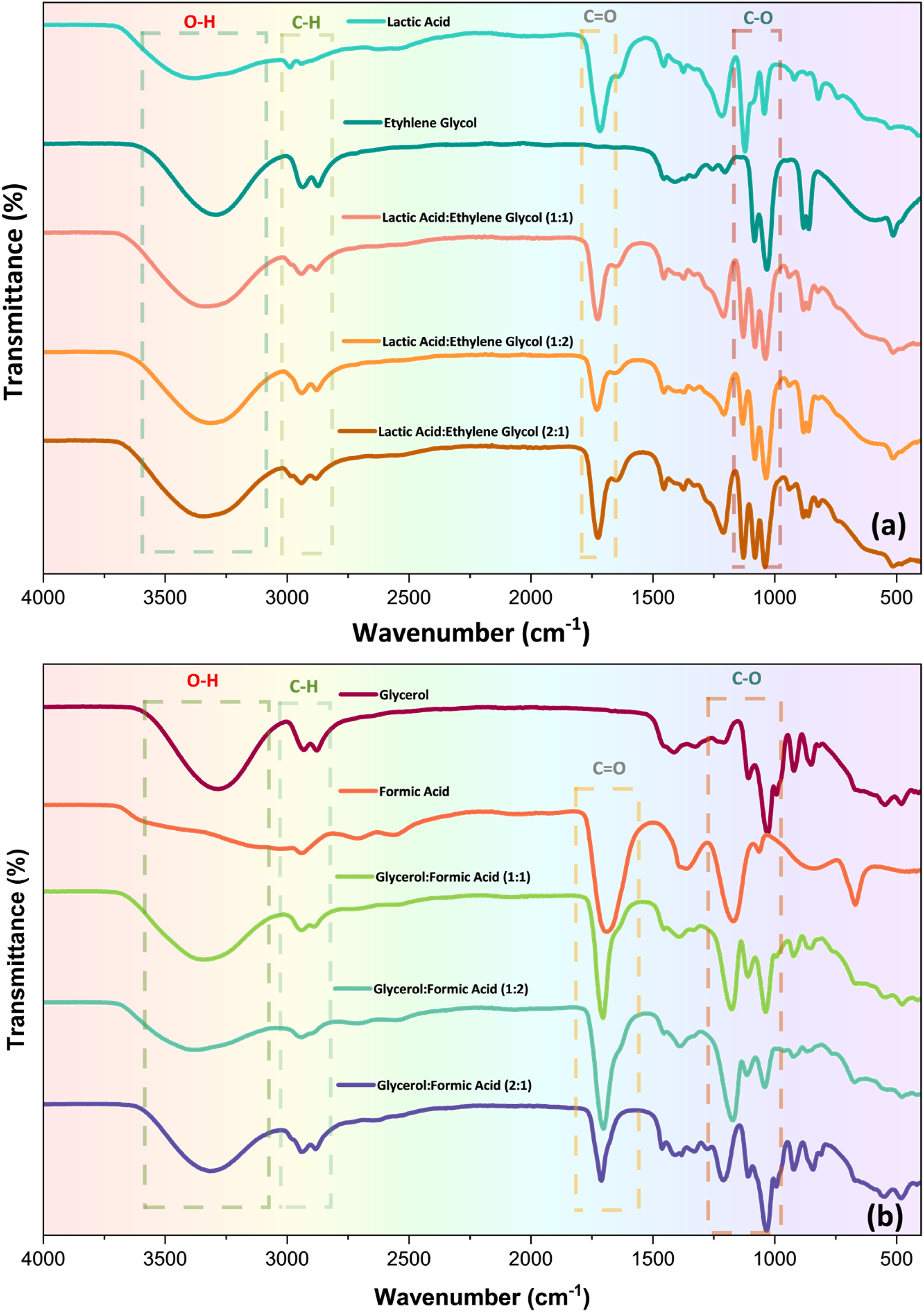
The spectra show frequency shifts and band broadening of the absorption bands with respect to the pure components. Specifically, an expansion of the O-H stretching vibration band is located in the 3300-3400 cm-1 area, accompanied by peak profile alterations. The O–H band in the lactic acid–ethylene glycol system (Figure 1A) is relatively narrow and more defined, while the similar region in the formic acid–glycerol system (Figure 1B) is larger and flatter. Also, the form and width of the O–H band differed for molar ratios of 1:1, 1:2 and 2:1 in both systems, with a particular broadening of the bands observed at the 1:2 ratio.
Another significant indication is the relative change of the carboxylic acid C=O stretching vibration about 1750 cm-1. The C=O band for the lactic acid-ethylene glycol system is clean and well-defined (Figure 1A), while the band for the formic acid-glycerol system is considerably larger and sharper (Figure 1B). Moreover, differences in intensity and profile of the C=O band were observed for DESs synthesized with varied molar ratios, showing variations of the band forms especially at 1:2 and 2:1 ratios.
Additionally, typical double peaks were observed in the range 2800–3000 cm-1, which are attributed to the C–H stretching vibrations. The intermediate intensity absorption bands of the region 800–1300 cm-1 were recognized as the fingerprint region consisting of C–O–C stretching vibrations, O–H bending vibrations and CH3 deformations.
Principal Component Analysis for Screening DESs
Principal component analysis (PCA) revealed that the initial principal component (PC1), accounting for 70.8% of the overall variance, primarily represented the general extraction performance; this was characterized by significant positive contributions from TPC and ABTS radical scavenging activity. The second principal component (PC2), which explained 26.9% of the variance, primarily differentiated the DES systems according to their antioxidant response profiles. This component distinguished solvents that favored DPPH from those exhibiting greater TPC and ABTS responses. Together, PC1 and PC2 explained 97.7% of the total variance, indicating that the variability of the dataset could be reliably interpreted in the two-dimensional PCA space.
In the score plot (Figure 2A), DES 2 (lactic acid: ethylene glycol, 1:2) and DES 3 (lactic acid: ethylene glycol, 2:1) are located on the positive side of PC1, which indicates that these solvent systems generally yield higher extraction efficiency than the others. DES 1 (lactic acid: ethylene glycol, 1:1) shows relatively high PC2 values but negative PC1 scores. This suggests a profile with stronger DPPH activity, but lower TPC and ABTS responses. In contrast, DES 5 (glycerol: formic acid, 1:2) is found in the negative areas of both PC1 and PC2, indicating that the extraction efficiency was the lowest among the solvents tested. Principal component analysis (PCA) of the DES systems based on TPC, DPPH and ABTS values: (A) score plot showing the distribution of DES samples in the PC1-PC2 space and (b) PCA biplot illustrating the relationship between the DES samples and the response variables
The biplot analysis (Figure 2B) corroborated these observations, demonstrating a close association between DES 2 (lactic acid: ethylene glycol, 1:2) and DES 3 (lactic acid: ethylene glycol, 2:1) with the TPC and ABTS loading vectors. This alignment indicates that these solvents are associated with higher phenolic recovery and stronger ABTS scavenging activity. In contrast, DES 1 (lactic acid: ethylene glycol, 1:1) is located closer to the DPPH vector, indicating a stronger association with DPPH radical scavenging activity. The glycerol-formic acid-based DESs (DES 4-6) appear farther from the response vectors, suggesting a lower ability to extract phenolic compounds and generate strong antioxidant activity.
Recovery of Phenolic Compounds From P. cubeba
Experimental Design Matrix and Responses Obtained From the BBD for ASE*
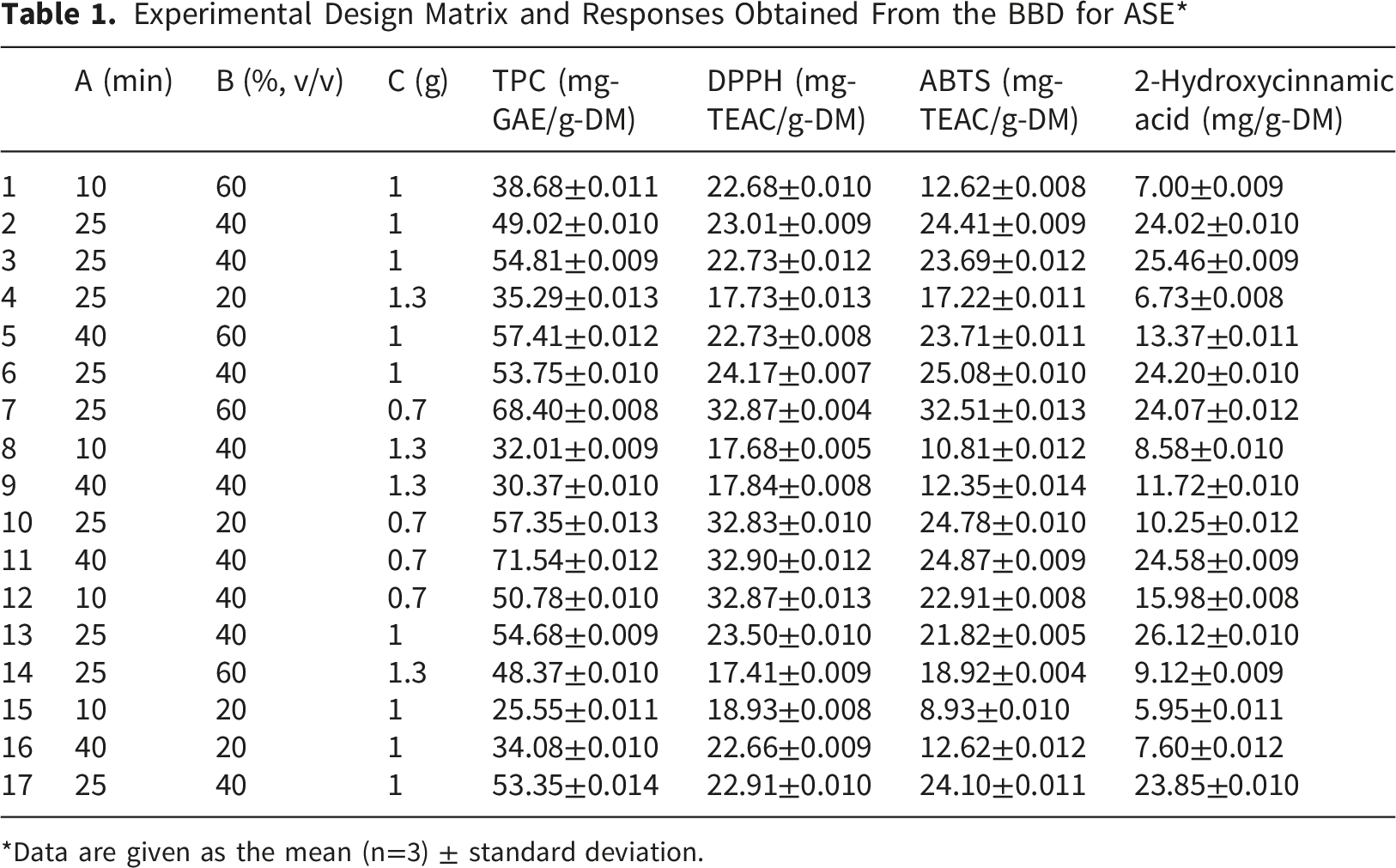
*Data are given as the mean (n=3) ± standard deviation.
According to the results obtained, TPC values ranged from 25.55 to 71.54 mg-GAE/g-DM, indicating that the extraction conditions had a significant effect on the recovery of phenolic compounds. The highest TPC value was obtained with an immersion time of 40 minutes, 40% water content (the ratio of water added to the DES) and a solid mass of 0.7 g, whilst the lowest value was observed with an immersion time of 10 minutes, 20% water content and a solid mass of 1 g.
Antioxidant activity values ranged from 17.41 to 32.90 mg-TEAC/g-DM for DPPH and from 8.93 to 32.51 mg-TEAC/g-DM for ABTS. The fact that the highest antioxidant activity values were generally obtained under conditions using a low solid content (0.7 g) and moderate water content (40–60%) indicates that extraction parameters affect not only the TPC but also the functional capacity of the extract. A generally positive correlation was observed between TPC and DPPH and ABTS results.
The 2-hydroxycinnamic acid content ranged from 5.95 to 26.12 mg/g-DM, with the maximum value obtained under extraction conditions close to the centre point. While TPC provides an overall estimation of phenolic compounds present in the extract, HPLC analysis specifically monitored the recovery of 2-hydroxycinnamic acid as an individual phenolic marker compound. Indeed, the fact that the conditions at which this compound reached its maximum did not fully coincide with those at which TPC reached its maximum indicates that extraction parameters are decisive in determining compound selectivity.
BBD-RSM Study
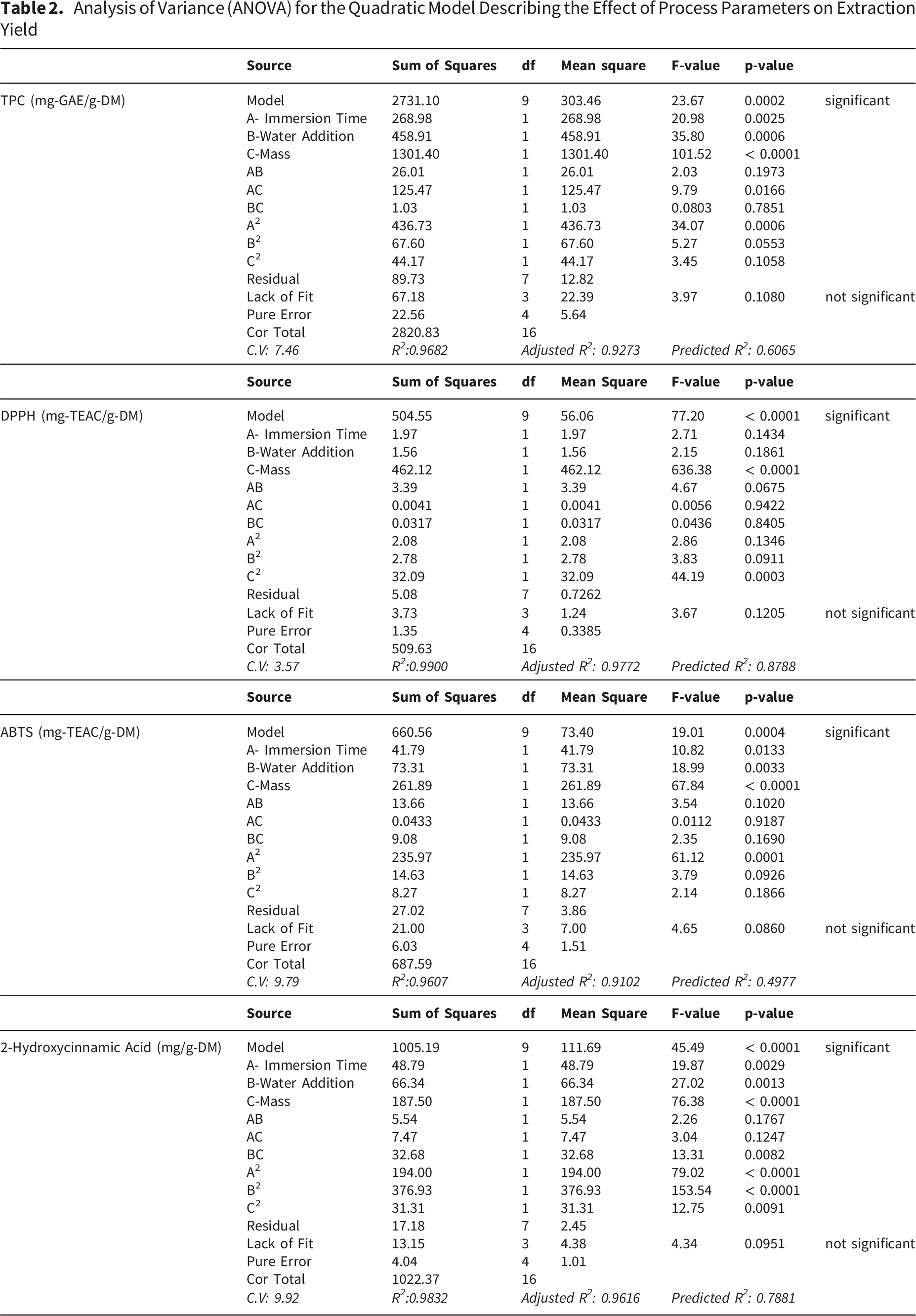
Analysis of Variance (ANOVA) for the Quadratic Model Describing the Effect of Process Parameters on Extraction Yield
The developed models correspond to total phenolic content (Y1, TPC), antioxidant capacity determined by DPPH (Y2), antioxidant capacity determined by ABTS (Y3), and 2-hydroxycinnamic acid content (Y4), respectively, and are expressed as follows:



The model was statistically significant for TPC (p = 0.0002; F = 23.67), with a high R2 of 0.9682 indicating it explains most of the variation in phenolic compound recovery. However, the predicted R2 (0.6065) being lower than the adjusted R2 (0.9273) suggests limited predictive power. Although the model exhibited a high R2 value (0.9682), the lower predicted R2 value suggests that the model is more suitable for explaining the effects and interactions of the extraction variables within the studied experimental range than for highly accurate predictions outside the studied conditions. Analysis of linear terms shows that sample mass (C) is the main factor, as increasing solid content reduces mass transfer due to a lower solvent-to-solid ratio. The notable effect of water content (B) is likely because adding water improves the DES system’s solvent properties. The significance of the AC interaction and the A2 quadratic term reveals the presence of interactions and non-linear effects during extraction.
The model was found to be highly significant in terms of DPPH (p < 0.0001; F = 77.20), and the high R2 value (0.9900) indicates that the model explains the variation in antioxidant activity to a large extent. The consistency between the adjusted and predicted R2 values demonstrates that the model possesses strong predictive capability. The fact that only the sample mass (C) was significant for this response highlights the decisive role of the solid-to-solvent ratio. Furthermore, the significance of the C2 term indicates a non-linear effect.
The model was found to be significant for ABTS (p = 0.0004; F = 19.01) and the R2 value (0.9607) indicates that the model explains a large proportion of the variation. However, the low predicted R2 value (0.4977) suggests that the model’s predictive performance is limited. The fact that all linear terms (A, B and C) are significant demonstrates that ABTS activity is influenced by all process parameters. In particular, the dominant effect of sample quantity is noteworthy. The significance of the A2 term indicates that the extraction time has an optimum value.
The model was found to be highly significant for 2-hydroxycinnamic acid (p < 0.0001; F = 45.49), and the high R2 value (0.9832) indicates that the model exhibits a strong fit. The consistency between the adjusted and predicted R2 values demonstrates that the model possesses a reliable predictive capability. The fact that all linear terms are significant for this response indicates that all extraction parameters influence the recovery of this specific compound. In particular, the dominant effect of sample mass highlights that the extraction of this compound is also largely dependent on mass transfer. The significance of the BC interaction term indicates that water content and solid quantity jointly influence solvent–analyte interactions, thereby playing a role in selective extraction. The significance of all quadratic terms, meanwhile, indicates the presence of distinct non-linear behaviour in the system and highlights that optimal extraction conditions are critical for this compound.
The fact that the lack-of-fit tests were found to be non-significant for all responses (p > 0.05) indicates that the developed models represent the experimental data without any statistically significant deviation. Overall, it is observed that sample quantity (C) is the most influential parameter across all responses, followed by water content (B) and immersion time (A).
Statistical Optimization
Table S4 summarizes the optimal extraction conditions and corresponding responses predicted by the developed models. In the optimization process, equal importance was assigned to all response variables (TPC, DPPH, ABTS, and 2-hydroxycinnamic acid). The optimum conditions were identified as 24.95 min immersion time, 52.55% (v/v) water addition to DES, and 0.70 g sample mass. Under these conditions, the deviations between predicted and experimental values were lower than 2%, demonstrating excellent agreement and confirming the adequacy and reliability of the developed models.
Response Surface Plots
The response surface and contour plots shown in Figure 3 illustrate the interactive effects of immersion time (A), the ratio of water added to the DES (B) and sample quantity (C) on extraction yield. Response surface and contour plots showing the effects of immersion time (A), water addition (B), and sample mass (C) on TPC, DPPH, ABTS and 2-hydroxycinnamic acid. (A–D) A-B interaction; (E–H) A-C interaction; (i-m) B-C interaction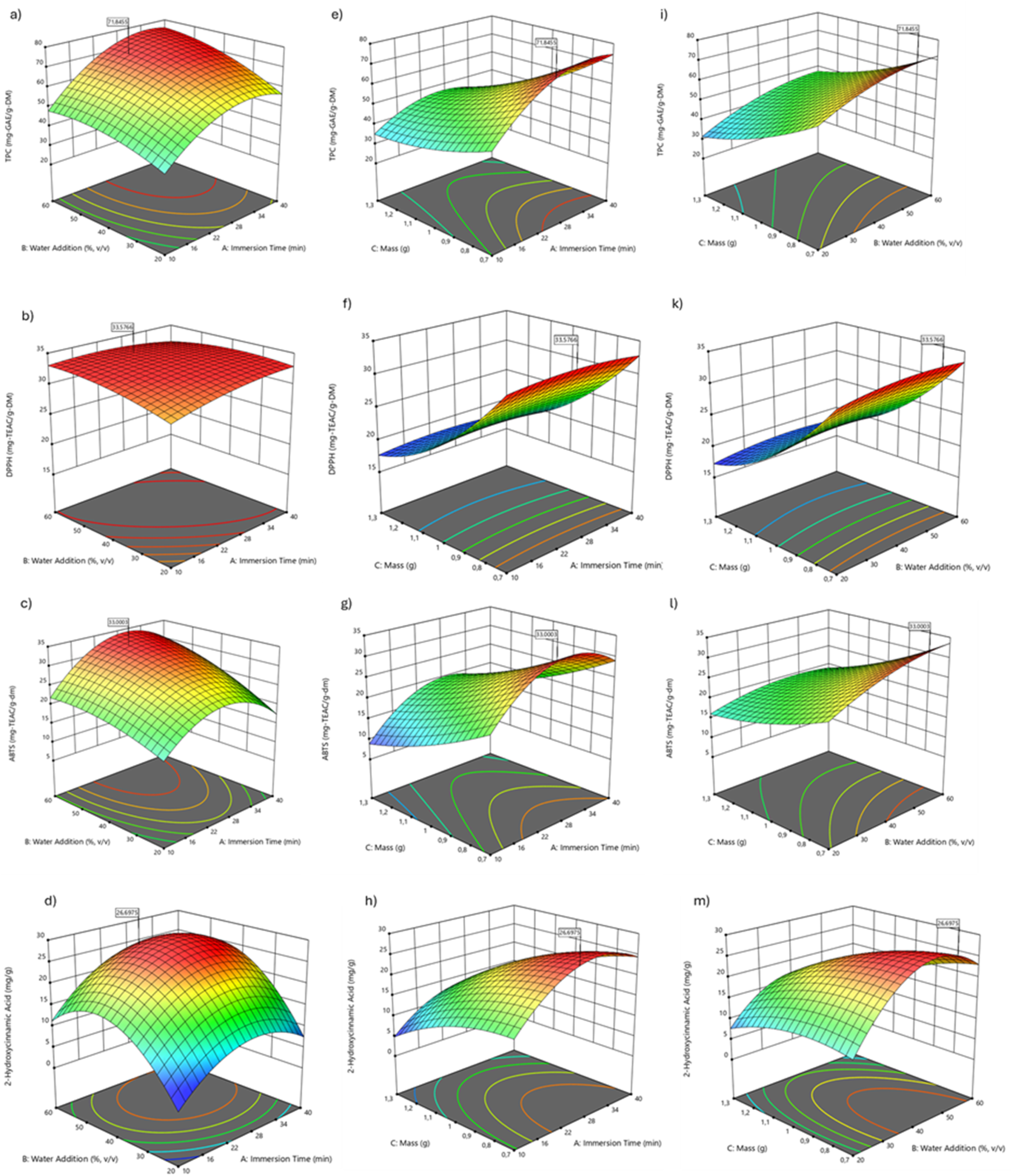
As shown in Figure 3 (a–d), both immersion time and water addition jointly affected all the responses measured. For TPC and 2-hydroxycinnamic acid, the surfaces displayed a distinct dome-shaped profile, indicating the existence of optimal conditions. Increasing A and B initially enhanced extraction efficiency. A similar trend was observed with ABTS, while DPPH exhibited a more gradual, nearly linear increase with only slight curvature.
Figure 3 (e–h) illustrates the interaction between immersion time and sample amount. Immersion time significantly affected all responses, while the influence of sample amount, though noticeable, was less strong. For TPC and 2-hydroxycinnamic acid, extraction efficiency improved with longer immersion times but plateaued at higher sample quantities. The DPPH response increased with both variables, though its slight curvature indicates a non-linear relationship. Regarding ABTS, longer immersion times clearly boosted the response, but higher sample amounts sometimes limited this increase.
Figure 3 (i–m) demonstrates how water addition interacts with sample amount. Increasing the water ratio generally boosts TPC and other responses. However, higher sample amounts tend to limit this benefit, especially at larger levels. The DPPH response shows a mainly linear increase with more water, but it decreases as sample amounts rise. Conversely, it is observed that ABTS displays a more curved trend, with higher values at high water ratios and lower sample amounts. Both TPC and 2-hydroxycinnamic acid exhibit a dome-shaped pattern, indicating optimal conditions.
Discussion
In the present study, a sustainable deep eutectic solvent (DES)-assisted automatic solvent extraction (ASE) process was successfully developed, characterized, and optimized for the efficient recovery of phenolic compounds from Piper cubeba L.f. fruits.
The spectra were analyzed to evaluate characteristic peak shifts and band broadening arising from interactions between the HBD and HBA components. The observed frequency shifts and band broadening with respect to the pure components are consistent with strong intermolecular interactions mediated by hydrogen bonds. 32 The expansion of the O-H stretching vibration band located in the 3300-3400 cm-1 area and peak profile alterations suggest the hydrogen-bond formation during the DES production. 33 The structural differences between the systems play a key role in these observations; the larger and flatter O-H region in the formic acid–glycerol system, compared to the narrower and more defined band in the lactic acid–ethylene glycol system, implies that the stronger hydrogen-bonding interactions of glycerol are attributable to the numerous hydroxyl groups. Furthermore, the broadening of the bands, in particular at the 1:2 ratio, shows that the hydrogen bond network changes according to the ratio of the components.34,35 The behavior of the carboxylic acid C=O stretching vibration about 1750 cm-1 provides further insight into the interactions between the components of DES. 36 The difference in intensity and profile of the C=O band of DESs synthesized with varied molar ratios indicates that the extent of engagement of the carboxylic acid groups in the hydrogen-bond interactions varies according to the component ratio. Especially, the variations of the band forms at 1:2 and 2:1 ratios imply the molar ratio-dependent molecular environment and the strength of the hydrogen-bond interactions. These spectral alterations confirm the emergence of a novel supramolecular structure in deep eutectic systems, differing from the individual features of the components and the occurrence of intermolecular interactions. These spectral alterations confirm the emergence of a novel supramolecular structure in deep eutectic systems that differs from the individual properties of the components.37,38Overall, the observed spectral shifts and band broadening confirmed the successful formation of the DES systems and highlighted the role of intermolecular hydrogen-bond interactions in determining their physicochemical properties.
Regarding the distribution in the PCA space, the distribution of the DES systems in the PCA space also indicates that the solvent compositions differ in their extraction behaviour. In particular, the lactic acid-ethylene glycol mixtures (DES 1-3) showed a better ability to recover phenolic compounds and a stronger antioxidant effect compared to the glycerol-formic acid-based DESs (DES 4-6).
Considering these results, DES 3 (lactic acid:ethylene glycol, 2:1) was selected as the most suitable extraction medium. As previously determined, PC1 explained 70.8% of the total variance and was mainly associated with TPC and ABTS responses, as indicated by their positive loading values (+0.670 and +0.435, respectively). DES 3 exhibited the highest positive PC1 score among all tested DES systems, indicating superior overall extraction performance. Although DES 1 showed a closer association with DPPH activity, DES 3 provided the most balanced extraction profile by combining high phenolic recovery with strong antioxidant activity. Therefore, DES 3 was selected for further optimization studies.
In the recovery process of bioactive compounds, the amount of water added to the DES system and the extraction time play a critical role in extraction efficiency. An increased immersion time enhances the transfer of phenolic compounds from the plant matrix to the solvent phase, whilst a lower solid mass increases the contact surface area with the solvent, thereby facilitating mass transfer. 39 Furthermore, the screening of functional characteristics showed that a generally positive correlation was observed between TPC and DPPH and ABTS results, suggesting that phenolic compounds are the primary determinants of antioxidant activity. Regarding the individual marker compound, this selective extraction behavior may be related to the molecular structure of 2-hydroxycinnamic acid. Unlike the broader group of phenolic compounds collectively represented by TPC, 2-hydroxycinnamic acid contains both hydroxyl and carboxylic acid functional groups that may participate in hydrogen-bond interactions with DES components. The strength of these interactions is influenced by solvent polarity and hydrogen-bonding capacity, which may contribute to the distinct extraction profile observed for this compound compared with the overall phenolic fraction.40,41 In particular, it is thought that a moderate water content supports the recovery of this compound, whereas high water ratios may limit the extraction efficiency of specific compounds by weakening solvent-analyte interactions in the DES system. 42 As noted in previous phytochemical evaluations, 2-hydroxycinnamic acid belongs to the hydroxycinnamic acid derivatives and is known for its potent antioxidant properties. 43
Previous studies have shown that P. cubeba fruit extracts exhibit high phenolic content and strong antioxidant activity, as determined by various antioxidant assays (e.g., DPPH and ABTS).44,45 In addition, several studies have characterized major phenolic compounds in P. cubeba using HPLC-based analyses, confirming the presence of bioactive constituents responsible for these activities.2,46 These findings are consistent with the present study and further support the potential of P. cubeba fruits as a valuable source of natural antioxidants.
To provide a broader perspective on extraction performance, the findings obtained in the present study were compared with conventional extraction methods previously reported for P. cubeba fruits. Hadi et al. (2025) reported total phenolic contents of 45.23, 36.04, and 12.60 mg GAE/g DM for 96% ethanol, 70% ethanol, and aqueous extracts, respectively, obtained by conventional maceration for 72 h. 47 Similarly, Qiang et al. (2022) reported TPC values of 0.66 ± 0.02 and 0.59 ± 0.01 mg GAE/g for ethanolic and methanolic extracts of P. cubeba, respectively. 48 In addition, Nahak and Sahu (2011) demonstrated that conventional solvent extraction could recover phenolic antioxidants from P. cubeba, with extraction efficiency strongly dependent on the solvent employed. 45 In the present study, the optimized DES-assisted ASE system achieved a maximum TPC of 71.54 mg-GAE/g-DM while requiring substantially shorter extraction times than the conventional extraction methods reported in the literature. The improved extraction performance may be attributed to the combined effects of pressurized extraction conditions and the unique hydrogen-bonding network of the DES system, which can enhance mass transfer and solvent–analyte interactions. These findings suggest that DES-assisted ASE represents a promising green extraction strategy for the recovery of phenolic compounds from P. cubeba fruits. In addition to achieving high phenolic recovery, the ASE system also provides important sustainability advantages through its automated operation and solvent recovery rates exceeding 90%, thereby reducing solvent consumption and improving the overall environmental performance of the extraction process. However, differences between studies may arise from variations in extraction methods, solvent systems, analytical methodologies, reporting units, and the geographical origin of the plant material; therefore, direct quantitative comparisons should be interpreted with caution.
Regarding the underlying mechanisms of the extraction parameters, increasing solid content reduces mass transfer due to a lower solvent-to-solid ratio, whilst the notable effect of water content (B) is likely because adding water improves the DES system’s solvent properties by decreasing viscosity and tuning the polarity, which directly facilitates mass transfer and improves phenolic compound solubility. As visually supported by the response surface plots in Figure 3 (a–d), the initial enhancement in extraction efficiency with increasing immersion time (A) and water addition (B) represents an efficient mass transfer phase. However, at higher water levels, the weakening of hydrogen bonds and partial disruption of the DES supramolecular structure, combined with longer extraction times, may cause degradation or structural changes in phenolic compounds, leading to reduced responses. 49
When evaluating the antioxidant responses, the fact that only the sample mass (C) was significant for this response highlights the decisive role of the solid-to-solvent ratio, and the dominant effect of sample quantity is noteworthy, while the significance of the A2 term indicates that the extraction time has an optimum value. This dome-shaped pattern is particularly evident for TPC and 2-hydroxycinnamic acid in Figure 3 (a–d) and Figure 3 (i–m), whereas DPPH exhibits a more gradual increase, likely due to the selective response mechanism of DPPH compared to the broader sensitivity of the ABTS assay. 4 Furthermore, the plateau observed at higher solid loadings in Figure 3 (e–h) confirms that sample quantity limits the process through solvent–solid equilibrium, solvent saturation, and internal diffusion resistance within the system.50-52In the case of the individual phenolic marker, the dominant effect of sample volume highlights that the extraction of 2-hydroxycinnamic acid is also largely dependent on mass transfer, and the significance of the BC interaction term Figure 3 (i–l) indicates that water content and solid quantity jointly influence solvent–analyte interactions, thereby playing a role in selective extraction. Furthermore, the significance of all quadratic terms indicates the presence of distinct non-linear behaviour in the system and highlights that optimal extraction conditions are critical for this compound. Collectively, these findings highlight the need to carefully optimise the extraction process not only in terms of total yield but also with regard to antioxidant activity and the selective recovery of specific phenolic compounds (as validated by the multi-objective optimization results in Table S4).
Limitation of the Study
Although the present study successfully optimized a DES-assisted ASE process for the recovery of phenolic compounds from P. cubeba fruits, some limitations should be acknowledged. First, the extraction performance of the optimized system was compared with conventional extraction methods through literature data rather than direct experimental comparisons. Second, the chromatographic analysis focused on 2-hydroxycinnamic acid as a representative phenolic marker compound rather than providing a comprehensive phytochemical profile of the extracts. While this targeted approach was considered appropriate for the primary objective of the study, namely the optimization of the DES-assisted ASE process and the evaluation of extraction selectivity, a more comprehensive phytochemical characterization could provide a broader understanding of the chemical composition of P. cubeba extracts.
Future studies should therefore include direct comparisons with conventional extraction techniques under identical experimental conditions and more comprehensive phytochemical characterization of the obtained extracts.
Conclusion
In this study, deep eutectic solvents (DESs) combined with automatic solvent extraction (ASE) were effectively used to recover phenolic compounds from Piper cubeba L.f. fruits. Among the tested systems, the lactic acid:ethylene glycol (2:1) mixture provided the best overall performance. The optimization results showed that extraction conditions, particularly sample mass, water content, and immersion time, play a key role in determining both phenolic content and antioxidant activity. It was observed that moderate water addition and lower sample amounts improved extraction efficiency, likely due to better mass transfer and more favorable solvent properties. At the same time, the behavior of 2-hydroxycinnamic acid differed from the overall phenolic response, indicating that extraction conditions can also influence compound selectivity. Overall, the findings suggest that DES-based ASE can be considered a practical and sustainable approach for recovering phenolic compounds from P. cubeba fruits. This method offers not only efficient extraction but also flexibility in targeting specific compounds, making it promising for future applications in food and nutraceutical fields.
Supplemental Material
Supplemental Material - Elucidating Deep Eutectic Solvent-Mediated Recovery of Phenolic Compounds From Cubeb Pepper (Piper cubeba L.f.) and Their Antioxidant Potential
Supplemental Material for Elucidating Deep Eutectic Solvent-Mediated Recovery of Phenolic Compounds From Cubeb Pepper (Piper cubeba L.f.) and Their Antioxidant Potential by Rabia Nur Bozkurt, Ebru Kurtulbaş, İrem Toprakçı, Nükte Topraksever in Natural Product Communications
Footnotes

Authors’ Contributions
Funding
The authors received no financial support for the research, authorship, and/or publication of this article.
Declaration of conflicting interests
The authors declared no potential conflicts of interest with respect to the research, authorship, and/or publication of this article.
Supplemental Material
Supplemental material for this article is available online.
References
Supplementary Material
Please find the following supplemental material available below.
For Open Access articles published under a Creative Commons License, all supplemental material carries the same license as the article it is associated with.
For non-Open Access articles published, all supplemental material carries a non-exclusive license, and permission requests for re-use of supplemental material or any part of supplemental material shall be sent directly to the copyright owner as specified in the copyright notice associated with the article.
