







Abstract
The attitudes non-members hold toward the Amish—or any ethnic, racial, and religious group—has consequences for that population, from criminal victimization to an ability to exercise human rights. Given their rapid growth and expansion in North America, an effective tool is needed to measure public attitudes toward the Amish. William McGuigan recently led the development of an Attitudes Toward the Amish (ATA) instrument, which was tested in northwestern Pennsylvania. In using the ATA in northeastern Missouri, we encountered problems with the instrument’s operational validity: no significant differences were found in the responses between a university undergraduate population of largely urban/suburban origin and the local rural population when we would otherwise expect differences. We revised the instrument and administered it to the same populations. Of the 16 items in the revised version, 14 were significantly different at the p < .05 level. A factor analysis revealed four components with face validity. Based on these results, we offer the Revised ATA (RATA) as an improved instrument and make recommendations for designing instruments intended to measure attitudes toward outgroups.
Introduction
Documenting prejudicial attitudes is important to identifying and working with intergroup tensions. Yet, the tools to measure attitudes are still relatively underdeveloped, at least in comparison to the concept these tools intend to measure, namely prejudice (Correll et al. 2010; Olson 2009; Olson and Fazio 2003). From an empirical perspective, this is problematic. Concepts must be tested and carefully qualified lest they degenerate into rhetorical devices that serve in-group interests of boundary making (Wimmer 2013). Scholars must continue to develop and refine tools that accurately measure attitudes, especially for groups that have been historically underrepresented in prejudice research.
The Amish have received sparse attention from scholars despite the fact that they are a rapidly growing ethnic-religious minority (Colyer et al. 2017). The Amish have been at the forefront of a number of high-profile conflicts around issues of private schooling, personal land rights, and hate crime targeting; they also deal with routine, localized prejudice. The presence of biased attitudes and prejudices in cases of conflict has seldom been investigated, perhaps because few reliable tools have been available to measure attitudes toward this minority.
Seeing this gap, William McGuigan took a widely used instrument measuring racism toward African Americans and adapted it to create the Attitudes Toward the Amish (ATA) instrument. McGuigan conducted several tests that supported the tool’s reliability and validity (McGuigan 2014; McGuigan and Scholl 2007). We administered it to a convenience sample of rural Midwestern residents living around Amish communities. We became apprehensive about the instrument’s operational validity, that is, that the tool produces real and practical applications.
First, we explore the subject of Amish and prejudice, including a review of McGuigan’s work on the ATA. We then demonstrate statistically that the ATA has issues of operational validity through our first phase of survey administration. We then describe, item-by-item, how we developed a Revised Attitudes Toward the Amish (RATA) tool; finally, we statistically demonstrate its improved operational validity via a second phase of data collection and analysis.
The Amish and Measures of Prejudice
The Amish are a rapidly growing social group in rural North America, part of the broader Anabaptist religious tradition and ethnically of Swiss-German ancestry (Enninger 1986). In 2010, the U.S. Religion Census reported 101,321 Amish members, 241,356 total adherents, and 1,755 congregations (Grammich et al. 2012). The Amish population doubles about every 20 years (Donnermeyer 2015), which is exceptional for any group in North America. This growth means that they are constantly in search of inexpensive land in rural areas to establish new communities (Anderson and Kenda 2015). Consequently, many relatively remote and deep-rooted rural communities are coming into contact with the Amish for the first time.
Because of the conspicuous lifestyle among the Amish—grooming customs, garments, non-motorized transportation modes, and architecture—they are easily identifiable as a group. Distinctiveness (perceived or actual) is necessary for members of any group to receive categorical out-grouping and “othering” treatment from non-group members (McGuigan and Scholl 2007). While many non-Amish carry positive images of the Amish—perpetuated in part through tourism and product marketing (Harasta 2014)—others carry prejudices that may lead to institutional discrimination through local governing policies (Fisher 1996; Pratt 2004) or individual hate crimes, such as targeting Amish homes for theft, damaging parked buggies, or throwing debris from motor vehicles at buggies (Byers and Crider 2002; Friesen and Friesen 1996: . Ch. 7; Smith 1961: . Ch. 22). When feelings run high on touch-button issues—including horse droppings on the road, zoning enforcement, animal treatment, and rejection of safety recommended devices 1 (Park 2018), public agents and service providers may need a tool to measure local attitudes toward the Amish.
Responding to this demand, McGuigan and Scholl (2007) developed the ATA scale to quantify attitudes to help delineate personal attitudes and inter-group tensions from purely pragmatic challenges. The term “attitudes” refers covertly to prejudice and bias. The ATA is based on survey items from the Modern Racism Scale (MRS) (McConahay 1986), which has been revised and reapplied to other groups. In its original form, this racism scale measured white people’s perceptions of African Americans. Participants are asked to indicate how much they agree with statements on a five-point Likert scale. Items measure both subtle racism—indirect or passive negative attitudes toward an ethnic/racial category—and blatant racism—direct and undisguised aggression toward an ethnic/racial category. This subtle/blatant distinction is capable of probing three prejudice typologies—blatant and subtle, just subtle, and neither (Pettigrew and Meertens 1995). McConahay’s Modern Racism Scale has been revised to address other groups, including Hispanics, Asians, and Jews.
McGuigan’s (2007) adoption of the ATA followed the same format, with questions reworded to predict the participant’s thoughts toward the Amish. Adopting and revising an instrument for a different group requires additional validation tests. McGuigan investigated the instrument’s construct validity, internal consistency, and temporal stability. For construct validity
Contact items: measures the contact hypothesis (Allport 1954), which states that more contact with an out-group (e.g., non-Amish people with the Amish) is associated with lower levels of prejudice, as measured by the ATA in this case.
The Need for Cognition Scale (NCS): assesses the extent to which people enjoy thinking (Cacioppo and Petty 1982), which has been negatively correlated with racial prejudice (Waller 1993).
The Social Dominance Orientation (SDO) scale: investigates the extent to which individuals prefer inequality among groups (Pratto et al. 1994), with such preferences being positively correlated with prejudice.
The Belief in Equality Inventory (BEI): ranks people’s belief that ability and potential are evenly distributed among populations, with greater belief negatively associated with prejudice (Gray, Connor, and Decatur 1994).
The Modified Godfrey-Richman I.S.M. scale: measures prejudice toward religious groups in general (Godfrey, Richman, and Withers 2000).
McGuigan administered the ATA, contact-related items, the NCS, the SDO scale, and the BEI to a convenience sample of 89 non-Amish adult customers at three local stores around New Wilmington, a small college town at the center of the largest Amish community in western Pennsylvania. Significant correlations between these scales and the ATA were in predicted directions (McGuigan 2014; McGuigan and Scholl 2007). This experiment was later replicated at Ball State University among students from Amish and non-Amish counties in Indiana (137 responses), yielding similar results (Byers and McGuigan 2017). In a separate study, the ATA and Modified Godfrey-Richman I.S.M. scale were administered to a convenience sample of 74 upper-level college students, with correlations in the expected directions (McGuigan 2014).
To test for internal consistency
Finally, to test for the ATA’s temporal stability
Because of McGuigan’s extensive testing of validity, we uncritically adopted it with the modest goal of contributing additional data to this small body of existing studies. Our sampling population consisted of residents of rural northeastern Missouri, a region with a number of small Amish communities (Donnermeyer and Anderson 2015:226, 231). However, during survey administration, verbal feedback from respondents alerted us to potential problems with operational validity, that is, the ATA’s ability to accurately represent respondents’ attitudes. This prompted a literature review, which identified studies that critiqued the original MRS scale’s operational validity. The ATA scale’s statements direct respondents toward socially desirable answers. With the presence of items measuring blatant prejudice, respondents are easily able to discern the purpose of the instrument and manipulate their answers to minimize any appearance of prejudice (e.g., Henry and Sears 2002; Redding 2014; Sniderman and Piazza 1993; Sniderman and Tetlock 1986). Further research has also argued that the subtle/blatant distinction which the MRS sought to measure is not only unnecessary but that the consequent typologies of prejudice—blatant/subtle, just subtle, and not prejudiced—are not empirically supported (e.g., Arancibia-Martini et al. 2016; Devine et al. 1991; Feilder, Messner, and Bluemke 2010; Hamberger and Hewstone 1997; Olson 2009). One strategy to salvage the blatant/subtle distinction has been to give respondents a limited time to answer questions, but this amendment has been criticized as an ineffective fix (Feilder et al. 2010). We concur with recent scholarship: blatant items should not be included on scales because it alerts respondents to the survey’s purpose in an era when appearing prejudiced is widely, even if not universally, stigmatized. Furthermore, blatant and subtle are treated as dichotomous, which is problematic.
Allport’s definition and description of subtle prejudice is nevertheless important for improving general prejudice scales. Subtle prejudice is the belief that out-groups will threaten the values of the in-group. Subtle prejudice emphasizes the differences between the in-group and out-group to explain the out-group’s minority status. Those with subtle prejudice have difficulty expressing positive emotions toward the out-group and often avoid complimenting them (Allport 1954). This definition can help guide improvements to scale items.
Our research first demonstrates that the ATA contains problems of operational validity, as others have shown for the MRS; in the initial phase of data collection and analysis, we administered the ATA to two ideologically different populations and found no significant differences between the two groups’ responses. We discuss our revisions of the ATA and demonstrate that the Revised ATA better captures respondent attitudes toward the Amish by administering the survey to these two populations and noting significant differences in responses that capture the distinctive contours of each group’s prejudice.
Survey Revision Process
An Overview of Northeastern Missouri
We began this study as a replication of McGuigan’s targeting a new population: residents of rural northeast Missouri. The regional hub of northeastern Missouri has a population of 17,000. In adjacent counties, county seat populations number not more than several hundred people and population density outside county seats is low. The regional economy is agriculture-oriented. Residents tend to identify as Republican and socially conservative. The regional hub hosts a public liberal arts university with approximately 6,000 students; this institution is the largest employer in the region. The vast majority of students come from outside the region, namely, Missouri’s two large metropolitan areas, St. Louis and Kansas City. The university population tends to identify as Democratic and socially liberal. A concentration of small Amish communities follows the northeastern Missouri/southeastern Iowa border area, making their presence conspicuous on highways, in stores, through business dealings, and as land owners. Amish communities have grown in recent decades; only several hundred Amish lived in Missouri and Iowa in the mid-1950s. They are a distinctive group, especially in social, organizational, and symbolic patterns, and are recognized and treated as such by area researchers and residents (Armer and Radina 2006; Cooksey and Donnermeyer 2013; Elmlinger 2014; Gangel 1971; Hartman 1986; Hawley and Hamilton 1996; Reschly 2000; Schwieder and Schwieder 1975). Based on our experience with the region’s and the university’s population, we proceed with the assumption that northeastern Missouri residents generally have higher levels of contact with the Amish than university students, and that different levels of contact will influence the salience of certain attitudes.
Phase I: Methodology
In Phase I, we started with the modest goal of using the ATA to contribute additional data to the studies of McGuigan, Scholl, and Byers. Participants in rural areas were selected based on a non-probability convenience sample. Researchers approached the subjects in public rural places, including a passenger train station, farmer’s market, and livestock auction. Only responses to the ATA instrument were recorded. However, respondents frequently made anecdotal comments criticizing the scale itself; we also began questioning the survey’s ability to accurately represent respondents’ attitudes.
An operationally valid measuring tool should detect significantly different attitudes between two social groups based on their cultural values and amount of contact. Accordingly, we decided to compare our rural sample to university students. Students were selected based on a random cluster sample of university classes from which 10 were randomly selected. Surveys were administered to all students in attendance during regular class times, at the convenience of their instructors. Because of the verbal feedback received from the rural sample, students were provided an additional page where they were encouraged to discuss their reactions to the survey.
Phase I: Results
In Phase 1, 59 rural residents and 169 students participated; the response rate for rural residents was not calculated, as it was a convenience sample; the student response rate was 100 percent. The disparity in sample sizes is due to our shift in focus during Phase 1 and an unexpectedly high level of accommodation from professors.
For the two samples, we calculated mean scores and t-tests for each item to determine if the two samples showed any significant differences (Figure 1). Results show no significant differences between the two groups on any item. Furthermore, standard deviations were remarkably low in all cases, indicating that participants were proximate in their responses. Even with the lower rural sample, none of the items are approaching significance so we doubt that additional surveys would substantially change our results. We decided to proceed with evaluation of the instrument’s items.
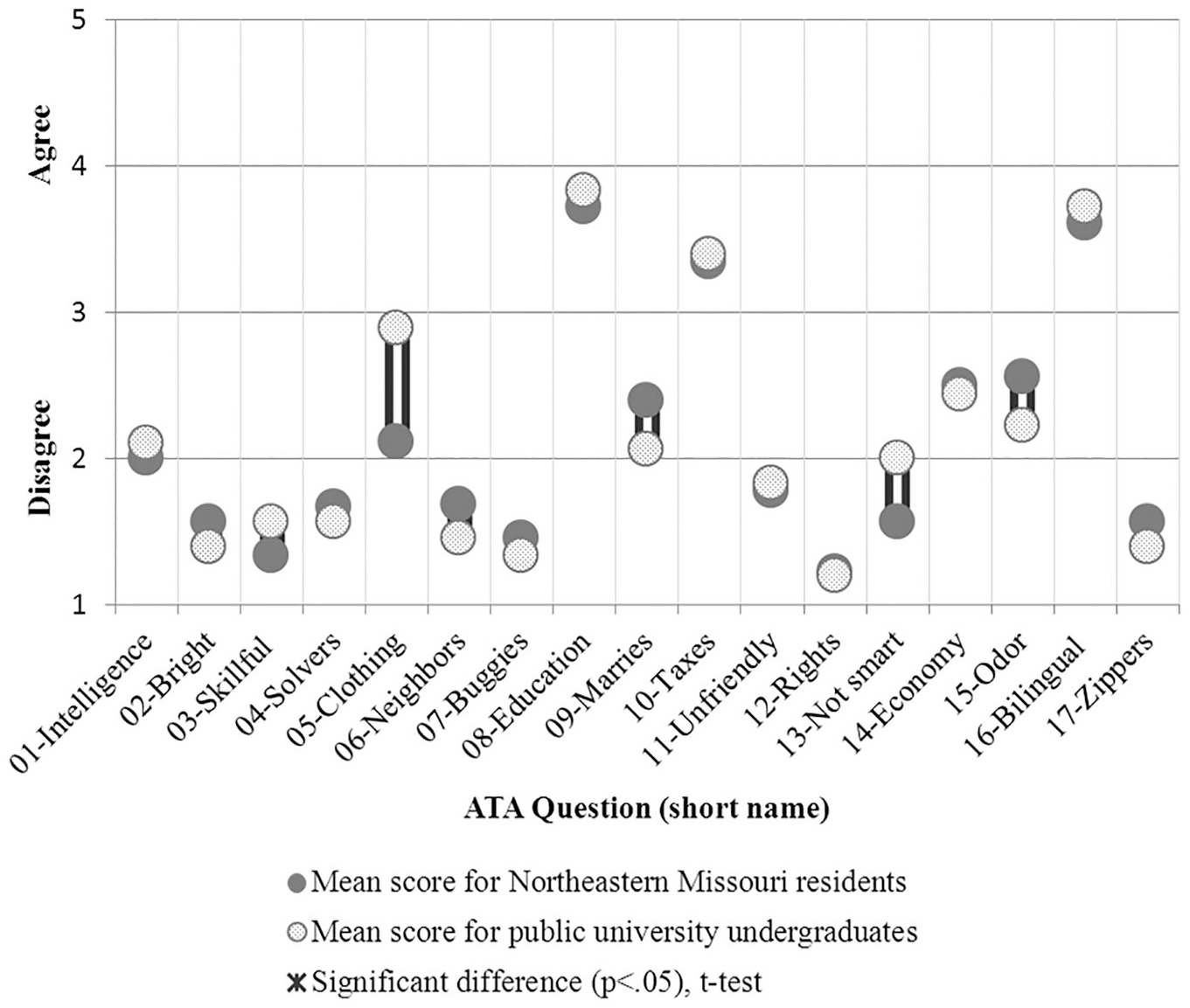
ATA responses- mean scores and significant differences between northeastern Missouri residents and public university undergraduates.
Based on written student comments and our anecdotal recollection of area resident comments, three critiques of the ATA emerged. First, some items were too difficult to answer for those with little knowledge of the Amish. Second, some items were factually inaccurate and therefore difficult to answer. Third, items had trigger words that prompted socially desirable answers, as one respondent stated succinctly: “It’s too obvious what the ‘right’ answers are.”
ATA Revisions
Based on the results of Phase 1, we revised the survey, guided by feedback from respondents, the statistical results, a review of the literature, and our knowledge of the Amish. Five revision principles emerged:
Eliminate measures of blatant prejudice.
Frame the tone of most items as positive, as it is more socially acceptable to disagree with a positive statement than to agree with a negative statement.
Recognize that “prejudice” is a simplification of multidimensional attitudes, namely (1) critiques of the “other” can be based on social philosophies other than an out-grouping prejudice and (2) critiques may follow varying value orientations.
Ensure that statements are factually accurate.
Improve the instrument design following survey construction principles, including neutralizing terminology, eliminating loaded wording, increasing understandability, tightening item wording, and eliminating double barrel items. Our changes and rationales are detailed in Table 1.
ATA Items and RATA Revised Items.

Note. ATA = Attitudes Toward the Amish; RATA = Revised ATA.
Phase II: Methods
We then administered the Revised ATA to residents in the area and students from the same university. As with phase one, rural participants in phase two were selected with a non-probability convenience sample. Participants were recruited at three public events: a flea market, a consignment auction, and a livestock auction. We did not survey the farmers’ market because it had closed for the season; neither did we survey the train station, as we had received very few responses there in phase one. All other procedures were replicated.
Student selection in phase two took place late in the semester, so changes had to be made to the method, as instructors were unwilling to allocate their class time for data collection. Students were instead selected based on a convenience sample and given surveys in on-campus residence halls, building lounges, and outdoor courtyards.
Phase II: Results
One-hundred area residents and 100 students responded to the RATA. We again calculated means, standard deviations, and t-tests for these two samples. Results (Figure 2) demonstrate significant differences between rural Missouri residents and college residents in their scores on all but two items, suggesting that the instrument is no longer leading respondents to socially desirable answers.
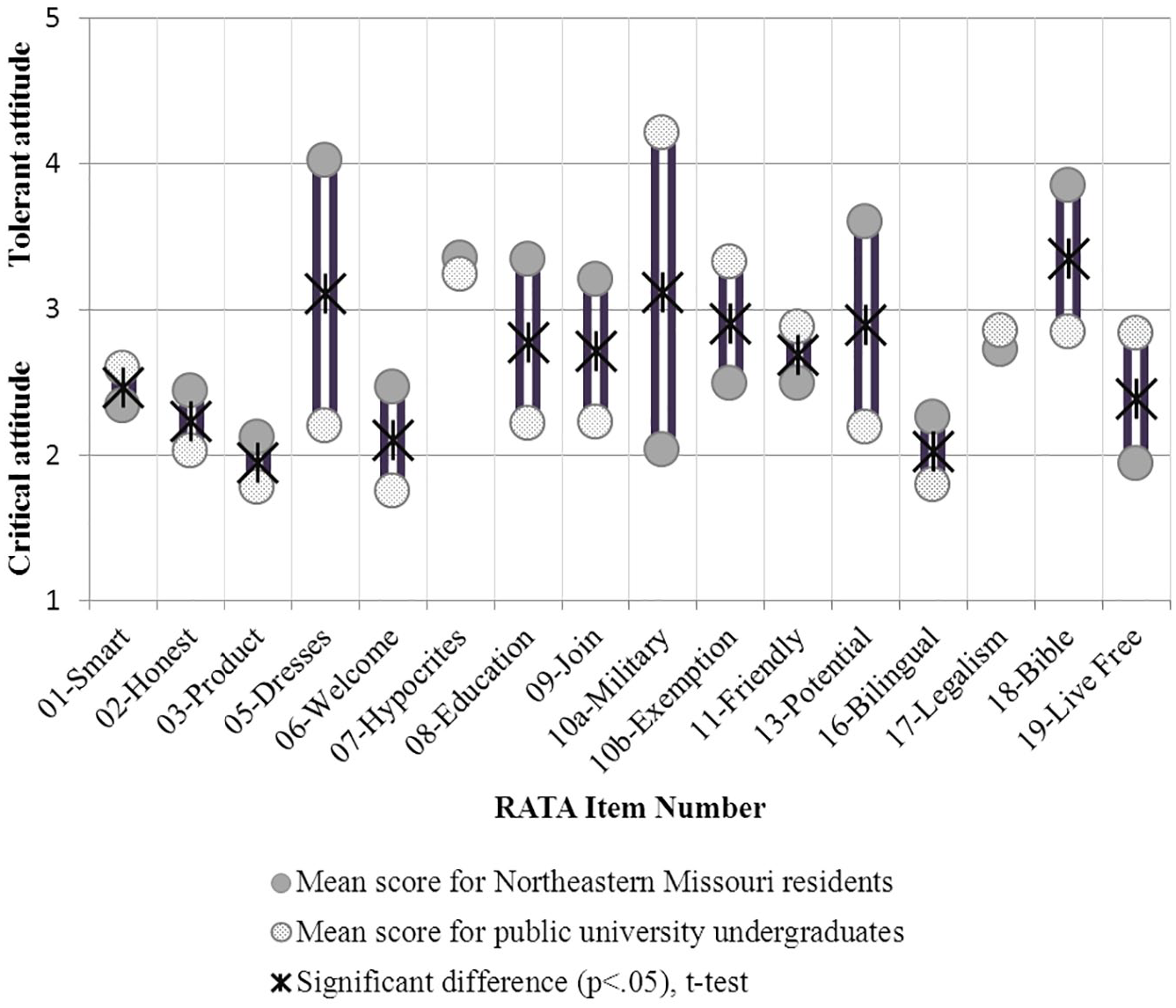
ATA responses- mean scores and significant differences between northeastern Missouri residents and public university undergraduates.
McGuigan (2014) conducted a factor analysis with varimax rotation to analyze the face validity (a subjective “at face value” validation) of the ATA; we did likewise for the RATA (Table 2). In our factor analysis, we selected four components with reasonably high eigenvalues. Component 1 had a very high eigenvalue while Components 3 and 4 were proximate; Component 2 fell in-between. We coded the results so that positive loadings indicate preference toward positive assessments of the Amish while negative loadings represent assessments against them. We considered loadings with values of ±0.375 to ±1.00.
Factor Analysis of Responses to the RATA.
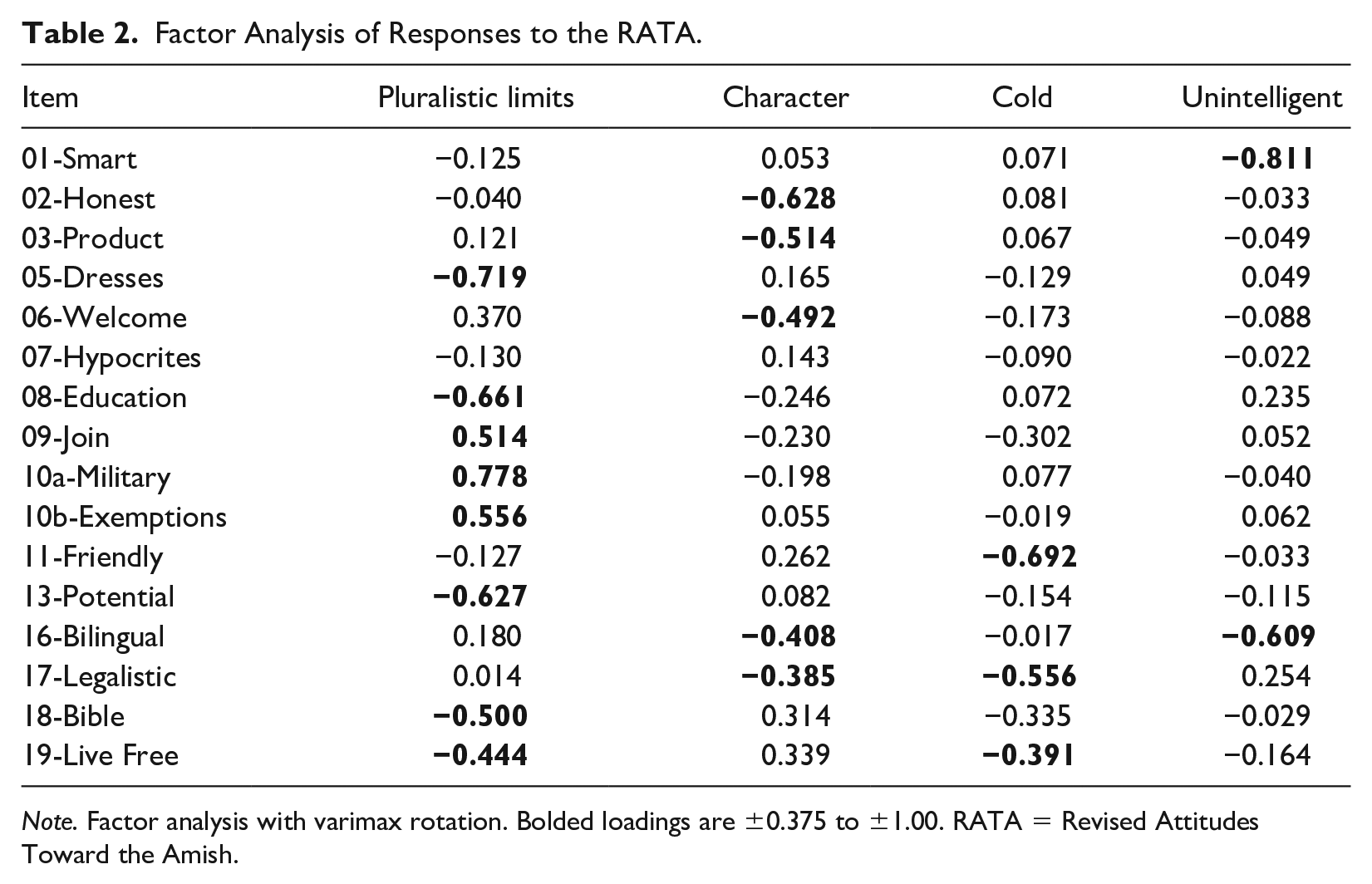
Note. Factor analysis with varimax rotation. Bolded loadings are ±0.375 to ±1.00. RATA = Revised Attitudes Toward the Amish.
Component 1 captures pluralistic limits; both high and low loadings representing a mixture of attitudes. High loadings signal a tolerant attitude of the Amish inasmuch as Amish positions align with a socially liberal attitude toward individual freedom and enlightenment, including pacifism and legal exemptions that allow Amish to live according to their beliefs. Support for a child joining the Amish probably has a high loading due to the emphasis on choice, and a high loading on welcoming Amish to the community would represent an attitude of wanting to make any minority feel accepted. Yet, this loading seems to disapprove of anything that limits Amish individuals’ choices, including a literal interpretation of the Bible, women’s dress, and a potentially substandard educational system.
Low loadings for Component 1 suggest a defense of the Amish’s right to live according to Amish values, for example, dress, school, and religious ideas. However, Amish exemption to governmental laws (preferential treatment), especially with military service, are not part of this defense. This signals a patriotic orientation that calls everyone to support and defend the system that gives people the freedom to live according to their values. Respondents who would be represented by this component are also not actively interested in intimate connections with the Amish—for example, through neighbors or through a family member joining them—indicating that they value social distance from people choosing to live differently (at least the Amish).
Component 2 focuses on Amish people’s character. Negative loadings suggest an interpretation of the Amish as dishonest—for example, not having quality products—and as having a legalistic system, which paired with the other items, suggests legalism as a system to excuse dishonesty and abuses. The Amish would not make good role models for children (at least inasmuch as they speak two languages) and would not be welcomed into the community.
Component 3 represents a view of the Amish as cold: unfriendly, legalistic, and smothering their own people. Component 4 represents views of Amish as unintelligent; the second of McGuigan’s (2014) components in his ATA factor analysis was similar.
These four components represent plausible, easily interpretable, and prevailing attitudes toward the Amish discussed elsewhere in the literature (e.g., Boyer 2008; Byers, Crider, and Biggers 1999; Park 2018; Pratt 2004; Trollinger 2012; Weaver-Zercher 2001) and thus contributes to the face validity of the RATA items. However, we must emphasize that these polarities did not clearly follow the divide between Northeasten Missouri residents and public university undergraduates, which invites further research into the complexity of attitudes.
Discussion
An effective survey instrument should detect variations across populations. In our initial administration of the ATA, we found no significant differences between university students and rural residents, groups we would reasonably expect to have contrasting perceptions of the Amish. This called into question the ATA’s operational validity, that is, whether the instrument accurately measures people’s attitudes. From respondents’ feedback and our own assessment, we concluded that the main problem was wording that prompted socially desirable responses; respondents could detect that the instrument was measuring prejudice and adjusted their answers accordingly. McConahay’s original racial prejudice scale was developed 30 years prior to our research. Since then, public sensitivity to prejudice has evolved considerably, as has the social stigma associated with it. Individuals are more seasoned at spotting prejudice in others as well as identifying cues for which they themselves are being tested. While we acknowledge that the ATA has already undergone rigorous testing, we also believe it prudent that the survey adapts to a changing social landscape. To that end, we revised the ATA to enhance its ability to accurately measure attitudes. In so doing, we also abandoned the concept of prejudice as an either/or phenomenon, acknowledging that attitudes are multilayered and poorly represented along a one-dimensional prejudice/non-prejudice scale. More helpful is an instrument that characterizes attitude that result in various combinations of context- and issue-specific social actions of prejudice and exclusion (Wimmer 2013).
Results from the RATA are a promising step in this direction. We identified statistically significant differences between university student and rural resident responses on all but two items. Additionally, a factor analysis produced four components that capture realistic yet multidimensional attitudes toward the Amish that do not simply categorize respondents as more or less prejudiced.
The pluralistic limits component is helpful in identifying underlying philosophies in common Amish/non-Amish conflicts. A liberally oriented conflict may entail non-Amish intervention when certain individual rights are perceived to be violated by the group or when they are perceived as wanting to impose their values on society (as discussed in relation to the Amish in Cohen 2014; Friesen and Friesen 1996: . Ch. 1; Mazie 2005; Neuberger and Taman 2014; Raley 2011). Cases may focus on perceived or actual deficiencies in family care, quality of education, treatment of animals, or absence of home safety equipment such as fire alarms. A patriotically oriented conflict might focus on Amish people’s responsibility as American citizens or a resource-based competition between the Amish and locals (as discussed in Glover 2011; Park 2018; Pratt 2004). Conflicts may focus on minority preferential treatment, as with exemption from a military draft and Social Security; interference with others’ use of the roads, as with horseshoe damage, horse droppings, and slow buggies holding up traffic; and a come-here/been-here tension when Amish move in and buy up land.
The first component shows that attitudes toward the Amish cannot be simply measured along a scale. Any given ideological cluster may be more tolerant of the Amish than another depending on the issue. Action in any conflict has the potential for misunderstandings and prejudices, whether it is a liberal-leaning “the Amish are patriarchal and hiding much abuse” or a conservative-leaning “the Amish are driving land prices up and locals out.”
The other three components, however, move into areas that do not clearly show a conservative or liberal philosophy. The character component, for example, suggests that some people have had poor personal experiences with the Amish. This component may capture some of the frustrations and dynamics documented qualitatively among local residents in a northwestern Pennsylvania Amish community (Park 2018) and service providers working with a Mennonites in Ontario (Good Gingrich 2016). Inversely, others have had positive experiences, including people who consume Amishness through tourism and media from a distance and certainly some who have regular, interpersonal contact. The hundreds of Amish communities vary in reputation with non-Amish neighbors.
Our study has several limitations mainly related to our sampling. In Phase 1, we surveyed a relatively low number of northeast Missouri residents compared to university students. This was due to our shift in purpose, from a study that used the ATA to one that investigated the operational validity of the instrument itself. We also lost several potential surveying sites by the time we discussed gathering more data, as winter was well underway and the outdoor venues we had used to sample the population were closed for the season. Additionally, in Phase 2, we needed to change our sampling methods again due to timing, both with the student population and with the sampling sites for the rural population. Nevertheless, we feel that the statistical differences between the two phases are compelling when juxtaposed against respondent feedback that identified problems with the original instrument; a literature review that revealed problems with the McConahay Modern Racism Scale, on which the ATA was based; and our own critical analysis of individual ATA items.
Despite these limitations, we feel that the RATA is a promising instrument. This study has several important implications for the development of attitudinal instruments. First, we strengthened the instrument by avoiding social desirability bias through using positive statements, avoiding loaded wording, and not measuring blatant prejudice. Second, we approached attitudes as multifaceted rather than as more or less prejudiced. Finally, we carefully considered how we worded descriptions about the out-group, so that the information is accurate but also addresses popular preoccupations that inform attitudes.
The instrument would benefit from further testing to ensure its reliability and validity. First, we recommend that the ATA and RATA be administered to two populations in another Amish region. Second, we recommend that the RATA be subjected to a test–retest study, as was the ATA, to measure stability. Third, to further explore operational validity, we recommend the instrument be administered to a population currently embroiled in a dispute, to explore whether or not the components reflect the philosophical tendencies we posit they do. Finally, this study is one of several that has empirically produced a set of non-Amish perceptions about the Amish (Anderson 2016; Byers and Crider 2002; Byers et al. 1999; Neuberger and Taman 2014; Park 2018). Scholars of the Amish should consider how these topic-specific sets can be generalized into an overarching set of attitudinal typologies toward the Amish and relate them to prevailing social philosophies. This work would be important in understanding issues at the interface between the Amish and adjacent/overlapping social systems.
Footnotes
Acknowledgements
The authors wish to acknowledge the contributions of Shannon Shaffer, Chenyan (“Tina”) Jiang, and Aidan Roam in distributing surveys during phase one and the support of the Truman State University Department of Sociology and Anthropology, under whose auspices we completed much of of this study.
Declaration of Conflicting Interests
The author(s) declared no potential conflicts of interest with respect to the research, authorship, and/or publication of this article.
Funding
The author(s) received no financial support for the research, authorship, and/or publication of this article.
Notes
Author Biographies
 ). From 2015-2018, he was a non-tenure track assistant professor of sociology and geography at Truman State University in northeastern Missouri. As a rural sociologist, he studies the demography and culture of the Amish, Mennonites, and other plain Anabaptist groups, as well as applied social issues.