






Abstract
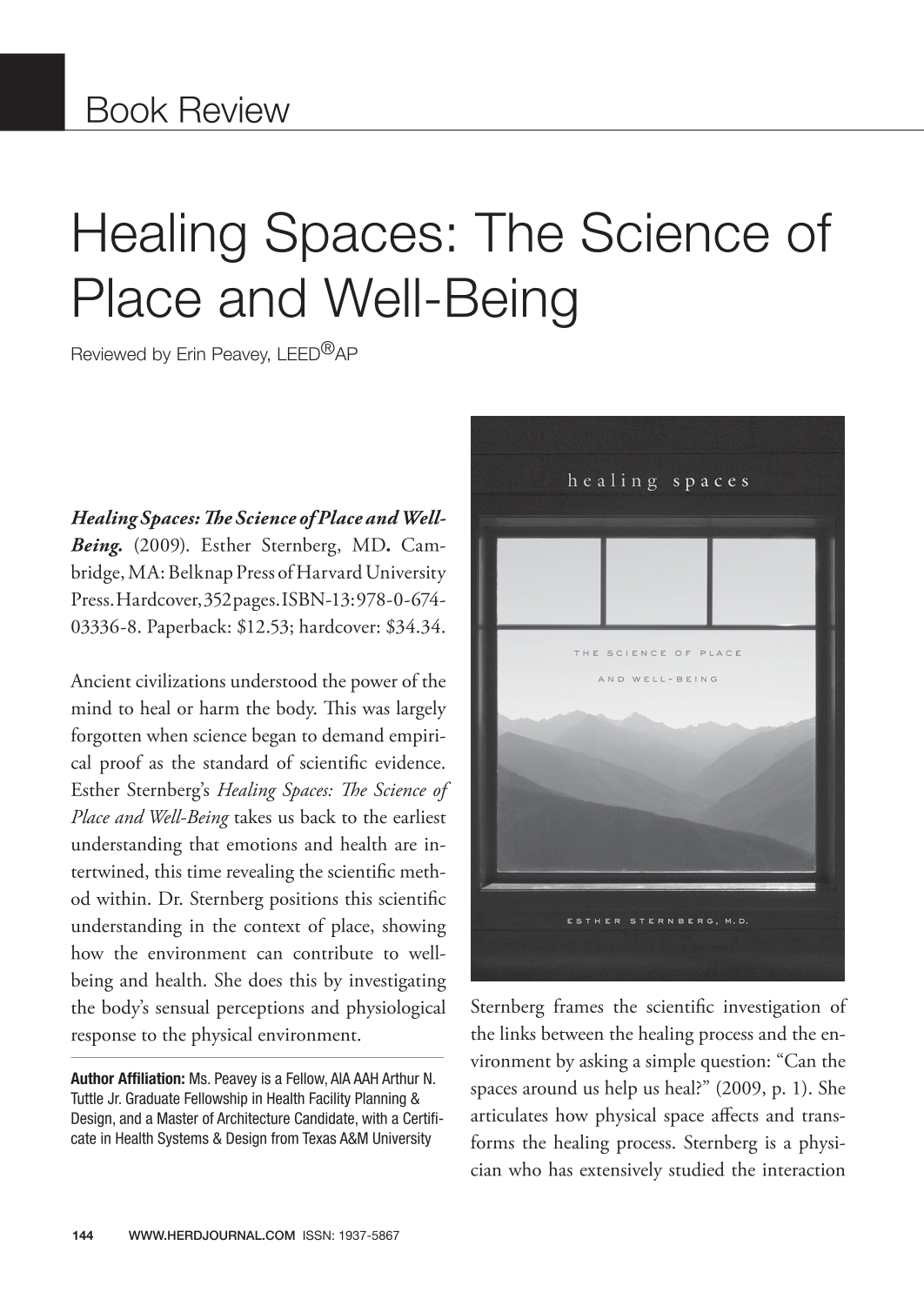
Ancient civilizations understood the power of the mind to heal or harm the body. This was largely forgotten when science began to demand empirical proof as the standard of scientific evidence. Esther Sternberg's Healing Spaces: The Science of Place and Well-Being takes us back to the earliest understanding that emotions and health are intertwined, this time revealing the scientific method within. Dr. Sternberg positions this scientific understanding in the context of place, showing how the environment can contribute to well-being and health. She does this by investigating the body's sensual perceptions and physiological response to the physical environment.
Sternberg frames the scientific investigation of the links between the healing process and the environment by asking a simple question: “Can the spaces around us help us heal?” (2009, p. 1). She articulates how physical space affects and transforms the healing process. Sternberg is a physician who has extensively studied the interaction between the brain and the functioning of the immune system, as well as the psychophysiological effects of stress on health. Fortunately for designers, she has dedicated this book to exploring the role of the physical environment on these issues.
Dr. Sternberg takes us on a journey through the senses of sight, sound, touch, smell, and spirit. She discusses the effect of the environment on the continuum of illness and health and how throughout our lifetime the environment can produce changes in our health. Healing Spaces offers fascinating case studies woven together to form a more holistic understanding of oneself and one's environment, always returning to the ideas of health, healing, and often healthcare. She creates this broad understanding by introducing the reader first to the macro-scale, and then delving into the micro-scale to create a more dynamic and complete understanding of the subject.
Although many of us believe in the healing powers of the environment, few understand the psychophysiological mechanisms that bring about this healing effect. This phenomenon is tied to the human stress response, in which chronic stress leads to suppression of the immune system, stifling the body's ability to heal. While developing the polio vaccine, immunologist Jonas Salk began feeling a sense of chronic stress and fatigue. Exhausted, he took a sabbatical to Assisi, Italy, where he was transformed by the beauty and spirit of the place, and he returned home to create the vaccine. Moved by his experience, Salk created a facility that would impart the same spirit, light, and nature as Assisi. Because of this moving experience, we now have the Salk Institute in La Jolla, California, one of the top centers for innovative scientific research.
Just as Salk was inspired by the beauty of Assisi, people are affected emotionally by sound and music. Sound perception is connected to different regions of the brain that are associated with reward, emotion, memory, and movement. These associations give music its power to thrill, delight, and elicit the memory of the night one first danced to its rhythms. The positive experience of sound may indeed encourage the healing process. The absence of loud noises can reduce the body's stress response, leading to swifter recovery.
Sternberg gracefully explains the process of how architectural space can affect the visual pathways of the brain, and how looking at beauty causes an increase in endorphins, which reduce one's perception of pain. Her writing is both analytical and personal, exposing people's preference to be surrounded by light and color by using the examples of gardens, cathedrals, and spaces of peace. Healing Spaces draws on the classics of psychology as Sternberg opens the world of our senses and shares the science behind them to help us understand more fully ourselves, others, and the effects of our designs on the human psyche.
One of the most successful experiments regarding how the environment can alter mood and play with emotion is said to be Disneyland. This environment can truly transform one's perception of reality and evoke powerful emotional responses. Disney was able to accomplish this play of comfort and stimulation by understanding the psychology of perception. Likewise, he recognized the need for landmarks and intuitive wayfinding. Disneyland exemplifies the opportunity to envision a place that will provide rejuvenation and health—a place quite different from the traditional hospital.
Sternberg talks not only about the physical world around us but also of the “world inside us” and instructs us to “do our part by simply enjoying the world around us” (p. 295). The book concludes that the best healing space is that which lies within each of us, and that by fostering this place, we foster our own healing. Sternberg's definition of health aligns with a more holistic and emotion-based health that is hinted at by the World Health Organization. Because healing is defined as a “state of complete physical, mental and social well-being” (WHO, 1948), Sternberg investigates each of these aspects fully and presents a definition of healing spaces that we all can embrace.
Sternberg starts and ends with her own experience, in her own way getting back to nature and feeling the light on one's skin and in one's heart. Healing Spaces empowers us to create spaces within our own lives that speak to inner peace and well-being. It is an excellent read for people interested in understanding themselves and their world more fully. Here the connections between place, mind, body, and health become clear and the need for more thoughtful environments of healing is made manifest.