







Abstract
Objective:
This paper presents a study to gain insight into the effects of the visibility of medical equipment on the well-being of patients.
Background:
Encounters with healthcare situations are characterized by stress and anxiety. The presence of wires, tubes, and monitors near the bedside may contribute to these feelings. One of the trends in healthcare design is to organize the headwalls of patient rooms in such a way as to reduce clutter and minimize the visibility of medical equipment, but no experimental studies are available that investigate the effects of the visibility of medical equipment in patient rooms.
Methods:
This experiment employed a single-factor between-subjects design (medical equipment visible vs. medical equipment out of sight) exposing participants (n = 42) to a scenario and a picture of a hospital room.
Results:
Placing medical equipment out of sight leads to reduced feelings of stress in patients. This stress-reducing effect is mediated by feelings of pleasure. Placing medical equipment out of sight leads to a more positive emotional state, which in turn leads to feelings of reduced stress in patients. Moreover, placing equipment out of sight leads to people having more trust in the healthcare provider.
Conclusions:
The current study emphasizes the importance of the built healthcare environment and shows what role the visibility of medical equipment can play in the healing process of patients.
Introduction
Encounters with healthcare situations are generally characterized by fear, anxiety, stress, and uncertainty (Mitchell, 2003; Pearson, Maddern, & Fitridge, 2005). Most hospitalized patients undergo a certain amount of physical discomfort; they feel vulnerable, they may be in pain, and they probably experience feelings of uncertainty. A sense of depersonalization is often felt: patients do not have control over their own bodies, they cannot control who enters the room, and they must fully rely on people they have never met—healthcare professionals.
When looking at most environments in which these encounters take place, one might rightfully ask how well these healthcare environments satisfy the psychological needs of patients. Research in the domains of environmental psychology and healthcare design supports the notion that the healthcare environment affects the health and well-being of patients (for reviews see Dijkstra, Pieterse, & Pruyn, 2006; Ulrich et al., 2008).
Traditionally, healthcare facilities, including patient rooms, were built with an emphasis on the functional delivery of healthcare. Gradually, this emphasis shifted toward a perspective of designing healthcare environments that are psychologically supportive (Ruga, 1989). This field of research is characterized by the concept of healing environments, which implies that the physical environment of healthcare settings “can make a difference in how quickly the patient recovers from or adapts to specific acute and chronic conditions” (Stichler, 2001, p. 2). For example, research shows that lighting conditions can affect length of stay (Beauchemin & Hays, 1996) and use of pain medication (Walch et al., 2005). Exposure to music can effectively calm patients before going into surgery (Lee, Henderson, & Shum, 2004), decrease postoperative pain (Good, Anderson, Ahn, Cong, & Stanton-Hicks, 2005), and decrease pain during surgical procedures (Dubois, Bartter, & Pratter, 1995).
The importance of a healthcare environment that promotes the health and well-being of patients is evident, but this healing environment should not negatively affect healthcare personnel. Moreover, the physical healthcare environment has different functions for the two main user groups, patients and healthcare personnel. Whereas the first group of users needs to recover as quickly as possible or adapt to specific acute and chronic conditions (Stichler, 2001), the second group needs to work effectively and satisfactorily in this environment on a daily basis.
Research that investigated how people experience their physical work environment is receiving growing attention (Vischer, 2008). Most of this research focuses on the effects of environments that have only one function, that of a work place. The sole purpose of those environments is to facilitate the working processes that take place there. However, when thinking about staff in healthcare facilities, their workscape is not just a work place; it also is the place that patients come for healthcare services. For example, healthcare staff spend considerable amounts of time in patient rooms and thus are most likely affected by the design of those environments as well. But are patient needs for the design of these rooms comparable to the needs of healthcare staff? Creating homelike environments with many decorations, soft lights, and nice furniture could give patients a positive feeling, but at the same time it might make the work of the medical team more difficult. On the other hand, efficient and professional environments can be very useful for nurses and physicians, but patients may feel less comfortable.
Several areas in the hospital are used by either staff or patients. Laboratory facilities or nursing stations can be designed in such a way that they provide an optimal work environment. Waiting rooms are almost exclusively used by patients and should be designed in a way that best serves patient needs. One area in the hospital used by both patients and staff is the patient room.
In the patient room, patients frequently are surrounded by a net of wires and tubes often resembling a plate of spaghetti. Caregivers have dubbed this the spaghetti syndrome, suggesting that this arrangement can seriously compromise patient safety when cables are inadvertently disconnected or infusion lines snapped off (Imhoff, 2004).
However, from a patient's perspective, exposure to all those wires and machines may have harmful effects on physical and psychological well-being. Bedside technology is assumed to evoke fear and anxiety in patients and family members, force immobilization on the patient, and lead to depersonalization (Halm & Alpen, 1993). The current study, therefore, tests the hypothesis that placing medical equipment out of sight leads to reduced feelings of stress in patients.
From a patient's perspective, exposure to all those wires and machines may have harmful effects on physical and psychological well-being.
Currently, one of the trends in healthcare design is to organize the headwalls of patient rooms in such a way as to reduce the clutter and minimize the visibility of medical equipment (Malkin, 2008). For example, research on headwall design demonstrates the positive effects of a ceiling boom compared to a traditional headwall in the case of high-acuity intensive care unit patients (Pati, Evans, Waggener, & Harvey, 2008). Moreover, standardization of headwall design is identified as one of the variables that can affect patient safety (Pati et al., 2009).
However, no experimental studies are available that investigate the effects of the visibility of medical equipment in patient rooms on feelings of stress. Based on the idea of bedside technology having negative effects on patients' well-being, the current study aimed to gain insight into the effects of the visibility of medical equipment. When medical equipment is placed out of sight, patients should feel less stress and be in a more positive mood. Moreover, it is hypothesized that the effects of the visibility of medical equipment on stress are mediated by feelings of pleasure.
The field of environmental psychology provides several theoretical frameworks that explain the effects of the physical environment (see, for example, Mehrabian & Russell, 1974). The framework proposed by Mehrabian and Russell makes stimulus-organism-response predictions. In this model, emotional states are proposed to be mediators between environmental stimuli and human behavior. Along this line, it is hypothesized that feelings of pleasure mediate the relationship between the visibility of medical equipment and stress.
Alternatively, one might argue that the visibility of all that equipment could have a reassuring effect; the patient might feel that he or she is being well cared for. The relationship between the physical environment and trust has hardly been explored up to now. One study demonstrated that a more aesthetically pleasing teacher's office resulted in a higher level of perceived credibility and trustworthiness of the teacher (Teven & Comadena, 1996). Thus there is limited evidence on how the physical healthcare environment may affect trust. The current study therefore also explores whether placing the equipment out of sight would lead to decreased feelings of trust in the healthcare provider.
Study Overview
The following hypotheses were tested in this study:
H1: Placing medical equipment out of sight leads to reduced feelings of stress. H2: Feelings of pleasure mediate the relationship between the visibility of medical equipment and stress. H3: The visibility of medical equipment leads to patients having more trust in healthcare providers.
Method
Design and Participants
The experiment employed a single-factor between-subjects design (medical equipment visible vs. medical equipment out of sight) with participants being exposed to a scenario and a picture of a hospital room. This procedure has been shown to accurately simulate real environments (Bateson & Hui, 1992; Stamps, 1990). Forty-two participants (24 females) with a mean age of 21.3 years (SD = 2.2) signed up and participated in the experiment. Participants received course credits or €2 for their participation. The study was approved by the ethics committee of the Faculty of Behavioural Sciences, University of Twente.
Procedure
Upon arrival at the laboratory, each participant was placed in a separate room with a computer, which provided all of the instructions. Participants were asked to imagine being hospitalized with appendicitis. The scenario described that they had undergone successful surgery but that they had to stay in the hospital for 3 more days. Next, participants were randomly assigned to either a picture of a hospital room in which medical equipment was visible (see Figure 1) or to a picture of a hospital room where medical equipment was placed out of sight (see Figure 2). After exposure to the pictures, participants were asked to complete measures to assess stress, emotional state, trust in the healthcare provider, and the perceived attractiveness of the hospital room.
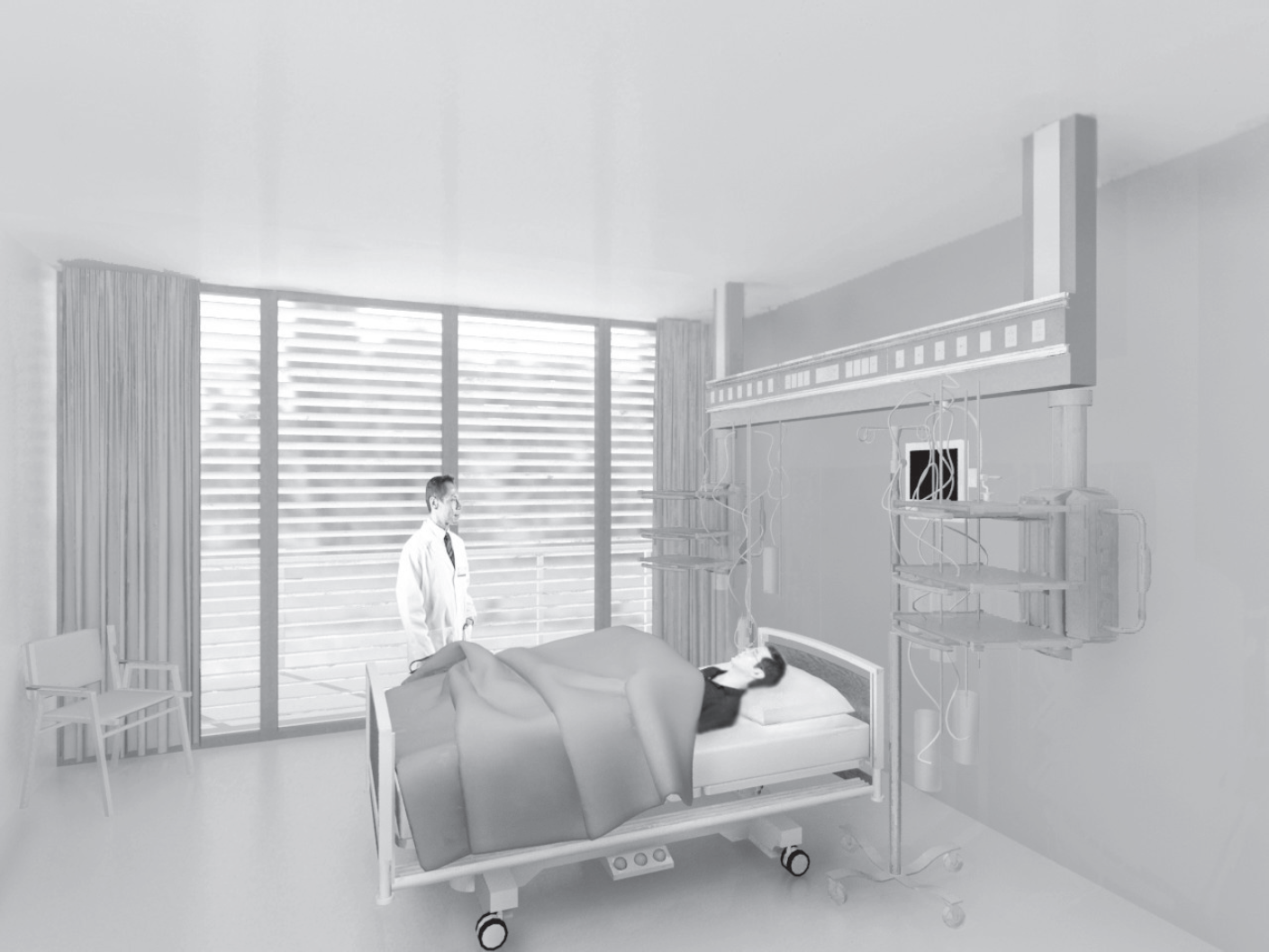
The hospital room with medical equipment visible.
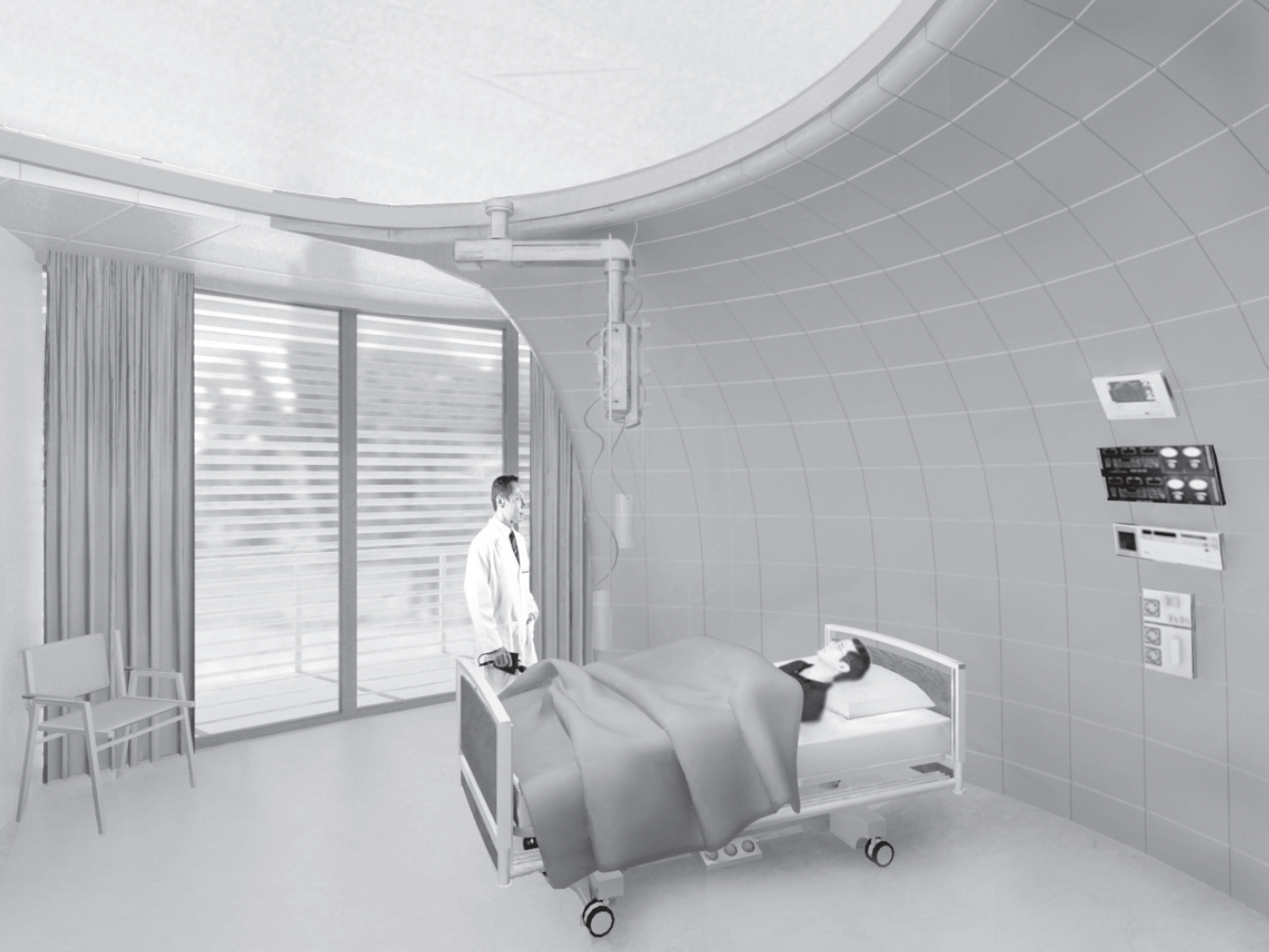
The hospital room where medical equipment was placed out of sight.
Measures
Attractiveness
As a confound check, to assess whether the rounder wall would lead to unintended differences in attractiveness, participants responded to a four-item bipolar adjective scale (Lohr & Pearson-Mims, 2005; Russell, Ward, & Pratt, 1981). They rated the pleasantness and attractiveness of the hospital room. The average score on this seven-point scale was used as a measure of attractiveness (α = .94).
Stress
To measure perceived stress, participants responded to the six-item subscale for tension of the Profile of Mood States (McNair, Lorr, & Droppleman, 1971). The average score on this five-point scale was used as a measure of stress (α = .85).
Pleasure
Feelings of pleasure were measured with four items of the Pleasure-Arousal-Dominance Model (Mehrabian & Russell, 1974) using a nine-point scale. The average score was used as a measure of pleasure (α = .85).
Trust
To measure the participants' feelings of trust in the healthcare provider, a scale of four items on a five-point scale was developed for this specific study. A sample item was “To what extent do you feel you are in good hands here?” The average score was used as a measure of trust (α = .87).
Results
Attractiveness
An analysis of variance (ANOVA) showed that participants in both conditions rated the room as being equally attractive (F(1,40) < 1).
Stress
An ANOVA was performed to test the first hypothesis. Participants in the room with the equipment placed out of sight experienced less stress (M = 1.9, SD = .59) than those in the room with the medical equipment visible (M = 2.4, SD = .76; F(1,40) = 5.3, p < .05).
Mediation Analysis
To test the second hypothesis, a mediation analysis using multiple regressions was performed (Baron & Kenny, 1986). The first regression analysis tested the relationship between visibility of equipment and stress. This analysis yielded a significant relationship (β = –.48, p =. 026). A second regression analysis, with the mediator (pleasure) as the dependent variable and visibility of equipment as the predictor, showed that placing the equipment out of sight increased feelings of pleasure (β = .98, p = .044). Another regression analysis was performed with both visibility of equipment and pleasure as predictors and stress as the criterion. This analysis revealed that the previously identified relationship between visibility of equipment and stress became insignificant (β = −.28, p = .17), whereas the mediator (pleasure) retained its significance (β = −.22, p = .002), indicating partial mediation (see Figure 3).
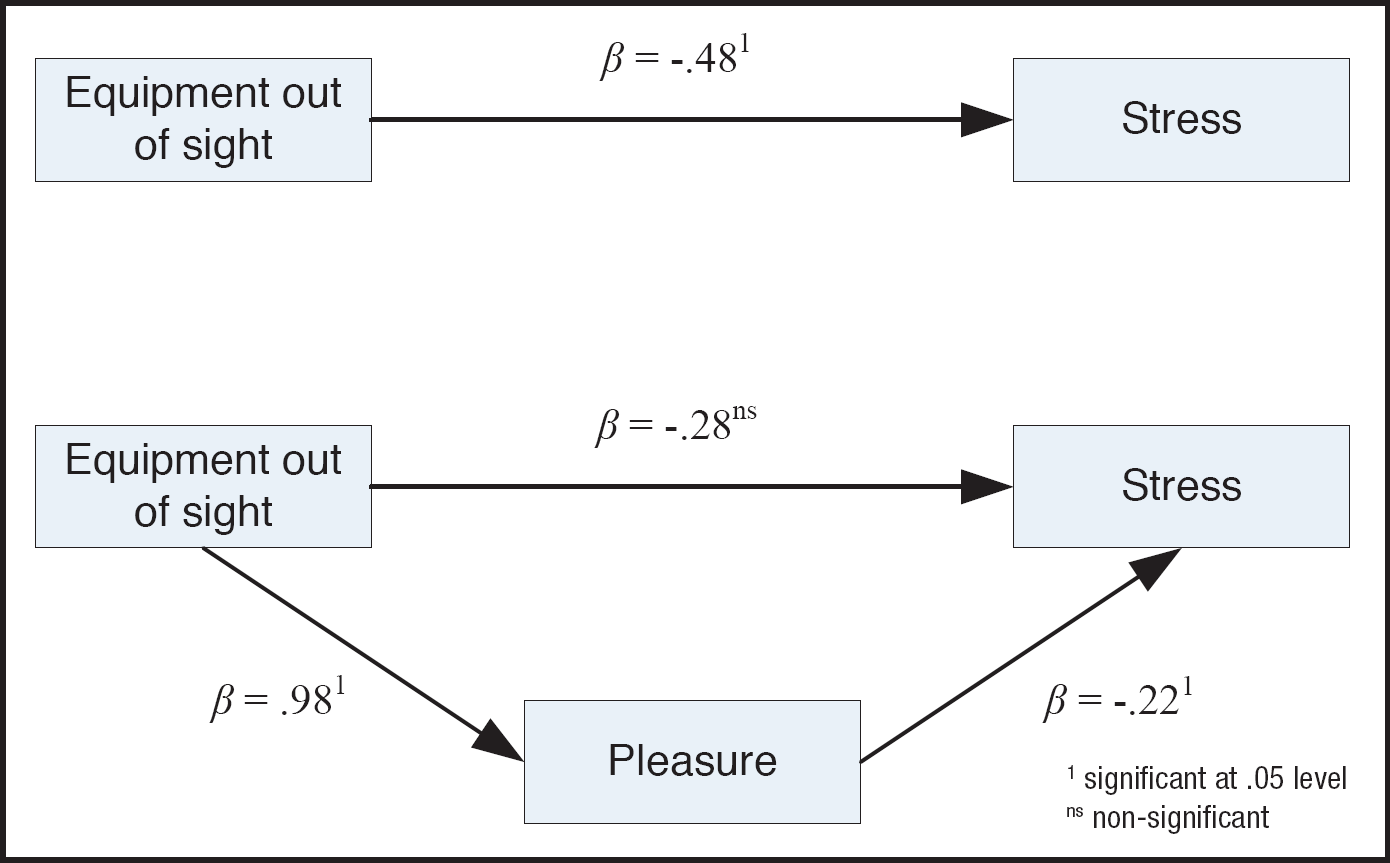
Mediation model with pleasure as mediator.
Trust
An ANOVA was performed and it disconfirmed the third hypothesis. Participants in the room with the equipment placed out of sight had more trust in the healthcare provider (M = 3.9, SD = .55) than those in the room with the medical equipment visible (M = 3.5, SD = .60; F(1,40) = 4.6, p < .05).
Discussion
The current study aimed to gain insight into the effects of the visibility of medical equipment on the well-being of patients. The first hypothesis that placing medical equipment out of sight would lead to reduced feelings of stress in patients was confirmed by this experiment. Moreover, results also demonstrated that these stress-reduction effects are mediated by feelings of pleasure; placing medical equipment out of sight leads to a more positive emotional state. This, in turn, led to reduced feelings of stress in patients. The third hypothesis was disconfirmed by the study. The visibility of medical equipment did not lead to patients having more trust in the healthcare provider. The effect appeared to be the other way around; placing equipment out of sight resulted in people having more trust in the healthcare provider.
The results of the current study suggest that a headwall design where medical equipment is placed out of sight leads to beneficial effects on patients. However, the staff perspective is of great importance in designing headwalls. The functionality of the headwall and accessibility to all medical equipment should not be hindered in any way by the design of headwalls intended to comfort patients and their families. Research on prototypes should be conducted to evaluate the ergonomics and ease of use for staff before implementation.
A third group that uses the patient room consists of the patients' visitors, their family members, and friends. There is evidence that a large number of family members experience distress and anxiety in the critical care environment (Garrouste-Orgeas et al., 2010; Kentish-Barnes, Lemiale, Chaize, Pochard, & Azoulay, 2009). Exposure to an overwhelming amount of medical equipment could potentially enhance these feelings. Future research should thus include the perspectives of staff, patients, and family simultaneously.
Ideally, the environment should support the needs and preferences of all groups simultaneously. According to Bitner (1992), the first step in the purposeful design of service environments is to identify desirable behaviors for these groups. Healthcare organizations should be concerned with patient and staff behavior, the interactions between patients and staff, and the role family members can play in the healthcare process.
Limitations
It could be argued that the findings of simulation experiments cannot be translated into actual healthcare settings. Participants in the current study were not hospital patients. Participants had to imagine being hospitalized with appendicitis, which is a scenario that does occur in this specific population and was chosen for this reason. There is a lot of debate on whether college students can and should be used in research (see Kardes, 1996; Petty & Cacioppo, 1996). The current study is a first exploration of how the visibility of medical equipment may affect feelings of stress. Moreover, a specific purpose was to investigate a possible mediating process that can explain the potentially beneficial effects of placing equipment out of sight. A sample of students—a group as homogenous as possible—is well-suited for unraveling such underlying processes (Kardes, 1996). Additionally, because this study is a first exploration of this topic, using this sample allows for an exploration without the risk of harming real patients. Evidence is also available that a simulation study (Dijkstra, Pieterse, & Pruyn, 2008) generates results similar to a field study (Park & Mattson, 2009). Both studies demonstrated that indoor plants in hospital rooms lead to less stress and a higher level of perceived attractiveness of the room environment.
Second, the participants in the study did not experience a real stay in a hospital room. Available evidence, however, suggests that photographs can accurately simulate real environments, and such studies show results similar to field experiments (Bateson & Hui, 1992; Stamps, 1990). However, these limitations demand replication in the field, which will also facilitate taking the staff perspective into account and the use of real patients instead of people pretending to be hospitalized and patients of different age groups and cultural backgrounds. Additionally, studies with prototype patient rooms can be conducted to gain additional insights into the effectiveness of different headwall designs (see also Watkins, Meyers, & Villasante, 2008).
When looking at the pictures of the hospital rooms, it becomes clear that the medical equipment has been put out of sight by means of placing a rounded wall at the headwall of the patient's bed. It could be argued that people simply prefer these round shapes. However, if this were the case, the basic attractiveness of the hospital room with the rounded wall would be higher than the attractiveness of the standard hospital room. The results of this study demonstrated that the perceived attractiveness of both rooms was equal, so this difference between the rooms cannot account for the results.
Conclusion
In summary, this study provides some first insights regarding how the visibility of medical equipment affects patients' well-being. The results demonstrated that the visibility of medical equipment affects patients' well-being by influencing feelings of stress. Moreover, this study provides insight into the underlying process that leads to stress reduction. Placing medical equipment out of sight results in a more positive emotional state, which in turn reduces stress. Moreover, the medical equipment not being visible also leads to a higher level of trust in the healthcare provider.
Footnotes
Acknowledgment:
The author would like to thank Wiegerinck Architectuur Stedenbouw, and in particular Sven Katzke, Hans Beekhoven, and Sandra Dijkstra, for their help in generating the research materials.
References
Supplementary Material
Please find the following supplemental material available below.
For Open Access articles published under a Creative Commons License, all supplemental material carries the same license as the article it is associated with.
For non-Open Access articles published, all supplemental material carries a non-exclusive license, and permission requests for re-use of supplemental material or any part of supplemental material shall be sent directly to the copyright owner as specified in the copyright notice associated with the article.
