







Abstract
Photovoice is a form of participatory action research and community-based participatory research and often used in social sciences to understand the needs of others and uncover the challenges and assets that may exist. Photovoice engages participants in the research process by inviting them to share their experiences through photographs and personal narratives. This act of storytelling and group discussion provides emotional connections among the participant cohort. Through the discussion of shared experience, common themes may arise. This column provides and overview of the photovoice methodology and highlights some of the benefits and limitations one might experience when leading photovoice based projects. Photovoice is a powerful tool that can prove useful for design researchers and practitioners alike as they seek to understand the challenges facing others. It is through this understanding that transformation to improve situations can occur.
The expansion and advancement of knowledge is the overarching purpose of research. Research studies are conducted across a wide variety of disciplines and areas of inquiry with similar goals and characteristics. Based on the nature of the study, the methodology used to collect data varies. In research where the central inquiry is qualitative and prone to subjectivity, the who, what, when, where, and how are considered, but also significant is the method in which data are collected, evaluated, and understood (Nagata et al., 2012).
Since the onset of COVID-19 in early 2020, safety protocols such as social distancing have limited access for researchers in social and behavioral science to gather data using traditional means (Valdez & Gubrium, 2020; Vindrola-Padros et al., 2020). However, alternative methods perhaps not formerly considered could circumvent obstacles and provide researchers with rich data to advance the body of knowledge. One such method is photovoice.
Photovoice derived from community-based participatory research (CBPR). CBPR is a method that engages the community as a partner in research among community participants, organizational delegates, and researchers to understand a particular phenomenon (McDonald & Capous-Desyllas, 2021; Nykiforuk et al., 2011; Valdez & Gubrium, 2020). While CBPR engages the community in investigative discussions to provide a voice to disenfranchised populations, researchers Caroline Wang and Mary Ann Burris sought to expand the methodology to enhance communities through the active use of photography (Garner & Faucher, 2014; Sutton-Brown, 2014; C. Wang & Burris, 1997; C. C. Wang et al., 1998; Wass et al., 2020). Equipping research participants with cameras to document circumstances centers the focus on the participants’ lived experience and shifts the discussion from the researcher to the participant to promote change (Budig et al., 2018; Caroline et al., 1997; Faucher & Garner, 2015; Marczyk et al., 2005). C. Wang and Burris (1997, p. 370) identify three overarching goals for photovoice, which are “(1) to enable people to record and reflect their community’s strengths and concerns, (2) to promote critical dialogue and knowledge about important issues through large and small group discussion of photographs, and (3) to reach policy makers.” Photovoice simply is a combination of photography accompanied by reflective narrative and social action to increase awareness of social issues within a community (Figure 1). Analogous to evidence-based design in which design decisions are based on the most relevant and available information (Joseph & Hamilton, 2008), which often entails input from the client (Hamilton, 2018), photovoice engages participants in the research process to identify and better understand information from the participants’ perspective and through community discussions.
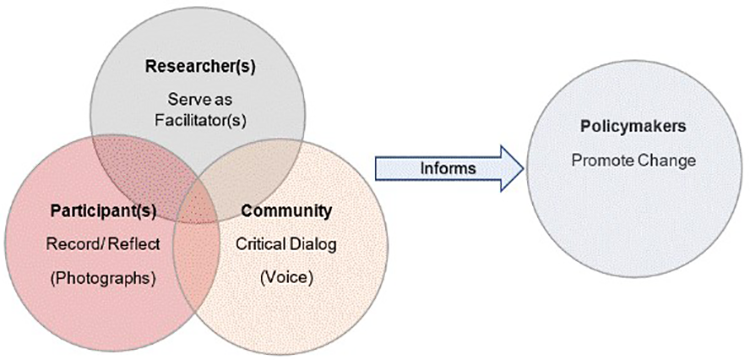
Photovoice conceptual model.
Photovoice Process
The photovoice process encourages participants to take an active role in leading the direction of inquiry as they reflect everyday experiences through the visual narrative (Nykiforuk et al., 2011). The researcher serves as facilitator, which removes the typical power dynamic associated with traditional research and assumes the photovoice participants to be the authority of their personal accounts (Sutton-Brown, 2014). The process follows nine steps to carry out a photovoice study: (1) select target audience of policy makers or community leaders, (2) recruit participants, (3) train participants on the photovoice methodology, (4) obtain informed consent, (5) suggest photograph themes, (6) camera distribution and use, (7) participants to take photographs, (8) discussion of photographs, and (9) share photographs and stories in a planned event with the participants and policy makers or community leaders (C. Wang & Burris, 1997). While the process Wang and Burris identify is foundational, other scholars have expanded or adjusted the process to meet the needs of specific research goals and objectives.
Recruitment of Participants
Situated within a constructivist research paradigm which recognizes that multiple realities exist based on individual perceptions and experiences, photovoice methodology provides participants a catalyst in which to express their realities (Nagata et al., 2012). In traditional research, which seeks to answer specific questions, photovoice is a particularly valuable tool as its investigative approach allows individuals the freedom to express what they find important. It is through discussion that common themes emerge, which can promote change. Recruiting efforts for participation in research sometimes can prove difficult. However, using a camera as a data collection device simplifies the task. Photovoice does not require reading and writing abilities, which make this process accessible for those who with limited capacities (Nagata et al., 2012). Community centers and advocacy organizations are often good resources for recruiting participants. While each research project is unique, certain aspects of the project can lead to purposeful recruitment. For instance, a researcher studying the effects of living in a food desert might partner with a local food bank or faith-based organization to have access to their client database.
Institutional Review Board (IRB) Approval
Prior to enlisting participants in the research process, a detailed set of protocols describing the study are needed for IRB approval. In a study that explored the nuances of IRB approval for photovoice, the researchers found challenges when it came to participants as collaborators to the extent of participant compensation, the interpretation and dissemination of participant photos, and the photos within the social context of participant’s lives (McDonald & Capous-Desyllas, 2021). McDonald and Capous-Desyllas posit that many IRB members are not familiar with the arts-based method and the dynamics of the research–participant relationship, which could result in the unforeseen restructuring of the project or in some cases relinquishing the project altogether. In one particular study, a few participants obtained verbal consent but failed to gain signed consent forms before taking photographs, which resulted in the images not being included in the display thus disappointing the participants (McDonald & Capous-Desyllas, 2021). Understanding the nuances associated with community-based action research, it is imperative researchers provide training for the participants prior to their involvement.
Training of Participants
Participants are likely to be more engaged when they understand their contributions to the project can possibly influence policy and incite change (Macdonald et al., 2020). Providing an overview of the photovoice methodology allows the participants to be aware of expectations and reasoning in which the research is conducted. Educating participants on the ethical responsibilities associated with photographing human subjects and the sharing of images should be a point of discussion to eliminate the potential for undue harm.
Informed Consent Forms
A photovoice project primarily considers three levels of consent (Sutton-Brown, 2014). While participation in the research is purely voluntary, each participant must be informed of the risks and rewards involved with participation. The first level of consent is completed prior to the start of the study in which the participants taking the photographs agree to the terms of the voluntary study. The second level is the acknowledgment and release form, which is administered prior to the distribution of cameras. If a photograph will contain human subjects, the participant will need to provide this form and obtain the signed agreement. The signed form also waives the rights to the photograph. Note that informed consent is not needed if human subjects are not recognizable in the photograph. The third consent form is completed by the participant and provides the researcher permission to use their photographs in any publications or public distribution.
Photograph Themes
Qualitative research typically consists of three measurement modalities: open-ended questions, closed-ended questions, and Likert-type scales (Marczyk et al., 2005, p. 153). Open-ended questions allow participants to answer the question anyway seen fit. Whereas closed-ended questions provide a list of answers for participants to choose, some may consider this leading. Likert-type scales may be considered the most restricting as it asks participant to respond on a continuum of possible responses. In keeping with the goals of photovoice in that, research is driven by participants lived experiences, researchers should provide a general topic to frame photographic themes but allow participants to identify questions, issues, and concerns they would like to address within the theme. Having an open-ended structure will promote richer discussion in which new findings may emerge.
Camera Distribution and Use
Advances in technology since the inception of the photovoice methodology make the act of taking a photograph relatively easy and in most cases, cost effective. Digital cameras eliminate the time-consuming and expense associated with the processing rolls of film; however, digital cameras have other related expenses. Ultimately, the researcher will determine the type of camera to use, which is often based on what the research budget will support. Wang and Burris (1997) suggest the quality of the photograph is not as important as the content and meaning. Having a simple to operate camera reduces possible anxiety associated with a complex camera. Providing instructions on how to best use the camera to capture the story will also increase the confidence of participants in taking quality photographs. However, Wang et al. (1997) argue that too much technical instruction may stifle creativity.
Participants Take Photographs
Research projects have a time line and budget in which to collect data, and it is no different in photovoice projects. Based on the research goals and initiatives, the researcher will determine a set period in which all participants have to complete the project. If the participants are capturing images of routine activities, ample time should be provided to allow for experiences to happen organically. This may be a time-consuming exercise if events do not occur at a regular interval.
Discussion of Photographs
Group discussions allow people to reflect on the images they have produced and respond to others work. In these settings, it is best to have the photographs projected on a screen in which everyone in the group can view the work easily. Enlarging the images has a visual impact on the subject matter and provides a powerful approach to the form of expression (C. Wang & Burris, 1997). Participants select the photos to display and describe why the image is important and others may disclose their own shared experiences, thus prompting further supportive dialog. The researcher as facilitator should set a supportive tone for the discussions in which mutual involvement and respect are encouraged.
The assessment of photovoice should be a three-stage process, which provides the foundation for analysis and consists (1) the selection of the photographs, which best reflect the needs and assets; (2) contextualizing, which tells the meaning of the photograph; and (3) codifying, which identifies issues, themes, or theories that emerge (C. Wang & Burris, 1997). Contextualizing gives the voice to the photographs; the photographs alone may not tell the full story.
Event to Share and Discuss Photographs
Upon the completion of the group discussion sessions, which most closely relate to the issues at hand, policy makers, who have the most influence on change, should be invited to participate in an event that is organized by the researcher and participants. This event allows participants to share common concerns along with photographs to persuade policy reform. In keeping with true nature of qualitative research, it is more appropriate to determine the decision-making agency after themes emerge. Predetermining contradicts the photovoice participant-directed approach (Sutton-Brown, 2014). While Sutton-Brown (2014) does not support the Wang et al. (1997) suggestion, which encourages potential community leaders at the onset of the study, there is value in considering both options. One could argue that based on the nature of the research inquiry, identifying potential community leaders may help to advance the research agenda.
Advantages and Disadvantages
Wang et al. (1997) identify numerous advantages of photovoice to include (1) photovoice provides needs assessment for health researchers and practitioners through nontraditional viewpoints. Researchers often have an agenda and may neglect or overlook what is important to the individual or community, photovoice captures their needs; (2) photovoice addresses the descriptive mandate of needs assessment through the visual image; (3) the process of photovoice can affirm the ingenuity and perspective of society’s most vulnerable populations; (4) the technique facilitates the study of different social and behavioral settings captured by the participants, which may not be available to the researcher; (5) the act of taking pictures and there display in a public setting can be a source of community pride; (6) photovoice helps to define program goals during needs assessment; (7) photovoice fosters storytelling among community members, which can contribute to the assessment process; (8) photovoice can connect social networks through the act of sharing photographs, which builds long-term relationships; and (9) the process can raise awareness of a community’s needs but can also expose its value.
While the advantages are compelling, it would be remiss to omit apparent disadvantages associated with photovoice, which can also be considered as limitations. The potential risk to participants from competing interest groups or individuals of power such as the case in which an individual is documenting situations that do not align with another’s interests (Sutton-Brown, 2014). This situation could cause uncertain outcomes. Therefore, participants may self-censure what they choose to photograph.
An additional limitation associated with photovoice is the analysis of photographs when used to assess community assets and needs as photographs hold an abundance of complex information that is often hard to decipher (C. Wang & Burris, 1997; C. C. Wang et al., 1998; C. C. Wang et al., 2004). It is through the discussion sessions does the voice provide context in which themes may emerge. In group discussions, strong personalities may sway other members of the group and not be a true reflection of the group (Faucher & Garner, 2015).
Future Studies
Photovoice is used to address a wide variety of topics such as homelessness, food insecurities, gender equality, education, health promotion and policy, and disaster recovery to name a few and has provided meaningful outcomes for researchers, the participants, and their respective communities (Knowles et al., 2015; Macdonald et al., 2020; Miller & Brockie, 2015; Schumann et al., 2019; C. C. Wang et al., 1998; C. C. Wang et al., 2004; Wass et al., 2020). In the era of COVID-19, there is looming concern for the safety of participants of CBPR projects who typically come from marginalized populations with unjust social structures (Valdez & Gubrium, 2020). Conducting research in group settings may be challenging; however, photovoice methodology is adaptable to accommodate various situations (Sutton-Brown, 2014; C. C. Wang et al., 1998). Exploring a process where the photographs and recorded voices are available through digital access or hosted through live webinars may be a worthy alternative solution in which to gain valuable information which addresses key issues facing communities.
Implications for Practice
When implemented as part of the programming phase, the photovoice methodology can provide the practitioner with valuable information which informs design decisions. The implications are numerous to include Photovoice provides needs assessment for health researchers and practitioners through nontraditional viewpoints. The process of photovoice can affirm the ingenuity and perspective of society’s most vulnerable populations. The technique facilitates the study of different social and behavioral settings captured by the participants, which may not be available to the researcher or practitioner. Photovoice helps to define program goals during needs assessment. Photovoice fosters storytelling among community members, which can contribute to the assessment process. Photovoice can connect social networks through the act of sharing photographs, which builds long-term relationships. The process can raise awareness of a community’s needs but can also expose its value.
Footnotes
Declaration of Conflicting Interests
The author declared no potential conflicts of interest with respect to the research, authorship, and/or publication of this article.
Funding
The author received no financial support for the research, authorship, and/or publication of this article.
