






Abstract
Overlapping fifth toe is thought to be a congenital deformity characterized by the proximal phalanx dorsally subluxating and adducting on the fifth metatarsophalangeal joint. Overlapping fifth toes may present as asymptomatic figments of parental concern, but not infrequently this deformity may be painful and disabling in both the pediatric and adult population. Pediatric overlapping fifth toe often corrects with normal ambulation and physicians only need to intervene if symptomatic deformity persists. Nonoperative optimization with strapping, splinting, and shoe modification would be reasonable first-line treatments. Surgical intervention including osteoclysis, percutaneous tenotomy, capsulotomy, syndacilization, tissue rearrangements, tendon transfers, phalangectomy, and toe amputation are indicated only after optimization of less invasive measures. Underlapping fifth toe (or “curly” toe) deformity is also felt to be congenital. In most cases, underlapping fifth toes are noticed by parents and family members early in infancy. The proximal phalanx in underlapping toes is typically in varus at the metatarsophalangeal joint with flexion. It is not uncommon for a rotational malalignment to be present (supination/pronation) as judged by the nailbeds. Similar to overlapping toes, pediatric underlappers commonly correct with reassurance and benign neglect up to age 6. Intervention is warranted in the setting of persistent pain and footwear difficulty. Accommodative shoes, absorbing cushions, and functional modification are the mainstays of nonoperative management. Operative intervention may consist of osteoclysis, percutaneous flexor tenotomy, capsulotomy, tissue rearrangements, tendon transfers, removal of symptomatic spurs, osteotomies, and amputation. After exhaustive review of the published literature, it is clear that fifth toe deformities (whether overlapping or underlapping) have not been extensively studied. No gold standard approach exists in treatment. Prospective research using larger numbers of patients with detailed outcome metrics are needed. Surgeons should carefully tailor surgical intervention to patient specific pathology.
“The deformity [overlapping fifth toe] is often bilateral and does not appear to have gender preference.”
Overlapping Fifth Toe
Introduction
Overlapping fifth toe is a deformity of many names, including crossover toe, digiti quinti varus, overriding fifth toe, and congenital varus deformity of the fifth toe.1-3 It was described as hereditary, 1 and although there are no prevalence data in the literature, it has been described as “not uncommon but not rare.” 4 The deformity is often bilateral and does not appear to have gender preference.5,6 It has been postulated that over half of people with overlapping fifth toe are asymptomatic.3,5,7,8 When symptomatic, however, this deformity can be painful and disabling. 4
History and Physical Examination
Symptomatic patients complain of skin trophic changes, deformity, painful corns, and activity and footwear-related pressure pain directly over the fifth toe as well as fourth toe discomfort.2,3,5,6,8,9 Cosmetic concerns are common. Parents and relatives of children with crossover fifth toe request consultations around the time of ambulation when shoe selection presents difficulty. 2
The pathognomonic sign of a crossover fifth toe deformity is typically at the metatarsophalangeal (MTP) joint, which may be subluxated in a dorsiflexed, adducted, and externally rotated position.1,2,7 The distal phalanges and interphalangeal (IP) joints of the fifth digit are compelled to scissor over the fourth toe. Soft tissue contractions involving the skin, capsule, tendon, ligament, and neurovascular bundles are commonly seen at the dorsomedial glabellous–extensor skin junction. 10 The medial collateral ligament has been shown to be shortened and taut.3,5,6 Deformity can also extend distally to the IP joints, which may be adducted, hyperextended, and rotationally malaligned.3,6,10 The extensor digitorum longus (EDL) tendon is shorted on account of its chronic medial displacement, leading to a dynamic and eventually static joint deformation.1,2 There is a wide range in the severity of this deformity from mild rotation to complete dislocation of the toe greater than 90° to the long axis of the ray. 10 It is important to keep in mind that despite impressive static deformity, the digit may in fact be passively correctable to the neutral position. It is therefore imperative to correlate weight bearing x-rays with clinical examination particularly during dynamic gait and functional activities (Figure 1).1,8
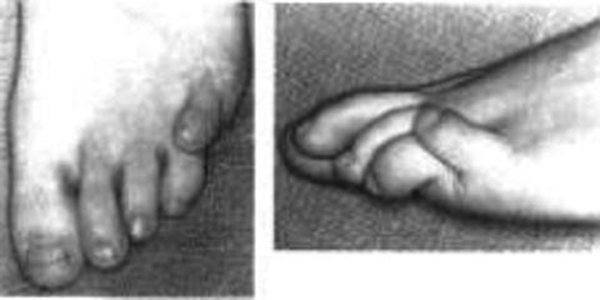
Clinical photograph of overlapping 5th toe.
Nonsurgical Treatment
In children, an overlapping fifth toe may autocorrect as the child begins to walk. 11 Often, the deformity persists and footwear selection is constrained leading to consternation and consultation. 9 Strapping, splinting, and bracing techniques have been described but appear to require long periods of application coupled with close followup. 4 It is not uncommon for the deformity to recur shortly after the discontinuation of strapping.12,13 There does seem to be general consensus for common sense nonoperative measures: custom-made shoes that allow room for the overlapping toe, shoe cutouts, and activity modification. 3 High-grade evidence for these are lacking.
Surgical Treatment
Surgical treatment is sometimes required in symptomatic patients who have failed nonoperative treatment. Surgical options fall into 3 general categories: soft tissue correction, bony work combined with soft tissue correction, and amputation.
Lapidus classically described a procedure with a goal of abduction, plantarflexion, and internal rotation of the affected toe. This operation transfers the EDL tendon to the conjoint tendon of the abductor digiti minimi and the flexor digitorum brevis. 2 A dynamic checkrein on deformity is created without bony osteotomy.
The Zanoli procedure 11 is similar to the Lapidus procedure but routes the transferred tendon differently. The EDL is divided at the tarsometatarsal joint and the fifth toe is held in the corrected position and a dorsomedial capsulotomy is performed. The distal end of the EDL tendon is then passed through the subcutaneous route on the plantar surface of the proximal phalanx and is sutured under tension onto the abductor muscle. This technique has been advocated (by its proponents) “the only way to achieve 3-dimensional correction of the deformity without damage to bone” 11 .
Syndactilization of the fourth and fifth toes has been described as a more simplistic method to correct overlapping fifth toe deformity. 14 Advocates remove a U-shaped section of full-thickness skin from the 4 to 5 webspace. Deformity correction is maintained by the creation of this iatrogenic deformity: co-opting the fourth toe forever as internal biologic splint for the fifth.
Cockin disliked the scar formation in V-Y advancement flaps advocated by Lapidus and Zanoli. He argued that although syndacty gives good results, it inappropriately replaces one deformity with another. 7 He advocated the “Butler Operation” where a circumferential racquet-shaped incision is made. The extensor tendon is divided and the dorsal capsule of the MTP is incised, which allows the toe to swing freely downward and laterally into correct position without tension. This technique requires significant skin and soft tissue rearrangements as maintenance of reduction is predicated on skin closure in a severely derotated position. Black also advocated for this technique, believing a circumferential incision necessary to correct the soft tissue contracture deformity as otherwise one cannot reduce the toe to an anatomic position (Figure 2). 3
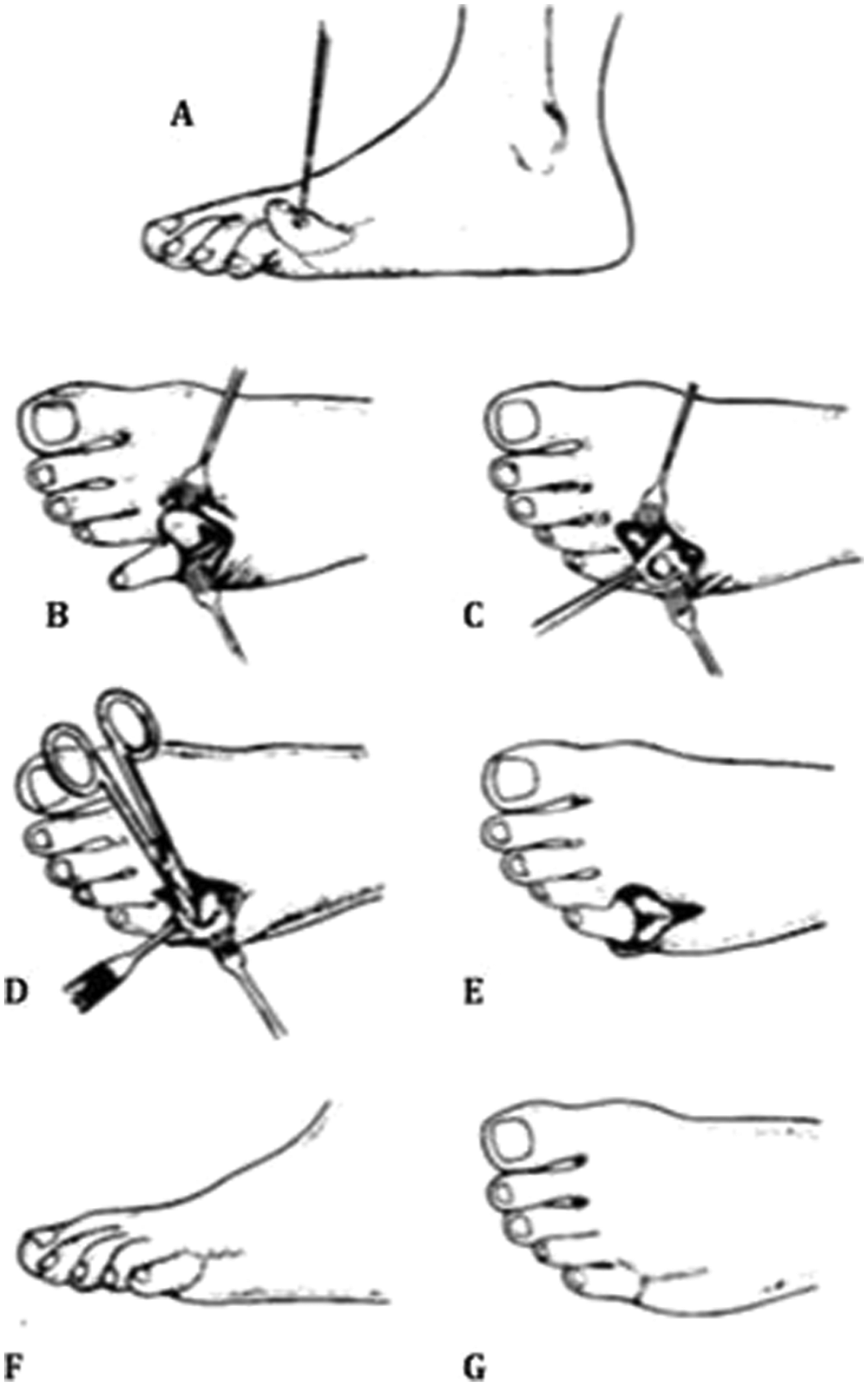
(A) Circumferential racquet-shaped incision is marked. B: The extensor tendon is identified and tenotomy performed. (C) Incision of the dorsal capsule of the MTP joint. (D) The plantar plate of the MTP joint is incised. (E) The fifth toe rests in a reduced position. (F) Lateral view after repair of skin. (G) AP view of foot after skin repair.
Weber suggested criteria for surgical intervention in the treatment of overlapping fifth toe. 10 His criteria depend on patient age, location of pathology, and severity of deformity. Accordingly, dorsal skin contraction is treated with V-Y skin rearrangement. If, after soft tissue release, the toe fails to maintain satisfactory alignment, he recommended adding a total proximal phalangectomy. The presence of an intractable plantar keratosis (plantar keratoma) coupled with a fifth metatarsal head exostosis and deformity required metatarsal head resection arthroplasty. Despite Weber’s focus on criteria, his article concluded that there should not be a universal approach to correcting this deformity. Operations should be tailored to specific patient and pathology.
Amputation of the overlapping toe was once the most common treatment for overlapping fifth toe. 9 The proposed benefit of amputation is rapid recovery, minimal functional disturbance, and complete pain relief. 1 Occasional complains of pain over the fifth metatarsal head, which becomes prominent after amputation, led to modifications including trimming of the metatarsal head in concert with the toe amputation. 15 Although amputation has proven an effective treatment, it is not without drawbacks. Many patients understandably do not like the notion of losing a body part. Some have religious objections to such surgery. In many patients amputation of a toe may be psychologically undesirable and the practice has fallen out of favor despite its long-term successful historical use.
Results
Currently, our literature lacks long-term follow-up for surgical treatment of overlapping fifth toe. Lapidus reported that his “results in a few cases have been quite satisfactory.” 2 In de Palma and Zanoli’s series of 18 feet, only 10 had “good” correction, 5 were “slightly overcorrected,” and 3 “overcorrected,” with no recurrences. 11 The Butler operation has yielded 91% to 95% patient satisfaction rates in poorly powered level 3 case series.3,7 There are no level 1 studies of the subject to our knowledge.
Authors’ Preferred Method for Overlapping Fifth Toe Deformity
The senior author has found that the judicious use of accommodative footwear and lambswool along with patient self-cobbling their shoes with a “ball-and-ring” shoe stretcher can, in many cases, make the shoe fit the foot and improve symptoms. When a patient continues to be symptomatic despite optimization of nonoperative measures, surgical treatment is pursued. We cannot advocate one individual surgical procedure over another. Our preferred surgical treatment for symptomatic crossover fifth toe is to do as little as possible but as much as necessary to correct the deformity. With mild deformity, in patients with severe coexistent disease, this may involve harkening back to toe osteoclysis. In significant deformity we have found the extensor digitorum longus to abductor digiti minimi tendon transfer coupled with the racquet incision soft tissue rearrangement with or without a shortening metatarsal osteotomy helpful. Skin trophic changes are treated with primary excision along with removal of the offending underlying bony exostosis. After the EDL tendon is sutured to the abductor digiti minimi tendon with enough tension to reduce the toe into the desired position, we have found 6-week K-wire fixation helpful in avoiding the potential vascular issues associated with repeated strapping. Two K-wires can help in cases of severe axial rotation malalignment. Nylon skin sutures are removed at the 2 to 3 week mark, X-rays are checked at 6 weeks, and pins pulled if appropriate. We continue bonnet-type strapping for an additional 6 weeks. Sports are typically resumed at the 3-month point. Neurovascular embarrassment can be an issue with large deformities and careful patient counseling advocated. Scab formation should not be confused with necrosis.
Curly, Underlapping, and Underriding Toes
Introduction
The curly, underlapping, or underriding fifth toe is a common congenital deformity16,17 that can be unilateral or bilateral.18-20 It is often noticed in infancy by parents and relatives. Cosmetic and skin issues typically drive consultation later in childhood. Fortunately, a majority of patients with underlapping fifth toes have no symptoms or functional limitations.17,21 Parents are often concerned by the appearance of the underlapping toe in their child and reassured when they remove their own shoes to discover a similar toe posture and alignment. In other cases, symptoms are severe, leading to significant gait disturbance and functional limitations.
History and Physical Examination
Although underlapping may be seen in any of the lesser toes, the fifth and fourth toes are most commonly affected. 22 In distinction to the overlapping fifth toe, the underlapping malformation is characterized by flexion, varus, external rotation, and frank scissoring of the fifth phalanges under those of the fourth toe.16,18,21,23 The deformity is typically centered at the distal interphalangeal (DIP)16,19 joint but may occur at both IP joints.18,21,23 The deformity is seldom rigid and is usually passively correctable. 23 Mild curly toes have a propensity to improve spontaneously without any treatment by age 6.18,21 However, this deformity occasionally progresses into a rigid digital contracture with hyperkeratotic lesions at areas of abnormal contact stresses. 19
Pathophysiology
The pathogenesis of the underlapping curly toe is unclear. Ross felt long flexor tendon over-pull with subsequent shortening initiated the curl of the toe, which then progressed into the classic underlapping posture. 23 Friend felt certain the underlying cause was a foot that remains pronated during late midstance of the gait cycle. 22 He hypothesized that this motion that caused the flexor digitorum longus (FDL) to subluxate and adduct the lateral digits into varus. Neither theory has been validated.
Regardless of the cause, there is clearly a clutch of symptoms from underlapping toes that causes patients to seek treatment. Blistering, callosities, and nail deformity can be particularly troublesome.16,20 Mechanical pain may result from toe compression against the ground or by abrasion against an adjacent toe during ambulation.20,22 Footwear discomfort and pain can be significant. 21 Many patients express a conscious desire for cosmetic improvement to what they see as blemishes on an otherwise normal foot.
Nonsurgical Treatment
Like the overlapping fifth toe, underlapping toes may correct early in development with progression from crawling to ambulation. Watchful waiting is recommended in all painless underlapping fifth toes. A trial of toe strapping would seem reasonable prior to more invasive correction. Accordingly, Turner reported 90 underlapping fifth toes treated with an aggressive toe strapping protocol. He was able to maintain this regimen for an astounding average of 12.1 months. Disappointingly, only 14 toes maintained the corrected position at end of strapping. 17 He concluded that strapping for underlapping toes was ineffective and asserted that strapping has no part in the treatment of this congenital deformity. Other reasonable (but not as robustly vetted) nonoperative treatments include accommodative orthosis, shoe cutout modification, and activity modification.
Surgical Treatment
The majority of the literature regarding surgical treatment of underlapping toe is predicated on a flexor tendon tenotomy or flexor to extensor tendon transfer.
Prior to Pollard’s publication in 1975, the standard operation for underlapping toes was flexor to extensor transfer as introduced by Girdlestone for treatment of claw toes. 16 Pollard advocated simple flexor tenotomy because it was quicker, simpler, and in his hands yielded better results than the more complex tendon transfer. Ross agreed with Pollard, and he contended that flexor to extensor transfer causes more morbidity and was being less reliable than flexor tenotomy in the treatment of isolated underlapping fifth toe (Figure 3). 23
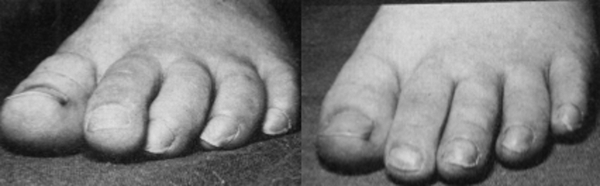
Curly toes before (A) and after (B) flexor tenotomy.
Results
Pollard directly compared flexor tenotomy (56 toes) with flexor to extensor transfer (63 toes). 16 He reported fair to good appearance in all tenotomy cases with less satisfactory appearances in the transfer group.
Hamer et al conducted a randomized trial of pediatric patients comparing flexor tenotomy and flexor to extensor tendon transfer. 24 The patients in this series underwent bilateral operations with one foot undergoing flexor tenotomy and the other a flexor to extensor tendon transfer. A blinded clinical assessment was performed at 4 years after surgery. He reported good results in both groups: no child had symptoms at follow-up and all were satisfied with their correction. Hamer et al concluded that the FDL tenotomy is the critical portion for correction in both procedures.
Authors’ Preferred Treatment for Underlapping/Curly Fifth Toe Deformity
The authors’ preferred nonoperative treatment begins with activity modification and shoe stretching to accommodate the underlapping fifth toe. If the patient continues to have pain, keratosis, or nail deformities despite nonoperative measures, surgical treatment is offered. In pediatric patients, it is clear that simple flexor tenotomy with either postoperative strapping or K-wire fixation can yield good results. We agree that isolated symptomatic flexible underlapping fifth toe deformity in the adult population can be reasonably treated with simple flexor tenotomy as well. Such cases are rare in our practice, with fixed deformation with claw and hammer posturing much more the norm. In these cases, we recommend a sequential approach in the operating room; starting with the treatment of the hammer toe deformity with an IP resection arthroplasty/fusion and extensor dermotenodesis (we add a middle phalanx osteotomy or “Akin-ette” to correct severe adduction deformity). Deformity correction is checked at each step by the “push-up” test, and if deformity persists, hammer toe correction is followed by long extensor tendon lengthening, MTP joint capsule release, metatarsal osteotomy, and (rarely) flexor to extensor transfer. We have not been satisfied with the functional results obtained by any procedure that necessitates the removal of the proximal phalanx (eg, Thompson or Ruiz-Mora) as these seem to leave the toe grossly unstable and functionless. Skin rearrangements such as a racquet incisional technique can be helpful in fine-tuning axial rotation. We have found K-wire fixation superior to serial strapping. Sutures are typically removed at 2 to 3 weeks and K-wires pulled in the office at 6 weeks after imaging. Strapping in the form of bonnet tapping is encouraged for an additional 6 weeks.
Conclusion
Symptomatic isolated deformity of the fifth toe is relatively rare and the majority of patients with overlapping and underlapping fifth toe do not experience symptoms. Nonoperative measures are centered on making the shoe fit the foot rather than the foot fit the shoe.
Overlapping deformity can spontaneously correct in children and watchful waiting until skeletal maturity is prudent. Surgical options exist for patients whose symptoms are not ameliorated by nonoperative measures. There is no gold standard procedure for this pathology. Described procedures have advantages and disadvantages. Follow-up has been limited in all studies and better outcome instruments are needed. It is clear, however, that attention should be paid to the patient’s deforming forces in order to choose the appropriate procedure.
Curly underlapping fifth toe deformity appears to be congenital, affecting approximately 3% of the population. 25 Like overlapping angular deformity, underlapping fifth toes are usually well tolerated and asymptomatic. In the pediatric population, improvement can be expected until the age of 6. Aggressive nonoperative toe strapping has not shown success and should be avoided. Accommodative footwear and functional modification is the mainstay of nonoperative treatment. In the pediatric population, there is reasonable evidence that flexor tenotomy is faster and easier than flexor to extensor transfer while producing similar results. 24 Recently, percutaneous procedures have been described but there are no published outcome studies thus far. 26 The ideal treatment of adult rigid underlapping toes has not been confirmed.
Further studies on fifth toe deformities are clearly needed. High-quality, prospective research involving large numbers of patients with detailed follow-up are essential to elucidating the true outcomes of the myriad described operative interventions. In the meantime, surgeons are encouraged to adapt surgical techniques to fit the specific deformity and symptoms of their patients on an individual basis.