






Abstract
Brand partner opportunism—deceptive or guileful behavior to gain an advantage—is a threat to a successful brand partnership. In this study, the authors examined the effects of coercive and noncoercive tactics for preventing opportunism as those tactics are influenced by relational norms—mutually held standards of behavior that support close relationships. In a survey of 367 hotel general managers from two large hotel brands, the authors found that, in partnerships characterized by strong relational norms, coercive influence strategies, such as threats, promises, or legalistic pleas, are less effective at limiting opportunism than are noncoercive strategies, such as information exchange, recommendations, or requests, which are more effective. In contrast, when relational norms are weak, the authors found that coercive strategies are more effective than are noncoercive strategies. However, regardless of the nature of the relationship, the GMs reported that coercive techniques work only briefly and are ineffective over the long term. Thus, considering the nature of the hotel industry, noncoercive strategies are more likely to benefit brand headquarters’ efforts to limit brand partner opportunism.
Brand partnerships in hotels typically combine an owner (which often purchases a brand franchise) and an operator (which may or may not provide a brand identity). Regardless of the branding arrangement, these two separate business entities contribute their respective assets to give the hotel the required cachet to succeed in the marketplace. With a good relationship, the two entities can work together to help the hotel project an image in the marketplace and position itself against competing brands. The relationship between the two partners that combine to establish a hotel’s brand drives the way in which the customers, competitors, suppliers, and partners perceive the hotel—and, thus, the hotel’s success. However, when the relationship is not cordial, the possibility arises that one partner or the other will work deceptively to its own advantage. In this article, we address that possibility, called opportunism, and discuss ways to control such deceptive practices.
Many research studies have concluded that good brand-partner relationships can create value for both parties. Dev, Brown, and Lee (2000), in a study of brand-hotel partnerships, find that that positive brand relationships between a brand and a hotel lead to lower levels of opportunism and higher levels of mutual cooperation. In another study, Brown and Dev (1997) demonstrate empirically that better brand-hotel relationships lead to higher occupancy, average rate, gross operating profit, quality assurance scores, and guest satisfaction ratings. Poor brand partnerships, on the other hand, have the expected opposite effect. Let us look at two case studies from news reports in 2004, where a hotel and its existing brand parted company.
Case Study 1
When Scott Robinson “did the math,” his calculations changed not only the name of the downtown (Toledo, Ohio) Ramada Inn & Suites hotel, but also its business model. As general manager of the nineteen-story hotel at Jefferson Avenue and Summit Street, Robinson figured the property could do as much business, yet save thousands of dollars, by severing ties with Ramada and selling rooms through the Internet as an independent. That means having its own website as well as renting rooms at discount rates through online travel agents. “The individual hotel owners are caught in the middle of the battle between the chains and the websites,” he said. As a result, some hotel owners and managers, like Robinson, wonder whether they are better off without the chains. Cutting ties with Ramada saved Hotel Seagate $212,000 a year in franchise and marketing fees (Chavez 2004).
Case Study 2
Innkeepers USA Trust, a hotel real estate investment trust and a leading owner of upscale, extended-stay hotel properties throughout the United States, announced that it had completed the acquisition of the 182-room Clarion Hotel in downtown Louisville, Kentucky, for $6.4 million. The property, which was in foreclosure, will be repositioned and converted to a Hampton Inn following a $4.5 million renovation program. “Hampton is one of the strongest brands in the industry and offers guests all the advantages of the Hilton family of hotel brands, including HHonors, Hilton’s award-winning frequent guest program, and access to Hilton’s worldwide reservations system,” say the new owners (Innkeepers Trust 2004).
These case studies illustrate the costs of a failed relationship between a hotel and its brand. In both cases, a brand lost its market presence, and in case 2 the hotel owner had also lost his investment to foreclosure. Smith Travel Research, leading provider of hotel statistics, reports that thousands of hotels change brand affiliations every year. Managing these brand relations has become a top priority for brands and hotels alike.
In this article, we examine one of the many sources of discord between a hotel and its brand, namely, opportunism, which occurs when one of the partners acts dishonestly with regard to the interests of the other. While the brand could act opportunistically, we are principally concerned with how brands can influence the behavior of hotel owning partners who try to take advantage of the relationship. Given the industry’s recent struggle to maintain both rate and occupancy, it is easy to see how the temptation for opportunism might arise. While owners want their hotels to make a profit (regardless of occupancy and rate), brands want to maintain their rate (sometimes at the cost of occupancy) to maintain their brand positioning and top line revenue (sometimes at the cost of profit) as they typically get paid as a percentage of revenue. Even when times are good, the hotel industry operates with a fundamental tension between rate and occupancy, on one hand, and revenue and profit, on the other (or, more to the point, between the goals of the brand and the owner). Thus, partners may be tempted to gain some advantage through dishonesty. For the brand managers, understanding how to influence a partner’s behavior in a way that minimizes opportunism not only protects one’s own interests but also can strengthen the brand partner’s business, because opportunism’s short-term benefits often lead to long-term disadvantages for both partners (Wathne and Heide 2000). In this study we wanted to test several strategies for managing brand partner opportunism to see which strategies work best under which relationship conditions. In particular, we wanted to know whether brands can manage opportunism better by forming relationships with their partners that establish certain expectations or norms of behavior.
Studying Opportunism
Ours is among the few studies to investigate brand partnerships in the hospitality sector, focusing on relationships between individual hotel properties and their brand headquarters in two North American lodging firms. We surveyed hotel general managers of two major brands not only because the industry exhibits some variation in brand characteristics, making our results generalizable to the hotel industry, but also because hotel general managers are well positioned to provide accurate data pertaining to their daily interactions with their brand headquarters (Dev, Brown, and Lee 2000; Parsa 1999). First we look at the dimensions of opportunism, and then we describe our study.
Literature Review
Scholars have been studying opportunism since the early 1980s, focusing on a variety of influence strategies, or means of communication that are expected to produce favorable outcomes, such as reduced intrabrand conflict, brand partner satisfaction, and loyalty (see, for example, Frazier and Rody 1991; Frazier and Sheth 1985; Frazier and Summers 1984, 1986; and Frazier, Gill, and Kale 1989).
Scholars generally classify influence strategies as coercive or noncoercive. Coercive strategies involve attempts to control opportunism through some combination of rewards and punishment and by communicating to partners the likely consequences of guileful behavior. Here the basis for behaving cooperatively rather than antagonistically is said to be external to the target partner, meaning that the opportunistic behavior is to be altered not by making the behavior less intrinsically attractive to the brand partner but, rather, through such extrinsic approaches as promises of rewards and threats of punishments designed to increase the costs of opportunism. While the motive to undertake the behavior may well remain, the behavior is suppressed by the prospect of punishment or reward. The coercive strategies we considered in our study include promises, threats, and legalistic pleas.
Noncoercive strategies involve attempts to change a brand partner’s attitudes towards the partnership, so with this type of strategy the basis of the influence is said to be internal to the target partner. Instead of discouraging an opportunistic partner from acting out of selfish motives, noncoercive strategies aim to make the target partner less opportunistic by its disposition. The three main categories of noncoercive influence strategies that we considered in our model are information exchange, recommendations, and requests (see, for example, Boyle, Dwyer, Robicheaux, and Simpson 1992; Mohr and Nevin 1990; and Payan and McFarland 2005).
Scholars refer to the cultivation of brand partner relationships that influence partner exchanges as socialization. Through socialization, one partner hopes to align the goals of another partner with its own, thereby avoiding potential opportunism by establishing relational norms that make the second partner to some extent self-governing rather than responding only to more direct forms of influence. Such relational norms establish mutual expectations about appropriate behavior on the part of brand partners. We focused on the following three norms that become especially salient in the context of close partner relationships: solidarity, role integrity, and conflict harmonization. When partners share the solidarity norm, they attach an intrinsic value to their partnership and behave so as to advance the shared goals of the partnership, even sometimes at the expense of self-interest. Partners that value role integrity share an interest in maintaining each other’s contribution to the effectiveness of the partnership. Conflict harmonization indicates the extent to which the partners are able consistently to resolve potential or actual conflicts quickly to their mutual satisfaction (see Brown, Dev, and Lee 2000; Heide and John 1992; Kaufmann and Dant 1992; Kaufmann and Stern 1988; and Macneil 1980).
Conceptual Framework
While the scholarly literature has focused primarily on the direct effects of relational norms on opportunism, we took a slightly more complex approach by looking at whether relational norms play a moderating role with respect to the effectiveness of influence strategies in limiting opportunism. So, for instance, we looked at whether and how socialization might enhance or inhibit the effectiveness of both coercive and noncoercive strategies. In this way, we intended our study to yield implications for brand partners who are mindful of the level of socialization in their partnerships. From a theoretical standpoint, we wanted to examine process mechanisms, which include influence strategies. Exhibit 1 provides a graphic illustration of the structure of the conceptual framework of the study, mapping the relationships that we tested in our statistical analysis.
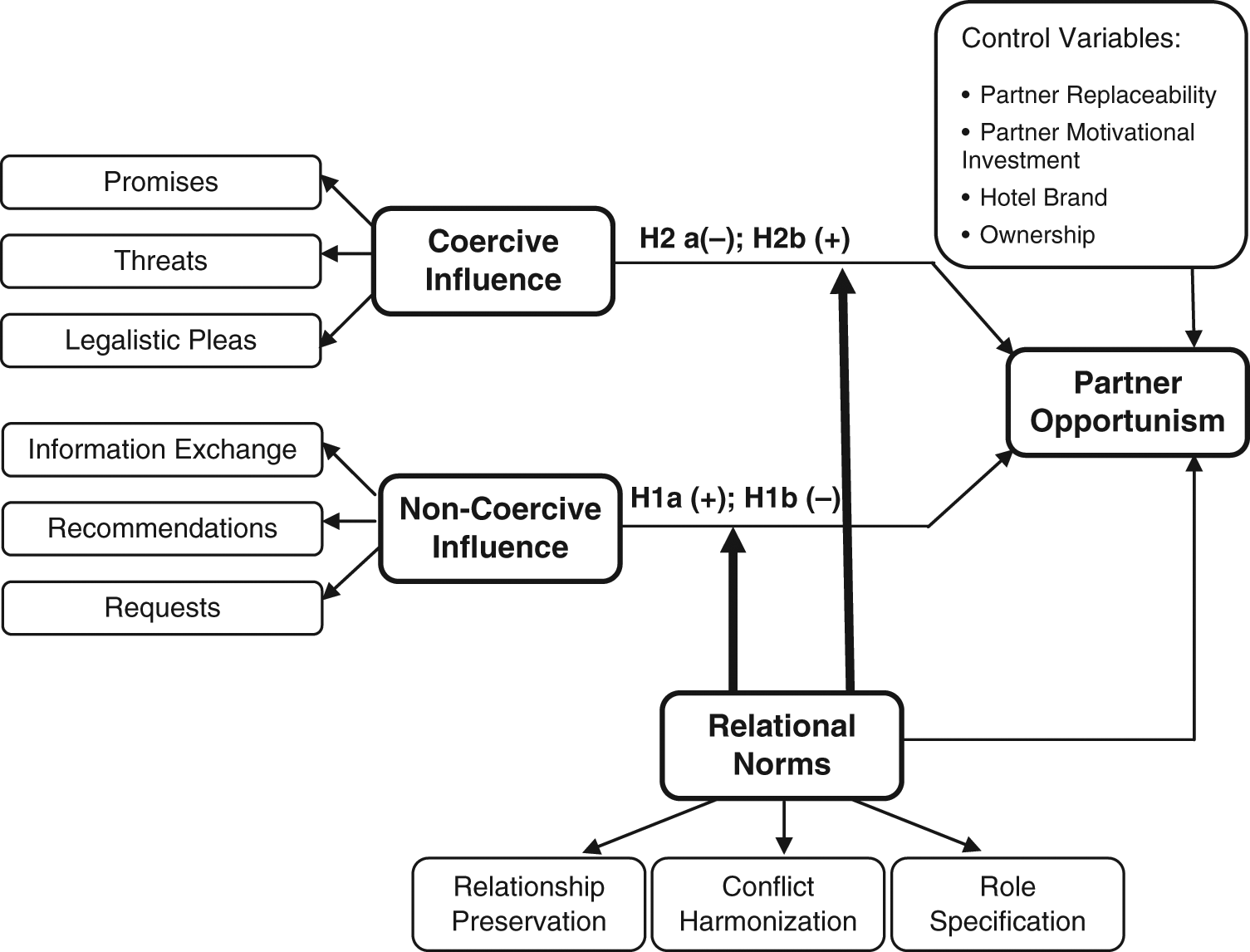
The Impact of Influence Strategies on Opportunism: The Moderating Effect of Relational Norms
Coercive and noncoercive strategies
In contrast to coercive strategies, noncoercive strategies operate less by directly rewarding or punishing bad behavior than by affecting the attitudes and beliefs of a brand partner to become more supportive and cooperative. Some scholars have argued in this respect that relational norms may support this process by enhancing reciprocal communication between partners, making it easier for one partner to deliver a message that limits opportunism by disposing the other partner to fully and diligently process the information contained in the message. Within an environment that enhances communication in this way, noncoercive influence strategies can be applied more effectively to limit a partner’s opportunism (Bhatnagar 1993; Bonoma 1976; Kasulis and Spekman 1980; Falbe and Yukl 1991; Jap, Manolis, and Weitz 1999; Mohr and Sohi 1995; and Payan and Nevin 2006).
You can see how such an environment would enhance the relational norms of role integrity and conflict harmonization. Effective message communication should encourage one’s partner to fully process a message’s content, and this helps to maintain the partners’ roles. With open lines of communication, the partners will have already overcome a barrier to conflict resolution, as their messages to and from one another will be conveyed clearly, facilitating negotiations over potential disagreements. When it is difficult for partners to communicate openly, on the other hand, disputes arise over the messages themselves, blocking progress on more substantive issues such as price or supply availability. This renders noncoercive strategies ineffective, at best, and the relationship can deteriorate even further, as weak relational norms open communications to misinterpretations and eventually the exploitation of shared information.
By the same token, we wanted to study the impact of relational norms on coercive strategies, such as threats, promises, or appeals to legal obligations. In essence, coercive strategies invoke immediate rewards for complying with contractual agreements or exchange arrangements and punishments for noncompliance. This suggests that coercive strategies are only as effective as the credibility of the rewards and punishments being invoked. Because coercive strategies by design operate in the short term, they are likely to be most effective in an exchange environment in which the partners work at arm’s length. If neither partner operates with long-term future outcomes in mind, imminent rewards and punishments seem more credible in the context of a relationship built on short-term financial outcomes.
Indeed, in an exchange environment characterized by strong relational norms, coercive strategies are likely to provoke dismay and frustration. If one partner perceives another as seeking an untoward advantage, the first partner will then easily justify opportunistic behavior in reaction. That is, where strong relational norms prevail, norm violation is likely to be reciprocated. Again, the effectiveness of coercive influence strategies seems to depend on the weakness or absence of relational norms in the partnership. Coercive strategies work best when transactions are viewed as “strictly business,” while noncoercive strategies work best when “it’s a pleasure doing business with you” is a natural expression of partner commitment (Ganesan 1994; Lusch and Brown 1982; Provan and Skinner 1989; Schurr and Ozanne 1985).
Hypotheses
We tested our reasoning on the effects of relational norms on influence strategies by formulating four hypotheses, two in reference to noncoercive influence and two in reference to coercive influence.
Noncoercive influence
We believe that strong relational norms should make noncoercive influence more effective in limiting partner opportunism. We formulated our hypotheses from the point of view of a firm seeking to influence partners with this goal in mind. If the firm in question perceives that its relationship to a particular brand partner is based on strong relational norms, we proposed the following:
Hypothesis 1a: To the extent that a firm perceives high levels of relational norms as characterizing the brand relationship, noncoercive influence strategies will be negatively linked to the extent of its brand partner’s opportunistic behavior.
This hypothesis predicts that empirical data will confirm the proposition that noncoercive influence works more effectively in limiting partner opportunism when a firm’s relationship to a given partner is based on relational norms such as solidarity, role integrity, or conflict harmonization. The converse of H1a is based on our belief that a relation ship with weak relational norms will undermine the effectiveness of noncoercive strategies in limiting partner opportunism:
Hypothesis 1b: To the extent that a firm perceives low levels of relational norms as characterizing the brand relationship, noncoercive influence strategies will be directly linked to the extent of its brand partner’s opportunistic behavior.
This hypothesis suggests that the use of noncoercive techniques will fail where relational norms are weak, and such approaches may in fact increase opportunism because the partner may well suspect the noncoercive approach or view it as vulnerability.
Coercive influence
We believe that weak relational norms enhance the effectiveness of coercive influence strategies in limiting partner opportunism. We state that in the following hypothesis:
Hypothesis 2a: To the extent that a firm perceives low levels of relational norms as characterizing the brand partnership, coercive influence strategies will be negatively linked to the extent of its brand partner’s opportunistic behavior.
This hypothesis predicts that empirical data will show that, when strong relational norms have not developed in a partner relationship, coercive strategies such as threats, promises, and legal pleas will be more effective in limiting opportunism in the behavior of the partner. Conversely, to test our reasoning on coercive influence and strong relational norms, we proposed the following:
Hypothesis 2b: To the extent that a firm perceives high levels of relational norms as characterizing the brand relationship, coercive influence strategies will be positively linked to the extent of its brand partner’s opportunistic behavior.
Here the prediction is that a firm will be frustrated in its efforts to limit partner opportunism if it attempts to use coercive influence strategies in the presence of strong relational norms. In these cases, the partner is likely to be surprised and dismayed by such coercive tactics, perhaps feeling that established norms have been violated, making the partner more likely to consider retaliatory opportunism in response.
The Sample
We tested these hypotheses by examining the relationship between individual hotels and their brand headquarters in two large hotel firms doing business in North America. We selected these two companies because each has both company-owned properties and franchised units. The questionnaire that we sent was pretested with a group of more than thirty hotel general managers enrolled in an executive-development program at the Cornell School of Hotel Administration. We also asked senior managers in both hotel chains to review the questions to ensure their relevance.
We surveyed hotel general managers to gather our data, because our pretest determined that the hotel’s GM was the person within the hotel best qualified to report on the hotel’s relationship with its brand headquarters. The two hotel chains provided names of GMs and their hotel addresses, and we sent our questionnaire to 1,736 hotel general managers. Some were undeliverable or their hotels had switched brand affiliation, leaving a pool of 1,650 potential respondents.
To increase the response rate, we included a cover letter in support of the research from the hotel company’s chief operating officer, and we assured the participants that all responses were confidential. Thus, we present only aggregate results here. We also offered each participant an executive summary of the study as an inducement to participate. Finally, we sent follow-up letters to managers who did not respond within four weeks of the initial mailing. This resulted in a total of 367 completed questionnaires, representing a 22 percent response rate. No difference was found in the results between brands. A comparison of early responders to late responders revealed no significant differences on the constructs of interest; therefore, nonresponse bias does not appear to be an issue for this research (see Armstrong and Overton 1977).
Measures
We used the following four constructs to represent the factors we wanted to measure in testing our hypotheses: hotel opportunism, headquarters’ use of coercive influence, headquarters’ use of noncoercive influence, and relational norms. To measure hotel opportunism, we targeted what scholars call “active opportunism,” which involves behaviors that are prohibited under the terms of the partner contract. The measure was taken on the basis of responses ranging from strongly agree to strongly disagree on a four-item, 7-point Likert-type scale. We measured the two categories of influence strategies by directly measuring a set of component strategies for each one. In the case of coercive influence, we tested promises, threats, and legalistic pleas, using a similar 7-point scale that was based on previous research. For noncoercive influence, we used similar scales to measure information exchange, recommendations, and requests. We approached relational norms in the same way, directly testing relationship preservation (solidarity), role integrity, and conflict harmonization on scales based on existing research to determine the extent to which our sample of general managers applied these terms to their relationship with brand headquarters (Boyle et al. 1992; Brown, Dev, and Lee 2000; and Frazier and Rody 1991).
We controlled for three variables to enhance the accuracy of our measures. First, research has found that opportunism is significantly related to dependence in relationships between partners, so we controlled for this by testing aspects of dependence that have been posited in the research literature, namely, motivational investment in the brand partner—in the case of a hotel property, this would be its perception of the importance of the brand to its success—and the difficulty of brand replacement, which involves the cost and commitment required for the hotel property to align itself with another brand. Again we used 7-point scales similar to those described above. Because our sample came from two hotel chains and included both franchised and headquarters-owned properties, we added two control variables to account for these differences (Emerson 1962; Frazier, Gill, and Kale 1989; Joshi 1998; and Provan and Skinner 1989).
We adjusted our use of some of the constructs based on a factor analysis that allowed us to combine the scale items pertaining to the three individual relational norms into a single indicator of relational norms and to combine two of the aspects of coercive influence (namely, legalistic pleas and threats) into a single measure. We should note also that we excluded from the noncoercive influence category the request strategy, because it is rarely employed and therefore did not converge with the results pertaining to information exchange and recommendations (Frazier and Rody 1991; Frazier and Summers 1986; Stoddard, Keith, and Brown 2000). Following these adjustments, we ascertained that our revised measurement model fit the data acceptably and exhibited the appropriate forms of statistical validity (see Exhibit 2 for the measurement model results and Appendix for a list of retained items). We also ruled out what is known as common method bias through standard approaches in the literature (Podsakoff and Organ 1986; Podsakoff et al. 2003).
Convergent Validity a
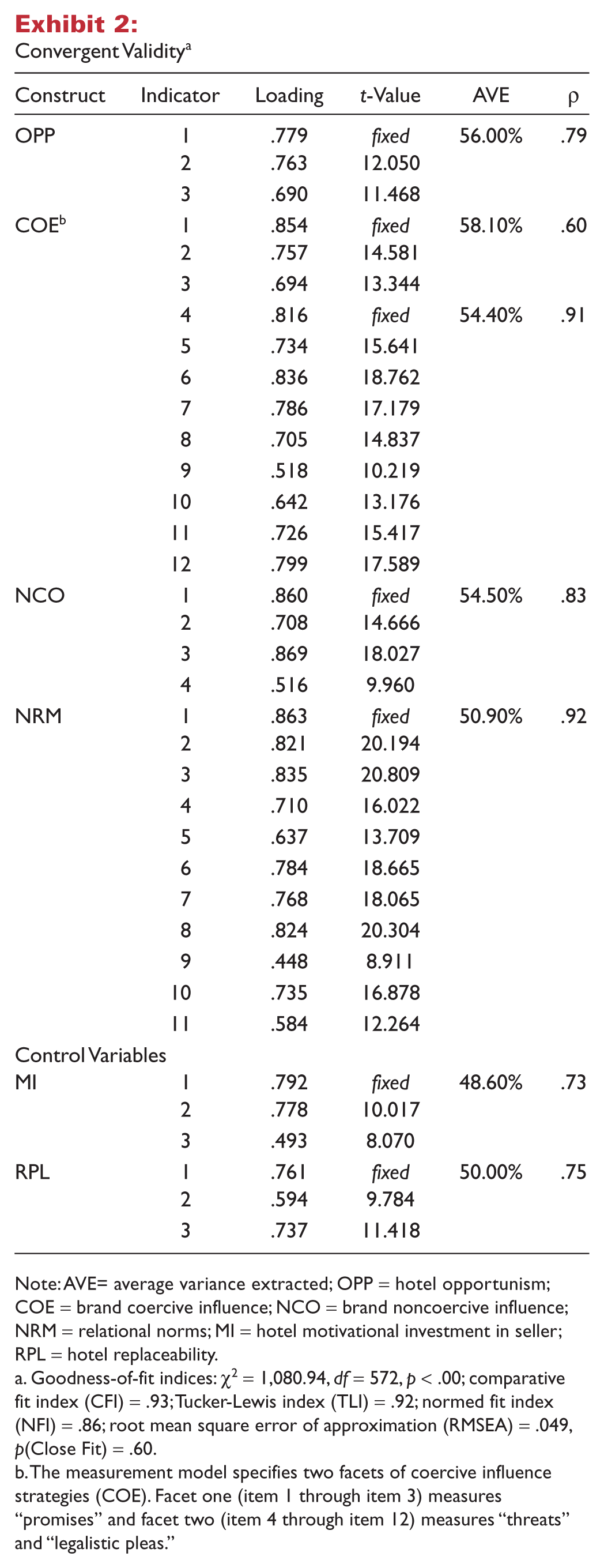
Note: AVE= average variance extracted; OPP = hotel opportunism; COE = brand coercive influence; NCO = brand noncoercive influence; NRM = relational norms; MI = hotel motivational investment in seller; RPL = hotel replaceability.
Goodness-of-fit indices: χ2 = 1,080.94, df = 572, p < .00; comparative fit index (CFI) = .93; Tucker-Lewis index (TLI) = .92; normed fit index (NFI) = .86; root mean square error of approximation (RMSEA) = .049, p(Close Fit) = .60.
The measurement model specifies two facets of coercive influence strategies (COE). Facet one (item 1 through item 3) measures “promises” and facet two (item 4 through item 12) measures “threats” and “legalistic pleas.”
Analysis
We tested the hypotheses by estimating the structural equations depicted in Exhibit 1. Our data fit the structural model acceptably (χ2 = 936.45, df = 633, p < .01; root mean square error of approximation [RMSEA] = .04, p (close fit) = 1.00, comparative fit index [CFI] = .94, nonnormed fit index [NNFI] = .93). Exhibit 3 reports the means, standard deviations, and correlation coefficients for the study constructs. The statistical model explained 30.6 percent of the variance in hotel opportunism, 12.8 percent of the variance in customer relationship performance, and 21.4 percent of the variance in hotel operational performance (see Exhibit 4).
Correlations
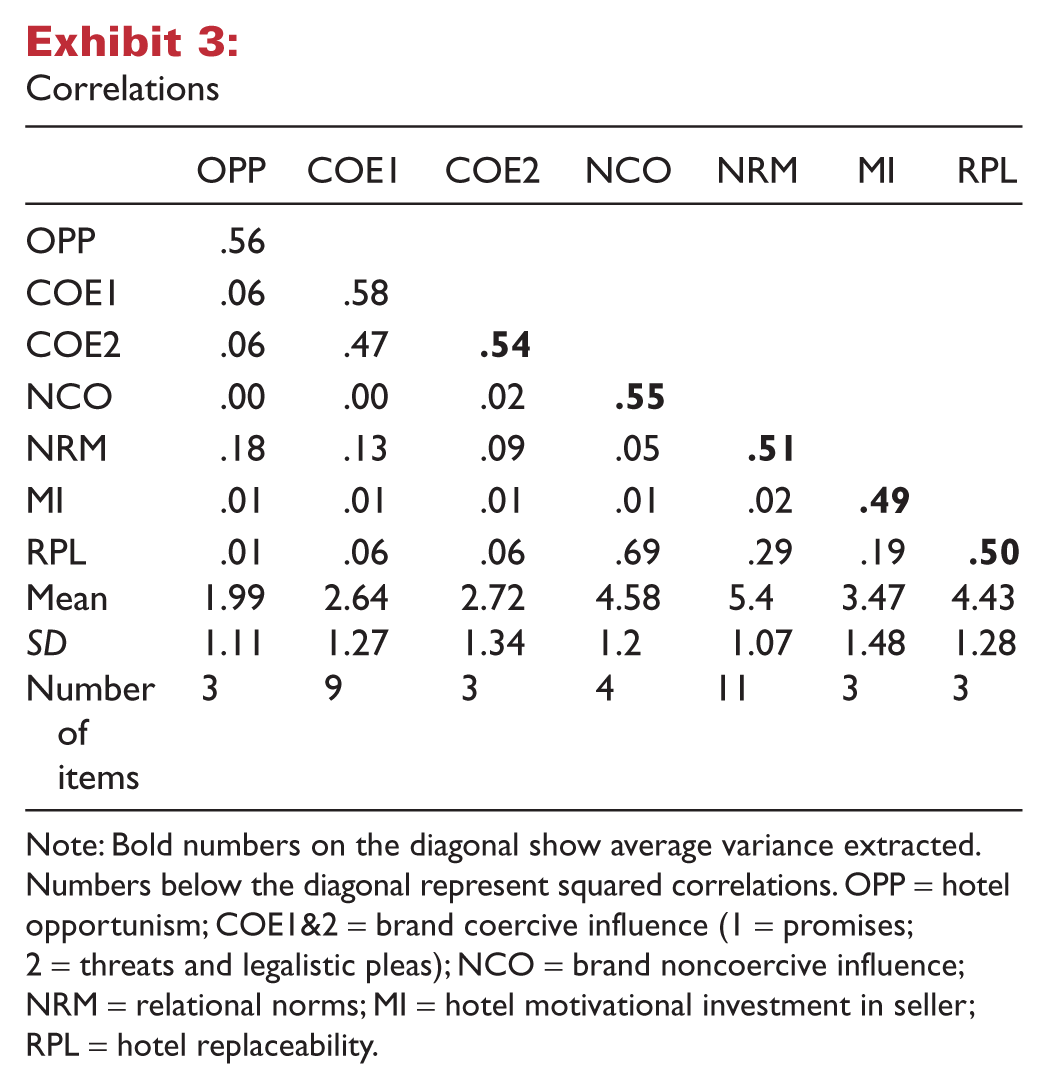
Note: Bold numbers on the diagonal show average variance extracted. Numbers below the diagonal represent squared correlations. OPP = hotel opportunism; COE1&2 = brand coercive influence (1 = promises; 2 = threats and legalistic pleas); NCO = brand noncoercive influence; NRM = relational norms; MI = hotel motivational investment in seller; RPL = hotel replaceability.
Structural Model Estimates a
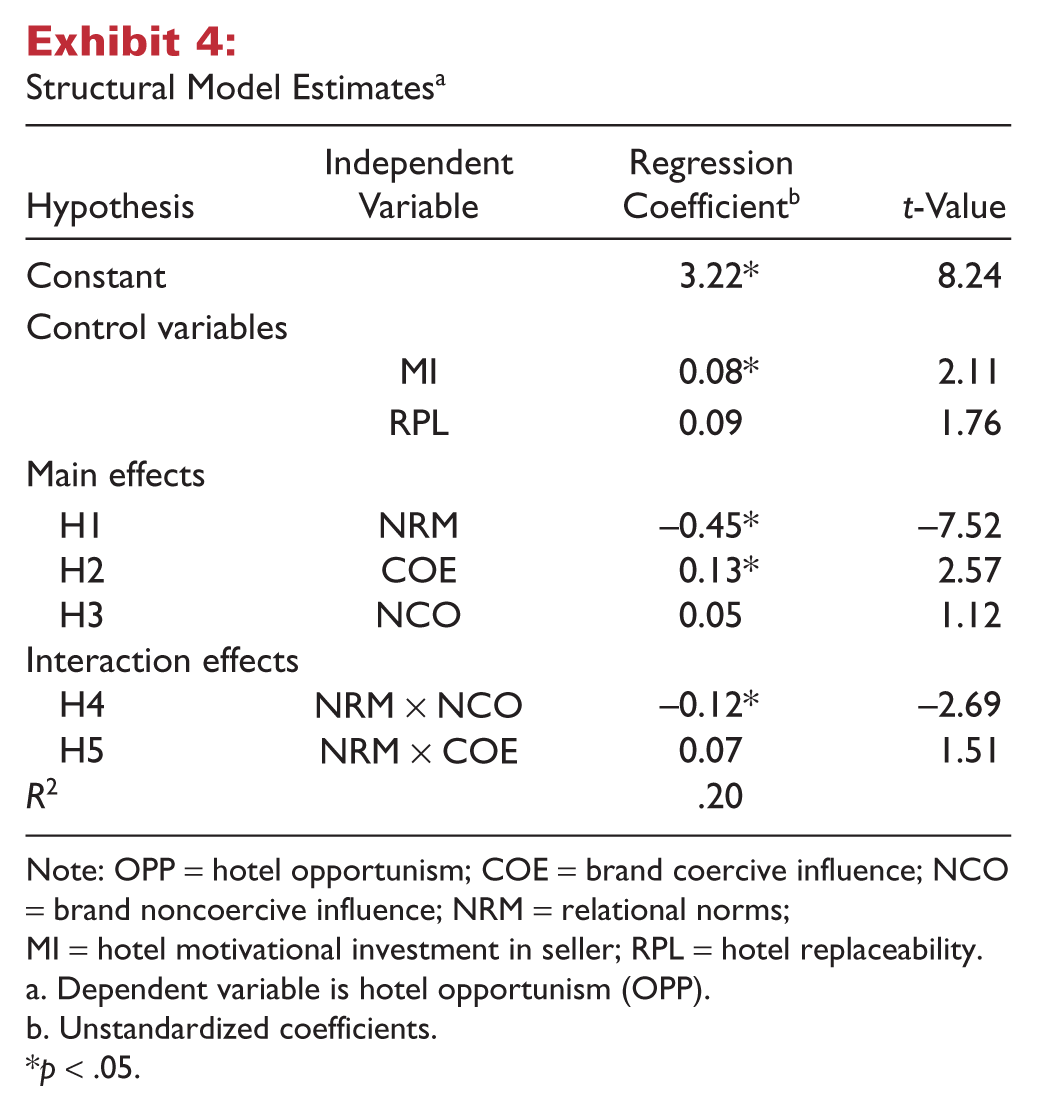
Note: OPP = hotel opportunism; COE = brand coercive influence; NCO = brand noncoercive influence; NRM = relational norms;MI = hotel motivational investment in seller; RPL = hotel replaceability.
Dependent variable is hotel opportunism (OPP).
Unstandardized coefficients.
p < .05.
Our statistical analyses were carefully adjusted to minimize various possible difficulties, based on standard procedures (as explained further in Brown et al. 2008). Our analysis confirmed the two hypotheses pertaining to the use of noncoercive influence to limit partner opportunism. H1a predicts that, when brand relationships are characterized by strong relational norms, noncoercive influence will effectively limit partner opportunism. Conversely, H1b predicts that, when relational norms are weak, noncoercive influence will exacerbate partner opportunism. When our brand headquarters employs noncoercive influence strategies in the presence of strong relational norms, opportunism decreases, while it increases when headquarters applies noncoercive strategies in the presence of weak relational norms. See Exhibit 5 for a graphic illustration of these results.
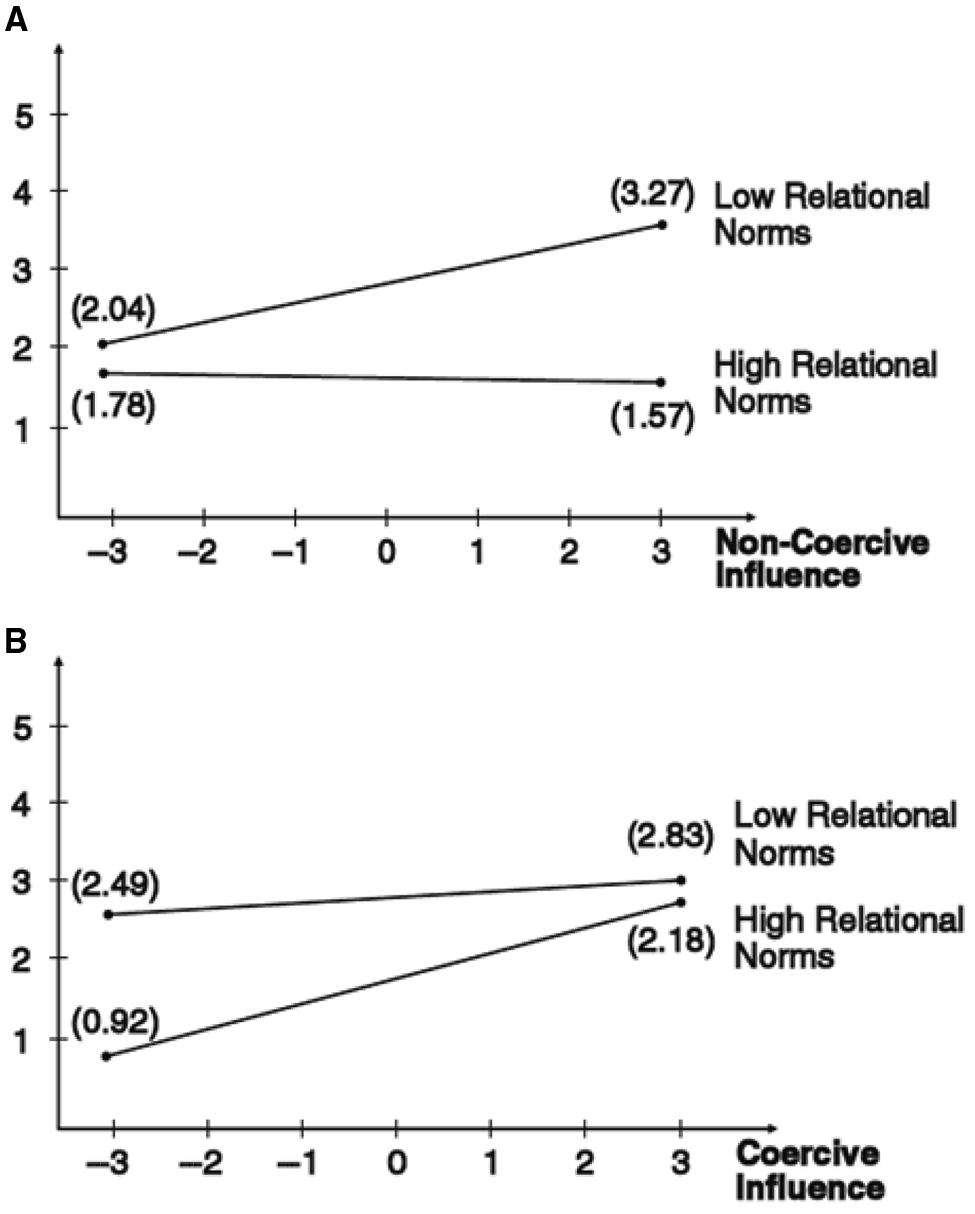
Decomposing the Effects of Relational Norms on the Relationship between the Brand’s Use of Influence Strategies and Hotel Opportunism—(a) Noncoercive Influence; (b) Coercive Influence
We achieved mixed results with regard to coercive influence strategies. H2a predicts that when brand relationships are characterized by weak relational norms, coercive influence will effectively limit partner opportunism. That did not prove to be the case. Coercive strategies are linked to an increase in opportunism even when employed in the presence of weak relational norms, so H2a is not confirmed. H2b predicts that, when relational norms are strong, coercive influence will exacerbate partner opportunism. We found confirmatory evidence for H2b, suggesting that when our brand headquarters employed coercive strategies in the presence of strong relational norms, opportunism increased significantly. In short, coercive strategies are correlated with an increase in opportunism regardless of the status of the relationship. Still, coercion provoked less opportunism in a weak relationship than in a strong one, suggesting that coercive tactics are somewhat less damaging when relational norms are weak than when they are strong. See Exhibit 5 for a graphic illustration of these results.
Managerial Implications
Before we offer practical implications, we must note the limitations of this study. The limitation that bears most directly on our study’s practical application is that our data are based on the perceptions of hotel property managers rather than on those of executives at brand headquarters. It is certainly possible that those executives will not share the perceptions of their property managers that pertain to their relationships. We also essentially tested influence flowing only in one direction (i.e., from the brand to the hotel). All this suggests future projects. For example, our study clearly identifies an area that deserves further research, and that is the question of how relational norms are developed and preserved. With those caveats, let us discuss the elements for managing opportunism that we identified here.
Based on what we learned from the hotel managers, brand executives should approach opportunism on the part of brand partners by carefully assessing the quality of their relationships. Those who enjoy relatively close relationships marked by strong relational norms such as solidarity and conflict harmonization should find it advantageous to employ noncoercive influence strategies in trying to limit or prevent opportunism. They can expect, for example, that when they share information with brand partners, the partners will not misuse that information, and that they can rely on the information that flows back from the partner. The better your relationship with a brand partner, the more effective noncoercive influence strategies will be in limiting opportunism.
Where relational norms are weak or nonexistent, however, noncoercive strategies unfortunately may encourage opportunism. Instead, our results suggest that, in the absence of strong relational norms, coercive influence techniques are more effective in limiting opportunism than noncoercive strategies; but we must note again that coercive approaches must be considered only as short-term tactics and that they apparently provoked opportunism regardless of relational norms.
Ultimately, our research adds to a trend in the literature that finds that coercive influence strategies, applied under conditions of weak relational norms, provide, at best, only short-term relief from partner opportunism. Over the long run, however, coercive influence tends to exacerbate opportunistic behavior because it is seen as limiting a partner’s autonomy. Opportunism is a common recourse in such cases. In the hospitality industry these outcomes may be even more likely, because a hotel manager and brand headquarters are more closely allied. If you enjoy good relations with your property managers, you will limit opportunism most effectively if you take the noncoercive approach.
Footnotes
Appendix
Acknowledgements
The authors acknowledge support for this study from the summer research program of the Cornell School of Hotel Administration, the two hotel companies we studied, and Reed Fisher for his help with collecting and compiling the data.

The author(s) declared no conflicts of interest with respect to the authorship and/or publication of this article.
The author(s) received no financial support for the research and/or authorship of this article.