







Abstract
When hotel employees feel stress from conflicts between work and family, some of the resulting exhaustion is inevitably reflected in their interactions with customers. This study paired two hundred hotel employees and customers in an analysis of customer satisfaction as it relates to employees’ service behavior, which is affected by the emotional, mental, and physical toll of work–family conflict. Employees’ exhaustion and emotional displays contain a mixed set of effects on customer satisfaction. The findings reveal that employees’ family interfering with work is linked to physical, emotional, and mental exhaustion, while work interfering with family does not have the same effect. Higher levels of physical exhaustion increased the likelihood that employees would display faked positive emotions and simultaneously suppress negative emotions. Customers could spot the fakery, but they judged that the fake positive emotions enhanced the employees’ role performance. At the same time, however, customer satisfaction was diminished when employees’ emotional displays were obviously not genuine. Thus, hotel managers may be interested in determining whether family issues are impinging on employees’ work responsibilities, given that the outcome may be reduced customer satisfaction.
The hospitality industry has long accepted the concept that customer satisfaction is driven in large part by interactions with frontline employees (Adams 1976, 1177). One important aspect of that interaction involves the effects of employees’ positive attitudes on customer satisfaction (Brown and Lam 2008), and it is acknowledged that job satisfaction is a large factor in those positive employee attitudes. Despite much study of employee job satisfaction, we have seen scant attention paid to what is clearly a key element in job satisfaction, namely, excessive family demands that might lead to negative attitudes and exhaustion. If employees share those negative attitudes during a service interaction, guest satisfaction may suffer and, further, this may interfere with service excellence.
Given the hotel industry’s long and irregular working hours, high levels of job insecurity, and high work stress (Karatepe and Uludag 2008; Pienaar and Willemse 2008), we posit that hotel frontline employees are prime candidates for role conflict between work and family. This work–family conflict refers to the incompatible and competing time and emotional demands from work and family (Greenhaus and Beutell 1985; Karatepe and Kilic 2009; Karatepe and Tekinkus 2006; Kim, Shin, and Umbreit 2007). Regardless of the level of employees’ work–family conflict or exhaustion, they are required to interact with customers in a cheerful way (Karatepe and Uludag 2008), as emotion is regarded as part of the service interaction. It can be argued, however, that work–family conflict leads to negative work attitudes and exhaustion and to less than ideal behaviors, including emotional displays that would have a detrimental impact on customer satisfaction. Researchers have examined the effects of employee attitudes as antecedents of customer satisfaction (e.g., prior expectations, disconfirmation, perceived performance, affect, and fairness), but these studies have generally ignored the effects of work–family conflict (Fournier and Mick 1999) in favor of more obvious and immediate factors within the workplace (Bell-Dolan and Anderson 1999). Unfolding the relationship between work–family conflict and customer satisfaction will help hospitality organizations solve of the riddle of why customers may remain dissatisfied even if the service is executed effectively. Our study results shed light on the ways in which family obligations might distract employees from fulfilling their job responsibilities and provide managers with valuable information needed to take appropriate corrective action.
We first discuss how work–family conflict might increase frontline employees’ physical, emotional, and mental exhaustion. We then illustrate how these three different types of exhaustion might influence employees’ display of positive emotions and suppression of negative emotions. Finally, we test the link between emotional displays, employees’ role performance, and customer satisfaction. Our integrative model is shown in Exhibit 3.
Theoretical Framework
Work–Family Conflict and Service Climate
Work–family conflict has two interdependent dimensions: work interfering with family and family interfering with work (Frone, Russell, and Cooper 1992; Frone, Yardley, and Markel 1997). Researchers have traditionally viewed work interfering with family and family interfering with work as having distinct antecedents and outcomes. Logically, work interfering with family represents the impact of work-related factors on family aspects, while family interfering with work reflects the effects of family responsibilities on work outcomes (Frone, Yardley, and Markel 1997). We propose, however, that both of these role conflicts influence employees’ workplace attitudes and behaviors. We say this because employees might attribute all work–family conflicts as stemming from work demands and thus perceive their jobs as the source of stress and exhaustion (Boyar et al. 2003; Grandey, Cordeiro, and Crouter 2005). In this view, when family matters inhibit the work flow, employees would blame the job for not allowing them to meet family demands, thus resulting in negative attitudes and withdrawal behaviors. However, when work duties prevent employees from enjoying family life, employees might feel more stressed about their jobs. Empirical investigations have demonstrated that both of these situations significantly increase employees’ exhaustion levels (Karatepe 2010; Yavas, Babakus, and Karatepe 2008) and eventually result in high turnover intentions (Karatepe and Uludag 2008).
Although the negative impact of work–family conflict on employees’ work attitudes is well established (e.g., Allen et al. 2000), we know little about the role of this conflict in influencing employee–customer interactions. As we indicated above, we posit that the service climate will be damaged when employees feel the effects of such conflict. However, a strong service climate tends to enhance customer experiences (Mayer, Ehrhart, and Schneider 2009; Schneider et al. 2005) and reduces work–family conflict (Schneider, Chung, and Yusko 1993).
Effects of Work–Family Conflict
We have seen little empirical support for the proposition that work–family conflict influences employees’ attitudinal and behavioral outcomes such as job satisfaction, family satisfaction, life satisfaction, job stress, burnout, organizational commitment, organizational citizenship behaviors, job performance, and turnover intentions (Karatepe and Baddar 2006; Karatepe and Bekteshi 2008; Karatepe and Uludag 2008; J. S. Michel et al. 2009; Mulvaney et al. 2007; Yavas, Babakus, and Karatepe 2008). One empirical study among frontline employees in Northern Cyprus found that work interfering with family rather than family interfering with work had a significant negative effect on job satisfaction (Karatepe and Kilic 2007). In their more recent study, Karatepe and Kilic (2009) showed a negative yet insignificant relationship between work interfering with family and family interfering with work and job satisfaction. A study of Chinese hotel sales managers found that both work interfering with family and family interfering with work had a significant negative relationship with job satisfaction (Zhao, Qu, and Ghiselli 2011). Karatepe and Kilic’s (2009) investigation demonstrated that family interfering with work rather than work interfering with family is negatively associated with affective commitment, while Namasivayam and Zhao (2007) did not find significant correlations between either type of interference and affective commitment.
In light of these inconsistent findings, scholars have called for future research integrating work–family conflict with service outcomes (Kelly et al. 2008; Maertz and Boyar 2011). Frontline employees’ attitudes can influence service outcomes such as customer satisfaction in two ways: (1) via affective processes (e.g., emotional contagion between the employee and the customer) and (2) employees’ willingness to engage in extra-role behaviors (Grandey, Goldberg, and Pugh 2011). Netemeyer, Maxham, and Pullig’s (2005) study addressed the second point but not the first. They demonstrated that work–family conflict results in job stress, which in turn decreases both in-role and customer-directed extra-role performances. Their results also illustrated that customer-directed extra-role performance had a positive impact on customer satisfaction. To fill the gap left by Netemeyer et al.’s research, this study examines the role of employees’ exhaustion and emotional displays in explaining the relationships between work–family conflict, service performance, and customer satisfaction.
Exhaustion
Exhaustion in this instance refers to three forms of depletion: physical, emotional, and psychological (Bhanugopan and Fish 2006; Enzmann et al. 1998; Pines and Aronson 1988, 12; Wright and Cropanzano 1998). Physical exhaustion refers to employees’ status of low energy or weariness (Weisberg and Sagie 1999); emotional exhaustion refers to individuals’ feelings of depression, hopelessness, and entrapment (Kim, Shin, and Umbreit 2007; O’Neill and Xiao 2010); and mental or psychological exhaustion reflects individuals’ negative attitudes toward themselves, work, and life. The depression and negative attitudes from exhaustion can spill over between work and family and result in role conflicts and deteriorated sense of well-being (Weisberg and Sagie 1999).
Exhaustion is the core dimension of burnout (Boles, Johnston, and Hair 1997; Lewin and Sager 2009; Maslach and Jackson 1981) and has a strong influence on individuals’ work attitudes (Cropanzano, Rupp, and Byrne 2003). Higher levels of work–family conflict tax the individual’s coping resources (Lewig et al. 2007). As people have a limited amount of “psychological and physical resources” to satisfy various work and family role demands (Aryee, Srinivas, and Tan 2005, 133), having to juggle both work and family obligations can lead to exhaustion (Grandey and Cropanzano 1999). Consequently, we propose that work–family conflict (i.e., both work interfering with family and family interfering with work) will increase frontline employees’ feelings of physical, emotional, and mental exhaustion.
Emotional Displays
Exhaustion also interferes with another aspect of frontline employees’ responsibilities, in which they are expected to manage both inner feelings and external facial expressions to “create a publicly observable facial and bodily display” for achieving organizational goals (Hochschild 1983, 7; Kim 2008). These organizational goals are reflected in job descriptions that outline the types of emotions frontline employees are expected and allowed to express along with emotions that they need to hide in their interactions with customers (Johanson and Woods 2008; Rafaeli and Sutton 1987). In addition to curtailing appropriate emotional displays (Chu, Baker, and Murrmann 2012; Cordes and Dougherty 1993; Cropanzano, Rupp, and Byrne 2003), exhaustion resulting from work–family conflict may lead employees to regard their work as personally costly and unjustified, consequently reducing the level of service offered to the customer (Cropanzano, Rupp, and Byrne 2003; Lam and Chen 2012). As a consequence, exhausted frontline employees often have to either fake positive emotions or struggle to suppress their negative emotions (Chu, Baker, and Murrmann 2012; Diefendorff and Gosserand 2003). Thus, we propose that frontline employees with a high magnitude of physical, emotional, and mental exhaustion are more likely to fake positive emotions and suppress negative emotions.
Customer Satisfaction and Role Performance
Role performance, which is the “cumulative set of actions, interactions, activities undertaken by the service provider in their fulfillment of service role” (Broderick 1999, 125), is a critical predictor of customer satisfaction (Burton, Sheather, and Roberts 2003), which reflects the customers’ evaluation of whether the service met their needs (Zeithaml, Bitner, and Gremler 2006, 110). Emotional displays are generally thought to operate as “control moves,” or efforts to manipulate emotional expressions (Goffman 1969, 12) in an effort to influence customers’ judgments and behaviors (Sutton and Rafaeli 1988). It is generally thought that displaying positive emotions and avoiding negative emotions is a prerequisite for positive customer evaluations (Giardini and Frese 2008).
However, inappropriate or obviously artificial emotional displays have been found to diminish customer satisfaction (Grandey 2000), even if such displays meet the letter of an employee’s job responsibilities. Moreover, the authenticity of displayed positive emotions reflects extra-role behaviors, thus enhancing customers’ overall evaluation of the service experience (Grandey, Cordeiro, and Crouter 2005). Conversely, when employees find themselves suppressing negative emotions and putting on faked smiles, they are likely to feel negative job attitudes and be less likely to go out of their way to satisfy the customer (Diefendorff and Gosserand 2003). Customers may also unconsciously mimic employees’ negative feelings, sense the inconsistency between displayed smiles and negative inner feelings, and adjust their service evaluations accordingly (Pugh 2001). Based on the above arguments, we propose that emotional display strategies are positively related to role performance but negatively linked to customer satisfaction.
Method
Procedures and Participants
We analyzed two hundred paired interactions of frontline employees and customers from six full-service hotels in the Macau S.A.R., China. Full-service hotels generally have a relatively large number of frontline employees interacting with guests. Based on a list published by a local tourism organization, we invited managers in ten 4- and 5-star properties to participate in the research project, of which six hotels, mainly catering to leisure travelers, agreed to participate. Forty frontline employees in each hotel, covering several departments, including front desks, bars and restaurants, and business centers, were randomly selected from an employee list provided by the hotel’s human resource department. This sample size ensured the minimum requirement (N = 30) for an approximately normal distribution (Ott 1993). Research assistants personally contacted employees at work and invited them to participate in the study. A cover letter indicated (1) that the study was financially supported by a research grant from the government, (2) that the results were solely used for academic purposes, and (3) that all responses would be kept confidential. In total, 240 surveys were distributed and completed on the spot.
Next, customers who had just interacted with the sampled employees were invited to participate in the study, by answering questions about the employee’s role performance and the customer’s satisfaction. The employee–customer surveys were immediately paired, and after deleting responses with excessive missing values, we ultimately obtained two hundred valid paired questionnaires (a response rate of 83.3%). We note that some participants were more agreeable to participate in the survey and were more careful in filling out the questionnaire than others.
Sixty-three percent of the employees were female, with an average tenure of 1.37 years (SD = 0.97) and an average age of 26.7 years old (SD = 5.61; range from 18 to 51). The average number of dependents (spouse, children, and elderly parents) was 1.26 (SD = 1.60). Of the 104 single participants 63 single respondents had no dependents but the other 41 had as many as 4 dependents. Among the married employees, just 10 had no dependents and the other 86 had up to 5 dependents. The human resource managers indicated that the sample is representative of their frontline employees.
With regard to marital status differences, we need to make two observations about this sample. First, we found no differences between single and married respondents’ perceptions of work interfering with family (F = .37, p = .55) or family interfering with work (F = .58, p = .45). Second, we were told that many employees without direct family responsibilities suffered from work–family-conflict-type stress due to negative spillovers between their work duties and social life. Thus, single participants in this study could be subject to feelings of exhaustion equally with their married coworkers.
The sample customers’ demographics were also consistent with the hotels’ guest profile. Fifty-two percent of the customers were male, their average age was 32.85 (SD = 10.03), and 78 percent indicated pleasure (vs. business) as their primary purpose of visit. A multivariate analysis of variance (MANOVA) test indicated that neither employees’ nor customers’ demographic characteristics nor the various hotel and service types influenced the variables of interest in this study (p > .05).
Measures
Work–family conflict was measured with four items modified from Grandey and her colleagues (2005). We started by defining the concept of work–family conflict for both single and married employees, and all items were rated on 7-point Likert-type scales, mostly anchored by strongly disagree and strongly agree. Two items measured work interfering with family (e.g., my job keeps me from spending time with my family members) and two items measured family interfering with work (e.g., my family demands make it hard for me to do my job well). Although the measurement scales should ideally have three or four items, more indicators may not necessarily represent the latent concepts better, and hence two-item measures are considered by some as acceptable options (Eisinga, te Grotenhuis, and Pelzer 2013; Hair et al. 2006; Reise, Widaman, and Pugh 1993). Considering the confirmative nature of the measurement scales in our study (and in the interest of a parsimonious questionnaire), we adopted two-item measures with highest factor loadings as indicators of their constructs (Hair et al. 2006).
Exhaustion was assessed by a six-item inventory devised by Pines, Aronson, and Kafry (1981), with two items measuring each of the three components of exhaustion. Using a 7-point scale anchored by low frequency of occurrence and high frequency of occurrence, we asked respondents to indicate how often they experience each form of exhaustion (Etzion 1984).
Employees’ emotional displays were measured by four items (Rupp and Spencer 2006; Spencer and Carnevale 2003) that use a scale of the extent to which employees perceive they have to exert effort in managing their emotions during their interactions with customers. Two items captured employees’ display of faked positive emotions (e.g., I tried hard to display enthusiasm to my customers), and the other two questions asked the extent to which they suppressed negative emotions (e.g., I tried hard to suppress how upset or distressed I felt).
Finally, the employees’ role performance was measured by customers’ responses to three items developed by Price, Arnould, and Tierney (1995), which captures the extent to which a service provider interacts with customers according to a job description and other organizational requirements. For the service that they just experienced, customers rated the employee on each of several attributes (e.g., “Efficiency in handling my requests”; “Amount of special attention paid to me”; and “Level of genuine behavior in his or her actions toward me”). Customers reported their satisfaction using three items developed by Hennig-Thurau et al. (2006). Two of the items were “I am delighted by this service experience” and “I am satisfied with this specific experience.”
Results
The data analysis strategies followed the two-step approach of structural equation modeling (SEM) suggested by Anderson and Gerbing (1988). The Cronbach’s α values of study constructs range from .83 to .93 (see Exhibit 1), thus exceeding the suggested cutoff value of .70 (Hair et al. 2006; Nunnally and Bernstein 1994). The results as shown in Exhibit 1 demonstrate that for all items, the composite reliability (CR) values ranging from .73 to .92 were above the cutoff value of .70, the average variances extracted (AVEs) ranging from .57 to .85 exceeded the .50 cutoff value, and ω values ranging from .73 to .91 were well above the .60 cutoff point (Fornell and Larcker 1981; Gignac and Powell 2009; McDonald 1999). Overall, we estimated the nine-factor confirmatory measurement model, and the results demonstrate that the measurement model fits adequately for the sample: χ2(83) = 68.59, p = .87, Goodness of Fit Index (GFI) = .95, Adjusted Goodness of Fit Index (AGFI) = .91, Comparative Fit Index (CFI) = .99, Incremental Fit Index (IFI) = .99, Root Mean Square Error of Approximation (RMSEA) = .01 (Bagozzi and Yi 1988). The modification indexes (MI) values range from 4.14 to 9.03, and the expected par change (EPC) values range from .07 to .16.
Descriptive Statistics (N = 200).
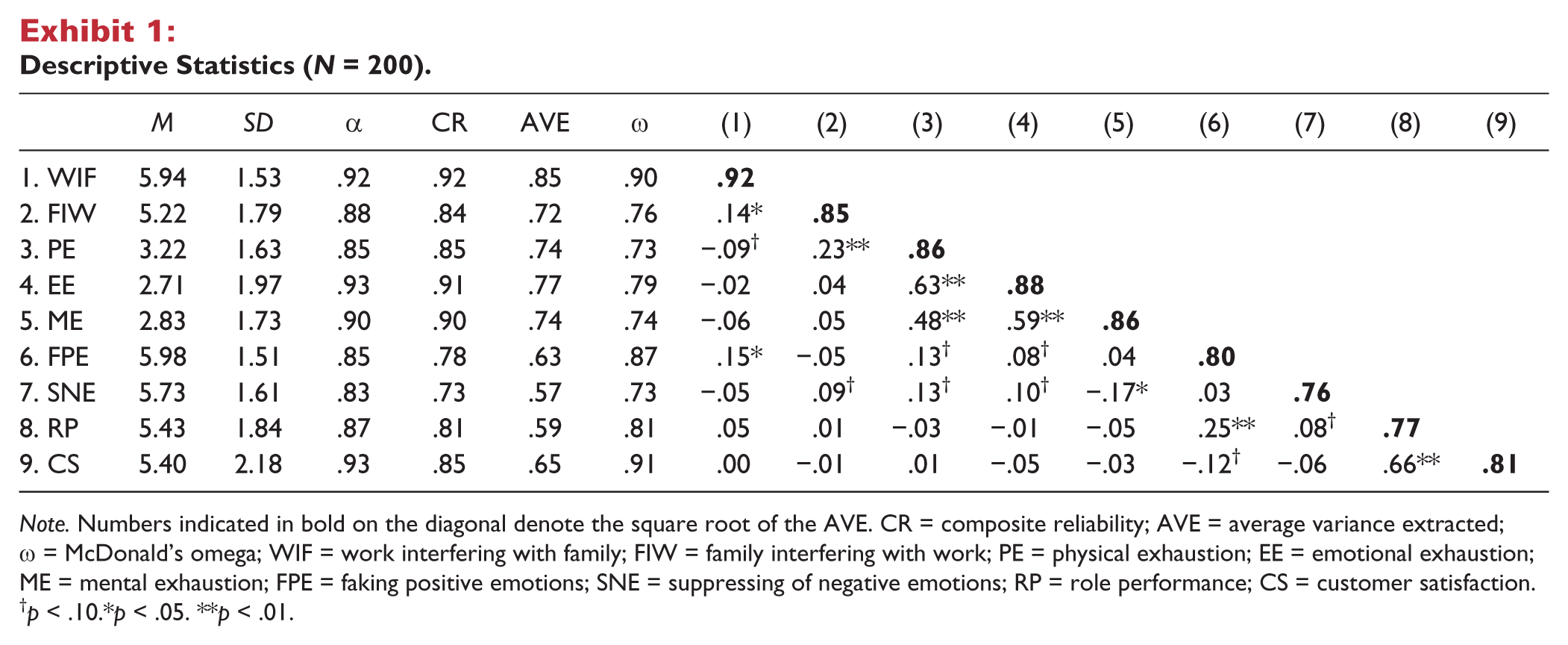
Note. Numbers indicated in bold on the diagonal denote the square root of the AVE. CR = composite reliability; AVE = average variance extracted; ω = McDonald’s omega; WIF = work interfering with family; FIW = family interfering with work; PE = physical exhaustion; EE = emotional exhaustion; ME = mental exhaustion; FPE = faking positive emotions; SNE = suppressing of negative emotions; RP = role performance; CS = customer satisfaction.
p < .10.*p < .05. **p < .01.
We then compared the full mediation and partial mediation models to determine the effects of work–family conflict using the standards established by Baron and Kenny (1986) to test the effect of interposing the mediator variable between an independent variable and a dependent variable. As the current hypothesized model has two groups of mediators: (1) physical, emotional, and mental exhaustion and (2) emotional displays (including faking positive emotions and suppressing negative emotions), we developed three partial mediation models: (1) a model in which both exhaustion and emotional displays mediate the effects of work interfering with family and family interfering with work on role performance and customer satisfaction; (2) a model with exhaustion only as a mediator; and (3) a model with emotional displays as a mediator.
The model fit indices of the fully mediated, partially mediated, and non-mediated models are shown in Exhibit 2. First, the fully mediated model (i.e., the hypothesized model) fits the data adequately: χ2(94) = 86.82, p = .69, GFI = .93, AGFI = .91, Normed Fit Index (NFI) = .90, CFI = .99, IFI = .99, RMSEA = .01 (Hu and Bentler 1999). The paths from family interfering with work to physical and emotional exhaustion, from physical exhaustion to emotion displays, from emotional exhaustion to faking positive emotions, and from faking positive emotions to role performance and customer satisfaction were significant, consequently fulfilling one condition of a mediation effect, namely, that the independent variable significantly affects the dependent variable. Second, the first mediation model—χ2(90) = 77.30, p = .83, GFI = .94, AGFI = .91, NFI = .91, CFI = .99, IFI = .99, RMSEA = .01; the second mediation model—χ2(92) = 85.05, p = .68, GFI = .93, AGFI = .90, NFI = .90, CFI = .99, IFI = .99, RMSEA = .01; and the third mediation model—χ2(96) = 92.60, p = .58, GFI = .93, AGFI = .90, NFI = .89, CFI = .99, IFI = .99, RMSEA = .01—adequately fit the data and have non-significant paths from work interfering with family and family interfering with work to outcome variables. In addition, the χ2 tests showed that the partial mediation models did not provide a better fit than the fully mediated model. As the significance of the independent variable disappears in the presence of the mediating variable, the next condition for a full mediation effect was satisfied. Finally, the non-mediated model also fits the data well, χ2(93) = 95.21, p = .42, GFI = .93, AGFI = .89, NFI = .89, CFI = .99, IFI = .99, RMSEA = .01, and the follow-up χ2 test indicated that the non-mediated model also did not provide a better fit than the fully mediated model. But the direct paths from family interfering with work to physical exhaustion, emotional exhaustion, faking positive emotions, suppressing negative emotions, role performance, and customer satisfaction are significant. The final condition of a mediation effect, that the independent variable significantly affects the mediator, is therefore fulfilled. Taken together, the fully mediated model as shown in Exhibit 3 is supported, thus demonstrating the effect of work–family conflicts on role performance and customer satisfaction.
Results of the Structural Models.
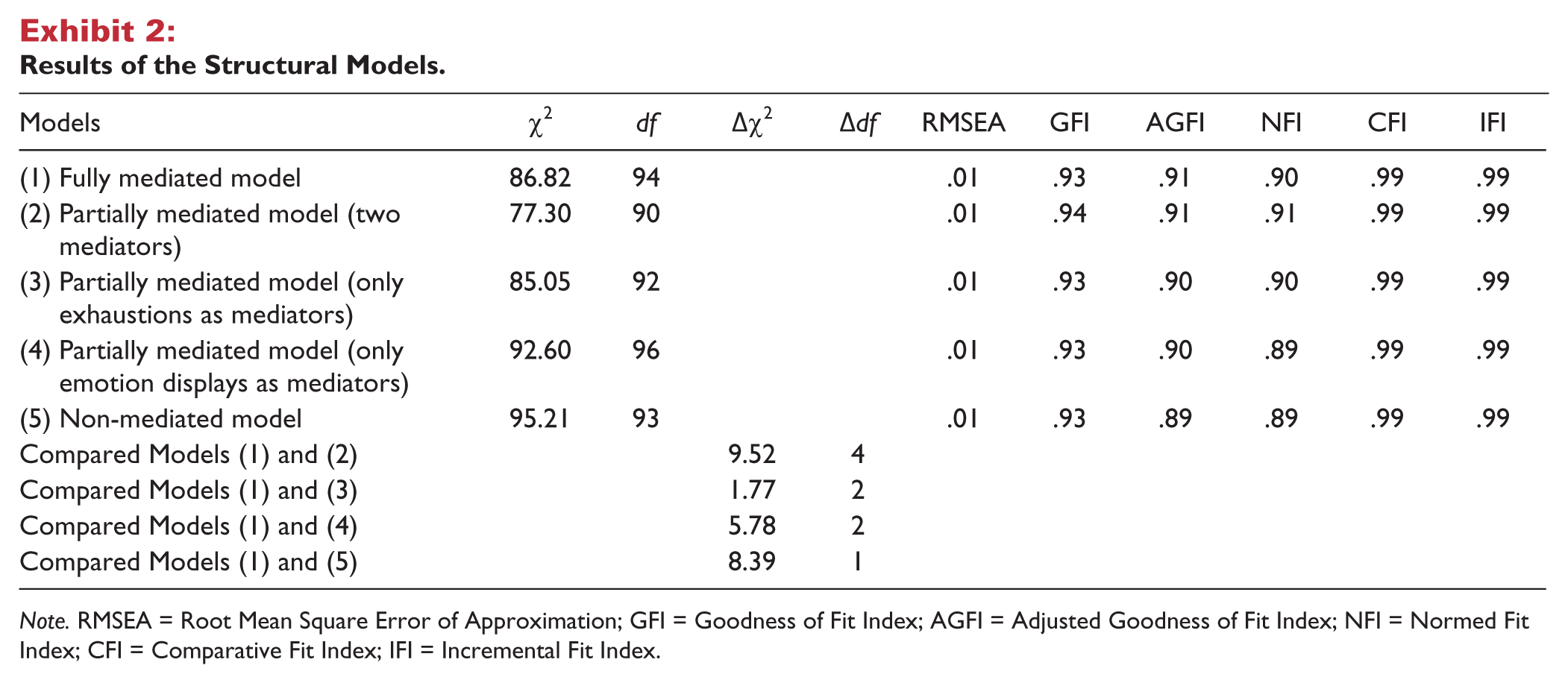
Note. RMSEA = Root Mean Square Error of Approximation; GFI = Goodness of Fit Index; AGFI = Adjusted Goodness of Fit Index; NFI = Normed Fit Index; CFI = Comparative Fit Index; IFI = Incremental Fit Index.
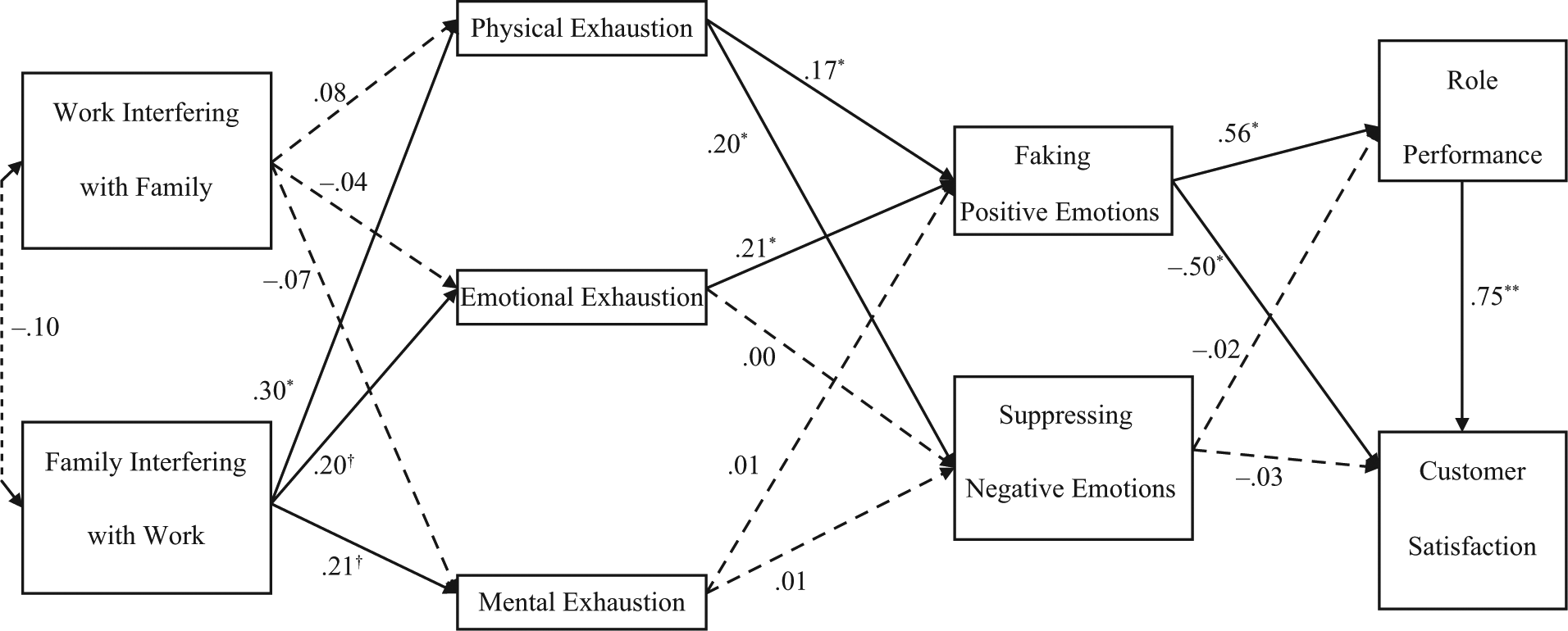
Results of the Fully-Mediated Structural Model.
Next, we assessed the path coefficients in this model to test our hypotheses. Contrary to Hypothesis 1a, participants’ work interfering with family failed to have a significant impact on their physical (β = .08, p > .05), emotional (β = −.04, p > .05), or mental exhaustion (β = −.07, p > .05). Thus, we do not see that employees’ role interferences from work to family influence their exhaustion level at the workplace. Looking in the other direction, though, participants’ family interfering with work had a significant effect on their physical exhaustion (β = .30, p < .05), and a marginally significant impact on emotional (β = .20, p = .07) and mental (β = .21, p = .08) exhaustion, partially supporting Hypothesis 1b. Neither work interfering with family nor family interfering with work had a significant direct impact on employees’ display of positive emotions or suppression of negative emotions (p > .05).
That said, our findings indicate that employees’ physical exhaustion significantly increased their display of positive emotions (β = .17, p < .05) and suppression of negative emotions (β = .20, p < .05). These results are consistent with Hypothesis 2a. At the same time, emotional exhaustion significantly increased the employees’ propensity to display faked positive emotions (β = .21, p < .05) but not their tendency to suppress negative emotions (β < .01, p > .05). Consequently, Hypothesis 2b is partially supported. Finally, we found no support for Hypothesis 2c, because mental exhaustion did not have a direct impact on the likelihood of demonstrating positive emotions (β = .01, p > .05) or suppressing negative emotions (β = −.01, p > .05).
The display of positive emotions increased customers’ perceptions of role performance (β = .56, p < .05) but that emotional display had the opposite effect on customer satisfaction (β = −.50, p < .05), supporting Hypotheses 3a and 3b. Contrary to the expectations expressed in Hypotheses 4a and 4b, employees’ suppression of negative emotions was not significantly associated with either role performance (β = −.02, p > .05) or customer satisfaction (β = −.03, p > .05). Finally, customer satisfaction was strongly influenced by employees’ role performance (β = .75, p < .01), thus lending support for Hypothesis 5.
Discussion
The findings of this study indicate that employees’ role interferences from family to work are positively linked to employees’ physical, emotional, and mental exhaustion but that is not the case for work interfering with family. Employees with higher levels of physical exhaustion were highly likely to fake positive emotions or to suppress negative emotions, while those with mental exhaustion seem most likely to fake positive emotions. Furthermore, guests judged that faking positive emotions had a positive impact on employees’ role performance and that performance was positively linked to customer satisfaction. At the same time, however, fake emotions had a negative effect on customer satisfaction. Surprisingly, suppressing negative emotions did not influence customer evaluations of the service encounter.
The Role of Work and Family Interference
This study’s finding that family interfering with work, rather than work interfering with family, influenced employees’ physical, emotional, and mental exhaustion is consistent with the traditional two-component model of work–family conflict (Frone, Yardley, and Markel 1997). Research has shown that work interfering with family influences family-related stress and behaviors, while family interfering with work results in work-related distress and behaviors (Boyar et al. 2003; Frone, Russell, and Cooper 1992; Frone, Yardley, and Markel 1997; Huang et al. 2004). Employees with greater role interferences from family obligations to work responsibilities exhibited higher levels of job-related exhaustion. This is a matter of concern, because exhaustion can translate into negative attitudes toward the workplace.
Emotional Labor
Our findings further indicate that employees with greater levels of physical exhaustion are likely to fake positive emotions and to suppress negative emotions, as well as to harbor negative feelings that carry over to the workplace. Given the requirement that frontline employees hide negative emotions from the customer, employees with greater levels of physical exhaustion are more likely to use such emotional labor strategies as faking positive emotions and suppressing negative emotions. However, the outcome of emotional exhaustion seems to be limited to faking positive emotions. These results indicate that physical exhaustion might have a stronger impact on emotional display strategies than emotional exhaustion. Both of these situations, though, can take a toll on the employee’s well-being and organizational commitment (Hülsheger and Schewe 2011; Johnson and Spector 2007). Curiously, the effects of mental exhaustion did not register in this study.
Effects on Role Performance and Customer Satisfaction
Our study findings also indicate that frontline employees’ excessive family demands influence customers’ satisfaction and their assessment of the employees’ role performance. Although faking positive emotions is positively linked to role performance, faking concurrently diminishes customer satisfaction. Given the nature of the hospitality service transaction, it is not surprising that displaying insincere positive emotions was positively linked to perceived role performance. However, our findings agree with other studies that suggest that customers can sense employees’ lack of authenticity, and therefore are less satisfied with the service encounter (e.g., Grandey 2000). In this regard, the fact that suppressing negative emotions was not significantly linked to customer evaluations makes sense. It is far easier for customers to read cues of genuinely positive emotions, such as a smile and enthusiasm, than to try to guess that the employee is suppressing negative emotions.
Implications for the Hospitality Industry
Our study’s results suggest that the relationship between frontline employees, their family life, and customers is complex and multidimensional. First, our findings provide new perspectives for hospitality managers because of the implication that frontline employees’ family responsibilities may interfere with service interactions and outcomes. Employees with heavy family burdens still have to follow organizational rules to ensure that their role performance reaches service standards. But exhausted frontline clerks might not go further than the letter of their job, and thus fail to notice guests’ special needs.
In that context, our findings imply that well-designed, family-friendly policies and benefit programs could help managers ensure service excellence. The recommendations that follow grow out of our finding that the workplace functioning of employees in this study was compromised by interference from family obligations. In that light, work–life benefit programs that assist in the family domain may be helpful in establishing a positive social exchange between an employee and an employer, and therefore employees will have higher commitment to the organization and work hard to achieve higher levels of work performance (Muse et al. 2008). In particular, a hospitality firm’s work–family policies should aim to establish a supportive organizational culture in which employees perceive great social support from managers (Grandey, Cordeiro, and Michael 2007). Such an organizational climate would help employees balance interferences between work and family domains, have high job satisfaction and well-being, and ultimately serve customers with authentic emotions.
To ensure service excellence, hospitality organizations should integrate service-oriented and family-friendly practices to ultimately establish an employee-focused organizational climate (J. W. Michel, Kavanagh, and Tracey 2013). A climate for service excellence directs, supports, and rewards frontline employees in their efforts to ensure customer satisfaction (Schneider, White, and Paul 1998), while family-friendly policies provide employees an opportunity to meet family demands (Allen 2001). Hospitality firms with an employee-focused work environment have often been distinguished in Fortune magazine’s list of best companies to work for (Hinkin and Tracey 2010). When employees sense that the firm values their contributions and cares about their well-being, they are less stressed, better satisfied, and greatly motivated to perform well (J. W. Michel, Kavanagh, and Tracey 2013). For example, many companies (e.g., Marriott) have implemented flexible work scheduling (Hinkin and Tracey 2010).
In conclusion, to compete successfully in the current economic environment, hospitality organizations, like any other service firms, need to manage customer experiences by providing genuine and enjoyable interactions between frontline employees and customers (Grewal, Levy, and Kumar 2009). This study demonstrates that employees’ family obligations can interfere with customer satisfaction and that interference from family obligations cannot be isolated from organizational consideration in the pursuit of service excellence.
Footnotes
Acknowledgements
The authors sincerely appreciate the insightful comments from the editor and anonymous reviewers.
Declaration of Conflicting Interests
The author(s) declared no potential conflicts of interest with respect to the research, authorship, or publication of this article.
Funding
The author(s) disclosed receipt of the following financial support for the research, authorship, or publication of this article: The authors are grateful for the financial support from the National Natural Science Foundation of China (71102097).