







Abstract
Hospitality studies often point to a need to investigate the linkage between service providers/firms, employees, and customers. Although there is a large body of literature showing that customer behaviors are shaped by the providers while employee performance and commitment are shaped by the organizations they are embedded within, most research exclusively uses data from a single level to infer social phenomena at multiple levels. This limitation creates fallacies that inhibit a complete understanding of research problems that traverse several social hierarchies. This article presents common research problems in the hospitality literature and examples of how multilevel methods could facilitate more rigorous research by controlling contextual and potentially confounding variables that exist at multiple levels. It also presents new research avenues that could advance the knowledge and theoretical development of the field. Based on examples of three scenarios delineating research problems in three major research streams, this article shows how multilevel methods could represent a leap forward to promote more rigorous and fruitful hospitality research. It further explains how multiple methods could bridge the divides between micro and macro research and between science and practice.
Hospitality research to date has employed a variety of analytical methods to investigate the complex and dynamic nature of hospitality phenomena and problems that exist in multiple levels of a social system (e.g., service provider/firm, functional units, teams, employees, and customers; Chen and Hu 2010; Chiang and Jang 2008; Kralj and Solnet 2010). Although these studies are insightful, as they build a necessary foundation that enhances the understanding of the hospitality industry, they face a common research limitation in that they use data from a single level (mostly customers or employees) to infer social phenomena that exist at multiple levels. In general, studies that encompass a different unit of analysis at multiple echelons of a social hierarchy require some form of multilevel design and analysis to improve the quality and precision of the results as well as to enhance the understanding of the complex social dynamics of the hospitality industry, which is often influenced by the social settings (Hitt et al. 2007; Klein and Kozlowski 2000). That is, customers’ and employees’ behaviors are not context-free, as they are often shaped by the organizations they are embedded within (House, Rousseau, and Thomas-Hunt 1995).
Although a few recent hospitality studies were conducted to explore the relationship between organizational and employee behaviors using multilevel methods (Hon and Leung 2011; Tews, Michel, and Stafford 2013; Way, Sturman, and Raab 2010), use of these methods is still relatively new to the field. Scholars who do not have multilevel research training may not fully understand the research design and data analysis (Aguinis, Gottfredson, and Culpepper 2013). This issue, coupled with the scant multilevel research in the field and the importance of multilevel methods in advancing the knowledge of the literature, calls for an urgent need to understand how the approach may help advance the literature (Aguinis et al. 2011; Hitt et al. 2007).
The objective of this article is to present some commonly encountered research problems in the hospitality literature, along with examples of how multilevel methods could facilitate more rigorous research by controlling and accounting for variance that exist at higher levels of a social system such as the hospitality research context. The article also aims to present new research avenues that could advance the knowledge in the field. It further works to open a forum of discussion about multilevel research in hospitality studies and serves as a catalyst to bridge the gaps in the literature, as further detailed. The author presents examples and recommendations of the approach in a nontechnical way so that they are accessible to a wide range of readership. Although multilevel research comes in two basic varieties—nested design and repeated measure design (Mathieu et al. 2012)—this article focuses primarily on the nested arrangement of the approach.
Multilevel Versus Single-Level Research
The multilevel method includes designs and analyses (or modeling) of the nested hierarchical nature of a social system that traverses two or more levels (Hitt et al. 2007; Klein and Kozlowski 2000). Snijders and Bosker (1999, 1) offer the following definition: Multilevel analysis is a methodology for the analysis of data with complex patterns of variability, with a focus on nested sources of variability . . . In the analysis of such data, it usually is illuminating to take account of the variability associated with each level of nesting. Multilevel analysis is an approach to the analysis of such data including the statistical techniques as well as the methodology of how to use these.
Multilevel modeling (MLM) solves problems arising from data aggregation and disaggregation (Raudenbush and Bryk 2002). First, data aggregation leads to lower statistical power and loss of valuable within-group information, while disaggregation leads to overestimation of the parameters of interest and to violation of the independence assumption. Second, data aggregation can lead to ecological fallacy or inference in that a researcher may erroneously use the aggregated results at the macro level to infer individual behaviors. Likewise, data disaggregation can lead to atomistic fallacy, in that a researcher may erroneously apply the disaggregated findings to infer group or macro-level behaviors (Klein and Kozlowski 2000). MLM is able to address issues pertaining to these approaches by modeling variables at different levels, enhancing the quality and accuracy of the results (Peterson, Arregle, and Martin 2012), as further discussed in subsequent sections.
MLM has two major tributaries. The first is contextual analysis, which focuses on the role of social context on individual behaviors. The second is mixed-effect models, in which it assumes that the social phenomena can be explained by effects that are fixed, random, or a mixture of the two (Snijders and Bosker 1999). MLM is often referred to as hierarchical linear modeling (HLM), random-coefficient models, multilevel regression models, mixed-effect models, and multilevel covariance structure (structural equation) models (Heck and Thomas 2009). The key difference between MLM and single-level modeling techniques such as ordinary least squares (OLS) regression, path analysis, and structural equation model (SEM) is MLM’s ability to assess the relationship between two variables at the lower level (i.e., micro level, individual level, Level 1, or L1) by explaining the random effects (random intercept and slope) emanating from higher-level (macro level, group/organizational level, Level 2, or L2) variables (Aguinis, Gottfredson, and Culpepper 2013). In other words, regression and SEM focus on the “average” relationship (i.e., slope) between two variables at L1 by treating both the intercepts and slopes as fixed (see Exhibit 1). However, MLM allows researchers to account for random intercepts and slopes of the relationship between L1 variables (e.g., employee satisfaction → organizational citizenship behavior [OCB]) by L2 factors (e.g., leadership style). Cross-level direct effect, hence, refers to an effect from an L2 predictor (leadership style) emanating onto an L1 outcome variable (OCB) by explaining the variance of intercept across higher-level groupings (e.g., hotel properties) from the L2 predictor. Cross-level interaction refers to an effect from an L2 predictor emanating onto the slope between two L1 variables by explaining the variance of the slope across groups from the L2 predictor (i.e., as a function of the L2 variable). Exhibits 1 and 2 both illustrate the relationship between satisfaction and OCB. The difference between the two exhibits rests on the fact that OLS regression provides an average estimate of the intercept and slope while MLM assesses the intercept and slope for each group. One can explain the variance of the random intercepts in Exhibit 1 by modeling a direct cross-level effect emanating from leadership style (L2 predictor), and the variance of the random slopes by modeling a cross-level moderating effect emanating from leadership style.
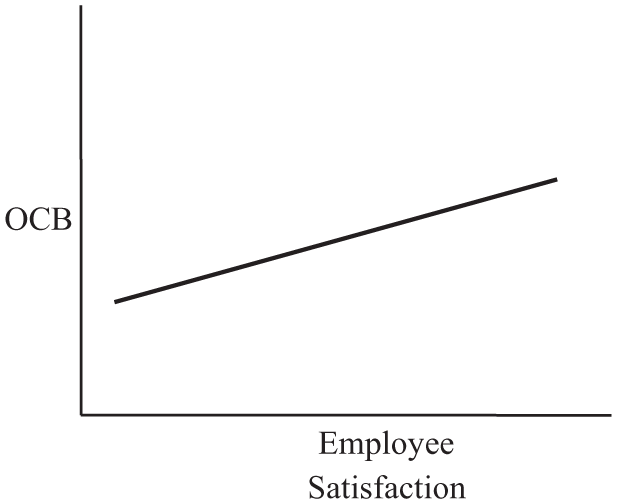
Illustrative Example Using OLS Regression.
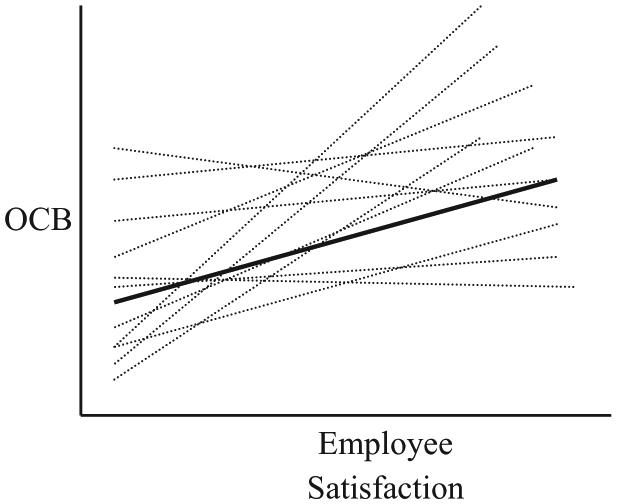
Illustrative Example Using Multilevel Modeling.
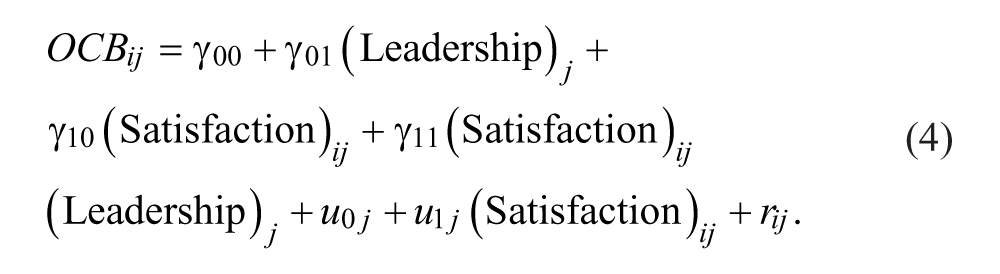
To better understand multilevel analysis using the above example for illustration, the following equations were presented. Equation 1 is similar to OLS regression, as the predictor and the outcomes reside at the same level. OCB ij is the predicted OCB score for the ith individual in a group (i.e., organization) j, β0j is the intercept for the jth group, β1j is the slope for the jth group, and rij is the L1 random error. Equation 2 includes the L2 predictor (i.e., leadership) hypothesized to emanate a cross-level direct effect onto the outcome variable (i.e., OCB). It shows that the jth group intercept is a function of the grand mean (the average across all groups) intercept γ00 and a random error u0j (i.e., represents how group intercepts deviate from the grand mean intercept). γ01 is the cross-level direct effect, which is the amount of change in a group’s average OCB score associated with one unit change in leadership style; in other words, it is the average OCB difference of one unit increase in leadership style.
Equation 3 includes the L2 predictor (i.e., leadership) hypothesized to emanate a moderating effect on the L1 outcome (i.e., OCB). It shows that the jth group slope is a function of the grand mean (the average across all groups) slope γ10 and a random error u1j (i.e., represents how group slopes deviate from the grand mean slope). γ11 is the cross-level interaction term, which is the amount of change in the satisfaction → OCB slopes across groups associated with one unit change in leadership style; in other words, it is the mean difference in satisfaction → OCB slopes when leadership style increases by one unit. Equation 4 combines the first three equations and resembles a typical MLM with cross-level direct effect and interaction.



Researchers should compute the intraclass correlation, ICC(1) = variance (u0j) / (variance [u0j] + variance [rij]) or ґ00 / (ґ00 + σ2), to identify the proportion of variance in OCB between groups. If ICC is near zero, then MLM is not necessarily an OLS regression and is a more parsimonious choice. However, if ICC ≥ .05, then MLM is an appropriate analytic choice, as it suggests that there may be an L2 variable (e.g., leadership) that explains the difference of OCB across groups. In such cases, MLM could greatly improve the precision of the findings and conclusions by explaining the random variances that are considered as residuals in single-level analysis. Readers are encouraged to refer to Aguinis, Gottfredson, and Culpepper (2013); Raudenbush and Bryk (2002); and Snijders and Bosker (1999) for a thorough explanation of the technical details about MLM.
Although single-level analysis has an advantage over its multilevel counterpart in being parsimonious and easy to use, it can only handle parameter estimation at one level. Multilevel analysis, however, can bridge the divide between micro and macro perspectives and account for micro-level behaviors by both micro- and macro-level attributes (Molloy, Ployhart, and Wright 2011). Bridging the micro–macro divide is the very key in understanding almost any given social phenomenon. As Klein and Kozlowski (2000) attest, virtually all organizational phenomena are embedded in a higher-level context, which often has either direct or moderating effects on lower-level processes and outcomes. Relevant contextual features and effects from the higher level should be incorporated into theoretical models.
The commentary from Klein and Kozlowski (2000) clearly indicates that individual behaviors are contextualized, which could be explained by the settings that employees and customers are embedded within. That said, without controlling or accounting for these potentially confounding factors from the organizational setting, parameter estimates could be biased. The extant literature such as systems theory, institutional theory, social construction theory, act-network theory, and environment-fit theory have consistently acknowledged that individuals are social actors and their behaviors are shaped by the environment or organizational context they are embedded within. Given the importance in better understanding individual behaviors within context, many scholars have called for a need to bridge the gap between micro and macro research (Hitt et al. 2007; Mathieu and Chen 2011; Molloy, Ployhart, and Wright 2011). The new advancement in applied psychology and management theories attest to an urgency for hospitality studies to adopt this new way of thinking. The following section offers three scenarios delineating problems in contemporary hospitality studies and how they could be addressed to advance the literature through MLM. These scenarios further exemplify the advantages of using MLM in addressing research questions in hospitality studies, and hence, the importance of using MLM as a mainstream design.
Research Problems and Applications in Hospitality Studies
As the field of hospitality matures, scholars are more compelled to look into concepts and theories that span across multiple disciplines such as management, marketing, and sociology (Angela et al. 1999). Theories derived from the business and sociology literature often take a dynamic view of social research, in that behaviors of individuals as social actors are shaped by the social settings they are embedded within (Klein and Kozlowski 2000). Thus, individuals who are nested within a common social context (e.g., organization) are not independent, and research findings that derive from a specific setting are not context-free. Hence, some critics have exhorted that social studies should embrace multilevel methods for rigorous scientific investigations (House, Rousseau, and Thomas-Hunt 1995).
Take organizational setting as an example. Management theories commonly acknowledge significant effects exerting from organizational properties (e.g., organizational structure and culture, human resource practices, and leadership style) to employee behaviors (e.g., job satisfaction, burnout, task performance, organizational commitment, and turnover; Robbins 2003). Marketing studies also widely suggest significant firm-level influences (e.g., brand equity, pricing and promotion, product and service offerings, promotional strategy, and distribution channels) on consumer behaviors (e.g., brand attachment, customer experience, perceived value, customer expectations, and customer satisfaction and loyalty; Schiffman and Lazar 2006).
Despite paradigmatic and disciplinary diversities, most scholars agree to an intricate linkage between organizations, employees, and customers. For example, Parasuraman (2000) coins the services triangle to denote how firm and management practices may impact employees and customers. Internal marketing efforts such as training, motivation programs, recruitment, and other organizational practices are engaged to help employees in delivering services to customers. Heskett et al.’s (1994) seminal work on the service–profit chain showcases a general framework that links service providers/firms, employees, and customers. According to Heskett et al., customer satisfaction and loyalty is a direct and indirect consequence of good service quality and value provided by satisfied, loyal, and productive employees. Yet, employees are satisfied and hence, loyal and productive only through the direct influence of firm-level practices such as service-oriented culture and high service standard.
From a broader multilevel lens, the social environment is a hierarchical system with different social units nested within one another: society/economy, industries, organizations, business functions/units, teams/groups, individuals. In short, research that traverses multiple levels of analysis requires applications of multilevel methods as detailed above. By encompassing multilevel methods, researchers can better take the research context into account and explain variations within and between different levels of the social system. Indeed, as Klein and Kozlowski (2000) assert, it is unlikely that single-level relationships are unaffected by other levels. This article attempts to bridge the gap in hospitality research that has been bifurcated into micro (customer and employee) and macro (organization) perspectives. Among various areas of hospitality research, this article, in subsequent sections, presents three major streams and commonly encountered research problems in each stream.
Scenario 1: Hospitality Firms (Providers) and Employees
A review of the literature suggests a growing interest in research investigations pertaining to the relationship among organizational and employee behaviors. This research stream focuses on the role of firm-level attributes and behaviors (e.g., organizational type, culture, leadership, trust, support, and corporate social responsibility) on employee-level perceptions and behaviors (e.g., employee motivation, organizational commitment, job stress and burnout, empowerment, job satisfaction, and job performance; Chiang and Jang 2008; Hsieh, Lin, and Lin 2008; Y.-K. Lee et al. 2012). The focus in this research stream is to understand the extent of the effects of organizational attributes and behaviors on employee behaviors. A dominant approach is to rely on single-level analysis (e.g., OLS regression, SEM, and analysis of variance), usually from the employee perspective, in the context of one or a few service providers (e.g., hotels and restaurants). Taking Chiang and Jang’s (2008) study as an example, the authors test the relationships between leadership, trust, and organizational culture as well as employee’s empowerment, job satisfaction, and commitment, based on self-reported response from hotel employees.
However, these studies face several imitations. First, the unit of analysis for organization-level variables should either be derived from properties that exist at the same level or aggregated from employees or managers at the individual level, to infer organizational-level properties based on consensuses from employees or managers. Second, by not accounting for the variations in the research context, these studies commonly assume that the results are context-free (i.e., homogeneous among firms). Yet, variations commonly exist in different social settings, as discussed above. For example, the effect of organizational culture on the impact aspect of empowerment could be much stronger at small local hotels, while the effect could be much weaker, or even vanish, at international hotel chains such as Marriott and Hyatt.
From a multilevel lens, researchers could control and account for confounding effects from both levels by exploring the organizational-level effects on employee-level behaviors either as direct or moderating effects by modeling them as random intercepts or random slopes, respectively. Taking Chiang and Jang’s (2008) study as an illustrative example, researchers could draw a sample of hotels (e.g., n ≥ 20) with an average of ten to fifty employees within each hotel. The study could be improved and extended by first aggregating employees’ perceived leadership, trust, and organizational culture at the organization level (L2). If both the median of within-group interrater reliability/agreement Rwg ≥ .70 (i.e., strong agreement) and reliability of mean rating ICC(2) ≥ .70 (a value of .60 is still considered acceptable) are warranted (James, Demaree, and Wolf 1993), aggregation of micro-level variables into higher macro-level variables is supported. Second parameter estimation of the relationship leading from leadership to trust and organizational culture (all at L2) can be performed in OLS regression. The relationship leading from trust (L2) and organizational culture (L2) to empowerment (L1), job satisfaction (L1), and organizational commitment (L1) can be performed using MLM. Researchers can also test the cross-level indirect effect leading from leadership (L2) to the L1 outcome variables. Cross-level interaction can also be examined to explore, for example, whether the empowerment → satisfaction and commitment relationships are stronger or weaker for organizations with a strong culture of employee harmony and development. In an extreme case, the relationship may even be negative if employee empowerment is perceived as a burden for organizations that have a strong emphasis on customer orientation, which may translate into lower employee satisfaction as employees may perceive empowerment is a management gimmick that puts pressure on employee performance. These possible boundary conditions could greatly improve the precision and generalizability of the results and hence, the usefulness in helping decision makers to formulate appropriate strategies.
Scenario 2: Service Firms (Providers) and Customers
Hospitality studies often point to the role of service firms’/providers’ value propositions, marketing mix appeals (e.g., service quality and offerings, service convenience, pricing, and promotions), and brand equity (e.g., brand image and awareness) on customers’ attitudes, expectations, perceptions, purchase intentions, and actual behaviors (Chen and Hu 2010; Kim, Ng, and Kim 2009; J.-S. Lee and Back 2008). Using Chen and Hu’s study as an example, the authors investigate the role of coffee quality, employee service, atmosphere, food and beverage quality, and extra benefits on customers’ perceived symbolic and functional value in a coffee shop.
This stream of research exclusively uses customers to assess firm performance and customer perceptions and behaviors. This approach has an advantage as it allows researchers to test relationships among variables that exist at both the firm and customer levels using single-level analysis such as OLS regression and SEM. A limitation exists in that customers of a specific service provider are not independent. That is, their service evaluations, satisfaction levels, and behaviors tend to be similar, hence, violating the independence-of-observation assumption by using the aforementioned single-level statistical techniques. For example, a coffee shop’s brand image, service environment, products, coffee quality, and pricing are different among industry players. Starbucks, for example, charges a premium due to its internationally renowned brand image and unique service offerings; thus, customers’ evaluations would be different for Starbucks than for Pacific Coffee or other coffee shops. Such discrepancy exists across the globe and across the hospitality industries and should be controlled and explained by factors at the macro level.
Using a multilevel approach, one could address this issue by investigating effects emanating from the firm level to the customer level. Again, using Chen and Hu’s study as an example, researchers could draw a sample of coffee shops (e.g., n ≥ 20) with ten to fifty customers each. Next, brand image could be included in their model as an L2 predictor to estimate how well perceived service quality (L1) influences perceived value (L1) when brand image is controlled (i.e., cross-level direct effect). Researchers could also model a brand image × service quality cross-level interaction effect to explain the variations of the strength of the relationship between service quality and value. For example, the results may suggest that for low brand image providers (e.g., mom and pop coffee shops), the effect of employee service and food and beverage quality are stronger, whereas for high brand image providers (e.g., Starbucks), the effect of atmosphere and extra benefits (e.g., free Wi-Fi) are stronger.
The example clearly demonstrates a need for multilevel design in understanding the complex interaction between firm-level and customer-level phenomena as well as how confounding factors can be controlled. It further allows the researchers and practitioners to gain deeper insights into the role of the research context and firm-level attributes to better explain customer behaviors. Hence, decision makers can better justify their service propositions and priorities. Although researchers may compare path coefficients between groups by using structural equation modeling or regression (i.e., moderated multiple regression), such methods only draw comparisons on a few groups—usually two to three groups. Multilevel analysis, however, allows researchers to test the difference in path coefficients by modeling the slopes as random rather than fixed. In addition, multilevel analysis could model the contextual factors as categorical or continuous variables. It could also be utilized to test the underlying factors that lead to the random variations or the slope of intercept at different levels.
Scenario 3: Employees and Customers
Investigation of the relationship between service employees and customers presents a clear challenge in research design and data analysis. The challenge arising from this relationship is that they are not necessarily nested within each other because an employee can serve multiple customers while a customer may receive services from multiple employees from the same firm. Yet, the marketing and hospitality literature widely acknowledges the roles of service employees and the delivery process on customer behaviors (Heskett et al. 1994; Rust and Oliver 1994). The overwhelming consensus suggests a strong positive influence of frontline employees on customers during the service delivery process across industries (Ha and Jang 2010; Wong and Fong 2010). Findings from this research stream commonly point to the role of employee service quality on customer satisfaction and loyalty. Yet, due to methodological limitations, research tends to use customers to assess employees’ performance. Other employee behaviors (e.g., organizational commitment and emotion) are generally excluded as customers do not have knowledge of these aspects.
Some researchers attempt to address this issue by using employees to evaluate the influence of organizational-level and employee-level behaviors on customers. One approach is to use employees’ perceptions of customers as a proxy of customer-level behaviors (He, Wenli, and Lai 2011; Kralj and Solnet 2010). For example, Kralj and Solnet explore the relationship between organizational service climate and customer satisfaction. The authors use employees from a single hotel to evaluate both service climate and customer satisfaction. He et al. extend the relationship between service climate and customer satisfaction through the mediator of employee commitment. Similar to the work of Kralj and Solnet, He et al. use employees to assess all the constructs.
Several methodology limitations exist in such a design. First, organizational service climate exists at the organizational level, employee commitment exists at the employee level, while customer satisfaction exists at the customer level. Hence, using employees to assess the constructs pertaining to different levels raises a major concern of the measurement validity. Spurious operational definition also raises concern over the conceptual definition of the constructs. Second, in the case of Kralj and Solnet’s (2010) study, using a single hotel to test the relationship between constructs casts doubt in regard to generalizability and reliability of the results. Third, the social context is ignored in these studies; hence, one may argue that difficult types of hotels (e.g., five-star hotels versus two-star hotels, resort hotels versus casino hotels, and international hotel chains versus local hotels) may play a significant role on the service climate and customer satisfaction. Neglecting to consider these elements in the research design will inevitably hamper its potential contributions.
These issues could be addressed using MLM. Taking the studies from Kralj and Solnet (2010) and He, Wenli, and Lai (2011) as an example, researchers could sample different types of hotels (e.g., n ≥ 30) with five to ten employees and twenty-five to fifty customers within each hotel. The first design involves matching employees and customers similar to Homburg, Wieseke, and Hoyer’s (2009) study of the service–profit chain in the context of travel agencies, in that field investigators assign a code to customers that matches with the employee who provides the services. In this design, customers are nested within employees. Such a design faces a key challenge because customers often receive services from multiple employees, as discussed above; hence, matching employees and customers may not be practically feasible in the hospitality setting. A second design addresses the problems by aggregating the employee attributes and behaviors at the firm level, assuming data aggregation demonstrates adequate Rwg and ICC(2) scores. In either design, researchers could improve the work from Kralj and Solnet (2010) and He, Wenli, and Lai (2011) by modeling employee satisfaction and commitment as L2 predictors and assessing its effect on customer satisfaction (L1). Researchers could further extend the model by (1) testing a 2-2-1 cross-level relationship leading from employee satisfaction to commitment (L2) to customer satisfaction (L1), and (2) testing an L1 relationship between service quality and customer satisfaction and introducing a cross-level direct or moderating effect from employee satisfaction and commitment (L2). Researchers could further propose a three-level model using the first design suggested above to examine the direct and moderating effect of firm-level attributes (e.g., L3 predictors: type of hotels, hotel ratings, and service climate) and employee behaviors (e.g., L2: employee satisfaction and commitment) on the service quality → customer satisfaction (L1) relationship. For example, results may suggest that the effect of customer’s perceived service quality is stronger when employees are more satisfied and loyal in high-end hotels with a service climate that focuses on employee empowerment, while the relationship is substantially weaker when employees are less satisfied in lower-end hotels with a service climate that focuses on service failure prevention. Further examples and implications are presented in the section that follows.
Conceptual Framework Linking Organizations, Employees, and Customers
From a broader perspective, conceptual and empirical developments of the literature (Hitt et al. 2007; Klein and Kozlowski 2000) widely support a three-level hierarchical system, as Exhibit 3 shows. The general multilevel framework depicted in Exhibit 3 illustrates how organizational-level attributes (e.g., organizational type, size, history, and structure) and behaviors (e.g., organizational culture, human resource practices, service climate, and customer orientation) may influence employees and customers (Klein and Kozlowski 2000; Robbins 2003). In turn, employee behaviors (e.g., employee satisfaction, team spirit, organizational commitment, and service performance) may further influence customer behaviors (e.g., customer expectations, satisfaction, loyalty, and actual spending; Evanschitzky et al. 2011; Heskett et al. 1994; Homburg, Wieseke, and Hoyer 2009). Firm-level attributes/behaviors may also moderate the relationships among employee-level variables (e.g., employee sociodemographics and status → satisfaction → commitment and performance), which may in turn moderate the relationships among customer-level variables (e.g., customer sociodemographics and beliefs → satisfaction → purchase intention). On one hand, the framework mirrors prior works such as the services triangle (Parasuraman 2000) and service–profit chain (Heskett et al. 1994) by linking organizations, employees, and customers in a chain of relationships. On the other hand, the framework reflects theoretical and methodological development in the literature presented above to suggest a bridge of the gaps between micro and macro research by delineating the directions of relationships at different levels.
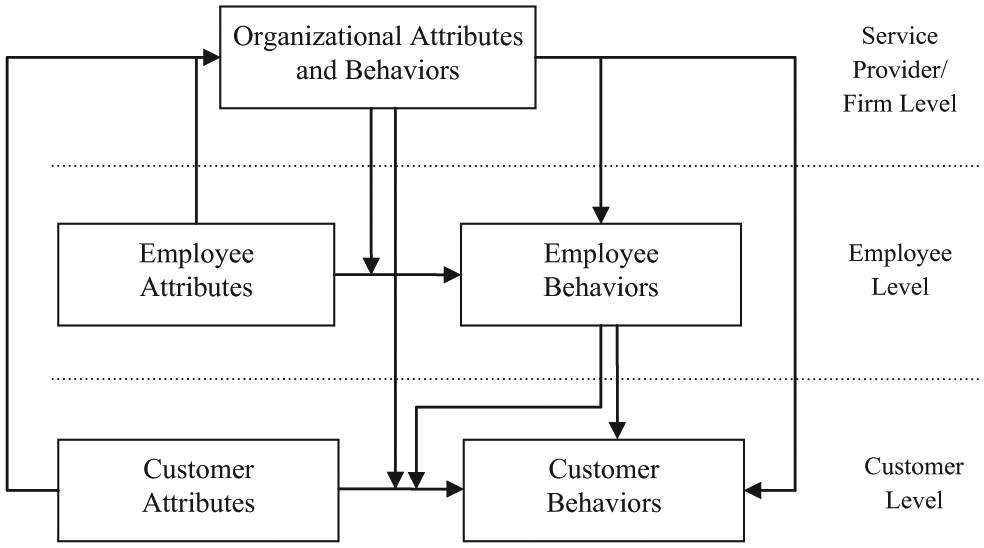
Service Firm-Level Effect on Employees and Customers.
Researchers may further extend the framework illustrated to investigate research problems at the macroenvironment level (e.g., destination and culture) or at the meso-level (i.e., between the organizational level and the employee level or between the organizational level and the customer level) to better understand the complex social system. For example, Sun, Aryee, and Law (2007) examine how city-level characteristics (L2) may impact the relationship between service-oriented citizenship behaviors, turnover rate, and productivity (L1) in the hotel industry in China. Likewise, researchers may also investigate meso-level phenomena to understand, for example, how different organizational settings and behaviors may influence functional units’ or teams’ behaviors and performance, which may in turn influence employees’ behaviors and performance. Meso-research offers a new paradigm in understanding the relationship between organizations and employees (House, Rousseau, and Thomas-Hunt 1995; Mathieu and Taylor 2007). It can also be extended to study effects leading from organizations to consumer groups or segments, and finally trickling down to individual customers. This offers a whole new research avenue that is yet to be explored. Taken together, multilevel research initiatives can be conducted at various levels of the complex social hierarchy, from global- and regional-level situations to organizational- and meso-level contexts, and further, to employee- and customer-level behaviors.
As the above discussions acknowledge, multilevel analysis may involve cross-level mediation and moderation (i.e., interaction); see Exhibit 3. Given the examples previously detailed, researchers may want to investigate the relationship between cultural value (L3: regional level) and employee creativity (L1: individual level) through the mediating role of leadership climate (L2: organizational level), or the relationship between brand equity (L2: organizational level) and customer purchase behaviors (L1: individual level) through the mediating role of perceived service quality (either at L1 or L2). Such designs require cross-level mediation analysis in estimating the effect of the intervening variable emanating onto the relationship between factors residing at different levels. Such an approach could help researchers to address questions about the extent to which higher-level factors influence lower-level entities through the partial or full mediating role of the mediator (either at higher or lower level). The work of Mathieu and Taylor (2007) details the procedures and examples of estimating cross-level mediation including testing preconditions and statistical power.
Perhaps a more interesting analytic in multilevel research is the possibility for researchers to test cross-level interactions. Rooted in modern-day contingency theory, cross-level interactions present a myriad of research opportunities to answer questions that could not otherwise be addressed in single-level analysis. Although this is also true for cross-level mediation analysis, cross-level interaction affords an important avenue for researchers to explain variance of slopes across groups (i.e., random slope) based on higher-level factors as discussed above. That is, a relationship between two variables at the individual level is not homogeneous across a higher level of grouping. Researchers could shed light on the literature through a search of the higher-level factors that could explain the presence of slope heterogeneity. Auginis et al. (2013) offer ten best practices for estimating cross-level interaction. They also provide a MLM tutorial for readers to grasp the technique. Practically speaking, cross-level interactions help managers to better understand boundary conditions within organizational settings and to formulate and implement strategies with greater confidence and accuracy.
Thus far, discussions pertaining to multilevel research focus primarily on downward effects emanating from higher-level factors onto lower-level entities (i.e., downward cross-level effect). Yet, upward effects leading from the individual level to the employee, group, or organization level (i.e., upward cross-level relationship or influence) are equally likely and important to the understanding of social phenomena (Mathieu and Taylor 2007). As Exhibit 3 illustrates, researchers may be interested in explaining organizational performance (L2 factors such as brand equity, turnover rate, and market share) by employee or customer behaviors (L1 factors such as OCB and job satisfaction, or customer share of wallet and satisfaction). Such research initiatives are critical for shedding new insights on how, when, and to what extent firm success is dependent on lower-level units. However, research on upward influence is sporadic (Croon and van Veldhoven 2007) for two major reasons. First, there is a lack of upwardly directed multilevel theory (Mathieu and Taylor 2007). Second, only MPlus could perform upward multilevel analysis, and is far less popular than HLM perhaps due to difficulties in programming MLM.
In summary, multilevel research offers a new way of designing and analyzing data that exist at multiple levels. To better assist researchers, the author presents a short list of future research opportunities in the form of questions that could advance the understanding of hospitality theories and practices (see Exhibit 4). This list is rather limited, as it only highlights research questions that involve two levels of analysis due to space limitation. Yet, researchers could easily expand these research questions to answer more complex questions with data traversing three levels as suggested above.
Selective Research Domain and Questions in Multilevel Design.
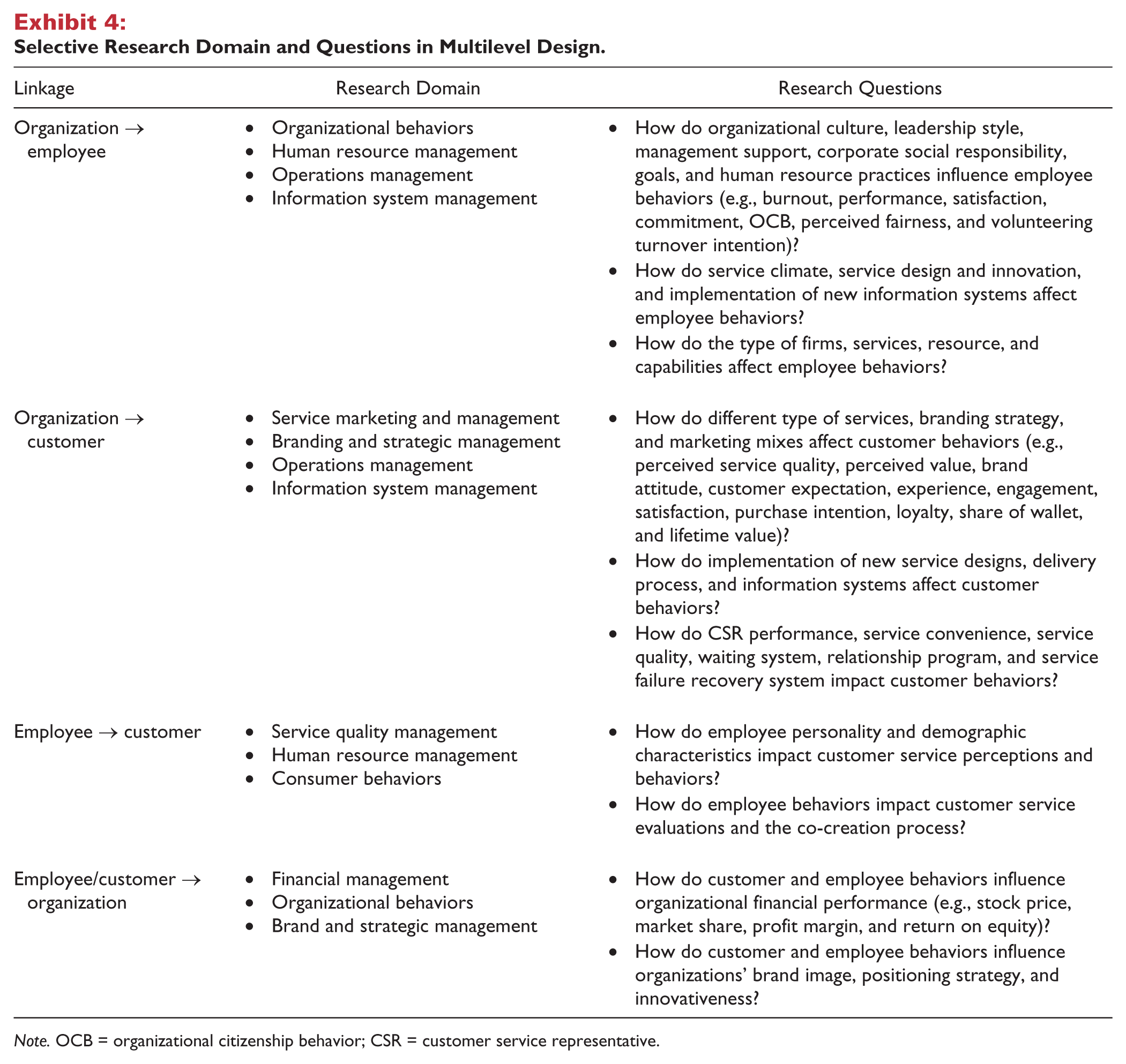
Note. OCB = organizational citizenship behavior; CSR = customer service representative.
Technical Considerations of Multilevel Design
Sample Size Requirement and Statistical Power
Like conventional single-level analysis, sample size does matter in MLM. Mathieu et al. (2012) survey multilevel studies published in the Journal of Applied Psychology between 2000 and 2010 and show that the average micro-level (L1) unit sample size has a median of 5, with a range from 2 to 291; while the macro-level (L2) sample size has a median of 51, with a range from 12 to 798. Indeed, some authors recommend a minimum average L1 sample size of 5 and a minimum L2 sample size of 20 unless the research context prohibits it (e.g., individuals nested with a family, employees nested within teams, functional units nested within organizations, organizations nested within industries, or industries nested within regions). They commonly agree that there is a trade-off of the sample sizes between L1 and L2 units in that a decrease of L1 sample size could be circumvented by an increase in sample size in L2, and vice versa, without impeding the quality of the analysis (Raudenbush and Bryk 2002; Snijders and Bosker 1999).
Yet, sample size matters more in respect to its statistical power (i.e., the probability of rejecting a hypothesized effect when it is false or 1—Type II error) in detecting significant effects and the magnitude of them. An early attempt from Kreft and de Leeuw (1998) coins the 30–30 rule of thumb in multilevel design suggesting that at least 30 L2 units and 30 L1 units for each L2 unit are required for this approach. Hox (2002) further proposes a 50/20 rule (i.e., 50 L2 units and an average 20 L1 units) and a 100/10 rule (i.e., 100 L2 units and an average 10 L1 units). Yet, simulation analysis conducted by Mathieu et al. (2012) suggests that such rules are fallacies, while empirical findings show statistical power for cross-level interaction is primarily determined by size of the cross-level interaction, followed by average L1 sample size, L2 sample size, and the standard deviation of the L1 slope. The general conclusion from their study suggests that an increase in average L1 and L2 sample sizes only helps improve statistical power slightly if the size of the effect is small.
Researchers can conduct a priori power analysis by using the ML Power Tool 1 in R developed by Mathieu et al. (2012) to anticipate the trade-off between L1 and L2 sample size (see more details from Aguinis, Gottfredson, and Culpepper 2013). Mathieu et al.’s simulation study shows that the average L1 sample size has a 3:2 premium as compared with the L2 sample size. Yet, performing a priori power analysis may require researchers to collect a great deal of information about the parameters (e.g., interclass correlation [ICC(1)], variance component for residual, intercept, direct cross-level effect, and cross-level interaction effect) that are not controllable by the researchers, perhaps from a large-scale pilot test, which may not be practical. However, researchers could perform such a diagnostic in a post hoc test and provide readers a cautionary note about the possibility of not detecting true effect in the population when the power is low.
Challenges, Limitations, and Opportunities in Multilevel Research
Although multilevel research has great potential to advance the predominant single-level investigation in the field, it is not without its limitations and implementation challenges. First, as some scholars note, the multilevel approach requires investigators to design the sampling plan with great care (Mathieu et al. 2012). Not only do investigators need to engage in multistage sampling methods, but they also need to decide how best to allocate scarce resources and whether to collect more samples at L1 or L2. A three-level multilevel design may even be more challenging as it requires a more complex sampling plan. Collecting data at three levels is a daunting task as it could drain a tremendous amount of resources in the process. Researchers, therefore, face a dilemma between what is statistically desirable (e.g., large statistical power with large sample size at all levels) and what is feasible with limited resources. A three-level design also requires more analytical efforts by testing the direct, mediating, and moderating effects that traverse three levels of a social hierarchy. Although multilevel research that involves three levels is rare, interested readers could still find examples published in the recent literature (Pituch, Murphy, and Tate 2009; Schaubroeck et al. 2012; Tasca et al. 2009). The sample size requirement and resource constraints may pose an even bigger challenge to hospitality researchers in certain areas such as the study of theme parks, airlines, events, and casinos, as there may not be an adequate number of higher-level groupings in these hospitality sectors in certain regions. Hence, it may be reasonable to acquire a large average L1 sample size to circumvent a small L2 sample size in such situations.
Another challenge for researchers rests on the steep learning curve in performing multilevel analysis. Because most researchers in the field do not have the necessary background and prior training in modeling random effects, it could pose difficulties at the beginning in understanding MLM. In fact, a survey of the tourism and hospitality programs across the globe, conducted by the author, suggests that none of them offer multilevel research courses in their curricula. 2 Rather than lament the difficulty in understanding multilevel research, hospitality scholars should embrace this new challenge and develop a community of people who can theorize and study it. Several authors have offered friendly manuals for researchers who wish to grasp MLM. They offer readers different angles for understanding this approach. These monographs are summarized as follows.
The text from Heck and Thomas (2009) is perhaps the most user-friendly multilevel reference on the market, as the authors provide an applied approach to multilevel design and analysis. It is eminently readable, and Heck and Thomas illustrate multilevel design with easily understandable graphical illustrations as well as clear explanations, guiding the readers through the analytical process without much mathematical nuance. Scholars who wish to gain a solid grasp of the technique can refer to the texts from Raudenbush and Bryk (2002) and Snijders and Bosker (1999) who offer readers a very comprehensive understanding about multilevel design and analysis from both applied and mathematical perspectives. Hox and Roberts’s (2011) edited text offers readers advanced multilevel analytical techniques such as multilevel latent variable modeling; modeling longitudinal data; and dealing with missing values, omitted variable bias, bootstrapping, centering, and cross-classified model. For a technical manual about software applications, readers can refer to Raudenbush et al. (2004) who provide a wide range of multilevel analytical techniques (e.g., handling two-level, three-level, and nonlinear models) in HLM 6. Muthen and Muthen’s (2007) user’s manual provides readers a solid background with numerous examples about conducting multilevel analysis in MPlus. Interested readers may also refer to van de Vijver, van Hemert, and Poortinga (2008) for a review of how multilevel analysis can be applied to address inter- and intracultural research problems. Klein and Kozlowski (2000) provide a review of how multilevel research could extend organizational theory.
Another challenge in multilevel research is the lack of multilevel theories in the field. This issue has been reported in prior literature (Hitt et al. 2007), while researchers have craved new theoretical development in conceptualizing and explaining the complex and dynamic nature of social phenomena that traverse different levels. This challenge is perhaps more acute in hospitality studies, as journal publications in this field differ from those in business (e.g., marketing, management, finance, operations research, and information systems), sociology, and psychology domains. Hospitality inquiries seek an in-depth understanding of specific hospitality industries by blending and adopting existing theories from different disciplines. This disciplinary- or domain-specific practice is manifested by publications replete with topics and theories mirroring prior research in the field of business and social science. Yet, the divide among research domains raises a fundamental challenge to scholars’ research interest and domain expertise as researchers tend to focus on a specific research area rather than blending multiple areas of studies into an integrated research inquiry.
It is important to bridge disciplinary gaps to advance hospitality theories; for instance, explaining how change in organizational-level attributes and behaviors (such as adopting a new management information system, adopting a new service standard and strategy, or changing leadership style and human resource practices) may influence frontline employee behaviors. Such influence may in turn impact customers’ perceived service quality and behavioral outcomes, as Exhibit 3 suggests. It is important also for hospitality scholars to realize how multilevel research could offer a new research avenue and could help advance existing theories originating from the fields of business, sociology, and psychology. For example, an upward multilevel influence could be theorized and assessed by linking customers’ service quality perceptions and behavioral outcomes to organizational success and change initiatives in the hotel or restaurant settings. Yet, such multilevel designs pose great challenges to investigators, as the effects leading from organizations to customers and vice versa may traverse three or four levels. However, even a two-level design, linking organizations and customers, can offer new insights to the understanding of the relationship between hospitality firms and their patrons.
Indeed, researchers have been calling for multidisciplinary research by bridging the disciplinary gaps. This message is clearly manifested by Mathieu and Chen (2011, 632): The multilevel paradigm refers to a way of thinking: considering management phenomena in context of looking for driving variables not only from focal unit of analysis but also from levels above and below. Such an approach often implies the development of multidisciplinary theories and investigations.
Hence, multilevel research affords an array of opportunities to develop new hospitality theories and managerial insights, by introducing existing theories from sociology and strategic management, for example, that are often macro focused to extend well-established micro-level theories in hospitality research.
Using Dalton and Dalton’s (2011) proposal as an example, they call for multilevel design in testing relationships among a board of directors’ composition, board leadership structure, and firm performance that exist at the individual, group, and organizational level, respectively. Their proposed research framework could further be elaborated by including intervening factors persisting from the employee and customer perspectives. That is, the conceptual underpinning of such theories would not be complete without considering the role of employees and customers, as Exhibit 3 suggests. Hence, hospitality researchers could add to the existing business literature by offering better insights into and more rigorous analytics of the complex social phenomena that require investigations through a multidisciplinary lens (Mathieu and Chen 2011).
In the same vein, multilevel research could help bridge the gap between science and practice, as this approach seeks to understand factors that persist in the research context (e.g., the organizational environment that gives shape to employee and customer behaviors); and to better explain micro-level phenomena by accounting for the variances in the context (Hitt et al. 2007). The science–practice divide, which is in part attributed to the divide between micro- and macro-level design and analysis, has resulted in a lack of readership from managers as they perceive that academic research lacks relevance (Aguinis et al. 2011; Rynes, Giluk, and Brown 2007). This is especially critical in hospitality studies, as decision makers put much emphasis on the research context and the ability to apply research findings to solve managerial problems that span various business functions and types of services (e.g., different types of hotels, restaurants, casinos, events, and airlines) within a specific industry.
Multilevel research could greatly assist managers to understand boundary conditions that persist in the organizational setting through examining cross-level interactions. That is, decision makers crave market intelligence and organizational knowledge to formulate strategies as to when and why a firm should expand or downsize, focus on employee and customer orientations, adopt certain innovations, develop and launch new services, engage in service excellence or focus on marketing communications, for example. Based on modern-day contingency theory, social phenomena are bounded by the social environment embedded within the larger system. In the same milieu, business decisions are dependent on specific situations and organizational settings. Hence, evidence-based practice and management emerge as a means to bridge the gap between academic research and practice so that managers could use findings from academic publications to support their decisions (Rynes, Giluk, and Brown 2007).
However, the divide of science and practice remains across fields despite tireless advocacy from journal editors (Hitt et al. 2007). The common consensus on the discrepancy between science and practice rests on the fact that academic scholars and practitioners are looking into very different topics of interest. Rynes, Giluk, and Brown’s (2007) study reveals that the human resource management (HRM) academic journals, for example, focus primarily on topics that reside at the micro level (e.g., employee ability and personality) while practitioners and bridge periodicals focus on broader appeals that often reside in different levels in organizations and industries (e.g., employee, team, organizational, and industry performances). Such discrepancy is likely to be a result of a lack of consideration of macro and meso-level of analysis as practitioners are concerned more about the strategic implications of findings that traverse multiple echelons of the organizational value chain. Indeed, Rynes, Giluk, and Brown (2007, 1001) summarize five key questions that human resource (HR) researchers have yet to answer; all involve more than a single level of analysis (e.g., “How should HR systems be aligned with strategy, and how can they be made internally consistent? How do HR practices affect firm performance? What are the most important contingencies or contextual moderators of HR practice–performance relationships?” As Rynes, Giluk, and Brown (2007, 1001) acknowledge, these are “big picture” questions, and they “seem to be framed mostly at the organizational, rather than individual, level of analysis, linking to the type of ‘strategic HR’ issues.” Yet, evidence-based practice and management requires practitioners to crave for more precise information and search for contingencies, nonlinearities, and contextual factors beyond the “average” findings from traditional approaches. Similar questions and concerns are likely to draw interest from hospitality practitioners, and answers to them inevitably involve MLM, as real-world problems exist at different levels of a social hierarchy (Hitt et al. 2007).
In summary, despite the challenges and steep learning curve in acquiring skills in conducting multilevel research, it offers tremendous opportunities that can advance new theories in the field. As the editor from the Cornell Hospitality Quarterly advocates, to improve the importance and impact of the journal, it is prudent that scholars from the business and related disciplines cite our work (LaTour, M., personal communication, November 12, 2013). To achieve this goal, hospitality researchers should embrace the challenges in multilevel research not only to help academics better explain social phenomena, but also assist practitioners to integrate theories with business practices to gain further understanding of the managerial problems at hand. In short, multilevel research has the ability to bridge three core research gaps in the literature: the gap between micro- and macro-level research, the gap among different disciplines, and the gap between academic science and practice.
Conclusion
Hospitality research to date has developed into an important field of study in its own right. Based on the existing conceptual and empirical work, hospitality scholars and practitioners alike have gained better knowledge in understanding customers, serving staff, and service-providing firms. Yet, as the field matures, there is an urgent need to develop new theories to provide a more complete picture of the complex social dynamics. Conceptual development therefore must be complemented with methodological development to investigate social phenomena that traverse levels. This article presents some contemporary research problems in the field and showcases how multilevel methods could address these problems by taking account of the social context, which has been commonly ignored in hospitality studies.
Although a multilevel approach may pose a higher requirement in the data collection procedure and research design (e.g., multistep sampling method in complex survey), its potential to reveal true social phenomena that reflect the complex social dynamics existing among multiple levels of unit of analysis should outweigh its methodological challenge (Hitt et al. 2007; Klein and Kozlowski 2000). In addition, multilevel methods offer researchers new research avenues that would otherwise not be possible using single-level analytical techniques. Conducting multilevel research can be rewarding; for example, the works from Tews, Michel, and Stafford (2013) and Way, Sturman, and Raab (2010) received the best paper awards from the Cornell Hospitality Quarterly. The commonality of both studies is that they both utilize the MLM to investigate employee behaviors by showing how organizational-level behaviors may help in explaining the micro-level HR phenomena. For example, Tews, Michel, and Stafford (2013) show a positive effect of fun activity (L1) on sales performance, affective commitment, and volunteering turnover (L1), while the relationship is moderated by managers’ support for fun activities (L2) in that the relationship is stronger for lower level of manager support. Such research offers managers better accuracy in formulating and executing their HR strategies. Future research could extend these works by following the framework presented in Exhibit 3, as well as addressing some of the research questions presented in Exhibit 4, through the MLM as in the previous examples. For instance, future research could add to Way, Sturman, and Raab’s (2010) work by examining how group-level service climate and OCB (L2) may influence employee job performance and turnover intentions (L1). It could further test the relationship between employee job performance (either L1 or L2) and customer-perceived service quality and satisfaction (L1), as well as perhaps the moderating effect of OCB (L2) on this relationship.
In summary, it is important for hospitality researchers to recognize the research limitations in the extant literature, to utilize multilevel methods to advance hospitality research, and to gain a more integrated understanding of hospitality phenomena that unfold across multiple levels. Many prestigious journals, such as the Academy of Management Journal, Journal of Marketing, Journal of Management, Journal of Applied Psychology, Journal of the Academy of Marketing Science, and Journal of International Business Studies, are increasingly publishing more manuscripts that have some multilevel components. The future outlook of the field is clear—because real-world problems rarely exist without involving units of analysis at two or more levels, future hospitality research should encompasses multilevel methods to tackle these problems. This article is the first in the field to call for multilevel research and to provide an agenda for such study. The author hopes that this article could open a forum of discussion about multilevel research in hospitality studies and serve as a catalyst to bridge the gaps persisting along the divides of micro and macro research, different research disciplines, and especially science and practice.
Footnotes
Declaration of Conflicting Interests
The author declared no potential conflicts of interest with respect to the research, authorship, or publication of this article.
Funding
The author received no financial support for the research, authorship, or publication of this article.