







Abstract
Identifying specific initiatives that can be undertaken by frontline employees to enhance customer delight is of great interest to service firms. In the hopes of contributing to this objective, the current research evaluates the impact of server recommendations on customer delight. Findings indicate that unsolicited server recommendations have a significant positive impact on customer delight. Moreover, the research provides no evidence to suggest that repercussions will result for the service provider even if the provision of an unsolicited recommendation leads to a negative outcome. The mediating role of expectations is examined to gain a better understanding of these recommendation effects. Consistent with self-fulfilling prophecy, the results reveal that customers are capable of experiencing delight even in heightened pre-experience expectation situations. These results provide evidence that the pursuance of customer delight as a strategic objective may warrant additional consideration.
Consumers in the United States are not eating out as often as they have in recent years. According to Statista, the total number of restaurant meals purchased in the United States per person per year has shown small yet consistent declines (Statista 2015). In addition, research by the NPD group forecasts sluggish growth at best for the next decade (NPD 2015). Given this less than idyllic outlook, to enhance operations, restaurants must identify specific initiatives to enrich the customer dining experience and increase the likelihood that the customer will return. Not surprisingly, research shows that food taste is the biggest driver of customer perceptions of a dining experience (Andaleeb and Conway 2006). However, it appears likely that the quality of the food is a necessary, but not sufficient element for success. Service managers must train frontline employees to adopt, as well as consistently engage, in practices that enhance the perception of the service experience. This sentiment is shared by Romm (1989, 39) who said, “The future restaurant may have to accept the responsibility of satisfying emotional hunger as well as physical hunger.”
Meeting customers’ emotional needs is possible through context-specific interactions with frontline employees. One aspect of this interaction that has the potential to fulfill a customer’s emotional hunger is the provision of a recommendation: a suggestion in favor of, or advice relative to, a particular course of action. The role of the person providing the advice is to “formulate judgments or recommend alternatives and communicate these to the person in the role of the judge” (Sniezek and Buckley 1995, 159). Lord, Lee, and Choong (2001) expand on this with the addition of a social influence element. They suggest that recommendations are an example of informational social influence whereby the employee provides credible evidence of reality.
People often seek the advice of others to increase the effectiveness of the external search process and improve the accuracy of the decision to achieve the desired outcome in a social context. The high level of involvement in the decision causes the customer to seek and judge the advice of a particular offering by someone very familiar with the offering (Bonaccio and Dalal 2006). A series of studies by Dalal and Bonaccio (2010) found that decisionmaker’s evaluations of advisors were highly associated with perceptions of advisor expertise and intentions. This parallels the literature on source credibility (Kelman 1961), which suggests that employees (advisors or personal advocates) are high in source credibility, a product of expertise and trustworthiness.
The provision of advice mentally engages the customer with the firm and its products, and the delight that is experienced is likely attributed to the source, in this case, the service firm. Kumar, Olshavsky, and King (2001) suggest that a sense of relatedness is triggered by engaging in activities that are core to the service offering. For restaurant wait staff, making an entrée recommendation is such an emotionally fulfilling activity. The difficulty evaluating a product (an entrée) prior to purchase suggests customers should rely on external search efforts (a recommendation) when making a choice (King and Balasubramanian 1994). The employee knows the product offering and lacks intentions to misinform, as it may influence service quality perceptions that would affect tipping behavior (Kinard and Kinard 2013). In the current context, the researchers are interested in understanding the influence of employee recommendations on customer delight.
The customer delight concept was originally defined by Oliver, Rust, and Varki (1997, 329) as “a function of surprisingly unexpected pleasure” resulting from an “exceedingly pleasing performance.” The driving force behind delight research has been the contradictory findings within the satisfaction literature regarding the benefits of satisfying the customer. Although satisfaction was long the mantra for firms, research on satisfaction has consistently shown weak relationships with customer loyalty measures (Jones and Sasser 1995; Keaveney 1995). Reichheld (1996) termed this contradiction between supposedly satisfied customers and loyalty the satisfaction trap. Conversely, customer delight has been shown as a strong predictor of key outcomes such as loyalty, commitment, willingness to pay, and purchase intentions (Barnes, Beauchamp, and Webster 2010; Bartl, Gouthier, and Lenker 2013; Chitturi, Raghunathan, and Mahajan 2008; Crotts, Pan, and Raschid 2008; Finn 2005, 2012; Hicks et al. 2005).
Research has revealed the basic elements in a restaurant service script (Romm 1989) and the appropriate attitude of the employee performing the script (Winstead 2000); however, little is known about the provision of advice (a recommendation). This lack of examination is surprising given the relatively common nature of, and the various forms in which, advice is provided (e.g., unsolicited vs. solicited and general vs. specific). Bonaccio and Dalal (2006, 144) note that the study of advice is “one of the most profitable (and needed) avenues for future research.”
This research also expands on what is known relative to customer delight. Research in this area has primarily focused on the differentiation of customer delight from satisfaction (Falk, Hammerschmidt, and Schepers 2010; Finn 2005) and the identification of service aspects that cause and effect each (Barnes, Ponder, and Dugar 2011; Sivakumar, Mei, and Beibei 2014). In addition, outcomes of satisfaction verses customer delight have also received much attention (Bartl, Gouthier, and Lenker 2013). However, theoretical reflection is needed to better understand customer delights relationship to expectations. No studies were identified that have examined the outcome of exchanges in which pre-encounter expectations were purposely raised by the service firm. This is interesting because the risk of raising customer expectations has been espoused as one of the major criticisms of customer delight (Rust and Oliver 2000).
From a managerial perspective, it is important to understand how the offering of a recommendation (an expectation-raising event) influences customer perceptions of service. Employee vocalization of an entree recommendation is often viewed by restaurant management as a risky endeavor. The inherent risk is that the customer views the employee as having over-promised while the food is perceived to have under-delivered. This aversion to potential over-promising is a commonly recited concern that is based on the idea that it may be difficult (if not impossible) to perform at a high-enough level to exceed expectations of what was promised. This research directly addresses a misunderstood phenomenon with the provision of straightforward insights relative to the fulfillment of customers’ emotional needs through the adoption of recommendations as an element of the service script.
Three studies are conducted to reveal the positive impact of employee recommendations on customer expectations of performance and customer delight. Study 1 considers the role of solicited versus unsolicited entrée recommendations. Additional variations of the provision of an entrée recommendation are examined in study 2 to determine what constitutes a best practice. In addition, expectations as a mediating variable are examined. In study 3, source expertise is manipulated to provide further theoretical evidence of the self-fulfilling prophecy (SFP). To summarize, this research strives to address two specific research questions:
Background Literature
Customer Delight
The ability of various aspects of customer–employee interactions to positively affect and even delight customers is not new (Arnold et al. 2005; Barnes, Ponder, and Dugar 2011; Kumar, Olshavsky, and King 2001). For instance, Barnes, Ponder, and Dugar (2011) reveal that employee affect, effort, and skill accounted for nearly 70 percent of delight producing factors in a service setting. Moreover, Verma (2003) found employee politeness, respect, friendliness, appearance, and taking a personal interest in the customer to be delighting aspects (i.e., delighters) of a customer service encounter. Similarly, evaluating travel blogs, Magnini, Crotts, and Zehrer (2011) found that customer service aspects (i.e., friendly, nice, helpful) accounted for 24 percent of the determinants of delight.
While food quality is the number one factor in patron’s future purchase behavior (Gupta, McLaughlin, and Gomez 2007; Hyun 2010; Sulek and Hensley 2004), identifying specific aspects of a service employee interactions with the ability to delight customers can result in a strategic initiative for the firm (Torres, Fu, and Lehto 2014). Supporting this notion, Keiningham and colleagues provide several examples of companies that have initiated successful delight initiatives (Keiningham et al. 1999; Keiningham and Vavra 2001). For example, Roche Diagnostics increased the percentage of their customers that were satisfied, in addition to their profit, by focusing on key drivers of delight specific to the automobile industry (Keiningham et al. 1999). Keiningham and Vavra (2001) also provide evidence of the difference between satisfied and delighted customers. For example, delighted customers were 57 percent more likely to rebuy or re-lease a luxury car.
With an increased interest in customer delight from both practitioners and academics, subtle interpretations on how delight occurs have emerged (Torres and Kline 2013). For example, delight can be evaluated based on human needs (Schneider and Bowen 1999), emotions (Kumar, Olshavsky, and King 2001), as a comparison with expectations (Berman 2005; Oliver, Rust, and Varki 1997), and with or without surprise (Barnes, Ponder, and Dugar 2011; Crotts and Magnini 2011; Kim and Mattila 2013; Magnini, Crotts, and Zehrer 2011). In the current context, the researchers evaluate delight in relation to expectations, which flows from the disconfirmation of expectations paradigm (Oliver 1980). Positive disconfirmation of expectations occurs when the perceived service performance exceeds the expectation boundaries established by the zone of tolerance (Parasuraman, Zeithaml, and Berry 1994). That is, expectations set the bar relative to the standard of performance preferred by the customer and to delight requires a performance that exceeds that standard. Just as expectations are especially important for delight in a tourism context (Magnini, Crotts, and Zehrer 2011), expectations are seen as important in the restaurant business (Wall and Berry 2007). Service employee interactions with customers are likely to play a role in the development of customer expectations relative to the encounter outcome. One such commonly occurring employee–customer interaction is that of a recommendation.
Employee Recommendations
A recommendation involves communicating information that helps the customer come to a decision on his own. The customer plans to order wine; the question is which wine? Customers rely on butchers, bartenders, servers, librarians, retail employees, and countless other frontline employees to provide insights into what constitutes the optimal decision. Recommendations should not be confused with suggestive selling. Suggestive selling (or cross-selling) is when the employee offers an additional product or service to a customer after the customer has already decided to purchase another item or service (Rosenberg 1995). “Would you like wine with your meal?” would be an example of suggestive selling.
Relative to entrée recommendations, one area of consideration relates to the timing of the delivery of the recommendation. That is, should the server wait to offer a recommendation until specifically requested or should the recommendation be unsolicited? By providing a recommendation as part of the service script, the firm provides the consumer with information, assists in the delineation of alternatives, and helps the customer come to a conclusion. The timing of the delivery of a recommendation may influence customer outcomes. Goldsmith and Fitch (1997) find differential effects of advice received based on whether the advice was solicited or unsolicited. They reveal that solicited advice is viewed as supportive and helpful in that it helps solve a problem and come to a decision. The perceived expertise of the advisor and that individual’s willingness to share knowledge suggests caring. However, unsolicited advice has been found problematic due to its intrusive nature (Goldsmith 2000; Goldsmith and Fitch 1997). The provision of unsolicited advice can be seen as a form of criticism or butting in. This threatens the patron’s sense of autonomy particularly due to the reality that the individuals involved are virtual strangers (lacking in a close relationship). These results agree with Smith and Goodnow (1999) who find unsolicited advice to be more unpleasant than pleasant due to implications of incompetence. Dakof and Taylor (1990) find advice to sometimes be perceived as inappropriate and insensitive. Even in the retail context, the timing of the advice suggests that it is particularly welcome when specifically requested (Gremler and Gwinner 2008; Menon and Dube 2000).
However, MacGeorge, Feng, and colleagues (Feng 2009; Feng and MacGeorge 2010; MacGeorge et al. 2004; MacGeorge, Lichtman, and Pressey 2002) have produced a line of research revealing the positive impact of unsolicited advice in supportive interactions. Drawing from augmentation theory, they identify differential aspects of the advice message that lead to more or less favorable evaluations. Perceptions of advice vary based on “who” provides it (Feng and MacGeorge 2010), “how” it is provided (Feng and MacGeorge 2010; MacGeorge, Lichtman, and Pressey 2002), and specifically “what” is said (MacGeorge et al. 2004). For instance, Feng and MacGeorge (2010) asked study respondents to recall a recent conversation in which they discussed an upsetting problem and the other person proceeded to provide advice (unsolicited). Related to the who aspect of the advice delivery, they found message quality to be positively affected by source factors including the perceived expertise and trustworthiness of the advising party. When it came to the how aspect, they found that advice perceived to be politely delivered and efficacious in nature was highly related to perceptions of message quality. Finally, MacGeorge et al. (2004) found that the feasibility and usefulness of the advice (the what) positively contributed to advice recipients’ perceptions. Therefore, it appears that unsolicited advice can have a positive influence on outcomes.
The provision of an unsolicited service employee recommendation to a customer appears to meet all three criteria. That is, (1) the advice is politely provided by a frontline employee familiar with the product or service, (2) the recommendation enhances the efficacy of the decision process (the patron does not have to ask for assistance), and finally, (3) the recommendation is both feasible and useful. Based on these findings,
But what if the outcome of the decision is not positive? The risk of providing an entrée recommendation, especially an unsolicited one, is that the customer will not be pleased with the outcome. However, Price, Arnould, and Tierney (1995) showed that although provider performance strongly affected positive affect, it did not necessarily have the same impact on negative affect. The reasoning was that customers understood that there are uncontrollable factors in play; things that were out of the control of the service provider (i.e., other customers, weather). Customers have also been shown to accept responsibility for a decision resulting in a negative outcome by claiming that the outcome was known all along. Hindsight bias provides insights into the customer’s line of thinking. Pre-consumption or foresight expectations are discounted in the direction of the negative outcome (Zwick, Pieters, and Baumgartner 1995). This gives the customer the ability to regulate disappointing outcomes (Tykocinski, Pick, and Kedmi 2002) and present himself or herself favorably to others (Guilbault et al. 2004). The motivational desire to regulate emotions derived from the negative outcome suggests a specific form of hindsight bias is in play: retroactive pessimism (Tykocinski, Pick, and Kedmi 2002). Retroactive pessimism proposes that individuals engage in motivated sense-making: we convince ourselves of the inevitability of the outcome (Pezzo and Pezzo 2007). In the context of a restaurant order, retroactive pessimism might surface if a customer is dissatisfied with an entrée that was ordered based on the advice of the wait staff. Believing that questions about the entrée should have been asked before deeming it acceptable, customers may judge the outcome to be foreseeable in hindsight. Given the reality that the decision was the customer’s to make and that the assessment of the taste subjective, blame for the less than desirable outcome is internalized. In essence, this ego-enhancing strategy enables individuals to convince themselves that the outcome was bound to happen. For this reason,
Self-Fulfilling Prophecy (SFP)
While delight is intuitively appealing to service providers, research suggests that it also has the potential to increase customer expectations of service quality going forward (Rust and Oliver 2000). The potential for increased expectations is one of the biggest criticisms of customer delight as a business strategy as this will likely ameliorate the possibility of engendering delight in the future (Ngobo 1999; Rust and Oliver 2000). According to Rust and Oliver (2000), the best-case situation is when a customer forgets about the delighting experience such that expectations are not raised and delight is engendered the next time the same incident occurs. However, there is no identifiable way to strategically enhance customer forgetfulness. Yet, evidence suggests that there may be another answer. What if when expectations increase, delight is still possible? In the context of recommendations, theory suggests the outcome is, in fact, an SFP (Merton 1948), and although expectations may increase, delight is still possible. Support for the power of the SFP can be found in several settings. For example, it has been found that when a teacher, boss, or coach expects more of a student, employee, or athlete, the individual expects more of him or herself and rises to the occasion (Miller, Brickman, and Bolen 1975; Rosenthal and Babed 1985). The same has been shown to be true in the field of medicine relative to physician-projected patient outcomes as well as the placebo effect (Geers, Rose, and Brown 2014). Patients who receive a placebo (a nonmedical substitute for a drug) have reported results consistent to the outcomes expected if the actual drug had been given. The expectation that the medicine will perform as expected is so strong that our minds translate this expectation into reality. A restaurant dining experience is used as the context to illustrate this effect. When you expect the food to be good (because it was recommended by someone very familiar with the offering), expectations rise, and the outcome fulfills the expectation. The SFP is in effect: customers expect to be delighted and are delighted.
SFP as conceptualized by Merton (1948, 1957) is used to explain a wide array of social phenomena. It has become a major area of research for educational, developmental, and social psychologists. Also referred to as the expectancy confirmation effect, SFP was described by Merton (1957, 477) as a basic sociological tenet whereby “public definitions of a situation (prophecies or predictions) become an integral part of the situation and thus affect subsequent developments.” The effects of the SFP are believed to occur anytime some force distorts or biases the processes that occur in a normal social interaction (Darley and Fazio 1980). The first step in SFP is the development of initial expectations based on information obtained prior to or during the interaction. The perceived accuracy of the expectations limits the potential biasing impact on outcomes (Jussim 1986). That is, performances that are consistent with an expectation serve to strengthen the expectation. Various biases are induced by expectations. For example, in a classroom setting, teachers were found to evaluate ambiguous information about student class background (lower or upper) in an expectancy-consistent manner (Darley and Gross 1983). Similarly, expectancy-consistent information is considered more diagnostic and attributable to personal characteristics (vs. situations; Deaux and Emswiller 1974). Research also reveals that expectancy-consistent results are more memorable (Chapman 1967) and recallable (Crocker 1981). The key to SFP is that the target (individual receiving the information) confirms the expectations.
Relative to the context of interpersonal exchanges, SFPs are referred to as interpersonal expectancy effects (Valentine et al. 2001). In this line of research, one individual plants an expectation in another person’s mind. The individual receiving the initial information (expectation) forms an impression based on that input which serves to bias the evaluation of the outcome in a confirming manner. Research in this area has revealed that positive expectations lead to positive perceptions of outcomes while negative expectations lead to negative perceptions of outcomes (Gurland, Grolnick, and Friendly 2012). For example, Mrug and Hoza (2007) provided children (aged seven) with information about another child. When the initial information provided about the child was positive in nature (smart, kind), the children’s attitudes about the child were less influenced by negative new information (additional evidence that the child was not smart or kind). Similar results were found in a study by Thelwell et al. (2013) relative to evaluative judgments of the competence of a coach. When the coach was described as professional (vs. in-training or no reputation), the observed performance of the coach was judged as being more competent. In addition, Klaaren, Hodges, and Wilson (1994) showed that when positive information about enjoyment of a movie was shared prior to watching the movie, respondents reported greater enjoyment of the event, even when experienced in uncomfortable chairs (an unpleasant environment). The results of these studies and others illustrate that the opinions of others bias our attention to actual event and guide our experience of the world (Shedlosky-Shoemaker et al. 2011).
Similar findings are evident in the met-expectations hypothesis. A meta-analysis of the effects of met expectations on newcomers’ attitudes confirmed a positive relationship between pre-employment expectations and job satisfaction and organizational commitment (Wanous et al. 1992). Basically, higher pre-entry expectations resulted in improved work attitudes. Expectations of other people play into this phenomenon. In the context of retail sales interactions, Manolis, Harris, and Whittler (1998) reveal the very real case of employee expectations of a customer’s behavior influencing that customer’s perceived behavior and thus fulfilling the employee’s initial expectations (an SFP). These interpersonal expectancy effects can involve an employee matching preconceived expectations (Sujan, Bettman, and Sujan 1986) or even buyer’s expectations about a salesperson’s trustworthiness (Schurr and Ozanne 1985).
The common foundational element of SFP, interpersonal expectancy effects, and the met-expectations hypothesis is the communication of expectations. Simply sharing one’s thoughts relative to the probable outcome of an event with another individual is found to change the perceived outcome. In the arena of service provision, this has very real implications relative to the issuance of recommendations. An employee recommendation is believed to serve as an informational cue that raises customer expectations of performance and biases the perceptual outcome in a positive manner.
Study 1
In study 1, the influence of solicited and unsolicited recommendations when the outcome is positive or negative (H1 and H2) is examined using hypothetical scenarios. This approach allowed for the random assignment of respondents to a scenario, the manipulation and control of independent variables, and a better understanding of the causal relationships being examined (Aguinis and Bradley 2014). Furthermore, this approach has been used in a number of marketing studies (Choi and Mattila 2005; Lynn and Brewster 2015).
The context for the scenario was a restaurant, specifically an entree recommendation by a server. Restaurants were chosen due the variability in approach from place to place relative to the provision of a recommendation. A 3 × 2 between-subjects experimental design manipulated recommendation type (entrée recommendation solicited by the customer, unsolicited entrée recommendation provided by the server, or control: unassisted entrée selection made by customer) and service outcome (good or bad; see the appendix for the scenarios). To ensure that the scenarios were evaluated differently, pre-test data were collected that assessed the perception of employee proactivity. Results revealed significant differences between the scenarios: Msolicited = 4.53, Munsolicited = 5.79, Mcontrol = 3.15, F(2, 210) = 55.94, p < .001. Furthermore, realism for each scenario was assessed using a three-item (believable, authentic, and realistic), 7-point scale. Analysis of variance (ANOVA) test shows no significant difference in realism (α = .925) between scenarios: Msolicited = 6.14, Munsolicited = 6.20, Mcontrol = 6.17, F(2, 210) = 0.104, p = .902.
Procedure
Experimental conditions were assigned randomly across respondents so that each combination of the stimuli appeared to a similar number of individuals. Each participant was assigned a written version of a dining scenario. In the scenario, the customer studies the menu for a few moments. In the solicited condition, the customer asks the server for an entrée recommendation. In the unsolicited condition, no request is made. In both recommendation conditions, the server suggests an entrée from the menu that the customer orders. In the control condition, the customer decides on an entrée without assistance and places the order. After reading the assigned scenario, respondents were then provided with outcome information related to the quality of the recommended meal (i.e., good or bad). Respondents were then asked to rate their level of customer delight, provide basic demographic information, and answer questions specific to information in the scenarios. To provide evidence that respondents were paying attention to the scenarios, multiple attention checks were used in all three studies. Because the independent variable manipulated in this research was direct and observable, attention checks represent an effective way to determine whether the manipulation was successful (Perdue and Summers 1986). For example, respondents had to correctly identify if they had received a recommendation and from whom. To control for any individual psychographic effect, susceptibility to interpersonal influence, personal responsibility, and general self-esteem were also assessed. However, initial regression analyses revealed these covariates to be non-significant and were subsequently removed from further tests.
Sample
The sample was recruited using a snowballing procedure whereby 70 upper level marketing research students at a southeast U.S. university recruited respondents. Recruiters had completed lectures on survey administration as well as having specific instructions to recruit both students and non-students. Recruiters were provided a survey link to provide to the final sample. Furthermore, all recruiters were informed that data falsification was akin to cheating and would be forwarded to the university. Recruiters were eligible for extra credit, and the maximum number of responses per recruiter was four. Generating a sample in this manner has been previously used in service research (Hennig-Thurau, Gwinner, and Gremler 2002). In all, 184 subjects participated in the study. The majority of respondents were female (63%), and the average age of the respondents was approximately twenty-five years. Customer delight relative to the overall experience was measured using a three-item (delighted, elated, and gleeful), 5-point interval scale (Oliver, Rust, and Varki 1997) ranging from strongly disagree to strongly agree (α = .95).
Results
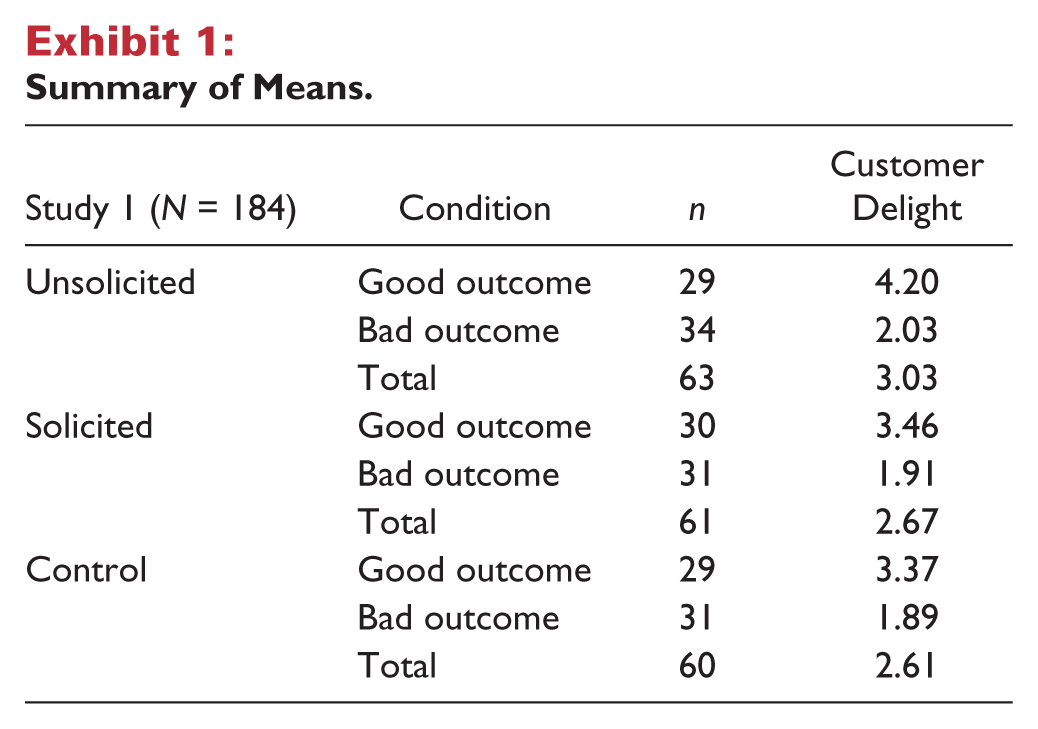
A two-way ANOVA test for main and interactive effects on customer delight was used. A summary of condition means is provided in Exhibit 1. Initial analysis of the demographic control variables revealed no significant effect on customer delight. Results did reveal a significant main effect for both food quality, F(1, 178) = 293.14, p < .001, and recommendation type, F(2, 178) = 9.23, p < .001. This suggests that when the service outcome is positive, customers are more delighted (M = 3.67) with the restaurant experience than when the service outcome is negative (M = 1.95). For recommendation type, post hoc analyses reveal that customer delight is significantly higher (M = 3.03) when subjects are provided with an unsolicited entrée recommendation by the server compared with the solicited (M = 2.67, p < .05) and control (M = 2.61, p < .01) recommendation conditions. In line with H1 and H2, there is also a significant interaction effect for customer delight, F(2, 178) = 4.81, p < .01. Specifically, when the service outcome is positive (i.e., the entrée tastes delicious), customers are significantly more delighted when the recommendation was unsolicited (M = 4.20) compared with the solicited (M = 3.46, p < .001) and control conditions (M = 3.37, p < .001). However, when the service outcome was negative (i.e., the meal was bad), there was no significant difference in customer delight between the unsolicited (M = 2.03) and solicited (M = 1.91, p = .759) or control conditions (M = 1.89, p = .678). Moreover, there was no significant difference in levels of customer delight between the solicited and control conditions. In sum, the results suggest servers should be encouraged to provide unsolicited entrée recommendations to customers.
Summary of Means.
Study 2
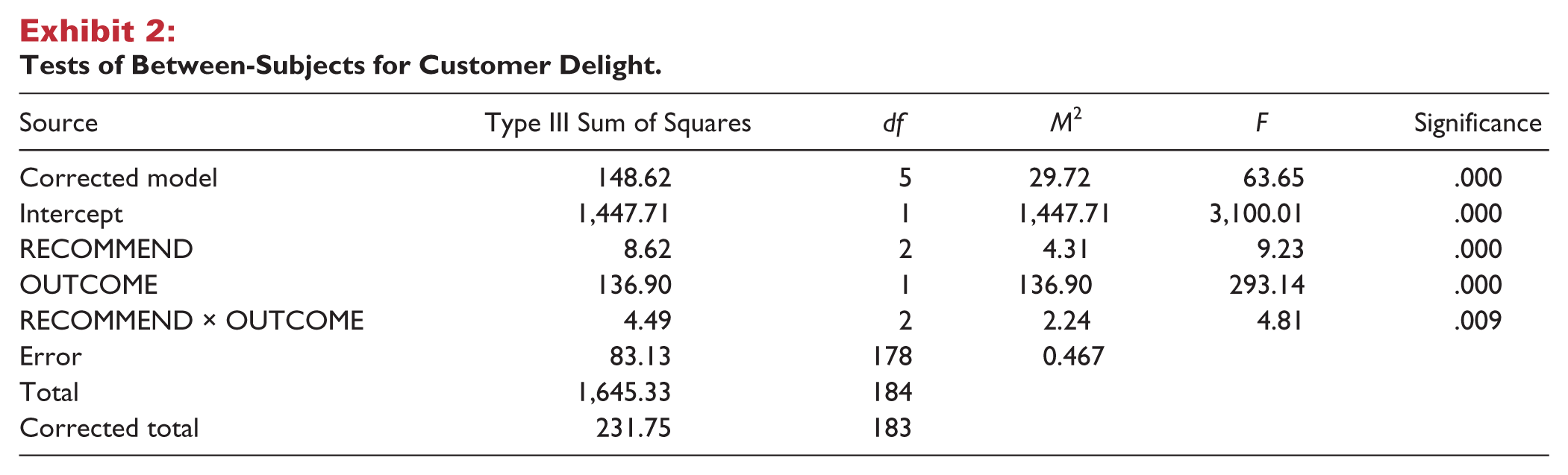
To determine what constitutes a best practice, an additional variation of the provision of an entrée recommendation is examined in study 2. In addition to the unsolicited (specific entrée) and solicited (specific entrée) prompts previously used, a third condition was added to assess the impact of a solicited request resulting in a general meal recommendation (“Everything is good”). The employee response “Everything is good” to the customer’s request for a recommendation was added due to its common occurrence in the service environment and to better understand the nuances of a recommendation. Two-way ANOVA results are provided in Exhibit 2. Again, perception of employee proactivity was significantly different across the scenarios: Msolicited = 4.67, Munsolicited = 6.09, Mgeneral = 1.81, F(2, 94) = 135.97, p < .001. Furthermore, there were no significant differences with regard to scenario realism (α = .925) across conditions: Msolicited = 6.09, Munsolicited = 5.94, Mgeneral = 6.33, F(2, 94) = 1.78, p = .175. The method used in the first study was largely followed. Only the methodological elements that are unique to study 2 are mentioned here.
Tests of Between-Subjects for Customer Delight.
Procedure
Given the findings from study 1, positive outcome scenarios (i.e., meal was good) were strictly used across conditions. Prior to being presented with outcome information related to the quality of the meal, respondents were asked to rate their expectation of food quality on a single-item, 7-point scale ranging from very bad to excellent. Information about the outcome was then provided, and the respondent was asked to complete items for customer delight (α = .84), basic demographic information, and information related to the scenario.
Sample
In an effort to obtain a more representative sample, data were collected from subjects recruited from an online consumer panel. A total of eighty-seven subjects were provided monetary compensation in exchange for participation in the study. Cell sizes ranged from twenty-seven to thirty-two across the three experimental conditions. The majority of respondents in the sample were male (62%), and the average age of the respondents was approximately thirty-two.
Results
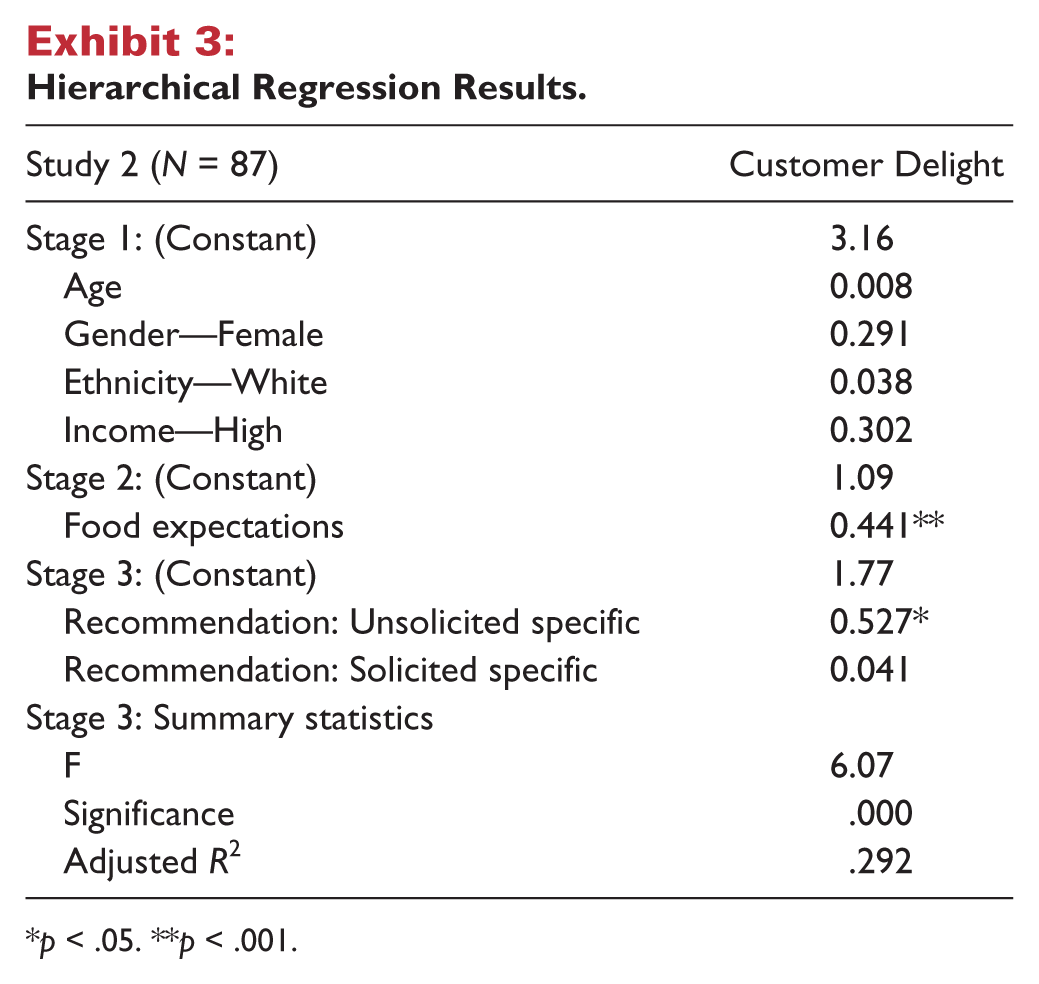
To test H3, hierarchical multiple regression analysis was used. To control for any effects of individual characteristics, demographic variables were included in the first stage of the model. This was deemed necessary as previous delight research has suggested that variables such as gender and ethnicity can affect customer delight (Beauchamp and Barnes 2015; Torres, Fu, and Lehto 2014). Dummy variables were created for gender (female), ethnicity (white/non-white), and income based on a median split. In the second stage, the effect of food quality expectations was controlled. In the final stage, two main effect dummy variables were added to represent the unsolicited specific recommendation and the solicited specific recommendation conditions. Customer delight was then regressed on the model. Results of the regression analysis are shown in Exhibit 3.
Hierarchical Regression Results.
p < .05. **p < .001.
Analyses of the first stage of the model with demographic controls reveal no significant influence on customer delight. Results for the second stage of the model suggest a significant positive effect for food quality expectations (t = 4.14, p < .001) on customer delight. Finally, the full model provides further support for the significant effect of recommendation type. An unsolicited specific entrée suggestion from the server is shown to significantly enhance customer delight (M = 4.21) compared with solicited specific (M = 3.55, t = 2.75, p < .01) or solicited general entrée recommendations (M = 3.38, t = 2.57, p < .05). There were no significant differences between the specific and general solicitation conditions for customer delight (p = .809). The results mirror those found in study 1, further supporting the recommendation that servers should provide unsolicited specific entrée suggestions to restaurant customers.
To further examine the hypothesized mediating effect of expectations, an orthogonal contrast was computed using the mean response for customer delight under the three recommendation conditions. The contrast compared the unsolicited condition with the means of the two solicitation conditions with the weights of 2, +1, and −1, respectively. Contrasts reveal that an unsolicited recommendation has a significant positive effect on customer delight (
Study 3
This study examines the psychological mechanisms of SFP. Similar to other studies that have tested SFP (Manolis, Harris, and Whittler 1998; Reingen, Gresham, and Kernan 1980), the initial expectations of participants were varied while providing the same ultimate outcome. The method used in the first two studies was largely followed. Only the methodological elements that are unique to study 3 are mentioned here.
Procedure
Employee expertise (high vs. low) was manipulated in a scenario involving the purchase of a restaurant entrée. For the high-expertise condition, the employee is described as having a sticker on their name badge that says “10 Years of Service—Expert Server” on their apron during their interaction. For the low-expertise condition, the waitress is described as wearing a “Trainee” sticker. The expertise manipulation was designed to induce high and low initial food expectations. To ensure the intended effects of the manipulation, a pre-test asked subjects to rate server expertise on the following single-item, 7-point Likert-type scale: “I would rate the server as an expert.” The t-test results confirm that waitress expertise was successfully manipulated: Mtrainee = 3.61, Mexpert = 5.83, t(69) = 9.05, p < .001. The same realism check used in the previous studies indicated there was no significant difference in realism (α = .952) between scenarios: Mtrainee = 6.22, Mexpert = 6.11, t(69) = 0.579, p = .564.
To control for the demonstrated effects of recommendation type, unsolicited employee recommendations were strictly used in the between-subjects experimental design. In both expertise conditions, the customer orders the entrée recommended by the waitress. Prior to being presented with outcome information, participants were asked to rate their expectations for the entrée on a four-item, 7-point scale (α = .879). Items for this scale included, “I think this entrée will be good,” “I believe I will be happy with the entrée,” “I expect the entrée to taste excellent,” and “My expectations for this entrée are high.” All participants were then provided with positive outcome information (i.e., the entrée was delicious).
Following the provision of outcome information, participants were asked to rate three items assessing customer delight (α = .901). It should be noted that some customers feel servers are only trying to recommend the most profitable dishes. To control for manipulative intent, a measure of selling orientation was included in the survey. The three-item, 7-point scale (α = .900) was adapted from Thomas, Soutar, and Ryan (2001) and comprised of the following items: “Servers try to sell as much as they can rather than satisfy the customer,” “Severs try to apply pressure to get customers to buy more expensive entrées,” and “Servers decide what meals to recommend on the basis of what they can convince customers to buy rather than what will satisfy the customer.”
Sample
A total of 118 individuals from an online panel were provided monetary compensation for participation in the study. Of the respondents, sixty were assigned to the high-expertise condition and fifty-eight to the low-expertise condition. The demographic profile of the respondents was male (60%) with an average age of approximately thirty-two. In addition, nearly two-thirds of the sample reported having earned a college degree.
Results
Prior to assessing the mediating effect of food expectations, direct main effects were examined using simple linear regression. To assess the effect of employee expertise, a dummy variable was created to represent the high-expertise condition. Analysis reveals that food expectations are significantly higher (t = 6.13, p < .001) when the waitress is perceived to possess a high degree of expertise (M = 5.91) compared with a low degree of expertise (M = 5.08). Similarly, customer delight is heightened significantly (t = 3.71, p < .001) when recommendations come from highly experienced wait staff (M = 4.49) compared with wait staff who are relatively inexperienced (M = 4.02). Regression results also demonstrate that higher expectations lead to significantly higher levels of customer delight (t = 8.13, p < .001). In addition, selling orientation has a significantly negative impact on both food expectations (t = −5.41, p < .001) and customer delight (−2.67, p < .01).
Because all direct paths were significant, indirect effects were again assessed using 5,000 bootstrapping re-samples with a 95 percent bias-corrected CI. Using selling orientation as a covariate, results of mediation analysis confirm H3 that expectations fully mediate the relationship between employee expertise and customer delight (β = .358, CI = [.208, .558]). Specifically, the significant positive effect of employee expertise on customer delight (β = .413, t = 3.13, p < .001) became non-significant (β = .058, t = 0.459, p = .647) when controlling for food expectations. The partial effect of selling orientation also became non-significant (β = .023, t = 0.474, p = .636). These results support the notion of a SFP, in that recommendations stemming from a credible source can raise expectations. It also supports research evidence by Barnes, Ponder, and Dugar (2011) that customer delight is still achievable in the wake of high expectations. Relative to the context of restaurant recommendations, if you expect food will be delightful based on the recommendation of an experienced employee and the expectation is fulfilled, then the experience is delightful.
Discussion
At the outset of this research, two main goals were established: first, to evaluate if recommendations could induce customer delight, and second, to evaluate the theoretical underpinnings of why this relationship may exist? These goals are relevant as previous research has shown the importance of interactions between the frontline employee and customer as a key component of value creation. As such, there are both theoretical and managerial implications.
Theoretical Implications
With regard to the first goal, when the service outcome is positive, evidence is provided that levels of customer delight are significantly higher when an unsolicited recommendation is used. Essentially, the customer takes an unsolicited recommendation as a positive display of expertise and/or empathy by the frontline employee. Previous research has found positive displays, such as effort or customization, to be important factors in the creation of customer delight (Barnes, Ponder, and Dugar 2011). These results are also consistent with research by Dalal and Bonaccio (2010), which indicated that customers want employees to “recommend for” a particular alternative.
To develop a more complete understanding of the mechanism whereby the unsolicited suggestion is leading to customer delight, additional studies were completed. In study 2, customer expectations were incorporated. Based on the advice literature and disconfirmation paradigm, it was assumed that a recommendation would increase expectations, thereby hindering the possibility of customer delight. As expected, when the customer receives a recommendation, their expectations increase. Yet, increases in customer delight were evident. These findings suggest that something besides disconfirmation is at work. This finding is consistent with SFP; a customer can still experience delight even in the face of increased expectations. This further supports Barnes, Ponder, and Dugar’s (2011) findings that customers are capable of reporting delight even when pre-experience expectations are high. In the hopes of further understanding the SFP effect, study 3 manipulated the level of expertise of the recommendation source. Consistent with the SFP literature, those respondents in the high-expertise condition experienced not only increased expectations but also significantly higher levels of customer delight.
It cannot be overstated that the disconfirmation paradigm has been critical to the understanding of customer satisfaction. This research does not suggest disproving the theory. Instead, the aim is to continue the development of an understanding that customer satisfaction and customer delight are distinct constructs (Finn 2012). In addition, these initial results suggest that disconfirmation may not be the only way to evaluate customer delight. For example, previous research highlighted how needs-based theory can explain instances of customer delight when disconfirmation may not be appropriate (Schneider and Bowen 1999). Similarly, Arnould and Price (1993) suggest that situations exist where expectations are not easily formed pre-experience, thereby negating the possibility for disconfirmation. By demonstrating that delight can occur even in instances of high expectations, the current research makes a contribution to the ongoing debate regarding the viability of delight. Namely, the caution projected in prior research (Ngobo 1999) that continuously raising expectations is problematic when attempting to achieve customer delight may be overstated.
When the service outcome is perceived negatively, there are also interesting implications for the service firm regarding unsolicited versus solicited recommendations. The results suggest that when the outcome was negative, the advice provided by the server had little to no impact on customer delight. This may occur as a result of hindsight bias, whereby the customer takes blame for the decision to accept the unsolicited recommendation. This finding has direct implications for the food service industry, suggesting that the provision of an entrée recommendation be added to the service script, as it appears to be a no lose proposition.
Managerial Implications
Aside from the theoretical implications on why unsolicited suggestion can be a powerful force in a service encounter, this research also provides managerial guidance. Based on the insights provided by this research, restaurants are encouraged to provide a consistent customer experience relative to employee recommendations via the use of a service script. The service script is defined as “a predetermined, stereotyped sequence of actions that defines a well-known situation” (Schank and Abelson 1977, 41). The service script describes verbal (i.e., appropriate phrases to greet customers, provision of a recommendation), non-verbal (i.e., smile), and behavioral (i.e., give the customers a couple of minutes to look over the menu before approaching the table) guidelines employees are expected to follow when interfacing with customers. In addition, frontline service employees should be trained to interpret customers’ non-verbal cues (Lynn 2001) and to be familiar with the various actions shown to increase tip size such as smiling, squatting next to the table, and calling the customer by name (Lynn and McCall 2009). The development of a service script ameliorates employee uncertainty and ambiguity about how exactly to perform staff duties (Hummel and Murphy 2011; Victorino, Verma, and Wardell 2013) and provides the service firm confidence that the right actions are taking place and the right information is disseminated (Feldman and Pentland 2003). Firms should consider creating a service script that includes an unsolicited and specific recommendation. Study 2 considered how the specificity of the recommendation might affect the customer. Although there are no statistical differences, there appears to be a pattern within the results that warrants attention. The mean for customer delight is lowest in the solicited general recommendation condition. This suggests that frontline employees should be hesitant when giving a generic gestalt recommendation such as “Everything is good.” Frontline employees should be trained to narrow the customer choice set through the use of open-ended questions to ease decision making as well as providing a prompt to the customer the employee is knowledgeable. As stated previously, customers want the employee to provide an unprompted, and most likely, specific recommendation.
Finally, this research highlights the influence of signaling to the customer the expertise of the employee. Study 3 provides evidence that something as small as an expertise cue on the frontline employee’s name tag can have an impact on the customer. In certain environments, signaling expertise has been the standard operating procedure (i.e., high-credence environments such as doctors, car repair). However, evidence suggests that expertise cues can also have an impact on the restaurant environment. Aside from signaling with name tags, restaurants would be encouraged to provide more cues to the customer. For example, highlighting any press coverage or positive reviews may help create an SFP.
Limitations and Future Research
As with any research, there are certain limitations that must be acknowledged. There are both strengths and weaknesses that occur when scenarios are used in research. Limitations include the difficulty in ensuring an adequate level of cognitive processing occurs after reading a short text prompt. Study 1 demonstrates no downside effect to the unsolicited recommendation even when the quality of the food served is deemed poor. This could be simply a measurement artifact: a floor effect. For example, the means for customer delight in the two scenarios of poor food quality were 1.91 (solicited) and 2.03 (unsolicited) on a 5-point scale, while the variances were .68 and .74, respectively. Additional research is needed to determine if this is a measurement bias. Alternatively, if this finding holds, a deeper understanding of the effect is required. For example, does the amount paid for a service affect retroactive pessimism? Although our sampling method has been repetitively used in service research, certain limitations to the snowballing procedure used in study 1 exist. For example, the sample demographics may be skewed. Finally, this research investigated solicited versus unsolicited recommendations using scenario-based methodology in a single context. The utilization of another experimental approach to manipulate the service experience is warranted. For example, field data would supplement the findings of the current research.
Beyond these limitations, there are several exciting avenues for future research. For example, it would be interesting to examine similar outcomes when a recommendation is made by a frontline employee but not taken by the customer. Would the provision of an unsolicited recommendation in this case still contribute to enhanced outcomes? Or what would happen if the customer changes his or her decision due to the recommendation? Moreover, Zhang and Hanks (forthcoming) highlight how one customer receiving delight (preferential treatment) does not occur in a vacuum, and thus, future research could evaluate the use of suggestions while incorporating social dynamics.
Despite extent research to the contrary, initial evidence of customer delight as a feasible business strategy is provided. In three studies, customer expectations do indeed increase when unsolicited and specific recommendations are provided by employees; however, no downside to this strategy is observed. Firms are encouraged to provide evidence to customers that employees are well trained and knowledgeable and to use service scripts to enhance the effectiveness of employee recommendations.
Footnotes
Appendix
Declaration of Conflicting Interests
The authors declared no potential conflicts of interest with respect to the research, authorship, or publication of this article.
Funding
The authors received no financial support for the research, authorship, or publication of this article.