







Abstract
Because the millennial generation is the largest generation in the U.S. labor force and is the most computer-literate generation, many organizations are investing in online methods for their training. From a recruitment perspective, applicants can use training information to form attitudes about an organization, such as their attraction. Yet, research has not examined whether organizational attraction is influenced by the type of training method an organization offers. Using two experiments, the purpose of the current article was to examine organizational attraction as a function of whether a training program is described as online or on-the-job, and pretraining satisfaction and perceived utility as mediators of this relationship. Study 1 used a two-group (online and on-the-job) between-subjects experimental design. Study 2 used a three-group (online, on-the-job, and combined online and on-the-job training) between-subjects experimental design to replicate Study 1 and add an additional condition: combining online and on-the-job methods. Participants were instructed to read a hotel’s recruitment information for a front office position and evaluate the hotel assuming the role of an applicant. Participants had higher organizational attraction when training was described as on-the-job training than as online training. The effect of training method on organizational attraction was mediated by training satisfaction and utility. The most important theoretical contribution of the current studies is that the results contradict the general stereotypes and expectations of millennials. The results contribute to understanding how prospective applicants use organizational characteristics, such as the type of training they offer, to form attitudes, such as organizational attraction.
Introduction
Training is one of the most common tools that U.S. hospitality employers use to ensure employees learn the procedures and standards of a company (Farooq & Khan, 2011; Jacobs & Washington, 2003; Morsy, Ahmed, & Ali, 2016; Salas, Tannenbaum, Kraiger, & Smith-Jentsch, 2012). With an effective and efficient training program, organizations can increase their performance and competitive edge (D. B. Collins & Holton, 2004; Huselid & Becker, 2011; Salas et al. 2012; Swanson & Holton, 2001). Employers spend more than 100 billion annually on training activities as reported by the American Society for Training and Development’s (ASTD’s) industry report (Miller, 2013). The ASTD industry report also found that online training delivery of instruction represented 39% of formal training hours. This trend of relying on online training methods is also reflected in the hospitality industry. In fact, many hospitality companies are increasingly using online training programs (Burgess & Russell, 2003; Chen, 2008; Newton & Doonga, 2007; Ozturan & Kutlu, 2010; Safar, 2012; Schweizer, 2004; Womble, 2008).
One of the reasons for the rising use of online training is not only to cut costs but also because millennials are the fastest growing generation in the U.S. workforce and are considered to be technologically savvy (Gibson & Sodeman, 2014). Millennials are one of many generations (e.g., Baby Boomers, Generation X, Generation Z) that are defined by the year in which they were born (between 1980 and 1999) and have specific characteristics due the economic, political, and culture in which they grew up (Seppanen & Gualtieri, 2012). The growing representation of millennials in the workforce has led companies to believe that because millennials are comfortable with technology, online training is preferable and attractive (Bannon, Ford, & Meltzer, 2011; DiLullo, McGee, & Kriebel, 2011; Ng, Schweitzer, & Lyons, 2010; Nicholas, 2008; Otey, 2013; Schullery, 2013; Seppanen & Gualtieri, 2012). However, the literature on attitudes toward training has not examined attitudes toward online training, particularly, from an applicant lens. In fact, there is no research from either the hospitality or general training literature examining how attitudes toward online training can influence prospective applicant attitudes toward an organization (Ng et al., 2010). This is a glaring gap for two reasons. First, organizations are investing in online training to accommodate millennials in the workforce, yet, research has not established whether millennials do indeed have positive attitudes toward online training, which can influence organizational attraction. Second, organizational attraction is an important outcome to examine because research show that applicants’ organizational attraction can be influenced by information about an organization’s training (Renaud et al., 2016; Roberson, Collins, & Oreg, 2005). That is, prospective applicants may view training method as indication of the skills and knowledge they might attain, indicating the extent to which an organization will invest in their employees.
The current article draws from the literature on pretraining attitudes (Ford, Baldwin, & Prasad, 2018; Mesmer-Magnus & Viswesvaran, 2010) and the recruitment and applicant–organizational attraction literature (D. G. Allen, Mahto, & Otondo, 2007; Chapman et al., 2005) to examine how training method type (online training vs. on-the-job training) can influence pretraining attitudes, such as pretraining satisfaction and perceived training utility and their subsequent effect on organizational attraction. The literature on pretraining attitudes suggests that employees have attitudes before the training and that these attitudes can influence their motivation to learn, which can ultimately affect training outcomes and attitudes toward the organization (Alvarez, Salas, & Garofano, 2004; Gegenfurtner, Veermans, Festner, & Gruber, 2009). For example, in a seminal study of pretraining attitudes, Tannenbaum et al. (1991) showed that employees can view training as a way in which organization invest and develop employees. In exchange for the perceived investment, employees are likely to feel more committed toward their organization. They found that pretraining motivation led to more organizational commitment post training, suggesting that how employees feel about the training even before they complete training can influence attitudes toward the organization. We extend this literature by examining how pretraining attitudes can also influence applicant attraction to an organization.
The current study examined pretraining satisfaction and perceived training utility because they are among the most commonly used and predictive measures of training attitudes (Madera, Steele, & Beier, 2011; Morgan & Casper, 2000). Research, however, has not examined if organizational attraction is influenced by the type of training method and its pretraining attitudes, such as satisfaction and perceived utility of the described training. Indeed, training attitudes, such as satisfaction and perceived utility, are almost always measured immediately after the training (Aguinis & Kraiger, 2009; Bell, Tannenbaum, Ford, Noe, & Kraiger, 2017). A complementary effective method, however, would be to also gauge training attitudes toward a potential training method before the training takes place. Examining attitudes before the training takes place would provide useful and practical information that could inform training programs. In addition, given the fact that millennials have less work experience and formal training experience than older generations (Staff & Schulenberg, 2010), the roles that pretraining satisfaction and perceived training utility play are particularly important for recruitment. Research shows that millennials desire to work for an organization that will develop them and provide essential skills (Gong, Greenwood, Hoyte, Ramkissoon, & He, 2018), suggesting that millennials are likely to use training information to develop pretraining attitudes that could potentially influence their attraction toward an organization.
To fill this gap in the training and recruitment literatures, the purpose of the current article is to examine organizational attraction as a function of whether a training program is described as online or on-the-job, and training satisfaction and perceived utility as mediators of this relationship using two experiments. Examining millennial attitudes—satisfaction and perceived utility—toward online training and how it influences organizational attraction can contribute to effective development, planning, and use of online training methods. On-the-job training was used as a comparison to online training because it is one of the most commonly used training methods in the hospitality industry (Chiang, Back, & Canter, 2005; Poulston, 2008). Thus, an examination of attitudes toward online training can be of significant value to both hospitality scholars and practitioners.
Literature Review
Theoretical Framework
Recruitment information that organizations provide to potential applicants can be an important factor in organizational attraction (D. G. Allen et al., 2007). Specifically, information that organizations share with applicants (e.g., benefits, locations, and training and development programs) may influence the interest of prospective job applicants, particularly, when applicants perceive a good fit with what the organization can offer them. In fact, a meta-analysis showed that organizational characteristics are among the most important predictors of applicant attraction (Chapman et al., 2005). One organizational characteristic that might influence applicants’ organizational attraction is training information.
We utilize signaling theory (Spence, 1973) to examine how training method type (online training vs. on-the-job training) can influence organizational attraction via the mediating effects of pretraining satisfaction and perceived training utility. According to signaling theory, decision makers use signals in situations of information asymmetry—decisions in transactions where one party has more or better information than the other (Spence, 1973). Signals are observable, or verifiable, and applicants often use information from an organization’s practices, such as their training, as signals of what type of organization they are applying to and what type of job experience they will have (Rynes et al., 1991). Thus, job seekers often rely on signals of unknown organizational traits that can influence their attitudes toward the organization.
What type of information can training method provide applicants? The literature on pretraining attitudes (Ford et al., 2018; Mesmer-Magnus & Viswesvaran, 2010) suggests that applicants may view a training method as indication of what the organization is willing to invest in its employees. That is, applicants perceive training as a social exchange between what the organization will provide them (e.g., new knowledge and skills to accomplish their jobs), and in return, applicants will form attitudes toward the organization (e.g., organizational attraction; Gould-Williams & Davies, 2005). However, we argue that this link will depend on their pretraining attitudes, such as whether they would be satisfied with the type of training and to what extent they perceive it to be useful. These attitudes toward the training might influence the extent to which an applicant is attracted to an organization. If they perceive the type of training negatively, they may be less attracted to the organization.
Training Methods and Training Millennials
Organizations make large investments in training programs, investing billions annually on training programs (Miller, 2013). Training in the hospitality industry focuses on providing new entrants the skills and knowledge necessary for successful job performance and to develop current employees for advancement and growth (Hinkin & Tracey, 2010; Kusluvan, Kusluvan, Ilhan, & Buyruk, 2010; Tracey et al., 2015). For the purpose of this study, we focus on two types of training, namely, online training and on-the-job training. Online training is the fastest growing method for training employees (Miller, 2013), which often include web-enabled instructional applications that rely on computer software to deliver professional development skills, technical skills, and job-related skills (Safar, 2012). On-the-job training is one of the most widely used training methods in the hospitality industry (Chiang et al., 2005; Poulston, 2008). On-the-job training can include job-shadowing employees, simulations, role-playing, and other in-person activities. On-the-job training methods can frequently suffer from inconsistency, whereas online training is often standardized (Barmak, 2014). Online training can also be less expensive because many of the administrative expenses can be effectively and significantly reduced (Burgess & Russell, 2003; Chen, 2008; Newton & Doonga, 2007; Ozturan & Kutlu, 2010; Schweizer, 2004; Womble, 2008). Thus, many major hospitality companies are increasingly using online training for newly hired employees and for professional development of current employees. For example, Marriott had a leadership training program that was moved into online (Fox, 2012). Hilton Worldwide (2017) has a virtual learning environment, where employees do online training modules and have a virtual instructor. Similarly, Fairmont Hotels and Resorts (2017) offer various hotel training programs, including an online Global Learning Center to train new and current employees.
Although the increasing use of online training is partially due to practical and financial reasons, the use of online training is also due to the belief or assumption that millennials embrace technology and therefore prefer online training (Bannon et al., 2011; DiLullo et al., 2011; Nicholas, 2008). This assumption might be due to several factors. Because of their familiarity with and use of technology (Schullery, 2013), it might be assumed that millennials will have positive attitudes toward online training and would be attracted to organizations that offer online training. Because millennials were exposed early to technology and use it daily (Werth & Werth, 2011), it might also be assumed that millennials learn more effectively with online training and prefer online training over on-the-job training methods.
Pretraining Satisfaction and Perceived Training Utility
The most common and important attitudes toward training are the perceived pretraining satisfaction and perceived utility of a training method or program that an organization offers (Morgan & Casper, 2000). Following Giangreco, Sebastiano, and Peccei’s (2009) conceptualization of training satisfaction, pretraining satisfaction is a global positive attitude toward the training method, specifically, how satisfied one feels toward the training method. Perceived utility refers to the usefulness (utility) of a training method or program and is often conceptualized a cost-benefit assessment (Madera et al., 2011). The importance of overall satisfaction and perceived utility are due to their influence of subsequent variables. For example, positive reactions to the training method can influence trainees’ motivation and subsequent attitudes toward the organization such as organizational attraction (Rhoades & Eisenberger, 2002).
Although there is little empirical research on millennials’ attitudes toward training methods, there is a large body of literature examining online learning in educational contexts that show mixed results in student attitudes toward online versus traditional classroom learning (Bernard et al., 2004; Means, Toyama, Murphy, Bakia, & Jones, 2009; Zhao, Lei, Yan, Lai, & Tan, 2005). For example, in a review of the literature, Tallent-Runnels et al. (2006) found that students liked the self-pacing and control over what to cover features of online learning but did not necessarily learn more than traditional classroom learning. In addition, students liked the ability of receiving instant feedback from instructors provided in traditional classroom learning. In a study of students’ preferences for learning methods, results showed that millennials often rely on online websites (e.g., Wikipedia and Google Search) for their studies (Nicholas, 2008). For individual learning style, students prefer online methods more than traditional methods because online methods offer the opportunity to process the materials at their own pace and in the order they prefer (Paechter & Maier, 2010). Students also had positive reactions to the fact that online methods allow them to practice and apply their knowledge without the stress of being in front of other students.
Despite the gap in the literature examining attitudes toward training methods, there are several reasons to expect that millennials would have more favorable training attitudes toward online than for on-the-job training methods. First, millennials are the generation that were raised with the Internet and are therefore referred to as the “always-connect generation” (Kohut et al., 2010). They have had access to technology since they were children, giving millennials the ability to adapt very fast to technology modifications (Gibson & Sodeman, 2014) and were raised in an interactive digital media environment (Otey, 2013). Second, they are the first generation to be born into a post–digital and globalizing world (Bannon et al., 2011). They have the ability of multitasking and using different technology simultaneously (Gibson & Sodeman, 2014). They spend significantly more time across various technology applications and functions (e.g., tablets, laptops, smart phones) in a normal work week than older generations (Howe & Nadler, 2010). Third, millennials have a dependence on technology. For example, according to the Pew Foundation, 80% of millennials sleep with their cell phones by the bed, and 89% of millennials have at least one social media profile (Social Network Fact Sheet, 2013). A study with 637 workers found that 78% of the respondents believe that millennials have an advantage with technology as they are the “digital natives” and have always had technology (Portillo, 2011). Because of their frequent use of technology, they have a propensity to trust and depend on new or imminent technologies. Thus, we hypothesized,
Training Method and Organizational Attraction
Although research has not examined training attitudes toward online versus on-the-job training methods (i.e., before training is completed by trainees), there is empirical research that supports the link between positive training attitudes and attitudes toward the organization. Both experimental and cross-sectional studies have shown that prospective applicants spend a significant amount of time reviewing training and development information and opportunities offered by potential employers (Cable & Graham, 2000). This research shows that training information is significantly and positively related with organizational attraction (T. D. Allen & O’Brien, 2006; Terjesen, Vinnicombe, & Freeman, 2007).
For example, a policy-capturing study found that business students’ organizational attraction to a hypothetical employer was influenced by training opportunities, which was manipulated as offering many or few opportunities (T. D. Allen & O’Brien, 2006). In a study of hotel employees, Roehl and Swerdlow (1999) found that training attitudes were related to employee morale and hand an indirect effect on organizational commitment. A study with 575 professionals demonstrated that job dissatisfaction was partly due to employee attitudes toward their current training at work (Melymuka, 2000). Another study using customer service employees found a significant relationship between job training satisfaction and overall job satisfaction (Schmidt, 2007).
Although research has yet to examine whether millennials’ organizational attraction is influenced by training method type, there are several reasons to expect that organizational attraction will be higher when training is described as online than as on-the-job. First is that millennials rely on, are comfortable with, and frequently use technology (Otey, 2013; Social Network Fact Sheet, 2014). Second is that they expect their workplace to be technologically savvy and rely on state-of-the art technology (Cho, Park, & Ordonez, 2013). Third is that millennials are often recruited by web-based applications because organizations have increasingly adapted to the technological needs of millennials (Ehrhart, Mayer, & Ziegert, 2012). Thus, signaling theory (Spence, 1973) would predict applicants use information from an organization’s practices, such as their training, which influences their attitudes toward the organization. Therefore, we hypothesized,
The current research examined how training method—online versus on-the-job methods—affects organizational attraction and how this relationship is mediated by training satisfaction and perceived training utility. Drawing from signaling theory (Spence, 1973), we hypothesized that applicants will use their attitudes toward the type of training an organization offers (online training vs. on-the-job training) as information to form attitudes toward the organization. According to signaling theory, decision makers use signals in situations of information asymmetry (Spence, 1973), a reality that applicant often face on the job market. That is, applicants do not necessarily have a lot of knowledge of an organization, or knowledge of what it is like to work for a specific organization, and therefore have to rely on recruitment information to conjecture how they will be treated by the organization. For example, Collins and colleagues (C. J. Collins, 2007; C. J. Collins & Han, 2004; Roberson et al., 2005) have shown that applicants’ organizational attraction and intentions to apply can be influenced by recruitment messages that can signal positive aspects of a job or of the organization, such as their reputation. This occurs because when making application decisions, applicants have to rely on signals that could provide information about the organization, such as the reputation and familiarity of their products. The goal for an applicant is to seek cues regarding the company as an employer.
In regard to training type, applicants are likely to form positive attitudes toward an organization, such as their attraction, if they perceive their training to be useful and satisfying. For example, Roberson et al. (2005) found that specific recruitment information on training and development and other HR-related benefits led to more positive perceptions of a hypothetical organization among applicants than when they read general information. Those results suggest that applicants use specific recruitment information, such as training, to assess an organization. For the current studies, the immediate outcomes of reading about an organization’s training methods (i.e., a signal) are training attitudes (pretraining satisfaction and perceived training utility). Because pretraining satisfaction and perceived training utility are among the most commonly used and predictive measures of training attitudes (Madera et al., 2011; Morgan & Casper, 2000), they serve as the psychological mechanism between the relationship between training methods and organizational attraction:
Overview of the Current Study
To isolate the effect of how training is described as online or traditional on-the-job, experimental methods were used to test the hypotheses. Using experimental methods is the only way to isolate the causal effect of training type on training satisfaction, training utility, and organizational attraction. By using experiments, individual differences, such as personality and experience, are controlled for with random assignment. Experiments are also useful for generalizing about theoretical effects of variables and testing implications from theories (Highhouse, 2009). Study 1 used a two-group (online and on-the-job) between-subjects experimental design (see Figure 1). Study 2 was designed to replicate Study 1 and to add an additional condition: a training method that combines both online and on-the-job methods (see Figure 2). This design was developed in an effort to replicate the hypotheses using a separate sample while expanding the training conditions, addressing limitations from Study 1. These efforts help to generalize the theoretical perspective adopted in this research (Tsang & Kwan, 1999). Thus, Study 2 used a three-group (online, on-the-job, and both online and on-the-job training) between-subjects experimental design.
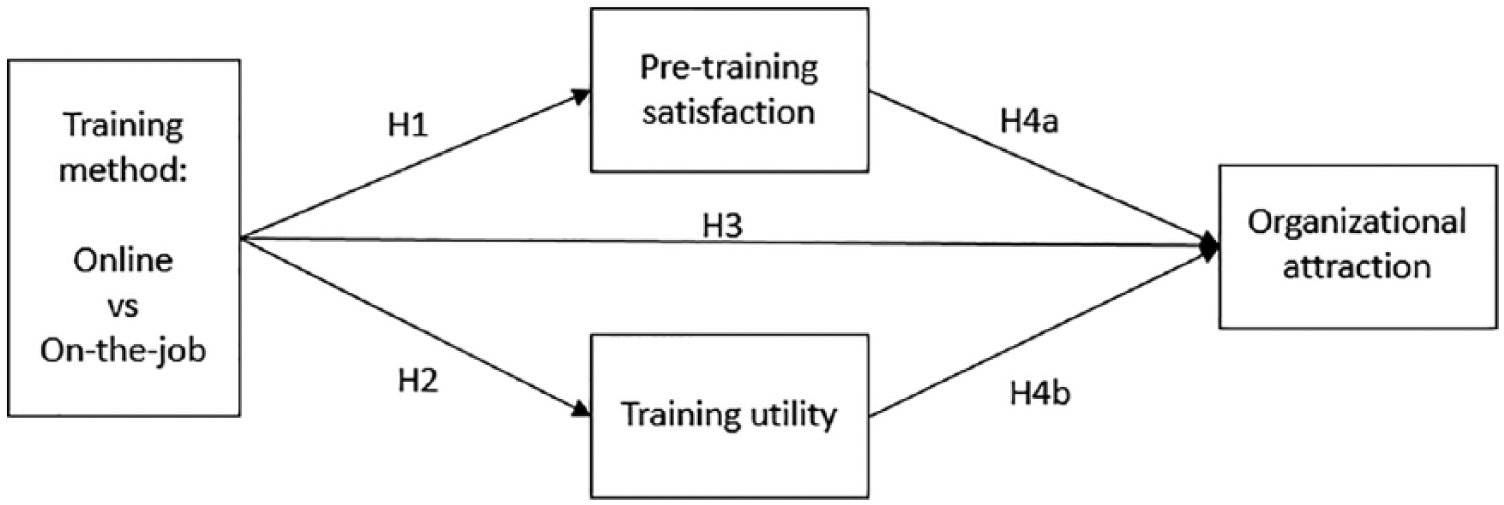
Conceptual Model for Study 1.
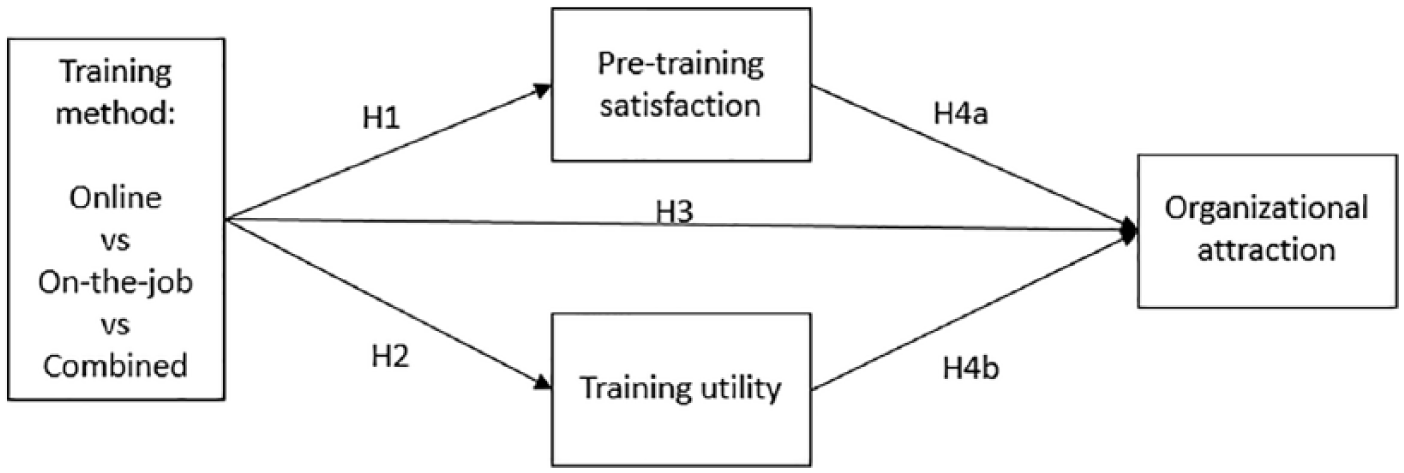
Conceptual Model for Study 2.
Study 1 Method
Sample and Procedure
The hypotheses were tested using a sample of 124 students from an undergraduate hospitality program in a university located in the southern U.S. region. The average respondents’ age was 23 years (SD = 4.94), 71.8% females and 27.4% males; 61.3% work part time, 20.2% work full time; and 17.7% were not working. Approximately 29% identified as Caucasian American, 29% Latino(a) American, 18.5% Asian American, 10.5% African American, and 11.3% “Other.” Participants were enrolled in various upper-level undergraduate courses and received extra credit for their participation. To keep the responses anonymous, the participants received a random number at the end of the survey that they used to report their completion.
The current study focused on college students from a hospitality program because (a) a college sample is a good representation of the millennial working population in the hospitality industry and (b) all the participants were upper-level undergraduates who will be actively seeking employment and therefore provided an opportunity to examine how manipulating training methods (online vs. on-the-job) influences organizational attraction. In addition, 33% of employees in the leisure and hospitality sector are 24 years of age or younger (U.S. Department of Labor Statistics, 2017), thus, our sample represents a significant percentage of the hospitality workforce.
Research Design
The study is a two-group (online training and on-the-job training) between-subjects experimental design. Participants received an online link where they were informed that they were going to read a hotel’s recruitment information for a front office position and evaluate the hotel assuming the role of an applicant. They were randomly assigned to one of the two conditions, which presented a scenario where a hotel uses either online or on-the-job training method. They were presented with a description of a hypothetical luxury hotel and described the training for a front office position. The training description included the general topics (e.g., company core values, company history, hotel facilities, and services) and the functional areas (e.g., front desk system functions, account adjustments, credit card payment, cash handling, and room change) that are included in the training. They then read that the training will be “online” or “on-the-job.” After reading the manipulation, respondents answered questions about their perception about the training, questions related to manipulation checks, and demographic information.
Measures
Training utility
Training utility was measured with four items developed by Guthrie and Schwoerer (1994). Sample items for this scale include, “The knowledge and skills gained through their training will help me as a front desk agent” and “The time spent on their training will be worthwhile to be a front desk agent.” The reliability was .93. A 7-point Likert-type scale from strongly disagree to strongly agree was used.
Pretraining satisfaction
A 4-item scale developed by Dabholkar and Spaid (2012) was used to measure pretraining satisfaction. Example items include, “Compared to an ideal training method, the training experience method in this hotel would make me feel . . .”and “Compared to an ideal job application experience, the experience described in this hotel would make me feel.” The reliability was .94. A 5-point Likert-type scale was used from very displeased to very pleased, very unhappy to very happy, very dissatisfied to very satisfied, and disgusted to delighted.
Organizational attraction
Organizational attraction was measured using a 5-item measure developed by Highhouse, Levens, and Sinar (2003). Example items include, “This hotel is attractive to me as a place for employment” and “For me, this hotel would be a great place to work.” The reliability for organizational attraction was .84. A 7-point Likert-type scale from strongly disagree to strongly agree was used.
Realism check
A realism check was conducted to verify the realism of the scenarios. The 2-item scale, “It was easy imagining myself in the scenario situation” and “The scenario situation was realistic” developed by Dabholkar and Spaid (2012) was used. A 5-point Likert-type scale from strongly disagree to strongly agree was used.
Statistical methods
Before testing our hypotheses, a confirmatory factor analysis (CFA) was conducted, allowing to assess model fit and convergent and discriminant validity of all constructs using AMOS version 25. Prior to conducting the analysis, descriptive statistics and graphs were generated to test the assumptions of multiple regression. Measures of skewness and kurtosis, histograms, and normal probability plots showed that the shapes of the distributions of training satisfaction approached that of a normal curve, ensuring the assumptions of normality. Training utility and organizational attraction presented kurtosis outside the normal threshold range (±1.96; Abu-Bader, 2011). Thus, to test the mediation model, percentile bootstrap confidence intervals (CIs) were used, which did not involve a bias correction. This decision was based on the fact that bias correction (accelerated CIs) may have slightly elevated Type I error rates (Hayes & Scharkow, 2013).
Study 1 Results
Manipulation Checks and CFA
The adequacy of the proposed measurement model was assessed through a CFA using AMOS 25. One item from organizational attraction—“I would not be interested in this company except as a last resort”—was eliminated due to low factor loading. The measurement model fit the data satisfactorily, χ2 = 91.72, df = 51, χ2/df = 1.79, Tucker–Lewis index (TLI) = 0.96, comparative fit index (CFI) = 0.97, goodness of fit index (GFI) = 0.89, root mean square error approximation (RMSEA) = 0.08. Although the RMSEA was higher than the commonly used threshold of 0.05, RMSEA produces a better estimation for large sample sizes compared to smaller sample sizes (Cangur & Ercan, 2015), particularly, in models with few variables. An RMSEA value falling between 0.08 and 0.10 is considered a reasonable fit for this range (Cangur & Ercan, 2015; Hu & Bentler, 1995) and together with the other fit indices, demonstrated a good model fit.
All factor loadings were between 0.83 and 0.93 (p < .001). As shown in Table 1, the average variance extracted (AVE) from all variables were above 0.50, confirming convergent validity (Hair, Black, Babin, & Anderson, 2016). In all cases, the squared root of AVE was found to be higher than the intercorrelations between two constructs of interest, confirming discriminant validity (Fornell & Larcker, 1981). The composite construct reliability (CR) exceeded the recommended .70 threshold for all variables (Fornell & Larcker, 1981).
Descriptive Statistics and Associated Model Measurements for Study 1 and Study 2.
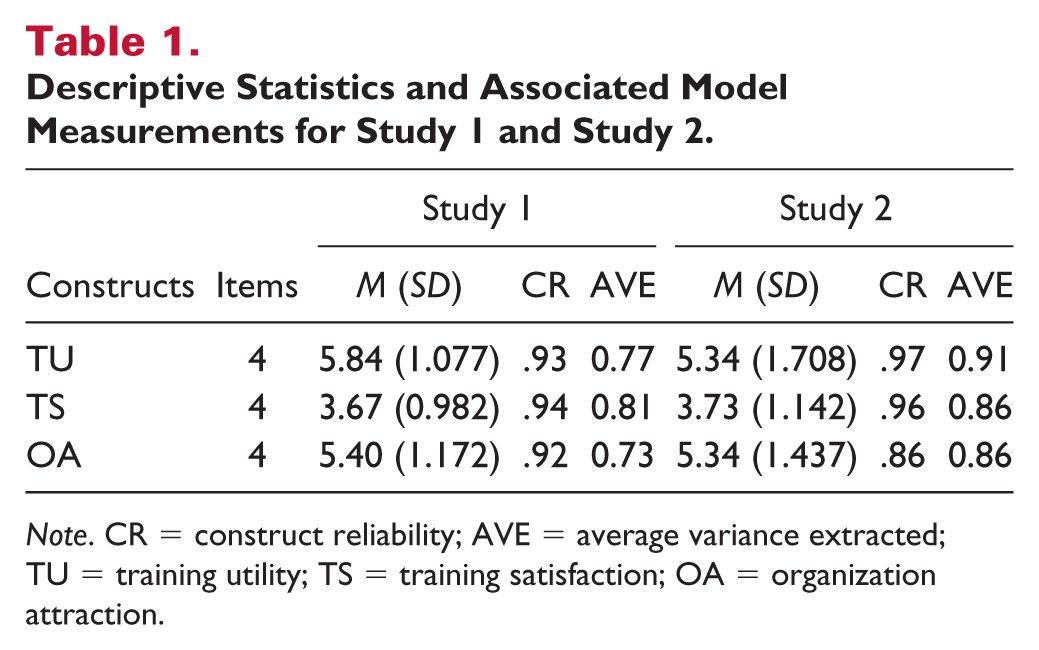
Note. CR = construct reliability; AVE = average variance extracted; TU = training utility; TS = training satisfaction; OA = organization attraction.
The concern of common method bias was mitigated using procedures recommended by (Podsakoff, MacKenzie, & Podsakoff, 2012): (a) respondents confidentiality was ensured; (b) they were informed that there are no “right” or “wrong” answers; (c) the order of the items were counterbalanced; (d) reversed-scoring items were included; and (e) different rating scales and anchors were used. Moreover, the three-factor model conducted through CFA had a better model fit when compared with the single-factor model (χ2= 393.41, df = 54, χ2/df = 7.28, GFI = 0.59, CFI = 0.76, TLI = 0.71, RMSEA = 0.23), providing support that common method bias is not a serious threat in this study.
Manipulation Checks
To verify the manipulation’s effectiveness, two steps were conducted. First, two items developed by Dabholkar and Spaid (2012) were used to capture the level of realism of the scenarios and both had high means: “It was easy imagining myself in the scenario situation” (M = 3.94, SD = 0.88) and “The scenario situation was realistic” (M = 4.02, SD = 0.78). Both means (out of a 5-point scale) indicated “agree” for these statements. Second, almost all respondents correctly identified the type of training used by the hotel in the scenario provided. No significant difference was found between the respondents who identified the items correctly from those who did not (F = 0.15, p = .69). Thus, all respondents were kept in the analysis.
Test of Hypotheses
Process on SPSS version 25 was used to test the conceptual model (Hayes, 2012). This study used bootstrap function extracting 5,000 samples for the analysis (95% CI). Table 2 shows the main and indirect effects results. The direct effect between training method and pretraining satisfaction was significant (b = −0.54, p < .05). The direct effect between training method and training utility was significant (b = −0.58, p < .05). Although both effects were significant, they were in the opposite direction of the hypothesized relationships. Pretraining satisfaction and training utility were lower when training was described as online than as on-the-job. Thus, Hypotheses 1 and 2 were rejected.
Results of Main and Indirect Effects for Study 1.
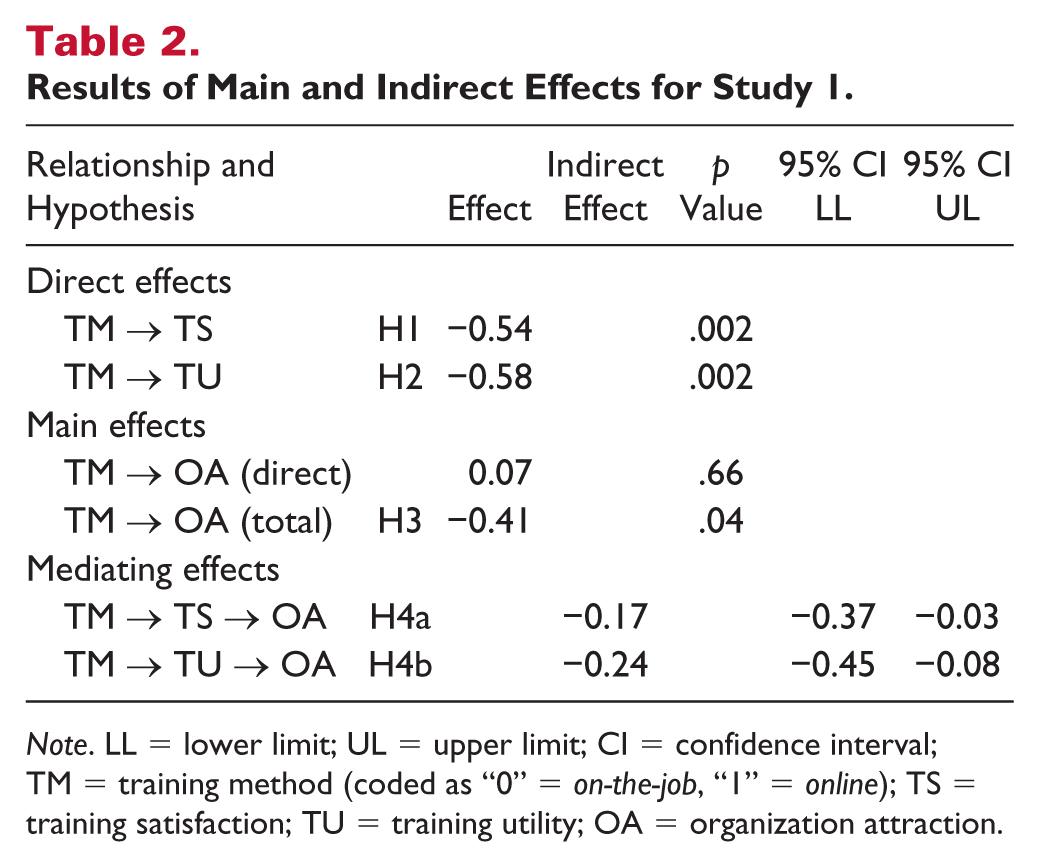
Note. LL = lower limit; UL = upper limit; CI = confidence interval; TM = training method (coded as “0” = on-the-job, “1” = online); TS = training satisfaction; TU = training utility; OA = organization attraction.
The direct effect between training method and organization attraction, while controlling for the mediators, was not significant (b = 0.07, p = .66). The total effect of training method and organization attraction was significant (b = −0.41, p < .05), suggesting that organizational attraction was lower for the online training condition than for the on-the-job training condition. This result disconfirms Hypothesis 3. As the independent variable is binary and one-unit change is relevant for this analysis, the partially standardized mediated effects in terms of standard deviation of the dependent variable were also analyzed. Pretraining satisfaction, b = −0.17, 95% CI = [–0.37, –0.03], and training utility, b = −0.24, CI = [–0.45, –0.08], mediated the relationship between training method and organization attraction, providing support for Hypotheses 4a and 4b.
The contrasts between the two mediators were not significant, b = −0.08, 95% CI = [–0.35, 0.19], indicating no significant differences between the strength of the two mediators. However, as the mediation effects were negative, the negative direction suggests that pretraining satisfaction and utility and organizational attraction were lower for the online training condition than for the on-the-job condition.
Study 2
Sample and Procedure
The hypotheses were tested using a separate sample of 146 students from an undergraduate hospitality program in an U.S. college. Participants were enrolled in various upper-level undergraduate courses, were distinct from Study 1, and received extra credit for answering the survey. Three multivariate outliers were identified through Mahalanobis distance test. The respondents were eliminated. The final sample consisted of 143 students. The average respondents’ age was 22 years (SD = 2.56), 67.1% females and 32.2% males; 60.1% work part time, 14% work full time; and 25.9% were not working. Approximately 28% identified as Caucasian America, 30.8% Latino(a) American, 16.1% Asian American, 7% African American, and 15.7% Other.
Research Design
The study was a three-group (online, on-the-job, and both online and on-the-job training) between-subjects experimental design. The exact same procedure used in Study 1 was used for Study 2, with the exception of the additional condition: a combination of both online and on-the-job training method. Specifically, the participants read that the training will be “online” or “on-the-job” or “a combination of both online and on-the-job.”
Measures
The same measures used in Study 1 were employed for Study 2.
Study 2 Results
Manipulation Checks and CFA
The adequacy of the proposed measurement model was accessed through CFA using AMOS 25. Before conducting the CFA, multiple regression assumptions were analyzed. Measures of skewness and kurtosis, histograms, and normal probability plots showed that the shapes of the distributions of organizational attraction approached that of a normal curve, ensuring the assumptions of normality. Training utility and training satisfaction presented kurtosis outside the normal threshold range (± 1.96; Abu-Bader, 2011). Thus, to test the mediation model, percentile bootstrap CIs were used (not bias corrected). One item from organizational attraction—“I would not be interested in this company except as a last resort”—was eliminated because it had a low factor loading, which was consistent with Study 1. The measurement model fit the data satisfactorily (χ2= 118.476, df = 51, χ2/df = 2.32, TLI = 0.967, CFI= 0.97, GFI = 0.87, RMSEA = 0.09). All factor loadings were between 0.89 and 0.97 (p < .001). As shown in Table 1, the AVE from all variables were above 0.50, confirming convergent validity (Hair et al., 2016). In all cases, the squared root of AVE was found to be higher than the intercorrelations between two constructs of interest, confirming discriminant validity (Fornell & Larcker, 1981). The CR exceeded the recommended 0.70 threshold for all variables (Fornell & Larcker, 1981).
The concern of common method bias was mitigated using the same procedures used in Study 1 recommended by Podsakoff et al. (2012). Moreover, the three-factor model conducted through CFA had a better model fit when compared with the single-factor model (χ2= 440.52, df = 54, χ²/df = 8.16, GFI = 0.59, CFI = 0.85, TLI = 0.82, RMSEA = 0.22), providing support that common method bias is not a serious threat in this study.
Replicating Study 1, the manipulation’s effectiveness showed high levels of realism of the scenarios: “It was easy imagining myself in the scenario situation” (M = 4.59, SD = 0.64) and “The scenario situation was realistic” (M = 4.57, SD = 0.71). In addition, all respondents correctly identified the type of training used by the hotel in the scenario.
Test of Hypotheses
Process on SPSS version 25 was used to test the conceptual model (Hayes, 2012); 5,000 Bootstrap samples were extracted for this analysis (95% CI). Because the independent variable is dichotomous (0 = online, 1 = on-the-job, and 2 = both online and on-the-job training), process allows dummy coding where one conditions is the comparison group. To replicate Study 1 and test the same hypotheses, the “on-the-job” condition was selected as the comparison group. Table 3 shows the main and indirect effects results.
Results of Main and Indirect Effects for Study 2.
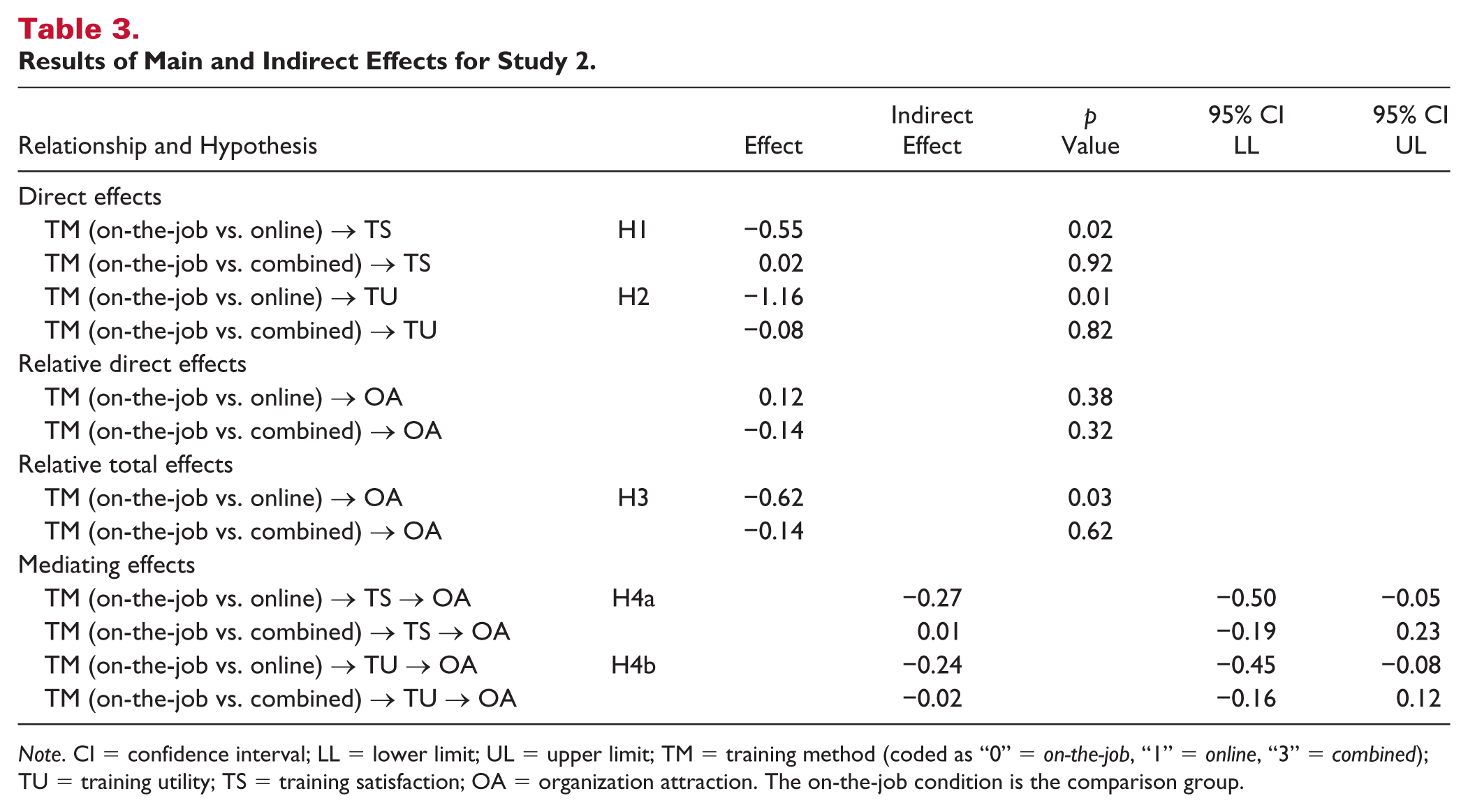
Note. CI = confidence interval; LL = lower limit; UL = upper limit; TM = training method (coded as “0” = on-the-job, “1” = online, “3” = combined); TU = training utility; TS = training satisfaction; OA = organization attraction. The on-the-job condition is the comparison group.
The direct effect of training method (on-the-job vs. online) and pretraining satisfaction was significant (b = −0.55, p = .02). The direct effect of training method (on-the-job vs. online) and training utility was significant (b = −1.16, p < .01). Although both effects were significant, they were in the opposite direction of the hypothesized relationships, replicating the same pattern found in Study 1, and therefore rejecting Hypotheses 1 and 2. These results suggest that pretraining satisfaction and training utility were lower when the training was described as online than as on-the-job.
The relative direct effect of training method (on-the-job vs. online) and organization attraction, while controlling for the mediators, was not significant (b = 0.12, p = .38). The same occurred for the on-the-job versus combined situation (b = −0.14, p = .62). The relative total effect was only significant under the on-the-job versus online situation (b = −0.62, p = .03). The negative effect suggests organizational attraction was lower for the online training condition than for the on-the-job training condition, confirming the results found in Study 1, rejecting Hypothesis 3. These results taken together demonstrate that the combined condition was not rated better in regard to satisfaction, utility, or organizational attraction than using on-the-job.
Training satisfaction, b= −0.275, 95% CI = [–4.92, –0.057] and training utility, b = −0.24, 95% CI = [–0.48, –0.08], mediated the relationship between training method (on-the-job vs. online) and organizational attraction, confirming Hypotheses 4a and 4b. However, the relationship is negative, demonstrating that those under online training condition were less satisfied and found the training to have less utility while compared with those under on-the-job training, which in turn negatively influenced organizational attraction. These results replicate Study 1.
Finally, the results showed no significant differences between on-the-job versus combined on-the-job and online training for the direct effects, relative direct effects, relative total effects, and the mediation effects. These results suggest that training attitudes were the same when training was described as on-the-job or as a combination of both online and on-the-job training.
Discussion
There is a lack of research from both the hospitality and general training literature examining attitudes toward online training (Ng et al., 2010), producing a glaring practical gap because organizations are investing in online training to accommodate the growing millennial workforce. This gap in the literature also presents a theoretical gap in understanding how prospective applicant attitudes toward online training relative to the traditional on-the-job training can influence organizational attraction. Using two experiments, the current study found surprising and counter-intuitive results. Specifically, it was expected that millennial participants would have higher pretraining satisfaction (Hypothesis 1), training utility (Hypothesis 2), and higher organizational attraction (Hypothesis 3) when training was described as online than as on-the-job training. The results from both studies showed a clear and consistent pattern, namely, attitudes were more positive for the traditional on-the-job training than for online training. In addition, the results showed that pretraining satisfaction and utility mediated the effect of training method on organizational attraction (Hypothesis 4). However, the significant mediation effects results were related to on-the-job training and not to the online training as expected. The assumption that millennials, the generation born and raised in a more technological world, would prefer online training (Bannon et al., 2011; Nicholas, 2008) was not supported in this study.
Theoretical Implications
The conceptual contributions of our work are 2-fold. First, the results suggest that potential applicants do use information about the type of training they will receive to make judgments on how attractive an organization is. The results contribute to understanding how prospective applicants use organizational characteristics, such as the type of training they offer, to form attitudes, such as organizational attraction. The current results showed that attitudes toward online versus on-the-job training methods (i.e., before training is completed by trainees) can influence organizational attraction, extending the recruitment/signaling literature to include training type as another signal that can influence organizational attraction. For example, research from the recruitment/signaling and applicant–organizational attraction literature (D. G. Allen et al., 2007; Chapman et al., 2005; C. J. Collins, 2007; C. J. Collins & Han, 2004) has focused on general recruitment messages or organizational characteristics as signals, but the current research shows that specific types of training can also influence organizational attraction.
The results can be understood within the signaling theory (Spence, 1973) framework used in recruitment and applicant–organizational attraction literature. According to signaling theory (Spence, 1973), applicants may view a training program as a signal that the company is willing to invest in them and provide them with the skills and knowledge to perform effectively, subsequently influencing pretraining attitudes. Considering how millennials view work as a continual learning process, which does not require them to have all the skills to be successful on the job before applying for a certain job position (Farrell & Hurt, 2014), this understanding about training is especially relevant. Prospective applicants analyze and cognitively process organizational signals, which will influence their attitudes, behaviors, and intentions (Ryan & Ployhart, 2000).
This study predicted and found that training type and commonly studied employees’ attitudes toward training would have a similar effect on job applicants. Thus, the training method (online versus on-the-job) affects attitudes toward the training (training satisfaction and perceived training utility), which then affects subsequent variables, such as organizational attraction. Although empirical research supports the link between positive training attitudes and behaviors toward the organization (T. D. Allen & O’Brien, 2006; Terjesen et al., 2007), this is the first known empirical research examining the effect of training attitudes on organizational attraction as a function of training method.
The second and most important theoretical contribution of the current studies is that the results contradict the general stereotypes and expectations of millennials, suggesting that millennials’ attitudes toward technology depends on the context. Specifically, the literature describes millennials as frequently relying on technology and expecting their workplace to adopt the latest technological advancements (Cennamo & Gardner, 2008; Cho et al., 2013; Ehrhart et al., 2012; Nicholas, 2008; Otey, 2013; Schullery, 2013). These attitudes, however, do not necessarily generalize to work training contexts. The results from the two studies are valuable in understanding how millennials perceive training methods. Even though the millennial generation is more connected to technology and has positive attitudes toward online education, the fact that the participants under the on-the-job training condition rated higher training satisfaction, training utility, and organizational attraction than the online condition reveals that other factors might be influencing their perceptions.
For instance, because millennials usually value immediate feedback and recognition and value career advancements opportunities (Mencl & Lester, 2014), they might see on-the-job training methods as more effective to achieve those ends. Millennials might perceive that they have a chance to interact with immediate supervisors/managers who are responsible for their performance appraisals and provide future promotion opportunities when using on-the-job training methods as opposed to online training.
Training for employment often involves learning knowledge of procedures and policies but also the behaviors related to carrying out the essential functions of the job (e.g., how to respond to customer complaints, knowing the procedures to upgrade services, how to adjust a bill, how to change credit cards on their system). This would require more hands-on opportunities to learn. In contrast, education, including online education, focuses on learning about concepts and theories. Thus, the implications from the education literature (e.g., Paechter & Maier, 2010; Tallent-Runnels et al., 2006) might not apply to training contexts for work.
Practical Implications
The current article also provides several practical implications for the hospitality industry. First, the results of the current article suggest that the industry needs to be cautious in how they develop and offer training for applicants and new employees. Understanding determinants of training delivery can inform efforts to identify and develop training practices that will maximize benefits of training for organizations (e.g., organizational attraction, larger pool of applicants) and for individuals and teams (e.g., signaling applicants about what type of job experience they will have if hired, better organization-fit). Despite the assumptions of millennials favoring online methods and the cost-saving benefits of online training, millennials might not perceive it as favorably as on-the-job training. This premise might be true due to the adoption of a one-size-fits-all approach while developing online trainings. Research in training methods have been indicating that the benefits of using technology and online training can be enhanced by providing adaptive guidance to trainees (Aguinis & Kraiger, 2009). On-the-job training naturally allows trainees to personally interact with trainers. This personal contact helps trainees to be empowered of their own training needs, which has been shown to be connected to greater tacit skills and learning motivation and performance, just to mention a few training outcomes (Barber, 2004; Huang & Jao, 2016). While developing training methods, practitioners need to be mindful that decisions must be made not only regarding the delivery medium (e.g., online or on-the-job training or a combination) but also about how to design the training to enhance learning and performance taking into consideration different learning behaviors and individuals characteristics (e.g., generation differences) and organizational aspects (e.g., budget, time). The results from Study 2 showed that using training that combines both on-the-job and online was not statistically different than on-the-job training, suggesting that combining both methods is preferable over relying only on online training.
Second, the results suggest that training information does influence organizational attraction. Therefore, information about training and development opportunities should be framed in way that aligns with the needs of millennial employees. For example, the results suggest that organizations emphasize on-the-job training methods, such as job shadowing and mentoring programs. Knowing that millennials value aspects such as feedback and recognition (Mencl & Lester, 2014), recruiting messages could provide information about how the organization’s training program helps to achieve important mile stones and how the personal interaction facilitates the process.
Third, increasing the perceived utility and training satisfaction is fundamental in influencing the link between training method and organizational attraction. Training information should highlight the utility of completing the training. This recommendation is particularly important for online training, given that the millennials in the current two studies perceived less utility and satisfaction with online training in comparison with traditional training. For example, explicitly mentioning how training offered by the organization can help employees to advance on their job roles and careers may help generate a larger pool of qualified applicants. Considering that detailed information in the recruitment process can enhance perceptions of specific organization’s attributes (Roberson et al., 2005) and knowing that millennials value career advancement opportunities (Mencl & Lester, 2014), providing detailed training information can signal its utility and how the organization is concerned and invested in employees’ success.
Limitations and Future Research
The current article has several potential limitations and provides suggestions for research. First, the participants in both experiments responded to a hypothetical hotel and may not respond in the same manner when evaluating real potential employers. A suggestion for the future research is to use qualitative methods collecting data from applicants through a focus group or interviews to further investigate how and why training methods affect organizational attraction.
Second, the current article only focused on millennials. Because every generation has distinct characteristics, values, and preferences, we cannot generalize that all ages are going to evaluate on-the-job training more positively than online training. Future research can look at other age demographics and examine potential differences in how they evaluate online and traditional on-the-job training methods.
Third, the current article only examined how training is framed as online, on-the-job, or as a combination of online and on-the-job training without considering specific skills. That is, future research can examine if specific training methods are more appropriate for the training of certain skills and/or topics. For example, online training may be perceived more favorably for passive topics such as company history and values, but on-the-job training may be perceived more favorably for active skills such as training service recovery methods and how to handle difficult customers. Moreover, this study tested online and on-the-job training without making distinctions between different types of training within the online and on-the-job training paradigms. Investigating differences between, for instance, virtual reality, game-based training programs, eLearning simulations, on-demand training, and different on-the-job training (e.g., mentoring programs, shadowing employees, classroom style, structured training) might bring relevant insight to researchers and practitioners and should be investigated in future studies. Different types of training can be combined with other organizational factors such as whether the training is voluntary or mandatory and whether employees should complete the training during the workday or during their own time (Sitzmann & Weinhardt, 2018), advancing the knowledge about training.
Fourth, although college students are a good representation of the millennial working population, the results of this study might be influenced specifically by the characteristics of the college selected for this study. This concern was minimized by the wide range of participants’ races, and therefore, different cultural perspectives. Still, future research should address this aspect by replicating this experiment in other contexts. Fifth and last, it is also critical to understand that not all millennials value the same aspects. Understanding how individual characteristics (e.g., personality) play can help recruiters, during the selection process, and managers, during trainings periods, to adjust accordingly the way the training is offered and conducted. Future research can address this aspect by evaluating whether personality characteristics influence attitudes toward a specific type of training
Conclusion
Training programs are one of the best tools to ensure that employees learn all the procedures to be successful in their job (Burgess & Russell, 2003; Chen, 2008; Newton & Doonga, 2007; Ozturan & Kutlu, 2010; Schweizer, 2004; Womble, 2008). Because the millennial generation is the largest generation in the labor force and is the most computer-literate generation, many organizations are using online methods for their training (Gibson & Sodeman, 2014). Yet, research has not examined how millennials evaluate online training relative to the traditional on-the-job training. Using two experiments, the current article found that millennial participants had higher pretraining satisfaction, training utility, and higher organizational attraction when training was described as on-the-job training than as online training. Both experiments suggest that organizations should not assume that millennials have more favorable attitudes toward online training than for traditional training methods.
Footnotes
Declaration of Conflicting Interests
The author(s) declared no potential conflicts of interest with respect to the research, authorship, or publication of this article.
Funding
The author(s) received no financial support for the research, authorship, or publication of this article.