







Abstract
Previous studies have shown that restaurant employees who use tip-enhancing behaviors such as smiling, introducing oneself by one’s name or writing “thank you” on the bill receive more tips. The aim of this study is to evaluate the impact of a training intervention about tip-enhancing behaviors on the amount of tips received by restaurant employees. The sample of this study comprised 143 employees working in 62 restaurants. Sixty-nine participants took part in the training intervention and 74 were in the control condition. After the training intervention, the amount of tips received by the employees was tracked over 5 days. Results showed that participants who followed the training intervention used more tip-enhancing behaviors than the participants in the control group, that a higher use of tip-enhancing behaviors was related to higher amount of tips and that the effect of the training intervention on the amount of tips was fully mediated by an increase in the use of tip-enhancing behaviors.
Introduction
Tips represent an important source of income for many restaurant employees in the United States as well as an additional source of income for employees working in countries where a service charge is already included in the bill. As such, larger tips can help restaurant managers to retain their top employees (Lynn, 2002) and to ensure that customers are satisfied with the service (Lynn & McCall, 2000). It is then in the best interest of the managers that employees receive high tips.
How is it possible for managers to increase the amount of tips received by their employees? There are so many factors linked to tipping that are out of the control of restaurant managers that this task might seem daunting. Indeed, research has for instance shown that tips are linked to the bill amount (Lynn & Grassman, 1990), to patronage frequency (Conlin, Lynn, & O’Donoghue, 2003), and even weather conditions (Cunningham, 1979). However, to increase the amount of tips received by employees, it has been suggested that managers could train employees in the use of tip-enhancing techniques (Lynn, 1996, 2005; Lynn & McCall, 2009). It is worth mentioning that training is often limited in the hospitality industry (Kusluvan, Kusluvan, Ilhan, & Buyruk, 2010) even if many studies have shown that training has a direct impact on firm performance (Aguinis & Kraiger, 2009; Arthur, Bennett, Edens, & Bell, 2003; Kusluvan et al., 2010). In the hospitality industry, training is especially important as low-skilled employees represent a large part of the workforce (Baum, 2002). Moreover, many studies have shown the importance of training opportunities to increase employee satisfaction and retention (Chiang, Back, & Canter, 2005; Choi & Dickson, 2009). Hospitality firms can then get a competitive advantage on offering adequate training to their employees and managers: they can become more attractive as employers (Hinkin & Tracey, 2010), increase employee engagement (Roehl & Swerdlow, 1999) and reduce turnover costs (Lashley, 2002). Training interventions can take different forms and have been shown among others to be effective in the following areas: adoption of new property management systems (Frash, Antun, Kline, & Almanza, 2010), employee hygiene (Yu, Neal, Dawson, & Madera, 2018), wine-service and restaurant wine sales (Gultek, Dodd, & Guydosh, 2006), or development of managers’ interpersonal skills (Tews & Tracey, 2009). Our study aims to show that a brief training intervention delivered to restaurant employees has a positive impact on the amount of tips they receive. To our knowledge, this is the first training intervention study conducted with restaurant employees to evaluate its effectiveness regarding the amount of tips. It should be, however, mentioned that scholars have recently shown that hairdressers who have received a training intervention on the use of emotional labor strategies at work received a larger amount of tips from customers than hairdressers who had not received this training (Hülsheger, Lang, Schewe, & Zijlstra, 2015). This latter study is interesting because it showed that service employees could be efficiently trained in (emotional labor) strategies helping them to increase the amount of tips.
Past research has documented that restaurant employees can use a wide range of techniques enabling them to increase their tips (Lynn, 2011; Lynn & McCall, 2009). For instance, it has been shown that they get more tips when they introduce themselves by their name (Garrity & Degelman, 1990), when they touch the customers briefly on the shoulder (Lynn, Le, & Sherwyn, 1998) or the forearm (Guéguen & Jacob, 2005) or when they bring a second candy with the bill (Strohmetz, Rind, Fisher, & Lynn, 2002). All these techniques have received considerable interest in the United States context because most servers’ wages are based on the tips they receive.
The question of the generalizability of these techniques was investigated only once (Lynn & McCall, 2009). In this study, 1,606 restaurant employees working in the United States completed an online questionnaire, in which they indicated to which extent they had used in the past 13 tip-enhancing behaviors, and they reported their tips compared to the tips received by their coworkers. Overall, an average indicator of the tip-enhancing behaviors was positively associated with the comparative tip measure. Apart from this study, little is known about the generalizability of the effectiveness of the tip-enhancing techniques.
The aim of this study is to evaluate the impact of a training intervention about tip-enhancing behaviors on the amount of tips received by restaurant employees. In this training intervention, restaurant employees learned about the existence, effectiveness, and ways to apply 12 tip-enhancing behaviors proven to be effective in previous research. The training intervention was brief (one session of 90 minutes) and was conducted most of the time directly in the restaurant in which the employee worked. This quasi-experiment contributes significantly to the literature on tip-enhancing behaviors in four important ways. First, most of the studies so far were conducted in only one restaurant and with few employees. On the contrary, this study has been conducted in multiple restaurants. Second, the study conducted by Lynn and McCall (2009) was correlational, so one cannot tell if there is a causal influence of engagement in tip-enhancing behavior on actual tipping. For instance, this link can also be interpreted in the following way: high-performing employees are more likely both to receive tips and to use tip-enhancing techniques. Using a training intervention, our study allows disentangling the sources of variance between employee effectiveness and the use of the tip-enhancing behaviors. Third, despite many calls addressed to managers to train their employees in the use of tip-enhancing behaviors (Lynn et al., 1998; Lynn & McCall, 2009), no study has attempted to show that it is possible to do so in an efficient way. Fourth, very few studies have been conducted on the effectiveness of tip-enhancing behaviors outside of the United States. As tipping norms differ between the United States and European countries, it is important to show that tip-enhancing behaviors are also effective in countries in which the tip is not considered a social norm. In the United States, it is customary to add 15% of the total amount of the bill for the tip (e.g., Lynn & Graves, 1996) and employees rely on tips because they have very low wages or none at all. However, in most European countries, a service charge is already included in the meal price, and service employees do not necessarily expect a tip (Travelex, 2008). It could, therefore, mean that the way restaurant employees interact with the customers does not have such a big impact on their tips as in the United States. It is even possible that the use of tip-enhancing behaviors in European countries could have detrimental effects on tip size as suggested by some scholars and service practitioners (Andersen, 1998; Arduser & Brown, 2005). To ascertain the value and effectiveness of tip-enhancing behaviors outside of the United States, it is necessary to conduct studies in many restaurants at the same time. So far, only a few of the tip-enhancing behaviors have been shown to be effective in Europe, and the results were observed in only one restaurant in each study (repeating the customer’s order in the Netherlands, Van Baaren, 2005; standing at a close distance in France, Jacob & Guéguen, 2012; touching the customer in France, Guéguen & Jacob, 2005; drawing on the check in France, Guéguen & Legoherel, 2000). Moreover, a recent study has shown that the positive effects of the tip-enhancing behaviors on the amount of tip were less reliable in France than in the United States (Lynn, 2018).
In light of the above literature review, we formulate the following hypotheses:
Method
Participants
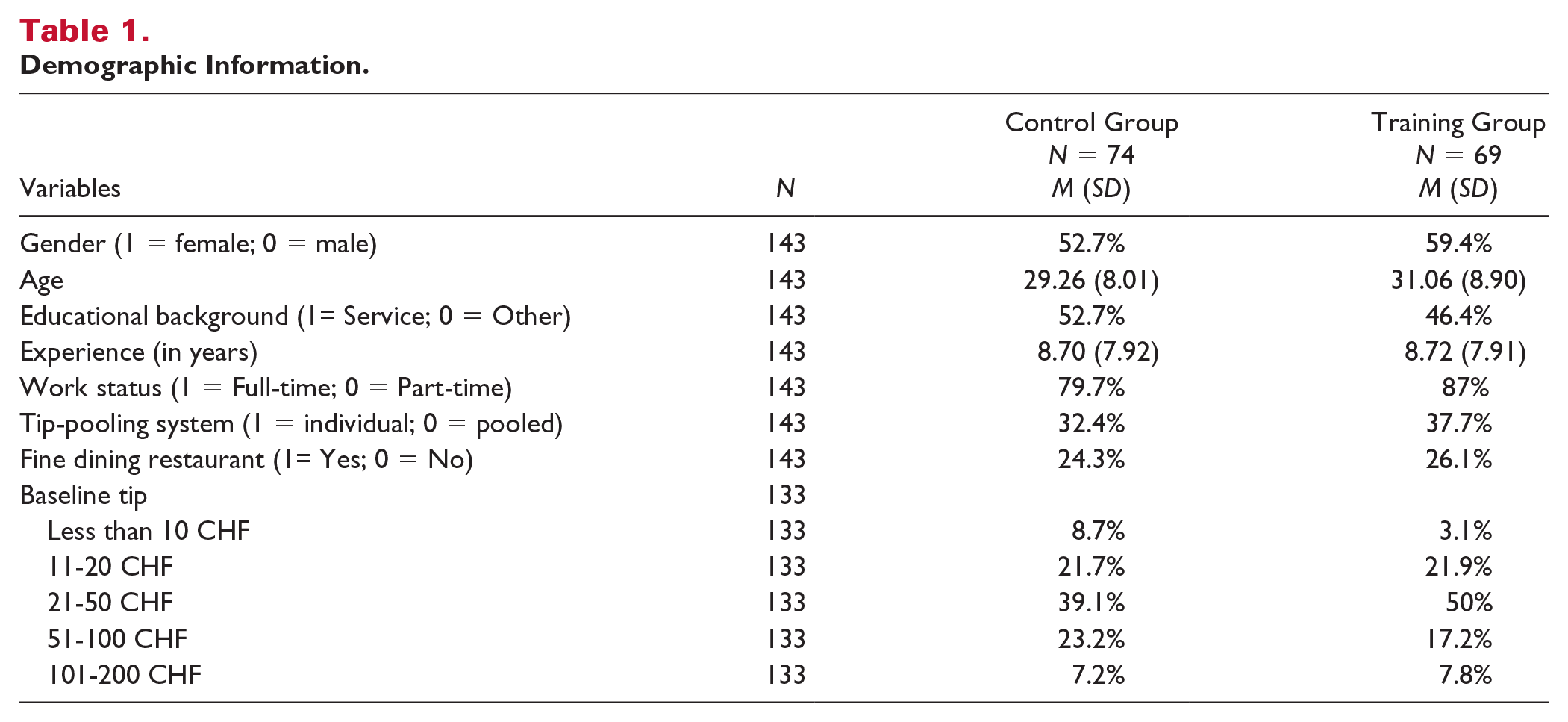
The sample of this study comprised 143 employees working in 62 restaurants in the French-speaking part of Switzerland. The mean age of the restaurant employees was 30.13 years (SD = 8.47), and they had in average 8.71 years of experience (SD = 7.89). Sixty-nine participants took part in the training group, and 74 acted in the control group. Forty-four percent of the participants were men, and 56% were women. Control and trained participants did not differ in any of these variables. They also did not differ on any of the other control variables examined in this study.
Procedure
Several methods were used to recruit participants. First, students studying in a Swiss hospitality management school who worked part-time in restaurants or bars were invited by email to participate in the study. Second, restaurant servers were approached individually in the restaurants in which they worked. Third, restaurant managers were contacted by email or were approached directly in their restaurant. They were informed that the aim of the study was to evaluate the effectiveness of a brief training intervention designed to enhance guest satisfaction and that this variable would be measured through the amount of tips received by employees. This method of recruitment was the most fruitful as employees were more likely to participate in the study once their manager was aware of and actively supported the study. Once the employees agreed to participate, they were given a sealed envelope with questionnaires and instructions. The envelopes were randomly preassigned to the control or the training group.
Participants in the control group were given an envelope that contained the following documents: (a) a cover letter with instructions about the procedure of the study, (b) a consent statement, (c) a sociodemographic questionnaire, (d) a diary, (e) a questionnaire about the use of tip-enhancing techniques, (f) a self-addressed stamped envelope with which to return all the documents. These participants were informed that they had to respond to the documents in the precise order in which they were presented in the envelope. Once they answered all the documents, they mailed them back to us. It is important to mention that participants in the control condition monitored their tips across 5 days without having been trained in the use of tip-enhancing behaviors. These pieces of information were reported in the diary. Participants in the training group were given an envelope that contained the following documents: (a) a cover letter with instructions about the procedure of the study, (b) a consent statement, (c) a sociodemographic questionnaire, and (d) a self-addressed stamped envelope to return all the documents. Once they answered these questionnaires, they mailed them back to the researchers. Once the questionnaires were received, the training intervention was scheduled in the restaurant (or on some occasions in a classroom). After the training, participants in the training group received a second envelope that contained another set of documents: (a) a second cover letter reminding them of the instructions for the second phase of the study, (b) a diary and (c) a questionnaire about the use of tip-enhancing behaviors, (d) a stamped envelope to return all the documents. Once the questionnaires contained in the second envelope were completed, they sent them back to the researchers. At the end of the study, participants were thanked and were paid CHF 40 for their participation.
Training intervention
The training intervention lasted approximately 1 hour and 30 minutes. Participants received, at the beginning of the training session, a small booklet describing the tip-enhancing behaviors. For each tip-enhancing behavior, there was a description of how to use it, why the behavior is effective, and with whom it is beneficial. The trainer was the first author of this study and showed the participants how to use each behavior, and then the group discussed how to use it in the restaurant. Participants practiced the tip-enhancing behaviors via roleplays and received feedback from the trainer or the other participants regarding the effectiveness of their use of the tip-enhancing behaviors. Past studies have indeed shown that practice and feedback are two key ingredients of effective learning (Salas, Tannenbaum, Kraiger, & Smith-Jentsch, 2012; Taylor, Russ-Eft, & Chan, 2005). Roleplays and active discussions were applied precisely for 12 tip-enhancing behaviors: introducing oneself by name (Garrity & Degelman, 1990), repeating the customers’ orders (Van Baaren, 2005), smiling (Tidd & Lockard, 1978), complimenting the customer (Seiter, 2007), squatting next to the table (Lynn & Mynier, 1993), standing at a close distance (Jacob & Guéguen, 2012), calling customers by their name (Seiter & Weger, 2013), upselling (Butler & Snizek, 1976), touching the customer (Crusco & Wetzel, 1984), giving a second candy (Strohmetz et al., 2002), drawing on the check (Rind & Bordia, 1996), writing “thank you” on the check (Rind & Bordia, 1995).
After the training intervention, participants were required to indicate for 5 days the amount of tips they received at the end of the workday, to indicate the weekday, the shift, to which extent the restaurant was busy, and the amount of tips received at the end of each workday. 1
Measures
Sociodemographic questionnaire
In this questionnaire, participants provided information about their age, gender, educational background, years of experience in the restaurant industry, and work status. They also provided information about the restaurant in which they worked (meal price, tip-pooling system [either individual or pooled], baseline tip [which represents the average amount of tip received daily by employees before the start of the study]).
Diary questionnaire
Each day, the servers indicated the day of the week as well as the shift when they worked (morning, noon, afternoon, and evening). Restaurant employees were asked to report at the end of each day the total amount of tips received throughout the day. When multiple employees were serving the same table, it was asked that they consider tips only for the tables for which they were responsible (and not the runners). As restaurant busyness could have an impact on the amount of tip, we included an item to measure to which extent the workday was busy in comparison to a usual workday (from 1 = not at all busy; 5 = extremely busy). This item (called busyness) has been taken from Hülsheger et al.’s (2015) study.
Questionnaire about the use of tip-enhancing behaviors
After the 5 days of observation, participants indicated to which extent they used 12 tip-enhancing behaviors seen during the training intervention. They responded according to the following scale: 1 = never; 2 = sometimes; 3 = often; 4 = all the time (Lynn & McCall, 2009). In multilevel modeling, only the average use of the tip-enhancing behaviors was considered. Participants in the control condition were not informed that these techniques would be learned during the training intervention.
Results
In Table 1, descriptive statistics are shown about the sociodemographic questionnaire. It is worth mentioning that only 49.7% of the participants received prior formal training in service, and that most of the participants worked in a restaurant in which the tips were pooled with other restaurant employees. It is also interesting to note that most employees receive average daily tips in the CHF 21 to CHF 50 range (which means approximately between $21 and $50 per day).
Demographic Information.
To test Hypothesis 1, namely that participants in the training group would use tip-enhancing behaviors more often than participants in the control group, a series of t-tests were performed for every tip-enhancing behavior and the average tip-enhancing behavior score. As shown in Table 2, participants in the training group used 10 of the 12 tip-enhancing behaviors more often than participants in the control group. These results support Hypothesis 1. There are only two tip-enhancing behaviors for which there is no difference between the trained participants and the control participants: squatting next to the table and calling customers by their name. First, regarding the strategy of squatting down, it received a lot of skepticism during the training sessions, and many restaurant employees found it inappropriate. It can explain why it was not used more often by trained participants. Second, regarding the strategy of calling customers by their name, it can be difficult to increase the frequency of using this strategy in 1 week, as it necessitates first to remember the names of the guests. With regard to this analysis, power analysis was carried out using G*Power 3.1.9.2 (Faul, Erdfelder, Lang, & Buchner, 2007). As the median effect size which appears in Table 2 is d = 0.5, we computed the achieved power with α = .05 and the sample size of N = 143; we overall achieved a 91% power. With a sample size of 143% and 80% power, we could detect an effect size of 0.42 or larger (which is the case for 7 of the 12 tip-enhancing behaviors and the average tip-enhancing behavior score).
Frequency of Tip-Enhancing Behaviors in the Control and the Training Group.
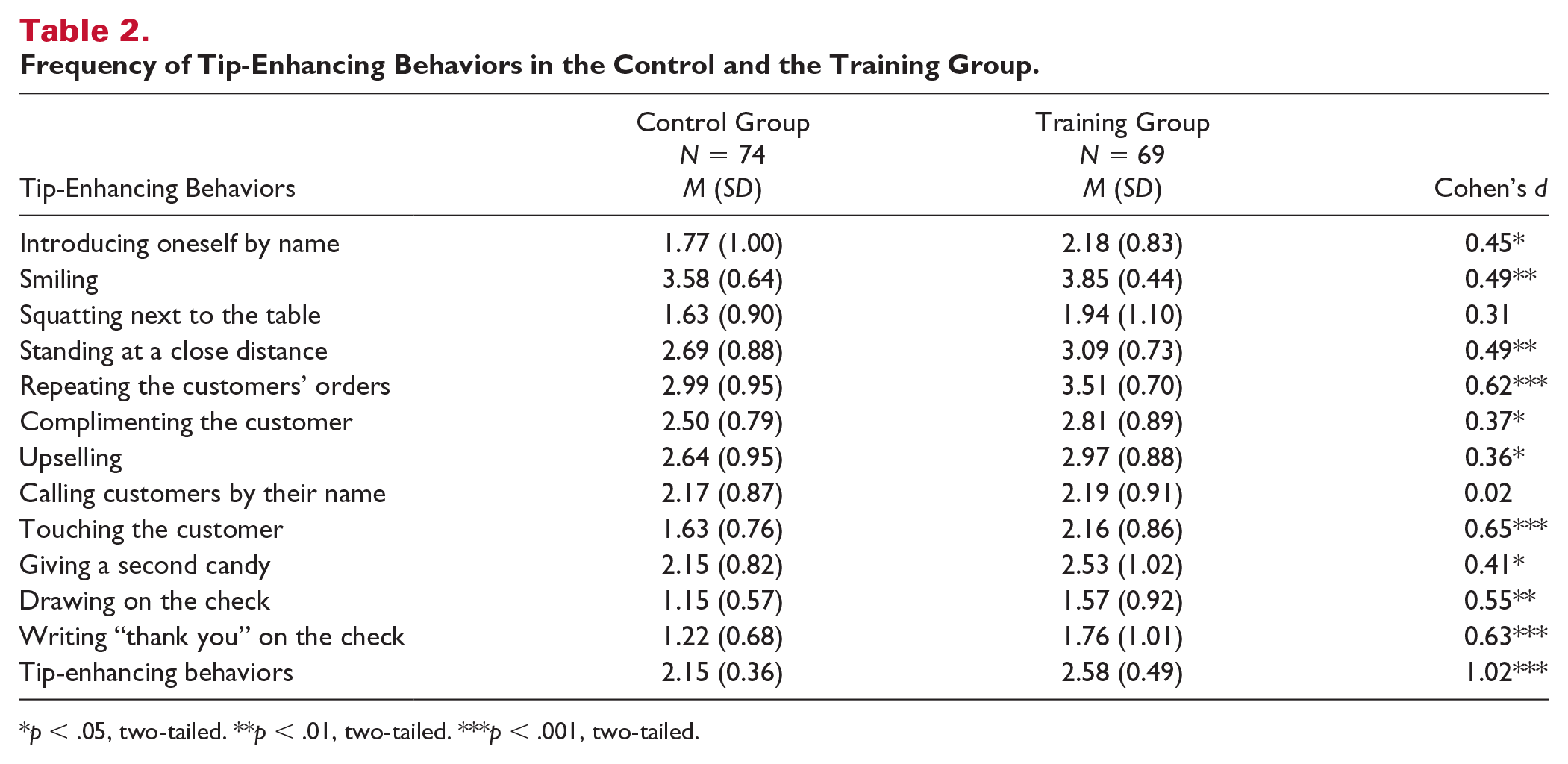
p < .05, two-tailed. **p < .01, two-tailed. ***p < .001, two-tailed.
In the next section, we tested if the training intervention had a positive impact on the amount of tip due to their higher use of tip-enhancing behaviors. In other words, the intervention could be effective for other reasons such as motivation or placebo. Therefore, the effect of the intervention should be partially or fully mediated by the use of tip-enhancing behaviors. Since we had multiple measurements regarding the amount of tip for each participant and some participants worked in the same restaurant, we used a three-level random intercept mediation model with measurement occasions nested in individuals and individuals nested in restaurants.
Because the amount of tip and experience were highly skewed, these two variables were Ln(x + 1) transformed. Non-dichotomous predictors were grand-mean centered. Analyses were performed using the Mplus statistical package (version 8.0) with Bayesian Markov Chain Monte Carlo (MCMC) estimation with the Gibbs sampler methods. Three chains with 50,000 iterations and with different starting values and random seeds were used. Convergence was assessed with the Proportional Scale Reduction (PSR) criteria, and the first half of the chains was discarded as a burn-in phase (Gelman & Rubin, 1992). We started by estimating a null model to compute the intraclass coefficient correlations (ICCs). ICCs for Restaurant Employee and Restaurant were 0.66 and 0.17, respectively, indicating that a multilevel model is appropriate and prevents from having biased standard errors and p-values (e.g., Musca et al., 2011). The next step was to add the mediation model at level 2. As shown in Figure 1, the training intervention was linked to increased use of tip-enhancing behaviors (which confirms in a multilevel approach our Hypothesis 1) and tip-enhancing behaviors were linked to an increased amount of tips (in line with Hypothesis 2). There was a significant indirect effect between the training intervention and the amount of tips while the direct effect was not significant, indicating total mediation and giving support to our third hypothesis that employees in the training group earned more tips than employees in the control group because they used more tip-enhancing strategies than the latter. The level 2 R2 was .09.
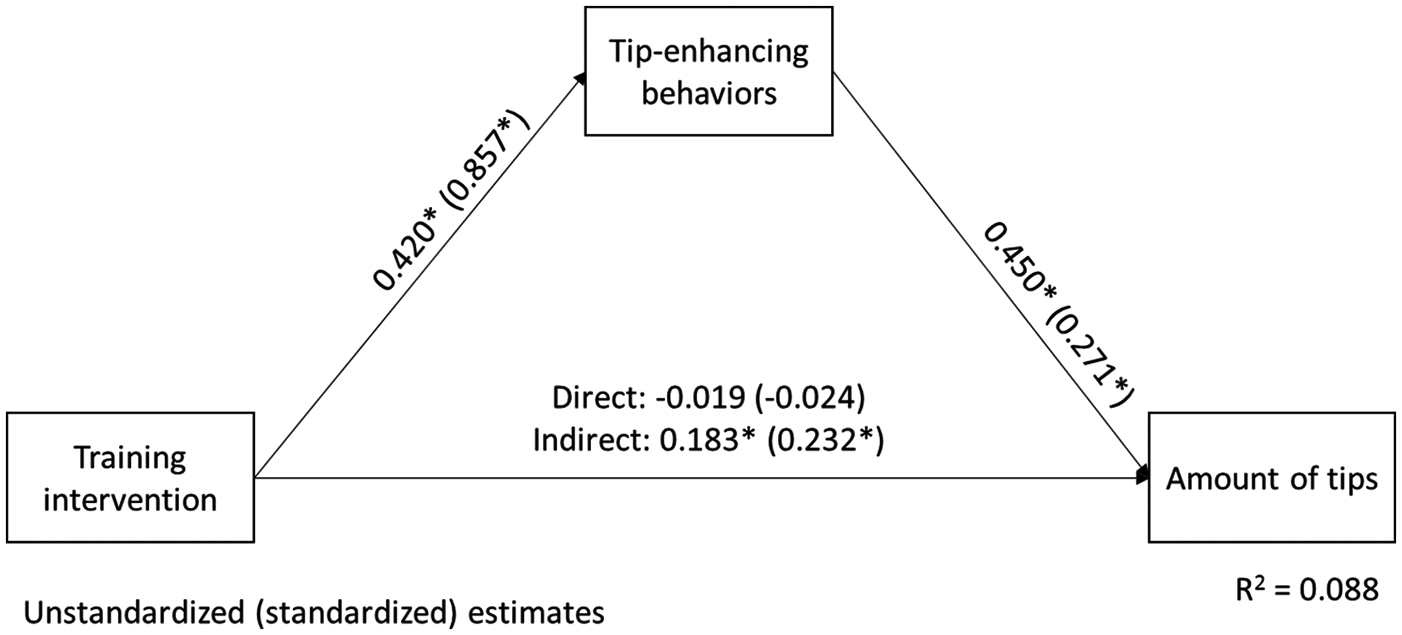
Mediation Analysis Between the Training Intervention and the Amount of Tips by the Use of Tip-Enhancing Behaviors.
The next step was to add level 1 predictors to this model to explore variables linked to the amount of tips received by the participants in our study. First, busyness was linked positively (B = 0.226, SE = 0.016, p < .01; β = .485) to the amount of tips. It means that employees received a larger amount of tips on days when they were busy. In other words, the more customers there are in the restaurant, the more opportunities restaurant employees had to receive tips. Results also showed that participants received more tips on average when they worked during the noon shift (B = 0.146, SE = 0.051, p < .01; β = .314) and during the evening shift (B = 0.326, SE = 0.053, p < .01; β = .701). The level 1 R2 was .47.
The next step was to evaluate level 2 predictors. Female restaurant employees received more tips than their male counterparts did (B = 0.268, SE = 0.099, p < .01; β = 0.345). The amount of tips was also positively related to the experience of the participants (B = 0.233, SE = 0.054, p < .001; β = 0.289). Participants who had more experience in the hospitality industry received more tips on average. The baseline tip was also significantly related to the amount of tips (B = 0.550, SE = 0.051, p < .001; β = 0.706). It means that restaurant employees who got high tips before the study also received in average higher tips in this study. The level 2 R2 was 0.64. Then, we added level 3 predictors in our model (restaurant-level), but neither meal price nor tip-pooling system was linked to the amount of tip received.
Discussion
The aim of this study was to evaluate the effectiveness of a training intervention on the daily amount of tips earned by restaurant employees. As hypothesized, the training intervention was successful at enhancing the use of tip-enhancing behaviors. Tip-enhancing behaviors were also effective in increasing restaurant employees’ daily tips. These findings reinforce our confidence that tip-enhancing behaviors have a causal relationship on the amount of tips given by the customers to the restaurant employees. So far, this relationship had been demonstrated only in a few restaurants or through correlational research.
This study is also the first one to demonstrate that it is possible and effective to train restaurant employees in the use of tip-enhancing behaviors. Even though research has generally shown that companies that train their employees see an improvement in employee performance (Arthur et al., 2003), it has also been proven to be difficult, sometimes, to change habits in others (Lamb, 2016). Until present, there had only been anecdotal evidence that the adoption of new tip-enhancing techniques leads to an increase in the amount of tips received (Lynn, 2011). We make this claim without considering the experimental studies that showed that randomly assigned guests who were touched, complimented, or smiled at for instance (experimental group) gave more tips than guests who did not receive this treatment (control group). Our study demonstrates that it is possible to successfully and quickly train employees and that the training has a positive and significant impact on the amount of tips earned.
Why has the training intervention been effective in our study? There are probably two factors related to the design of the training that can explain its success: (a) most participants received the training intervention in their work environment. Most studies have shown that acquiring a new skill in the environment in which this skill will be used will enhance the transfer of the competence (Godden & Baddeley, 1975), (b). The training comprised mainly discussions and roleplays with feedback and not lectures. Recent meta-analyses have shown that people retain better when they are actively involved in the training than when they are listening passively to a lecturer (Arthur et al., 2003).
It is interesting to observe that in our study the effect of the training intervention on the amount of tips was fully mediated by the use of tip-enhancing behaviors. One likely reason to explain the positive impact of the training intervention on the amount of tips is that by adopting more tip-enhancing behaviors, restaurant employees appeared more friendly (Lynn & Grassman, 1990). Other reasons could theoretically explain the relationship between the training intervention and the larger amount of tips. First, it is possible that the training intervention produced a kind of placebo effect among participants. As participants in this condition believed that they could be more effective in serving customers afterwards, it is possible that this belief had a positive impact on their behavior and on the customers. This phenomenon has been labeled as the Galatea effect in the scientific literature (McNatt & Judge, 2004). As the effect of the training intervention on the amount of tip was fully mediated by the use of tip-enhancing behaviors, this explanation is highly unlikely. To totally rule out this hypothesis, it would be necessary that future studies use an active control group in which participants follow a training which is not related to the use of tip-enhancing behaviors (Boot, Simons, Stothart, & Stutts, 2013). However, it would be of questionable practice to use this kind of active control group in restaurants as restaurant employees and managers have little time to devote to training and would not accept that their time is wasted with potentially ineffective methods. Second, another reason that could explain the positive effect of the tip-enhancing behaviors in the training group could result from increased efforts. It is possible that participants not only used more tip-enhancing behaviors but also decided to be more attentive and to inquire more often to the guests about their overall satisfaction with the meals for instance, which could result in better customer satisfaction. In support of this possibility, we would like to mention that participants’ pretraining self-efficacy and pretraining motivation are variables that positively influence training effectiveness, and the work environment plays an important role to enhance both (Tracey, Hinkin, Tannenbaum, & Mathieu, 2001). If employees have (a) supportive supervisors, (b) a work environment in which they can apply the techniques learned through training (job support), and (c) rewards for using these techniques (organizational support), they are more likely to be motivated and feel capable regarding the training intervention. Even if these variables were not tested in our study, we hypothesize that they contributed to some extent to the effectiveness of the training intervention. First, restaurant managers either allowed us to conduct the training in their restaurant or even participated, which increased probably participants’ perception of supervisor support. Second, apart from a few tip-enhancing behaviors (e.g., giving a second candy) that could not be used in all the restaurants (for economic or logistic issues), the participants had almost complete autonomy in the way they greeted and interacted with the guest. It means that they had the opportunity to use almost any of the tip-enhancing behaviors learned in training (which corresponds to the idea of job support). Finally, as the tip-enhancing behaviors that were taught were expected to have a direct influence on rewards (higher amounts of tips), there was organizational support for the use of tip-enhancing behaviors. At the same time, we must admit that restaurant employees in Switzerland earn decent salaries even without tips. It is then likely that not every participant was motivated to use tip-enhancing behaviors. In the United States, however, where restaurant employees depend much more on tips than in Switzerland, we would expect the training intervention to have an even bigger impact on the amount of tips.
A few limitations should be pointed out in this study. First, only self-reports were used to measure the frequency of the tip-enhancing behaviors and the amount of tip. As shown by previous scholars, an over-reliance on self-reports can lead to common-method biases, our measures were all based on self-reports, which may lead to different types of common-method bias (Podsakoff, MacKenzie, Lee, & Podsakoff, 2003). A second limitation is that the period of observation only comprised 5 days. There is no guarantee that the training intervention would have positive effects over longer periods of time. Future studies could be undertaken to see if positive results hold on longer periods.
Despite these limitations, this study shows that a brief training intervention has a positive impact on the amount of tips received by restaurant employees. It also extends previous findings that tip-enhancing behaviors are effective in the United States. We think it is important to emphasize this aspect, as most studies on the effectiveness of tip-enhancing behaviors have been conducted in the United States. In Switzerland (as in many European countries), the service is already included in the meal price. As a consequence, very few customers tip. Tips only represent 4% of the bill size in Switzerland (Fernandez, de Boer, & Terrier, 2016). By comparison, tips represent 15% of the bill size in the United States. Another difference between Switzerland and the United States is that in Switzerland all the restaurant employees receive a salary, which is not the case in the United States. It leads restaurant employees in Switzerland to be less proactive/aggressive in trying to earn high tips. Indeed, if we compare how often participants in the control group of our study use tip-enhancing behaviors in comparison to the sample in Lynn and McCall’s (2009) study, it can be said that Swiss restaurant employees tend to upsell less, are less likely to introduce themselves by their name and to write “thank you” on the check. As restaurant employees earn a decent salary in Switzerland, it is not sure that using tip-enhancing behaviors could be perceived appropriately by customers. Our results show the contrary because the training intervention had a positive impact on the amount of tips received by restaurant employees.
Our study has therefore important implications. Training employees in the use of tip-enhancing behaviors outside of the United States has beneficial effects for managers as well as employees because employees who receive higher tips are more likely to remain loyal to their employer (Lynn, 2002). Moreover, even if the relationship between customer satisfaction and the amount of tip is tenuous (Lynn, 2001), an increase in the amount of tips received could reflect a slight increase in customer satisfaction, which could mean better word-of-mouth and higher customer loyalty. This study can also help restaurant managers in the United States who consider abandoning tipping. It seems that many restaurateurs are thinking about replacing tipping-policies with a service-charge system or a service-inclusive pricing (Lynn, 2017; Lynn & Brewster, 2018), but unfortunately, this change from a tipping policy to a nontipping system comes with a cost, which is that customers tend to be less satisfied after this change than before (Lynn & Brewster, 2018). If the adoption of service charges and service-inclusive pricing diminish the motivation of restaurant employees to deliver personalized service to the guest (which could be one of the explanations for the diminished customer satisfaction), restaurant managers could start training their employees on the use of tip-enhancing behaviors as we did in this study.
Footnotes
Declaration of Conflicting Interests
The author(s) declared no potential conflicts of interest with respect to the research, authorship or publication of this article.
Funding
The author(s) disclosed receipt of the following financial support for the research, authorship, or publication of this article: This work was supported by HES-SO University of Applied Sciences and Arts Western Switzerland (N° SAGE-X: 45285).
