







Abstract
Organizational resilience (OR) has increasingly been recognized as a critical capability for firms, particularly in hospitality and tourism (H&T). Despite its relevance, empirical and quantitative research on hotel OR remains scarce. This study develops and validates a comprehensive framework of hotel OR through a dynamic capabilities (DCs) lens. Using a survey of hotels across three continents and analyzing the data using PLS-SEM, the framework is empirically tested and confirmed. The results define OR as composed of five interdependent DCs: (a) anticipation, (b) recombination, (c) responsiveness, (d) knowledge and decision-making, and (e) networking. The framework extends existing knowledge by offering a holistic, empirically validated model and translating findings into a practical managerial dashboard that enhances managers’ understanding of OR, supports benchmarking across hotels, and enables proactive strategies and rapid decision-making.
Introduction
Organizational resilience (OR) refers to an organization’s ability to anticipate, absorb, adapt, and recover from external shocks while maintaining its competitiveness and core functions (Madni & Jackson, 2009). In recent years, OR has become a critical construct for the survival and success of organizations (Annarelli & Nonino, 2016; Baba et al., 2020; Bec et al., 2016), particularly in the dynamic and volatile hospitality and tourism (H&T) environment (Filimonau et al., 2020; Jiang et al., 2021; Wieczorek-Kosmala, 2022; Xu et al., 2024) characterized by multiple risks (e.g., natural disasters and pandemics) that call for a proactive approach toward developing and maintaining OR (Coles et al., 2021; Núñez-Ríos et al., 2022). Hotels that lack resilience are often forced to adopt reactive strategies, whereas resilient hotels can prepare in advance, adapt quickly, and maintain operations in turbulent contexts. For example, as shown by Prayag et al. (2020), hotels in New Zealand affected by the Canterbury earthquakes leveraged adaptive cultures and collaborative networks to continue serving customers. Likewise, during the COVID-19 pandemic, several international hotel chains recombined digital platforms and global supply networks to sustain service delivery (Woo et al., 2024).
Despite academics and practitioners showing a high interest in resilience (e.g., Brown et al., 2021; Filimonau & De Coteau, 2020; UNWTO, 2020; World Bank, 2020), the concept is usually addressed mainly by providing conceptual (e.g., Ho et al., 2023) and qualitative investigations (e.g., Jiang et al., 2021). OR has been addressed only sparingly at the hotel level, although significant exceptions exist (e.g., Brown et al., 2018). Most empirical insights emerged reactively during crises such as COVID-19 (Hussain & Malik, 2022; Khan et al., 2021). Interestingly, it has been recognized that hotels’ capabilities—including OR—need to be dynamic, that is, continuously reshaped based on data and information from the internal environment and relationships with the external environment (Hussain & Malik, 2022; Prayag et al., 2024).
Asadzadeh et al. (2017) and Rahi (2019) emphasized that the resilience literature needs to move from conceptual debate to empirical research. Dynamic capabilities (DCs) theory provides a valuable lens for addressing this gap by highlighting how organizations sense opportunities, reconfigure resources, and respond to environmental turbulence (Teece, 2007). For hotels, this capability to integrate internal processes with external networks is critical to resilience (Eisenhardt & Martin, 2000; Jiang et al., 2019; Prayag et al., 2024).
This study adopts a quantitative approach to develop a hotel OR framework, using DCs theory as the primary lens (Augier & Teece, 2009; Jiang et al., 2019; Paton et al., 2000). We develop an empirical survey by integrating previous scales from the literature, refining them through expert consultation (both academics and practitioners), and conducting a pilot study. The resulting questionnaire was administered to 86 hotels across three continents, and the data were analyzed using PLS-SEM.
Results suggest that hotel OR can be defined as composed of five interdependent DCs: (a) anticipation, (b) recombination, (c) responsiveness, (d) knowledge and decision-making (KDM), and (e) networking. These results contribute to extending current knowledge in the OR field in H&T by offering a multidimensional and multilevel framework, as advocated by the recent literature on the topic (e.g., Jiang et al., 2019; Orchiston et al., 2016; Rahi, 2019). We also provide a valuable tool for hotel managers in the form of a dashboard that allows them to identify OR success areas or areas in need of improvement, enabling proactive management strategies and quick decision-making.
Theoretical Background
OR in H&T
The OR concept has found broad interest concerning both destination and tourist organizations. Destination resilience has been conceptualized as a multilevel construct involving interdependent stakeholder networks (Amore et al., 2018; Calgaro et al., 2014; Espiner & Becken, 2014). At the organizational level, instead, studies have examined how businesses build resilience through human resource practices (Ngoc Su et al., 2021), internal communications (Sharples et al., 2023), and financial adaptation (Wieczorek-Kosmala, 2022). Quantitatively speaking, it is worth mentioning the work of Melián-Alzola et al. (2020), which analyzed the predictors of resilience and how they contribute to Canary Islands hotels’ resilience and performance—as well as those by Prayag et al. (2020) and Pathak and Joshi (2021), in which the resilience is measured together with psychological resilience of tourism business owners and managers. Within the hospitality industry, OR encompasses not only reactive strategies but also proactive measures that allow hotels to sense environmental changes, recombine existing resources, and respond effectively to disruptions (Battisti & Deakins, 2017). Hotel resilience extends beyond internal capabilities and requires collaboration with external stakeholders, knowledge-sharing mechanisms, and an adaptive organizational culture (Brown et al., 2021). For hotels, OR can be considered as a portfolio of capabilities—such as anticipate risks, recombine internal and external resources, respond through adaptive cultures, and leverage stakeholder networks—which must be translated into concrete managerial practices, like scenario planning, proactive scanning, problem-solving, learning processes, and stakeholder collaboration (Battisti & Deakins, 2017; Brown et al., 2021).
To summarize, OR is a multidimensional (i.e., multiple capabilities interacting with each other) and multilevel (i.e., intra- and interfirm level) capability through which an organization (i.e., hotel in our case) may dynamically reinvent its business models and strategies by anticipating potential threats, coping effectively with the challenging conditions of the environment, and learning from these events (Duchek et al., 2020; Hall et al., 2017; Ruiz-Martin et al., 2018; Souza et al., 2017).
Researchers have begun developing conceptual models and applying various approaches to better understand how tourism organizations can develop and manage OR (Amore et al., 2018; Brown et al., 2017; Hall et al., 2017; Scuttari & Corradini, 2018). However, these models have not fully captured the multidimensionality and multilevel aspects of OR, as advocated by recent literature on the topic (e.g., Jiang et al., 2019; Orchiston et al., 2016; Rahi, 2019).
DCs Theory
Researchers have increasingly recognized the need for holistic frameworks capturing both intrafirm and interfirm dimensions of OR (Hall et al., 2017; Jiang et al., 2019), which is considered as “a dynamic condition describing the capacity of a hotel, together with its stakeholders, to assess, innovate, adapt, and overcome possible disruptions that are triggered by disaster” (Brown et al., 2017, p. 365). In this vein, DCs theory can be particularly relevant.
DCs are defined as “the firm’s ability to integrate, build, and reconfigure internal and external competencies” (Teece et al., 1997, p. 516) to address VUCA (volatile, uncertain, complex, and ambiguous) environments (Schwarz et al., 2020). DCs play a crucial role in enabling companies to achieve competitive advantage and higher performance by identifying opportunities and formulating appropriate responses through suitable actions (Eisenhardt & Martin, 2000; Helfat et al., 2009; Souza et al., 2017; Teece, 2007). DCs provide a helpful lens for better understanding resilience, its components, and how these latter interact (Parker & Ameen, 2018; Şengül et al., 2019; Van der Vegt et al., 2015).
Earlier studies adopting the DCs lens consider resilience as the capability to sense weak signals (i.e., anticipation) and to continuously adjust to turbulences (i.e., responsiveness) (Hamel & Välikangas, 2003; Su & Linderman, 2016; Weick & Sutcliffe, 2011). Battisti and Deakins (2017) introduced the proactive posture and the capability to integrate external resources as crucial DCs for resilience. A proactive posture determines the organization’s “strategic and behavioural readiness to respond to early warning signals of change in the organization’s internal and external environment before they escalate into crisis” (Lee et al., 2013, p. 34). In contrast, resource integration capability enables an organization to respond effectively to and recover from a crisis via its external networks, thereby exploring new resources and opportunities (Jiang et al., 2019; Lee et al., 2013; Makkonen et al., 2014; Şengül et al., 2019).
Other studies highlighted the importance of resource recombination capabilities as crucial for organizations to appropriately respond to external shocks/disruptions (Akpan et al., 2021; Ambulkar et al., 2015; Kurtz & Varvakis, 2016; Parker & Ameen, 2018). In this vein, Şengül et al. (2019) count among the crucial DCs for resilience: (a) adaptive culture, which may enable quick implementation of new business models (Aldunce et al., 2014), and (b) organizational learning and decision-making, which allow organizations to learn from past experiences and apply this learning to future events, thus making (potentially) better decisions (Jiang et al., 2019; Madni & Jackson, 2009).
Although previous studies have identified many DCs for OR, a holistic OR framework for hotels and a corresponding measurement scale remain lacking (Ho et al., 2023). Filling these gaps constitutes the founding objective of this investigation.
Method
This study aims to quantitatively investigate OR in the hotel context. Given the lack of an OR scale specifically designed for hotels, this study utilized a mixed-methods approach (deductive and inductive) to develop the item pool (Leoni et al., 2022). A comprehensive literature review on OR in general (e.g., Duchek et al., 2020; Hepfer & Lawrence, 2022; Limnios et al., 2014), OR in H&T contexts (e.g., Calgaro et al., 2014; Ntounis et al., 2021; Senbeto & Hon, 2020), and OR according to DCs theory was undertaken (e.g., Akpan et al., 2021; Battisti & Deakins, 2017; Şengül et al., 2019; Su & Linderman, 2016). An initial list of items potentially related to OR was deductively compiled. The content validity of the scales is based on the literature review (as suggested by Melián-Alzola et al., 2020). The different items and related subconstructs presented in previous scales were systematized to identify similarities and differences (Leoni et al., 2022). After this integration, an inductive approach was implemented through in-depth interviews with experts to ensure the content validity of the items generated from the review process (DeVellis & Thorpe, 2021). This study used semistructured interviews (Table 1) with eight experts: a university professor with more than 20 years of experience in tourism research, two professionals from the Hotel Resilient organization, 1 and four hotel managers with more than 10 years of experience. Experts reviewed the initial measurement scales using the Likert-type 5-level scoring method (5 “very important,” 4 “important,” 3 “general,” 2 “unimportant,” and 1 “very unimportant”), plus a column titled “Suggestions” where experts had the opportunity to provide specific feedback for each item. The initial survey was revised as follows: some questions were reformulated for clarity, some words were changed to reduce misinterpretations, and some questions were better tailored to the specificities of the hotel industry.
Semistructured Interview Outline.
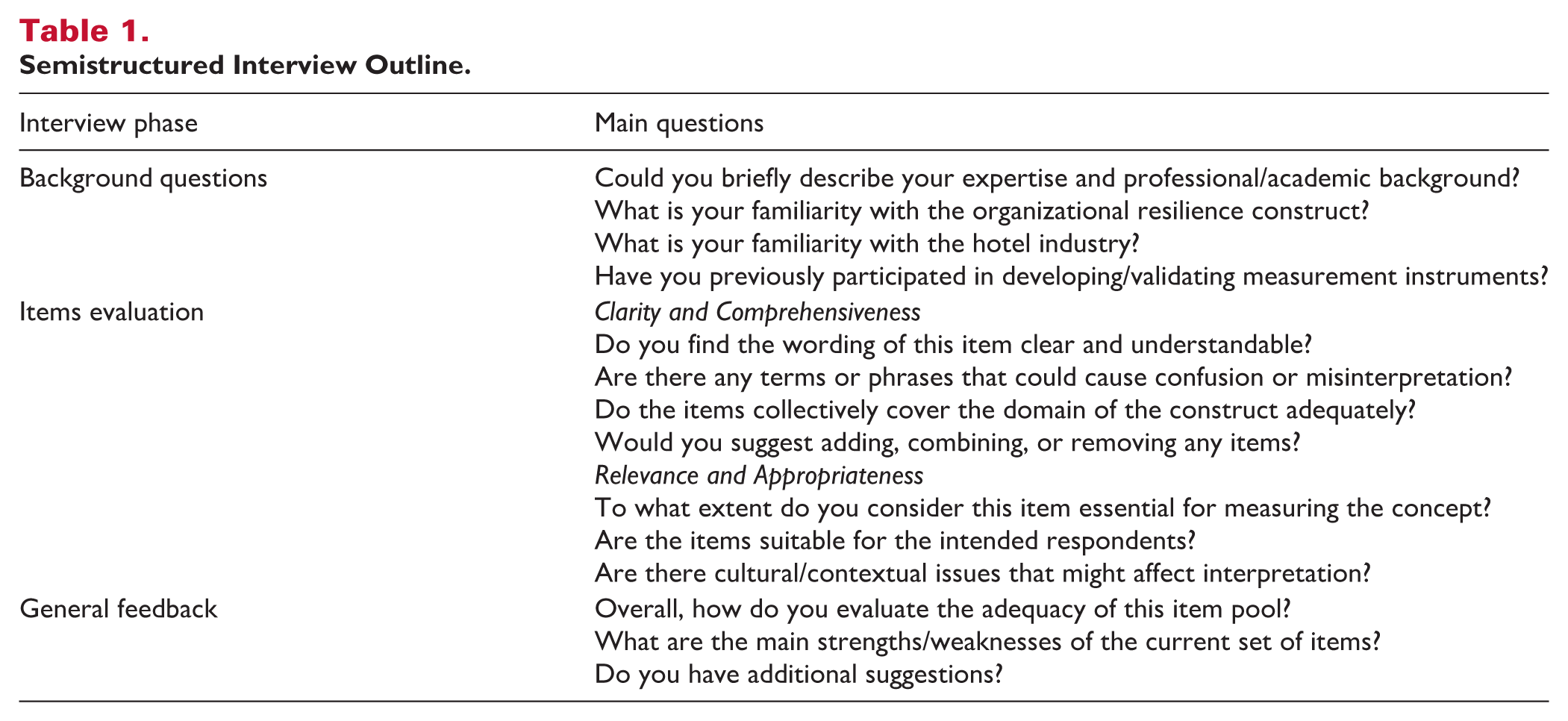
The reliability and construct validity of the items were evaluated through pretesting (Lee & Jan, 2019). To do so, the study engaged three managers and eight Strategic Board members of a prominent large hotel group in a focus group discussion session. During this session, they were invited to share their perceptions of the various items according to the different elements reported in the section “Items evaluation” of Table 1. Based on their feedback, some grammar, word choice, and answer options were modified.
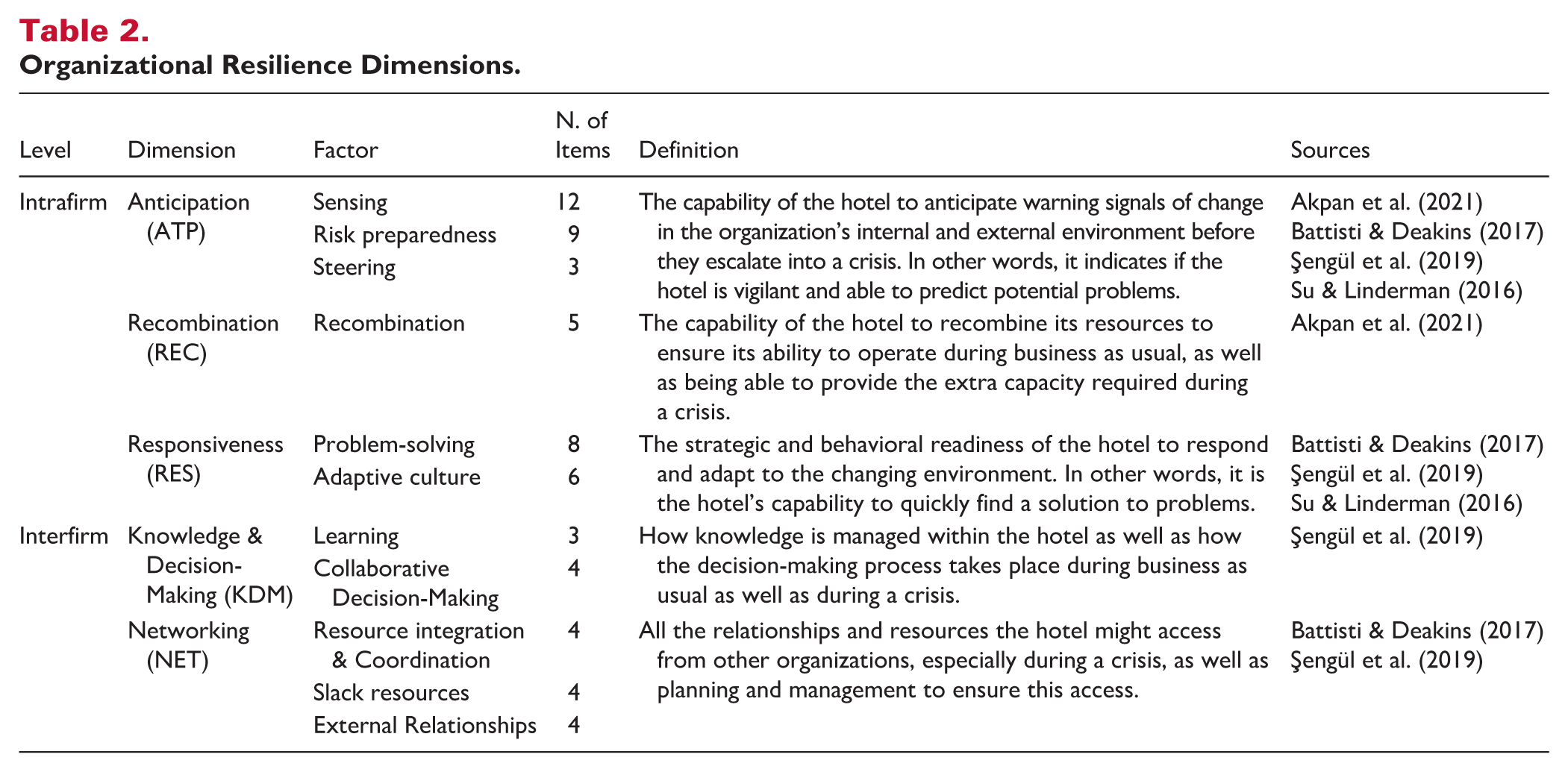
OR was measured through 10 factors grouped into five dimensions (Table 2): (a) anticipation (ANT), (b) recombination (REC), (c) responsiveness (RES), (d) KDM, and (e) networking (NET).
Organizational Resilience Dimensions.
The resulting questionnaire was administered between March 2024 and December 2024. Hotels received the questionnaire by email, accompanied by a cover letter indicating the purpose of the study and potential contributions, ensuring complete confidentiality for the respondents. Given our research objectives, the best survey respondents were employees with an overall view of the organization and high-profile roles (e.g., hotel managers/directors).
The following strategies to increase the response rate were applied: (a) Hotels were contacted by telephone to obtain their consent to participate in the investigation; (b) A reminder email was sent 3 weeks, 2 months, and 6 months after sending the questionnaire; (c) Hotels were contacted again by telephone after each remainder to encourage completion of the questionnaires as well as to clarify any questions related to the research; and (d) A summary of the study findings was promised to respondents.
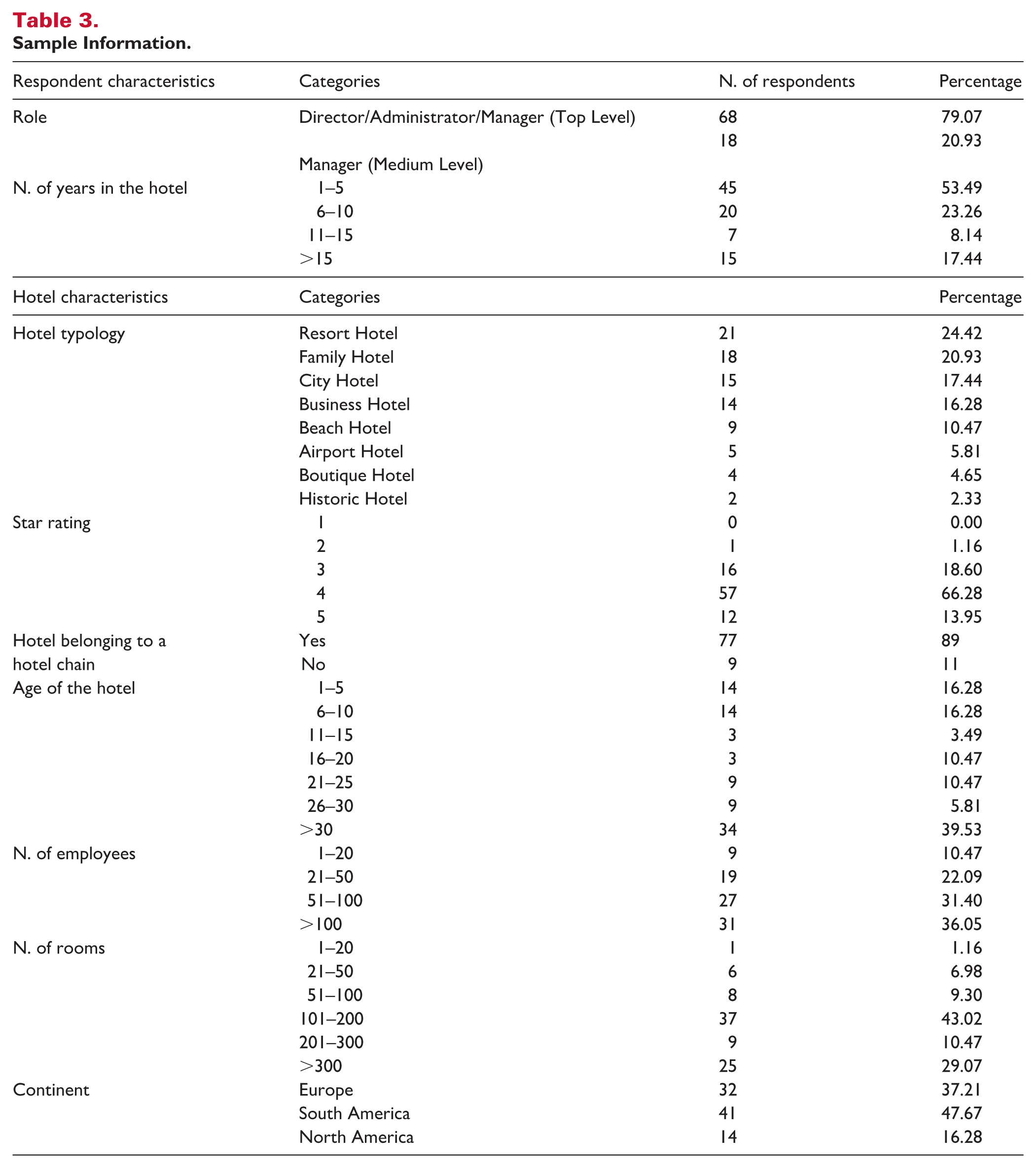
In total, 347 hotels were contacted, 92 agreed to participate in the investigation, and 86 usable questionnaires were returned, with an overall response rate of 21.03%. Both sample size and response rate are common for studies conducted at the organizational level and in the hospitality sector (Chowdhury et al., 2019; Melián-Alzola et al., 2020). Managers can be considered hard-to-reach respondents because they: (a) have little time to devote to academic studies, especially when there is no direct and immediate benefit; (b) are reluctant to share sensitive information, especially regarding hotel strategies; and (c) are not easily reachable through traditional channels, such as emails (Anseel et al., 2010). Practical constraints (e.g., budget, time, resources) can also affect sample size (Bartlett et al., 2001). Despite this, a heterogeneous sample (i.e., respondents from three continents and across different hotel types) has been obtained, providing perceptions from managers with diverse experiences across contexts, thereby yielding more representative and robust results for the phenomenon under study.
Table 3 shows the respondents’ general profile and the main characteristics of the hotels investigated.
Sample Information.
Based on the sample size and model complexity, PLS-SEM was used (Guenther et al., 2023). To assess sample adequacy in PLS-SEM, the most common recommendation is to evaluate it using the construct with the highest number of incoming structural paths, known as the most complex endogenous construct (Hair et al., 2021). In this study, the construct Recombination is predicted by three latent variables: Steering, Slack Resources, and Collaborative Decision-Making. To assess the adequacy of our sample (n = 86), we relied on two established criteria in the literature:
a. We conducted a power analysis based on Cohen’s (1988) approach for multiple regression. Given the observed R2 of .57 and three predictors, the corresponding effect size (f2 = 1.33) can be classified as very large according to Cohen’s benchmarks. For an effect of this magnitude, the minimum sample required to achieve 80% statistical power at a 5% significance level would be approximately 12 observations.
b. Based on the 10-times rule (Hair et al., 2021), which suggests a minimum of 10 observations per predictor, a sample size of 30 would be required (10 × 3). Given that our valid sample includes 86 observations, we exceed all recommended thresholds, providing support for the structural model and subsequent analysis grounded in theory.
Item reduction analysis was conducted to ensure that only functional and internally consistent items were included. Given the large number of items (i.e., 62), some multicollinearity is expected, which can be identified using the VIF indicator (see the Supplementary materials file for details). In this case, the authors adopted the PLS-SEM algorithm, identifying VIF levels higher than 6 through the outputs report and then, in an iterative process, removing one item at a time to improve model fit.
Latent-variable correlations were conducted to understand the internal structure of a set of items (i.e., factors in our case) and the extent to which the relationships among the items are internally consistent (McCoach et al., 2013). All latent items show positive correlations ranging from 0.288 to 0.899 across all 12 factors (see the Supplementary materials file for details).
The collected valid responses were analyzed using confirmatory factor analysis (CFA) to validate the questionnaire items and understand their contributions to the identified dimensions. The CFA shows promising results (see Supplementary materials) in terms of Cronbach’s alpha (ranging from 0.806 to 0.929), composite reliability (ranging from 0.811 to 0.953), and average variance extracted (ranging from 0.615 to 0.826) for all 12 factors, suggesting good internal consistency and convergent validity. Discriminant validity was assessed using the Fornell–Larcker criterion and the heterotrait–monotrait ratio, indicating acceptable levels for all the factors (see Supplementary materials).
After confirming the questionnaire items’ reliability, the PLS-SEM algorithm was used to examine the relationships among the constructs. The primary benefit of using PLS-SEM is that results are not affected by a small sample size, and, in general, the technique yields similar results for both large and small samples (Hair et al., 2021). SmartPLS 4.0.6.9 has been used to analyze primary data (Ringle et al., 2022). The initial Pearson correlation analysis shows positive correlations among the variables, with weaker correlations among specific NET variables. The correlations are statistically significant. The Shapiro–Wilk test for multivariate normality supports the analysis (p < .001). Moreover, we adopted the SmartPLS bootstrapping procedure (n = 5.000 resamples) to estimate the model, providing two outputs: Patch coefficient (see Table 3), with the P values, which were all statistically significant, and the PLS-SEM (Figure 1), which reports the loadings on factors and betas between factors. The bootstrapping procedure ensured the reliability and robustness of our parameter estimates. The literature provides strong support for employing PLS-SEM with bootstrapping for complex models where predictive accuracy is paramount with limited sample sizes, as it generates empirical estimates by resampling the dataset with replacement, that is, by providing valid inferences without relying on parametric assumptions (Hair et al., 2021; Henseler et al., 2009; Streukens & Leroi-Werelds, 2016).
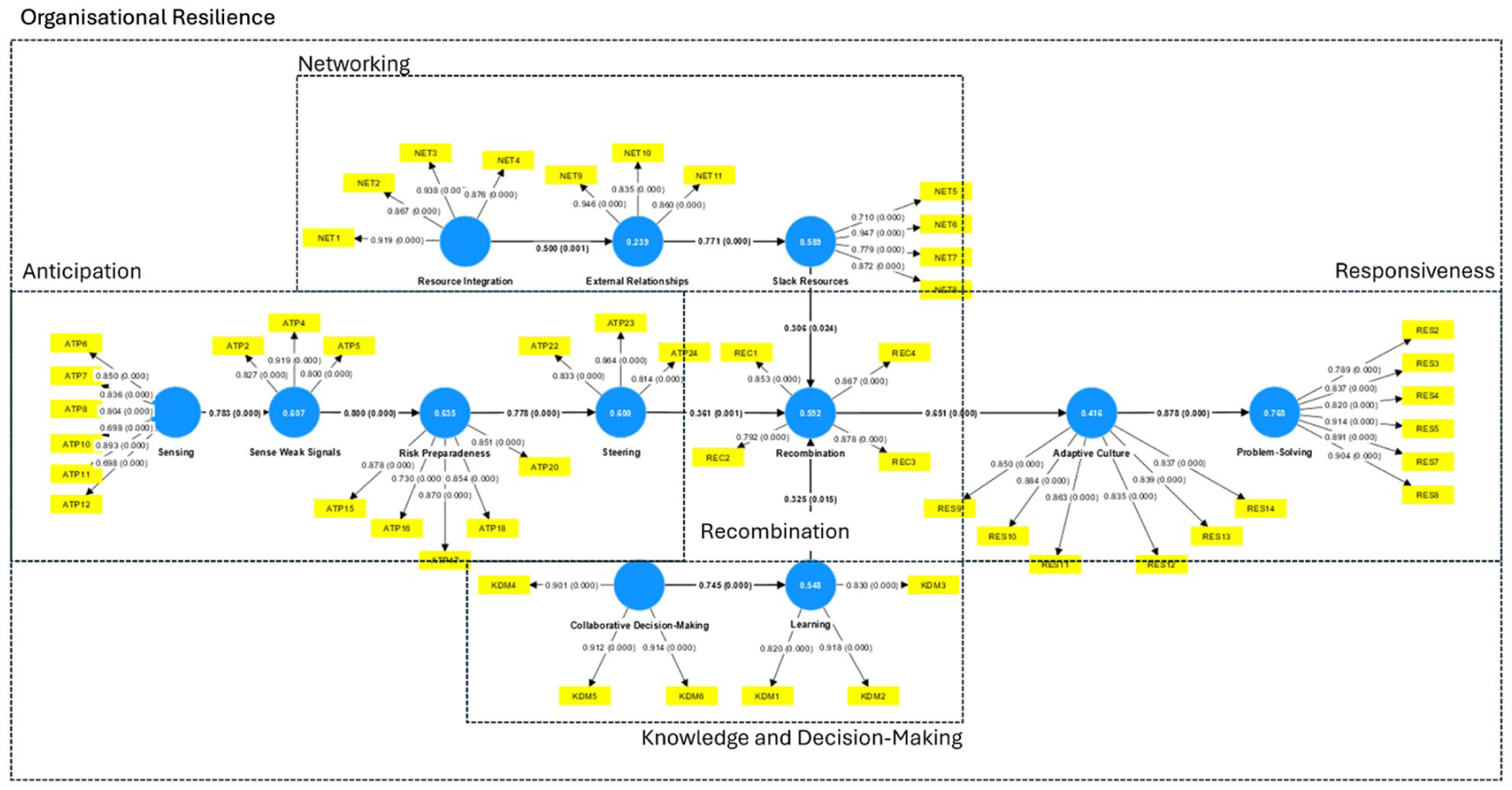
Results of PLS-SEM.
Considering the CFA, these outputs support the formation of the 12 factors and their relationships within the context of the five dimensions. Figure 1 shows the final model.
Given the novelty of the proposed model, additional consistency and supplementary statistical analyses were conducted to provide further validation and structural insight. First, an additional PLS-SEM analysis was estimated, including only intrafirm constructs. Although all structural paths remained statistically significant, the model’s explanatory power decreased (R2 declining from 0.570 to 0.406), indicating that the exclusion of external networking and collaborative decision-making substantially reduces the model’s ability to explain recombination capabilities. These results highlight the critical role of access to external stakeholders and collaborative decision-making processes in strengthening OR, particularly under crisis conditions. A hotel in crisis mode has a crucial need to access external stakeholders to share resources and solve problems; supporting and being supported is critical.
Based on the validated measurement structure and using JASP 0.18.3, a K-means clustering analysis was conducted to identify three OR clusters (low, medium, and high) using the factor and dimension structure derived from the PLS-SEM model. Cluster classification relied on the mean scores of the indicators associated with each of the 12 factors across the five OR dimensions (ATP, REC, RES, NET, and KDM). To examine whether the identified clusters differed significantly across the OR dimensions, the cluster solution was submitted to MANOVA followed by ANOVA analyses (see Supplementary materials for details). These analyses were conducted to characterize and compare the profiles of the identified clusters across the OR dimensions and are therefore intended to describe cluster differentiation rather than to serve as an independent validation of the clustering solution, given that the cluster classification was derived from the same set of OR dimension scores. The results consistently supported the proposed multidimensional structure, confirming that OR is appropriately represented by the five dimensions, 12 factors, and their corresponding indicators within the heterogeneous sample analyzed.
Hotel OR Framework
This research has addressed a significant gap in the H&T literature by quantitatively assessing OR in the hotel industry. It is worth noting that the constructs investigated in the study are related to one another both empirically and theoretically, as explained below. This allows us to create an explanatory OR framework in the hotel context (Figure 2).
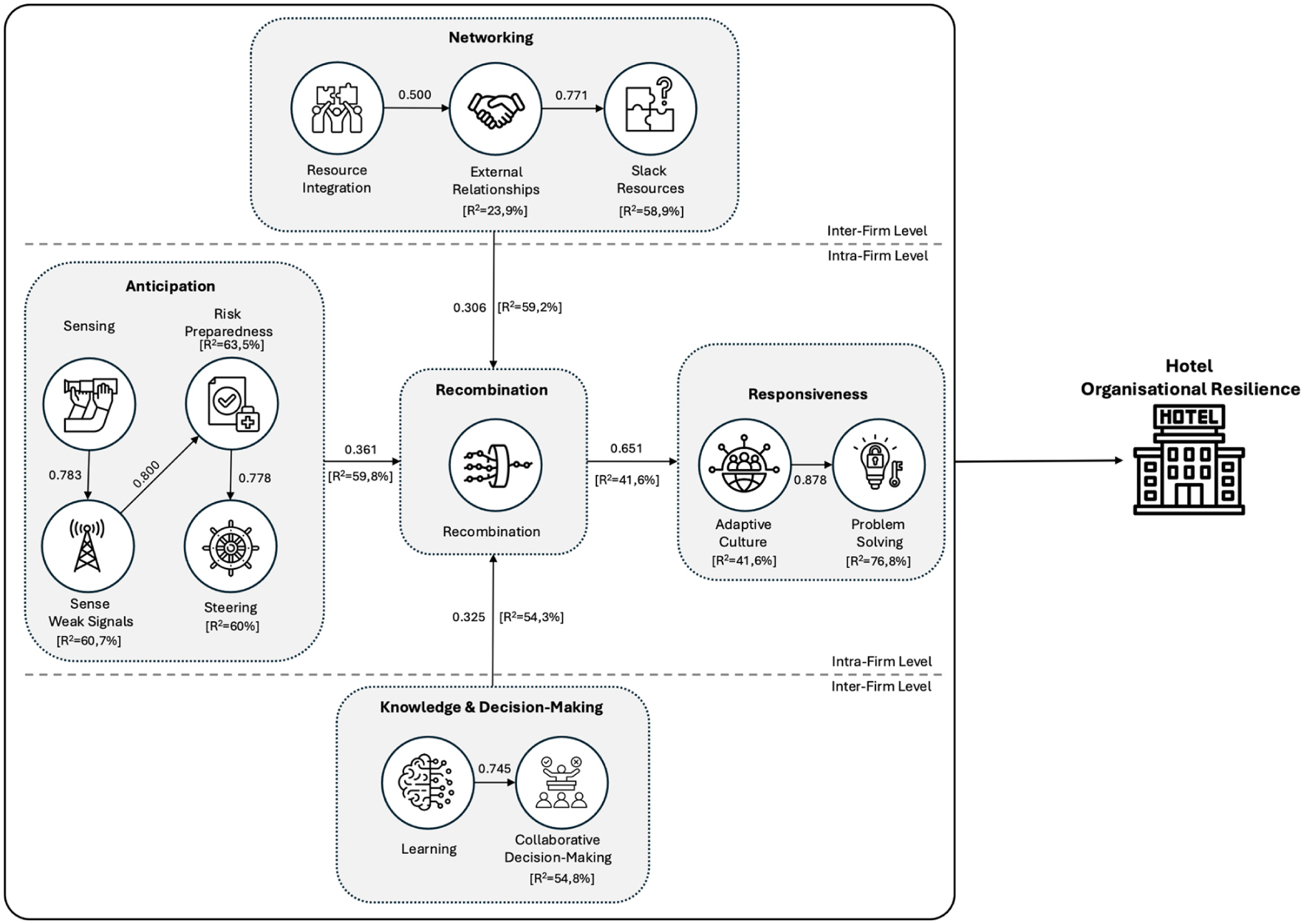
Hotel Organizational Resilience: A Dynamic Capabilities Multilevel Framework.
The proposed framework conceptualizes hotel OR as composed of five interdependent DCs: anticipation, recombination, KDM, networking, and responsiveness. These dimensions operate across intra- and interfirm levels and collectively shape an organization’s ability to sense, adapt, and transform in the face of environmental disruptions, as described in detail below.
Responsiveness describes the strategic and behavioral promptness of hotels in responding to and adapting to a changing environment, quickly finding solutions to problems (Battisti & Deakins, 2017; Şengül et al., 2019; Su & Linderman, 2016). For example, think about hotels—especially in destinations affected by extreme weather—with predefined emergency protocols (e.g., power-outage contingencies, guest-relocation agreements) that can restore operations more quickly, thereby minimizing damage. In our framework, Responsiveness comprises two factors: Problem Solving and Adaptive Culture. The OR preceding factors jointly explain 76.8% of the variance in Problem Solving, while the predictors of Adaptive Culture explain 41.6% of its variance. These findings reveal a positive effect of 0.878 (p < .000) of Adaptive Culture on Problem Solving. In other words, increasing the level of adaptive culture within hotels can enhance their problem-solving capabilities, thereby bolstering OR (Madi Odeh et al., 2023). Problem Solving involves a firm commitment from managers and staff, clear responsibilities, and effective communication during crises (Akpan et al., 2021), while Adaptive Culture emphasizes a sense of responsibility and ownership when challenges arise, necessitating agile adaptation.
At the same time, Responsiveness depends on how resources are recombined to address environmental change (Koronis & Ponis, 2018). In fact, Recombination describes an organization’s ability to recombine its resources to ensure it can operate during business-as-usual and provide the extra capacity required during a crisis (Akpan et al., 2021). For example, during the pandemic, many hotels repurposed underutilized conference spaces into co-working hubs, thereby attracting residents and digital nomads. Recombination is explained by 59.8% of the variance attributed to three previous dimensions: Anticipation, Knowledge & Decision-Making, and Networking. The analysis revealed a positive effect of 0.651 (p < .000) of Recombination on Adaptive Culture, signifying that Recombination can foster an adaptive culture within hotels, enabling them to properly recombine their resource bases (Akpan et al., 2021; Koronis & Ponis, 2018). This, in turn, enhances readiness for Problem Solving, thereby contributing to greater OR. However, to appropriately reconfigure resources, organizations need to create conditions that enable successful resource recombination. According to the provided model and in line with the literature on resilience and DCs, Recombination depends on the organization’s anticipation capability, as well as on KDM and networking capabilities, which enable organizations to access knowledge and resources more easily.
The Anticipation dimension describes the hotel’s ability to anticipate warning signs of change in the organization’s internal and external environment before they escalate into a crisis. For example, several hotels developed monitoring routines during the COVID-19 pandemic by tracking government regulations and travel advisories, allowing them to adjust booking policies ahead of local competitors. Anticipation indicates whether the organization is vigilant and able to predict potential problems (Ansoff, 1975; Schoemaker et al., 2018). Four factors were considered: Sensing, Sense Weak Signals, Risk Preparedness, and Steering. The Sensing capacity of the organization positively affects the ability to Sense Weak Signals, with a significant effect of 0.763 (p < .000). This, in turn, positively impacts Risk Preparedness (0.800; p < .000), indicating that the ability to perceive subtle environmental changes builds preparedness. Risk Preparedness significantly influences Steering, with a positive effect of 0.778 (p < .000). This means that preparation through planning enables better coordination and flexibility during disruptions. Altogether, Steering is explained by previous factors, 60% of the variance; Risk Preparedness by 63.5%; and Sense Weak Signals by 60.7%. This chain shows that Anticipation starts with sensing, develops through interpretation, and culminates in strategic preparedness and coordination (Duchek, 2020; Teece, 2018).
Concerning the KDM dimension, we observed how knowledge is managed within the hotel and how the decision-making process unfolds during a crisis (Barreto, 2010; Şengül et al., 2019; Teece, 2007). A notable example is the implementation of property management systems integrated with customer feedback analytics, which enable managers to detect service quality issues in real time and make data-driven decisions. Two factors were considered: Collaborative Decision-Making and Learning. Collaborative Decision-Making enhances Learning, with a positive effect of 0.745 (p < .000), indicating that decisions made through a shared, inclusive process promote learning. This, in turn, affects Recombination through a positive effect of 0.325 (p < .015). Learning, therefore, contributes significantly to the organization’s capacity to adapt and recombine resources in times of uncertainty.
Finally, the Networking dimension refers to all the relationships and resources the hotel might need to access from other organizations during a crisis, as well as the planning and management to ensure access to them (Battisti & Deakins, 2017; Şengül et al., 2019). For example, hotels embedded in strong destination networks could access subsidies more quickly during the crisis, while hotels in rural areas often leveraged community partnerships, such as collaborating with local farms to secure food supplies when global supply chains were disrupted. Thus, Networking influences Recombination primarily through Slack Resources, which are affected by External Relationships (0.771; p < .000) and, in turn, are affected by Resource Integration (0.500; p < .001). Slack Resources then impact Recombination with a positive effect of 0.321 (p < .006). The preceding factors explain 59.2% of the variance in Recombination (R2 = .592): building and maintaining external networks enables hotels to tap into a broader base of resources, including logistics, technology, personnel, and capital, which becomes vital in crisis response (Ivanov & Dolgui, 2020; Woo et al., 2024).
These findings reinforce recent calls (e.g., Hall et al., 2017; Jiang et al., 2019; Ruiz-Martin et al., 2018) to conceptualize OR as a multilevel construct that considers both internal capabilities and external relations. The provided analysis confirms that hotel OR can be understood as a multilevel DC, providing strong empirical and theoretical insights into how hotels can enhance OR by integrating internal and external capabilities.
Conclusion
This study provides a multilevel framework, from a DCs lens, that explains how hotels interested in developing their OR must focus their attention and efforts on two main types of DCs and 12 specific factors at intra- and interorganizational levels. Concerning the former, we find that (a) Anticipation—which refers to the hotel's capability to anticipate the warning signals of changes in the internal and external environment of the organization before they degenerate into a crisis—facilitates (b) Recombination, understood as the capability to effectively transform available knowledge into something new and/or recombine existing internal resources and capabilities with external ones. At the same time, Recombination is positively influenced by (c) Networking—understood as the creation and maintenance of crucial contacts that allow hotels to effectively address unexpected challenges by expanding their organizational boundaries and swiftly access external resources, especially during crises—and (d) KDM, which refers to how internal and external knowledge is managed within the hotel as well as how the decision-making process takes place in combination with other also during a crisis. The so-conceived Recombination capability influences (e) Responsiveness, understood as the hotel’s capability to respond to and adapt to the changing environment by quickly finding solutions to problems. All these relationships strengthen the hotel’s OR, thereby enhancing its ability to adapt, recover, and thrive amid various challenges.
Based on the above, theoretical and managerial contributions can be identified, along with their limitations and future research avenues.
Theoretical Contributions
The present study contributes to the OR and H&T literature in several significant ways.
First, this study provides an OR framework of multilevel DCs that might be used to create more resilient tourism organizations, particularly hotels, supporting and advancing previous conceptual and qualitative studies (e.g., Coles et al., 2021; Ho et al., 2023) through empirical evidence (as advocated by Rahi, 2019), thus providing a solid foundation for further investigations and enriching the conceptualization and understanding of OR.
Second, this study responds to the calls by Orchiston et al. (2016) and Jiang et al. (2019) by providing a scale for measuring OR in hotels adopting a DCs lens, moving beyond mere conceptual debates to empirical evidence and measurement models. This study advances the OR literature by empirically validating a DCs-based resilience framework specific to the hospitality sector. Unlike previous studies that focus on conceptual models (e.g., Amore et al., 2018), this research provides a measurement scale that operationalizes OR as a multilevel construct. In addition, by conceptualizing OR through the DCs lens, this study stresses the importance of integrating, building, and recombining internal and external capabilities to enhance resilience in environments characterized by dynamism and volatility (Haarhaus & Liening, 2020). By doing so, this investigation improves understanding of how organizations—particularly hotels—can proactively anticipate, adapt to, and respond to disruptions and challenges (Garrido-Moreno et al., 2021; Melián-Alzola et al., 2020).
Third, this study defines OR as a multidimensional and multilevel DCs. By identifying five interconnected DCs (i.e., anticipation, recombination, responsiveness, KDM, and networking), the study highlights the complexity and interplay of various capabilities required for OR. This contributes to a nuanced understanding of the concept, emphasizing its multifaceted nature and the interdependencies among different DCs at intra- and interfirm levels, as already understood in other fields (e.g., Adobor, 2019; Ali et al., 2023). For clarity, Amore et al. (2018) have already attempted to conceptualize resilience from a multilevel perspective, but only at the destination level and without adopting the DCs lens. Our investigation complements and enriches Amore et al.’s (2018) study and the understanding of the OR concept. By integrating intra- and interfirm DCs, the study contributes to the broader discussion on how organizations codevelop resilience through strategic alliances and knowledge networks (Adobor, 2019).
Managerial Contributions
This study offers valuable insights and implications for hotel managers and practitioners.
By providing a comprehensive measurement scale to assess hotel OR levels, the study gives managers a practical tool to evaluate their OR capabilities. In this way, managers can make more informed decisions across organizational aspects (e.g., strategic planning, resource allocation, and crisis management), thereby enhancing the overall resilience of their hotels. The provided results are a valuable guide for hotel managers, helping them understand the multidimensional nature of OR and focus on the necessary DCs. All participating hotels have received a dashboard (Figure 3).
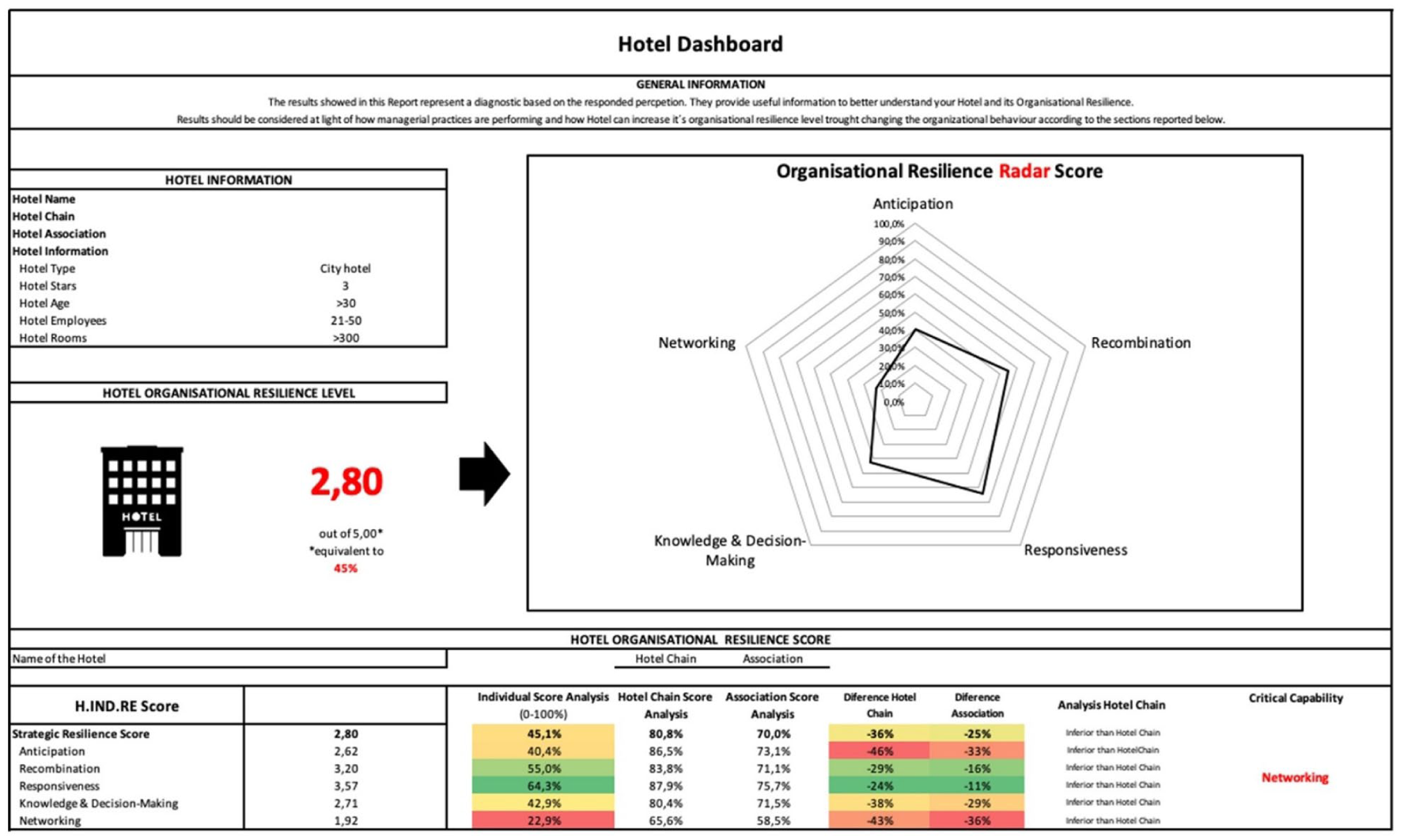
Hotel Organizational Resilience Dashboard.
The dashboard presents a visual translation of the survey results, offering a direct, accessible view of them across the five resilience dimensions, enabling managers to identify their relative strengths and weaknesses immediately. By doing so, the dashboard helped hotel managers understand their OR situation. For instance, a hotel that observes lower anticipation scores than competitors can prioritize enhancing its risk scanning and scenario planning. Similarly, high recombination scores may highlight strong adaptive resource allocation practices that can be further leveraged.
The dashboard allows benchmarking not only within hotel chains or associations but also against the broader set of surveyed hotels. This comparative view fosters organizational learning by enabling managers to identify best practices and areas for development, and to facilitate targeted discussions on how to strengthen their OR by implementing tailored resilience strategies. Managers of the investigated hotels reported that the ease of interpretation helped them integrate resilience considerations into strategic planning, resource allocation, and crisis preparedness discussions more effectively than when relying solely on raw survey data.
The different tools produced by this investigation could be seen by managers/practitioners as the founding elements of an Organizational Resilience Management System (ORMS). Integrated into hotel routines, the ORMS enables continuous resilience monitoring and enhancement, serving as a decision-support system to guide resource allocation, crisis preparedness, and stakeholder engagement, while also supporting benchmarking and knowledge sharing across networks.
Limitations and Future Research
The present study’s findings should be further refined in future studies. The following main limitations and future research venues have been identified.
First, this study used hotel managers’ self-reported data, which may have led to a social desirability bias (Yüksel, 2017). Participants may have overexpressed their engagement in OR due to social acceptability. Despite this study adopting several procedural remedies (e.g., careful survey construction and the latent method factor technique), the possibility of response bias cannot be entirely ruled out. Future studies should triangulate findings by drawing on multiple sources of information (e.g., employees, customers, archival records) to better capture and measure hotel OR. In addition, researchers could adopt behavior-specific and observational indicators to reduce the risk of socially desirable responding in self-report survey studies (Zhu et al., 2024), thereby strengthening construct validity.
Second, as demonstrated by the proposed model, OR is a multilevel DC made of both intralevel and interlevel constructs. Future investigations are called to consider in depth the perspectives of the hotel’s external stakeholders (e.g., local communities, government agencies, and the like), given their critical role in shaping the environment/destination within which the hotel operates. By doing so, it will be possible to provide a refined understanding of the challenges and opportunities outside the hotel’s boundaries, further helping the hotel to identify vulnerabilities, anticipate changes, and develop strategies that enhance its overall OR. In this regard, examining the interplay between OR and destination resilience appears particularly promising. Future research could explore how hotels contribute to, depend on, and co-evolve with destination-level resilience initiatives, thus advancing integrated strategies that enhance the adaptive capacity of the broader tourism ecosystem (Baiocco et al., 2023; Paniccia & Leoni, 2019).
Third, future research may conduct more specific investigations to understand differences between resilience typology (e.g., strategic resilience, operational resilience, etc.) and to consider particular contexts of investigation. For example, the OR required by resort hotels is likely different from that needed by city hotels, in line with their distinct risk features. The model provided can be adapted by future research in line with the specific needs and cases under investigation.
Fourth, the statistical results for Steering to Recombination (0.381—p < .002) and Collaborative Decision-Making to Recombination (0.250—p < .028)—despite being statistically significant—are lower than those for other relationships found. This suggests the existence of a missing factor that can connect Steering and Collaborative Decision-Making to Recombination in a more significant way. Expert consultations initiated during this study indicated that “Communication” may represent the missing factor, understood as the organization’s capability to manage information flows and sensemaking across internal and external stakeholders (Pfeffermann, 2017). Future research is encouraged to empirically test the role of Communication as a mediating mechanism between Steering, Collaborative Decision-Making, and Recombination, thereby refining the proposed framework and associated measurement scale.
Finally, a relatively small sample of worldwide hotels was collected. However, this study employed PLS-SEM specifically due to its suitability for small sample sizes and complex models (Hair et al., 2021; Henseler et al., 2009). To mitigate the risk of overfitting, we adopted an iterative item-reduction strategy (e.g., based on VIF and outer loadings), confirming internal consistency and convergent/discriminant validity at all levels. The bootstrapping procedure (5,000 resamples) enhanced the robustness of parameter estimates. Importantly, the model structure is theory-driven, and the resulting paths reflect meaningful, interpretable relationships aligned with the DCs framework. While we acknowledge the small sample as a limitation, the consistency of findings supports the validity of the model in this exploratory phase. Future studies are encouraged to validate the model using larger samples across different geographical regions, employ longitudinal designs to capture resilience dynamics over time, and integrate qualitative methods to complement quantitative results. Such approaches would provide richer insights into the evolutionary nature of hotel OR.
Supplemental Material
sj-docx-1-cox-10.1177_19389655261431754 – Supplemental material for Hotel Organizational Resilience: A Dynamic Capabilities Framework
Supplemental material, sj-docx-1-cox-10.1177_19389655261431754 for Hotel Organizational Resilience: A Dynamic Capabilities Framework by Luna Leoni and Mateus Panizzon in Cornell Hospitality Quarterly
Footnotes
Acknowledgements
The authors gratefully acknowledge all the experts for their time, devotion, and precious contributions to this study.

Author Contributions
Conceptualization: Luna Leoni; Data Curation: Mateus Panizzon; Investigation: All Authors; Formal Analysis: Mateus Panizzon; Methodology: All Authors; Writing – Original Draft Preparation: Luna Leoni; Writing – Review & Editing: Luna Leoni.
Funding
The authors received no financial support for the research, authorship, or publication of this article.
Declaration of Conflicting Interests
The authors declared no potential conflicts of interest with respect to the research, authorship, or publication of this article.
Supplemental Material
Supplemental material for this article is available online.