







Abstract
Overburdened and fenceline communities have historically experienced multiple disproportionate impacts from pollution. These communities continue to live with the impacts of pollution, which manifest as disparities in health outcomes. These realities necessitate a need to study the interrelated aspects of the built, natural, and social environments that ultimately shape the quality-of-life outcomes of residents. However, traditional impact assessments rely heavily on quantitative data and contemporary environmental monitoring data, often missing historical records and the evolution of industrial activities and the regulatory landscape. This omission increases the demand to shift methodological approaches from single-medium sources focusing on quantitative environmental monitoring and its attendant impacts to approaches integrating situated and local knowledge and considering social and economic factors. This study presents a cumulative impact assessment case study of the environmental injustices of Port St. Joe (PSJ), FL. The study systematically incorporates oral history interviews and archival records to highlight the need for incorporating diverse sources into cumulative impact assessments. PSJ, particularly North Port St. Joe (NPSJ)—a historically African American fenceline community—has endured a disproportionate burden of environmental risks due to nearby chemical industries. Today, NPSJ faces challenges such as frequent flooding, degrading lands, and the contamination of water, all of which were further intensified by the impacts of Hurricane Michael in 2018 and the COVID-19 pandemic in 2020. This study demonstrates how oral histories and archival records can enrich cumulative impact assessments, reveal underestimated impacts, and amplify the voices of those most affected.
INTRODUCTION
Port St. Joe (PSJ) is a small coastal city in Gulf County, FL, in the FL Panhandle. With its unique environmental and social dynamics, this city has a population of about 3500 people. 1 The first FL constitution was signed in 1838 by delegates in the now-lost town of St. Joe. Years later, new settlers established the city of PSJ near the original site. 2 The city has beautiful beaches and deep connections to FL’s maritime and industrial past. On the northern side of the city, across the railroad tracks, is North Port St. Joe (NPSJ), the city’s predominantly African American community. For 61 years, NPSJ residents lived adjacent to the paper mill and three other chemical plants. This proximity has left long-lasting negative social, economic, environmental, and public health impacts on the community, ranging from respiratory problems and contaminated land to persistent economic disadvantage and social marginalization.
When asked about his experience growing up in NPSJ with the air quality and the smell from the paper mill and chemical plants, this elderly man responded:
“Yes, on one hand it was a positive job factor, but on the other hand it was very negative. You know, who wants to grow up with the smell, you grow up with the smoke, and you grow up with some condensation on your car or whatever the case may be. And it’s just not a positive environment to actually grow up in. So, that’s the two sides of it.”
This reflection captures the trade-offs between economic prosperity and environmental degradation. While this case is characteristic of broader environmental injustices, much of the literature focuses on the distribution of environmental risks and hazards with less attention to the underlying historical, political, and spatial processes that produce and sustain these disparities. Risk assessments often concentrate on the effects of a single project or pollutant, emphasizing direct, immediate, and easily detected impacts. However, impacts from various projects collide, compound past injustices, and are likely to persist in the future. Communities like NPSJ have experienced environmental and social impacts from multiple developments over time, with effects that have combined and continue to interact across space and time. PSJ was struck by Hurricane Michael in 2018, and the effects of this disaster, such as the impacts of mold on health, were compounded by the COVID-19 stay-at-home orders in 2020. Together, these overlapping crises and the vulnerability of NPSJ led to worse biophysical, socioeconomic, and health outcomes for NPSJ compared with the rest of PSJ.
Cumulative impact assessments (CIAs) have emerged as tools for evaluating how multiple and compounding impacts affect populations, aiming to capture the totality of impacts rather than treating them in isolation. They rely on a comprehensive understanding of past conditions to inform and improve their predictions about what may happen. Yet, despite their comprehensive aim, most CIA approaches rely heavily on quantitative measures and formal regulatory data, failing to capture localized and/or nonquantifiable impacts, such as the lived experiences and historical context of overburdened communities. CIAs can also be challenging in regions where data are not readily available.3,4
These limitations call for a more comprehensive approach to CIAs. In this study, our objective is to demonstrate how oral histories and archival research can be incorporated into contemporary CIA studies to enrich the assessment, reveal underestimated impacts, and amplify the voices of those who have been most affected by these impacts over time. Drawing on local and regional historical archives and 27 oral history interviews conducted following Oral History Association (OHA) best practices, 5 we apply this approach to PSJ, FL, a city in the FL Panhandle with a complex environmental history that endures the lasting impacts of industrial activities. The FL Panhandle follows the southeast coastline as the most susceptible area in FL for a land-falling hurricane. With legacy contaminants from past industries expected to affect future generations due to inadequate/nonexistent cleanup and concerns over accidental industrial releases growing as extreme weather events increase with climate change, 6 it is necessary to assess the cumulative impacts on communities.
In the following sections, we assess some of the dominant frameworks in CIAs and outline some opportunities for oral histories and archival records, as well as show how we collected the oral histories and archival records. Next, we examine the case of PSJ, grounding our analysis in the historically overburdened community of NPSJ, and demonstrate how integrating oral histories and archival records in the CIA can reveal underestimated impacts while centering community knowledge.
DOMINANT FRAMEWORKS OF CIA AND OPPORTUNITIES FOR ORAL HISTORIES AND ARCHIVAL DOCUMENTS
CIA studies have relied heavily on models based on quantitative data and contemporary biophysical monitoring data to assess the impacts of projects on ecological systems. 7 The selection of biophysical and socioeconomic components—by risk and impact assessors—as part of the scoping process may leave out other information sources necessary for understanding cumulative effects, such as cultural resources and lived experience with these impacts over time, 8 and why those valued components are in conditions they are in. 9 Another challenge of traditional CIAs is shifting baselines, where contemporary studies of environmental change perceive the current state of the biophysical and social environment as the baseline for predicting cumulative impacts. This approach misses the historical or long-term changes.10,11 Rural communities present a unique challenge to CIA due to the unavailability of baseline environmental monitoring data. What happens when there are no data to link legacy industrial releases to health outcomes? This provides justification to incorporate other forms of information, such as oral histories and archival records containing monitoring data from these facilities.12,13 In conducting retrospective analysis to establish baselines for historical conditions and trends, which components of the socioecological systems do researchers consider, and how do they begin to establish that baseline? There may be the tendency to oversimplify complex socioecological interactions, masking subtle but significant impacts, especially over time. The conduct of CIAs is often shaped by practice and to satisfy legislative and regulatory requirements, and such a “checkbox” mentality—where the focus is on keeping impacts below predetermined threshold limits—overlooks the social, cultural, and historical dimensions of disparate impacts. This approach also does not account for slow and incremental changes or changes that may be undetectable by monitoring methods.
This need for CIAs to critically consider the social, cultural, and historical contexts within which change has occurred in the past requires CIAs to be context-specific and integrate local and traditional knowledge to advance environmental justice (EJ)— “the just treatment and meaningful involvement of all people regardless of income, race, color… in agency decision-making and other Federal activities that affect human health and the environment.” 14 Using variables such as low income, high employment, residential segregation, housing cost, and so on, 15 to map out communities and label them as disadvantaged communities often does not capture the lived experiences of these affected communities or how they became communities suffering from environmental injustices. 16 Socioeconomic assessments, as part of the impact assessment process to establish EJ considerations, primarily focus on variables such as race, income, and education. Consideration of such variables is a useful approach for determining where to concentrate efforts to overcome environmental injustices. However, this overemphasis limits the social relevance of the studies and may contribute to the marginalization of Indigenous and local perspectives by failing to account for place-based knowledge that these communities hold and ignoring traditional ecological relationships that define lived experiences of injustices. 17
EJ research using CIA often falls into the same trap of solely relying on technical and scientific knowledge, with little attention to knowledge outside Western scientific paradigms.18,19 This limited attention by researchers to community well-being, displacement, cultural loss, and gentrification can narrow the understanding of impacts. Lee has observed, however, the evolution of EJ and CIA research to include participatory approaches beyond dominant frameworks, as he notes that interdisciplinary approaches that combine natural and social sciences and mixed-methods research could provide a more holistic view of cumulative impacts.20,21 Community engagement alleviates some of CIAs operational challenges by providing access to local knowledge, broadening the consideration of social values and environmental issues, and reducing the likelihood of litigation.22,23 Community engagement also helps to build consensus around sustainability goals by fostering cooperation and confronting discrimination; however, converting such consensus into measurable and evaluative criteria for CIA may be challenging. For example, some of the impacts identified by the public may not be regularly monitored by standard assessment tools, making it difficult to gather data consistently over time. To address these challenges, innovative approaches have emerged that incorporate qualitative data (such as interviews, surveys, and narratives from oral histories and archival records) into geographic information systems to better understand and map out people’s lived experiences.24,25 This approach is particularly necessary in data-deficient regions. We follow the works of others and advocate that CIAs should give equal attention to the biophysical, social, and economic.26,27,28,29 If all effects are cumulative, then it is imperative to consider not only why the biophysical and socioeconomic environment is in its current condition but also how individuals’ lived experiences provide insights into past exposures and the ongoing legacies of long-term environmental impacts. 30
Oral histories and archival records can provide insights into long-term and historical cumulative impacts that are not easily quantifiable. Oral histories can document changes in the biophysical environment or community health patterns. Including oral histories and archival records can provide context-specific knowledge for the social aspects of CIA. 31 Participatory mapping, such as sketch maps, which give residents the opportunity to identify areas of concern and significance, can democratize the CIA process, as demonstrated by Huang and London. 32 It allows for a deeper understanding of historical accounts and how cumulative impacts are perceived and experienced by those directly affected. While these approaches help capture place-based knowledge and address the limitations of traditional approaches, if not applied carefully, they can skew perceptions and conclusions. 33
METHODS AND INFORMATION ANALYSIS
The study drew on oral histories and archival records to trace the long-term and interrelated social, economic, and environmental harm experienced by residents of NPSJ. Oral histories were collected in Spring 2022 by the second author and a team of undergraduate students from 27 residents of NPSJ. Interviews were semi-structured and organized along seven themes: employment, housing, health, education, governance, economics, and the criminal justice system. A snowball sampling approach was used to identify participants for the oral history interviews. Community leaders from the NPSJ Project Area Coalition (PAC) assisted in identifying residents who had long-standing ties to the community and could speak to its environmental history. Consent forms were distributed to participants to be signed and returned. Consent was also obtained verbally at the start of the interviews. Oral history interviews were transcribed and coded using the qualitative data analysis software MAXQDA. We used a combination of deductive codes (the seven themes along which the interviews were conducted) and inductive codes (emerging from the data). We adopted a purposive sampling strategy to select and further analyze specific narratives for inclusion in the CIA. For example, when assessing historical exposure, we paid particular attention to narratives from elderly individuals who had lived through these experiences.
Archival research was conducted at the Corinne Costin Gibson Library in PSJ and the University of West FL Archives and Historical Center. The first author conducted a document analysis of the archival records. These materials included historical city planning documents, land use maps, and community development reports. 34 He also consulted digital archives, including the FL Newspaper Archives and the Library of Congress, as well as minutes from PSJ city council meetings accessed via the Gulf County website. Documents were selected based on their relevance to industrial development, environmental management, housing, health, and civic engagement. We focused on materials that provided historical context for contemporary issues. For example, in assessing why land was subsiding in some areas in NPSJ, we focused on documents on past industrial activities and land use practices. In analyzing these documents, we looked for recurring environmental stressors such as industrial emissions, waste, and adverse health outcomes to understand the long-term burdens faced by the community. While the Environmental Justice Screening tool (EJScreen) and other tools, such as the Climate and Economic Justice Screening Tool (CEJST), highlight present-day risks and disparities, they offer little insight into the historical processes that have contributed to these conditions. By integrating the oral histories and archival records, we were able to contextualize contemporary issues by revealing the impacts of historical events and examining how they interact with contemporary issues. This approach contributes to a comprehensive understanding of the environmental injustices experienced by the NPSJ community, underscoring the complex interplay of socioeconomic factors and systemic oppression.35,36
ARCHIVAL DATA AND ORAL HISTORIES OF ENVIRONMENTAL INJUSTICE TO INFORM FUTURE CUMULATIVE IMPACT ASSESSMENTS
In rural counties like Gulf County, the unavailability of baseline environmental monitoring data compounds the challenges of CIAs. In this context, the oral histories from the residents of NPSJ revealed the enduring impacts of industrial pollution, health disparities, and socioeconomic inequalities. Two key themes emerged from the oral histories: (1) the legacy of pollution from the industrial era and (2) the resilience of the community in the face of discrimination. We find that residents of NPSJ have borne the disproportionate burden of pollution due to their proximity to these industries. 37
The community experiences a great deal of social and economic disparities compared with the rest of the city. Residents of census tract 9602, which represents NPSJ, have a lower household median income; of the 472 Black or African Americans living in the city of PSJ, 23.1% live below the poverty line, compared with 8.2% of 2773 White residents. 38 Life expectancy is also marginally lower in this census tract (74.8 years) compared with 76.3 years in tract 9601 and 77.4 years in tract 9603. 39 This disparity is rooted in the history of residential segregation. “We’ve always been segregated. We still have that problem today,” said an elderly male resident of NPSJ. Data from the U.S. Census Bureau shows no Black or African American owner-occupied housing units in census tracts 9603.01 and 9603 (which represent much of the city’s south side). 40 The disparity is also rooted in discrimination, as racial divisions in the city reflected in the hiring and treatment of workers at the paper mill, the major employer in the city. In 1938, the St. Joe Paper Company began operating the paper mill in PSJ, adjacent to the NPSJ community (Fig. 1). The establishment of the paper mill was an anchor for the establishment of other industries. The paper mill predates the enactment of National Environmental Policy Act in 1970 and the implementation of strict environmental regulations and impact assessment requirements. 41 The paper mill released fly ash and other emissions into the air for years while discharging waste containing lead and other hazardous chemicals into soil, St. Joseph Bay, and land. 42 Between 1955 and 1957, three other chemical plants began operating in PSJ, utilizing by-products from the paper mill for their operations to produce crude and distilled tall oil. 43 Labor at the mill was racially divided, as Black workers were confined to the lowest-paid, most hazardous roles. One interviewee recalled, “We had the bull gangs; we had to clean up. Yeah, that’s all we had.” 44 This account reflects the occupational hazards and risks Black workers were exposed to—particularly those who had responsibility for cleanup (i.e., the bull gangs), which compounded the exposure they already experienced in their residential space.
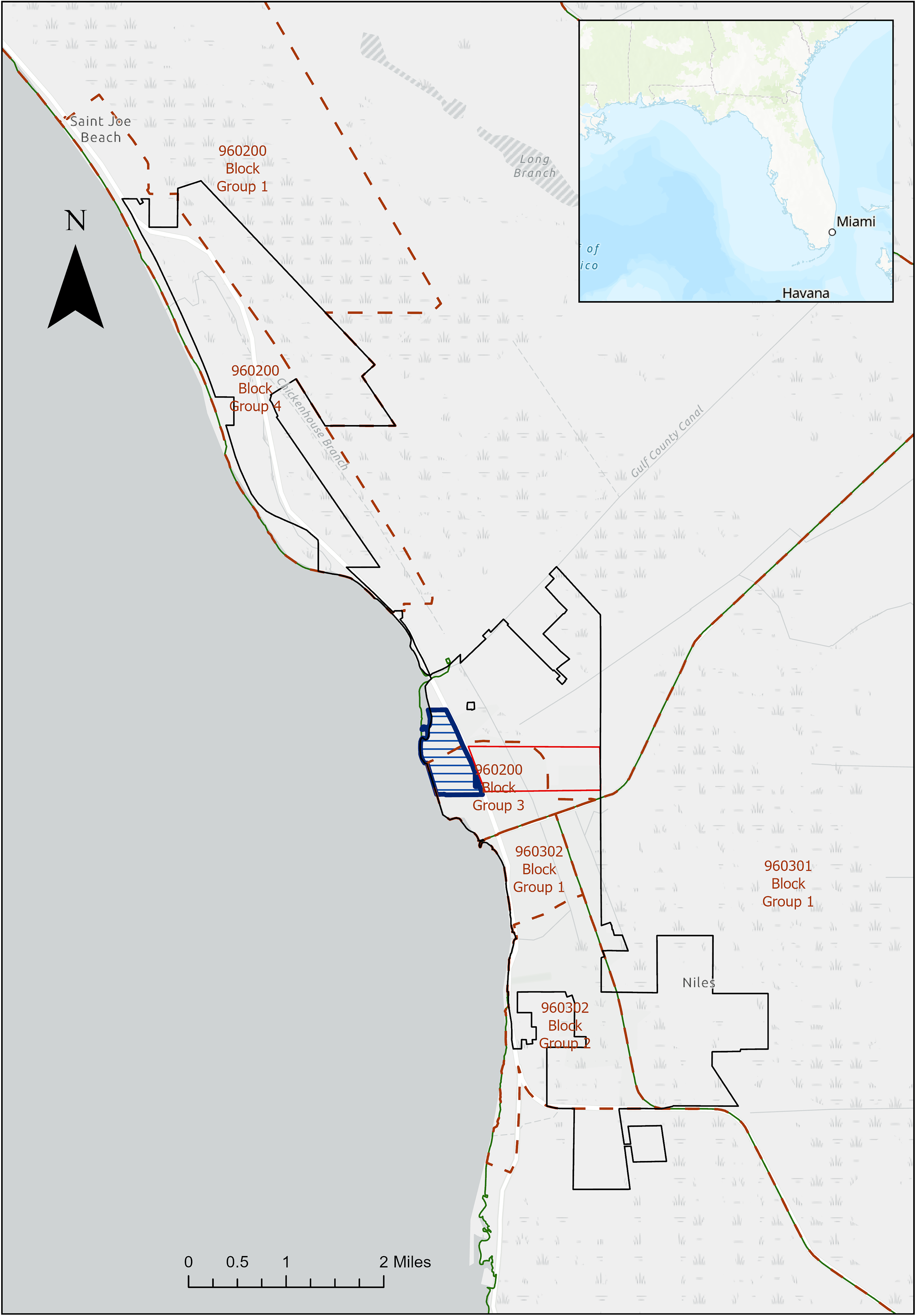
Map of the city of Port St. Joe, showing the site of the former paper mill (now a brownfield site) and the community of NPSJ marked out in a red solid line. Orange dashed lines represent census block groups; red solid lines represent the NPSJ boundary; blue lines represent the brownfield area; green lines represent census tracts; and black lines represent Port St. Joe City. NPSJ, North Port St. Joe.
Finally, land-use planning and environmental management played a role in creating and sustaining these disparities. The area’s proximity and access to the Gulf County canal, which connects the Gulf of Mexico to the Intracoastal Waterway, and the rail system made it a suitable location for these industries to establish themselves adjacent to the NPSJ community. 45 The St. Joe Company, which owned most of the land in the city, facilitated this industrial expansion. 46 During the 1940s and early 1950s, waste from the paper mill was dumped into wetlands in the NPSJ community, known then as “the quarters.” The St. Joe Paper Company subdivided the lots in the mid-1950s to create the Mill View Subdivision.47,48 Some of the houses constructed on these lots have begun to deteriorate. “And some of these homes are actually built on wood chips and debris that was buried, and you got water running underneath them. And so the houses are sinking there,” said an elderly man, describing the physical instability of homes in some areas in NPSJ. A 2001 study by the FL Department of Health corroborates these claims. The report found that subsidence of the fill material caused structural damage to homes and affected water, sewer, and gas lines. 49 The study also found lead in soil below Agency for Toxic Substances and Disease Registry health-based screening levels, indicating it was unlikely to cause any illness. However, cumulative exposure to lead, even at low levels, can still pose significant long-term health risks.50,51
An analysis of cancer risks associated with emissions from pulp and paper mills—specifically, a 1989 extract from the Environmental Protection Agency’s air toxics exposure and risk information system —identified the St. Joe Paper Company as having an estimated individual lifetime cancer risk greater than 1 in 1000 for chloroform emissions. 52 The inclusion of the paper mill highlights the risks associated with the facility. Historical documents showed that in the past, air emissions from the paper mill blew directly into the community of NPSJ—court records in St. Joe Paper Co. vs. State Dep’t of Envtl. Regul., 371 So. 2d 178, 179 also showed that for years, the paper mill failed to meet air quality standards. 53 Archival records, including a 1980 emission test report and a 1976 report on the compliance status of major air pollution facilities in the United States, reveal the St. Joe Paper Company as a major source of pollution.54,55,56 Although these emission test results and reports provide insight into the environmental risks associated with the paper mill, they do not capture the cumulative nature of the impacts. Additionally, contemporary health data are collected at the county level, making city-scale assessments challenging. This challenge masks the impact residents in places like NPSJ have been exposed to. Data from EJScreen give some insight into some health indicators. A critical look reveals some challenges with data collection, as some indicators are reported at the block group level, while others are at the census tract level. The data reveal high rates of heart diseases (87th percentile), asthma (35th percentile for tract 9602 and 16th percentile for tract 9603), cancer among adults (91st percentile), and people with disabilities (96th percentile for census tract 9602 and block group 3 and 69th percentile for census tract 9603 and block group 2) evidencing underlying health disparities. 57 These technical reports gain further meaning when viewed alongside oral history accounts that reveal the personal and generational toll of these exposures. One resident, an elderly woman, shared:
Because I know of one lady who, as a matter of fact, she had never smoked, and when they diagnosed her, she had stage 4 lung cancer. She didn’t live anytime. I’d say within three or four months, she passed away. So, you know, it’s those kinds of things, and nobody in her house smoked. So that tells you something, particularly knowing what we know now about the environmental issues that we have in a town such as ours that have had these manufacturing plants.
Her remarks show how oral histories can fill the gaps left by technical data, particularly in communities where environmental data are limited, aggregated, or absent at the city or neighborhood level.
In 1999, the paper mill shut down, and by 2005, all the other chemical plants closed, marking the end of an industrial era. 58 Between 2000 and 2010, the population declined across the city as people sought opportunities elsewhere. African Americans and the NPSJ community experienced the most decline in this period, with a 19% population drop from 1097 to 888 compared with a 1.4% drop of Whites from 2497 to 2462. 59 An elderly male resident described the impact of the mill shutting down on the community. He said:
After the mill shut down, it really just sort of, you know, it kind of devastated the community and impacted a lot of the people, I think, their sense of, you know, purpose, in being able to sustain themselves. So, a lot of people had to leave home; the young folks especially had to leave home.
This account highlights the economic and social decline following the mill’s closure and reveals how economic decline and social displacement following industrial shifts can impact communities.
The city also lost its tax base due to the paper mill’s closure. Gulf County ranked high in unemployment in the state of FL. 60 Since then, the city of PSJ has been making efforts to bring development back to the city, such as revitalizing the port and associated industrial development, waterfront businesses, and downtown redevelopment. 61 Much of these revitalization efforts have sidelined the NPSJ community. In instances where the community has been engaged, plans have not been seen through to completion, such as the redeveloping NPSJ master plan prepared by the NPSJ PAC. That plan involved working on Martin Luther King Boulevard, which was the business corridor of NPSJ. Residents of NPSJ have expressed their frustration with the slow progress of development. One female resident shared:
Nothing to enhance North Port St. Joe, in a sense. Nothing that would give us the revenue that we would probably need to start rebuilding North Port St. Joe, you know.
Another male resident reflected on the community’s struggle to regain economic vitality.
But now, we’ve lost our economic engine. Martin Luther King Boulevard—which we all know, in a lot of cities, is where the Black folks’ business district is—used to be a thriving engine; it’s no longer there. And so the work that we are trying to do is to revitalize the community, create opportunities, you know, so that we don’t lose.
The failure to complete plans and the slow progress of work reflect the ongoing difficulty of overcoming a history of exclusion. This exclusion and limited development contribute to the community's vulnerability to hazards.
When Hurricane Michael struck in 2018—the fourth Category 5 storm on record to make landfall in the United States—NPSJ’s limited infrastructure and preparedness compounded the storm’s impacts.62,63 The community experienced some of the highest wind speeds during Hurricane Michael. A resident of NPSJ describing his experience following the storm stated:
With Hurricane Michael, we experienced some type of homelessness. Our house was damaged 70 percent and…we had to wait for it to be repaired because of the mold. That’s tough. The other thing was the fear of having ridden out the storm…and that developed some syndromes. I don’t know if that’s the right word for it, but when we get regular thunderstorms, the wind gets high, immediately you tense up, your muscles tense up.
This personal account highlights both the immediate physical damage to their home and the long-term emotional and mental health toll on residents—information that an assessment of physical hurricane damage or resulting death alone would not have revealed. While the rest of the city began to recover more quickly, NPSJ was left behind, vulnerable not only to natural threats but also to the compounded effects of ongoing environmental injustices. The COVID-19 stay-at-home orders compounded the impacts of the storm on housing and health by delaying rebuilding efforts and worsening the economic fallout from the pandemic. For residents of NPSJ, the stay-at-home orders accentuated the disparities in housing conditions as they were forced to stay in older and dilapidated houses, exposed to mold and other pollutants, as most of these houses were built in the 1950s and 1960s. 64 The relatively newer housing stock in the rest of the city rebounded quickly, as observed by Boda et al. in a study of the impacts of Hurricane Michael in Gulf County. The authors noticed the widespread use of plastic tarps in NPSJ in 2020. 65 The use of plastic tarps in NPSJ was still evident in another study conducted in 2023, illustrating the delayed recovery of NPSJ compared with other areas of the city. 66 This “double jeopardy” of environmental injustice, as observed by Huang and London, where “the people with the fewest social, economic and political resources experience the greatest concentrations of environmental threats to their health and well-being” 67 is evident in NPSJ. The community, adjacent to industrial zones, has limited access to green spaces. Only one of the city’s 11 parks is located in NPSJ, and no trail passes through the area. A resident said this regarding the only park:
Right now, we are sitting in a park that doesn’t have a public restroom. We have to go to the city and get permission to get a key to unlock the restroom. So people can use the restroom. This is the only Park in St. Joe that goes like that.
This statement highlights the infrastructure challenges in NPSJ and the systemic issues that have long burdened the community. Without addressing historical neglect and involving the community in decision making, attempts at revitalization risk perpetuating environmental risks and compounding impacts.
While still reeling from the aftermath of the hurricane and the pandemic, the community of NPSJ faced a new threat in the fourth quarter of 2022—a plan by a private developer to construct a liquefied natural gas (LNG) export plant on the former paper mill site. The continued zoning of the site as industrial, according to zoning records, and plans by the local government to revitalize the port contributed to the decision to put up the LNG plant. The proposed project involved transporting the LNG with trucks for 1300 feet to the docks to be loaded onto cargo ships. 68 Federal Energy Regulatory Commission determined that the proposed PSJ LNG plant fell outside its jurisdiction because it involved exporting LNG via truck or container shipments. 69 Responsibility for assessing the project’s impacts was deferred to state and local regulators as proponents were expected to obtain permits. 70 City officials supported the proponents of the LNG plant, potential jobs were overestimated, and environmental impacts were underestimated. 71 The assumption by city managers and policymakers that industrialization will continue on land zoned as industrial and previously affected by industrial activities, and so environmental impacts will be minimal, is based on narrow definitions of the environment or the focus on the biophysical environment. This assumption continues to leave fenceline and overburdened communities—historically impacted by pollution—in harm’s way.
Regulatory agencies recognize LNG plants as hazardous for their safety and environmental health risks. The U.S. Department of Transportation’s Pipeline and Hazardous Materials Safety Administration notes hazards such as pool fires and flammable vapor clouds associated with LNG plants, which pose risks to nearby communities.72,73 Incidents such as the 2019 and 2021 accidents at the Freeport LNG plant in Texas further underscore the dangers of LNG facilities. 74
The city’s pursuit of industrial development, driven by economic struggles since the paper mills’ closure, has often prioritized potential industry attraction over residents’ health concerns, often sidelining the concerns of residents of NPSJ, a community burdened by historical industrial pollution.75,76,77 Residents of NPSJ and leaders from the NPSJ PAC, along with the Pioneer Bay Community Development Corporation (now the NPSJ CDC), strongly opposed the project, citing environmental injustice.78,79 Subsequently, the developers withdrew the proposal. 80 The proposed LNG plant raised concerns about the potential for air pollution, destruction of ecological resources, and gentrification. Such industrial developments can often lead to shifts in the city’s demographic composition due to the influx of new residents and increased property values. Residents of NPSJ have expressed their desire for development to move away from industries that can potentially displace their community. A male resident expressed his unease:
I’ve been in places where, where there’s been what they want to say, you know, dead encroachment, you know, displacement, where it was a community that was right on the water, and now the Indigenous people, the black people who lived in those areas are no longer there. Delray Beach is one that I actually went down and looked at how the displacement happened there. And so we don’t want to see that happen.
Residents of NPSJ have also expressed their desire to see a more cohesive city where everyone has the opportunity to thrive. As one resident put it, “Well, in my eyes, I would want to see one St. Joe, you know, that we all become a part of the community and not a Black side of town, White side of town.” These personal accounts, gathered before the threat of the LNG became an impending reality, reveal how if proponents of the LNG plant had consulted residents of NPSJ prior to attempting to implement the project—they might have saved themselves the public defeat that was the outcome of the opposition to the LNG.
CONCLUSION: ADVANCING THE INTEGRATION OF ORAL HISTORIES AND ARCHIVAL RECORDS INTO CIAs
From a social and EJ perspective, our analysis has focused on past discrimination that has led to the vulnerability of the community of NPSJ to natural and environmental hazards. We have shown how a history of segregation, and then industrial pollution, led to the increased exposure of residents of NPSJ to pollutants. Industrial pollution and discrimination over time interacted with social and economic vulnerabilities, exacerbating health outcomes. With deindustrialization came economic decline, which led to underinvestment in the community, leading to more vulnerabilities to disasters. This economic decline becomes a justification and incentive to develop, which can result in creating more hazards for the community of NPSJ. We demonstrate how community knowledge and lived experiences can shape environmental assessments and ensure more equitable outcomes. By integrating oral histories and archival records, we have shown how qualitative data can expand traditional CIAs to include social and historical dimensions. This approach has shown how incorporating qualitative data can help establish baseline conditions and provide a holistic understanding of legacy vulnerabilities. The study also details how social and environmental impacts interact and compound over space and time. The approach utilized in this study provides insights for assessing the social and environmental impacts of projects in rural and data-scarce areas while ensuring community engagement in environmental decision making.
Regulatory agencies and the research community should consider collecting more local data and developing a systematic protocol for collecting oral histories, following institutional review boards and the OHA guidelines. Local assessments should ensure transparent community engagement to account for local voices, lived experiences, and their full consideration in assessments. The result of such an approach is a more holistic and inclusive study that advances scholarship at the intersection of social, historic, and community-specific dimensions of environmental change. The United States Environmental Protection Agency (USEPA’s) National Service Center for Environmental Publications provided historical environmental monitoring reports. The data from these reports can be used to assess health exposure risks. In addition to community-held documents in public libraries and museums, these information sources help establish baseline conditions to provide a nuanced understanding of current conditions in communities. Future studies should import this information into a qualitative Geographic Information System to assess where impacts would be greatest. By expanding the scope of data collection and integrating diverse sources, CIAs can more effectively predict and mitigate long-term, cumulative impacts.
AUTHORS’ CONTRIBUTIONS
N.K.: Conceptualization and writing—original draft. K.O.-D.: Conceptualization and writing—review and editing. J.W.: Writing—review and editing.
Footnotes
ACKNOWLEDGMENT

AUTHOR DISCLOSURE STATEMENT
No competing financial interests exist.
FUNDING INFORMATION
No funding was received for this article.