







Abstract
With data from the U.S. General Social Survey linked with regional environmental quality data this article considers the individual demand for environmental quality as measured by stated preferences, relative to its supply, to determine if race/ethnicity matter for the demand and supply of environmental quality and environmental justice. Parameter estimates reveal that relative to Whites, the distribution of environmental quality is unjust for African Americans, Native Americans, Asian Indians, Southeast Asians and other race. This suggests that as race/ethnicity conditions the distribution of environmental justice, there remains an unmet demand for environmental quality in the United States among non-Whites, As such, environmental policy interventions that acknowledge the intersection of race/ethnicity, civil rights, and environmental—such as the Environmental Protection Agency equity action plan―are well-motivated.
INTRODUCTION
At least since 1983, the pioneering scholarship of Robert Bullard has produced insight on how race adversely conditions environmental quality.1,2,3,4 Across a wide variety of environmental quality measures, relative to Americans in general, the communities where Black and other non-White Americans reside are lower in environmental quality,5,6,7,8,9 racial disparities in environmental quality raise questions of whether there is “environmental justice” that is independent of race/ethnicity.
If, as economic theory posits, individuals trade off private consumption for environmental quality, the distribution of environmental quality will reflect an equilibrium that is optimal, implying that it is welfare optimal. 10 This follows from individuals being bound by a budget constraint to purchase essential consumption goods such as housing, requiring that they trade off environmental quality for desirable and essential consumption goods such as housing. In equilibrium, individuals with lower incomes will locate to communities with lower environmental quality, implying they have optimized their consumption and supply of environmental quality in their geography. Such an outcome can be deemed “Market Justice” with respect to the distribution of environmental quality, as it reflects the optimal tradeoffs available to individuals in the market.
While there are several definitions of what constitutes environmental justice, that environmental quality is conditioned on race/ethnicity suggests the same for the distribution of environmental justice.11,12 To the extent that individuals sort into optimal consumption-environmental quality choices, the distribution of environmental quality can be viewed as market justice,” as such choices reflect the income constraints they face conditional upon their preferences. Given this optimizing choice, if individual demand for environmental quality equals the supply, the distribution of environmental quality can be viewed as “Environmental Justice” as individuals are satisfied with their housing consumption-environmental quality choice dictated by what was enabled by the market. With data from the U.S. General Social Survey (GSS) linked with regional environmental quality data, this article considers the individual demand for environmental quality, as measured by stated preferences, relative to its supply, to determine if after accounting for individual equilibrium market sorting into consumption-environmental quality choices, race/ethnicity matter for environmental justice.
The remainder of this article is organized as follows. The second section provides a theoretical framework that motivates our empirical strategy. A simple model is provided that enables a consideration of whether, conditional on individuals sorting into communities on the basis of housing consumption-environmental quality combinations, there is a distribution of environmental justice that is not conditioned on race/ethnicity. The data and methodology are discussed in the third section. In section 4, the parameter estimates are reported. The last section concludes.
A SIMPLE MODEL OF NEIGHBORHOOD CHOICE, ENVIRONMENTAL QUALITY AND MARKET/ENVIRONMENTAL JUSTICE
We appeal to an economic-theoretic supply-and-demand approach in our empirical methodology. In particular, we posit that there exists both a supply and demand of environmental quality that are measurable and estimable via parameterization―at least approximately. The central aim is to determine the extent to which the supply and demand of environmental quality are aligned for individuals and whether or not the relationship between demand and supply is conditioned on race/ethnicity, which can inform the extent to which the distribution of environmental quality satisfies a particular notion of environmental justice―theoretically developed and exposited upon below.
Our theoretical framework is an equilibrium excess demand extension of Banzhaf and Walsh,
13
whereby the price of environmental quality is accounted for with a Lindahl public good price.
14
While the model exposition is formal, at a fundamental level it is simply a demand and supply model that is the foundation of elementary principles of economics. Let household preferences be characterized along a continuum by the indirect utility function V(y, P, E, p), where
To enable a sorting of households from low-housing price/low environmental quality to high-housing price/high environmental quality communities, it is assumed that the slope of the indirect utility function is increasing in The market justice enabled by sorting into housing-price/environmental quality combinations across communities is also environmental justice if the demand for environmental quality equals its supply.
A proof of this proposition follows from considering the equilibrium of a typical individual given by
For the continuous distribution of environmental justice across individuals defined by The distribution of environmental justice is racially biased and unjust if relative to Whites there is a difference in the excess demand of environmental quality for non-Whites.
This notion of environmental justice is perhaps a new one, and may differ from standard notions of it in the extant literature. It does however, cohere with John Rawls’ first principle of justice: 17
First: each person is to have an equal right to the most extensive scheme of basic liberties compatible with a similar scheme of liberties for others.
We attempt to empirically operationalize this principle by permitting the possession of an individual equal right to environmental quality to be equal to its demand for that right relative to its supply. In a Rawlsian sense, if in a population of individuals, the excess demand for environmental quality for non-Whites and Whites is no different, there is environmental justice. On the other hand, if relative to Whites, the excess demand for environmental quality is higher, there is environmental injustice—conditioned on race/ethnicity.
Below, we exploit the above proposition and corollary to empirically determine if there is a racial bias in the distribution of environmental justice. In particular we attempt to estimate
There are, as identified by Laura Pulido, some possible shortcomings to our economic approach to environmental justice that may reduce its explanatory power. 18 Pulido argues that most environmental racism research cast in the framework of economic theory typically relies on narrow, apolitical methods that reduce racism to individual discriminatory acts and polluting emitting facility siting decisions, which obscures its structural and ideological nature. Mainstream economics research methodologies view knowledge as what can be counted, replicated, and rendered independent of human interpretation. The economic approach typically tests whether polluting facilities/emissions are disproportionately located in communities of color, and focus on technical questions of statistical significance, and treat racism and polluting facilities/emissions as something measurable mainly through discrete, and locational measurements in data.
Pulido’s critique privileges research on environmental justice that integrates qualitative methods and historical analysis to trace how environmental racism emerges from long-term processes like segregation, deindustrialization, historical white privilege, and state regulation, rather than only from economic approaches that abstract away from such considerations. There is however some scientific virtue to our economic approach to environmental justice. Our econometric method estimates parameters are at least correlations between race and environmental outcomes. Banzhaf, Ma and Timmins note that the correlation between race and environmental outcomes is robust across research studies. 19 To the extent that causality requires correlation, economic approaches to environmental racism that estimate parameters without accounting for more nuanced and unobserved ideological and structure factors can inform potential causal mechanisms. Indeed Banzhaf, Ma, and Timmins conclude (p. 190) that correlations estimated through parameterized economic models are useful “even if these correlations are the result of socioeconomic processes. Simply because the inequity is mediated through some mechanism does not mean it isn’t there.” 20 In this context, our economic approach to environmental racism is a sensible strategy to identify the extent to which race is a possible causal driver of environmental justice.
DATA AND METHODOLOGY
Our data are from two sources. We use the 2018 U.S. GSS for data on individual demand for environmental quality, and relevant sociodemographic characteristics. The GSS is a nationally representative repeated cross section sample of adults living in the United States. 21 Conducted biennially, the GSS includes a standard core of demographic, behavioral, and attitudinal questions, with variation across survey years on topics of special interest. 22
Given the inquiry of this article, we utilize as dependent regressands, four variables identified in the 2018 GSS that are sensible approximations and/or proxies for an individual’s demand for environmental quality. These four questions are (1) In general, do you think that air pollution caused by industry is: [Ordered Categorical Response], (2) Are you very interested, moderately interested, or not at all interested in issues about environmental pollution?: [Ordered Categorical Response], (3) Are we spending too much, too little, or about the right amount on Improving and protecting the environment?: [Ordered Categorical Response], and (4) Do you think that pollution of America’s rivers, lakes and streams is: [Ordered Categorical Response]. 23
The second source of our data is the U.S. News and World Report 2019 ranking of the U.S. states on environment and pollution—which aligns temporally approximate with the 2018 GSS. 24 These data rank each state according to (1) Industrial toxins based on 2019 Environmental Protection Agency (EPA) data on total chemical pollution per square mile of land area, and (2) Low Pollution Health Risk, a risk score based on 2019 EPA data capturing the risk pollution poses to health per capita due to the chronic health effects of chemical pollution from manufacturing, mining, electric power generation, and hazardous waste treatment. 25 We used these rankings as a measure of the aggregate supply of environmental quality with the property that the lower (higher) a state’s ranking the lower (higher) is the supply of environmental quality. Each of these supply measures captures environmental quality in a general sense as they capture multiple causes and consequences of environmental degradation. As the public version of the GSS only reports the region of respondents, we construct for each ranking measure the average ranking—rounded to the nearest integer—for the region in which the respondent lives as a measure of the supply of environmental quality available to the individual in the community/geography resided in. 26
Our measure of the supply of environmental quality has low geographical resolution, as it is constructed on the basis of the lowest level of geographical resolution possible in the publicly available GSS―9 Census divisions. This crude level of supply aggregation may indeed mask significant variation across the communities in which individuals live. As such, our parameter estimates may render an inference about the demand and supply of environmental quality that is an ecological fallacy, an attempt to infer individual behavior on the basis of highly aggregated measures. The ecological fallacy results from an aggregation bias due to the high level of aggregation of one outcome, and a specification bias due to a differential distribution of confounding variables engendered by the high level of aggregation 27 . Given the practical limitations of disaggregating, our environmental supply variable in the publicly available GSS, our estimation framework attempts to mitigate and/or eliminate this ecological bias by including the same confounding covariates as controls for both the individual demand for environmental quality and the highly aggregated low geographic resolution supply of environmental quality.
Given the environmental quality demand and supply variables of interest are measured in ordered response categories, we utilize a Bivariate Ordered Probit framework to estimate the relevant parameters for the demand and supply of environmental quality:
28


Observable supply and demand are determined by the following threshold—or category—crossing conditions:

We include in
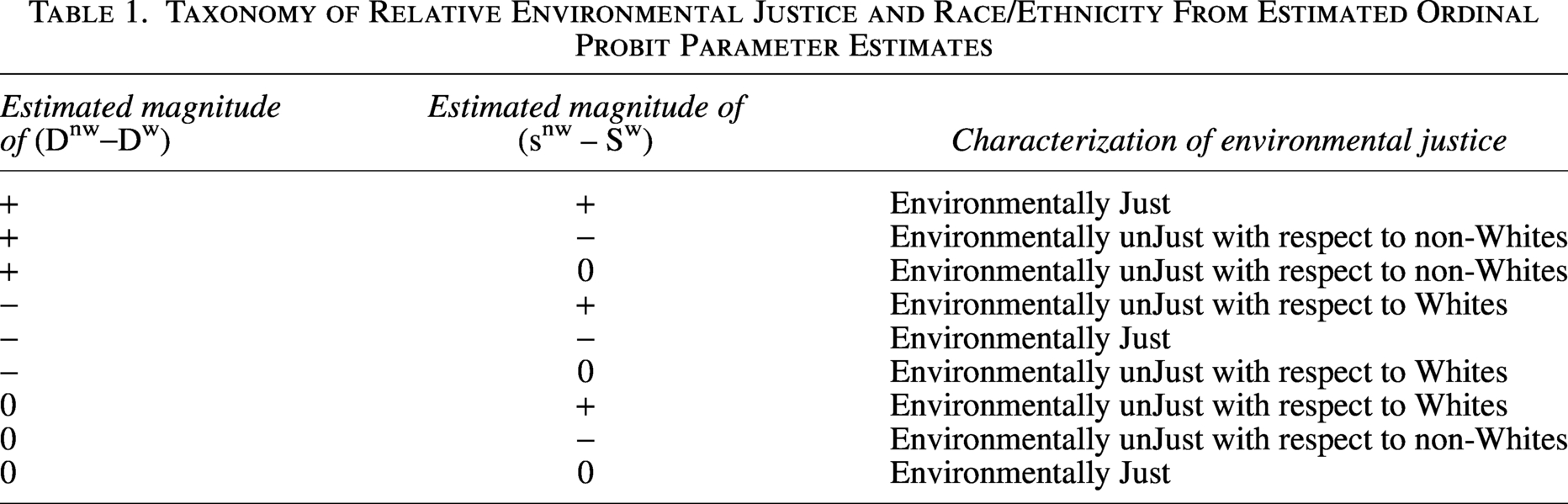
The estimated coefficients on the non-White racial dummy variables enable a taxonomy for a characterization of relative environmental justice. Define the difference between the differences between the demand and supply of environmental quality between non-Whites and Whites excess demand for environmental as (
The estimated magnitudes of the relative effects enable a characterization and taxonomy of how environmental justice is conditioned on race/ethnicity is depicted in Table 1. As an illustrative interepretive example, suppose both (
Taxonomy of Relative Environmental Justice and Race/Ethnicity From Estimated Ordinal Probit Parameter Estimates
RESULTS
A statistical summary for the estimating sample, along with a definition of the regressands and covariates, is reported in Table 2. Our racial/ethnic measurement follows the detail that the GSS enables, which is not completely compatible with the U.S. Census Classifications. In particular we use the GSS variable RACECEN1, which allows individual respondents to report across 16 racial/ethnic classifications. This is in contrast to the 6 U.S. Census classifications. The RACECEN1 variable also allows categorization of Asians into those from the Indian subcontinent and Asians from Southeast Asia.
Covariate Summary
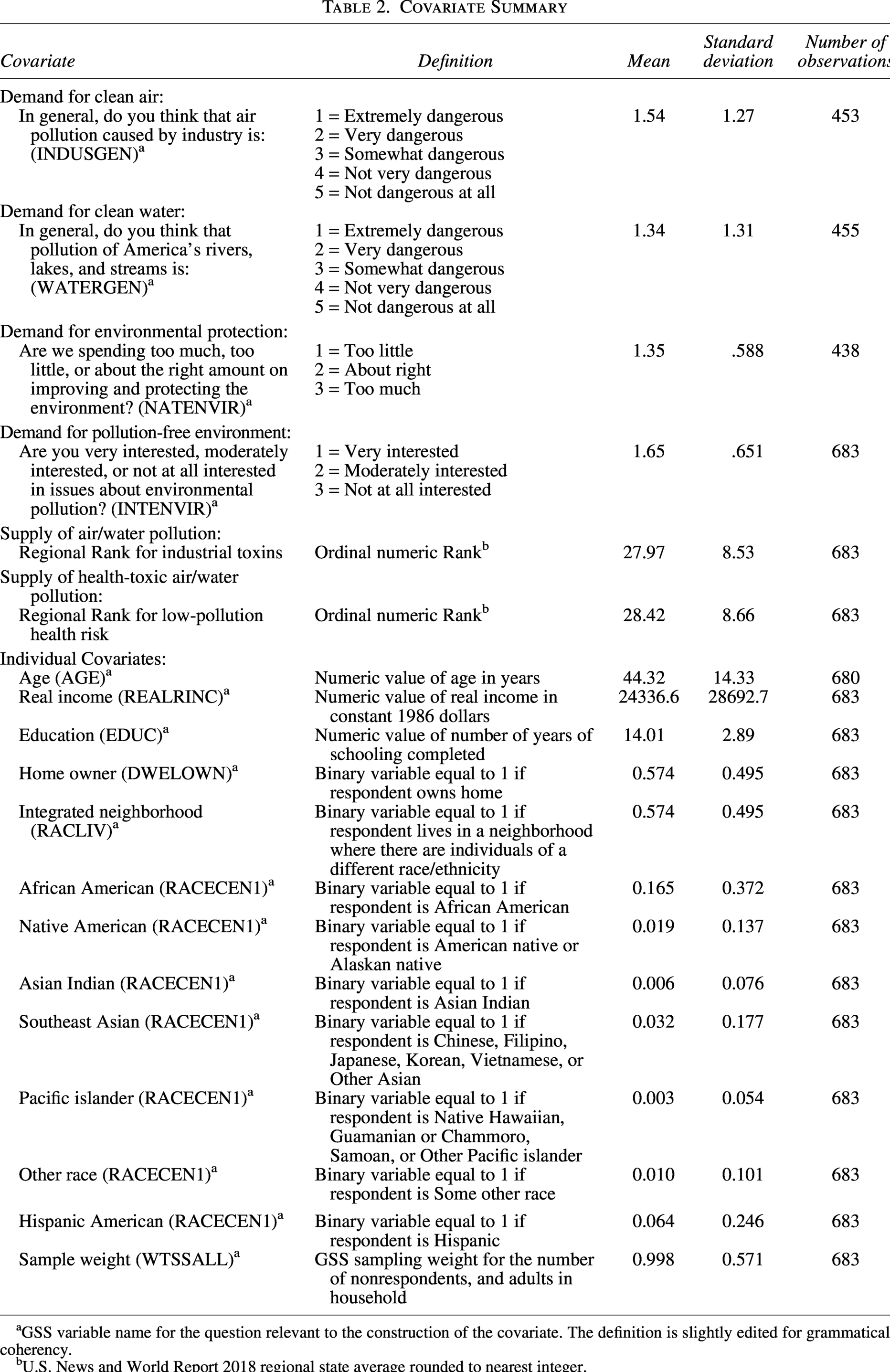
GSS variable name for the question relevant to the construction of the covariate. The definition is slightly edited for grammatical coherency.
U.S. News and World Report 2018 regional state average rounded to nearest integer.
Given that our GSS sample reflects complete case counts for the regressand and regressors in our estimating specifications, the shares of each racial/ethnic group in the sample are not necessarily representative of their populations shares in the U.S. This may introduce bias in our parameter estimates. To mitigate or eliminate this bias, we also report parameters estimates in which the specification is weighted by WTSSALL, which accounts for any differential probability of selection into the sample, subsampling of nonrespondents, and number of adults in the household of the respondent. The weighted parameter estimates, as they account for the possible non-representativeness of the sample relative to the population, will enable inference on the true population effect of race/ethnicity on the supply and demand of environmental quality.
Bivariate Ordinal Probit parameter estimates across two distinct supply and four distinct demand for environmental quality are reported in Tables 3–6.
29
In each instance, the joint distribution of the correlated residuals of the individual demand and aggregate supply specifications is assumed to be bivariate normal. To assess the adequacy of the regressors—as both the supply and demand specifications include the same regressors—a chi-square test for the joint zero equality of all the estimated parameters is reported. As a goodness-of-fit measure, we report the Pseudo-R
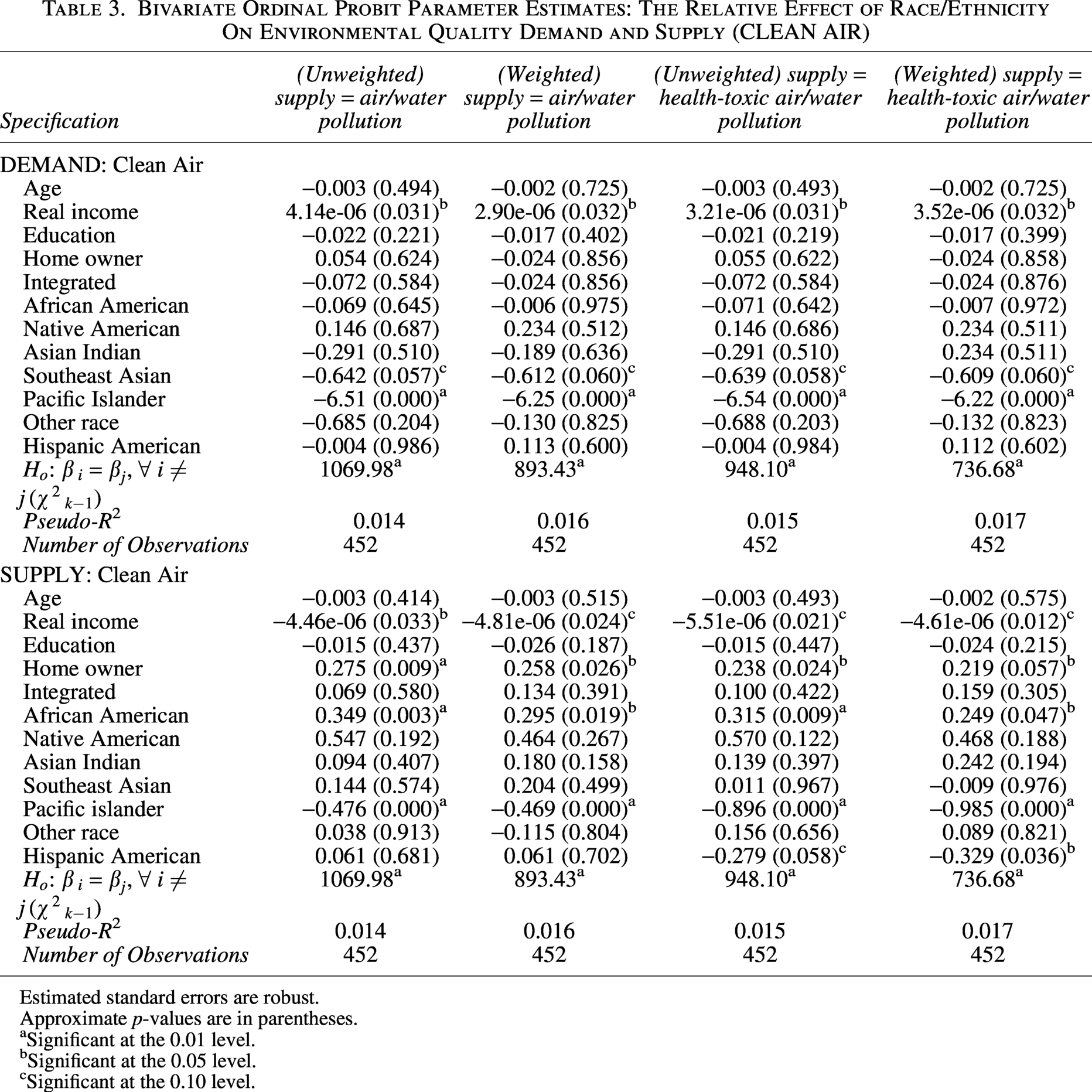
Bivariate Ordinal Probit Parameter Estimates: The Relative Effect of Race/Ethnicity On Environmental Quality Demand and Supply (CLEAN AIR)
Estimated standard errors are robust.
Approximate p-values are in parentheses.
Significant at the 0.01 level.
Significant at the 0.05 level.
Significant at the 0.10 level.
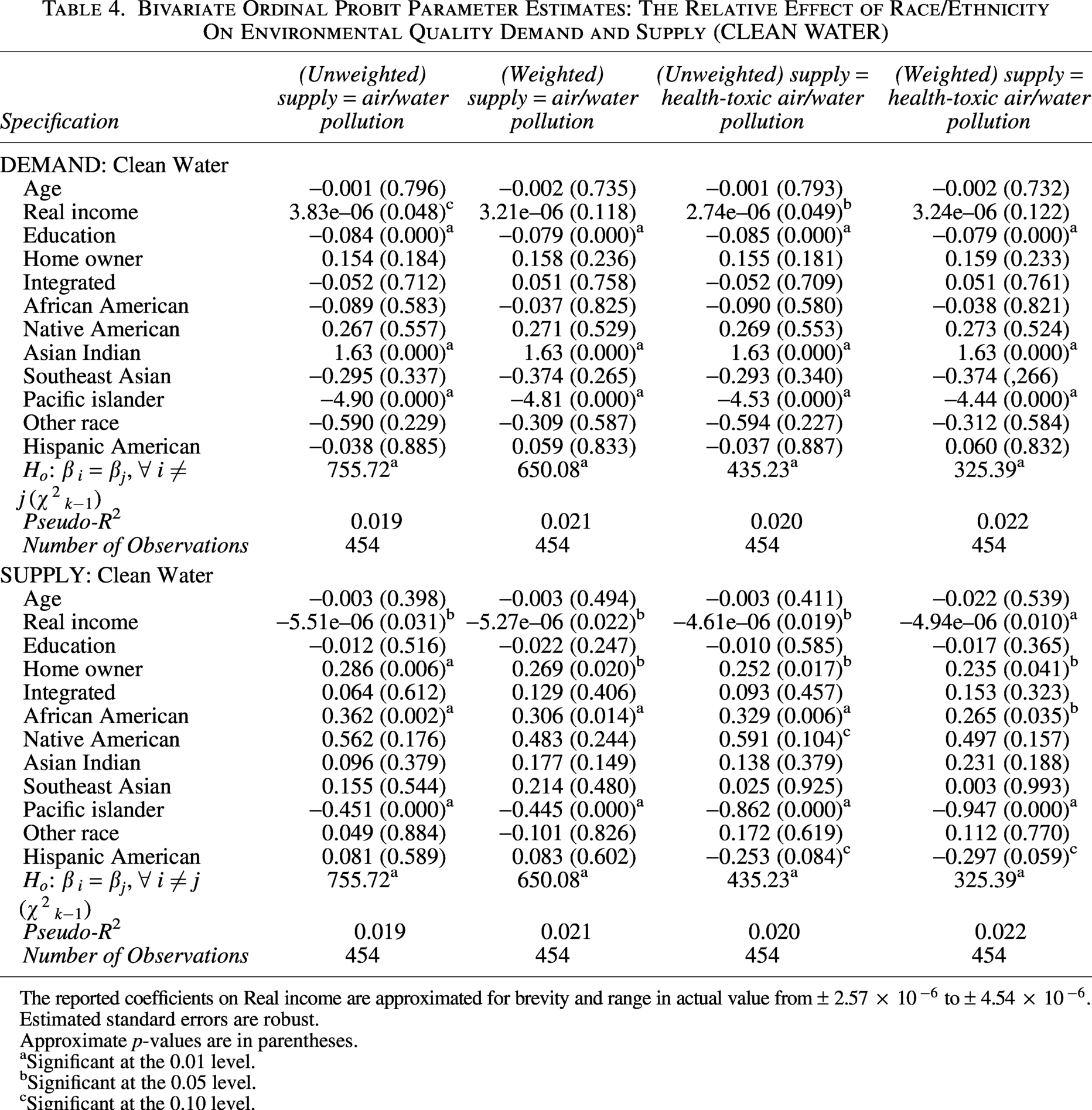
Bivariate Ordinal Probit Parameter Estimates: The Relative Effect of Race/Ethnicity On Environmental Quality Demand and Supply (CLEAN WATER)
The reported coefficients on Real income are approximated for brevity and range in actual value from ± 2.57
Estimated standard errors are robust.
Approximate p-values are in parentheses.
Significant at the 0.01 level.
Significant at the 0.05 level.
Significant at the 0.10 level.
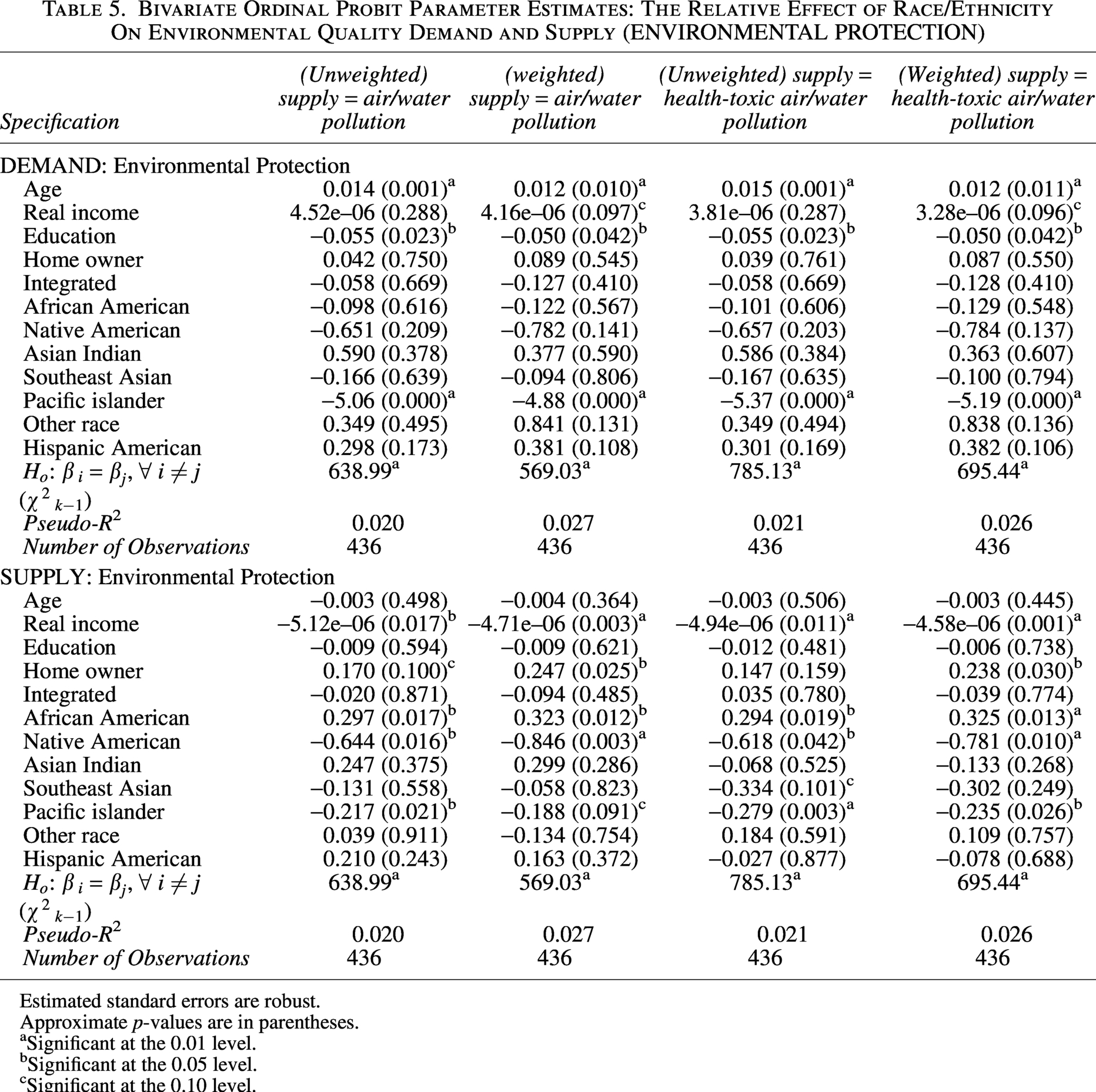
Bivariate Ordinal Probit Parameter Estimates: The Relative Effect of Race/Ethnicity On Environmental Quality Demand and Supply (ENVIRONMENTAL PROTECTION)
Estimated standard errors are robust.
Approximate p-values are in parentheses.
Significant at the 0.01 level.
Significant at the 0.05 level.
Significant at the 0.10 level.
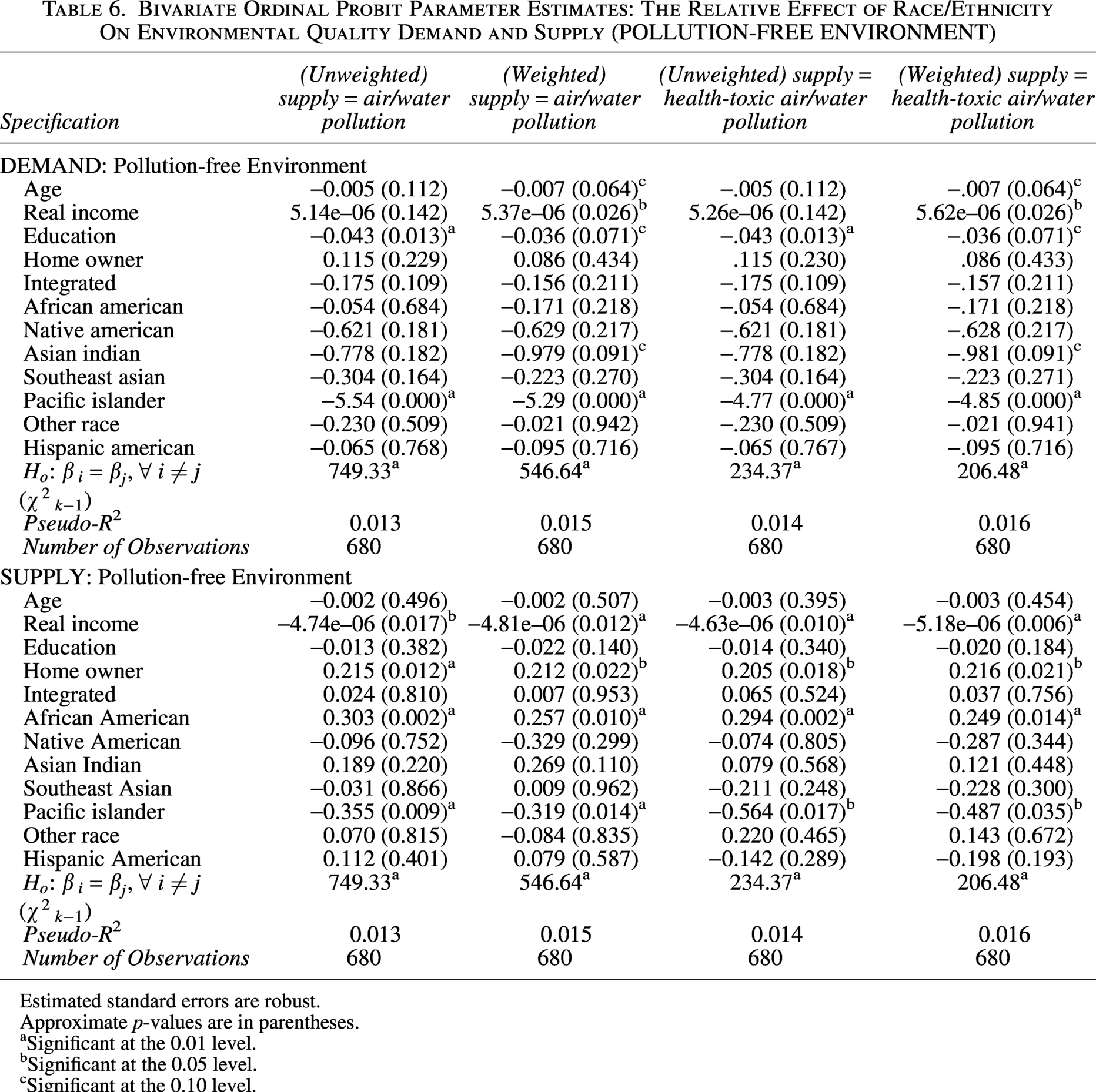
Bivariate Ordinal Probit Parameter Estimates: The Relative Effect of Race/Ethnicity On Environmental Quality Demand and Supply (POLLUTION-FREE ENVIRONMENT)
Estimated standard errors are robust.
Approximate p-values are in parentheses.
Significant at the 0.01 level.
Significant at the 0.05 level.
Significant at the 0.10 level.
As long as the either or both of the row vectors of covariates are not perfect indicators of the latent
The pseudo-R2’s for all the parameter estimates in Tables 3–6 are low, suggesting that our specifications are a poor fit relative to a Null model with no regressors. However, the pseudo-R2 is based upon a pseudo-likelihood of the specifications, which only approximates the true likelihood function for the specifications. 32 As pseudo-likelihoods estimates are biased relative to standard likelihood estimates the pseudo-R2 also is also a biased measure of fit 33 . In this context, the chi-square test for the joint zero equality of all the estimated parameters is likely a better measure of the adequacy of the specifications—and the null hypothesis that the parameters are jointly zero is always rejected in all the specifications.
As White Americans are the excluded racial group in our specifications, the included racial/ethnic classifications capture the demand and supply effects of non-Whites relative to Whites. Given that low values of each of our demand variables indicate stronger demand for the environmental quality under consideration―see Table 2―if a particular racial/ethnic dummy variable has a positive (negative) sign, it suggests that relative to Whites, non-Whites have lower (higher) demand. For the supply specification, higher ordinal values indicate lower supply, so a positive (negative) sign on a particular racial/ethnic dummy variable suggests that relative to Whites, non-Whites have lower (higher) supply. A statistically insignificant or zero value for a particular racial/ethnic dummy variable suggests no differences in demand or supply relative to Whites. The pattern of sign and significance informs conclusions about environmental justice based upon our theory-based taxonomy in Table 1.
Table 3 reports weighted and unweighted parameter estimates for the demand and supply of clean air across the two measures of supply. Following the taxonomy of environmental justice in Table 1, relative to Whites, the parameter estimates suggest that with respect to clean air the distribution of environmental justice is “just” for Native Americans, and Asian Indians. For African Americans, Southeast Asians, and Other Race, the parameter estimates suggest that the distribution of environmental justice is “unjust.” With respect to relative environmentally unjust outcomes for Hispanic Americans, the parameter estimate suggests that while Hispanic Americans and Whites have no difference in the demand for clean air, Hispanic Americans have―as indicated by the estimated supply function in two instances―a relatively higher supply of clean air. Thus, relative to Hispanic Americans, the distribution of clean air is “unjust” for White Americans.
Parameter estimates for the demand and supply of clean water across the two measures of supply are reported in Table 4. The parameter estimates suggest that with respect to clean water, it’s distribution is “just” for Southeast Asians, Pacific Islanders, Other Race, and in one instance for Native Americans across both measures of supply. For Asian Indians, Pacific Islanders and at least on average for Hispanic Americans, the parameter estimates suggest that the distribution of clean water is “unjust.” For African Americans, and in at least one instance for Native Americans and Hispanic Americans, the parameter estimates suggest that the distribution of clean water is “unjust.” With respect to Asian Indians, their relatively lower demand for clean water is not offset by a lower supply, suggesting that relative to Asian Indians, the distribution of clean water is “unjust” for White Americans. For Hispanic Americans, the signs on the parameter estimate suggests that while they have no difference in the demand for clean air, Hispanic Americans have―as indicated by the estimated supply function in two instances―a relatively higher supply of clean air. Thus, relative to Hispanic Americans, the distribution of clean air is “unjust” for White Americans.
Table 5 reports parameter estimates for the demand and supply of environmental protection across the two measures of supply. The parameter estimates suggest that with respect to environmental protection its distribution is “just” for Asian Indians, Pacific Islanders, Other Race, and Hispanic Americans across both measures of supply. For African Americans, the parameter estimates suggest that the distribution of environmental protection is “unjust.” For Native Americans, and in one instance for Southeast Asians, the signs on the parameter estimate suggests that while they have no difference in the demand for environmental protection relative to White Americans, they have a relatively higher supply of environmental protection. Thus, relative to Native Americans and Southeast Asians, the distribution of environmental protection is “unjust” for White Americans.
Parameter estimates for the demand and supply of a pollution-free environment across the two measures of supply are reported in Table 6. The parameter estimates suggest that with respect to a pollution-free environment, the distribution is “just” for Native Americans, Southeast Asians, Pacific Islanders, Other Race, and Hispanic Americans. For African American, and in two instances for Asian Indians, the parameter estimates suggest that the distribution of a pollution-free environment is “unjust.”
In general, the parameter estimates in Tables 3–6 suggest that relative to Whites, the distribution of environmental quality is unjust for African Americans, Native Americans, Asian Indians Southeast Asians, and Other Race. Given the taxonomy in Table 3, the parameter estimates do suggest that in some instances, in particular specifications, the distribution of environmental quality is unjust for Whites with respect to Native Americans, Asian Indians, Southeast Asians, and Hispanic Americans. The preponderance of the findings for African Americans suggest that among non-Whites, they are the racial/ethnic group subject to the most environmental injustice. This suggests that there may be racial/ethnic discrimination in the provisioning of environmental quality (Christensen, Sarmiento-Barbieri, and Timmins, 2002), particularly as it relates to African Americans.
CONCLUSION
With data from the 2018 U.S. GSS linked with regional environmental quality data, this article considered a new supply and demand theory of environmental justice. We test an economic supply and demand model to determine if after accounting for equilibrium sorting in the market whereby individuals make their optimal housing-environmental amenity choices, race/ethnicity matter for the demand and supply of environmental quality, and the distribution of environmental justice. Parameter estimates from Bivariate Ordinal Probit specifications of the demand and supply of environmental quality revealed that relative to White Americans, the distribution of environmental quality is unjust for African Americans, Native Americans, Asian Indians, Southeast Asians, and other races. For African Americans, the preponderance of environmentally unjust outcomes across our measures of environmental quality suggests that they are the racial/ethnic group subject to the most environmental injustice and subject to racial/ethnic discrimination in the provisioning of environmental quality. This suggests that while there may be “market justice” with respect to the allocation of environmental quality, it does not constitute an outcome of environmental justice, as race/ethnicity appears to matter for the supply and demand of environmental quality.
There are at least three noteworthy limitations of our analysis. First, the GSS environmental quality demand proxies we deploy are stated preferences, which may be biased measures of actual preferences, resulting in biased parameter estimates. However, as revealed preferences are positively correlated with stated preferences 34 , our use of stated preferences as actual demand may constitute an approximation of actual demand with little or no bias. 35 Lastly, our measure of the supply of environmental quality has low geographical resolution, as it is constructed on the basis of the lowest level of geographical resolution possible―census divisions―in the publicly available GSS. This coarse level of supply aggregation may mask significant variation across the communities in which individuals live. In this context, our parameter estimates may render an inference about the demand and supply of environmental quality that constitutes an ecological fallacy―an erroneous inference of individual demand behavior on the basis of highly aggregated supply measures. 36 However, to the extent that the inclusion of individual covariate information for highly aggregated measures reduces or eliminates ecological bias―which we include as regressors in our low geographic resolution supply measures―our parameter estimates may not suffer from any significant bias. 37 A fruitful avenue for future research on environmental justice with GSS data would be to secure private information from GSS respondents on their specific place of residence, to link them to the supply of environmental quality that face at a more fine-grained community level—perhaps with U.S. EPA region/community specific data on measures such as particulate matter, air quality, etc. 38 Finally, race-specific environmental outcomes are not necessarily an individual discrete act of optimizing malicious intent. They may reflect a deeply embedded structural phenomenon operating perhaps through white privilege or racial capitalism. 39 As we do not account for the structural nature of racism, there could be some bias in our results. However, as our parameter estimates are correlations that do not account for structural socioeconomic processes, they at least inform the extent to which race is a possible causal determinant of environmental justice. 40
Our findings provide reasons as to why the changes implemented by the current U.S. Presidential administration to the U.S. Environmental Protection Agency equity action plan should raise concerns. 41 The initial action plan articulates as EPA policy objectives, policy interventions to promote and embed environmental justice at the federal, tribal, state, and local levels. In addition, the action plan calls for the strengthening of civil rights enforcement in communities with environmental justice concerns. The proposed recent changes to the EPA’s policies deemphasize, and remove considerations of race-specific environmental justice initiatives in favor of “colorblind” and “merit-based” approaches. This includes, the termination of the EPA’s Diversity, Equity, and Inclusion programs and offices, and the national Office of Environmental Justice and External Civil Rights. 42 Our parameter estimates suggest that as race/ethnicity continues to condition the distribution of environmental justice, there still remains an unmet demand for environmental quality in the U.S. among non-Whites. As such, the recent EPA policy reversals on deprioritizing environmental justice is not warranted, and environmental policy that acknowledges the intersection of race/ethnicity, civil rights, and environmental justice are still needed.
AUTHOR’S CONTRIBUTIONS
G.N.P.—the sole author—was solely responsible for review and editing, conceptualization, securing necessary data, formal econometric/statistical analysis, revisions, and methodology.
Footnotes
AUTHOR DISCLOSURE STATEMENT
No competing financial interests exist.
FUNDING INFORMATION
Partial funding for the research was provided by the E Pluribus Unum Fund.