






Abstract
Our goal is simple but powerful to ensure that the communities most impacted by pollution finally have access to the environmental data that affects their lives. This tool will support community-driven solutions to harmful environmental conditions and severe climate risks. This portal is the first of its kind to be built on the recommendations of environmental justice communities.
BACKGROUND
The Mississippi River Chemical Corridor, commonly known as Cancer Alley, stretches along the river from Baton Rouge to New Orleans and includes one of the highest concentrations of petrochemical and refining facilities in the United States. Spanning roughly 85 miles, the corridor is home to more than 200 industrial plants and produces approximately one-quarter of the nation’s petrochemicals. For decades, industrial facilities have been built alongside residential communities, often in areas with limited political and economic power. This clustering has resulted in sustained exposure to air pollution, hazardous chemicals, and industrial risks over time. As new facilities and expansions continue to be proposed, the corridor illustrates how historical siting decisions and cumulative impacts shape present-day health and environmental conditions across multiple parishes. Cancer Alley, like similar areas around the country, presents countless health-related concerns for African Americans and People of Color living in the corridor, which have been recognized and acknowledged as the product of Environmental Racism by the U.S. Environmental Protection Agency (EPA; 1992) in several national publications, as well as, PROPUBLICA (October 2022) and the American Civil Liberties Union (ACLU) of Louisiana (March 2021), to name a few. Over the course of several decades, major chemical plants/corporations have been allowed to pollute this area, creating grave health risks, leading to illness, health care disparities and increased mortality. Leaders within local CBOs, residents, the Deep South Center for Environmental Justice (DSCEJ), and Intellectual Concepts, LLC, have been working vigilantly and collaboratively toward mitigating and ultimately eradicating the negative impacts of these chemical plants and the tremendous deleterious impact on those communities. Although community leaders have been fighting for change for more than 30 years, there’s still a preponderance of work to be done. In effort to make an indelible impact and to foster and drive marked change, it is critical to empower the residents within the communities with pollution data and education to interpret the data in order to be an integral part of the change that must occur. In a series of recent and extensive “needs assessment” interviews, conducted in November 2022, by Intellectual Concepts, LLC and The DSCEJ, the data from leaders of the seven Community-Based Organizations (CBOs) unanimously reported a data, knowledge, and comprehension gap among residents within the affected communities. The multifaceted challenge warrants the creation and development of a user-friendly data hub, specifically designed to arm the residents with pertinent information that will be easy to decipher and comprehend and equip them to confidently convey it to fellow residents and key decision makers in government and personnel at the large corporations.
INTRODUCTION
A key component of DSCEJ’s Communiversity Model3 is access to relevant data to support CBOs’ assessment of the most pressing environmental-related issues; thereby bolstering the community-centered expertise inherent to living in the places where they raise families and work, allowing them to advocate effectively for solutions that genuinely address their concerns. In addition, such a data platform becomes a key research tool as the CBOs move through the various levels of the Communiversity Model. The Communiversity Model is distinctive at its foundation, based on community-driven solutions. Its “Knowledge to Action” design empowers communities to engage in the democratic process by amplifying their voices and presenting data supporting these solutions.
The customized Environmental Justice Data Action Portal (EJDAP) meets the residents and leaders within the community where they are intellectually. It provides them with data, knowledge, and resources, for them to act now on issues impacting their communities not only today but also for years to come. This user-friendly, readily accessible data portal is populated with robust and relevant critical content based on feedback and results of a needs assessment conducted at the beginning of the development of the portal and includes data, ranging from historical metrics, health and economic impact data, air quality metrics, training on story mapping of blighted properties, analyzing pollution data, and zoning and permitting to understanding the cumulative impact and correlation to health issues.
SYSTEM
Needs assessment
EJDAP’s development follows a system engineering process approach in delivering the software and data management systems. Through this user focus approach, we have elicited user needs from various stakeholders, particularly CBOs currently working with DSCEJ. These needs were captured through a series of 45-minute to 1-hour interviews.
User needs identification
A user need is an expression of the required capability of the system, expressed in generic (i.e., nonsolution oriented). In this process, a survey questionnaire was developed and, using existing DSCEJ community partners, conducted interviews to elicit input on types of data and tools to be incorporated into the development of the EJDAP. These interviews were conducted virtually with 7 CBOs over three months. A sample of the survey vehicles used is provided in Appendix A.
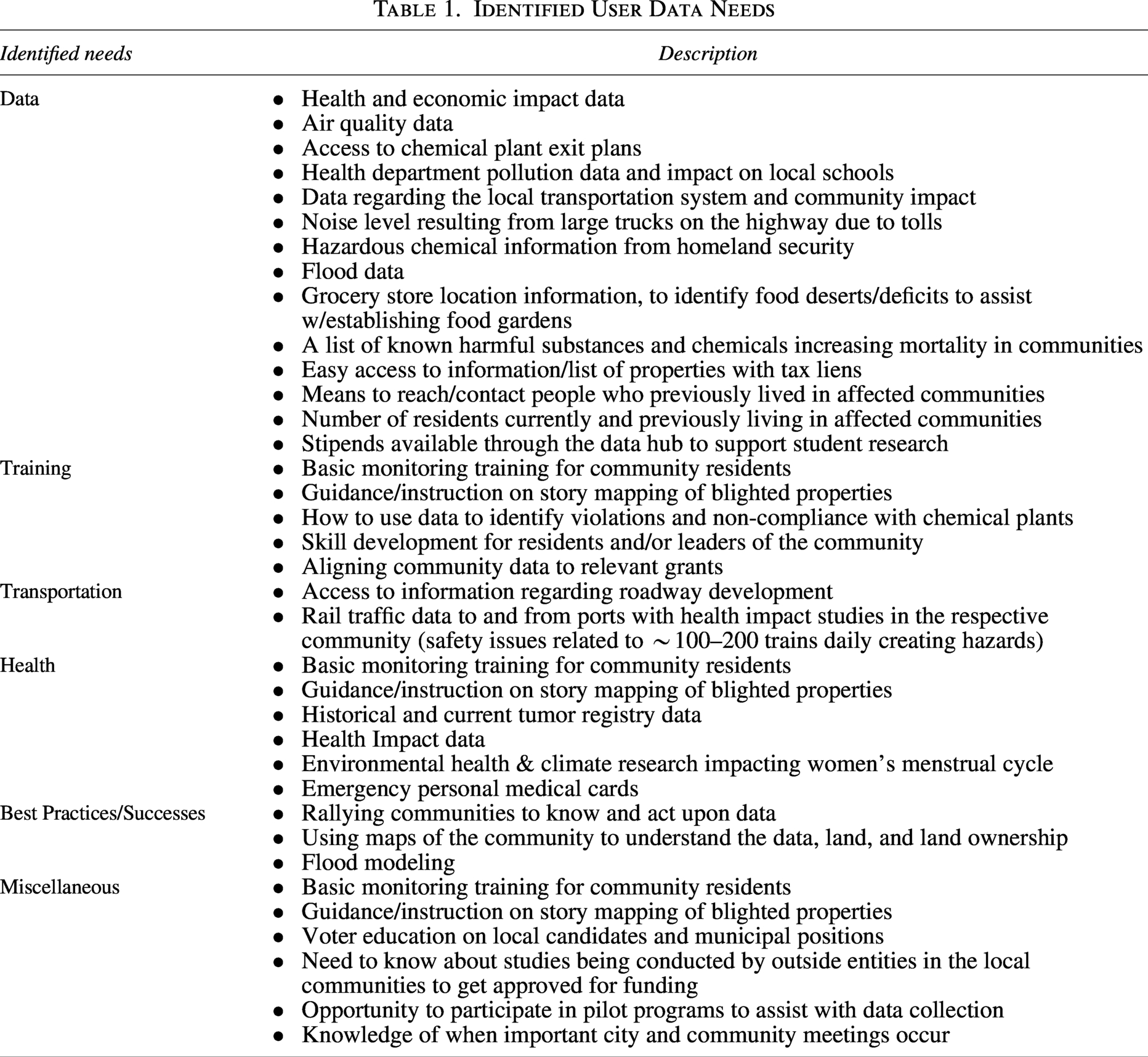
After all the initial interviews, the results, shown in Table 1, were summarized and presented to the participating CBOs. This allows participating CBOs to rank the various needs in the order of importance to their respective communities.
Summary of all identified user needs
The data from leaders of the seven CBOs unanimously reported a data, knowledge, and comprehension gap among residents within the affected communities. The following are the compiled user needs for data, support, and training.
Needs ranking
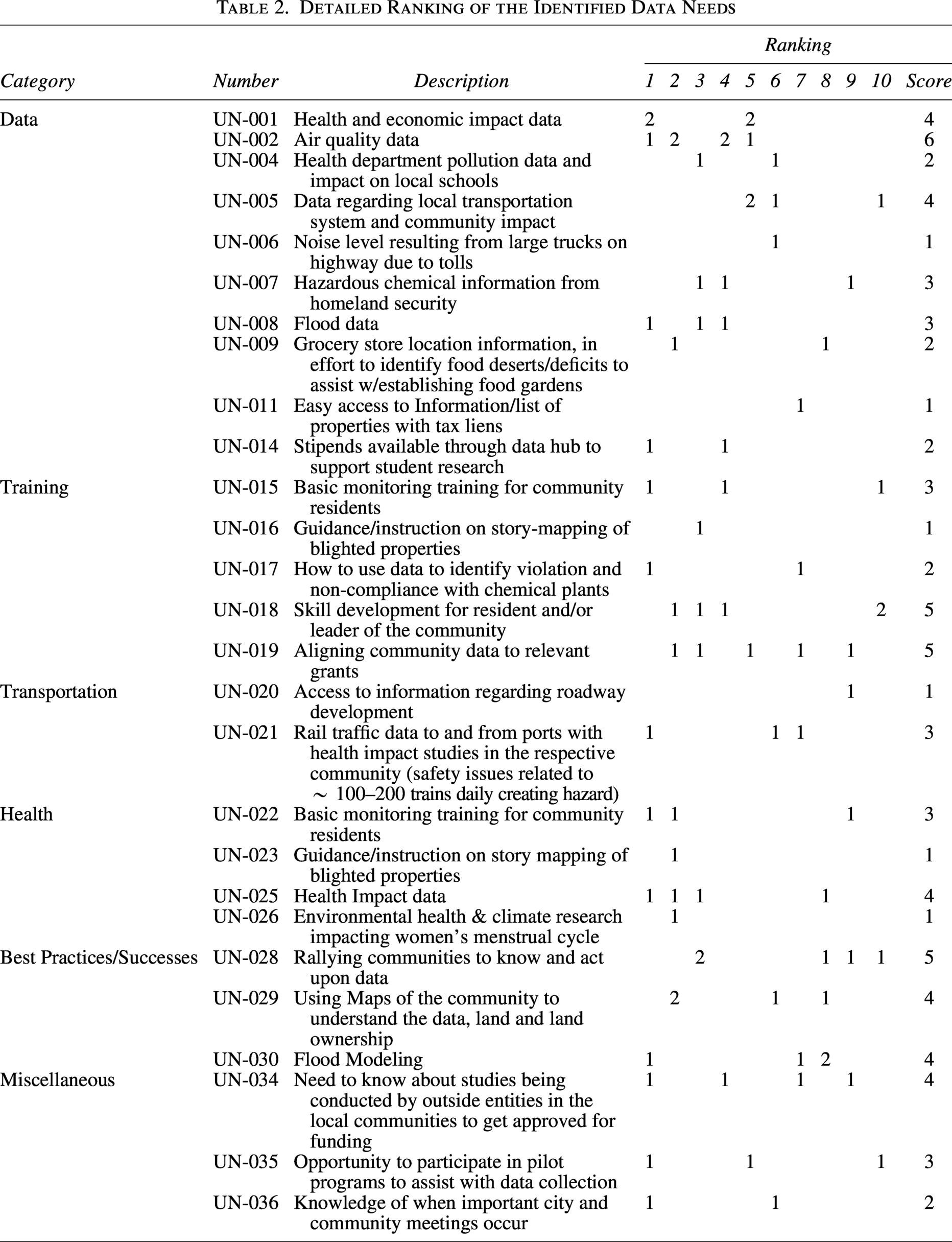
The participating CBO were requested to rank the top 10 needs from the 36 needs identified during interviews. The detailed ranking is shown in Table 2.
As is evidence from Table 2, some of these needs cannot be met within the scope of the current available funding. These needs will be addressed in a follow-up phase with additional funding. The data incorporated into the current EJDAP deployment focuses on available federal data from agencies such as EPA, CDC, Census, and private data, where an agreement to share data currently exists. Of course, in 2025, some of these data from EPA are no longer available.
Environmental justice data action portal
EJDAP is a data-sharing tool designed primarily for CBOs, as a platform for collaboration among CBOs and community residents for the sharing of best practices and providing easy access to and translating complex data in a user-friendly format. It is an online portal that merges six distinct, rich databases outlined below, which have traditionally been used by researchers but have tremendous potential to add value to the work of EJ communities throughout the United States.
Currently featured datasets
Greenhouse Gases—Explore locations where industrial facilities release greenhouse gas emissions contributing to the climate crisis. These data can be used to help understand emission sources and trends, assess reduction goal progress, and develop policies and strategies.
Toxic Release Inventory—Explore location data on toxic chemical releases. These data can be used to track pollution, study health impacts, raise community awareness, enforce regulations, and shape policies.
Social Vulnerability Index—Assess an area’s vulnerability to natural disasters and other hazards. These data can be used to identify areas’ needs for support and guide resource allocation for disaster preparedness and response.
Environmental Justice Index—Explore environmental justice disparities within communities and pinpoint areas facing disproportionate environmental burdens. These data can be used to guide policymaking, resource allocation, and community advocacy efforts for equitable environmental protection and public health initiatives.
Climate and Economic Justice Screening Tool—Identify how communities rank in their experience of cumulative burdens in the categories of climate change, energy, health, housing, legacy pollution, transportation, water and wastewater, and workforce development. These data can be used to help identify disadvantaged communities that will benefit from federal investment. These data are no longer available from the federal government.
PHAROS Health Database—Explore this comprehensive, independent database identifying and assessing the toxicity and potential hazards of various chemicals and materials. Health impacts for all hazardous chemicals released based on Toxics Release Inventory reporting are provided. These health impacts are classified into six major categories based on the data available from the Pharos database: (1) carcinogenicity, (2) reproductive toxicity, (3) skin sensitization, (4) development toxicity, (5) eye irritation, and (6) skin irritation. These data can be used to advocate for safer practices, educate community members on potential hazards, and engage with local authorities and decision-makers.
Although the data from these sources is publicly accessible, (1) the process for accessing the data is onerous, (2) in their available form they are not easily understandable to a lay person, and (3) they are not designed in the context of the potential uses/needs of Environmental Justice (EJ) communities. The design uses a custom Application Programing Interface (API) to merge these disparate data sources and presents these data (via reports, graphs, etc.) in a simple way. The portal meets the needs of EJ communities/leaders and will be interactive—allowing users to easily run queries and conduct research that is relevant to the specific needs of their communities.
The EJDAP architecture
The underlying architecture of the platform is shown in Figure 1. In addition, built into the platform is an option that allows a user to browse the platform based on their zip code. Any user can browse the portal to see the conditions within the areas covered by the zip code in which they live.
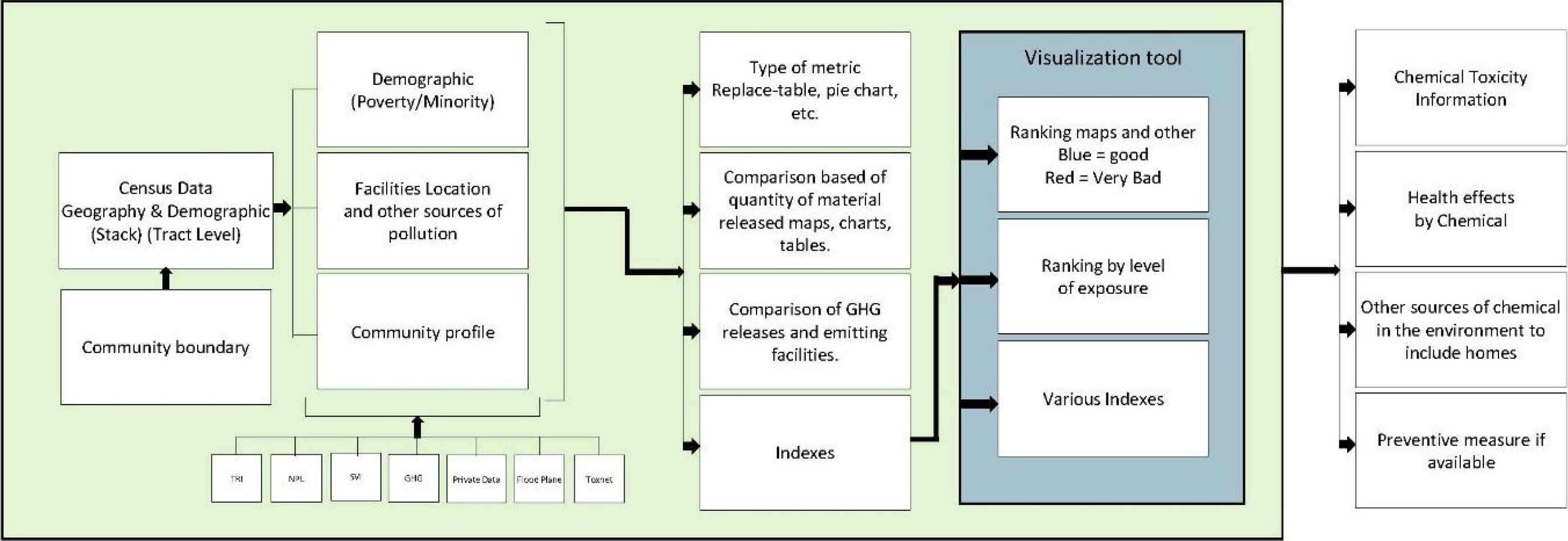
Environmental justice data action portal architecture.
Identified User Data Needs
Detailed Ranking of the Identified Data Needs
The secured CBO area within the portal provides CBOs storage space uploading and storage of any community-gathered data after an internal quality review by DSCEJ. This provides CBOs with a structured way to showcase their work, access research materials, and share best practices with peer organizations.
The EJDAP is accessible at https://EJDAP.ORG
Footnotes
Appendix A: Needs Assessment Survey Questions
What types of data does your organization use? Does your organization generate any of its own data? If so, please describe. How does your organization use data?
Does this include holding industrial companies in your community accountable? Where do you go to find data on health, environment, climate, or other issues of concern to your community? Are you familiar with EJ SCREEN, CEJST, and other environmental mapping tools? Are you aware of any data used by a governmental agency, university, or the news media about your community? Do you find data difficult to access or use? If so, please describe the difficulty. What ways do you think data can be easier to access and use by your community? What would you like to see improved about access to and use of data to make the case for change? What specific data needs do you have to help you hold industrial companies accountable? Would you be interested in more training in your communities on data tools and resources? [Reserved for other questions].