







Abstract
This paper delves into the largely unexplored terrain of how principles from maternal theory can be instrumental in cultivating an ethics of care within learning relationships. Traditional research in Human Resource Development (HRD) and Adult Learning has often emphasized identity-based developmental relationships, with a focus on race and gender. However, the maternal identity, despite its profound impact on individual and collective behaviors, has not been significantly addressed as a core identity within these relationships. This paper aims to bridge this gap by exploring the role of maternal practice as a pivotal element in fostering an ethics of care. Through an analysis of three key components of maternal practice—maternal thinking, motherwork, and othermothering—this paper explores how maternal practice can transform learning and development practices by enriching an ethics of care. We argue that embracing maternal practice in learning relationships not only deepens understanding but also enhances the efficacy of care strategies, ultimately contributing to more compassionate and effective practices within our discipline.
Keywords
Introduction
Human Resource Development (HRD) and Adult Learning have long navigated the intricate terrains of developmental relationships, emphasizing the importance of identity in shaping these connections (Collins, 2012; Ghosh & Hutchins, 2022). Traditionally, research in these fields has focused on identity-based development relationships, with an emphasis on race and gender (Bierema et al., 2022; Ghosh & Hutchins, 2022) and these critical dimensions have been extensively analyzed to understand their implications for personal and organizational development. However, one significant aspect of identity—maternal identity—has been overlooked despite its profound potential to influence individual and collective behaviors in learning environments and workplaces. While the maternal experience has been studied in broader educational and organizational contexts, (Ghosh & Chaudhuri, 2023), including academia (Cahusac & Kanji, 2014; Huopalainen & Satama, 2019; Ward & Wolf-Wendel, 2004), the concept of “maternal practice,” rooted in the practices of mothering, offers a robust framework for instilling an ethics of care in developmental relationships broadly, and learning relationships specifically. Maternal practice is characterized by responsiveness, responsibility, and attention to needs, traits that foster an environment where empathy and mutual respect are paramount (Ruddick, 1980). When these maternal attributes are incorporated into both Adult Learning and HRD practices, they hold the potential to revolutionize traditional learning and development paradigms, shifting the focus toward relational depth and ethical sensitivity.
This paper aims to bridge the gap in HRD and Adult Learning literature by introducing a conceptual framework that places maternal principles at the forefront of fostering an ethics of care in learning relationships. By drawing on three key components of maternal practice—maternal thinking, motherwork, and othermothering, this work explores how these maternal dimensions can transform both individual learning experiences and organizational care strategies. The integration of maternal practice is significant as it alters the existing landscape of developmental relationships and aligns with broader societal shifts toward recognizing and valorizing care work typically associated with maternal roles (Bahn et al., 2020; Maher, 2010; Power, 2020). Specifically, this paper delves into how maternal principles can be instrumental in cultivating an ethics of care within learning relationships in both educational and professional contexts. This paper argues that embracing maternal values in developmental relationships deepens understanding and catalyzes a broader cultural shift towards more empathetic and sustainable practices within HRD and Adult Learning. The goal of this paper is to advocate for more compassionate and effective learning environments and organizational cultures, where developmental relationships foster ethical connections that reflect maternal virtues, suggesting a paradigm shift toward more inclusive, ethical, and supportive practices.
Literature Review
Maternal Practice
Maternal practice encompasses a set of ethical, relational, and developmental activities rooted in caregiving, typically associated with mothering but applicable to a wide range of human relationships. Of importance to note is that maternal practice within maternal theory focuses less on motherhood as an institution, and more on theorizing mothering as a human experience, which makes it accessible to groups beyond biological mothers (O’Reilly & Ruddick, 2009). In fact, Ruddick’s (1995) foundational work on maternal thinking conceptualizes mothering not as a biological imperative but as a deliberate, reflective, and moral practice. Specific to the scope of our argument, Confortini and Ruane (2014) note that maternal practices “recognize how the process of knowing is dependent on relationships and caring labor, as well as locality or context,” (p. 73) supporting our conceptualization of the alignment between maternal practices, ethics of care and learning relationships.
This broader framing allows maternal practice to serve as a conceptual bridge between personal experience and institutional structures in learning and development environments. To this point, this framing of maternal practice has informed scholarship on peacebuilding (Confortini & Ruane, 2014), knowledge creation (Ruddick, 1980), and leadership ethics (Nicholson & Kurucz, 2019). Through these incorporations of maternal theory, caregiving becomes a framework for ethical reasoning and relational learning that extends beyond the domestic sphere. Maternal practice, then, is a mode of engagement characterized by attentiveness to others’ needs, responsiveness, and responsibility—qualities that align closely with adult learning and HRD values such as empathy, dignity, and human development (Armitage, 2018). For the purposes of this research, we explore the following three key components of maternal practice—maternal thinking, motherwork, and othermothering, which are described in detail below.
Maternal thinking, as described by Ruddick (1980), is a form of cognitive and ethical reflection cultivated through caregiving. It includes three core commitments: preservation, growth, and social acceptability of the child. These commitments require ongoing ethical decision-making and situational responsiveness—skills also central to effective learning facilitation and HRD practice. McGuire et al. (2021) highlight the relevance of these traits in post-pandemic organizational contexts, where a contextual and human-centered approach is increasingly necessary. When applied to adult education, maternal thinking can guide educators and HRD professionals toward practices that prioritize learner well-being, adaptability, and emotional intelligence (Brooks & Nafukho, 2006; Farnia & Nafukho, 2016). Moreover, maternal thinking resonates with humanistic leadership principles that emphasize authenticity and ethical care (Bierema & Callahan, 2014). It provides a relational lens through which adult development is viewed not merely as skill acquisition, but as ethical growth supported by empathetic guidance.
Motherwork, theorized by Collins (2021), expands the notion of care from the personal to the political, underscoring how caregiving is central to community survival and social justice. This concept is especially relevant in contexts of racial, economic, or structural marginalization, where caregiving becomes a form of resistance and empowerment. Motherwork involves both immediate nurturing and long-term vision—what Collins calls “work for the day to come”—and is inherently collective in nature. Within educational settings, motherwork informs pedagogical approaches that are transformative and community-driven (Bierema & D’Abundo, 2004; Boyd & Myers, 1988). In HRD, it supports the integration of care into leadership and organizational ethics, especially in programs focused on equity and employee well-being (Bierema & Callahan, 2014; Kuchinke, 2017). By focusing on group empowerment, motherwork reframes HRD’s focus from individualized productivity to communal sustainability and equity. It is a critical intervention that realigns developmental goals with broader ethical imperatives.
Othermothering, also conceptualized by Collins (1991), refers to the practice of women—particularly in African American communities—assuming mothering roles for children who are not biologically their own. It is a tradition rooted in collective care, kinship networks, and survival in the face of structural inequities. In learning contexts, othermothering models how care can be distributed among educators, peers, and mentors, challenging the hierarchy often inherent in formal education (Sheared, 2023). Othermothering also has implications for HRD, particularly in mentoring models and employee resource groups that rely on mutual support and shared leadership (Byrd, 2022). It encourages a team-based and community-oriented approach to employee development that centers inclusivity and psychological safety. As such, othermothering represents a powerful framework for building learning relationships that are not only supportive but deeply ethical and structurally conscious. Its communal ethos reinforces the broader aims of maternal practice by embedding care into both organizational culture and developmental processes.
On the one hand motherhood is inextricably linked to issues of gender and power (Ruddick, 1983). Although “powerless mothers are also powerful” in the one on one relationship with their children, Ruddick (1983) states that “in most societies, … women are socially powerless in respect to the very reproductive capacities that might make them powerful,” underscoring an inherent tension within experiences of motherhood and its standing in our culture (p. 102). However, there are essential qualities embedded within the act and experience of mothering that are more broadly relevant to human relationships within both personal and professional life. Furthermore, while we acknowledge the intersectionality of mothering that can lead to a diversity of experiences, we believe that theorizing for developmental relationships should incorporate maternal practice, since “the experiences of mothers and the mothering practices involved in the caring for children—at whatever level of ‘success’ or ‘failure’—highlights the inescapability of relational contexts” (Confortini & Ruane, 2014, p. 71).
Identity Based Developmental Relationships
Developmental relationships are cornerstones of significant experiences within Adult Learning and HRD practice, including mentorship (Hezlett & Gibson, 2005; Jeong & Park, 2020; Thurston et al., 2012), training and development (Chaudhary et al., 2012; Sekgala & Holtzhausen, 2016) and career development (Gisbert-Trejo et al., 2018). Ghosh and Hutchins (2022) state that relationships are considered “developmental” when they promote “interdependent generative connections that result in growth and learning among individuals” (p. 1). These types of connections within enriching relationships have been seen as related to a variety of organizational dimensions including performance outcomes (Scandura & Hamilton, 2002) and employee engagement (Susanto & Sawitri, 2022; Welsh & Dixon, 2016). Given Critical HRD’s interest in understanding how identities shape experiences of professional work, there has been an increased focus on identity-based developmental relationships (Warhurst & Black, 2019), but most of this specific literature that examines identity and its role in mentoring and other developmental relationships has focused primarily on race and gender (Manongsong & Ghosh, 2023; Murrell & Onosu, 2022; Tolar, 2012).
Excluding maternal identity in both research and practice homogenizes the experiences of women in ways that run counter to intersectionality theory and do not provide adequate context or information for understanding mothers’ lived experiences. While common discourse may broadly discuss “women” at work and imply that their experiences are the same, intersectionality theory tells us that the intersecting identities of race and class, among others, alter women’s experiences. The same is true of mothers who, when explored as a subset of women, face different challenges. Organizational research indicates that the experiences of women without children and mothers vary significantly in terms of the changes they experience in their physical bodies related to pregnancy and new motherhood (Gatrell, 2013) pay rates and the phenomenon of the “motherhood penalty” (Benard & Correll, 2010), discrimination (Bornstein et al., 2012; Cheung et al., 2022), retention (Cahusac & Kanji, 2014) and the perceived lack of commitment to their work (Burgess, 2013).
Ultimately, while critical HRD scholarship has emphasized race and gender in developmental relationships, the role of maternal identity—especially when intersecting with these dimensions—remains underexplored. Maternal identity disrupts dominant developmental models by revealing the implicit expectation that ideal workers and mentees remain unencumbered by caregiving responsibilities. For mothers, particularly women of color, participation in mentoring or leadership development may be limited not by capacity but by structural exclusion from informal networks and flexible resources (Cahusac & Kanji, 2014; Gatrell, 2013). This intersection reveals how developmental relationships are shaped not just by who is invited to the table, but by who is positioned to stay. Centering maternal identity in these frameworks exposes the organizational blind spots that devalue caregiving labor and normalize inequitable access to professional growth.
Learning Relationships
Central to adult learning is the actual transfer of knowledge between the instructor and the adult learner that may occur within a specific type of developmental relationship such as a learning relationship. Fowler and Mayes (1999) state that a learning relationship exists when “we learn from, or through, others” (p. 11). Learning relationships can vary significantly according to the situational context, the characteristics of the individuals or groups involved and the strength of the relationship that exists between the participants. Notably, alongside learning in a variety of group forms, such as teachers and learners and networks or peer groups, Fowler and Mayes (1999) note the learning relationship between “parent and child” as an example of a one-on-one learning relationship (p. 11). Learning relationships can be present within a professional developmental relationship and are focused on the sharing, transfer and development of knowledge.
Merriam and Brockett (2011) emphasize that adult learning is “a cognitive process internal to the learner”: and within the relationship between learner and educator, it is “what the learner does in a teaching-learning transaction” (pp. 5–6). This differentiated approach uniquely situates the values of maternal practice in learning relationships theorizing. Specifically, incorporating maternal identity into learning relationships highlights how caregiving responsibilities reshape the temporal, emotional, and cognitive dimensions of adult learning. Mothers may engage in learning under conditions of constrained time, heightened stress, or institutional expectations that dismiss caregiving as irrelevant to academic or professional success. This produces a different kind of relational need—one grounded in flexibility, empathy, and recognition of competing obligations. The traditional learner-educator dynamic often assumes an idealized adult learner whose availability and priorities mirror those of non-caregivers (Rose et al., 2024). Acknowledging maternal identity thus challenges dominant learning models and invites more inclusive, care-sensitive approaches to relational pedagogy. These insights also align with existing understandings of adult learning, which recognize that learning is often unplanned, incidental, and embedded in everyday life (Merriam & Brockett, 2011). For mothers, caregiving itself becomes a site of experiential learning—one that is practical, collaborative, and deeply contextual. This challenges traditional notions of adult learning as purely voluntary and self-directed (Jacobs & Hundley, 2010), and instead underscores the need for frameworks that value relational and care-based learning as legitimate and formative.
Ethics of Care in Adult Learning and HRD
The conceptual development of an ethics of care is largely credited to Gilligan (1982) whose work centers on ethical issues with a specific look at their relevance to gender. As a general definition, an ethic of care “is a reflective and action-oriented process about learning of the other and demonstrating relationship behavior that seeks to recognize, value, trust, and develop the other” (Hawk & Lyons, 2008, p. 320). While the ethics of care offers a powerful foundation for relational practice, much of the literature treats care as a generalized moral orientation without interrogating who performs care, under what conditions, and at what cost. Maternal identity, especially when situated within systems of racialized or gendered labor, sharpens the distinction between abstract care and embodied caregiving. Scholars such as Collins (2021) and Ruddick (1995) emphasize that maternal practices represent both personal and political commitments shaped by structural inequities. In CHRD, this lens calls for a more critical care ethics—one that includes caregiving labor as both moral work and professional expertise. It also suggests that institutional applications of care ethics must consider material support for caregivers, not merely rhetorical alignment with values like empathy or dignity.
Over time, academic disciplines including nursing (Green, 2012; Vanlaere & Gastmans, 2007; Woods, 2011), adult education (Diller, 2018; McKenzie & Blenkinsop, 2006; Rabin, & Smith, 2013), and business and management (Branicki, 2020; Formentin & Bortree, 2019; Nicholson & Kurucz, 2019) have highlighted what it means to integrate an ethics of care into practice, given Tronto’s (2013) assertion that care is no longer just happening in the home, but extends into various facets of public life and Robinson’s (1997) claim that care is central even to “relations among moral agents on a global scale” (p. 114). As compared to other fields, the literature on an ethics of care in HRD has been somewhat limited, but scholars have noted the connection between the principles of caring ethics and the core values of HRD (Armitage, 2018) and connected the importance of a caring orientation within the field in the wake of the COVID-19 pandemic (McGuire et al., 2021; Rodriguez et al., 2023; Saks, 2021). Within adult education, the ethics of care have been explored as an important framework to be leveraged within adult literacy programs (Morgan-Bowyer, 2017) and adult learning communities (Hedayati-Mehdiabadi & Gunawardena, 2022). For the purposes of this article, Armitage’s (2018) summary of an ethics of care as espousing “values of human relationships, empathy, dignity, and respect” (p. 212) will be leveraged in order to make the connection to mothering principles.
Conceptual Framework
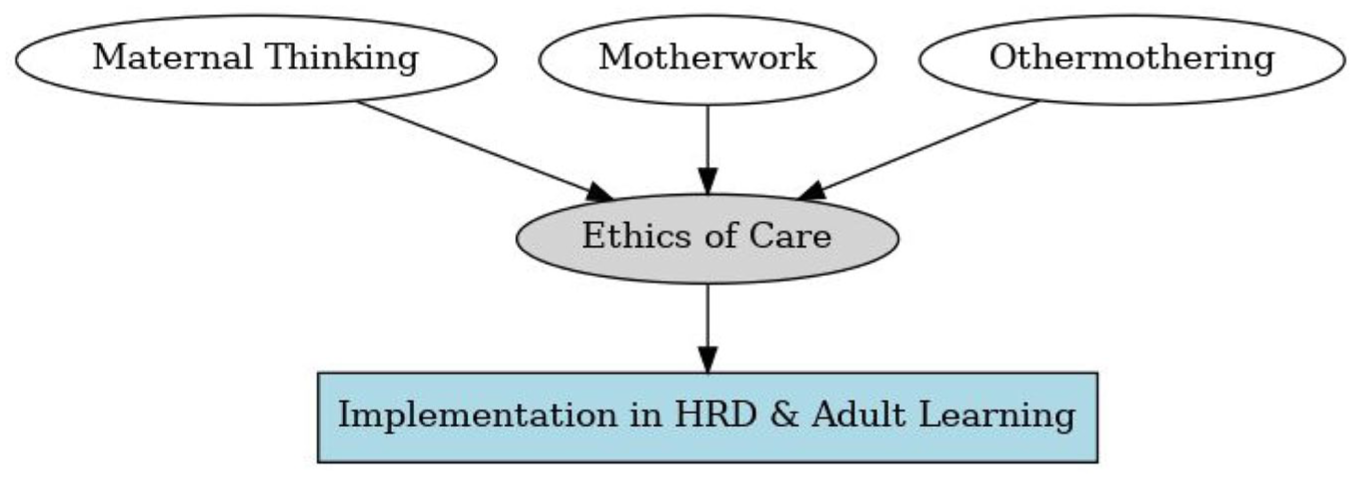
To represent the theoretical connections among the components of maternal practice, we have developed a conceptual framework (Figure 1) that visually maps the relationship between maternal thinking, motherwork, and othermothering, and their collective contribution to the development of an ethics of care. This central ethics of care then informs practical implementation within HRD and Adult Learning contexts. Maternal thinking emphasizes individualized empathy and ethical responsiveness; motherwork grounds care in social responsibility and justice; and othermothering centers collective caregiving and community inclusion. Together, these maternal practices generate a multidimensional ethics of care that challenges performance-driven models in learning and development. The framework highlights that care is not incidental but integral to how individuals grow and thrive in educational and workplace contexts.
Maternal practice in HRD and adult learning contexts.
It is important to note that each arrow in the diagram represents a specific form of influence. For example, maternal thinking contributes reflective, empathetic practices that shape ethical decision-making. Motherwork introduces a political and community-based orientation toward care, advocating for systemic change and collective empowerment. Othermothering extends the circle of care beyond biological boundaries, modeling inclusive, relational development that benefits broader learning ecosystems. These pathways converge on the ethics of care, which then flows into practical implementation across HRD and Adult Learning contexts. This conceptual map reflects a shift from isolated caregiving narratives to a systemic understanding of how maternal values shape professional and educational development. It also offers a foundational structure for future empirical research and theoretical advancement in care-centered learning design.
Discussion
By drawing on three key components of maternal practice—maternal thinking, motherwork, and othermothering—educators and practitioners can create learning environments that are not only effective in promoting knowledge and skill acquisition but also nurturing in ways that support the holistic development of learners. This section explores how each of these components of maternal practice can contribute to the cultivation of an ethics of care in adult learning relationships and the subsequent implications to both adult learning and HRD.
Maternal Thinking: Cultivating Compassionate and Responsive Learning
Maternal thinking, as conceptualized by Ruddick (1980), involves a unique form of reflective practice centered around the needs and well-being of children. It is important to note that when Ruddick conceptualizes maternal in this instance, it is as a social category, similar to our previous reference to race and gender across developmental relationship literature. She notes that “although maternal thinking arises out of actual child-caring practices, biological parenting is neither necessary nor sufficient. Many women and some men express maternal thinking in various kinds of working and care with others” (p. 246). It is from this point that we understand maternal thinking as incredibly poignant as it relates to the skills needed to promote an ethics of care. As noted by Ruddick (1980), through maternal thinking, “many mothers early develop a sense of maternal competence, a sense that they are able to protect and foster growth of their children” (p. 344). This type of thinking prioritizes the preservation of life, fostering the growth of the child, and preparing the child for social acceptance. Ruddick argues that the practice of maternal thinking is not just a set of instinctual actions but a deliberate, thoughtful process that involves making ethical decisions in the best interest of the child. The mother must constantly adapt to the changing needs of the child, demonstrating a commitment to nurturing that is both practical and deeply ethical. The virtues cultivated through maternal thinking—such as patience, empathy, and adaptability—are crucial in creating a supportive environment that allows the child to thrive. Furthermore, maternal thinking promotes the value of women’s ways of knowing, emphasizing that mothers have “cultures, traditions and inquiries which we should insist upon bringing to the public world” (Ruddick, 1980, p. 245).
When applied to the adult context, the reflective and adaptive nature of maternal thinking results in decisions being made with a deep commitment to well-being. This mindset, when applied to adult learning relationships, encourages educators to approach their learners with the same level of care and concern one would show for a child. In this context, an ethics of care is fostered by recognizing and responding to the unique needs, challenges, and aspirations of each learner. Educators who engage in maternal thinking are likely to create learning environments where students feel understood, supported, and valued, which are essential elements of an ethics of care. McGuire et al. (2021) suggest that an ethics of care within the workplace can be used to prioritize a “contextual and personal approach that involves dialogue and recognizes the unique circumstances” of individuals (p. 31).
In practical terms, this means that educators adopt a more personalized approach to teaching, taking into account the diverse backgrounds and experiences of adult learners. They are more likely to employ pedagogical strategies that are flexible and adaptive, allowing learners to engage with the material in ways that are meaningful to them. This approach not only enhances the learning experience but also fosters a deeper connection between educator and learner, grounded in mutual respect and understanding. The ethics of care that emerges from maternal thinking is thus characterized by a commitment to the learner’s holistic development, rather than just their academic or professional success.
Maternal Thinking: Implications for Adult Learning and HRD
In the context of adult learning, these principles of maternal thinking can be highly applicable. Educators who adopt a maternal approach to teaching may find themselves more attuned to the diverse needs of adult learners, who often bring a wide range of experiences, challenges, and expectations to the learning environment. This approach aligns with adult learning theories, particularly those emphasizing the importance of creating a learner-centered environment (Doyle, 2023; Hermans et al., 2013; Memmott & Brennan, 1998). By focusing on the unique needs and circumstances of each learner, educators can create more effective learning experiences that are responsive and adaptable, much like the maternal thinking process that Ruddick describes. This method of teaching not only promotes academic success but also fosters a deeper sense of connection and care between educators and learners.
Furthermore, in HRD, the application of maternal thinking can be transformative. HRD professionals who incorporate these principles into their practice may develop more empathetic and effective training programs, which has been advocated across HRD literature (Kunnanatt, 2012; Lewellen et al., 2022). For example, a maternal thinking approach could support many priorities in HRD including the creation of programs that prioritize ethical decision-making as advocated by Kuchinke (2017), support humanistic leadership styles (Bierema & Callahan, 2014), and foster the development of emotional intelligence (Brooks & Nafukho, 2006; Farnia & Nafukho, 2016). These programs would not only enhance individual performance but also contribute to the creation of a more supportive and ethically grounded organizational culture. The focus on nurturing and responsiveness inherent in maternal thinking aligns with the core values of HRD, which seek to develop individuals in a way that benefits both the person and the organization.
Moreover, the integration of maternal thinking into HRD practices can help organizations navigate the complexities of workforce diversity. As organizations become increasingly diverse, HRD professionals are tasked with creating inclusive environments that respect and respond to the needs of all employees. Maternal thinking, with its emphasis on empathy, adaptability, and ethical care, provides a valuable framework for addressing these challenges. By applying these principles, HRD professionals can design initiatives that are more inclusive, recognizing and valuing the diverse experiences and needs of their workforce. This approach not only enhances employee engagement and satisfaction but also fosters a culture of mutual respect and ethical care within the organization.
Motherwork: Fostering a Communal Approach to Learning
Motherwork, as articulated by Patricia Hill Collins, extends the role of mothering beyond the personal and biological domain to include the social, cultural, and political responsibilities of caregiving through the promotion of social activism and community building. Collins (2021) argues that motherwork is inherently political and communal, as it “recognizes that individual survival, empowerment, and identity require group survival empowerment, and identity” (p. 173). This aspect of motherwork is especially significant in marginalized communities, where systemic inequalities necessitate a collective approach to caregiving and community preservation. In this regard, motherwork represents a “collective-effort to create and maintain family life in the face of forces that undermine family integrity” (Collins, 2021, p. 173). Through motherwork, we engage in practices that resist oppressive structures, advocate for social justice and responsibility, and transmit cultural values and knowledge to the next generation.
With its emphasis on social responsibility and community well-being, motherwork extends the ethics of care beyond the individual to encompass the collective. In adult learning relationships, this means that the educator’s role is not only to support the individual learner but also to foster a sense of community and shared responsibility among learners. By incorporating the principles of motherwork, educators can encourage learners to consider the broader social implications of their education and to engage in practices that benefit not only themselves but also their communities. This communal approach to learning reinforces an ethics of care by promoting values such as solidarity, mutual aid, and social justice within the learning environment. This not only enriches the learning experience but also instills a sense of ethical responsibility that extends beyond the classroom. The ethics of care fostered by motherwork is thus deeply connected to the broader goals of transformative education, which seeks to empower learners to become agents of change in their communities.
Motherwork: Implications for Adult Learning and HRD
Education has long been a vehicle for social change. In the context of adult learning, the concept of motherwork can further inform pedagogical practices (e.g., critical pedagogy, transformative learning theory, liberation education) that emphasize social justice and community engagement. Educators can draw on the principles of motherwork to create learning experiences that not only focus on individual development but also consider the broader social impact of education. By incorporating the values of motherwork into the curriculum, educators can foster a learning environment that supports both personal growth and social responsibility, aligning with the broader goals of transformative education, because as Collins (2021) notes, motherwork is “work for the day to come,” transforming the lives of “one’s own biological children, the children of one’s own racial ethnic community, [and] to preserve the earth for those children who are yet unborn” (p. 173). Transformative education aims to help “individuals work towards acknowledging and understanding the dynamics between their inner and outer worlds,” which for the learner involves the “expansion of consciousness and the working toward a meaningful integrated life as evidenced in authentic relationships with self and others” (Boyd & Myers, 1988, p. 261), holistic ideas about learning which are aligned with the goals of motherwork.
The implications of motherwork for HRD are profound. Bierema and D’Abundo (2004) note that “HRD has a unique opportunity to educate organizations about social responsibility” and “integrate social consciousness into organization activities that could potentially affect significant social change. This involves putting the development of humans back in the HRD equation” (p. 444). While HRD practices often emphasize individual performance improvement towards organizational goals, “there are long term costs associated with failure to provide the resources and infrastructure to support whole person development … [as well as] social costs of such neglect that will impact lives, communities and the environment” (p. 444). It is through the integration of motherwork principles that we can shift this focus toward a more collective, learning-focused approach.
Additionally, by adopting a motherwork perspective, HRD can move beyond traditional diversity training programs to create initiatives that actively address systemic inequalities and support the development of marginalized groups. This perspective emphasizes that care is not just a personal value but a collective and political act, especially within communities historically excluded from dominant organizational narratives. Mentoring programs rooted in motherwork can focus on the unique challenges faced by women of color, acknowledging the intersection of race, gender, and caregiving responsibilities. Leadership development initiatives informed by social justice and community engagement further reinforce the idea that professional growth is intertwined with collective empowerment. Embedding care ethics into leadership training and mentoring frameworks creates a deeper structural support for inclusivity, allowing HRD to shift from surface-level representation to sustained, equitable development.
Moreover, policies that embody the values of motherwork serve as tangible applications of these principles in organizational life. These include comprehensive paid parental leave, childcare access, lactation support, flexible work arrangements, and recognition of caregiving labor in promotion and evaluation criteria. Such policies not only support individual well-being but also reflect an organizational commitment to ethical care and shared responsibility. Community-based initiatives, including advocacy efforts or employee-led networks that elevate caregiver voices, further demonstrate the broader social impact of care-centered policy design. Altogether, these strategies reframe HRD’s purpose—positioning it not solely as a tool for performance improvement but as a means to build ethical, inclusive, and socially responsive workplace cultures.
Othermothering: Learning as a Communal Endeavor
Othermothering, a concept also discussed by Patricia Hill Collins, involves women assuming mothering roles for children who are not their biological offspring. This practice is rooted in the traditions of African American communities, where extended kinship networks and community bonds are essential for survival. Othermothering reflects a collective approach to child-rearing, where the responsibility for nurturing and caring for children is shared among multiple caregivers (Collins, 1991). This practice is not only a response to economic and social pressures but also a manifestation of a communal ethic of care, where the well-being of all children is seen as a shared responsibility. Collins (1991) notes, “given the pressures from the larger political economy, the emphasis placed on community-based child care and the respect given to othermothers who assume the responsibilities of childcare have served a critical function in African-American communities … children who for other reasons have been rejected by their bloodmothers have all been supported by othermothers” (p. 288). Othermothers often step in to provide support, guidance, and care, ensuring that children are raised within a supportive community network.
Othermothering introduces a communal dimension to caregiving that is particularly relevant in adult learning relationships. By embracing the principles of othermothering, educators and HRD professionals can foster a learning environment where care and responsibility are shared within the learning community. This collective approach to care challenges the traditional hierarchical dynamics of teacher-student relationships, promoting instead a model where everyone—educators, learners, and peers—plays a role in supporting each other’s development. In this context, othermothering reinforces an ethic of care where learning is a communal endeavor, where everyone’s success is interconnected. The ethics of care that emerges from othermothering is thus characterized by a strong sense of community, mutual respect, and shared responsibility, all of which are essential for creating a supportive and inclusive learning environment.
Othermothering: Implications for Adult Learning and HRD
As noted above, the principles of othermothering can be applied to create more supportive and inclusive learning environments. The importance of inclusive learning environments has been noted within adult learning. Given the belief that knowledge is socially constructed, it is essential to acknowledge lived experiences across intersections of race, gender, sexual orientation and other identities as individuals emerge from these identities and experiences (Sheared, 2023). Just as othermothers provide care and guidance within their communities, educators, mentors, and peers can play similar roles in supporting adult learners. This communal approach to learning fosters a sense of belonging and mutual support, which is particularly valuable in adult education settings where learners may face significant personal and professional challenges. By integrating the principles of othermothering into educational practices, institutions can create a more inclusive and supportive learning environment that recognizes the diverse needs of adult learners and the importance of community in their educational journeys.
The concept of othermothering also has significant implications for HRD, particularly in the areas of mentoring and professional development. Traditional mentoring models often focus on one-on-one relationships between a mentor and mentee, but an othermothering approach suggests the value of communal mentoring, where multiple mentors provide support and guidance to an individual. This approach can be particularly beneficial in organizations that are committed to diversity and inclusion, as it allows for the sharing of diverse perspectives and experiences, fostering a more holistic and supportive developmental experience for employees. As an example of this, Byrd (2022) discusses the “potential for developmental relationships among members of employee resource groups (ERGs) to influence socially just and morally inclusive organizations” (p. 220). Moreover, in a team setting, the principles of othermothering can be applied to create a culture of mutual support and shared responsibility, where team members actively contribute to each other’s development. This approach not only enhances individual learning but also strengthens team cohesion and collaboration, leading to improved organizational performance. By incorporating othermothering into HRD practices, organizations can create a more supportive and inclusive environment that values the contributions of all employees and fosters a culture of collective growth and development.
Implications
Future Research Implications
This conceptual paper explores how principles from maternal theory can be instrumental in cultivating an ethics of care within learning relationships and how maternal practice can transform learning and development practices. Our analysis centers practices that emerge from African American communities and black maternal experiences. However, it is important to acknowledge that maternal practices, and the experience of mothering broadly, are inextricable from intersections of race, class and cultural context. Systemic inequalities and challenges related to intersecting identities can make the application and resonance of these maternal principles in both HRD and adult education more challenging for individuals to implement and leverage within their own lived experiences. HRD practitioners and adult educators who aim to educate around these topics must be aware of how systemic issues such as access to childcare, education level and wage gaps may contribute to creating extra challenges for individuals with intersecting marginalized identities. Future research building off of this conceptual work should aim to understand how maternal practices differ in historically marginalized communities and privileged communities in order to provide nuance around the specific challenges that these theories present to individuals with intersecting, marginalized identities with the hope of providing adequate support to educators and practitioners.
Further, leveraging an intersectional framework will inevitably raise questions of gender in relation to the implementation of these maternal practices. This manuscript has centered the experiences of mothers and their role in shaping these essential maternal practices, thereby contributing to valuable knowledge creation within this space that has broad applicability to developmental and learning relationships within HRD and adult education and an evolving, broadening scope of care work. Similar to intersectionality theory, which came out of the unique experiences of black women, maternal practices and the way in which we have chosen to explore it, came out of the unique experiences of mothers. While we understand the value and applicability of broadening the discussion of intersectionality in regards to gender, we do not want to lose the essence of these practices and the origins from which they were birthed and subsequently lose valuable insight into these experiences (Alexander-Floyd, 2012; Hancock, 2007). Future research can aim to explore how other caregivers experience or leverage these maternal practices and an ethics of care within their caregiving and their developmental relationships.
Theoretical Implications
Incorporating maternal identity into Adult Learning and HRD challenges existing theoretical assumptions that prioritize autonomy, performance, and hierarchy over interdependence and care. Traditional models of developmental relationships—such as those centered on leadership pipelines, mentorship hierarchies, or human capital theory—rarely account for the emotional and ethical labor embedded in caregiving roles. By introducing maternal thinking, we elevate care as a strategic and epistemological resource rather than a private or secondary concern. This re-centers knowledge production and professional development as relational acts grounded in responsiveness, empathy, and ethical accountability. Theorizing maternal practice therefore pushes the field toward more inclusive frameworks that better reflect the lived realities of those navigating caregiving responsibilities alongside professional growth.
Furthermore, maternal practices—particularly motherwork and othermothering—expand existing HRD and adult learning theories by introducing collective responsibility and resistance to dominant individualist paradigms. These concepts expose how systemic forces such as racism, sexism, and economic inequality shape developmental experiences and access to resources. As such, they align naturally with critical HRD and feminist pedagogies, which seek to dismantle oppressive structures and promote equity. Theorizing maternal identity does not merely add a new variable to existing frameworks; it demands a shift in the questions we ask, the relationships we value, and the metrics we use to define success. Future theoretical development should explore how maternal practices inform alternative leadership models, organizational learning processes, and identity-based mentoring that reflect care as a core principle of adult development.
Conclusions
By integrating and combining the three principles of maternal thinking, motherwork, and othermothering, into learning relationships, Adult Learning and HRD professionals can fundamentally reshape the learning and development landscape. Maternal thinking, with its emphasis on empathy and responsiveness, encourages educators to consider the individual needs of each learner, fostering a deep sense of connection and care. Motherwork broadens the scope of care to include social responsibility, social justice and communal values into their teaching practices. Coupled with the collective approach of othermothering, these principles create a robust framework for nurturing both the intellectual and emotional development of learners.
The ethics of care that emerges from this integration is both comprehensive and transformative. It goes beyond traditional educational models that often prioritize cognitive development and academic achievement. Instead, this ethics of care places equal importance on the emotional, social, and ethical dimensions of learning. By creating environments where learners feel genuinely valued, supported, and empowered, educators can enhance not only the effectiveness of learning and development initiatives but also the overall well-being of their learners. This approach acknowledges that learning is a deeply human process, one that thrives in environments where care and empathy are prioritized. The result is a more inclusive and supportive educational experience that recognizes and responds to the diverse needs of adult learners. Moreover, the incorporation of maternal practices into learning relationships represents a significant shift toward creating educational environments that are ethically and emotionally enriching. As learners navigate complex personal, professional, and social challenges, they require educational spaces that offer more than just intellectual stimulation. They need environments where their whole selves are acknowledged and where they are encouraged to grow not just as professionals but as individuals who contribute to the well-being of their communities. Maternal practices, with their focus on care, community, and practical engagement, provide the tools necessary to build these kinds of environments.
Incorporating these maternal principles into HRD practices also aligns with broader trends in the workplace, where there is an increasing recognition of the importance of emotional intelligence, ethical leadership, and social responsibility. By fostering an ethic of care in HRD, organizations can cultivate a more compassionate and supportive culture, one that values the holistic development of its employees. This not only improves individual and organizational performance but also contributes to a more sustainable and socially responsible business model. As organizations strive to meet the demands of a diverse and globalized workforce, the integration of maternal practices into HRD offers a pathway to creating workplaces that are not only productive but also humane and just.
Ultimately, the integration of maternal thinking, motherwork, and othermothering into adult learning relationships is a powerful step toward a more holistic approach to education and development. It challenges educators and HRD professionals to rethink traditional models of learning and to embrace a more inclusive, caring, and ethical approach. In doing so, it lays the foundation for educational environments that are intellectually stimulating, ethically grounded, and emotionally supportive. These environments, in turn, have the potential to transform not only the lives of learners but also the communities and organizations in which they live and work. The adoption of maternal practices in adult learning and HRD is thus not just a pedagogical shift, but a broader cultural movement toward a more caring, just, and equitable society.
Footnotes

Funding
The authors received no financial support for the research, authorship, and/or publication of this article.
Declaration of Conflicting Interests
The authors declared no potential conflicts of interest with respect to the research, authorship, and/or publication of this article.