







Abstract
Professional development in academic advising is often constrained by limited institutional resources, geographic isolation, and uneven access to training. This case study explores how the Adventures in Advising podcast functions as a tool for professional learning and public-facing scholarship within this context. Drawing on concepts of communities of practice, agency, professional identity, and public scholarship, we analyzed 100 podcast episodes, conducted interviews with avid listeners, and reviewed reflections from the podcast co-creator. Findings reveal a developmental arc in which the podcast expanded access to timely and equitable professional development, fostered community and reduced isolation, supported the transformation of practice and professional identity, and broadened global perspectives on advising. These results demonstrate how podcasting can operate as a participatory and relational form of informal learning, advancing reflection, belonging, and meaning-making in an emerging professional field. Implications highlight the potential of podcasts to democratize professional learning and mobilize knowledge across institutional and international contexts.
Keywords
Introduction
In recent years, the concept of public-facing scholarship has gained significant traction in academia, emphasizing the need for scholars to extend their research and expertise beyond traditional academic circles. This form of scholarship involves engaging broader, engaging broader, non-academic audiences through various platforms, including op-eds, public debates, and digital media (Bartha & Burgett, 2015; Robbins & O’Connor, 2023). This aligns with broader concerns in human resource development (HRD) and adult learning fields about overcoming barriers to knowledge dissemination and practice-based impact.
Among the tools supporting this shift, digital media—particularly podcasts—have become increasingly important for making scholarship more inclusive, accessible, and relevant. Podcasts offer flexible, on-demand access to content and provide an alternative to the often inaccessible formats of academic publishing (DeMarco, 2022; Fox et al., 2021). For listeners, they enable just-in-time learning through narrative, storytelling, and dialogue; for creators, they present an opportunity to curate content, amplify voices, and potentially support the development of communities of practice. Although podcasting is typically one-way communication, it can still contribute to a sense of community through shared content, identity, and ongoing engagement with topics and hosts (Singer, 2019; Wilbur et al., 2022). In this way, podcasts function both as content delivery tools and as catalysts for professional connection and reflection.
This intersection of accessibility, engagement, and professional development is particularly relevant in the field of academic advising. Like other adult learning professions such as student affairs, instructional design, and faculty development, advising relies heavily on practitioner knowledge, but faces structural limitations around access to formal training. Advisers often encounter barriers to professional development due to geographic isolation, time constraints, or lack of institutional support. Podcasts help address these challenges by providing a flexible platform for ongoing learning, sharing innovative practices, and promoting reflection. As both listeners and contributors engage with this medium, they participate in a form of public scholarship that, for some participants, supported both individual and collective development (Abdous et al., 2012; Cook, 2023).
Despite their growing relevance, little research has examined how podcasts operate as a form of public-facing scholarship within adult education and human resource development. This study addresses that gap by investigating how the Adventures in Advising podcast functions as a tool for public scholarship and professional learning. Since its launch in January 2020, the podcast has published 111 episodes, accumulated over 55,000 downloads, and reached listeners in 107 countries and territories. While the United States comprises most downloads (86%), global engagement from Canada, Ireland, the United Kingdom, and Australia further underscores its reach. With 72% of downloads occurring on mobile devices, the podcast reflects the growing appeal of mobile, flexible learning formats in professional communities (DeVet, 2025).
The purpose of this case study is to explore how a professional podcast functions as a tool for public-facing scholarship and professional learning in the context of academic advising. By examining how the Adventures in Advising podcast supports knowledge dissemination, reflective practice, and professional identity, the study contributes to broader conversations about digital media, informal learning, and continuing professional education across adult learning environments. The study is guided by two research questions:
How do listeners describe the podcast’s role in their ongoing professional development and workplace practice?
In what ways does the podcast reflect and promote principles of public-facing scholarship and adult learning?
This study contributes to the growing body of scholarship on informal, digital, and workplace-based learning by positioning podcasting as a one potential site of professional learning and public engagement. We explore how audio-based media can promote knowledge-sharing, community-building, and professional identity formation within a global advising community. In doing so, the study demonstrates the potential of podcasts to democratize access to continuing education and foster reflective practice across professional roles.
Conceptual Framework
This conceptual framework was used to inform the design of the study, the development of the interview protocols, and the analytic lens through which participants’ accounts were interpreted. The framework synthesizes established ideas from adult learning, human resource development, and professional education to understand how podcasting supports informal, practice-based learning. It draws on key concepts—community and participation, agency, professional identity, and public-facing scholarship—to explore how the Adventures in Advising podcast functions as a space for reflection, knowledge exchange, and professional growth. Together, these concepts illuminate how podcasting can promote meaning-making, empower practitioner agency, and foster collective identity within an emerging professional field.
Community and Participation
Wenger’s (1998) Communities of Practice (CoP) framework emphasizes the collective nature of learning. A CoP is characterized by a shared domain of interest, a community of individuals who interact regularly, and a shared practice developed over time. This study draws on CoP to understand how podcast listeners engage with content, connect with each other, and build shared language, norms, and values in the academic advising field. Concepts like legitimate peripheral participation help explain how listeners—especially newcomers—might first engage passively before developing deeper identification and potentially contributing to the community in other ways.
Agency and Professional Identity
This study conceptualizes agency and professional identity as mutually reinforcing processes that unfold through informal learning contexts like podcasting. In academic advising—a profession often characterized by role ambiguity, diffuse entry points, and inconsistent institutional recognition—both constructs are essential for understanding how practitioners develop a sense of purpose and voice. The Adventures in Advising podcast emerged in this study not only as a site of learning and community, but also as a discursive space in which listeners exercised agency and constructed professional identities.
Agentic Learning in HRD
Agency is understood in this study as the capacity to make choices, act with intention, and shape one’s professional environment in alignment with evolving values and identities (Baker, 2019). Rather than viewing individuals as resources to be optimized, a humanistic and critical approach in HRD links agency to meaning-making, moral engagement, and the pursuit of purpose in work contexts (Fenwick, 2011; Kuchinke, 2013).
In settings marked by complexity and change, agency involves more than adapting to external demands; it requires reflective, ethical, and often disruptive action. Podcasting—especially when grounded in storytelling and dialogue—can foster this kind of agentic learning by exposing listeners to diverse viewpoints, validating their experiences, and offering new language and frameworks for thinking about their practice.
Podcasting as a Site of Identity Work
Professional identity refers to the evolving sense of self situated within a professional context, encompassing both self-perception and how that identity is communicated to others. Rather than being fixed, professional identity is shaped through ongoing reflection, relational experiences, and situated practice (van Oeffelt et al., 2017).
Engagement with the podcast prompted many participants to articulate or re-evaluate their sense of what it means to be an academic adviser. For some, hearing advisers name values and practices that resonated with their own experiences was affirming. For others, the podcast provided new language or perspectives that helped shift their self-understanding. In this way, the podcast served as a reflective space in which professional identities could be explored and reshaped.
Digital professional communities are widely recognized as spaces where identity work unfolds, offering practitioners the opportunity to validate their experiences, share concerns, and feel a sense of belonging that may be absent in institutional contexts (Evans, 2019). The podcast mirrored these functions, creating opportunities for participants to locate themselves within a wider advising community.
Identity construction in professional contexts often involves the integration of personal values with institutional and disciplinary norms, and it benefits from reflective dialogue and opportunities for situated meaning-making (Billett & Somerville, 2004). The podcast’s combination of personal storytelling, values-based discussion, and critical engagement provided this opportunity, particularly in a profession where formal structures for identity development are often limited. Through repeated engagement, participants began to see themselves as more than institutional functionaries—as educators, mentors, leaders, and scholars within an emerging professional field.
Integrating Agency and Identity in Professional Practice
Agency and identity work intersect in the ways professionals make meaning of their experiences, act upon their values, and align themselves with broader communities. Identity construction is shaped by context and evolves through critical reflection and self-positioning in relation to others and the profession at large (Beauchamp & Thomas, 2009).
Podcasting in this context becomes a medium for practicing HRD principles: it fosters autonomy, invites transformation, and supports the ongoing development of self within a professional domain. Through exposure to diverse stories and perspectives, listeners engaged in identity construction and agentic learning simultaneously. As such, podcasts serve not only as tools for professional development but as dynamic spaces for identity affirmation and professional empowerment.
Scholarship and Knowledge Mobilization
Boyer’s (1990) expanded view of scholarship offers a way to think about podcasting as a form of public-facing, applied, and integrative scholarship. The Adventures in Advising podcast disseminates research and practitioner wisdom (Discovery), synthesizes cross-institutional insights (Integration), offers field-relevant applications (Application), and promotes professional learning (Teaching). While Boyer’s work is not central to our analytical approach, it provides a helpful lens for considering the podcast’s contributions to legitimizing academic advising as a knowledge-based profession.
This study also positions podcasting as a vehicle for public-facing scholarship—the intentional creation and sharing of knowledge in ways that are accessible, relevant, and dialogic. Public-facing scholarship moves beyond traditional academic publishing to engage broader audiences through media, storytelling, and community-informed practices (Ellison & Eatman, 2008). It values reciprocity, practical application, and the co-construction of meaning between scholars and publics. In this sense, the podcast mobilizes knowledge across institutional and geographical boundaries, making scholarship more immediate and relational. It exemplifies how advising knowledge—often siloed or undervalued—can circulate in ways that promote inclusion, visibility, and professional empowerment.
Application to This Study
The conceptual framework guiding this study brings together four interrelated constructs—community and participation, agency, professional identity, and public-facing scholarship—to explore how podcasting can function as a site of professional learning in academic advising. Taken together, these concepts provide a multidimensional lens for understanding the Adventures in Advising podcast not merely as a media artifact but as a dynamic space where knowledge is exchanged, identities are negotiated, and agency is enacted. Community and participation emphasize the podcast’s role in connecting dispersed practitioners and fostering belonging in a field that often lacks formalized professional development structures. The construct of agency highlights how listeners actively interpret, adapt, and apply what they hear, using the podcast as a springboard for reflection and action. Professional identity centers how listeners come to see themselves—and to be seen by others—as advisers within an evolving field. Finally, public-facing scholarship frames the podcast itself as a mechanism of knowledge mobilization, expanding access to field-specific insights and affirming practitioner expertise.
This framework positions podcasting as a participatory and relational form of informal learning with the potential to shape both individual practice and broader professional discourse. Rather than treating these constructs in isolation, this study examines how they converge through listeners’ engagement with the podcast—how community supports identity formation, how agency is expressed through knowledge use, and how public scholarship creates space for all of these processes to unfold. This framework informed the design of the study, the development of interview protocols, and the analysis of how listeners and the podcast creator described their experiences. It also guided our focus on meaning-making, reflection, and belonging as key dimensions of professional learning.
Research Design
This study employs a case study design to explore how the Adventures in Advising podcast functions as a tool for public-facing scholarship in academic advising. A case study design is appropriate for this research because it allows for an in-depth exploration of a contemporary phenomenon within its real-world context (Yin, 2018). This approach is particularly suitable for addressing the “how” and “why” research questions guiding this study and provides rich, contextually grounded insights into the podcast’s impact.
Case Description
The case examined in this study is the Adventures in Advising podcast, a bounded system defined by its structure, content, and audience as a long-running professional podcast in the field of academic advising. As a contemporary, real-world phenomenon situated within its natural context, the podcast meets the criteria for case study research (Yin, 2018). It is produced and hosted by a practitioner in the field and features over 100 episodes that include interviews with academic advisers, researchers, and higher education leaders. These episodes cover a range of topics relevant to advising practice, such as professional development, mentorship, advising technologies, diversity and inclusion, and leadership.
The boundaries of the case include the podcast’s episodes, the podcast creator’s reflections, and the experiences of avid listeners who have engaged with the content. This delimitation allows for an in-depth exploration of the podcast as both a product and a site of professional learning. We define this case as a bounded system that encompasses the Adventures in Advising podcast as both a media product (e.g., episodes, production process, and global reach) and a professional practice (e.g., content creation, listener engagement, and meaning-making). The unit of analysis is the podcast as a site of professional learning and public-facing scholarship in the advising field. The case is bounded by time (2020–2023), scope (first 100 episodes), and disciplinary context (academic advising), and is illustrative of a broader phenomenon: how podcasts contribute to informal, digitally mediated learning and community-building in human resource development (HRD) and adult education contexts. What makes this case significant is its illustrative potential: it represents one of the longest-running advising-focused podcasts, offering insight into how audio-based media can serve as a platform for public-facing scholarship, community formation, and professional identity development. Studying this case provides a window into the broader phenomenon of digital professional learning and informal knowledge-sharing within emerging academic fields like advising.
Sources of Data
This study used three complementary sources of data: written reflections from the podcast co-creator, interviews with avid listeners, and a content analysis of the first 100 episodes of Adventures in Advising. Each source was selected to capture a distinct perspective—producer, audience, and content—to develop a holistic understanding of how the podcast functions as a tool for public-facing scholarship and professional learning.
First, the podcast co-creator provided written reflections in response to structured prompts. These reflections offered insight into the podcast’s origins, evolution, production process, audience engagement strategies, and perceived impact. This source was essential for understanding the podcast’s intentions, goals, and behind-the-scenes decisions—elements not accessible through external observation alone. The reflection prompts can be found in Appendix A.
Eight “avid listeners”—defined as advisers who reported listening to ≥20 episodes of Adventures in Advising—were purposefully recruited through the first author’s professional advising networks (conference contacts, listservs, and social-media groups). Potential volunteers completed a short screening form in which they confirmed their listening history and provided demographic details (institution type, advising role, years in the field). We sought maximum variation on those characteristics, and no one who met the criteria was excluded. The final sample (Table 1) represents advisers from community colleges, public and private 4-year institutions, and an international research university, with 3 to 15 years of experience and positions ranging from front-line adviser to director.
Participant Characteristics of Avid Podcast Listeners.
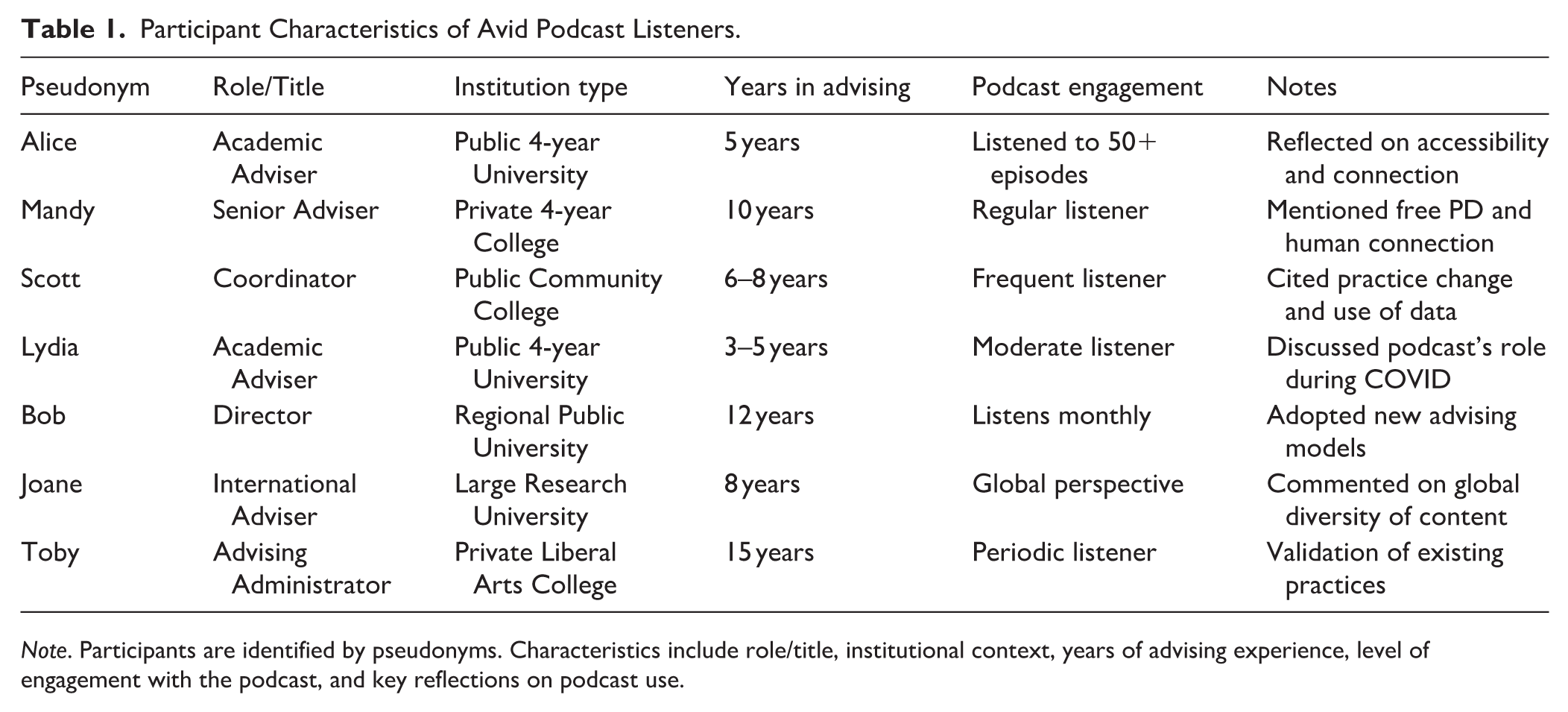
Note. Participants are identified by pseudonyms. Characteristics include role/title, institutional context, years of advising experience, level of engagement with the podcast, and key reflections on podcast use.
Semi-structured interviews were scheduled for 75 min, conducted via Zoom (one, because of scheduling constraints, was completed asynchronously via e-mail), and audio-recorded with consent. A common interview guide ensured that all participants addressed the same core questions about how the podcast shaped their professional development, advising practice, and sense of community; probing questions were used to clarify or deepen responses as needed. Prior to each interview, participants reviewed and signed an IRB-approved informed-consent form distributed through Adobe Sign. This multi-perspective, criterion-based sample allowed us to examine the podcast’s perceived benefits and limitations from diverse advising contexts and career stages, offering grounded insight into its professional relevance (see Table 1).
Third, the first 100 episodes of the podcast were analyzed as primary source material. This dataset offered a comprehensive view of the podcast’s content—its topics, guests, language, and themes—allowing us to trace how knowledge, values, and advising discourses were constructed and shared over time. This content analysis also allowed us to contextualize and triangulate claims made by both the co-creator and listeners.
Analytically, the three data sources were treated as complementary lenses on the same bounded case. While coding was inductive across all sources, emergent themes were compared and refined through constant comparative analysis. Patterns that appeared in more than one data source (e.g., the role of podcasting in reducing isolation) were treated as particularly robust, while contradictions or tensions (e.g., gaps between producer intent and listener interpretation) were examined for complexity. This multi-perspectival approach enhanced the credibility and depth of our findings and allowed us to understand the podcast as both a media artifact and a site of participatory professional learning.
Data Analysis
Because the study included both experiential data (interviews and reflections) and media artifacts (podcast episodes), we employed two analytically distinct but complementary approaches: thematic analysis for the interview transcripts and podcast co-creator reflections, and content analysis for the podcast episodes.
Thematic Analysis of Interviews and Reflections
To analyze the semi-structured interviews and written reflections, we followed a six-step approach to thematic analysis (Braun & Clarke, 2006). This process began with data familiarization: team members listened to interviews, reviewed transcripts, and read the podcast co-creator’s written responses. Next, we generated initial codes inductively, drawing from participants’ own language to capture concepts related to professional development, identity, advising practice, and engagement with the podcast. Example open codes included “changed advising strategies,” “sense of connection,” “validation of current practices,” and “exposure to diverse perspectives.” These codes were grouped into broader categories, which were refined into themes aligned with the research questions.
To support analytic rigor and minimize interpretive bias, especially given the co-creator’s dual role as interviewer and participant, the team used collaborative coding discussions and analytic memoing throughout the process. Coding was conducted in Microsoft Word and Excel to allow shared access, transparency and cross-comparison, which is consistent with recommendations for small qualitative datasets and team-based, inductive analysis. Once themes were finalized, we drew on Scholarship Reconsidered (Boyer, 1990) and Communities of Practice (Wenger, 1998) during the interpretive phase—not to define codes a priori, but to enrich our understanding of how professional learning and public-facing scholarship emerged through participants’ experiences.
Content Analysis of Podcast Episodes
In parallel with the thematic analysis of interviews and reflections, we conducted a conventional qualitative content analysis (Hsieh & Shannon, 2005) of the first 100 episodes of Adventures in Advising. This approach was selected because limited prior research exists on advising-related podcast content, making it appropriate to derive categories directly from the data without imposing a predefined coding scheme. Our goal was to capture both manifest and latent meanings related to the podcast’s content focus and knowledge contributions.
Episodes were logged for descriptive characteristics, including guest role, episode length, and format. Then, open coding was used to identify recurring topics such as mentorship, diversity and inclusion, advising technology, leadership, and global advising perspectives. These codes emerged inductively from the transcripts and summaries and were grouped into broader content categories reflecting the evolving discourse of the advising field.
This categorization was complemented by iterative memoing and selective, deeper analysis of segments mentioned by participants or relevant to emergent themes from the interview data. In keeping with the conventional content analysis approach, coding was shaped by immersion in the full dataset and was grounded in participants’ actual language and the contextual meaning of podcast content (Hsieh & Shannon, 2005). No theory-driven categories were imposed during this phase.
This analysis provided both a structured overview of the podcast’s subject matter and a nuanced understanding of how Adventures in Advising reflects and shapes public scholarship and professional dialogue within academic advising. Together, the two approaches allowed us to explore the podcast as both a media product and a site of learning and engagement. Thematic analysis illuminated the personal and professional significance of the podcast to its listeners, while content analysis provided a systematic overview of what the podcast offered and how it evolved. This dual strategy supported a comprehensive understanding of how Adventures in Advising functions as a vehicle for public-facing scholarship and professional development.
Ethical Considerations
The study received approval from the first author’s institutional IRB, ensuring that all ethical guidelines were followed. Participants were informed of their rights, including the voluntary nature of participation, the confidentiality of their responses, and their right to withdraw from the study at any time. All data, including audio recordings and transcripts, were securely stored on password-protected devices and encrypted servers to ensure participant confidentiality. Transcripts were anonymized, and pseudonyms were used in any reports or publications to protect participants’ identities.
Findings
This study sought to explore how a podcast contributes to the dissemination and development of knowledge in the field of academic advising through public-facing scholarship. Analysis of the interviews, podcast episodes, and the creator’s reflections revealed four interconnected themes that trace a developmental arc. First, the podcast created access to professional development opportunities that were responsive to advisers’ needs and emerging trends. Building on this foundation, it fostered a professional community that reduced isolation and cultivated belonging. These opportunities and connections, in turn, supported advisers in transforming their practice and deepening their professional identity. Finally, the podcast extended this impact outward, broadening advisers’ perspectives through global conversations and knowledge sharing. Together, these themes suggest that the podcast functioned as one space for ongoing learning, community connection, professional reflection, and the exchange of advising knowledge across contexts. See Figure 1.
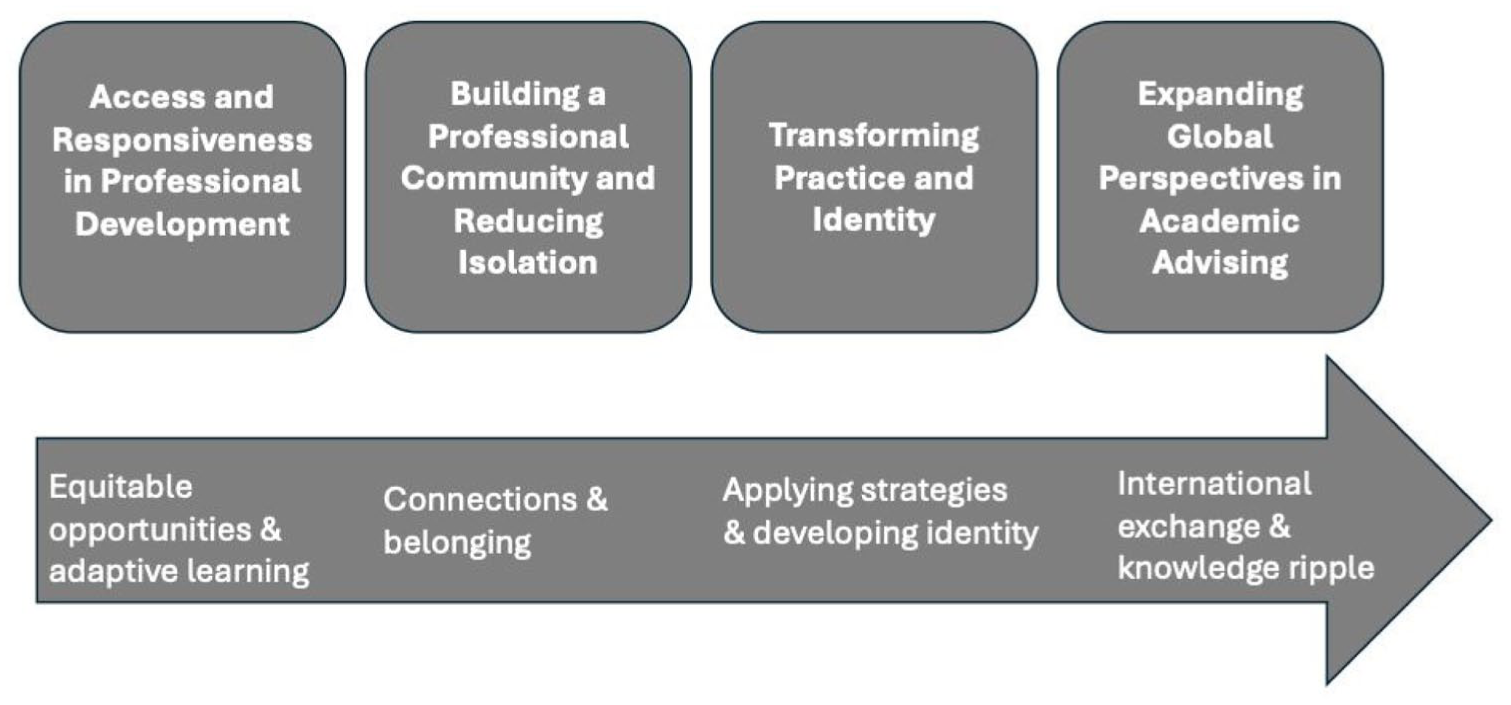
Developmental Arc of Podcast Engagement in Professional Learning.
Access and Responsiveness in Professional Development
Participants described the podcast as a vital tool for sustaining professional learning in accessible, flexible, and timely ways. Two key sub-themes emerged: its role in promoting equity in access to professional development and its responsiveness to evolving trends in the field.
Accessibility and Equity in Professional Learning
Participants highlighted the podcast’s accessibility as a strength—both in terms of its ability to reach a wide audience across institutional contexts and its capacity to offer professional development at no cost. Alice, for example, reflected on how the podcast broadened her understanding of advising challenges by exposing her to approaches different from her own: “Listening to it from a different perspective has given me a much broader understanding of the range of problems the students have for sure but also the different ways that you can approach them.” Alice’s comment points to accessibility not only as a structural condition (e.g., cost or format) but as a cognitive one: access to diverse professional perspectives that extend learning beyond one’s immediate institutional environment.
Mandy, in contrast, focused on the podcast’s financial and structural accessibility. She described it as “free professional development” and emphasized how crucial this is in a field where access to training is often uneven. She noted that many advisers—especially those in under-resourced institutions—struggle to attend conferences or participate in formal workshops due to cost, workload, or lack of supervisor support. The podcast, she explained, offers a flexible and inclusive alternative: “Not everyone can afford to go to conferences or even get time away from work to attend. Being able to listen to the podcast during my commute or while making dinner means I can still keep learning.” Her insights speak to the role of podcasting in democratizing access to professional learning, particularly for advisers who lack institutional support or funding. This capacity to deliver knowledge for free, on demand, and across formats not only expands access but also fosters a sense of inclusion and shared growth within the advising community.
Responsiveness to Trends and Innovation
In addition to financial and structural access, participants emphasized that the podcast’s flexibility and real-time responsiveness also enhanced accessibility—especially by enabling advisers to stay current with emerging trends in the field. The podcast kept Scott informed of “emerging trends, best practices, and innovative ideas.” Insights from the podcast content analysis reinforce this dynamic nature. For example, Episode 99 discusses AI integration in advising, illustrating how technological advancements shape the field. The podcast creator’s reflections further support this theme, as they emphasized the intentional selection of emerging topics to ensure the podcast remains a relevant professional development tool. This alignment across listener experiences, content analysis, and creator reflections demonstrates how the podcast serves as a real-time resource for advising innovation.
Participants described using the podcast as a space for reflection, often pausing to think through how new ideas applied to their own advising contexts or staff development work. This suggests that learning occurred not simply through exposure to new practices, but through reflective engagement with the reasoning and values underlying those practices, a process consistent with transformative learning perspectives (Mezirow & Taylor, 2009). For example, participants noted how they reflect on the material during or after listening, applying it to their advising contexts or integrating it into staff development.
Beyond promoting accessibility and trend responsiveness, participants described how the podcast fostered connection and community—key dimensions of engagement and professional growth. This relational aspect of learning is explored in the next theme.
Building a Professional Community and Reducing Isolation
Participants emphasized that listening to the podcast itself fostered a sense of connection and belonging within the academic advising profession. This feeling of community was not only discussed within podcast episodes, but also experienced by listeners through regular engagement with its conversational format, recurring guests, and shared professional language.
Reducing Isolation and Expanding Networks
One of the most significant contributions podcasts make to the field of academic advising, according to participants, is their ability to foster a sense of professional community and reduce feelings of isolation. The nature of advising can be solitary, especially in cases in which advisers serve in departments with small teams or are geographically distant from professional networks. Podcasts, however, create a bridge connecting advisers across institutions and regions, cultivating a shared space where ideas, experiences, and best practices can be exchanged. Episodes 13 and 15, for example, explore how advisers developed global networks during COVID-19. Additionally, the podcast creator reflected on the increasing role of digital spaces in sustaining professional communities, reinforcing the idea that podcasts help mitigate professional isolation.
Alice’s reflection encapsulates the power of podcasts in this regard. Although the people she has connected with through the podcast may not know her personally, they have nonetheless expanded her professional network: “My actual advising world has shrunk because everything feels a little bit more accessible now because of the podcast” (Alice). Alice’s account points to community being produced through recognition and discursive proximity rather than direct interaction, as listeners come to feel embedded in a shared professional world despite physical distance.
Lydia reinforced this idea by sharing how podcasts played an especially important role in reducing isolation during the COVID-19 pandemic: “It has made me feel more connected in that way… especially at the height of the pandemic when professional development wasn’t at the forefront of our minds” (Lydia). Lydia’s account suggests that community was experienced less through interaction and more through continuity and recognition during periods of professional disruption.
Humanizing the Profession and Fostering Belonging
The ability to feel part of a community through podcasts is particularly valuable for new advisers or those transitioning into the field. For these individuals, building a professional network from scratch can be daunting, especially if they lack immediate access to mentors or colleagues in their institutions. Podcasts, however, function as one informal platform that can support community building. As Scott described, “It builds a crucial role and a sense of community within the adviser community… It’s encouraged advisers at all stages.” Scott’s experience highlights how podcasts provide an accessible entry point to the advising community, allowing both new and experienced professionals to connect with peers facing similar challenges. For advisers in small or isolated departments, these platforms reduce barriers to professional networking by enabling engagement through listening before active participation.
Furthermore, the discussions within podcasts often serve to humanize the advising profession. As Mandy noted, podcasts reveal the “human side” of people in the field, which helps create a more relatable and approachable sense of community: “That’s the big thing for me—just like learning new things about my friends and even people I don’t know” (Mandy). Mandy’s reflection suggests that community is sustained not only through professional alignment, but through affective identification and the circulation of personal narratives. The conversational nature of podcasts often leads to moments of vulnerability and shared personal experiences, which help to humanize colleagues who might otherwise seem distant or inaccessible. This element of personal connection makes networking feel more organic and less formal, fostering a sense of camaraderie that is sometimes difficult to achieve through other professional development avenues.
In many ways, podcasts democratize professional relationships by making the knowledge and experiences of seasoned professionals available to all. The podcast helped Bob connect with others in the field, whether they are newer or seasoned advisers: “The podcast has given me more connection to the academic advising community…It has made me more conscious about participating in the advising community and finding new ways to become more effective” (Bob). Through this lens, podcasts are not merely educational tools; they are facilitators of professional identity development. Advisers not only gain knowledge but also begin to see themselves as part of a larger, interconnected professional network. This shift in identity—from being isolated to being part of a community—can be empowering, fostering both personal and professional growth.
Across participants, this sense of community appeared to emerge through three interrelated mechanisms: the development of shared professional language, recognition of oneself in others’ experiences, and ongoing engagement with recurring professional discourses. As advisers felt more connected to a broader community, many also began to translate the knowledge and insights gained from the podcast into their day-to-day advising practices. The sense of belonging often prompted deeper engagement with advising strategies and a more intentional application of what they learned. The next theme explores how the podcast actively influenced advising practices through the integration of new approaches and reflective development.
Transforming Practice and Identity
Participants described the knowledge gained through podcast episodes as informative and, for some, influential in shaping their perspectives. Two sub-themes emerged: how advisers integrated new strategies and approaches into their practice, and how podcast engagement prompted reflection, validation, and ongoing professional identity development.
Integration of New Strategies and Approaches
Bob’s experience exemplifies this process of learning and integration. Listening to the podcast introduced him to new advising approaches, which he then incorporated into his own sessions: “I used knowledge from previous podcasts into my methods, such as strengths-based and triage advising. I integrate what I’ve learned into the session, which provides for more effective academic advising” (Bob). His account highlights how advisers do not merely consume podcast content passively, but actively select and adapt it to enhance their own advising strategies.
Scott’s account, drawn from his interview as a listener, illustrates how podcast content directly shaped his advising strategies—particularly in data-driven decision-making. He explained, “Now that I’m in this coordinator position, I intentionally use that now…It’s greatly shaped my advising practice.” Scott’s account suggests that podcast learning functioned as a mechanism for translating abstract professional discourse into concrete, data-informed advising practices. Scott’s shift toward data-informed advising represents a change in professional practice catalyzed by podcast learning. In this way, his example supports the study’s central aim of understanding how podcast engagement can serve as a form of ongoing professional development and applied public scholarship in academic advising.
Reflection, Validation, and Professional Identity Development
By presenting new ideas or challenging existing approaches, podcasts push advisers to reconsider and refine their current methods. The analysis of podcast episodes echoes this impact, with episodes such as Episode 4 discussing the use of innovative technologies like chatbots to address repetitive advising tasks, freeing advisers to focus on strategic student engagement. Additionally, the podcast creator’s intentional selection of diverse interviewees amplifies innovative advising practices that listeners can adapt and implement within their own contexts, enhancing the practical application of podcast content.
Podcasts also provide a platform for advisers to learn about the broader advising profession and to see how their own practices fit within larger trends. For Scott, hearing about data-informed decision-making helped him better understand the role of evidence in advising: “It’s prompted me to reflect on broader purposes in advising and how I approach my role.” Toby noted, “I think the podcast allowed some verification of what I’m doing makes sense and who I am as an administrator. And how advising works on my campus, makes sense.” Toby’s reflection points to validation as a key mechanism of professional identity development, in which advisers come to recognize their practices as legitimate and meaningful within a broader professional discourse.
Just as the podcast helped advisers apply new strategies and reflect on their professional roles, it also encouraged them to think beyond their local contexts. The final theme explores this broadening of perspective.
Expanding Global Perspectives in Academic Advising
Participants described the podcast as a space for encountering advising perspectives beyond their local or national contexts. Two sub-themes emerged: learning from diverse international contexts and global reach and the ripple effect of knowledge sharing.
Learning From Diverse International Contexts
Joane highlighted the power of podcasts in fostering a deeper appreciation for both the commonalities and differences that exist across advising practices worldwide: One participant, Joane, praised the podcast for encouraging global reflection, stating that it “opened people up to thinking about advising from a much more global perspective…You learn from the commonalities, but you learn even more from the differences.” Joane’s account suggests that global learning occurred through comparative sense-making, as advisers positioned their own practices in relation to alternative institutional and cultural models. This process reflects identity work at a transnational level, where professional meaning is constructed through contrast rather than consensus.
Global Reach and the Ripple Effect of Knowledge Sharing
Mandy noted how podcasts have the potential to widen their impact as they reach more listeners: “Right now, I think it’s like a drop in a pond, and it’s rippling out. But the more people we can get to listen, the wider that circle can be” (Mandy). Mandy’s metaphor frames knowledge-sharing as a distributed and participatory process, in which professional learning expands through collective uptake rather than centralized dissemination. Together, these themes illustrate how podcasting functions not only as an informal educational tool but also as one site where professional community-building and reflective identity development could occur.
Discussion and Implications
These findings underscore the podcast’s dual contributions: advancing public-facing scholarship in line with Boyer’s (1990) call to integrate and apply knowledge beyond academic settings, and fostering social learning and identity development as described by Wenger’s (1998) Communities of Practice. Together with constructs of agency and professional identity (Baker, 2019; van Oeffelt et al., 2017), these frameworks provide a rich lens through which to interpret podcasting’s potential for knowledge dissemination, meaning-making, and community formation. While podcasts have been studied in fields like social work and family counseling (Casares, 2023; Fox et al., 2021), their potential in academic advising remains unexplored. This research addresses this gap by examining how podcasts foster shared learning, build common practices, and strengthen professional identity through community participation (Cook, 2023).
Beyond demonstrating that podcasts are useful for professional development, this study makes three conceptual contributions. First, it positions podcasting as a form of public-facing scholarship embedded in communities of practice rather than a dissemination tool. Second, it shows how podcast engagement supports professional identity development through validation, recognition, and reflective sense-making. Third, it highlights podcasting as a site of agentic learning, where practitioners actively reinterpret and apply knowledge within local contexts. Together, these contributions conceptualize podcasting as a relational, developmental professional learning space rather than a passive medium.
These conceptual claims are also evident in the podcast’s content and the creator’s reflections. For example, Episode 75 illustrates how podcasts function as platforms for sharing scholarly insights in accessible formats, effectively bridging research and practice (DeMarco, 2022). The creator’s reflections further highlight an intentional effort to make knowledge more accessible and to create space for practitioners to engage with scholarly ideas outside of traditional academic settings.
Podcasts provide advisers with flexible, accessible professional development that complements traditional formats like conferences or workshops (Casares, 2023). Their asynchronous nature allows advisers to engage with content at their own pace, making professional growth more sustainable and integrated into daily practice (Sienkiewicz & Jaramillo, 2019). Unlike static resources, podcasts can respond quickly to emerging issues, offering up-to-date information on student needs, technology, and institutional policies (Chandler et al., 2022). When student-led, educational podcasts have also been shown to strengthen teaching skills, deepen learning, and promote engagement through simplified language and peer connection, highlighting their pedagogical value across disciplines (Mulherkar, 2024). By lowering access barriers, podcasts particularly benefit marginalized communities who may lack access to traditional academic resources (DeMarco, 2022; Fox et al., 2021). This accessibility facilitates the development of shared practice and identity within the advising community, reflecting Wenger’s (1998) communities of practice and the ways that identity work unfolds in digital professional spaces (Evans, 2019).
The findings also contribute to research on digital media’s role in professionalizing academic fields (Boehm et al., 2016. Adventures in Advising podcast listeners reported stronger field connection, improved practices, and deeper professional community engagement. This aligns with public-facing scholarship’s goal of engaging practitioners directly through accessible formats (Lin & Huang, 2024) while also supporting agency and professional identity development through reflection and validation (Baker, 2019; van Oeffelt et al., 2017). By fostering open dialogue and reflective practice, podcasts create professional communities in which collective meaning-making occurs, suggesting learning and development are embedded in communities sharing common domains (Cook, 2023). It serves as a platform for knowledge co-creation, in which practitioners share experiences, researchers present findings, and administrators discuss policy implementations (Sullivan, 2019), contributing to more inclusive and representative professional knowledge (Fox et al., 2021) and exemplifying public-facing scholarship as reciprocal, applied, and dialogic (Ellison & Eatman, 2008). This alignment with Boyer’s (1990) scholarship model demonstrates how alternative media can advance the field’s professional development while maintaining academic rigor.
At the same time, podcast engagement highlights HRD’s humanistic focus on meaning-making and purposeful work (Fenwick, 2011; Kuchinke, 2013), situating podcasting as a space for agentic learning and reflective identity work. Podcast-based leadership education initiatives further illustrate that both production and consumption can support critical thinking, community engagement, and learner motivation across professional contexts (Norsworthy & Herndon, 2020).
The dual role of the podcast creator as both practitioner and researcher highlights key considerations for future practitioner-led scholarship. This positionality brings unique advantages, including insider access and motivation to improve practice. However, it also introduces complexity in maintaining analytic distance. This study contributes to ongoing discussions about reflexivity and methodological rigor in research conducted by practitioner-scholars, particularly when they are embedded in the phenomena they study.
These findings have significant implications for the future of professional development in academic advising. As the field continues to evolve, podcasts and similar digital platforms may play an increasingly central role in adviser training, continuing education, and professional networking. The success of Adventures in Advising suggests that professional development initiatives should consider incorporating digital, asynchronous elements to maximize reach and impact. Furthermore, the podcast’s effectiveness in building community and fostering professional identity indicates that future professional development efforts should prioritize opportunities for connection, reflection, and dialogue among practitioners.
The extensive reach of Adventures in Advising reinforces the CoP framework (Wenger, 1998), in which learning occurs through active participation and shared experiences. This participation strengthens professional identity formation while advancing Scholarship of Integration (Boyer, 1990) through cross-border knowledge exchange. Together, these suggest that podcasts may provide one way of amplifying diverse voices within the advising profession and advancing its professionalization through accessible, responsive professional development. The data on global engagement particularly illuminates the podcast’s role in internationalizing the advising profession. While U.S. listeners predominate, the significant international audience suggests a growing recognition of academic advising as a global practice. In this sense, podcasting exemplifies public-facing scholarship that transcends borders and mobilizes knowledge inclusively (Boyer, 1990). This study demonstrates how podcasts can serve as useful tools within such contexts—facilitating professional development, democratizing access to learning, fostering a sense of belonging, and supporting agency in professional practice.
These features support lifelong learning, just-in-time knowledge acquisition, and the integration of theory with everyday practice. They resonate with principles of andragogy, emphasizing self-directed learning, experiential engagement, and immediate applicability (Knowles et al., 2015). Prior research further suggests that differentiated podcast formats enhance engagement, self-regulation, and learner performance in asynchronous environments (Errabo et al., 2024). From an HRD perspective, the flexible and dialogic nature of podcasting is especially well-suited to practitioner-driven professional learning and diverse epistemological traditions (Egan, 2022). In this sense, podcast engagement supports movement from peripheral observation to active participation in professional communities, aligning with Boyer’s (1990) framework for the Scholarship of Teaching, Integration, and Application as podcasts bridge research, practical insights, and collaborative learning. When combined with agency and identity perspectives (Beauchamp & Thomas, 2009), podcasts can be seen as powerful contexts where reflection, action, and belonging intersect.
This study also contributes to broader conversations in HRD by illustrating how professionals use digital media to navigate field-specific challenges, adapt to change, and build peer networks across institutional and geographic boundaries. These patterns of engagement hold relevance not only for academic advisers, but for adult educators, instructional designers, corporate trainers, healthcare educators, and others involved in workplace learning and development. By simultaneously advancing public engagement and cultivating a professional learning community, podcasting embodies the intersection of Boyer’s (1990) and Wenger’s (1998) models, while also advancing critical agency and identity development—illustrating how scholarship and practice can co-evolve in informal, practitioner-driven spaces.
Podcast listeners engage with content that reflects the values, challenges, and evolving discourse of the advising profession, contributing to the development of shared norms and language. For many, listening becomes a form of peripheral participation—particularly for those newer to the field—providing access to conversations they might not encounter in their home institutions. Concepts like legitimate peripheral participation help explain how newcomers may begin by listening passively but gradually develop stronger identification with the advising community, eventually acting on what they learn or engaging in knowledge-sharing within their own contexts. The podcast thus becomes a digital site of situated learning, identity alignment, and agentic reflection, reinforcing both the relational and practical dimensions of the advising profession.
The Adventures in Advising podcast functioned as a medium of agency both for the creator and the listeners, allowing knowledge production outside of formal institutional hierarchies and encouraging listeners to reflect, reframe, and act in ways that align with their values (Carson et al., 2021). This reflects the idea of critical agency—the capacity not only to act, but to examine systems and imagine new possibilities within and beyond them (Stenalt et al., 2024). For advisers working in roles that are frequently undervalued or ambiguous, the ability to engage critically with their field through podcast content may create a sense of empowerment and direction.
Participants in this study described both subtle and significant shifts in how they saw themselves as advisers. Some reported new confidence in naming their advising philosophy or contributions; others described actions they took—starting initiatives, mentoring others, seeking leadership roles—as inspired by ideas encountered in the podcast. Listening became not a passive activity but an invitation to reframe, reimagine, and enact one’s professional identity with agency. In this sense, the findings reflect how community, identity, agency, and public-facing scholarship converge to shape professional growth in academic advising.
Limitations and Future Research
This study has several limitations that should be considered when interpreting the findings. First, all interviewees were avid listeners who had engaged with at least 20 episodes of the podcast. This sampling criterion ensured deep familiarity with the content but may have also introduced positivity bias, as these participants may be more likely to emphasize benefits over limitations. While their insights offer rich perspectives on podcast engagement, they may not fully capture the views of more casual or critical listeners.
Second, all interviews were conducted by the podcast co-creator, a coauthor of this study. Although this insider role enhanced rapport and contextual richness, it may have influenced participant responses or their willingness to share critical feedback. Additionally, the coauthor’s dual role as both podcast co-creator and member of the research team introduces potential interpretive bias during the analysis process. While collaborative memoing, debriefing, and team review of transcripts were employed to minimize this influence, the possibility that the coauthor’s positionality shaped theme development or interpretation cannot be fully eliminated.
Third, although our sample provided rich insights into sustained engagement, we did not capture the perspectives of casual or one-time listeners. Future studies could explore disengagement by investigating factors such as content relevance, accessibility, or competing professional development priorities. Understanding why professionals choose not to persist with a podcast may offer important insights into digital fatigue, learning preferences, or perceived credibility of podcast-based content in adult education and HRD.
Finally, this study focused exclusively on avid listeners who had engaged with at least 20 episodes of the podcast. While this approach provided rich insights into sustained listener experiences, it excluded those who may have sampled the podcast only once or twice and chose not to continue. Understanding the perspectives of these disengaged or briefly engaged listeners could offer valuable information about barriers to access, content relevance, or format preferences. However, identifying and recruiting such individuals presents significant methodological challenges, as they are less likely to respond to recruitment efforts centered within advising networks or podcast-related communications.
These limitations underscore the need for future research that includes a broader spectrum of listeners—including infrequent or critical consumers of podcast content—and utilizes independent interviewers to reduce the potential for social desirability bias. Expanding both the sample and the researcher role will help clarify the broader applicability of podcasts as tools for professional learning across adult education and HRD contexts.
Emerging from this study are several opportunities for future research across adult education and HRD contexts:
Investigating how podcast use influences professional identity, reflective practice, and sense of community among adult learners and professionals.
Conducting comparative analyses of podcasts and other digital learning formats (e.g., webinars, online courses, social learning platforms) in professional settings.
Exploring how organizational context, institutional type, or learning culture shapes podcast engagement and integration into practice.
Examining listener trajectories from passive consumption to active contribution—such as speaking on episodes, applying insights, or initiating workplace changes.
Ultimately, this study positions podcasts as not only accessible educational tools, but as key infrastructures for knowledge sharing, peer connection, and the professionalization of adult learning roles. By supporting individualized and collective learning in context, podcasts exemplify the principles of adult education and HRD in action.
Conclusion
This research reveals how the Adventures in Advising podcast advances public-facing scholarship and community building within academic advising. The findings demonstrate podcasts’ effectiveness as tools for professional development, knowledge dissemination, and community engagement in emerging fields. This understanding can inform future initiatives in academic advising and other professional communities seeking to leverage digital media for collective growth.
By examining how advisers engage with podcasts as an informal learning tool, this study contributes to a broader understanding of how professional development can occur through non-traditional formats. Unlike conventional forms of professional development, podcasts are responsive to emerging trends, foster individualized learning, and support professional identity development. These features make them particularly well-suited to advising, a field that often lacks widespread access to formal professional training and relies heavily on peer knowledge-sharing.
The study also offers broader implications for the academic advising profession and for scholarship on digital learning communities. As podcasts continue to shape how professionals access knowledge, connect across institutional boundaries, and co-construct meaning, they demonstrate the potential of participatory media to reshape professional learning ecosystems. For academic advising, this suggests a future where development opportunities are increasingly decentralized, practitioner-driven, and integrated into the rhythms of everyday work. More broadly, this study calls on researchers and professional organizations to take seriously public-facing, digitally mediated forms of scholarship as legitimate and powerful sites of learning, identity formation, and community building in contemporary professional life.
Footnotes
Appendix A
Appendix B

Funding
The authors received no financial support for the research, authorship, and/or publication of this article.
Declaration of Conflicting Interests
The authors declared no potential conflicts of interest with respect to the research, authorship, and/or publication of this article.