






Abstract
This paper critically examines the institutionalization of Work-Integrated Learning (WIL) in Alberta’s postsecondary education system through a neo-institutional lens. While WIL is often promoted as a tool for enhancing employability and bridging academic and labor market demands, this study argues that WIL is not a neutral or universally beneficial intervention. Drawing on institutional logics theory and informed by the reoriented neo-institutionalism of Hasselbladh and Kallinikos, the paper explores how WIL is shaped by underlying assumptions about legitimacy, knowledge, and desirable outcomes. Using a qualitative case study design that includes interviews with 28 institutional actors, the study examines how WIL is institutionalized across Alberta’s postsecondary institutions and identifies three dominant institutional logics underpinning this process: employability, professionalization and cultural fit, and integration-as-adaptation. These logics frame WIL in ways that reinforce economic utility, marginalize civic and transformative educational aims, and place the burden of integration on immigrant learners. Situated within Alberta’s performance-driven policy landscape, exemplified by Alberta 2030 and Bill 74, the paper demonstrates how institutional rationalities and government mandates converge to narrow the purpose of higher education. The study contributes to both migration and higher education scholarship by interrogating how institutional structures shape immigrant learner experiences and by calling for more inclusive and reflexive models of WIL.
Keywords
Introduction
Work-Integrated Learning (WIL) has emerged as a defining feature of Canadian postsecondary education (Raza, 2026). Promoted through national frameworks like Co-operative Education and Work-Integrated Learning Canada (CEWIL, 2021) and provincial strategies such as Alberta 2030: Building Skills for Jobs (Government of Alberta, 2021a), WIL is increasingly framed as a strategic response to economic imperatives and labor market transitions. In Alberta, WIL has been explicitly positioned as a policy mechanism to improve graduate employability, foster economic innovation, and support the integration of skilled immigrants into the workforce (Raza, 2026). These developments mark a significant shift in how higher education institutions are expected to operate and reorient their missions from broad civic and intellectual goals toward more utilitarian and industry-aligned objectives (Billett, 2015).
Despite its widespread adoption and promotion, WIL is frequently discussed in instrumental terms: as a set of best practices, an educational innovation, or a bridge between classroom learning and professional experience (McRae & Johnston, 2016; Zegwaard et al., 2023). This paper challenges such interpretations by arguing that WIL must be examined not only as a pedagogical tool but also as a socially and politically embedded practice (Chua et al., 2024; Raza, 2026). Far from being neutral or universally beneficial, WIL is structured by dominant institutional logics; assumptions about what constitutes legitimate knowledge, valuable learning, and desirable outcomes (Hasselbladh & Kallinikos, 2000). These logics shape how WIL is institutionalized, how success is defined, and how learners are positioned within educational and workplace systems.
Drawing on a neo-institutionalist framework, this paper critically analyzes the institutionalization of WIL in Alberta’s postsecondary sector. Neo-institutional theory, particularly in its reoriented form as articulated by Hasselbladh and Kallinikos (2000), offers a powerful lens to interrogate how educational practices are embedded in wider ideological structures. Rather than treating institutions as static or functionally rational, neo-institutionalism emphasizes their role in reproducing dominant cultural norms and legitimizing specific forms of reasoning. Within this framework, the concept of institutional logics (Thornton et al., 2015) helps illuminate the symbolic and material patterns that guide organizational practice.
Institutional logics are the socially constructed rules, values, and assumptions that shape how individuals and organizations interpret their roles, responsibilities, and goals (Thornton et al., 2015). In the context of WIL, these logics are evident in policy documents, funding frameworks, institutional structures, and curricular designs. They frame what counts as valid learning, appropriate professional behavior, and successful integration, particularly for international students and skilled immigrants, who are often constructed as both targets and beneficiaries of WIL initiatives. While institutional logics are often treated as abstract or distant forces, they are enacted through everyday decisions made by instructors, coordinators, and administrators; decisions that are conditioned by broader policy landscapes and institutional priorities (Raza, 2026).
To examine these dynamics, this paper focuses on Alberta, where WIL has been aggressively institutionalized through policy tools such as Bill 74 (Government of Alberta, 2021b), the Alberta 2030 strategy (Government of Alberta, 2021a), and Investment Management Agreements (IMAs). These instruments have reshaped the purpose of postsecondary education, elevating employability and economic productivity as core mandates. By tracing how WIL is defined, delivered, and evaluated across a range of Alberta institutions, the study explores how institutional logics manifest and how they shape the experiences of immigrant learners.
The research is guided by three interrelated questions:
How is WIL institutionalized across Alberta’s postsecondary institutions?
What institutional logics underpin WIL practices and policies?
How do these logics shape institutional constructions of learners’ educational and integration experiences within WIL?
While WIL applies broadly to all students, skilled immigrants and international students occupy a particularly salient position within policy and institutional discourse, where WIL is frequently framed as a mechanism for labor market integration. This study therefore adopts an analytical focus on how immigrant participation is constructed within WIL, rather than suggesting that WIL is exclusively designed for this group.
Theoretical Framework: Institutional Logics and the Rationalization of WIL
Institutional theory has long been concerned with understanding how social structures shape and stabilize human behavior. Classical institutionalism focused on how organizations develop values, norms, and internal political dynamics that shape institutional behavior (Parsons, 1991; Selznick, 1949). Rather than viewing institutions as purely formal structures, early institutional scholars were attentive to organizational agency, leadership, and local processes of adaptation and co-optation. However, this tradition primarily focused on individual organizations and their internal dynamics, paying less attention to the broader cultural and organizational environments within which institutions operate (Greenwood et al., 2002). Neo-institutionalism emerged in the late twentieth century as a response to these limitations, introducing a more dynamic view of institutions as socially constructed systems of meaning (DiMaggio, 1988). Rather than merely emphasizing internal organizational processes, neo-institutional scholars examined how institutions shape and legitimize action through shared cultural frameworks, norms, and expectations (DiMaggio & Powell, 1983; Meyer & Rowan, 1977).
Key concepts such as isomorphism and legitimacy helped explain why organizations often adopt similar structures and practices, not primarily for reasons of technical efficiency, but to secure legitimacy within their institutional environments (Greenwood et al., 2002). Later developments in neo-institutional theory introduced the concept of institutional logics to explain the coexistence of multiple and sometimes competing rationalities within organizational fields (Friedland & Alford, 1991; Thornton et al., 2015). This perspective shifted attention toward heterogeneity, contestation, and the ways actors navigate overlapping institutional expectations. At the same time, early neo-institutionalism was criticized for overemphasizing institutional conformity and underplaying issues of agency, power, and resistance within organizations. In their influential critique, Hasselbladh and Kallinikos (2000) reoriented the field by emphasizing the role of institutional rationalities, deeply embedded assumptions about what is rational, desirable, and legitimate that guide organizational practice. Drawing particularly on Foucault’s (1991) later work on governmentality and rationalities of governance, they argued that institutions do not merely reflect social norms; they embody and reproduce dominant forms of reasoning. These rationalities are not applied wholesale but are translated by actors into specific practices through processes of negotiation, contestation, and selective interpretation.
This paper adopts a reoriented understanding of neo-institutionalism (Hasselbladh & Kallinikos, 2000) to examine WIL as an educational policy in Canadian postsecondary education. Rather than treating WIL as a neutral policy instrument facilitating skills development or labor market entry, it is conceptualized as an institutionalized form structured by powerful logics that influence its design, delivery, and outcomes (Chua et al., 2024). Institutionalization occurs as WIL becomes embedded in the mission statements, policy frameworks, and everyday practices of postsecondary institutions. While institutionalization processes have been studied extensively in the context of Canadian higher education (e.g., Taylor & Kahlke, 2017), they have not been examined through the lens of institutional logics in relation to WIL. Given that WIL is increasingly being incorporated into postsecondary education through governmental policies and funding mechanisms (e.g., Government of Alberta, 2021a, 2024), the way it is institutionalized warrants critical inquiry. To unpack these dynamics, the concept of institutional logics (Thornton et al., 2015) is employed as the primary analytical lens to highlight the rationalities that underpin WIL and examine how they shape the lived experiences of skilled immigrants navigating educational and employment systems.
Institutional logics are foundational to understanding how cultural, symbolic, and material elements shape the behaviors of individuals and organizations within a given institutional field. As Thornton et al. (2015, p. 2) explained, institutional logics refer to the “socially constructed patterns of symbols and material practices, assumptions, values, beliefs, and rules by which individuals and organizations produce and reproduce their material subsistence, organize time and space, and provide meaning to their social reality.” These logics are not static or uniform; multiple logics may coexist, overlap, or conflict within the same institutional space. In the context of WIL, institutional logics are embedded in policy documents, curricular decisions, assessment frameworks, and workplace expectations. They frame what counts as legitimate knowledge, appropriate behavior, and successful integration (Thornton & Ocasio, 2008).
Based upon a review of the relevant literature, three interrelated institutional logics are particularly salient in shaping WIL practices in Canada: employability, professionalization and cultural fit (or Canadian experience), and integration. Firstly, the logic of employability positions education as a pathway to employment, emphasizing the acquisition of marketable skills, workplace competencies, and job readiness (Hall, 2007; Taylor & Kahlke, 2017). In Alberta, this logic is evident in the framing of WIL as a bridge between immigration and economic productivity (Government of Alberta, 2021a). While it may improve short-term labor market outcomes, this logic often narrows the purpose of education to economic utility, marginalizing broader forms of learning and social participation (Raza, 2026). Secondly, the logic of professionalization and cultural fit reinforces normative expectations around Canadian experience, including workplace communication styles, team dynamics, and credential recognition (Bhuyan et al., 2017). Foreign educated and trained immigrants (e.g., skilled workers or international students) are often expected to conform to these norms to be deemed employable or culturally appropriate, which can result in the erasure or devaluation of their transnational expertise and prior experiences (Guo, 2009; Raza & Chua, 2024). Finally, the logic of integration as one-sided adaptation constructs integration as a linear process of immigrant adjustment, rather than a reciprocal or systemic transformation (Raza, 2024). This logic frames skilled immigrants as deficient and in need of acculturation (Guo, 2009), placing the burden of adaptation solely on newcomers while leaving institutional norms and structures unexamined. In doing so, it masks the role of systemic barriers and reinforces a deficit model of immigrant subjectivity (Guo, 2009).
These institutional logics do not operate in isolation but mutually reinforce one another to define the rationalization of WIL in ways that align with dominant socio-political agendas. They shape the design of programs, influence practitioner decisions, and condition immigrant experiences in ways that often reproduce, rather than resolve, existing inequalities. By foregrounding institutional logics as the core analytical lens (Thornton et al., 2015), this paper makes visible the ideological foundations of WIL and interrogates how skilled immigrants are positioned within, and respond to, these institutionalized frameworks. In doing so, it contributes to a broader understanding of higher education as a contested space shaped by the politics of knowledge, legitimacy, and belonging (Klingbeil, 2023; Younes, 2025).
Research Context: The Policy Landscape of WIL in Alberta
WIL has emerged as a cornerstone of Alberta’s postsecondary policy agenda, particularly through the Alberta 2030: Building Skills for Jobs strategy (Government of Alberta, 2021a). Launched to reorient post-secondary education toward economic recovery and labor market needs, Alberta 2030 positions WIL as an essential mechanism for producing job-ready graduates. The strategy calls for closer collaboration between postsecondary institutions and industry, promoting experiential learning as a bridge between academic programming and employer expectations
This strategic vision is being operationalized through both targeted programs and legislative reforms. The Work-Integrated Learning Industry Voucher Pilot Program (Government of Alberta, 2024) exemplified this shift by funding approximately 650 paid student placements over 3 years in Alberta’s priority sectors: technology, construction, and life sciences. The initiative offered matched grants to employers and connected students with hands-on, mentor-based learning experiences, with the aim of scaling the model across sectors. Framed as an instrument for economic growth, the program reinforced WIL’s role in aligning education with workforce development.
More consequentially, the legislative foundation for institutionalizing WIL was strengthened through Bill 74: Advanced Education Statutes Amendment Act (Government of Alberta, 2021b). This Act modernized the Post-secondary Learning Act (Government of Alberta, 2003) to reflect the core priorities of Alberta 2030. The revised preamble redefines the purpose of postsecondary education as being “highly responsive to labour market needs” and focused on enabling students to contribute to “an innovative and prosperous Alberta” (p. 1). Experiential learning, specifically apprenticeship and workplace-based learning, is recognized as equally valuable to academic instruction, signaling a shift in how institutional quality is defined. Through the Act, the government reasserts its authority to assign institutional mandates, enforce compliance via Investment Management Agreements (IMAs), and align institutional performance with provincial priorities, including WIL targets. Section 78 of the Act mandates that IMAs specify the institution’s role, expected outcomes, and “anything else determined by the Minister,” including WIL integration (Government of Alberta, 2003, p. 57).
This institutionalization of WIL must also be understood in the broader political and economic context of Alberta’s post-secondary sector. Postsecondary education in Alberta has historically been pressured to prioritize industry needs over broader intellectual or civic missions (Younes, 2025). As a province deeply tied to oil and gas industries, successive governments have adopted performance-based funding (PBF) models, standardized governance structures (e.g., Bill 43), and recurring budget cuts to ensure alignment with economic goals (Hall, 2007; Klingbeil, 2023). Alberta 2030 accelerates this trajectory by binding institutional funding to specific performance metrics; chief among them, the inclusion of WIL in approved programs. Institutions are now expected to balance these commitments with the delivery of industry-responsive and skill-based training programs. The dominance of an institutional logic of employability, which frames education primarily as a means to improve labor market outcomes, narrows the scope for alternative educational values, including inclusivity, civic responsibility, and transformative learning.
Alberta’s postsecondary policy landscape reflects a concerted effort to institutionalize WIL as both a pedagogical and economic imperative. Through targeted programming, legislative reform, and PBF, WIL has become a structural feature of postsecondary education in Alberta. This paper interrogates how these institutional logics shape the design and delivery of WIL programs and, in turn, the educational and integration experiences of skilled immigrants, who are often positioned within policy discourse as both economic contributors and targets of integration.
Research Design
This study adopts a qualitative case study design (Merriam, 2009; Yin, 2018) to examine how WIL is institutionalized within Alberta’s postsecondary education system. The case is bounded by the provincial policy context of Alberta, where WIL has been explicitly advanced through policy instruments such as Alberta 2030, Bill 74, and IMAs. A case study approach is appropriate as it enables an in-depth, contextually grounded analysis of how policy reforms are interpreted, enacted, and negotiated across institutional settings. This approach also allows for the integration of multiple data sources, including policy documents and interviews with institutional actors, to capture the complexity of governance processes and institutional responses.
The study draws on data that explore how WIL practitioners, postsecondary educators, and industry partners make sense of their work around incorporating WIL in programs and curriculum within Alberta’s postsecondary education system. Twenty-eight participants in total were recruited from three groups: (i) 15 WIL practitioners or administrators; (ii) five instructors; (iii) eight industry partners. Postsecondary institutions in Alberta were selected because they are mandated to incorporate WIL in their programs and curricula. Similarly, industry partners that received funding under the Alberta 2030 program were selected for participation.
A purposeful sampling strategy (Merriam, 2009) was employed to select participants who were directly involved in the design, delivery, or management of WIL across institutional and industry contexts. The selection of WIL practitioners, instructors, and industry partners was guided by their proximity to WIL implementation and their ability to provide insight into how policy mandates are interpreted and enacted in practice. This approach aligns with the study’s focus on institutional logics, as these actors play a key role in translating policy expectations into organizational practices. Participants were selected from a range of industry partners engaged in WIL placements as well as nine postsecondary institutions within Alberta’s differentiated system, spanning multiple institutional types: research-intensive universities (University of Alberta and University of Calgary); comprehensive universities (University of Lethbridge and Mount Royal University); polytechnic institutions (Southern Alberta Institute of Technology [SAIT], Northern Alberta Institute of Technology [NAIT], and Lethbridge Polytechnic); and colleges (Bow Valley College and NorQuest College). While universities and polytechnic institutions differ in mandate and program orientation, they are examined together in this study due to their shared exposure to provincial WIL policy mandates and accountability frameworks. This variation enabled the study to capture diverse institutional contexts and perspectives, while remaining focused on a common policy environment shaped by Alberta 2030 and related reforms.
Following ethics approval (H24-02250), participants were contacted through email invitations. For post-secondary institutions, email invitations were sent to the generic email addresses provided on the webpages that offered information about their WIL strategy. Interested WIL practitioners and instructors contacted the researcher to participate in the study. Industry partners were contacted based upon the information shared by WIL practitioners or publicly available information on the website of postsecondary institutions. After receiving the signed informed consent form back from the interested participants, online interviews were scheduled through Zoom.
The interviews used a semi-structured protocol, were conducted between 2024 and 2025, and lasted for approximately an hour. An overview of the study was provided in the beginning of the interview to position the interviewer as a curious researcher. Throughout the interviews, efforts were made to affirm the value of participants’ perspectives and to minimize social desirability bias in their responses. Ethical protocols were upheld, including ensuring voluntary participation, the right to withdraw at any time, and the confidentiality of all collected data. All participants were given the option to review their transcripts and make revisions if desired.
The data were analyzed using a theoretically informed thematic analysis guided by Braun and Clarke’s (2006, 2022) six-phase approach and sensitized by the institutional logics perspective (Thornton et al., 2015). The analysis began with repeated reading of interview transcripts to support familiarization with the data, followed by initial coding of segments relevant to the research questions. Coding was primarily deductive in orientation, using the three institutional logics identified in the theoretical framework, employability, professionalization and cultural fit, and integration-as-adaptation, as sensitizing concepts rather than fixed categories. This allowed the analysis to remain theoretically anchored while also attending to variation, tension, and overlap within participants’ accounts (Braun & Clarke, 2022). Codes were then reviewed, grouped, and interpreted to develop broader themes that captured how these logics were institutionalized and enacted across institutional contexts. In this way, the institutional logics informed the coding process, while theme development remained iterative and interpretive.
Interview data were first coded manually to support close engagement with meaning and context. The data were subsequently organized in NVivo, which was used as a data management tool to support systematic coding, retrieval, comparison, and refinement of coded segments. NVivo did not function as an independent source of validation; rather, it supported the transparency and organization of the analytic process. Methodological rigor was approached in terms of trustworthiness rather than validity and reliability. Credibility was supported through sustained engagement with the data, iterative coding, and opportunities for participants to review their transcripts. Transferability was addressed by providing contextual details about Alberta’s WIL policy environment and institutional settings. Dependability and confirmability were strengthened through a transparent coding process, documentation of analytic decisions, and the use of theory to guide, but not predetermine, interpretation.
A purposeful sampling strategy (Merriam, 2009) was employed to capture a range of institutional roles and perspectives. Academic and industry participants reflected the broader groups to which they belonged. For instance, WIL practitioners represented faculties of arts and sciences, while industry partners included typical partner organizations that host WIL students. The recruitment strategy, which relied on publicly available contact information and generic institutional email addresses, may have introduced elements of self-selection into the sample. Participants who chose to respond may have had a particular interest in WIL or stronger views on its implementation, which could shape the perspectives represented in the data. While this approach facilitated access to knowledgeable participants across institutions, it may limit the extent to which the findings capture the full range of perspectives within the sector.
This study does not include direct data from students participating in WIL programs. Instead, it examines how learner experiences, particularly those of skilled immigrants and international students, are constructed, interpreted, and governed through the perspectives of institutional actors, including administrators, instructors, and industry partners. As such, the findings reflect a top-down institutional account of learner experiences rather than learners’ lived experiences. While this approach enables analysis of how WIL is rationalized and operationalized within institutional contexts, it may not fully capture the diversity or complexity of learner perspectives, which may diverge from institutional representations.
Findings
The findings presented in this section are organized around four interrelated themes that illuminate how WIL is shaped by dominant institutional logics in Alberta’s postsecondary landscape. These themes are: (1) the institutionalization of WIL as a structural and policy-driven process; (2) the logic of employability, which prioritizes economic alignment and job readiness; (3) the logic of professionalization and cultural fit, which constructs normative models of workplace behavior; and (4) the logic of integration-as-adaptation, which places the burden of belonging on immigrant learners. Each theme reflects how institutional rationalities are translated into organizational practices, framing the experiences of both educators and learners within the WIL ecosystem.
While the analysis was guided by three institutional logics – employability, professionalization and cultural fit, and integration-as-adaptation – the thematic structure reflects an interpretive expansion of this coding framework. The first theme, institutionalization of WIL, captures the broader organizational and policy conditions within which these logics are enacted, rather than representing a separate logic. The remaining three themes correspond to the dominant institutional logics identified in the theoretical framework. The relationship between the theoretical coding framework and the final thematic structure is summarized in Appendix Table A1. In this way, the findings present a synthesis of theoretically informed coding and empirically derived patterns across institutional contexts.
Institutionalization of WIL
The institutionalization of WIL across Alberta’s postsecondary institutions reflects complex interactions between organizational structures, professional identities, and provincial policy pressures. Drawing on the lens of institutional logics (Thornton et al., 2015) and neo-institutional theory (Hasselbladh & Kallinikos, 2000), this section reports how WIL is embedded within university and college systems, how legitimacy is constructed and contested, and how isomorphic pressures shape convergence across institutional types.
Alberta’s postsecondary institutions vary significantly in how WIL is organizationally structured. While some WIL units are embedded under senior academic portfolios, such as the Vice-President Academic or Teaching and Learning divisions, others are decentralized across faculties. For example, one polytechnic institute moved from “a decentralized to a centralized WIL model,” now situated under academic leadership (Interview 1). This repositioning signaled a shift in institutional recognition, allowing WIL to be more closely integrated into teaching priorities. Centralization at another polytechnic moved WIL from its academic-orientation to industry-focus: “When I first came to our college, there were faculty members doing the WIL and we have slowly pulled this out and away from faculty and into our team” (Interview 6). The rationalization for this reorientation is to provide industry-informed support to students and to balance power dynamics between faculty and students where students can use their agency, irrespective of faculty pressure, to decide if they want to continue working with an industry partner. Leadership structures differ as well. At a university, a non-academic staff member oversees WIL coordination within a faculty of arts (Interview 14), aiming to align it with the Government of Alberta’s (2021a) definition, while at another university, a program chair and an instructor, takes the lead independent of government’s approach: “What I am doing with the foreign-trained lawyers’ program isn’t tied to any government mandate. I created the program with a vision in mind” (Interview 28). All WIL practitioners and instructors in this study held full-time positions and brought substantial industry experience to their roles. While not all instructors had formal education training, their professional backgrounds were valued more highly than pedagogical qualifications, reflecting institutional preferences for industry expertise over teaching credentials.
The professional backgrounds of WIL leaders strongly influenced how they interpreted and performed their roles. Several WIL practitioners described previous experience in student advising, career services, or employer engagement, identifying themselves as “industry experts” and reinforcing the influence of this logic on their behavior (Taylor & Kahlke, 2017). For instance, one WIL administrator noted: “I was hired onto a moving train to create 150 internships a year and had to build the tracks as the train was moving, which is perfect for me because that’s kind of how I like to work anyway” (Interview 12). Similarly, another WIL practitioner mentioned their logistic duties: “My team supports all credit and non-credit WIL across the institution except in health. Health has their own WIL team that does their WIL for accreditation and other government standards” (Interview 9). Some participants with teaching and research background pointed to tensions in WIL-program development and implementation and how its heavy focus on employability might overlook the democratic and cultural aspect of education (Billett, 2015). One Vice President Academic noted: “Currently our framework is taking a bit longer to complete because it’s not easy to try and marry these two [experiential learning and democratic values] in part because sometimes they compete” (Interview 10). Similarly, an Academic Director with instructional background problematized the provincial government’s definition of WIL: “The current WIL framework actually doesn’t align well with the national definitions. From my perspective, it is a poor mash up, and up to this point, has not included the voices of students in this conversation around WIL. Not at all” (Interview 11). These backgrounds shape the priorities WIL coordinators emphasize, whether through curricular alignment, logistical management, or industry engagement, and reflect the interpretive logics they bring to their institutional settings.
WIL institutionalization in Alberta shows clear signs of isomorphic convergence (DiMaggio & Powell, 1983). Institutions reported aligning their WIL strategies with external models, particularly those promoted by provincial policy (e.g., Alberta 2030) and national frameworks like CEWIL (2021). At a university, the creation of a new career preparation course was inspired by similar programs at other postsecondary institutions in Alberta (Interview 10). An Associate Dean at a polytechnic institutions noted: “Our definition of WIL builds upon the government definition, and we make sure that what we are building adheres to those requirements” (Interview 4). Others expressed concerns about the top-down imposition of externally funded platforms: “The province is funding platforms that duplicate what we’re already doing” (Interview 7). These dynamics reflect both mimetic and coercive isomorphism (DiMaggio & Powell, 1983), where institutions emulate perceived best practices while also responding to policy-driven pressures to expand WIL, even in the absence of sustained funding or internal alignment.
Employability Logic: Instrumentalization of WIL for Job-Readiness and Economic Alignment
In alignment with economic policies (Government of Alberta, 2021a) and legislative reforms (Government of Alberta, 2021b), WIL is overwhelmingly framed through the logic of employability across Alberta’s postsecondary institutions. It is viewed as a strategic mechanism to support student transitions into the workforce, enhance job readiness, and align educational programming with labor market needs. This institutional logic (Thornton et al., 2015) was especially prominent in programs serving international students and skilled immigrants, who are frequently positioned as needing Canadian work experience to support long-term credential recognition and professional reintegration (Bhuyan et al., 2017; Guo, 2009).
Several institutions have embedded WIL into program structures as either mandatory or elective components, including co-op placements, applied research, capstones, and service learning. In polytechnic and college contexts, WIL was often described as “mandatory” across all programs, intended to ensure “every learner has an opportunity for a work integrated learning experience prior to their graduation” (Interview 1). This design supports employment readiness, while offering students opportunities to gain relevant Canadian work experience. In graduate and professional programs, WIL is offered in more flexible formats. For instance, one university developed an on-campus internship stream to accommodate students with “immigration, health, or scheduling constraints” and offer industry-relevant experience in research, nonprofit, or administrative roles (Interview 14).
A consistent theme across institutions was the perceived importance of WIL in helping internationally educated professionals begin long-term career re-entry trajectories. As one program lead explained:
They [students] often tell me they have a 10-year plan. The plan is to come and take programs like this post diploma certificate and work for a while, get their permanent residency, and then start their journey toward becoming certified. So, you can see it’s a long journey for many of our students, I think work-integrated learning will help them build those connections in the community and may be open up ideas to them that they previously didn’t even know that they didn’t know. (Interview 2)
For students whose prior credentials are not immediately recognized, WIL opens pathways beyond precarious or survival employment and helps them discover unfamiliar sectors or roles. A participant from a polytechnic described WIL as a way to help students “see possibilities, besides driving a taxi or working at 7/11 until I get where I need to be” (Interview 1).
The pragmatic orientation of WIL was also reflected in curriculum co-designed with industry. Several institutions reported using Program Advisory Committees (PACs) to ensure that WIL opportunities were aligned with current industry needs and employment pathways. One academic director explained, “Every program at our institution has what we call a program advisory committee made up of industry partners as well as related regulatory bodies” (Interview 3). In other cases, projects were tailored to serve local nonprofit organizations, allowing students to “do impactful work that helped the community and made a real difference” (Interview 14).
However, the scaling of WIL to meet government expectations has produced structural strain. Multiple participants described how provincial WIL mandates were implemented “top-down,” often without adequate planning or funding. One participant commented that “we’re looking to meet metrics, for no increased amount of funding” (Interview 8), while another added, “WIL was pushed down to us, with a lot of assumptions made about what supports would look like” (Interview 1). The pressure to meet targets has, in some cases, outpaced institutions’ capacity to secure quality placements or manage logistical complexity. “Our WIL services team is running out of capacity. We’re falling behind getting ahead of placements” (Interview 1), a program chair explained. In some cases, reduced funding has also changed the nature of work: “Now that the funding is no longer available, we are not functioning as a job posting service” (Interview 12).
Moreover, several institutions place the onus on students to secure their own placements, particularly in decentralized or optional WIL models. While this approach is often framed as building initiative and networking skills, it disproportionately disadvantages international students who lack local contacts and contextual knowledge. As one university staff member cautioned, “If your method of finding an internship is through job boards, you’re not going to find anything” (Interview 15). Another added that some students “are not always seeing the big picture. They also now need the skills in order to go out and apply for that job and get hired” (Interview 2).
Despite these limitations, many participants underscored the transformative potential of WIL when implemented thoughtfully. In flexible, well-supported programs, students gain applied experience, explore new career pathways, and develop confidence in their ability to succeed in the Canadian workforce. As one graduate internship coordinator summarized, “The idea is to give them more industry experience, so that they’re more employable in the future” (Interview 14).
Professionalization and Cultural Fit Logic: Constructing the Ideal Worker Through Normative Expectations
From the perspective of institutional logics (Thornton et al., 2015), the logic of professionalization and cultural fit in WIL reflects socially constructed expectations about what constitutes appropriate behavior, communication, and workplace competence in the Canadian context. Institutions invoke this logic to socialize students, particularly international students and skilled immigrants, into dominant professional norms, thereby shaping their perceived legitimacy and employability within the labor market.
Across interviews, WIL was consistently framed as a space where students gain technical skills and learn how to behave, communicate, and “fit” into Canadian workplaces. One WIL practitioner explained the rationale behind this framing: “One of the biggest challenges we hear from employers is lack of Canadian experience or lack of understanding of the Canadian workplace or that sort of thing. So they are kind of set up to fail because it’s difficult for them to access all those pieces” (Interview 3). An industry partner noted, “Employers want people who are self-directed, reliable, have good attitudes, not just technical skills” (Interview 20). As a result, WIL programs emphasize skills that employers implicitly or explicitly demand such as “conflict navigation” (Interview 17), “soft skills like communication, time management, and initiative taking” (Interview 5 and 15), and “career-relevant skills” (Interview 4).
This logic is often embedded in curriculum and instruction in subtle ways. In several institutions, WIL assessments are not based on job performance but on reflection and perceived professional growth.
While the work placement is central to the students’ experience, we do not assign grades based on job performance. Instead, the WIL Experience bundle comprises 10% of the course grade and is evaluated through three components: primarily based on a student’s relationship with their supervisor, the feedback received, and the student’s critical reflection on that feedback. (Interview 17)
Such practices institutionalize a model of the ideal worker who is not only competent but also self-aware, adaptable, and attuned to culturally specific cues of professionalism (Guo, 2009).
Practitioners across multiple sites reported designing WIL programs to include guided reflection, mentorship structures, and onboarding for employers to ensure students learn expected behaviors. “We start by having a conversation with the employers that this is a student who needs mentorship” (Interview 15). However, the assumption of a singular model of professionalism often overlooks the transnational expertise of internationally educated professionals (Guo, 2009). Several participants noted that international students arrive with advanced credentials and work experience but are still expected to learn basic “Canadian” workplace norms. A faculty teaching internationally trained lawyers about Canadian work ethics noted that “I teach them to start with something more standard like ‘Hi’ or ‘Hello’ and avoid legalese like ‘thereof’ or ‘forthwith.’” (Interview 28)
Efforts to cultivate cultural fit extend beyond students to employers, especially in institutions seeking to educate host organizations about inclusive supervision. As one participant noted, “Every employer who takes a student will have to do a one-hour training with EDI [equity, diversity, and inclusivity] principles woven throughout” (Interview 9). Some institutions take it to a level that industry partnership is conditional upon equity-based values: “If an employer partner does not match those values, then that’s an employer partner we do not want to work with” (Interview 8). Yet these interventions are uneven and often depend on individual institutional champions rather than systemic support. “Sometimes businesses aren’t necessarily as excited to take a student that maybe they don’t see as high value worker” (Interview 3).
The logic of professionalization also appeared in how institutions frame success and failure. In some cases, students were perceived as unprepared not because of their technical deficits but due to perceived misalignments with normative expectations of professionalism (Guo, 2009). One faculty member noted ongoing issues with culturally unfamiliar communication styles: “Sometimes students don’t understand the various ways we have to communicate. For a while, many students from India seemed to be always sending me lowercased text message type emails and/or everything would be in the subject line” (Interview 18). Such examples illustrate how institutions use professional communication as a key metric of readiness, often without accounting for transnational variation in norms. As another participant observed, “Some come in with the mindset that, as long as they don’t get fired, they’ve passed” (Interview 4). These comments reflect a deeper process of subject formation where students are not only taught technical skills but are expected to internalize a specific model of professional selfhood; one that conforms to institutionalized norms of Canadian work culture and interaction (Bhuyan et al., 2017).
Overall, the professionalization and cultural fit logic operates as a normative framework that structures the socialization of students into the labor market. It reflects institutional assumptions about what counts as legitimate professional behavior, often privileging Canadian norms while marginalizing transnational knowledge. As Thornton et al. (2015) argued, institutional logics are not merely abstract structures; they are enacted and reproduced through daily practices, pedagogical models, and evaluative criteria. They foster the mechanisms through which WIL programs train students for work and to become particular kinds of workers.
Integration-as-Adaptation Logic: Individualizing the Burden of Belonging
From a neo-institutionalist perspective (Hasselbladh & Kallinikos, 2000), the logic of integration-as-adaptation reveals how WIL programs frame the successful integration of international and immigrant learners as the outcome of individual adjustment rather than systemic transformation. According to Thornton et al. (2015), institutional logics operate through patterned assumptions, rules, and beliefs. In this case, the dominant assumption is that newcomers must conform to pre-existing institutional and workplace norms in order to succeed, often without equivalent expectations placed on employers, institutions, or systems to adapt in return (Bhuyan et al., 2017; Guo, 2009). This assumption conflicts with contemporary understanding of integration as a two-way process where both the host society and newcomers are expected to adjust, learn, and integrate with each other (Raza, 2024; Raza & Chua, 2024).
Across interviews, WIL was widely perceived as a promising tool to help international students and skilled immigrants “integrate” into Canadian professional life. However, the institutional discourse around this integration was overwhelmingly one-sided. Participants described students as being expected to demonstrate resilience, self-direction, and cultural fluency, often in unfamiliar or under-supported contexts. As one WIL practitioner noted:
A lot of times we hear people say, ‘Oh, they don’t speak English,’ and I’m like, ‘Yeah, they do. It’s just daunting to try.’ So, I think empowering newcomers to practice and build confidence in their English is important, that way, they are not seen as people who don’t speak English. (Interview 6)
Such reflections highlight how institutions often interpret hesitation or difference as deficiency, reinforcing the burden of adaptation on students. As others noted, students unfamiliar with the Canadian workplace were frequently expected to manage employer expectations independently, often without adequate institutional orientation or contextual guidance (Interviews 15 and 17).
Numerous programs acknowledged that international students face legal, logistical, and structural constraints that limit access to WIL. Visa conditions, transportation challenges, funding exclusions, and fluctuating federal policies were cited as recurring barriers. “If the WIL piece is optional, the student visa doesn’t actually allow them to participate,” explained one college administrator (Interview 2). Another added, “It’s heartbreaking. If a student is not legally eligible and they apply for a job posting, it’s a waste of time for everyone involved” (Interview 15). These constraints were rarely offset by institutional supports or flexible program designs, thereby reinforcing the adaptation burden on students.
In many programs, international students were also expected to navigate professional risks and workplace harm alone. Several institutions described pulling students from placements due to harassment or unsafe conditions (Interview 11), while others noted the emotional toll of over-preparing for integration in contexts where structural exclusions persist. Despite these concerns, formal mechanisms for addressing employer-side responsibilities remain underdeveloped. As one instructor reflected, “Sometimes we’re going to work with a project and the group of students is not going to be successful. That’s a possibility” (Interview 2).
Some institutions recognized that the WIL system itself reproduces these barriers. Participants voiced concerns that government policies incentivizing WIL implementation were poorly aligned with the realities of student experiences. “We were told to use outcomes that aren’t tailored to our program. It’s just very high-level and vague” (Interview 18). Others noted that program requirements failed to differentiate between domestic students and internationally educated professionals: “One-size-fits-all does not work. They expect international students to go through WIL just like someone out of high school” (Interview 11).
Even in institutions committed to flexibility and empathy, this logic persisted. The emphasis remained on helping students adapt, linguistically, culturally, and emotionally, rather than transforming institutional structures. As one faculty member put it: “We try to meet students where they’re at, but it can’t be 100% on them” (Interview 5). Another added, “We hold info sessions, but many students still don’t understand the limitations” (Interview 14), pointing to the gap between formal support and lived accessibility.
Ultimately, the logic of integration-as-adaptation places the burden of belonging on international students, while minimizing the role of institutional or systemic change. It constructs international students and skilled immigrants as capable only if they demonstrate flexibility, endurance, and cultural compliance. As Thornton et al. (2015) remind us, such logics do not simply describe institutional practice; they legitimize it. In this case, they render invisible the broader conditions under which integration is negotiated, thereby naturalizing exclusion and individualizing responsibility.
Discussion and Conclusions
This study examined how WIL is institutionalized across Alberta’s postsecondary education landscape, using institutional logics theory as its core analytical framework. Drawing on Thornton et al. (2015) and the critical reorientation proposed by Hasselbladh and Kallinikos (2000), the findings illustrate how WIL is not simply an educational innovation but a socially constructed and politically embedded practice shaped by dominant rationalities. These rationalities, or institutional logics, manifest in how WIL is structured, delivered, and evaluated, particularly with regard to the employability of skilled immigrants and international students. The four main findings: institutionalization of WIL; employability logic; professionalization and cultural fit; and integration-as-adaptation, highlight the layered ways in which WIL is embedded in institutional structures (DiMaggio, 1988), policy priorities (e.g., Government of Alberta, 2021a), and cultural expectations (e.g., Bhuyan et al., 2017). The discussion below interprets these findings through the lens of institutional logics (Thornton et al., 2015) to analyze how WIL practices are shaped by and reinforce broader ideological and organizational agendas.
The findings confirm the strong presence of employability logic in the institutionalization of WIL (Billett, 2015). This logic frames WIL as a mechanism to produce job-ready graduates and enhance institutional alignment with labor market needs. Guided by the Alberta 2030 strategy (Government of Alberta, 2021a, 2021b) and reinforced through Bill 74 and IMAs (Government of Alberta, 2021b), institutions have been mandated to embed WIL across curricula and institutional mandates. These practices reflect what DiMaggio and Powell (1983) termed coercive isomorphism, where policy instruments directly shape institutional behaviors. The study expands on this concept by illustrating how these top-down directives are translated into organizational practices. For instance, participants described being “pushed” to adopt WIL targets without increased funding, and staff were hired primarily for their industry background to align programs with employment readiness metrics and to maintain legitimacy (Meyer & Rowan, 1977). One university introduced a career preparation course based on what “other schools are already doing,” (Interview 10) indicating mimetic isomorphism as well (DiMaggio & Powell, 1983). These examples show how external mandates and internal rationalities reinforce a narrow, economically driven framing of higher education in Alberta (Younes, 2025). As Hasselbladh and Kallinikos (2000) argued, such rationalities embed dominant ideologies that prioritize economic reasoning over inclusive or transformative educational aims.
This study makes three contributions to existing scholarship. First, it contributes to research on WIL by demonstrating that its expansion is not merely pedagogical but deeply embedded in policy-driven accountability structures and performance regimes (Hall, 2007; Klingbeil, 2023; Younes, 2025). Second, it advances scholarship on immigrant integration by showing how WIL reproduces integration as a process of individual adaptation, aligning with and extending assimilationist critiques in migration studies (Bhuyan et al., 2017; Guo, 2009; Raza, 2026; Raza & Chua, 2025). Third, it contributes to neo-institutional analysis by illustrating how institutional logics are not only diffused through policy but actively translated into organizational practices that shape subjectivities, legitimacy, and access (Hasselbladh & Kallinikos, 2000). In doing so, the study extends existing accounts of isomorphism (e.g., Greenwood et al., 2002) by showing how policy mandates, institutional rationalities, and everyday practices interact to stabilize particular forms of educational and social order.
Importantly, the findings highlight how WIL has been operationalized not only as a pedagogical tool but also as a performance metric linked to funding and legitimacy (Raza, 2026). The pressure to meet WIL quotas has led to centralized management models, industry-oriented staffing decisions, and increased expectations for student participation. These patterns reflect the broader neo-institutional insight that institutions respond to legitimacy demands by conforming to prevailing norms (Hasselbladh & Kallinikos, 2000), even when doing so constrains pedagogical diversity or civic aims. While many participants framed WIL as transformative for immigrant learners, this transformation was often situated within an employability narrative (Younes, 2025), leaving limited room for systemic critique or institutional reflexivity.
The professionalization logic operates as a cultural mechanism for defining legitimate professional conduct in Canadian workplaces. As Hasselbladh and Kallinikos (2000) noted, institutions often function as vehicles for the diffusion of rationalities and ideologies about what constitutes legitimate knowledge and practice. Findings from this study show that WIL programs emphasize not only technical competencies but also behavioral norms such as punctuality, initiative, and communication style. These soft skills become gatekeeping criteria, privileging students who can demonstrate cultural alignment with employer expectations. Aligning with Bhuyan et al. (2017) and Guo (2009), the findings highlight how these norms are often framed as neutral or universally desirable, yet they reflect specific socio-cultural expectations rooted in dominant professional classes. This study shows that WIL becomes a site where skilled immigrants and international students are socialized into normative Canadian behaviors through assessment practices that embed these expectations into the curriculum. Thornton and Ocasio (2008) remind us that institutional logics are not merely top-down; they are enacted and internalized through daily practices. The employer onboarding practices and EDI training described by participants illustrate moments of resistance or re-interpretation, where institutions attempt to challenge dominant norms (Hasselbladh & Kallinikos, 2000). However, such interventions are inconsistent and reliant on individual actors, underscoring the absence of systemic institutional transformation.
The integration-as-adaptation logic reflects a persistent deficit model in which students, especially international and immigrant learners, are positioned as lacking the cultural, linguistic, or professional capital needed to succeed. As in Hasselbladh and Kallinikos’ (2000) formulation, institutional rationalities are not simply constraints but actively shape the subjectivities of actors within the system. The findings demonstrate how this logic manifests through expectations of resilience, adaptability, and independent problem-solving. Participants indicated that students are often left to navigate structural barriers, such as visa restrictions, workplace discrimination, or unclear institutional supports on their own. Institutions, while acknowledging these barriers, seldom challenge the systemic configurations that produce them (Hasselbladh & Kallinikos, 2000). Instead, they offer individualized supports like coaching or workshops, which, while useful, leave the underlying structures of inequality intact. This individualized approach masks the broader systemic conditions under which integration occurs, shifting the responsibility of belonging onto the student. This framing closely aligns with assimilationist traditions in immigration scholarship, where adaptation is positioned primarily as the responsibility of newcomers rather than as a reciprocal process involving institutional or workplace transformation (Bhuyan et al., 2017; Guo, 2009). As Raza (2024) argued, true integration requires reciprocal adaptation, yet institutional policies and practices overwhelmingly expect one-sided adjustment. This institutional logic (Thornton et al., 2015) legitimizes exclusion while presenting itself as inclusion, rendering invisible the asymmetries in power and access that immigrant learners must navigate.
The findings also suggest that the logic of integration-as-adaptation operates not only at the societal level but is reproduced within workplace contexts through WIL. While multicultural frameworks conceptualize integration as a reciprocal process (Raza, 2024), WIL practices translate this into workplace-specific expectations where students are required to conform to pre-existing professional norms (Bhuyan et al., 2017; Guo, 2009; Raza & Chua, 2025). In this sense, the workplace becomes a key site where broader societal logics of integration are operationalized, though not necessarily in reciprocal or transformative ways. However, without direct input from learners, it is not possible to fully assess how these expectations are experienced, negotiated, or resisted in practice, pointing to an important direction for future research.
This study has several limitations. First, the analysis is based on the perspectives of institutional actors and does not include direct accounts from students, limiting the ability to fully capture how WIL is experienced by learners. Second, the use of purposive and self-selected sampling may have resulted in the overrepresentation of participants with strong engagement in or perspectives on WIL. Third, the study is situated within Alberta’s specific policy context, which may limit the transferability of findings to other jurisdictions with different governance arrangements. These limitations point to the need for future research that includes learner perspectives and comparative policy contexts.
Together, the findings underscore how WIL, as currently institutionalized in Alberta, is shaped by overlapping institutional logics that prioritize economic alignment, normative professionalism, and individual adaptation. While these logics enable certain institutional efficiencies and policy goals, they also constrain the transformative potential of WIL. By foregrounding institutional logics as the analytical lens (Thornton et al., 2015), this study reveals how seemingly neutral educational practices are embedded in ideological projects that shape not only institutional behavior but also the lived experiences of those most affected by these systems (Hasselbladh & Kallinikos, 2000). Future research and policy must attend to these logics explicitly, challenging institutions to reflect not only on what WIL does but also on what it assumes, and who it excludes.
Footnotes
Appendix
Mapping of Institutional Logics (Coding Framework) to Findings Structure.
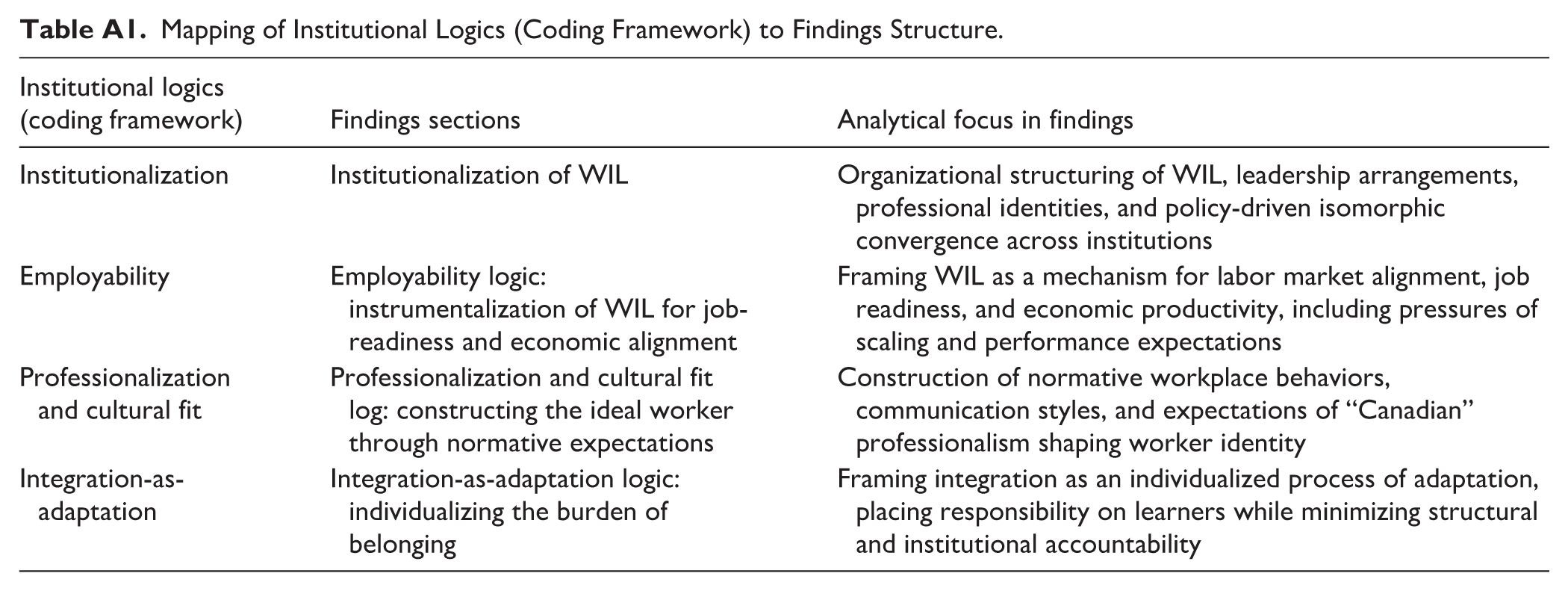
| Institutional logics (coding framework) | Findings sections | Analytical focus in findings |
|---|---|---|
| Institutionalization | Institutionalization of WIL | Organizational structuring of WIL, leadership arrangements, professional identities, and policy-driven isomorphic convergence across institutions |
| Employability | Employability logic: instrumentalization of WIL for job-readiness and economic alignment | Framing WIL as a mechanism for labor market alignment, job readiness, and economic productivity, including pressures of scaling and performance expectations |
| Professionalization and cultural fit | Professionalization and cultural fit log: constructing the ideal worker through normative expectations | Construction of normative workplace behaviors, communication styles, and expectations of “Canadian” professionalism shaping worker identity |
| Integration-as-adaptation | Integration-as-adaptation logic: individualizing the burden of belonging | Framing integration as an individualized process of adaptation, placing responsibility on learners while minimizing structural and institutional accountability |

Funding
The author disclosed receipt of the following financial support for the research, authorship, and/or publication of this article: The author received funding from the Social Sciences and Humanities Research Council (SSHRC) of Canada.
Declaration of Conflicting Interests
The author declared no potential conflicts of interest with respect to the research, authorship, and/or publication of this article.