







Abstract
Introduction
The global wildlife trade is a major driver of biodiversity loss, rivaling habitat loss and climate change in its impacts on species declines and extinctions (Lenzen et al., 2012; Morton et al., 2021). Although research and policy have historically focused on vertebrates (Bush et al., 2014; Scheffers et al., 2019), evidence shows that invertebrates are increasingly exploited through legal and illegal trade networks (Caldas et al., 2018; Lassaline et al., 2023, 2025). Despite representing the majority of animal diversity and providing essential ecosystem functions (Kitching et al., 2020; Prather et al., 2013), invertebrates remain underrepresented in conservation policies and enforcement priorities (Cardoso et al., 2011; Goodsell et al., 2025; Taylor et al., 2018).
Among terrestrial invertebrates, scorpions are ecologically important mesopredators, and some species are able to cause severe envenomation, being considered medically significant to humans (Polis, 1990; Martins et al., 2021; Lira et al., 2024; Theart et al., 2026).
This medical significance is well documented, as envenomation by certain species can result in systemic clinical manifestations and, in severe cases, death, especially in children and elderly individuals (Bucaretchi et al., 2014; Martins et al., 2021; Theart et al., 2026). Scorpions comprise more than 2,900 described species worldwide (Rein, 2026), and many exhibit restricted distributions and low dispersal capacity, traits that may increase their vulnerability to overharvesting (Esposito & Prendini, 2019; Herzig et al., 2023; Raymundo et al., 2022). At the same time, scorpions have gained popularity in the exotic pet trade, facilitated by online platforms that enable informal and transboundary exchanges (Herzig et al., 2023).
Brazil harbors over 200 scorpion species (Bertani et al., 2024) and is among the most diverse countries for scorpions worldwide. Together with Mexico (which harbors more than 300 species), these countries account for approximately 20% of the global scorpion fauna (Ponce-Saavedra et al., 2023; Rein, 2026). Brazil’s scorpion fauna shows high endemism and predominance of medically significant taxa, particularly within the genus Tityus (Guerra-Duarte et al., 2023; Lourenço, 2003). Species such as T. serrulatus, and T. stigmurus are responsible for thousands of envenomation cases annually (Duarte et al., 2024; Guerra-Duarte et al., 2023). Despite legal prohibitions under Brazilian federal law (e.g., Law no. 5,197/1967 and no. 9,605/1998) on the collection and commercialization of native fauna (La Laina et al., 2021; Lourenço & Jesus, 2019), wildlife trafficking persists and is increasingly mediated by digital platforms (Dandriyal et al., 2026; Osorio, 2024; Phelps et al., 2016).
The potential international circulation of Brazilian scorpions raises conservation, legal, and biosecurity concerns. Unregulated extraction may affect local populations, particularly of species with limited distributions, while transboundary movement of medically significant species poses risks of envenomation and accidental establishment outside their native range. Here, we provide the first exploratory documentation of Brazilian scorpion species involved in the international exotic pet trade using data from publicly accessible online platforms. Specifically, we aimed to identify and quantify records of Brazilian species in the trade, characterize their occurrence outside Brazil, and evaluate the associated conservation and biosecurity concerns.
Materials and Methods
Data Collection and Search Strategy
We conducted a systematic survey of Brazilian scorpion species traded as pets using data obtained exclusively from publicly accessible online platforms. Data were collected between January 2020 and December 2024. The primary platforms surveyed included Facebook (public groups and pages), Instagram, and commercial websites advertising live invertebrates for sale. No private groups, closed forums, or encrypted messaging applications were accessed.
Searches were performed using combinations of keywords in Portuguese and English, including generic terms (e.g., “scorpion for sale”, “pet scorpion”, “escorpião à venda”, “escorpião pet”) and genus-specific terms (e.g., Tityus, Rhopalurus, Jaguajir, Bothriurus), as well as references to Brazil or Brazilian origin (e.g., “Brazilian scorpion”, “from Brazil”, “Brasil”). Only posts explicitly indicating the availability, possession, exchange, or sale of live scorpions were considered. Posts related exclusively to husbandry advice, photographs without ownership claims, scientific discussions, or museum specimens were excluded. For each eligible post, we recorded the date, platform, apparent country of the seller or keeper, species identity, and price (when provided).
Ethical Considerations
This study relied exclusively on observational data obtained from publicly available online sources and did not involve direct interaction with traders, buyers, or platform users. No personal identifying information was recorded, stored, or disclosed. Usernames, profile images, and specific URLs were omitted to preserve anonymity and comply with ethical guidelines for digital research (Townsend & Wallace, 2016; Gupta, 2017; Sloan & Quan-Haase, 2022).
Results
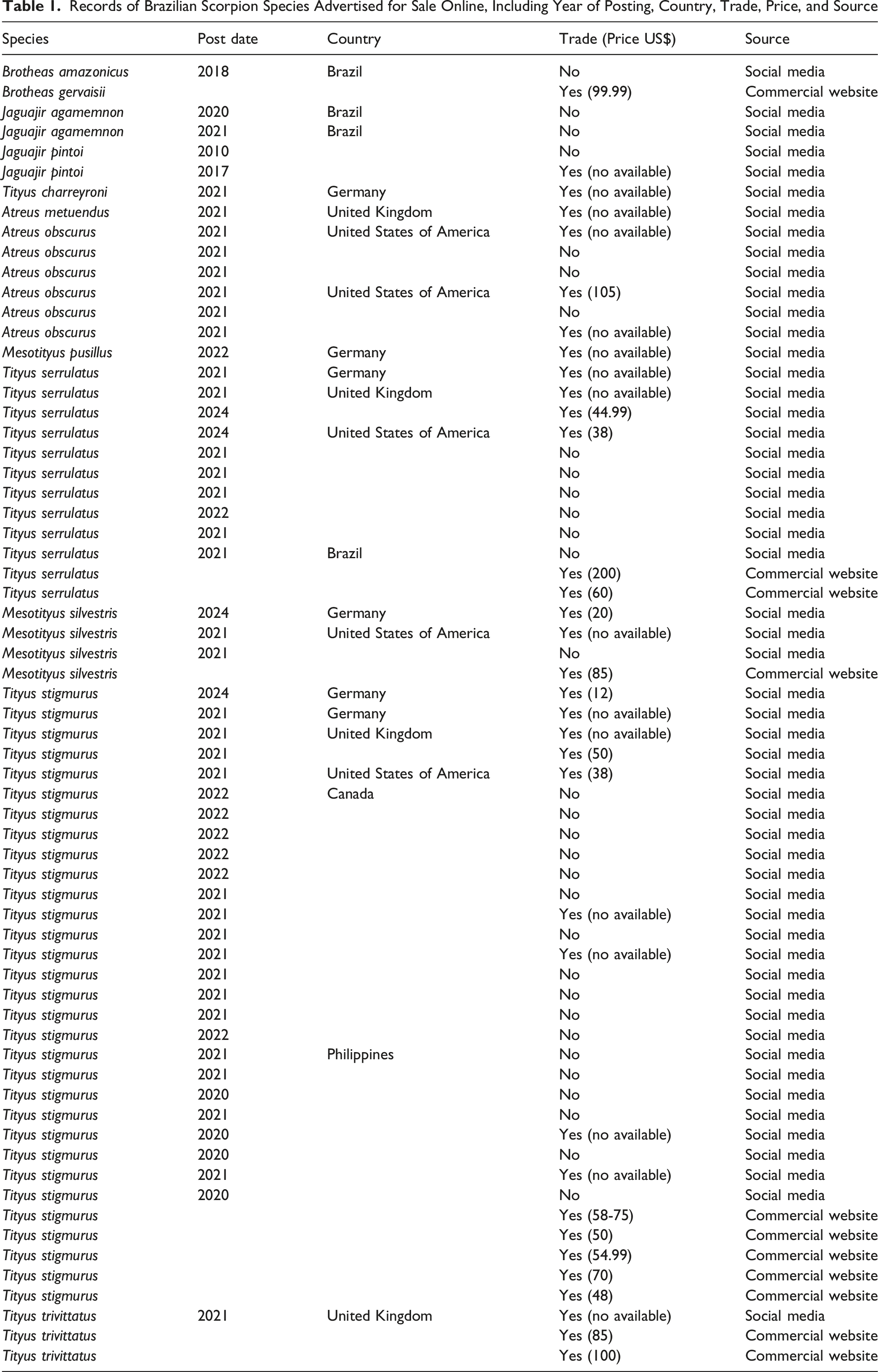
Records of Brazilian Scorpion Species Advertised for Sale Online, Including Year of Posting, Country, Trade, Price, and Source
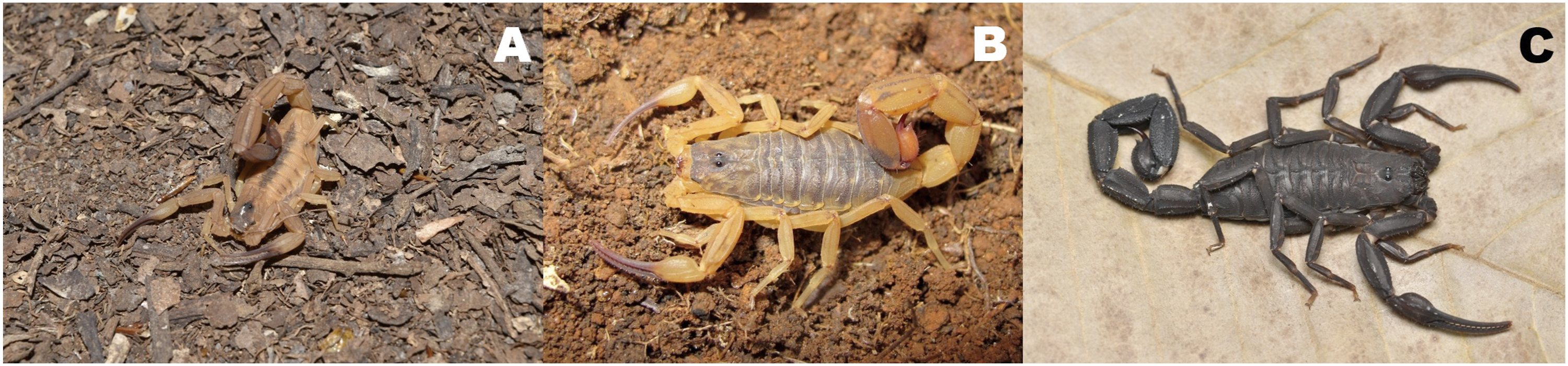
Scorpion species for medical importance found in pet trade transactions. A) Tityus stigmurus, B) Tityus serrulatus and C) Atreus obscurus. Photos by Lais Pordeus (A) and Pedro Martins (B and C)
Most records were associated with sellers located outside Brazil, primarily in Europe and North America (Table 1). Germany (n = 5), the United States (n = 5), and the United Kingdom (n = 4) accounted for the highest number of posts, with additional records from Canada and Southeast Asia. A subset of posts explicitly indicated commercial availability, while others documented possession without evidence of a sale offer. When provided, prices varied among species and sellers, ranging from approximately US$12–70 for T. stigmurus and M. silvestris to values exceeding US$100 for A. obscurus. In many cases, prices were not disclosed, and availability was communicated through private contact. Commercial posts were frequently associated with accounts that offered multiple invertebrate species or repeatedly advertised scorpions over time, suggesting sustained engagement in the exotic pet trade rather than isolated exchanges. Records spanned the period from 2010 to 2024, demonstrating long-term persistence of Brazilian scorpion species in online trade environments. The recurrent appearance of the same species across multiple years and platforms suggests continued demand and stable circulation over time. Species such as T. stigmurus and T. serrulatus were consistently detected throughout the sampling period, reinforcing their prominence within the trade.
Discussion
This study provides the first exploratory documentation of Brazilian scorpion species involved in the international exotic pet trade using publicly accessible online data. Our results demonstrate that native species are recurrently present in social media and commercial websites across multiple countries and over more than a decade, reinforcing evidence that invertebrates are increasingly incorporated into global trade networks facilitated by online platforms (Hughes et al., 2023; Lassaline et al., 2025). Social media and commercial websites appear to function as low-detection channels enabling transboundary circulation, as previously documented for other taxa (Phelps et al., 2016; Salas-Picazo et al., 2023; Sung et al., 2021). However, the available data do not allow us to determine how these animals are transported, whether they are shipped alive, or if shipments comply with postal and international regulations, highlighting an important gap in understanding the logistics and enforcement of this trade.
The predominance of Tityus species in online records likely reflects their wide distribution (Barrios-Montivero et al., 2025; Martins et al., 2023), ecological plasticity (Amado et al., 2021a, 2021b; Barroso et al., 2025), and growing interest among hobbyists (Herzig et al., 2023; Raymundo et al., 2022). Several of these species are of recognized medical importance (e.g., Bucaretchi et al., 2014; Martins et al., 2021), yet remain largely absent from wildlife trade monitoring frameworks. Although extraction rates and population-level effects were not assessed, many scorpions exhibit limited dispersal ability (Lourenço, 2010; Lourenço & Duhem, 2010) and habitat specialization (Lira, 2025), traits that may increase sensitivity to sustained removal. Even species considered synanthropic, such as T. stigmurus and T. serrulatus (Amado et al., 2021a, 2021b), could experience localized genetic or demographic impacts if harvesting is concentrated. For litter-associated taxa like M. pusillus, removal may also affect soil and leaf-litter food webs (Dionisio-da-Silva et al., 2024; Lira et al., 2016; Silva-Júnior et al., 2021). The absence of baseline population data for most Brazilian scorpions further limits impact assessment, underscoring broader impediments in invertebrate conservation.
All species identified in commercial posts are native to Brazil, where legislation prohibits possession and commercialization of venomous wildlife without authorization (La Laina et al., 2021; Lourenço & Jesus, 2019). Their presence in international online markets highlights a mismatch between national regulation and the transboundary nature of digital trade (Salas-Picazo et al., 2023; Sung et al., 2021). Invertebrates are rarely prioritized in border inspections or multilateral agreements (Blasco-Aróstegui et al., 2025; Lassaline et al., 2025), and global instruments such as CITES predominantly focus on vertebrates (Andersson et al., 2021). The patterns observed here suggest that similar governance gaps extend to neglected arthropod taxa.
Beyond conservation, the circulation of live scorpions has biosecurity implications. Medically significant species recorded in this study are responsible for severe envenomations in Brazil (Guerra-Duarte et al., 2023; Martins et al., 2021), and their presence in non-native regions may increase risks where antivenom access is limited (Jagpal et al., 2022; Ng et al., 2018). The translocation of live individuals also creates the potential for biological invasions, as some species may establish self-sustaining populations outside their native range, particularly those with high ecological plasticity (Bertani et al., 2018; Lourenço et al., 1994). For example, Isometrus maculatus (DeGeer, 1778) and Liocheles australasiae (Fabricius, 1778) are recognized introduced species that now exhibit globally widespread distributions (Fet et al., 2000; Kawai, 2021). Indeed, reports of introduced scorpion populations in non-native regions (Fet et al., 2000; Kawai, 2021; Sherwood et al., 2024) demonstrate that venomous arthropods can become established and should be explicitly considered in invasive species and biosecurity planning.
Our study is based on opportunistic records from publicly accessible platforms and likely underestimates the magnitude of the trade, as private transactions and encrypted channels were not assessed. Species identification relied on user-provided information or image-based assessment, introducing potential taxonomic uncertainty. Nevertheless, digital monitoring offers a valuable tool for detecting emerging trade pathways involving understudied taxa. Integrating online surveillance with field-based population data and regulatory collaboration will be essential to better evaluate the conservation relevance of invertebrate trade. In addition, the relatively high value attributed to some species (more than US$100) may be associated with factors commonly reported in the exotic pet trade, such as perceived rarity, distinctive morphology, and demand among collectors. Overall, our findings reinforce the need to incorporate neglected tropical invertebrates into wildlife trade monitoring and conservation governance frameworks.
Implications for Conservation
The online trade of Brazilian scorpions reveals an underrecognized pathway of pressure on tropical invertebrate biodiversity. Although population-level impacts were not assessed, sustained international demand may contribute to localized extraction, particularly for species with restricted distributions or low dispersal capacity. The mismatch between national wildlife legislation and the transboundary nature of digital trade exposes enforcement gaps, especially for invertebrates, which are rarely prioritized in monitoring frameworks. Beyond conservation concerns, the international movement of medically significant species raises biosecurity and public health risks in countries lacking appropriate antivenoms. Integrating Neotropical scorpions into wildlife trade surveillance systems such as CITES, in which only five scorpion species are currently listed (all of them from Africa) (CITES, 2026) and strengthening digital monitoring strategies are essential steps to prevent unnoticed biodiversity erosion and emerging biosecurity threats.
Footnotes
Acknowledgments
We are grateful to the two anonymous reviewers for their valuable comments and suggestions, which greatly improved the clarity and presentation of the manuscript.

Author Contributions
AFAL conceived the ideas and designed methodology; AFAL and KVLA collected and analyzed the data; AFAL and KVLA wrote the manuscript, and approved the final version for submission.
Funding
The authors received no financial support for the research, authorship, and/or publication of this article. The authors acknowledge the use of ChatGPT (OpenAI) for assistance with English language editing, including grammar, spelling, and improvements to text fluency. All scientific content, interpretations, and conclusions remain the sole responsibility of the authors.
Declaration of Conflicting Interests
The authors declare no conflict of interest.
Data Availability Statement
All data supporting the findings of this study are presented within the article.