






Abstract
Nature-based Solutions (NbS) initiatives like coral restoration sites have potentially changed ecological conditions by influencing species composition and structural attributes. While numerous studies highlight the positive impacts on coral survival and coverage of coral restoration projects, there is a growing need for in-depth investigations into the morphological traits of coral species and the community-level structure. Here, we conducted benthic surveys during January 2020 and May 2023 in a coral restoration site located in the Maritime Police Camp (Mabini, Philippines), and compared the morpho-functional groups between timepoints. Surveys conducted in 2023 demonstrated a significant increase in arborescent hard corals compared to 2020. Additionally, outstanding sponges and other life categories (e.g., echinoderms & mollusks) showed notable increases in 2023. These observations suggest a rise in fast-growing corals and enhanced structural complexity during the pandemic, likely linked to reduced anthropogenic pressures. However, causality cannot be confirmed, particularly in the context of COVID-19 restrictions, highlighting the need for further long-term and multi-site studies conducted under similar conditions of reduced anthropogenic pressure to better understand the ecological responses observed here. The observed temporal shifts in coral and benthic communities at the restoration site highlights the importance of continuous monitoring and adaptive management in coral restoration. In particular, future restoration efforts can become more precisely tailored to promote long-term biodiversity and ecosystem functioning of coral reefs in the face of environmental change.
Introduction
Coral reefs serve as habitats for various marine organisms, provide medical compounds, protect coastal areas, and generate income from fishing and tourism (Cooper et al., 2014; Woodhead et al., 2019). Live hard coral has diminished since the 1950s, with global estimates indicating losses of approximately 4.7% to 6.8% per decade over this period (Eddy et al., 2021). This degradation can be attributed to anthropogenic climate change, typhoons, and unsustainable fishing (Hughes et al., 2019; Maire et al., 2016; Newton et al., 2007). Thus, efforts to preserve the coral reefs are crucial to ensuring marine biodiversity and supporting economic activities dependent on these ecosystems. In response to these complex and interconnected challenges, Nature-based Solutions (NbS) offer an integrated approach that not only focuses on ecosystem restoration but also addresses broader societal needs. NbS are defined as interventions that restore, protect, or alter ecosystems to address societal challenges such as climate change, biodiversity loss, disaster risk reduction, and economic and social development (The International Union for Conservation of Nature 2020). Specifically, coral restoration through NbS not only rebuilds ecosystems but also enhances their resilience to ongoing climate change and human pressures, ensuring long-term sustainability, yielding favorable outcomes. This is a promising alternative that delivers multifaceted benefits in addressing environmental-related challenges. For instance, NbS efforts in Malaysia, the Pacific Islands, and Hawaii have enhanced coastal protection against natural disasters, provided education and recreation for locals, and positively contributed to the economy by improving fish catch, tourism, or employment (Chee et al., 2021; Hein et al., 2019; Kittinger et al., 2012).
Coral reefs undergoing restoration are subjected to various human-induced pressures such as pollution, tourism, overfishing, and coastal development (Hoegh-Guldberg et al., 2019). These negative factors can significantly hinder restoration efforts, making it essential to implement strategies that mitigate these impacts. The COVID-19 pandemic in 2020, which led to reduced human activity, altered this dynamic, bringing both challenges and opportunities for these initiatives (Coll 2020; Coll et al., 2021). Batangas, Philippines, is no exception to these challenges, restoration efforts in Batangas have faced significant threats from dynamite fishing and sustainable tourism (Matorres et al., 2024). These activities undermine the ecological integrity of restoration sites (Matorres et al., 2024).
Local governments have attempted to mitigate these impacts by providing alternatives, such as sinkers for tourist boats to prevent anchor damage, making this an appropriate site for coral restoration (Matorres et al., 2024). Previous studies conducted in Batangas, Philippines have focused on coral color assessment and benthic composition analysis (Hildawa et al., 2024). Verdadero, (2017) reported an average hard coral cover of 40% in Batangas. Despite efforts to monitor these important ecosystems, there remains a gap in understanding the complexities of coral reefs in Batangas and their changes over time. However, relying solely on hard coral cover as an indicator of reef health may not provide a complete picture of the reef’s condition (González-Barrios & Álvarez-Filip 2018). Moreover, local governments in Batangas have acknowledged their limitations in monitoring the health of coral reefs and the effectiveness of restoration efforts (Matorres et al., 2024). There is a need for detailed and consistent monitoring over time to examine potential changes in the coral reefs of Batangas.
To address this limitation, incorporating morpho-functional classifications allows researchers and conservation managers to evaluate biodiversity and functional redundancy within coral assemblages. (González-Barrios & Álvarez-Filip 2018). Coral species exhibit varying capacities that contribute to reef functionality based on their morphological and physiological traits (González-Barrios & Álvarez-Filip 2018). Understanding these traits helps in assessing how different coral species contribute to habitat structure and complexity (González-Barrios & Álvarez-Filip 2018). For instance, branching and tabular Acropora, which are vital for their reef-building capabilities, are expected to be the most susceptible to human activities and serve as important indicators of reef health (Baird & Hughes 2000; Cybulski et al., 2020; Darling et al., 2017). We anticipate higher abundance in vulnerable coral species, such as these Acropora types, with an increase in abundance while algae morpho-functional groups will decrease. Therefore, assessing morpho-functional groups is crucial in NbS projects, as it provides insights into potential changes in benthic community composition and structural complexity, which in turn helps guide targeted restoration efforts and supports habitat complexity and overall biodiversity (González-Barrios & Álvarez-Filip 2018; Kramer et al., 2022). Examining these changes will help characterize reef habitat and performance, which are crucial to making informed decisions about conservation management strategies (Alvarez-Filip et al., 2022; Cabaitan et al., 2015).
Therefore, this study aims to address the identified gaps in understanding the dynamics of coral reefs in Batangas in response to restoration efforts. Specifically, the objective is to examine the changes in coral reef characterization within the Maritime Police Camp (located in Batangas, Philippines) by analyzing the ecological shifts in morpho-functional groups associated with NbS projects over two distinct periods: 2020 and 2023. By focusing on these morpho-functional groups, this study seeks to provide insights into the resilience and functional dynamics of coral reefs, thereby informing more effective conservation and management strategies.
Methods
Study Location
The active restoration site selected for this study was Maritime Police Camp (MP) in Mabini, one of the 31 Municipalities in the province of Batangas, located in the central part of the Philippines (Figure 1). Batangas City Government, (2014). We selected two depths for the study, 5 m and 10 m, because Mabini has been undergoing coral transplantation efforts since 2013 at these depths (Flores et al., 2017). A. Region of Anilao (Mabini, Philippines) and maritime police camp [MP] (13.74871° N, 120.901291° E); B. Photograph of MP restoration site during 2020; C. Photograph of MP restoration site during 2023; D. Example of coral nubbins attached to restoration pipes at the MP site. Map open source Esri, GEBCO. 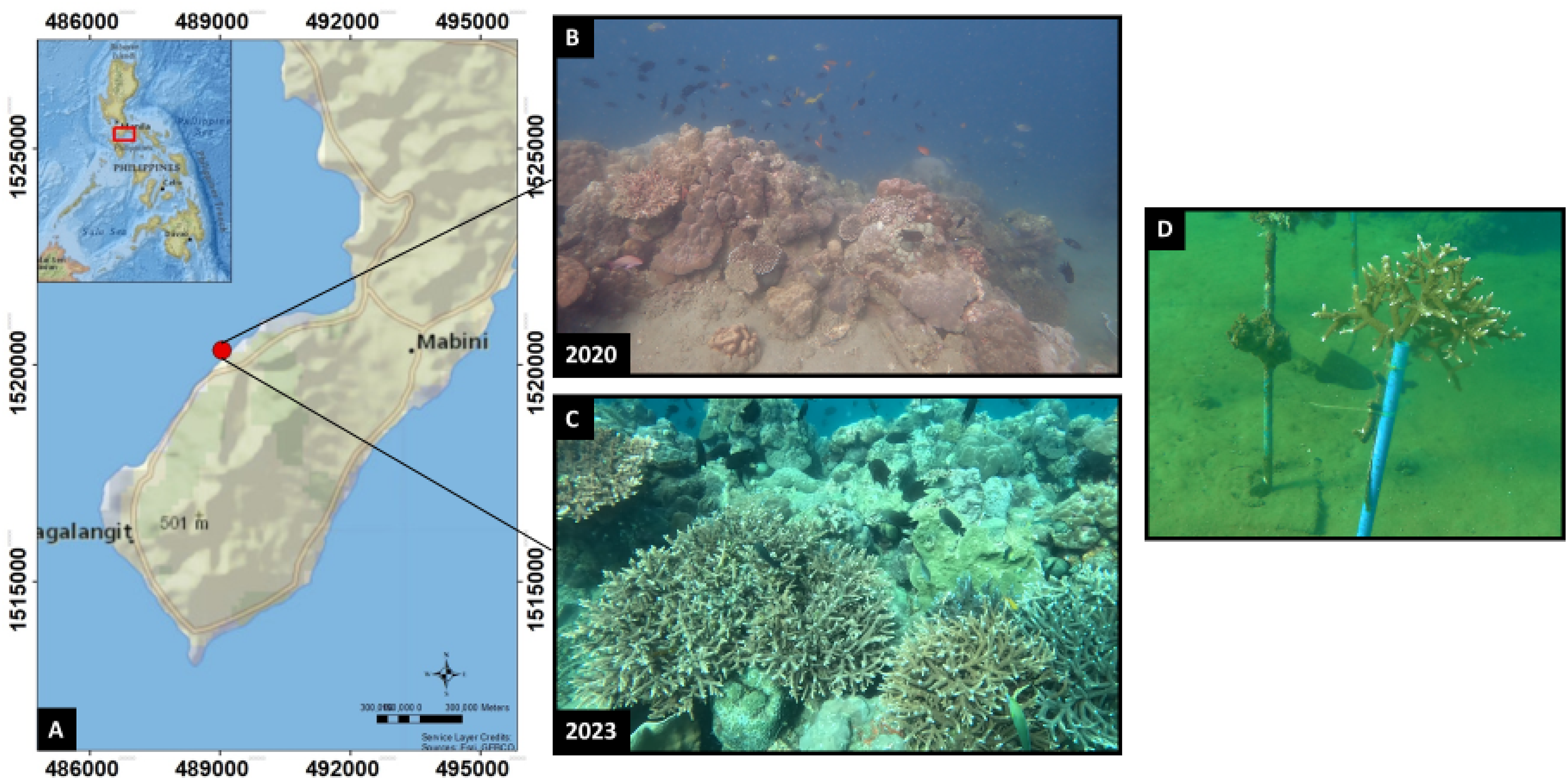
Benthic Surveys
Assessment of the morpho-functional groups and biodiversity shows complexities of coral reefs, which is imperative as indicated by previous research (Alvarez-Filip et al., 2009; Tebbett et al., 2019). We conducted the same random sampling in the same benthic survey location in the morning of January 31st 2020, and the morning of May 20, 2023 as early as possible before the anticipated surge of local and international tourists to the area. Although May typically marks the beginning of the tourist season, the number of visitors was still relatively low during our sampling period, minimizing cumulative pressure from tourism (Figure 2). Illustration of the benthic survey procedure conducted during 2020 and 2023. Icons adapted from Flaticon (https://www.flaticon.com/free-icon/ruler_2046957) and Vecta Symbols – IAN-style ecology icons (https://vecta.io/symbols/category/ian-symbols).
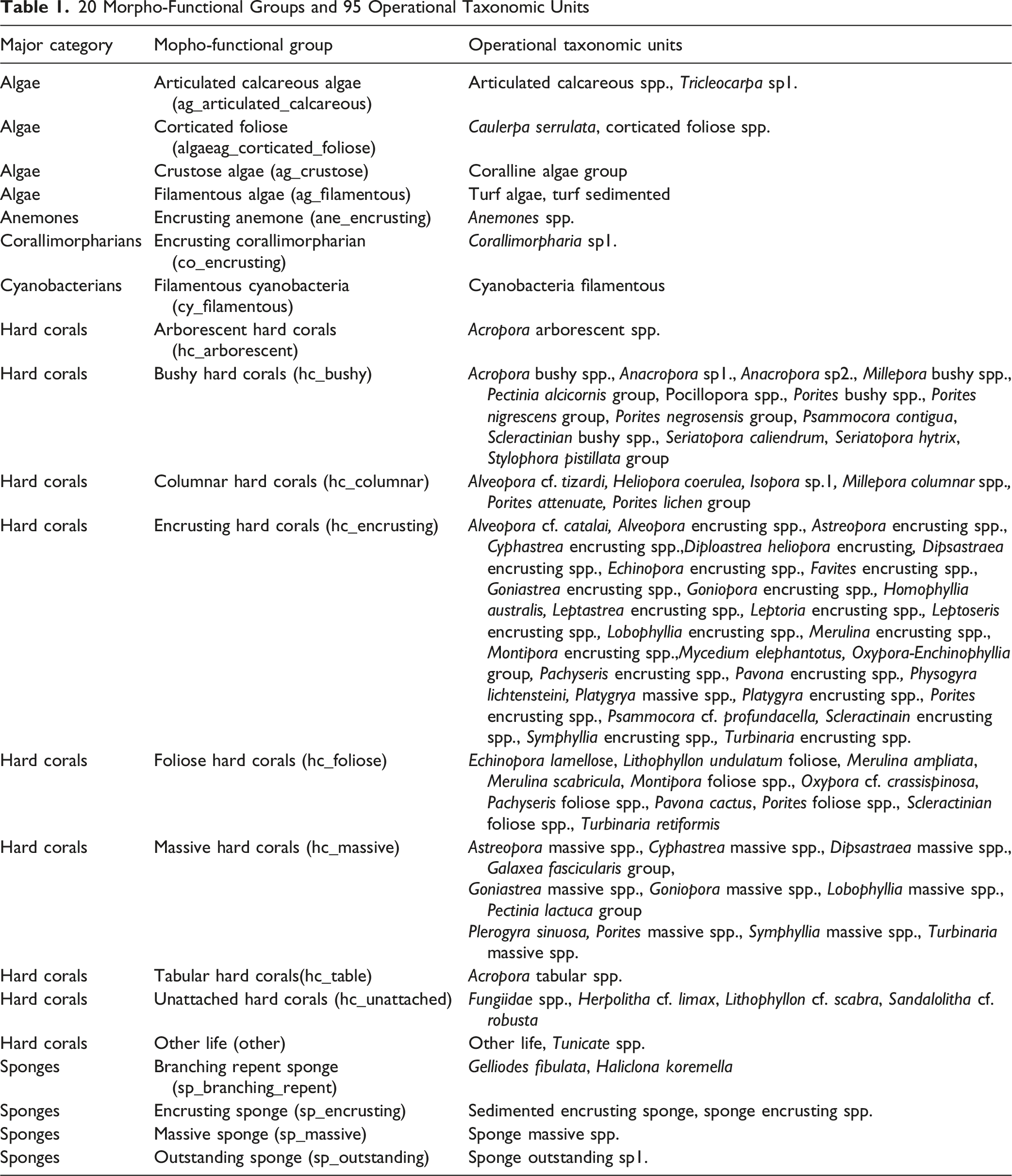
20 Morpho-Functional Groups and 95 Operational Taxonomic Units
Data Analysis
All analyses and data visualization were conducted in R version 4.2.3 (R Core Team 2023; Oksanen et al., 2014; Kohl 2024; Wickham 2016). We employed a paired t-test with bootstrapping (5,000 resampling iterations) on CLR-transformed data to determine significant changes in the abundance of various morpho-functional groups at combined 5 m and 10 m depths during 2020 and 2023 (Aitchison, 1982; Kohl, 2024). The paired t-test was chosen because it allows for the comparison of the same sites across two time points, effectively accounting for within-site variability. This method is particularly suitable for detecting changes over time in paired observations, making it appropriate for our study’s focus on evaluating shifts in specific coral morpho-functional groups. Statistical significance was set at a 0.05 alpha level. No correction for multiple comparisons was applied, as the compositional nature of point-count data induces structural negative correlations among morpho-functional groups even after CLR transformation, violating the independence assumption underlying standard corrections such as Bonferroni (Gloor et al., 2017).
For community-level analyses, Hellinger-transformed data were used for non-metric multidimensional scaling (nMDS), PERMANOVA, and PERMDISP (Legendre & Gallagher 2001). The nMDS ordination was employed for visualization, reducing multidimensional data into lower dimensions while preserving the rank order of dissimilarities and allowing exploration of similarities and differences in morpho-functional compositions between 2020 and 2023 (Cybulski et al., 2020). PERMANOVA with 999 permutations was applied to test the statistical significance of overall coral abundance changes, while PERMDISP assessed whether dispersions among groups differed significantly, ensuring that differences detected by PERMANOVA were not driven by heterogeneity of variance. Although these permutation-based tests captured community-level patterns, the paired t-test on CLR-transformed data provided additional insights into specific morpho-functional group shifts that may have contributed to observed assemblage differences.
Diversity Indices and Indicator Evaluation
The Dufrêne and Legendre (1997) species indicator was employed to identify morpho-functional categories significant in distinguishing 2020 and 2023 surveys. For instance, a morpho-functional group is deemed characteristic of a community if it is widespread across most transects within that community but largely absent from others. For the evaluation of morpho-functional group diversity within both 2020 and 2023, we utilized Hill numbers (encompassing morpho-functional categories richness, Shannon diversity of morpho-functional categories, and Simpson diversity of morpho-functional categories) (Chao et al., 2014). Morpho-functional categories richness (H0) denotes the number of morpho-functional groups within 2020 and 2023. Shannon diversity (H1) accounts for both richness and evenness to provide a comprehensive measure of diversity, considering ecosystem entropy, while Simpson diversity (H2) estimates the dominance of species without accounting for richness (Chao et al., 2014). In addition, data from National Oceanic and Atmospheric Administration Coral Reef Watch (2019) and the Philippine Department of Tourism (2024) were gathered to examine potential environmental and anthropogenic factors influencing coral communities, such as thermal stress, tourism pressure, and coastal ecosystem disturbance.
Results
Morpho‒Functional Groups During 2020 and 2023
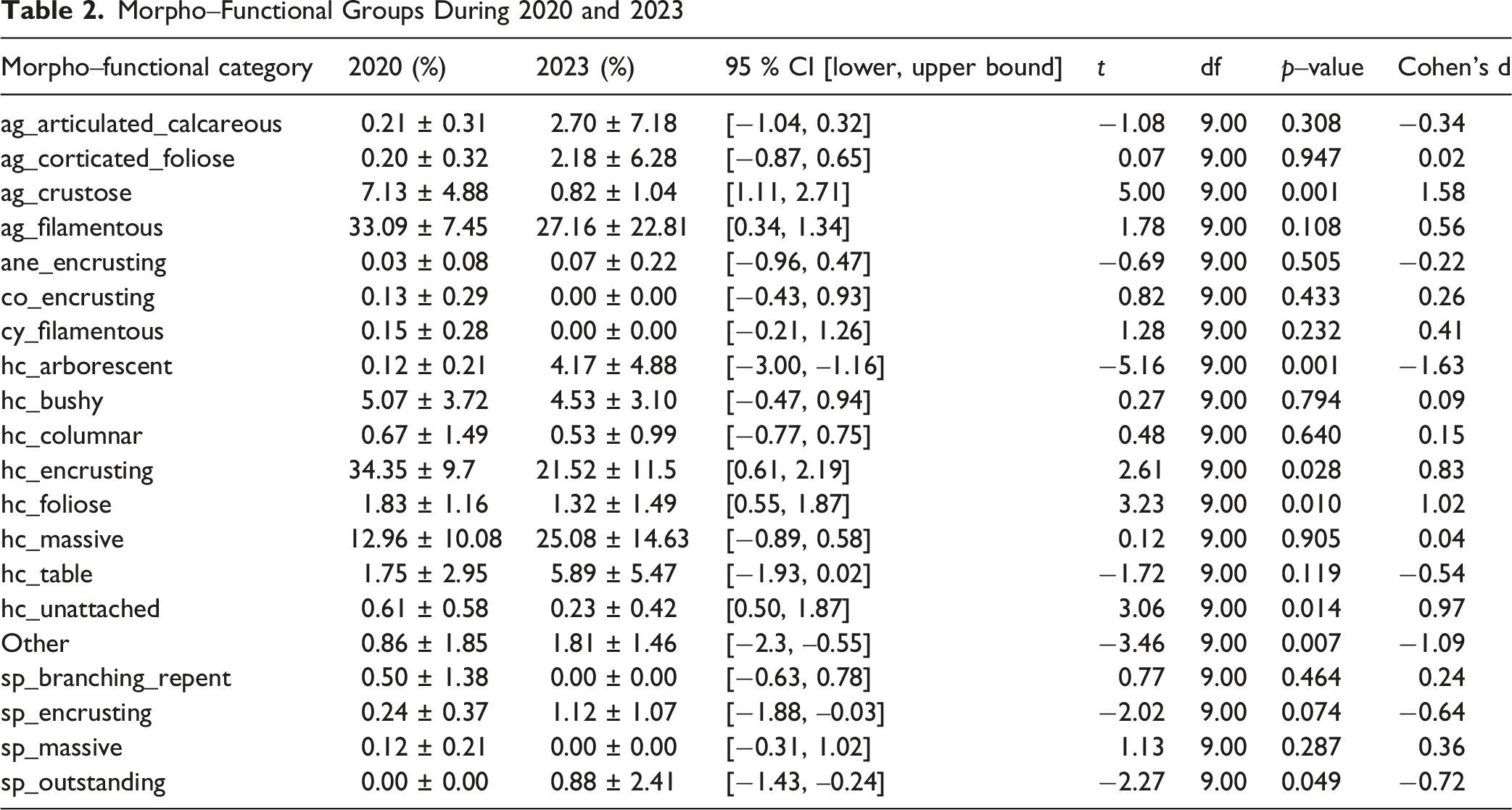
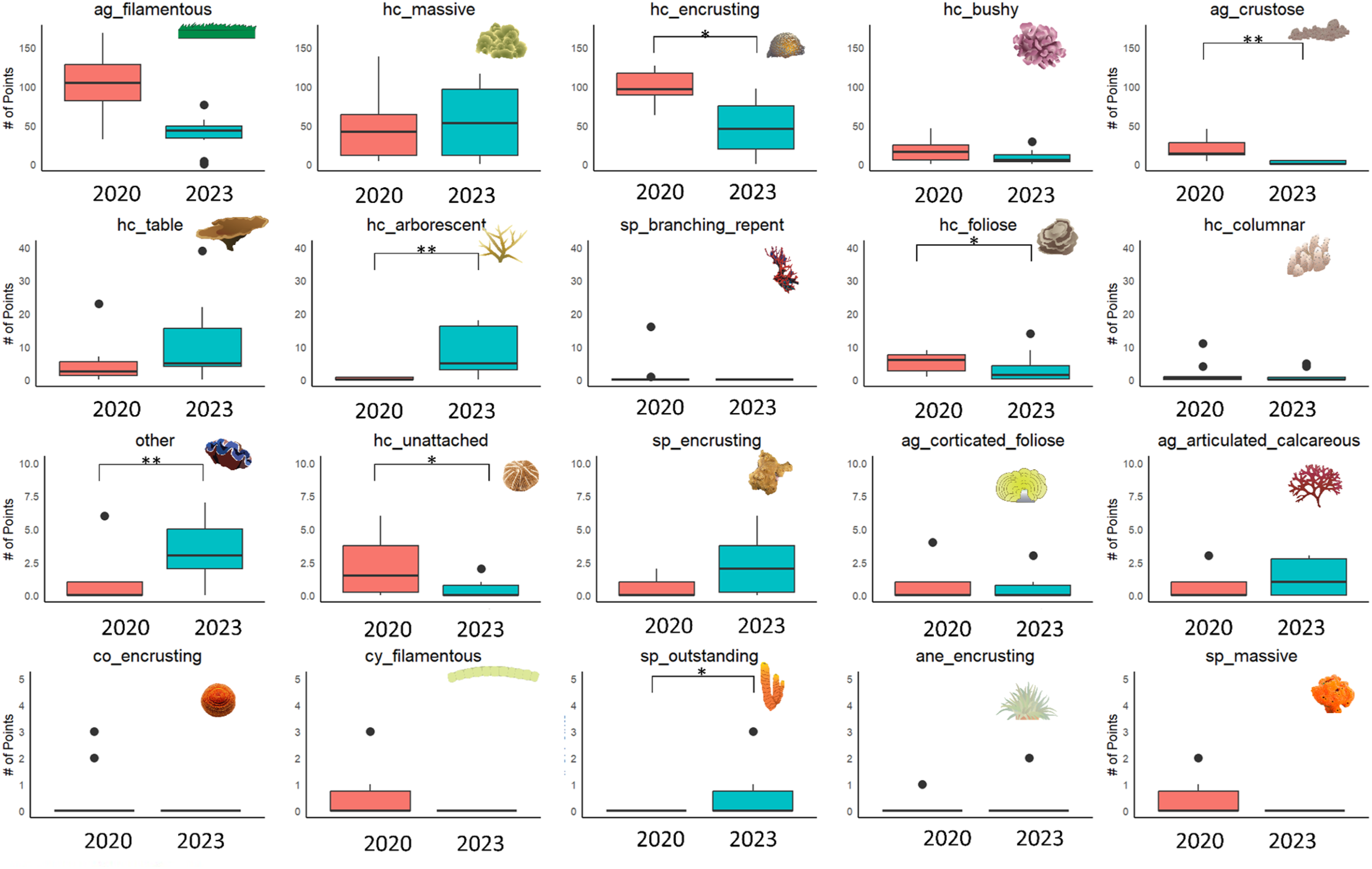
Morpho-functional group percentage cover during 2020 (pink) and 2023 (cyan) at the Maritime Police Camp restoration site, Mabini, Philippines. Each boxplot displays the median (horizontal line), interquartile range (box), and 1.5× interquartile range (whiskers) of percentage cover across 10 transects per period. Individual points represent values from each transect. Asterisks indicate statistically significant differences between periods based on bootstrapped paired t-tests on CLR-transformed data: *p < 0.05; **p < 0.01. Icon adapted from Vecta Symbols (https://vecta.io/symbols/category/ian-symbols).

Mean percentage cover of major benthic groups at the Maritime Police Camp restoration site, Mabini, Philippines, during 2020 (pink) and 2023 (cyan). Bar heights represent the mean percentage cover of each major benthic group calculated across 10 transects per period. Error bars represent ± one standard error of the mean. Percentage cover was calculated per transect as the proportion of identified points within each major benthic group relative to the total number of identified points per transect
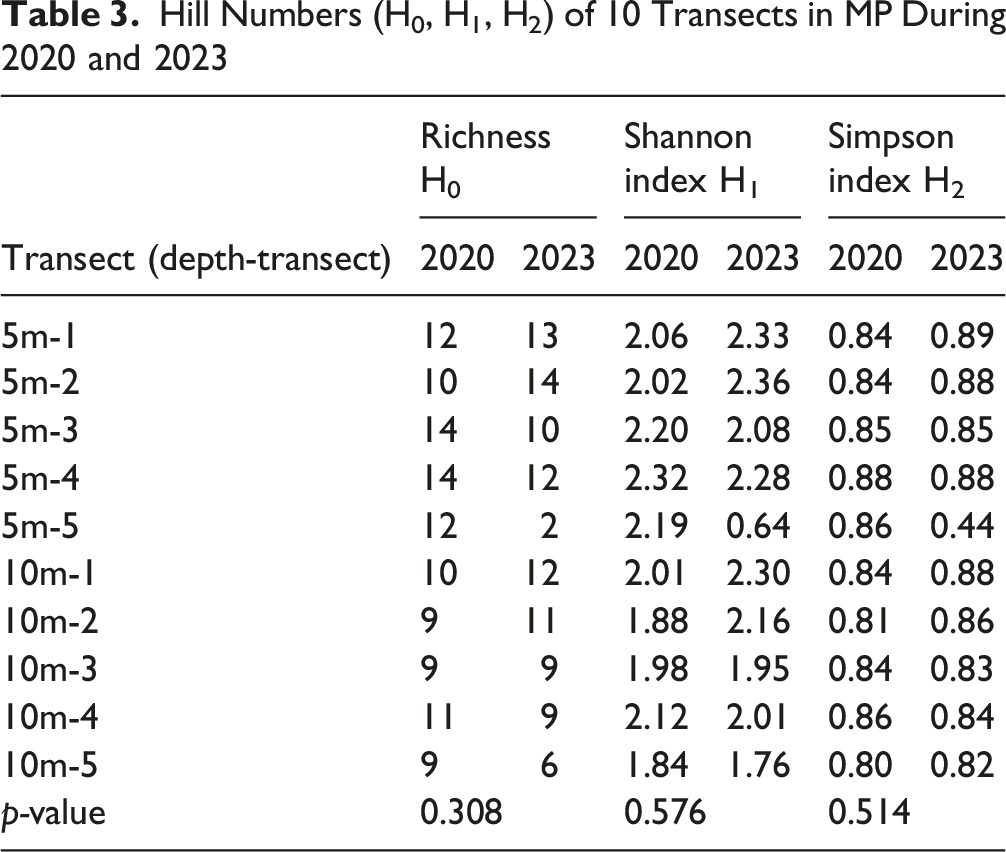
nMDS ordination presents distinct abundance patterns of morpho-functional groups, highlighted by the proximity of ellipses during 2020 and 2023 periods (Figure 5). Two-way PERMANOVA revealed a significant difference in benthic community composition between pandemic periods (F = 3.76, R2 = 0.17, p = 0.002), while depth had no significant effect (F = 1.11, R2 = 0.05, p = 0.323) (Figure 5). Tests for homogeneity of multivariate dispersion using Permutational Analysis of Multivariate Dispersions (PERMDISP) showed no significant differences in dispersion between pandemic periods (F = 1.31, p = 0.268) or depth categories (F = 0.00, p = 0.994). This indicates that within-group variability was comparable among groups, suggesting that the significant PERMANOVA result for pandemic period reflects true differences in community composition rather than differences in dispersion. Results from the Dufrêne and Legendre (1997) species indicator identified crustose algae (p<0.001) and encrusting hard corals (p<0.01) as the indicator group during the 2020 period. During the 2023 period, arborescent hard corals (p<0.01) emerged as the indicator group. Furthermore, morpho-functional groups for Richness, Shannon Index, Simpson Index demonstrated non-significant differences for 2020 and 2023 (Table 3). nMDS of morpho-functional groups in MP. Ellipses are 2020 (pink) and 2023 (cyan) groups. Each pink point represents each transect taken during 2020 and cyan points represent transects taken during 2023. AGAC (ag_articulated_calcareous), AGCF (ag_corticated_foliose), AGC (ag_crustose), AGF (ag_filamentous), AGE(ane_encrusting), COE(co_encrusting), CYF(cy_filamentous), HCA(hc_arborescent), HCB(hc_bushy), HCC (hc_columnar), HCE(hc_encrusting), HCF(hc_foliose), HCM (hc_massive), HCT(hc_table), HCU(hc_unattached), O(Other), SPBR(sp_branching_repent), SPE(sp_encrusting), SPM (sp_massive), SPO(sp_outstanding) Hill Numbers (H0, H1, H2) of 10 Transects in MP During 2020 and 2023
Data from National Oceanic and Atmospheric Administration Coral bleaching watch (National Oceanic and Atmospheric Administration Coral Reef Watch, 2019) reveals the yearly SST mean did not change drastically during 2020 (28.50 ± 1.55°C), 2021 (28.50 ± 1.42°C), 2022 (28.7 ± 1.28°C) and 2023 (28.4 ± 1.31°C) (S1). Further data from the Philippine Department of Tourism (2024) showed that tourist arrivals were 8,260,913 in 2020. Arrivals dropped substantially in 2021 (1,482,535) and began to recover in 2022 (2,653,858), but remained below pre-pandemic levels. Although tourism continued to recover in 2023 (5,450,557), the total number of tourists was still lower than in 2020 (S2).
Discussion
This study revealed significant ecological changes in coral communities between 2020 and 2023. Arborescent hard corals increased significantly, while crustose algae, encrusting hard corals, foliose hard corals, and unattached hard corals decreased. Outstanding sponges and other life categories also showed significant increases during 2023. Overall, hard coral cover was higher in 2023 (63.3%) compared to 2020 (57.4%), and community composition differed significantly between the two periods (PERMANOVA: F = 3.76, R2 = 0.17, p = 0.002), while depth had no significant effect on community composition (F = 1.11, R2 = 0.05, p = 0.323).
Decrease in foliose hard corals was observed between sampling periods. Foliose corals often occupy intermediate positions in competitive hierarchies and are considered generalist taxa tolerant of high sedimentation and low light conditions (Edinger & Risk, 2000), as observed in coral communities in Singapore (Januchowski-Hartley et al., 2020). Their relative decline may therefore reflect competitive displacement by faster-growing morpho-functional groups, particularly arborescent hard corals, which increased substantially during the same period.
Similarly, a reduction in crustose algae was detected between 2020 and 2023. Crustose algal assemblages include both calcifying crustose coralline algae (CCA) and non-calcifying forms, which play different ecological roles in reef ecosystems (Britton et al., 2021). While CCA can facilitate coral larval settlement and reef cementation, other crustose algae may compete for substrate space (Tebben et al., 2015). Therefore, the ecological implications of this reduction likely depend on the taxonomic composition of the crustose assemblage, which could not be resolved at finer resolution in this study (Jorissen et al., 2021).
Additionally, a lower abundance of encrusting hard corals was observed in 2023. Encrusting corals are generally considered relatively stress-tolerant due to their low-profile growth form and strong substrate attachment. However, they remain susceptible to decline under elevated or prolonged environmental stress, such as high sedimentation, reduced light availability, or increased nutrient input (Torda et al., 2018). As such, the observed reduction may reflect changing environmental conditions or other unmeasured local stressors, although these drivers were not directly assessed in this study. Moreover, a decrease in unattached hard corals was also identified during 2023, which may be linked to their mechanical susceptibility to movement caused by waves and currents (Uhrin et al., 2005).
Conversely, a significant increase in arborescent hard corals was observed during 2023. These morpho-functional groups provide keystone structures for reefs and enhance structural complexity, aiding reef recovery and resilience (Darling et al., 2017; Stahl et al., 2023). A higher abundance of arborescent hard corals in 2023 is consistent with conditions of reduced anthropogenic pressure, although causality cannot be confirmed from this study design. A study in Malaysia similarly found that reduced tourist activity during COVID-19 was associated with recovery of fragile morpho-functional groups such as arborescent hard corals (Maidin et al., 2021). Increases in other life categories were also observed during 2023, including sightings of juvenile giant clams (Tridacna gigas) and feather starfish (Crinoidea sp.). The appearance of these organisms may reflect broader changes in reef condition associated with the restoration activities at this site (Boström-Einarsson et al., 2020; Ladd et al., 2018).
Lastly, an increase in outstanding sponges was observed in 2023. While sponge proliferation may be partly related to their competitive ability to occupy available substrate (Bell et al., 2018), this observation warrants caution as sponge dominance can also be associated with ecosystem stress and eutrophication (George et al., 2018). The increase in arborescent hard corals and other life categories in 2023 is consistent with changes in reef condition, although the specific drivers remain uncertain given the limitations of this study design.
Multivariate Analysis and Ecological Implications
The nMDS analysis revealed two main observations: the close proximity between 2020 and 2023, and the larger 2023 ellipse compared to the 2020 ellipse. The results suggest potential alterations in morpho-functional groups, indicative of coral community assemblage restructuring or compositional adjustment over this short time (Soares et al., 2021). Supporting this interpretation, the two-way PERMANOVA indicated that benthic community composition differed significantly between the pandemic periods (F = 3.76, R2 = 0.17, p = 0.002), whereas depth had no detectable influence (F = 1.11, R2 = 0.05, p = 0.323). The lack of significant differences in dispersion among groups, as shown by PERMDISP, suggests that these compositional differences are unlikely to result from variation within groups. Together, these findings support the notion that the observed shifts in community composition between 2020 and 2023 reflect genuine changes in benthic assemblages rather than artifacts of sampling variability.
Shifts in coral assemblage composition do not necessarily ensure the persistence of reef ecosystem functioning, as different morpho-functional groups contribute unequally to key ecological processes such as carbonate production, habitat complexity, and resistance to disturbance. Therefore, the functional implications of the observed changes remain uncertain and warrant further investigation. Analysis of mean SST from 2020 to 2023 indicates no drastic changes, ruling out significant temperature shifts. However, the Philippine tourism industry has suffered notably, suggesting that human activities may be associated with shifts in coral restoration outcomes in MP.
Sampling was conducted in January 2020 and May 2023 due to logistical constraints imposed by COVID-19 restrictions, which limited field access and prevented repeated sampling within each year. Although these months fall in different parts of the calendar, both occur within the Philippines’ dry season (December–May), characterized by relatively low rainfall and high light availability (PAGASA, n d), making them broadly comparable in environmental conditions. Mean SST measured during the two sampling periods did not indicate substantial differences, suggesting that temperature was unlikely to drive the observed differences in benthic communities. In contrast, human activities, including tourism, may have influenced benthic community composition, given reductions in visitation during COVID-19 restrictions and the subsequent resumption of activity in 2023. Further studies on abiotic factors are needed to understand various drivers for changes in coral assemblages.
Our initial expectation that vulnerable coral groups would increase alongside a reduction in algal cover was not consistently supported. While some coral morpho-functional groups showed higher values in 2023, algal cover also increased, suggesting a more complex or transitional benthic response rather than a clear recovery signal. High hard coral cover is generally associated with reef-building potential and ecosystem stability (Heres et al., 2021; Komyakova et al., 2013; Morgan et al., 2016). However, this study did not assess disturbance history or long-term recovery dynamics; therefore, resilience cannot be inferred from the observed coral cover alone. The observed temporal shifts in benthic community composition are consistent with reduced anthropogenic pressure during the pandemic period, though direct causal attribution cannot be established given the limitations of the study design.
It is suggested that the decrease of unsustainable tourism activities may contribute to changes in coral communities. For instance, a study in Malaysia found that decreased tourism activities in Tunku Abdul Rahman Park was associated with an increase in coral cover of 1.17% (Maidin et al., 2021). Similarly, a study in Akumal Bay, Mexico found that rapid increases in tourism were associated with a decline in coral cover of 79% (Gil et al., 2015). However, traditional assessments of reef health often focus solely on coral cover, which may not provide a complete picture of reef condition. Overall, monitoring coral morpho-functional groups between 2020 and 2023 reveals a complex picture of changes in community composition. The findings underscore the importance of site-specific coral reef restoration efforts and provide valuable insights into the ecological roles and functionalities of these groups. Classifying corals based on their morpho-functional traits enables researchers to predict how changes in environmental conditions may affect coral growth and survival. This understanding aids in conservation efforts, allowing for targeted management strategies that prioritize the protection of key reef-building species essential for maintaining structural complexity and habitat provision. Significant functional similarity can enhance resilience to disturbances, as it indicates that multiple species can perform similar ecological roles, thereby providing stability to the ecosystem (González-Barrios & Álvarez-Filip 2018). In summary, studying morpho-functional groups of corals provides valuable insights into their ecological roles, adaptive strategies, and potential responses to environmental changes, which are vital for the conservation and management of coral reef ecosystems (Kramer et al., 2022). Further research is needed to better understand the drivers behind these changes and to inform future conservation strategies.
Limitations
This study has several limitations. First, the small sample size may restrict the generalizability of our findings and reduce the statistical power to detect moderate ecological differences among sampling periods. In addition, potential intra-annual variation could particularly affect the results for groups like filamentous algae and crustose coralline algae. Due to logistical constraints, this study lacks a control site, limiting our ability to distinguish restoration-driven changes from broader environmental trends. Furthermore, the comparison is based on only two time points (2020 and 2023), and thus does not represent a continuous time series, constraining our ability to infer temporal trends or trajectories in community dynamics. This study did not include direct measurements of anthropogenic pressures, such as fishing intensity, anchor damage, or nutrient loading. Therefore, while the observed patterns are consistent with reduced anthropogenic disturbance during the pandemic period, any attribution of these changes to COVID-19-related effects remains speculative. Second, the lack of consideration for abiotic factors such as salinity and light availability is a limitation that could affect the comprehensive understanding of coral health and recovery.
However, despite budget constraints, we believe this research is valuable as it is one of the few studies focused on coral communities within the Maritime Police area in this localized context. Third, future studies should consider direct measurements of anthropogenic pressures, such as fishing intensity, anchor damage, or nutrient loading. To enhance the robustness of future studies, it is essential to expand sample sizes and consider both abiotic factors and policy impacts. By acknowledging these limitations, we underscore the need for more detailed studies that can build upon our findings, ultimately leading to more effective and targeted coral restoration strategies.
Implications for Conservation
Holistic monitoring is essential for Nature-based Solutions (NbS) in coral restoration, particularly those focused on morpho-functional groups. This approach deepens our understanding of ecosystem dynamics and resilience, enhancing the effectiveness of restoration efforts. It also informs coral restoration managers, allowing for more adaptive management and improved conservation outcomes. Additionally, monitoring fosters collaboration among stakeholders, ensuring scientific findings are integrated into conservation practices. Understanding the different morpho-functional traits helps predict species resilience to stressors like bleaching and climate change, aiding in targeted conservation. This study highlights the value of monitoring coral reef communities before and after unprecedented events such as the COVID-19 pandemic. The observed patterns provide preliminary insights into potential ecological responses and emphasize the need for further research to better understand processes driving changes in reef condition.
Supplemental Material
Supplemental material - Morpho-Functional Group Dynamics at a Coral Restoration Site in Mabini, Philippines
Supplemental material for Morpho-Functional Group Dynamics at a Coral Restoration Site in Mabini, Philippines by Mariana Gabrielle Cangco Reyes, Jeffrey Pagaduan, Syuan-Jyun Sun in Tropical Conservation Science
Footnotes
Acknowledgements
The authors thank the reviewers for their time and constructive comments, which helped improve this manuscript. We gratefully acknowledge our diving sponsor, Philippine Association on Underwater Activity. We thank NTU-IPCS and AFS Intercultural Program for financial support. Permission was acquired to conduct this research from the Philippine National Police Maritime Group Special Waterborne Operation School (SWOS) in Barangay Solo, Mabini, Batangas Philippines. Special thanks to Truong Hung Vuong for his guidance on the manuscript. MGCR would like to thank Jego Agabin, Miya McGlone, Pia Macelino, Catherine Ong, Yuting Vicky Lin, Wanchien Victoria Hsiao, and Tzu-Yu Lai for their assistance with data collection.

Ethical Considerations
Ethical approval was not required.
Author Contributions
MR conceived the study, conducted fieldwork design and data collection; MR, JP, SJS analysed and visualised the data; MR, JP, SJS wrote the manuscript. SS and JP provided supervision.
Funding
S.-J.S. was supported by the NTU New Faculty Founding Research Grant, National Science and Technology Council 2030 Cross-Generation Young Scholars Program (112-2628-B-002-013-; 113-2628-B-002-028-; 114-2628-B-002-027-), Academic Research-Career Development Project (Sprout Research Projects; 115L7845) provided by National Taiwan University, and the Yushan Fellow Program (MOE-111-YSFAG-0003-002-P1; 112V1024-2) provided by the Ministry of Education. MGCR was supported by NTU-IPCS and AFS Intercultural Program for financial support.
Declaration of Conflicting Interest
On behalf of all authors, the corresponding author states that there is no conflict of interest.
Data Availability Statement
Available with the corresponding author.
Supplemental Material
Supplemental material is available online.
References
Supplementary Material
Please find the following supplemental material available below.
For Open Access articles published under a Creative Commons License, all supplemental material carries the same license as the article it is associated with.
For non-Open Access articles published, all supplemental material carries a non-exclusive license, and permission requests for re-use of supplemental material or any part of supplemental material shall be sent directly to the copyright owner as specified in the copyright notice associated with the article.
