







Abstract
In this article, the intricate relationship between the logic of damage as an act of political communication and its mediation is addressed. The mediation of protest by mainstream media is often deemed to be one-sided, biased in favor of the establishment and predominantly antiprotest, focusing on the spectacular crowding out real debate on the issues. A content analysis of the 2010 U.K. student protests as reported by four U.K. newspapers found this to be only partially true. The use of symbolic damage tactics by the protesters did not squeeze out attention for the issues, rather it increased media attention and coverage considerably. Militant voices were more quoted and given more space in articles than moderate voices. In all newspapers there was a degree of understanding for the anger of the students, but the use of symbolic damage tactics did produce much negative exposure. The use of symbolic damage tactics not only relates to a mainstream media opportunity structure, creating spectacle and drama, but also potentially produces division, negative representation, and delegitimization. Finally, the use of insurrectionary symbolic damage is a reminder of the failings of representative democracy in how it deals with political conflicts.
Introduction
When engaged in social struggles, activists choose from what is often called a repertoire of contentious action (Tilly 1986). The repertoire of contentious action has not only gradually expanded over time to encompass a variety of tactics such as mass demonstrations, strikes, sit-ins, occupations, general disruptions, mockery, judicial activism, and so on, but it is also partially constrained by the political—and I would argue by the mediation opportunity-structure determining what constitutes visibility, what is considered to be possible or imaginable to do with and through media, and what is deemed legitimate or illegitimate as protest tactics (Cammaerts 2012).
della Porta and Diani (2006) identify three distinct logics of contentious action that activists relate to when deciding from the available repertoire of contentious action—numbers, damage, and bearing witness to injustice. In this article, the focus will be foremost on the logic of damage as a tactic in struggles for social change and strategies of resistance and the role and impact of its mediated representation. While using the tactic of damage in view of political goals is by no means uncommon in the history of social change (Nieburg 1962), it is usually branded as unacceptable political violence, as disrespectful toward the civilized rules of rational engagement set out by liberal representative democracy.
One of the key functions of established political institutions, . . . is to place limits on the possibilities for dissensus and restriction and on the sites in which political contestation can occur . . . The role of politics, in the first sense, is not generally to produce dissensus and controversy, but to contain and channel it. (Barry 2001: 207)
This article attempts to engage with this democratic conundrum. While historically, liberal representative democracy and the social as well as civic rights that are inherent to it are in most countries the outcome of political violence, contesting the fundamental values of liberal capitalism and elitist models of democracy through violent means and through the logic of damage is invariably repressed by the state and brandished in the media. In other words, the accommodation and normalization of a certain type of dissent, such as legitimate mass demonstrations, “goes along with the stigmatization of others” (della Porta 1999: 91). The intricate question here remains: Is there a place for tactics of damage in a liberal democracy and where do we draw the line between what is acceptable and defendable as forms of direct actions in a democracy and what is not? Is disruption or damage to property also violence?
The 2010 U.K. student protests against cuts in public spending and a considerable rise in tuition fees were a recent example of the contentious nature of this debate. During these protests, tactics of damage were widespread and deeply contested. Before addressing this case more in depth, a theoretical grounding of political violence and the logic of damage are required. Subsequently, the literature on the mediation of protest will be addressed. After this, a quantitative content analysis of four British newspapers will be presented focusing on their reporting of the U.K. student protests of 2010 and the ways in which disruptive damage impacted on the mainstream media’s representation of the protests.
Political Violence and Democracy
Liberal democracy with its emphasis on the rule of law and a social contract between the State and individuals implies that there is a natural as well as moral obligation to obey the authority of the State and its government, and subsequently to not contravene that legitimate authority by acting against the law; defying the rule of law, it is argued, would end up in complete anarchy and chaos (Hobbes [1651] 2004).
However, personal consciousness and ethics can be in contention with these obligations and with the rule of law. This complies with the Kantian principle that the State does not have an automatic and natural right to a person’s unreflexive obedience (Honderich 1989). This concurs with a right to resist oppression and defeat power that is illegitimate (Taylor 2002), which emanates from the French revolution and Rousseau’s response to Hobbes (cf. Rousseau 1755).
Honderich (1989: 193) explains that deciding to use violent tactics is often “the result, in part, of a conviction that non-violent means, or means that are less violent, will not succeed in ending or alleviating the circumstance of injustice.” Along the same lines, Eubank and Weinberg (2001: 163) argue that in a democracy, violent tactics often advocate “the political views of an excluded minority of the public,” which “are no longer seriously considered in the normal democratic struggle.” Communication or rather a lack thereof is deemed to be of crucial importance in this regard, as Etzioni (1970) observed:
When the upward channels of communication are not effective, power relations amongst groups in the society and the distribution of political power will tend to grow further apart. The greater the discrepancies between the social and the political patterns of a nation, the greater the internal tensions, conflicts and potential for violence. (p. 17)
Defining Political Violence
The very question of what constitutes violent resistance is fraught with pitfalls and ethical dilemmas. As a result of this, “every social scientific attempt to delimit, describe, classify, and explain public violence generates controversy” (Tilly 2000: 4). Conceptually, a distinction is often made between violence directed at people and damage targeted at property, at things. Keane (2004) even goes as far as to exclude violence against property all together from the very definition of political violence. For him, the use of political violence should be limited to “the direct but unwanted physical interference by groups and/or individuals with the bodies of others, who are consequently made to suffer” (Keane 2004: 35).
However, legally and certainly in its mediated representation and public perception, this distinction is seldom made, on the contrary even. In the United Kingdom, protesters can be charged with violent disorder under the Public Order Act of 1986, which applies to violent acts directed against people just as much as it does to damaging property. Furthermore, strategies involving damage to property often imply violent confrontations with police forces. As such, in the social movement literature, political violence extends to riots and violent clashes with the police as a result of tactical disruptions (della Porta 1995). Similarly, in political philosophy, political violence is also broadly defined as “a considerable or destroying use of force against
While from an ethical and conceptual perspective it certainly does make sense to challenge “the modern bourgeois conviction that violence against things is somehow equivalent to violence against people” (Keane 2004: 34), violence against things or inflicting damage to property is articulated here as a form of political violence—the use of unlawful force with a view to challenge the liberal status-quo.
Types of Political Violence
Besides the moral questions relating to the difference between damage to things and violence against people, we should also differentiate between different modes of political violence that promote social change: (1) revolutions, (2) propaganda by the deed, and (3) insurrectionary symbolic damage. Let us briefly consider these three.
As the cases of the United States (1776), France (1789), and Russia (1917) demonstrate, a violent revolution represented at some point in history the prevalent and often only possible way to achieve radical and above all systemic change. The nature of the forces against which the respective proponents of independence from Imperial Britain, of liberté, égalité, fraternité in France, and of proletariat control in Russia were up against, required them to wage a full-on war of maneuver to realize their goals, that is, taking control of the state through violent means. In recent history, nonviolent revolutions have become the norm in many parts of the world as the cases of East-Germany (1989), Czechoslovakia (1989), Georgia (2003), Ukraine (2004), and Lebanon (2005) demonstrate. However, more recently we can witness the reemergence of violent uprisings unsettling authoritarian regimes in Tunisia, Egypt, and other North African and Middle-Eastern countries. These examples show that violent revolutions are not a thing of the past.
Another early violent tactic, still frequently used by many radical activists, is that of propaganda by the deed (Brousse 1877) or as it was described in the beginning of the twentieth century and still today, “the act of terror.” This can be traced back to the anarchist turn to violence at the end of the nineteenth century when many anarchists relinquished pacifism and started advocating for insurrectionary deeds destined to affirm socialist principles by violent acts (Malatesta 1995). Many other movements followed suit; the suffragette movement, for example, enacted propaganda by the deed tactics, which was underlined by their slogan “Deeds, Not Words” and by their “circus tactics” of smashing windows in Oxford Street or disrupting elite events (Purvis 2005). The anarchist violence constituted a direct and spectacular threat to the ruling classes and the bourgeoisie, to the authority of the state and to the status quo it protected.
However, it is being argued here that radical disruptive tactics involving damage to property or what Carter (2005: 41) calls “minor sabotage” should be differentiated from the terror deed. Such disruptive acts tend to reclaim or appropriate symbolic spaces controlled by dominant political and economic actors in society and partially overlap with acts of civic disobedience. The political violence in this case is directed at property, at hierarchical structures, at the rules and conventions of liberal democracy, and at economic, social, or cultural hegemonies. At the same time, inflicting insurrectionary damage does not aim to overthrow a given regime, and it is often largely symbolic in nature. 1
Such symbolic insurrectionary violent tactics align both with the “logic of damage” and the “logic of bearing witness” to injustice (della Porta and Diani 2006: 170). Rather than destroy the system, such tactics first and foremost aim to “bring the illegitimacy of the private to public attention, create public debate” (Williams 2008: 116). Activists engaging in such acts perform a type of political violence that “provides both public drama, which symbolizes the issues at stake, and an element of moral suasion” (Carter 2005: 41); in other words, protesters perform or play revolution. It is this type of public collective violence that could mainly be observed during the 2010 U.K. student protests.
Mainstream Media, Protest, and Disruptive Violence
While being contested by many as a too crass generalization, it is at the same time well documented that the large majority of mainstream media outlets and journalists serve the interests of the economic and political elites by whom they are owned and as a result of this they typically defend liberal and capitalist values (Chomsky 2002; McChesney 2008). Such a post-Althusserian perspective of “the media” being an ideological apparatus dominated by state and capitalist interests and biased against social and protest movements is very prevalent in activist circles (McCurdy 2008; Rucht 2013). This prevalent critique of the “biased” mainstream media has some salience and is supported by a panoply of empirical studies.
Halloran et al. (1970) concluded many decades ago that in covering demonstrations, the mainstream media primarily focused on incidents of violence, on the spectacular rather than on the large majority of peaceful demonstrators and the causes they promote. Gitlin (1980) found similar patterns in the United States and so did the Glasgow Media Group in relation to the reporting of U.K.-based industrial conflicts in the 1980s. The latter argued that what is being presented as neutral reporting is in fact “an array of codes and practices which effectively rest upon a cultural imperative to hear the causes of disputes in one way rather than another” (Eldridge 1995: 212). Mainstream media are, in other words, “not neutral unselective recorders of events” (Oliver and Maney 2000: 464), they shape the public debate and by and large, it is argued, they represent dissensus in negative terms.
By treating radical protesters as folk devils and through the activation of moral panics, dissent and critique against the status quo is being neutralized and its repression legitimized, something Cohen (1972) already observed in relation to youth subcultures. Similar mechanisms are at work when reporting disruptive activism. For instance, the 2000 May Day demonstrations in London received a considerable amount of negative mainstream press coverage, feeding as well as producing “a moral panic.” The headlines of the right-wing U.K. newspapers on May 2, 2000, speak for themselves:
“Anarchy thugs riot in central London” (The Times)
“Rioters dishonour war heroes” (The Daily Telegraph)
“May Day Mayhem” (Daily Express)
“Riot Yobs desecrate Churchill Monument” (The Sun)
In a study on these protests, Donson et al. (2004: 11) concluded that “[t]he process of silencing and demonization is ultimately underpinned by anonymising constituent individuals and reducing their identities as the ‘mob.’”
Similar mechanisms were at play in the reporting of the protests against the G8 Summit in Gleaneagles (the United Kingdom). In this regard, Hewson (2005) laments the use of fear tactics by the mainstream media in their construction of a dichotomy between the “good” protesters—Bono’s “Make Poverty History” and Bob Geldhof’s “Live 8”—and the “bad” protesters—the anarchists:
Beginning more than a year away from the summit, rarely would a couple of weeks go by without a series of articles promoting the ominous spectre of potentially “violent anarchists” planning to disrupt progress on Africa as part of their “extremist agenda” . . . The de-mobilising ideological effect of this kind of media bombardment cannot be underestimated. (p. 138)
However, as briefly pointed out at the outset of this section, not all mainstream media are at all times docile actors in the service of state and/or capitalist interests as suggested by the propaganda model. Mainstream media do at times report favorably on social movements or promote a progressive cause—for example, the positive representation of women rights or defending an antiwar stance (Cammaerts and Carpentier 2009; Van Zoonen 1992). Cottle (2008) observes in this regard that
much has changed since earlier studies documented how the mainstream news media invariably report protests and demonstrations through a dominant law and (dis)order frame, labelling protesters as deviant and de-legitimizing their aims and politics by emphasizing drama, spectacle and violence. (p. 5)
The mainstream media are, in other words, not always exclusively biased against protest movements and direct action. The argument here is not that these kinds of emancipatory fissures within the mainstream media are systematic or without inherent problems, but that it would be wrong to depict the entirety of “the mainstream media” as monolithical and as outrightly opposed to citizen and public interests.
The opportunity structure when it comes to mainstream media resonance presents activists with a paradoxical dilemma (Cammaerts 2012). It forces protesters to choose between legitimate peaceful protest events on one hand, which is not exactly newsworthy anymore, or more disruptive spectacular protests on the other hand, which have more chances of being reported but with a higher probability of negative reporting, potentially harming the interests of the movement. The challenge for activists posed by the media opportunity structure could thus be summarized as such: “How can a protest be disruptive enough to become newsworthy, careful enough to avoid interference with others, and yet peaceful enough to avoid any hint of violence?” (Scalmer 2002: 142).
Furthermore, activists who employ symbolic disruptive violence often do not seek positive exposure in the media, but rather publicity. Tactics of symbolic damage become part of their struggle for visibility. In this regard, DeLuca and Peeples (2002: 140), focusing on the 1999 violent disruption of the World Trade Organisation (WTO) meeting in Seattle, conclude that “[f]ar from discrediting or drowning out the message of the WTO protesters, the symbolic violence generated extensive media coverage and an airing of the issues.”
This also exposes the interactionist dimension of the intricate relationship between activists, protest, and media. From this perspective, direct action cannot be approached without considering its media representations or to put it in another way protest events are often organized and designed with mainstream media representations in mind (DeLuca 1999; Gamson and Wolfsfeld 1993; Scalmer 2002). Elsewhere, I introduced the mainstream media opportunity structure to denote not only the opportunities for visibility of protest but also the constraints (Cammaerts 2012). This also justifies a focus on researching how media organizations and journalists represent protest and what the precise impact is of tactics of insurrectionary symbolic damage.
Mainstream Media Representation of the 2010 U.K. Student Protests
Context and Methodology
In the autumn of 2010, the U.K. coalition government of Conservatives (Tories) and Liberal Democrats introduced radical changes to the way universities would be funded—for example, funding for teaching in the humanities and social sciences was cut by 100 percent and the amount which students have to contribute was raised from £3,000 (US$4,800) to a maximum of £9,000 (US$14,400) per year. Besides this, the U.K. government also decided to scrap the Education Maintenance Allowance (EMA), a weekly amount college students from low-income families received to stimulate them to continue studying.
Resistance against this was fierce and widespread. Students twittered, set up Facebook pages, mobilized, protested, occupied, and outsmarted police tactics. The fact that these virulent protests have taken many somewhat by surprise demonstrates quite vividly that commonplace views of an apolitical and indifferent young generation proved to be greatly overstated. The student protests also led to many instances of insurrectionary symbolic damage against property, provoking violent reactions from police and sparking a broader debate about the legitimacy of tactics of symbolic damage and political violence in a democracy.
Four demonstrations were held in London (cf. Table 1). The first one was organized on November 10, 2010, by the National Union of Students (NUS) under the slogan “Fund Our Future: Stop Education Cuts” and attracted some 50,000 protesters. A number of them—between 1,500 and 2,000—subsequently split off from the main demonstration and converged on the Conservative party headquarters. Its windows were smashed and the building was occupied by some 200 protesters, while many others held a vigil outside. At some point, Edward Woollard, a college student threw a fire extinguisher from the roof of the building nearly missing a police officer. He was later sentenced to two years and eight months imprisonment in a youth offender institution.
Four Student Demonstrations in London.
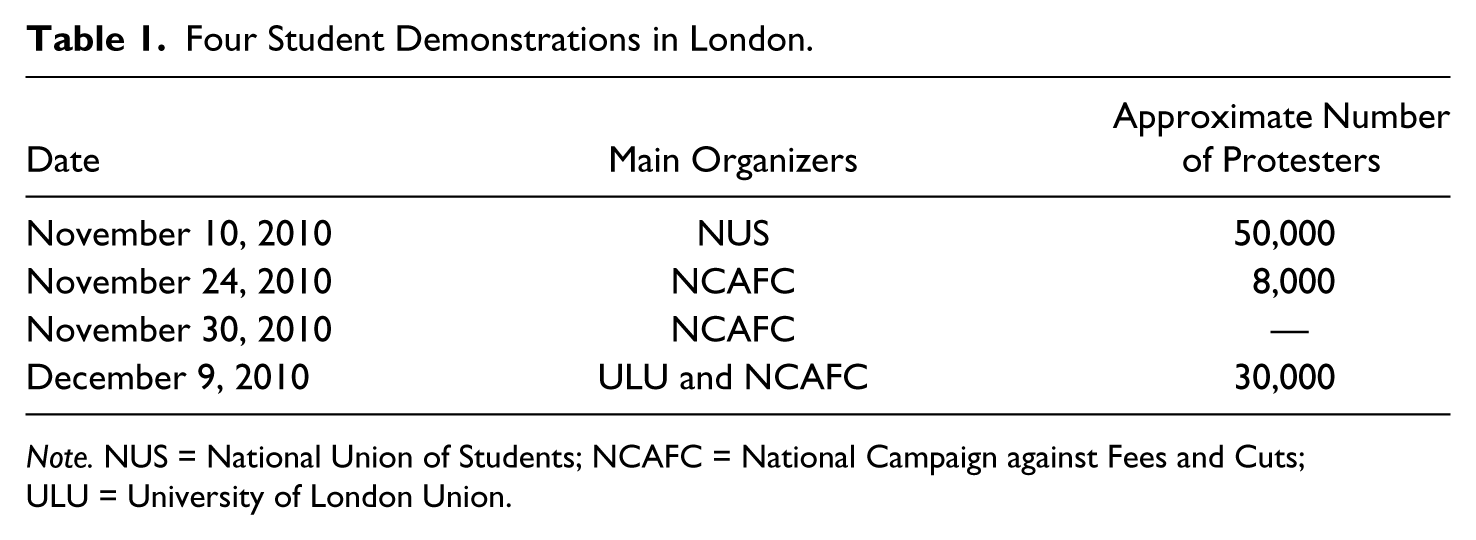
Note. NUS = National Union of Students; NCAFC = National Campaign against Fees and Cuts; ULU = University of London Union.
The second demonstration on November 24, 2010, was much smaller and organized by the National Campaign against Fees and Cuts (NCAFC), a more militant organization than the NUS. More than 25,000 students signed up to their Facebook page 2 and many more answered their call to mount protests against the cuts across the United Kingdom. In London, about 8,000 students, mainly college students, took to the street and converged on Trafalgar Square. As they wanted to march toward Parliament, about half of the protesters were cordoned in and detained by police for several hours using a tactic called kettling. 3 An abandoned police car was demolished, which led to fierce discussions among protesters, some even claiming that the vehicle had been left there on purpose so as to provide the media with spectacular images of students trashing a police van. 4 In total, the police arrested forty-one protesters.
The third demonstration in London, also organized by the NCAFC, took place on November 30, 2010, a freezing cold day and was much smaller in size. It is, however, difficult to find reliable figures of the number of protesters that day because this demonstration was highly dispersed and chaotic. To prevent being kettled, protesters played a cat and mouse game with police. It was described by one of the demonstrators as “a roving protest.” 12 Small groups of protesters roamed the streets, dispersing whenever they saw police forces. A total of 153 protesters were eventually arrested after they refused to leave Trafalgar Square.
The final demonstration took place on the day of the vote in Parliament—December 9, 2010. There were actually two separate protest events taking place that day, making the conflict within the student movement highly visible and real. While the NUS organized a serene candlelit vigil on Victoria Embankment close to Parliament, the ULU and the NCAFC organized a rally that converged on Parliament Square. This latter 30,000 strong demonstration again was very erratic and police tactics were heavy handed and aggressive, using mounted horses at some point to charge into crowds, kettling protesters, and thereby dispersing the protesters throughout central London. Protesters attempting to break police lines and advance on Parliament itself were forcefully stopped. Besides this, many monuments were sprayed with slogans (see Figure 1), the statute of Winston Churchill was defaced, a Christmas tree donated by Norway was set on fire in Trafalgar Square, and the Treasury (the ministry responsible for the budget) and Her Majesty’s Revenue & Customs were attacked and had their windows smashed.
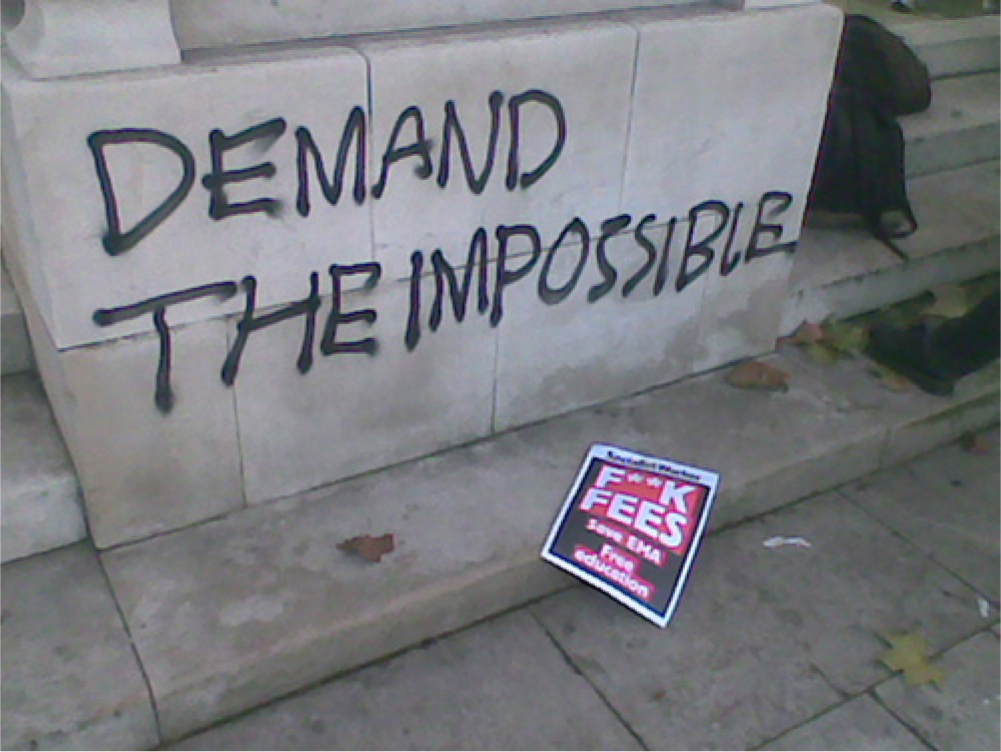
Situationist May ’68 Slogan in Parliament Square, London, December 9, 2010.
Some protesters also targeted Oxford Street shops and stumbled upon Prince Charles and his wife caught up in a traffic jam in Regent Street caused by the protests. Slogans such as “Off with their heads!” and “Whose Regent’s Street? Our Street!” were shouted and the Rolls Royce of the royal couple was vandalized. In its typical jingoistic and condemning tone, the Daily Mail described the event as follows: “With terror written across her face, the Duchess of Cornwall comes under fire from a snarling mob of student fees rioters last night” (Daily Mail, December 10, 2010). 5
In the aftermath of the protests on December 9, there was also quite some debate on and attention for police tactics and violence. Several students ended up in hospital 6 and footage emerged of police pushing a protester out of his wheelchair twice. 7 Another noteworthy event after the vote was that Aaron Porter, the president of the NUS, resigned after a sustained campaign against him for failing to support more militant students in their struggle against the government (NCAFC 2010).
For the content analysis, newspapers were chosen over and above television coverage or weblogs, although it has to be noted that many U.K. newspapers have a considerable readership online (cf. Table 2). Furthermore, unlike in many other countries, newspapers still fulfill an important role in the overall media consumption of U.K. citizens. Four newspapers were selected on the basis of their ideological leaning with two newspapers broadly situated on the right of the political spectrum (Daily Mail and The Daily Telegraph) and two on the left (The Guardian and The Independent). A thorough search on Lexis using keywords such as “protest(s),” “students,” “student protest,” “tuition,” and “fees,” for the period November 11–December 23, 2010, resulted in a total of 334 articles, including news articles, interviews, editorials, and commentary pieces.
Distribution of Articles across Newspaper Titles.
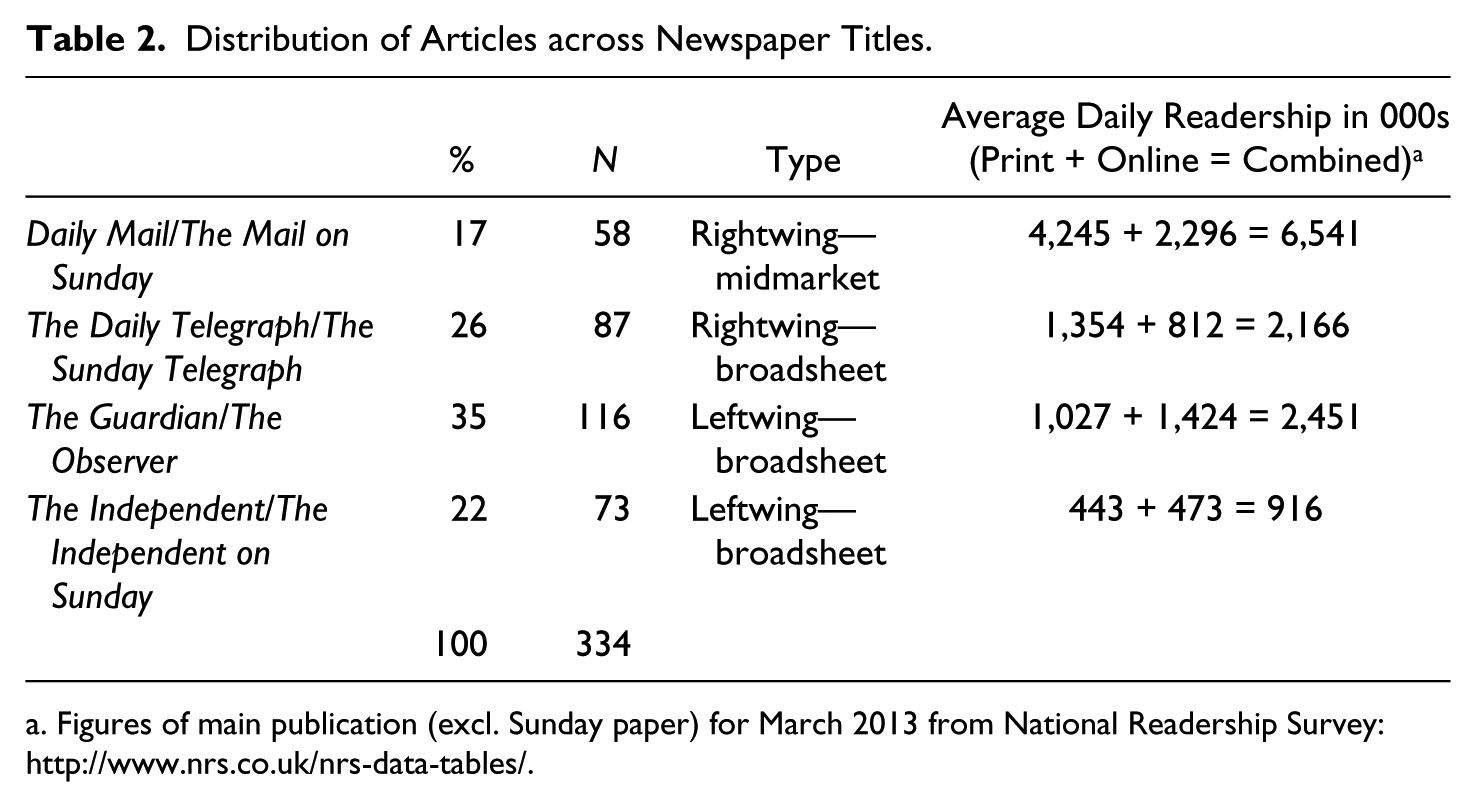
Figures of main publication (excl. Sunday paper) for March 2013 from National Readership Survey: http://www.nrs.co.uk/nrs-data-tables/.
The sample was exhaustive, that is, the corpus included all articles published in the selected newspapers during the period of analysis. A pilot of thirty-three articles was done, after which new codes and variables were added; furthermore, the same 10 percent sample of articles was coded by a second coder which yielded an intercoder reliability of .88 percent. 8
The coding frame probed the main focus of the article, the tone used to describe the protesters, which actors were given a voice and to which extent, and whether violence was mentioned and how this was framed. Besides this, the coding frame also ascertained whether the articles differentiated between moderate and militant/radical student protesters and how the relationship between both was articulated. Finally, representations of class and the way social media was used by journalists were also assessed.
Discussion and Analysis of Results
In the corpus of articles, a variety of focal points were identified; some articles were factual accounts of what had happened, reporting the protest events; others focused mainly on the political process in Parliament and the political debate in Westminster. Again other articles engaged with the issues the students wanted to address, that is, the tuition fees, the quality of higher education or the lack thereof, student debts, and so on. A smaller proportion of articles dealt with the new culture of protest, in a sense countering the common perception that young people are depoliticized and do not care about politics. The student protests also generated a media discourse about protest tactics and internal debates within the student movement. A considerable amount of media coverage had as primary concern the use of tactics of damage by protesters and this also elicited considerable attention for the way in which police reacted to the various protests organized by students, including the use of violence by the police against the protesters.
The temporal dimension and shifts in attention
Quite some fluctuation in the amount of attention for the issues the students wanted to address can be observed. The peaks in media attention coincided with the various demonstrations being organized; the third demonstration receiving least attention and those that were most violent—the first and the fourth—receiving most media attention.
While Figure 2 presents N values, Figure 3 provides a proportional representation of the shifts in main focus of articles across the period of analysis. Taking both figures together, we can observe that the proportion of articles focusing on the political process gradually increases as we approach the vote on December 9. Articles having as main focus violence by protesters were considerable and make up a large part of the increases in the number of articles after the first and the fourth demonstrations (see periods November 11–16 and December 11–15).
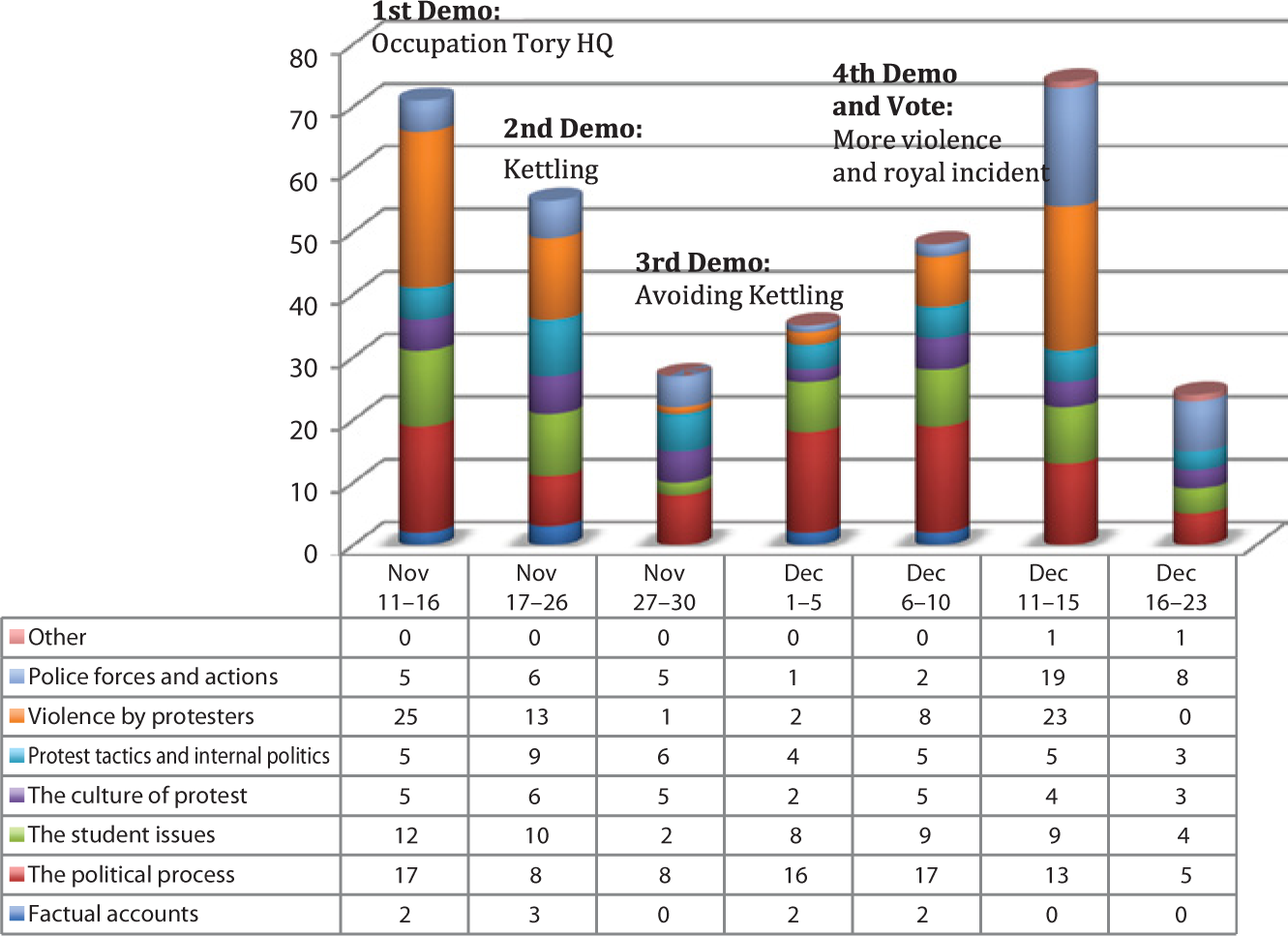
Shifts in main focus of the articles across time (N values).
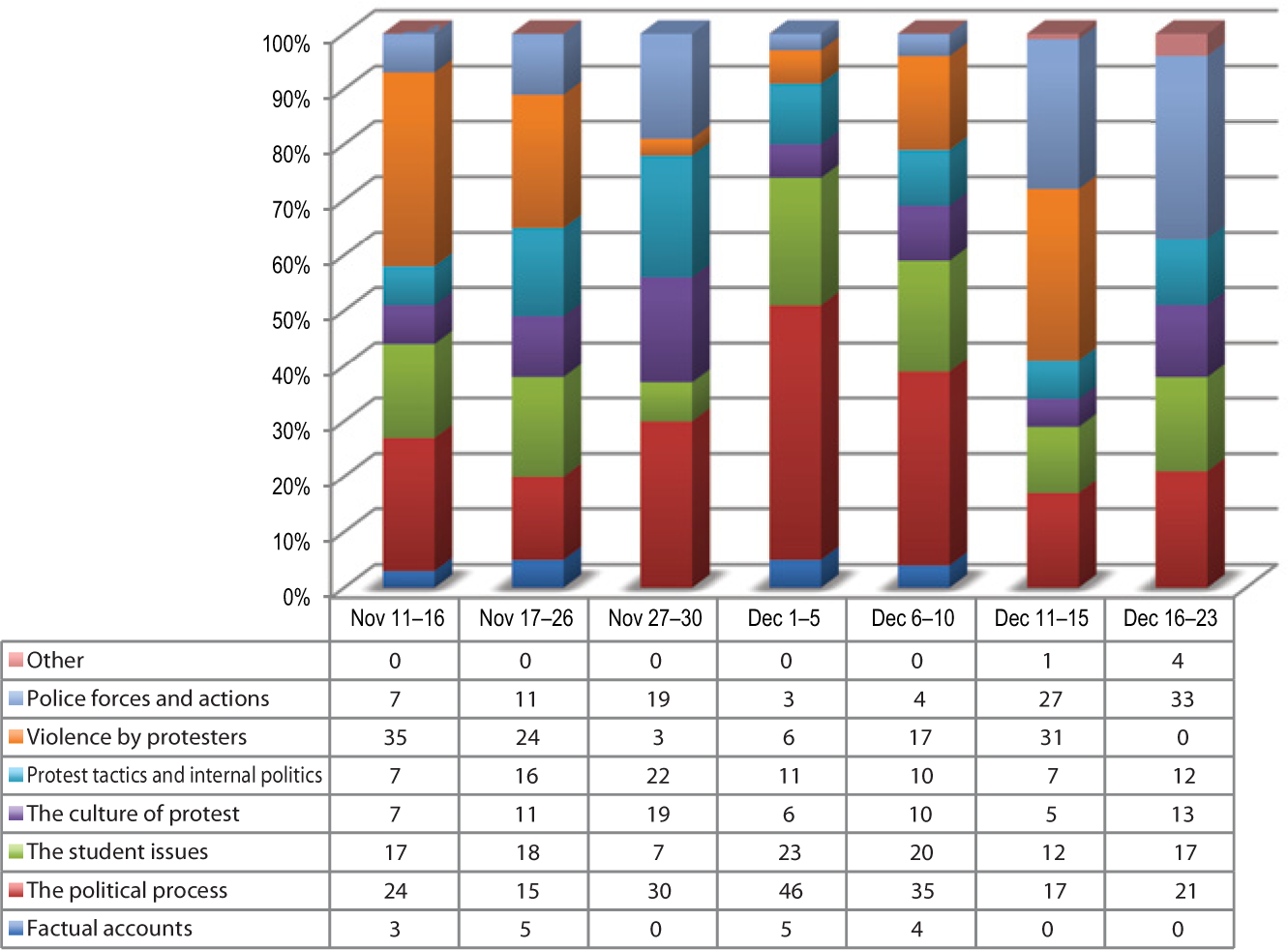
Shifts in main focus of the articles across time (proportional, in percent).
However, this attention for damage inflicted by the protesters did not dramatically affect the coverage of the issues the students wanted to address. In fact, internal politics and conflicts within the movement impacted much more negatively on the reporting of the issues as the period November 27–30 demonstrates. After the vote in Parliament and the contentious encounter with the royals, we can also observe a slight drop in attention for the issues students wanted to address as only 12 percent of articles related to student issues in the period December 11–15 compared with an average of 16 percent for all articles.
Certainly in the first part of the period of analysis, quite some attention was devoted to the identity of the student protesters, to the new culture of protest, to young people as active citizens, and to the use of social media by the protesters to organize themselves and mobilize for action. In the second part of the period of analysis, we can notice a notable increase in attention for the handling of the protests by the police and police violence against protesters. This relates to discussions on the legitimacy of kettling as a tactic to contain protesters and police brutality against the students, some ending up in hospital as a result.
Who is given a voice and to which extent?
Besides what has been reported on, the question of who was given a voice in the various newspaper articles is also of relevance. Given the internal conflicts within the student movement discussed earlier and the debates among students regarding the legitimacy of using tactics of symbolic damage and confrontation, a distinction emerged between moderate and more militant student voices at the level of the sources used in the various news articles. Besides this, other voices used as sources in the various articles included politicians, police and officials, experts and eyewitnesses, and nonstudent civil society representatives. 9
If we consider the amount of sources used per newspaper and cross-tabulate this with the type of source, we can compare the distribution across different types of sources per publication (cf. Figure 4). For example, whereas 30 percent of total number of sources used were politicians, in The Independent 37 percent of all sources used were politicians and 34 percent in the Daily Mail. It is nevertheless striking how relatively evenly distributed the different types of sources are across the various newspapers that were analyzed suggesting a relative homogenization in news production.
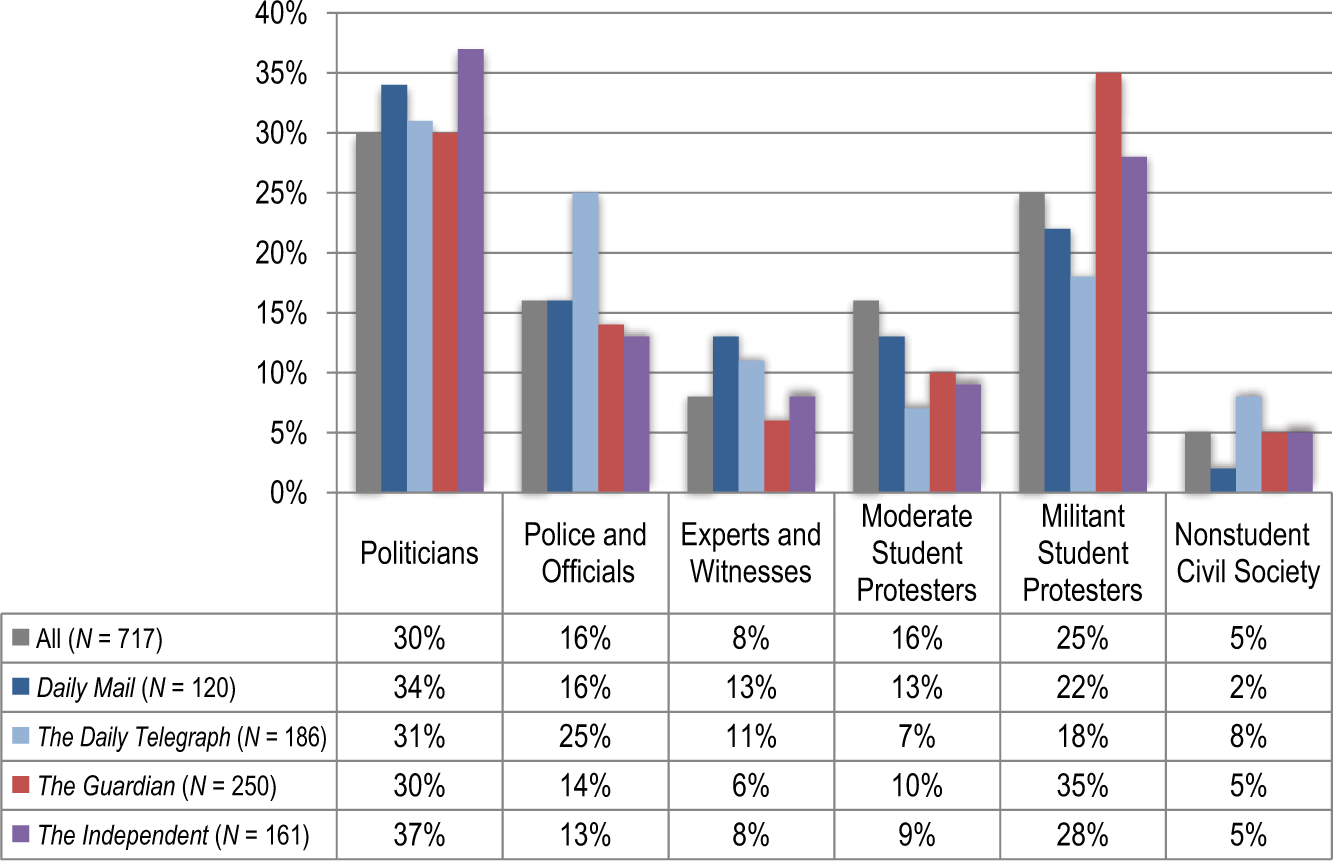
Distribution of sources used (N = 717).
Not entirely surprising, but in The Daily Telegraph, a disproportional amount of attention for police and official spokespersons can be observed compared with other newspapers. The right-wing media also use more independent experts, but above all more quotes from eyewitnesses to describe events. While militant student voices are given more prominence than moderate student protesters in all newspapers, this is especially the case in The Guardian where 35 percent of sources (N = 45) were militant students. As will be shown below, the context in which these militant sources are being used varies from one newspaper to the other. The category “nonstudent civil society representatives” refers foremost to unions, supporting the student protests. The relatively higher degree of nonstudent voices in The Daily Telegraph is due to giving a platform to right-wing civil society organizations such as the TaxPayers’ Alliance advocating for low taxes and a drastic reduction in public spending, including higher education.
Social media and user-generated content, primarily Facebook, Twitter, and You Tube, were also used a lot as a source, especially in the right-wing media. While 20 percent (N = 56) of all analyzed articles mentioned social media in some form, 35 percent (N = 20) of these used social media as a source to expose violence or to refer to what protesters had posted. In the Daily Mail and The Daily Telegraph, about 50 percent of articles mentioning social media used it as a source, compared with 11 and 33 percent, respectively, for The Guardian and The Independent.
Besides the number and type of sources used, an analysis of the number of words attributed to sources exposes yet another aspect of the reporting. The amount of words attributed to sources was divided through the total number of words of the article after which an average was calculated per type of source and per newspaper. Besides this, the number of articles in which the sources appeared has also been provided. Table 3 shows that on average quotes of politicians took up 17 percent of a news article in the Daily Mail, compared, respectively, with 14 percent in The Daily Telegraph, 16 percent in The Guardian, and 16 percent in The Independent.
The Average Percentage of Article Space Taken Up by Sources When Quoted and Number of News Articles in Which Sources Are Quoted.
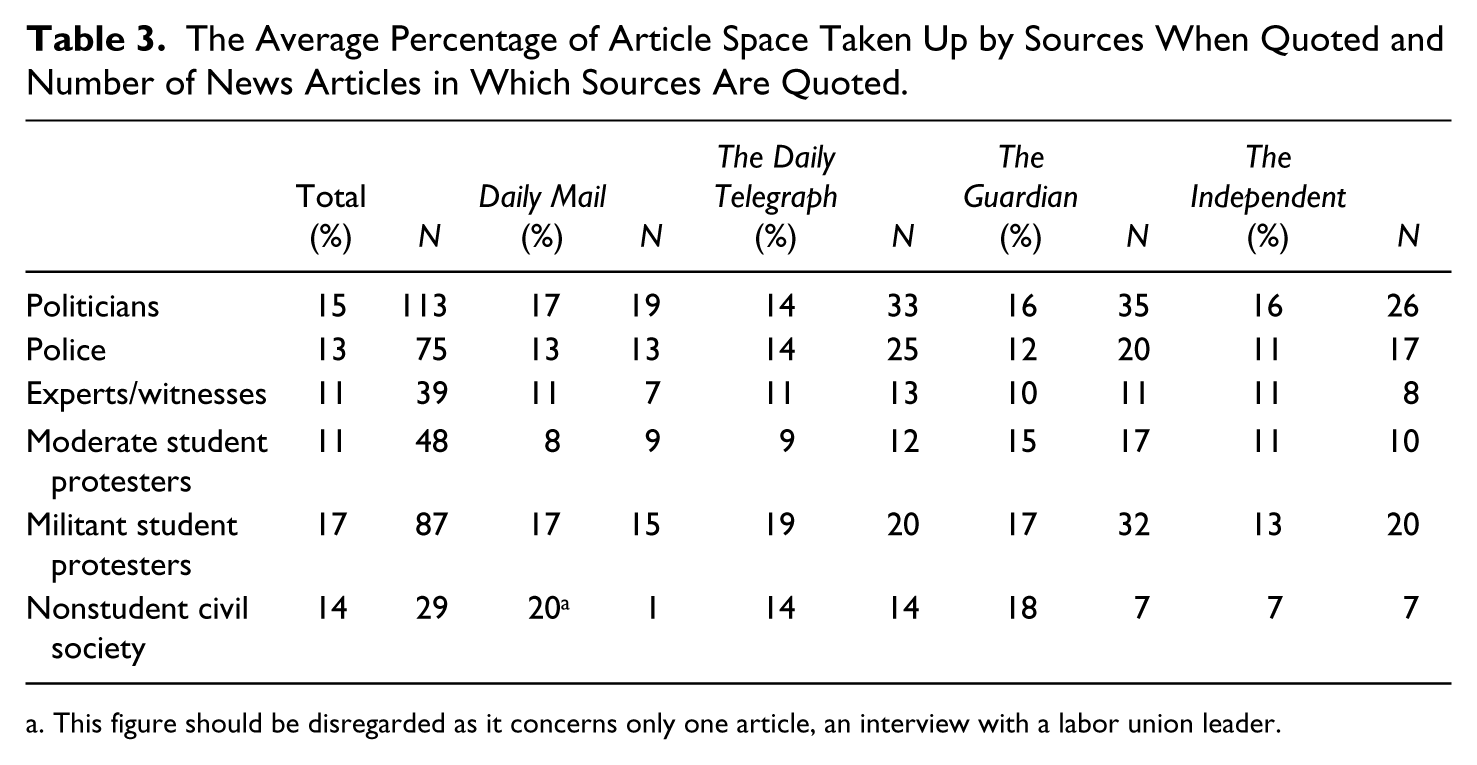
This figure should be disregarded as it concerns only one article, an interview with a labor union leader.
This analysis points out that while there might be more official sources used in total, the amount of space they occupy in quotes is fairly similar to that of (militant) students. There are not only more militant student sources given a voice, but on average they are being quoted more and longer than moderate student voices across all publications.
Again, it has to be stressed here that the way in which these sources are used varies greatly. This relates to the next section and the tone being adopted by the journalist writing the report. Hence, being given a voice does not necessarily mean that protesters are given a platform or that what they say goes uncontested.
Overall tone of reporting
The student protesters were identified in three different ways and coded as such: (1) in a fairly neutral way as “students” or “protesters”; (2) in a positive spirit as “active citizens,” “activists,” “passionate,” “experiencing a political awaking,” “reminiscent of 1968,” “in solidarity with the unions and the wider cuts”; or (3) in a negative light as “troublemakers,” “rioters,” “truants,” “agitators,” “anarchists,” “thugs,” “yobs,” “mobs,” “hords,” “perpetrating illegal acts.”
As was to be expected, the right-wing press had a predominantly negative tone toward the students and the protests (cf. Figure 5). Despite this, in some of the right-wing press articles, student protesters were being represented positively, usually in conjunction with making a distinction between “good” moderate and “bad” radical students (see below) or through interviews with labor union leaders praising the students for their protest actions. It also has to be noted that the Daily Mail and The Daily Telegraph were to some extent sympathetic to the cause of the protesters, but highly disapproving of the tactics used by the militant protesters: “This wasn’t a typical protest. For a start, these students have a legitimate grievance, as it is about to become very much more expensive for middle-class Britons to get an often poor quality university education” (Daily Mail, November 11, 2010). 10
Without condoning the violence, we should be mindful of the deep sense of grievance among today’s youth—the widespread feeling that they have a raw deal. This generational inequity is most starkly exemplified by the imposition of student fees by people whose own university education was lavishly subsidised. (The Daily Telegraph, December 11, 2010)
11
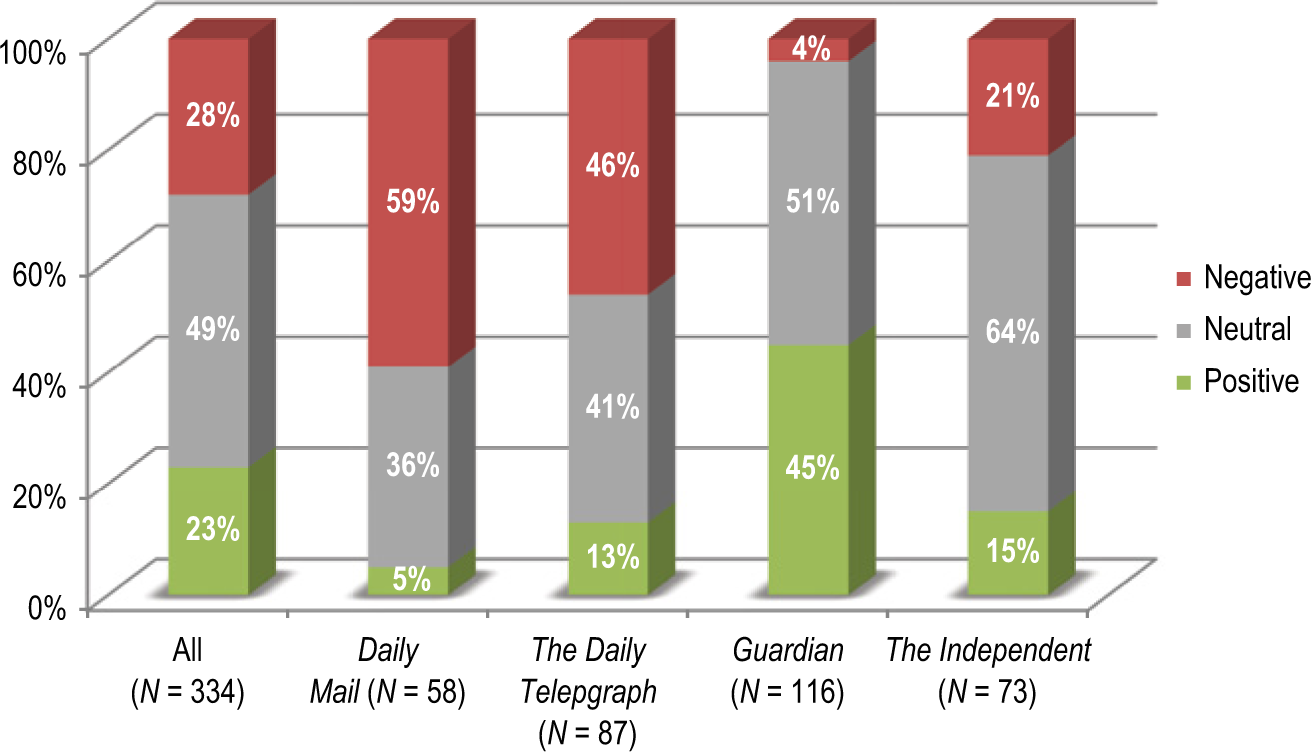
Overall tone of the articles toward student protesters.
Figure 5 also exposes differences between The Guardian and The Independent in the overall tone toward the protests. Whereas negative frames were seldom used in The Guardian to describe the student protesters (4 percent, N = 5), The Independent quite frequently did (21 percent, N = 15) and took a much more neutral stance (64 percent, N = 47) toward the protesters than The Guardian did.
Finally, as is apparent in the quotes above, class played an important role in the reporting on the student protests and also had a bearing on the tone of the reporting. All analyzed articles (24 percent, N = 83) explicitly mentioned class, referring to either the political class (4 percent), the working class (36 percent), or middle class (60 percent). As this shows, especially middle classes were often referred to. While some of these articles had a positive disposition toward middle classes (30 percent, N = 15) calling them emancipated, claiming their legitimate right to protest, burdened, being hit the most, and so on, the majority of articles referring to middle classes (70 percent, N = 35) denoted them as spoiled, privileged, and unreasonable. This negative disposition toward middle classes was most pronounced in the right-wing media. Both in the Daily Mail and The Daily Telegraph, more than 85 percent of articles mentioning the middle class did so in a negative way.
The reporting of violence by protesters and by police
A substantial majority of articles addressed or mentioned violence in some way or another, even if the main focus was not violence per se. While about 20 percent (N = 72) of articles had as main focus violence by protesters, 63 percent (N = 210) of articles mentioned or addressed violence directly. As can be expected, the right-wing press emphasizes violence more than the left-wing press with the Daily Mail and The Daily Telegraph mentioning violence in, respectively, 71 percent (N = 41) and 70 percent (N = 61) of its articles on the tuition fee debate and the protests against it. In The Guardian and The Independent, violence is addressed in, respectively, 58 percent (N = 67) and 55 percent (N = 40) of the articles, which is considerably less. It has to be noted here that overall the distinction between damage to things and violence against people was not made in the reporting of the student protests.
However, violence is not necessarily limited to violence by protesters (cf. Figure 6). While in the right-wing media, attention is almost exclusively focused on the damage inflicted by protesters, in The Guardian and to a lesser extent in The Independent attention for police violence or a more balanced approach is more prevalent, certainly in the latter stages of the period of analysis (cf. Figure 3).
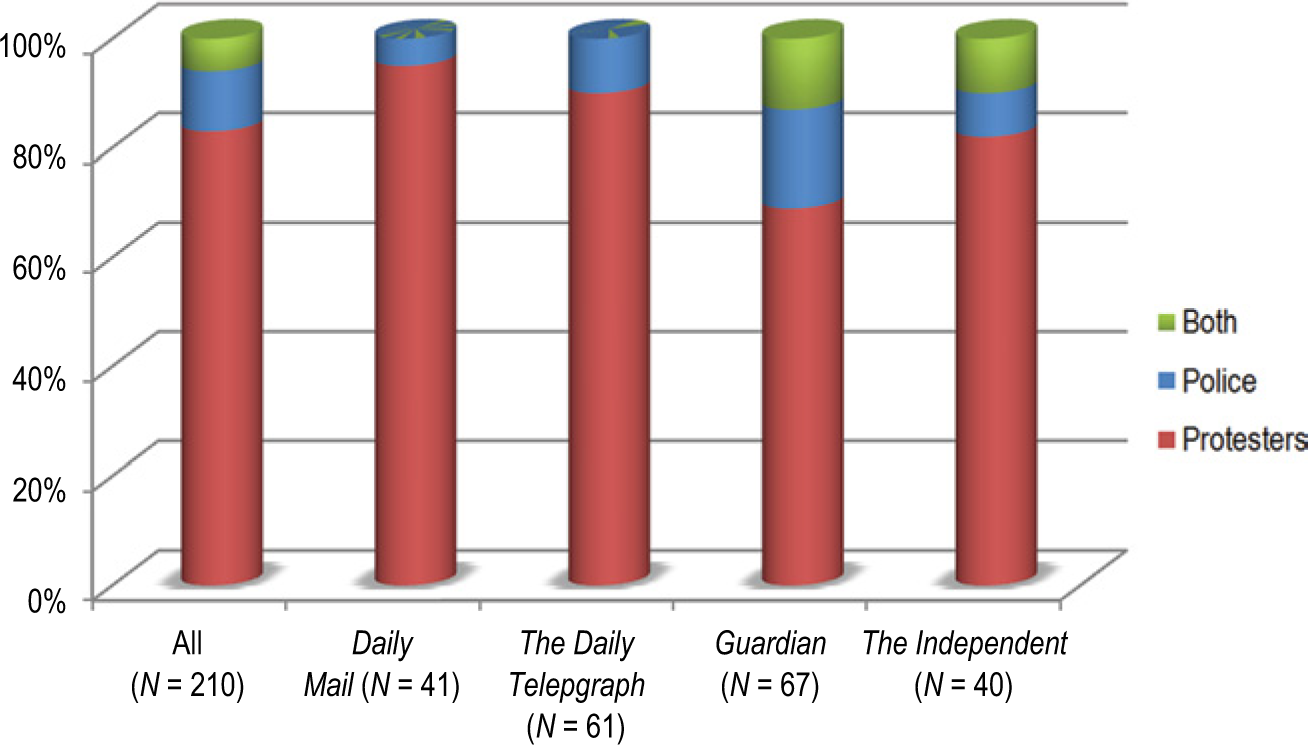
When violence is mentioned, who’s violence?
The frame in which the symbolic damage enacted by protesters was positioned also reveals a stark distinction between the right-wing and left-wing press. A neutral stance implied that when it concerned the tactics of symbolic damage, positive and negative voices were given space in the same article. A negative frame represented the typical liberal response, that is, describing the tactics of symbolic damage enacted by the protesters in a condemning way, denoting it as illegitimate, orchestrated, and unworthy of a democracy. A positive frame on the contrary approached the tactics of symbolic damage as a legitimate form of resistance, as passionate politics, as a necessary evil to get heard, or as cheeky banter and teenage naughtiness. As Figure 7 points out, the dominant frame toward the tactics of symbolic damage enacted by the student protesters was a negative one.
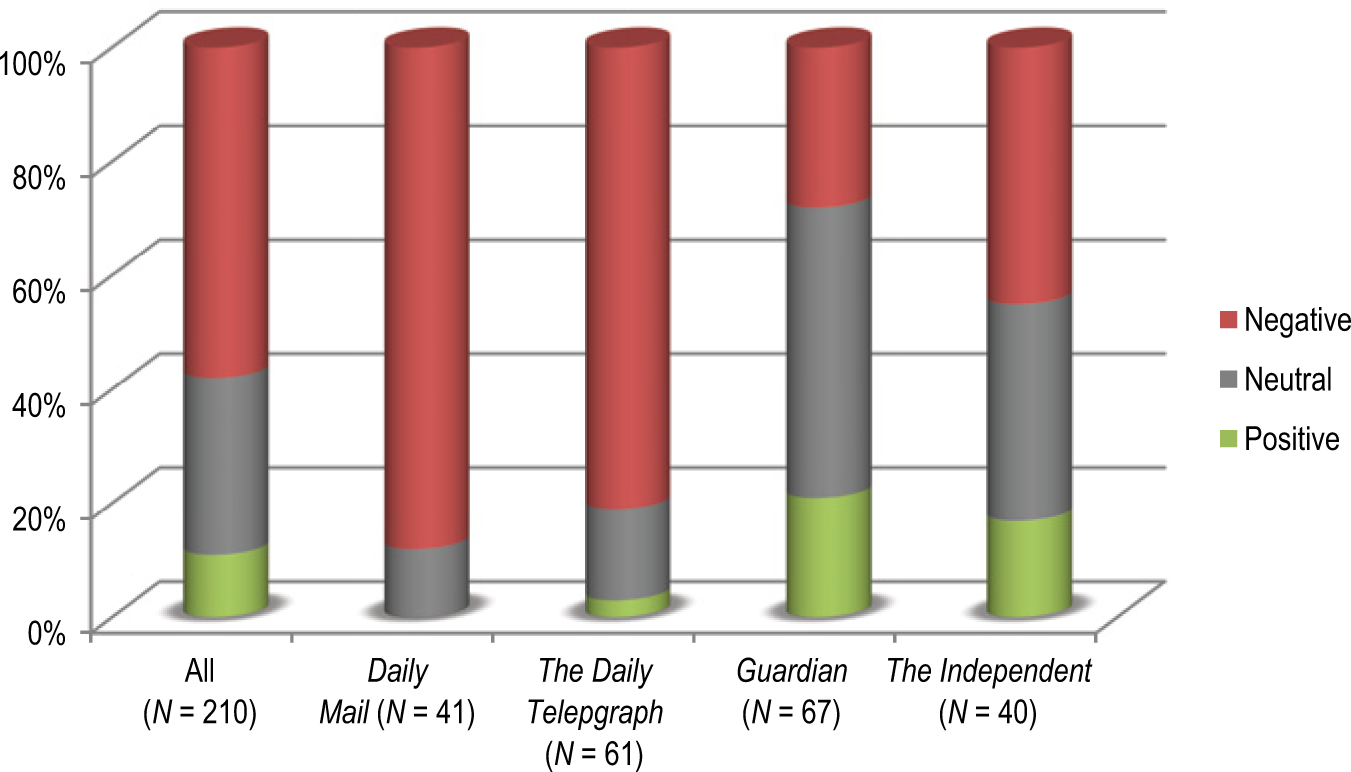
Frames toward tactics of symbolic damage enacted by protesters.
While the right-wing newspapers unequivocally condemned the tactics of symbolic damage enacted by the students, the left-wing press took a much more nuanced and neutral stance, at times even adopting a positive “understanding” frame. However, it has to be pointed out here that even in the left wing, this was only the case in a minority of articles; 21 percent of articles in The Guardian mentioning violence had a positive frame, 17 percent in The Independent, 3 percent in The Daily Telegraph, and 0 percent in the Daily Mail.
The tactics of symbolic damage did set a particular tone and inevitable all media tended to focus on the spectacular and the violent rather than the peaceful and the civic, as Figure 8 reveals. All the front-pages of the major U.K. newspapers on the day after the first protest ran with the same spectacular photo of a protester kicking in a window of the Tory headquarters.
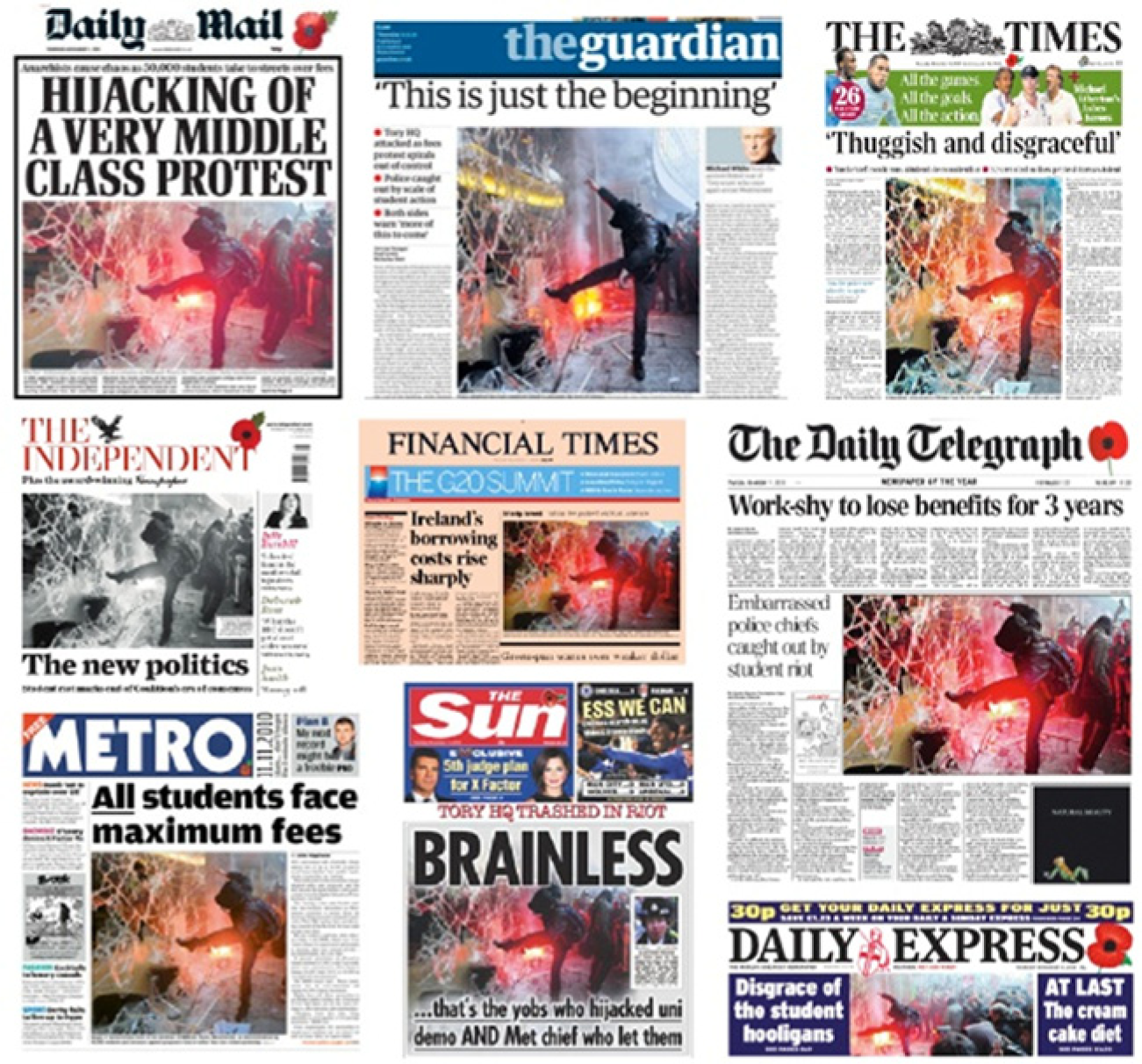
Front-pages of U.K. newspapers on November 11, 2010, after the first demonstration.
A common tactic of the media in this regard is to construct an artificial division between a peaceful majority exerting their democratic right to protest (i.e., the good protester) and a violent minority that hijacks the legitimate protest to cause disruption and to damage property (i.e., the bad protester). These attempts were refuted by the students, as this quote illustrates: “I hate the way [the media] try and blame it on a small minority, everyone here is angry—it’s not a small group of hardcore anarchists, it’s just students who are very, very angry” (Student protester quoted on British Broadcasting Corporation [BBC] Web site 12 ).
Internal conflicts and the “bad” versus the “good” protester
The use of tactics inflicting symbolic damage and the increased involvement of more militant, anarchist, and anticapitalist groups in the protests, certainly after the first demonstration on November 11, caused internal conflicts and ultimately led to a split in the student movement between the moderate NUS and the more radical ULU and NCAFC. These internal conflicts reinforced the elite-frame of the good versus the bad protesters and also received considerable media attention with 11 percent (N = 37) of the total number of articles focusing on the internal debates within the student movement regarding protest tactics. As mentioned above, the president of the NUS resigned in the aftermath of the protests as he lost support and legitimacy after forcefully condemning the actions of militant students and seemingly appearing to partially support the government policies on tuition fees.
In the corpus of articles, some evidence of this can be found. As Table 4 shows, about a third of all articles (N = 109) differentiate between moderate and radical student protesters and of those articles a bit more than 75 percent represent the moderate and the militant groups as separate groups with different agendas, implying that radical groups who are not students hijacked the student demonstrations to cause massive disruption and violent disturbances.
Observers said as few as half of the crowd were students, with a There are fears that anarchist groups and violent yobs are planning to it is about the Lib Dem leader that the protesters, the peaceful majority and the Some blamed non-students, including teenage
Representation of the Relationship between Moderate and Militant Students.
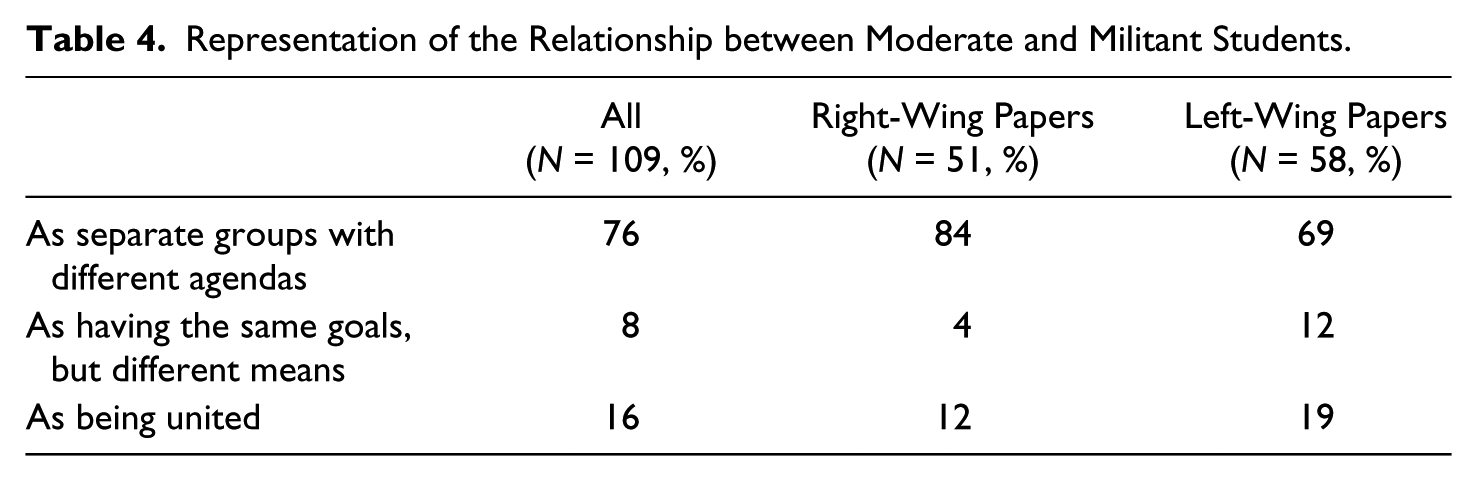
Inevitably, this “hijack”-frame and making a clear-cut distinction between the moderate “good” protesters and the radical “bad” ones is most prevalent in the right-wing press, but as can be seen in the quotes above, it is also adopted in the left-wing press, albeit to a lesser extent. More nuanced positions—for example, outlining that moderate and radical groups have the same goals but are just using different protest tactics or giving voice to those that challenge this distinction fundamentally—as the student quoted above does—are less prevalent, especially in the right-wing media.
Conclusion
The spectacle of symbolic damage enacted by the protesters exposed the exuberant passion and anger of the student protesters concerning political choices made by democratically elected representatives against their interests. It is part of a radical “struggle for public visibility” (Rucht 2004: 27) and embedded in a much longer legacy of damage as a form of political resistance and direct action by subordinate actors (della Porta and Diani 2006). As argued in this article, this use of the logic of damage should foremost be seen as a communicative act of resistance and the result of the lack of channels of communication between those taking a political decision and those directly affected by the decision. The spectacular nature and shock value makes their opposition and resistance highly visible. Given its nature as an act of political communication, the mediation of symbolic damage is of prime importance for those engaging in it. The media react forcefully to the spectacle of violent performances and while this does not necessarily create positive exposure, it certainly produces lots of publicity.
The content analysis presented above confirms the negative bias toward militancy and radical protest as well as the pervasiveness of journalistic routines in selecting sources and reporting on disruptive protests. However, militant voices were not only more numerous, on average they also received more article space than moderate voices. It has to be noted though that getting a voice does not necessarily mean positive exposure, but neither does it mean exclusive negative exposure. Even right-wing newspapers expressed some degree of understanding for the anger of the students toward the government. The shock effect of insurrectionary symbolic damage clearly increased media exposure for the protesters and is thus not necessarily as detrimental to a given cause as is often being claimed.
From this perspective, the mainstream media opportunity structure (Cammaerts 2012) is contradictory. On one hand, protesters must create spectacle and drama to be heard, to create ample media resonance. The use of damage and violence provides the kind of spectacle that makes the mainstream media pay attention. It also makes the desperation and resolve of the protesters highly visible. On the other hand, the use of symbolic damage tactics is risky for protest movements as it can create divisions within a protest movement, enabling the media to distinguish between the “good” and peaceful versus the “bad” and violent protesters. It can also elicit agents provocateurs tactics by police and security forces (cf. Healy 2007). Furthermore, liberal mainstream media invariably condemn the use of violent tactics in Western democracies. This is most pronounced not only in the right-wing press but also, to some extent, in the left-wing media. The Independent, for example, was rather lukewarm toward the student protests, certainly when it concerned violence.
The sad thing in many respects is that protesters feel they have to resort to the logic of damage, that violent confrontations are seen to be needed to get a voice, to be reported upon, to stimulate public debate, or to have certain demands be taken seriously. The persistence of various forms of political violence in democracies, including tactics of damage, is thus above all a vivid reminder that liberal democracies are not able to fulfill their promise of liberty, equality, and social justice for all, nor do they manage to pacify and democratize all economic, political, and cultural conflicts and tensions embedded in democratic societies. Changes in how democracy is organized and run might be the clue to reduce the need for protesters to resort to violence rather than demonize those who see no other way than symbolic forms of violence to make themselves heard and counter the symbolic violence of elites.
All this also brings to the foreground questions in relation to protest tactics and what is deemed acceptable in a liberal democracy, questions concerning the nature of democracy and questions relating to the dialectic between media representations of protest and tactics of dissent, all of which require further research and further theorization.
Footnotes
Declaration of Conflicting Interests
The author declared no potential conflicts of interest with respect to the research, authorship, and/or publication of this article.
Funding
The author received no financial support for the research, authorship, and/or publication of this article.