







Abstract
Media freedom is typically viewed as crucial to democracy and development. The idea is that independent news media will facilitate free and fair elections and shine a spotlight on corruption—thereby serving as a fourth estate. Yet political leaders often justify restricting media freedom on the grounds that irresponsible news coverage will incite political violence—potentially undermining government and in effect acting as a fifth column. So is media freedom a force for democracy or a source of civil conflict? We hypothesize that the effect of media freedom on civil conflict is conditioned by a country’s level of intolerance. Specifically, we predict when social intolerance is low, media freedom will discourage domestic conflict because the tone of the news coverage will reflect the level of tolerance and ameliorate any inflammatory coverage. In contrast, we predict that high levels of social intolerance will fuel and be fueled by inflammatory news coverage if the media are free, thereby promoting civil conflict. We test our hypotheses across countries and over time drawing from World Values and European Values Surveys and the Global Media Freedom Dataset and find that the combination of media freedom and high social intolerance is associated with increased civil conflict.
Introduction
In April 2002, Venezuelan news media provided round-the-clock coverage of the general strike, protests, and political violence that led to the temporary ouster of President Hugo Chávez Frías. Yet these same news organizations failed to question the constitutionality of the short-lived coup and, for the most part, neglected to cover Chávez’ return to power (Encarnación 2002). In fact, media coverage of the uprising was so favorable to the opposition that some characterized it as a “media coup” (Castillo 2003). The clashes between the pro-Chávez and anti-Chávez demonstrators left nearly two dozen people dead and hundreds more injured. Moreover, though at first glance the opposition appeared to be heterogeneous, in truth the divisions between the government’s opposition and its supporters were largely driven by deep class divisions that have been present in Venezuelan society “around conceptualizations of civilization and barbarism, knowledge and ignorance and rich and poor since its inception” (Cannon 2004: 287). Questions remain about the alleged collusion of the oligarchy-owned media, right-wing military, and business leaders with the U.S. government. What is known, though, is that the news media played a crucial role in this attempt to undermine Venezuela’s democratically elected government.
The actions of the Venezuelan media challenge the assumption shared by a wide range of international governmental and nongovernment organizations that free and independent news media will serve the public and promote democracy by acting as a fourth estate, providing a check on political and economic elites. In 2002, the Venezuelan news media conspired with the opposition (in this case economic elites) and functioned more like a fifth column than a fourth estate. 1 In fact, political leaders often accuse news media of acting as a fifth column, and these same leaders sometimes justify restricting media freedom on the grounds that irresponsible news coverage will incite political violence and promote civil conflict. Similar claims have echoed in Rwanda, Egypt, India and, more recently, in Hungary.
Contrary to their idealized role, news media are not always a force for good, and similarly, media freedom does not come with guarantees of high-quality news coverage or a diversity of opinions. In this study, we consider the conditions that might lead news media to function as a fifth column and instigate political violence. Specifically, we hypothesize that the effect of media on civil conflict depends on media freedom and is conditioned in part by a country’s level of social intolerance, meaning a general prejudice against group differences (these could be differences in race, religion, spoken language, etc.). As the case of the Venezuela illustrates, independent news media can fan the flames of social intolerance. In 2002, there were sharp divisions in the country, with the government characterizing the opposition as “few in number and privileged” and the opposition (with the help of the media) describing Chávez and his supporters as “uncouth, unpolished, in effect uncivilised, poor, mixed race, without finesse, ‘sin preparación’” (Cannon 2004: 298).
Thus, we predict that high levels of social intolerance will fuel and be fueled by inflammatory news coverage, especially if the news media are free and independent, and that this combination will serve to promote political violence and increase the likelihood of civil conflict. Here, we conceptualize civil conflict as militarized conflict between organized groups within a country, one of which is typically the government, which can range from small insurgencies to large-scale civil wars (Pettersson and Wallensteen 2015). 2 Under this scenario, the news media play a critical role, appealing to their intolerant audience with sensationalist coverage that raises the salience of various grievances within society, thereby presenting an opportunity to leaders of opposition groups and/or extremist movements to the point that these groups are able overcome their coordination and collective action problems and mobilize against the government or against marginalized populations. In contrast, we predict that when social intolerance is low, media freedom will discourage political violence and thereby decrease the likelihood of civil conflict because the news media will seek maintain and broaden their audience with a tone and pattern of coverage that provides a balance of views that will appeal to a diverse audience and ameliorate any inflammatory coverage. We test our hypotheses across countries and over time drawing from World Values and European Values Surveys and the Global Media Freedom Dataset (GMFD), and find support for our hypothesis that media freedom mitigates civil conflict when social intolerance is low, and that it instigates civil conflict when social intolerance is high.
We begin with a review of the literature on the origins of civil conflict. Then we discuss recent studies linking social intolerance to domestic conflict and consider how media freedom might encourage or discourage civil conflict. Next, we outline our research design, and provide our sample and variable descriptions, in particular how we aggregate individual survey data to generate a country-level measure of social intolerance. We present our results and then show how these observed dynamics correspond with the role of media and societal conflict within India. We conclude with a discussion about the implications of these findings for media policies and future research.
Origins of Civil Conflict
Civil conflict is one of the more lethal forms of political violence and represents one of the great challenges facing the international community. Fearon and Laitin (2003) observe that there were more than 127 civil wars between 1946 and 1999, and the World Bank estimates that nearly twenty million people have been killed in civil conflicts since 1945 (Flores and Nooruddin 2009). Furthermore, almost half of the civil wars experienced a recurrence of the conflict (Collier et al. 2003). This phenomenon, known as a “conflict trap,” is the situation in which states that experienced a civil conflict are more likely to experience a future conflict (Collier et al. 2003; Walter 2004), especially in the period shortly after the original conflict ended (Collier et al. 2003; Collier and Sambanis 2002; Elbadawi et al. 2008). Thus, it is not surprising that researchers devote significant attention to determining the causes and consequences of these events as well as offer numerous policy recommendations intended to reconstruct and reconcile the affected societies.
Civil conflict has been studied in depth, particularly over the last decade, but the causes remain relatively unclear due to a mixed empirical record that offers support for multiple, competing theories. The two primary competing arguments are grievance-based theories (Gurr 1971; Muller and Seligson 1987) and greed-based theories (Collier 2000; Collier and Hoeffler 1998, 2004; de Soysa 2002; Lujala et al. 2005; Ross 2004), both of which describe individual and/or group motivations to violently rebel against the state. Although still lacking a definitive consensus, much of recent research on the civil conflict onset supports the idea “that the conditions that determine the feasibility of rebellion are more important than those that influence motivation” (Collier et al. 2008: 464). However, this emerging consensus may be partially attributable to the fact that many of the key factors espoused by the greed-based theories are more easily quantifiable and measured. Grievance-based theories, however, rely more on individual and group negative orientations toward their respective governments and other societal groups that are considerably more difficult to directly measure, particularly on a mass scale (see Gurr 1971; Horowitz 1985; Kalyvas 2006; Posen 1993; Saideman 1998). Thus, grievance-based theories are relatively unexplored, and the mechanisms through which such grievances can be spread have been largely unidentified. This is where we propose that the media play an important role.
In particular, the work on societal fractionalization, as often measured by various indicators of country-level demographic divisions and polarization along ethnic, religious, political, and linguistic dimensions, is strongly tied to the theoretical underpinning of grievance-based explanations of civil conflict. As Muller and Seligson (1987) point out, even if groups have legitimate grievances against government, they still need to overcome impediments to collective action to act. The critical question is how some groups are able to overcome this challenge and act while others lie dormant. This implies that grievances must also require other mechanisms to raise their relative salience to the point that collective problems are overcome and groups engage in civil conflict. We contend that free and independent news media can provide one such mechanism, and in addition to raising the salience of grievances, media can also be used to overcome coordination problems (Chwe 2001).
In the extensive literature linking ethnicity to civil conflict, the principal causes attributed to violence stem from environments of societal distrust, fear, bitterness, and intolerance divided along varied group distinctions that exacerbate societal divisions to the point of violence (Horowitz 1985; Kalyvas 2006; Lake and Rothchild 1996; Posen 1993; Saideman 1998). This strongly suggests that, as a reflection of societal divisions, the underlying societal attitudes on trust, perceived threat, and intolerance play a large role in either moving societies toward or away from conflict.
Despite the theoretical link between societal attitudes and conflict, empirical studies rarely use direct measures of attitudes to predict conflict onset. Sambanis (2004) criticizes this disconnect between theorizing and empirical testing in the previous research. He points out that testing essentially micro-level mechanisms of mobilization with macro-level proxies for societal attitudes in cross-national analyses is problematic. He advocates for more precise linkage between theorizing, measurement, and testing to appropriately evaluate societal based hypotheses of civil conflict. Of course, one factor previously inhibiting this approach was a lack of survey data with enough data points and geographic coverage to make meaningful inferences. We contend, however, that the proliferation of new cross-national survey data over the last few decades now allows for this type of analysis.
Media, Tolerance, and Conflict
News media are generally theorized to play a positive role in society, providing information that is crucial to the democratic process, serving as a voice for the voiceless, and holding those in power (especially government) accountable. 3 Based on this idealized role, there has been a call to spread media freedom throughout the world, because news media must be free and independent from government control to have these desired effects. 4 Yet, though there are some indications that media freedom is associated with decreased corruption (Camaj 2013), there is little empirical evidence to support the assumption that free media will always be a force for good.
While studies have found that two countries with media freedom are less likely to engage in conflict with each other (Choi and James 2006; Van Belle 2002), we do not know the effect of media freedom on civil conflict. In fact, research on the role of media in protest and repression nexus suggests that under certain conditions media freedom may have an inflammatory effect rather than a pacifying effect, especially at the domestic level. Whitten-Woodring (2009) finds that in the absence of democracy, media freedom is associated with increased repression, probably in response to protest. Stein (2013: 8) proposes that “the mainstream media serve as opposition leaders’ barometer of government tolerance for public displays of dissent,” such that increased critical reporting of government signals an opportunity for protest movements. Of course, government crackdowns on journalists who engage in such critical reporting can also discourage protest (Whitten-Woodring and James 2012). Kim et al. (2015) find that if people believe government repression will ultimately fail, people will protest and news media will engage in watchdog reporting even in the absence of media freedom. Thus, there is evidence that watchdog reporting is associated with protest, and although watchdog reporting may sometimes occur in the absence of media freedom (in environments where criticizing the government is dangerous for journalists), we argue it is far more likely to occur when government either loosens or loses some control of media. In addition, news media may sometimes be directly associated with opposition movements, in which case the more free the news media are, the more likely opposition affiliated news media will facilitate mobilization against the government. Given that media freedom and watchdog reporting can facilitate protest, it follows that media freedom and shifts in media freedom may lead to other types of domestic conflict and political violence, in particular civil conflict. 5
We posit that there are several ways in which free and independent news media can be used to increase the chances of civil conflict. First, inflammatory framing of news events can widen existing divisions in a society. Second, the use of language, especially derogatory labels and classifications of certain groups in the news, can have a dehumanizing effect, which in turn weakens established social norms against violence. Third, leaders can use media to mobilize and coordinate groups, letting them know when and where there will be opportunities for action. To be clear, we are not claiming that it is necessarily journalists who are inciting the political violence; in many cases, it is their sources—usually political elites—who are using the news media to this end.
First and foremost, through framing, in particular focusing on the more sensational, frightening, or violent aspects of a group’s grievance, media can exacerbate societal divisions by raising the relative salience of the grievance to a mass scale, thereby assisting groups in overcoming their collective action problems, a notion that converges well with earlier theorizing on grievances and civil conflict (see Muller and Seligson 1987). Although the previous research on ethnic and civil conflict suggests several different individual attitudes likely to influence the likelihood of conflict, we argue that social intolerance may have the most serious short- and long-term influence on the likelihood of civil conflict. Conceptualized here as an individual’s degree of prejudice against various groups within society, social intolerance has long been associated with damaging social and political consequences, such as political violence and repression, that negatively affect transitional, postconflict societal relations (see Gibson and Gouws 2003). 6 As Gibson (2007: 327) notes, “[t]o the extent that a political culture emphasizes conformity and penalizes those with contrarian ideas, little tolerance exists, and the likelihood of political repression is high.” Under these conditions, grievances against the government by various targeted groups may deepen to the point of violent action, especially if the news media’s frames amplify these grievances.
Intolerance can often serve as a partial manifestation of a society’s level of fractionalization, particularly along social dimensions. Thus, mass intolerance can often result in the exclusion or diminishment of opposition groups from participating in the political system and targeted exclusionary policies (Gibson 2007, 2008). Furthermore, news media have the potential to reinforce these prejudices through the use of demeaning and dehumanizing language to describe groups, thereby rendering their marginalization more acceptable. Gibson (1998) argues that similar manifestations of intolerance may be a slippery slope leading to the suppression of minority rights, which would further strengthen grievances by those groups against the government.
All told, mass societal intolerance creates or exacerbates existing grievances of social and political groups against either the government or other relevant groups within society. As Gurr (1971) and others have observed, if these grievances are salient enough to overcome collective action problems, 7 then groups are more likely to rebel and cause civil conflict within their respective countries. This contention is further supported by the studies on ethnic conflict, which demonstrate that these environments of intolerance and distrust can spur groups to act out violently within society and, in extreme cases, rebel (see Horowitz 1985; Kalyvas 2006; Lake and Rothchild 1996; Posen 1993; Saideman 1998). In a study on the former Yugoslavia, Dyrstad (2012) observes that attitudes of ethnic intolerance in 1989 were higher in those regions that would subsequently experience ethnic civil war during the country’s dissolution than those that remained more peaceful.
Therefore, we expect that higher levels of societal intolerance to increase the likelihood of civil conflict within a country. Moreover, in a free media environment, media can be used to heighten and amplify social intolerance, and mass media and now social media can be used to mobilize and coordinate protest and collective violence (Bailard 2015; Warren 2015). Thus, we expect the interaction of media freedom and social intolerance to increase the chances of political violence in general and civil conflict in particular.
One likely mechanism through which the interaction of media freedom with social intolerance could promote civil conflict is the formation of echo chambers. Jamieson and Cappella (2008: 76) describe the echo chamber effect in the context of the conservative movement in the United States stating that the metaphor of an echo chamber captures the ways messages are amplified and reverberate through the conservative opinion media. We mean to suggest a bounded, enclosed media space that has the potential to both magnify the messages delivered within it and insulate them from rebuttal. (p. 76)
We posit that such echo chambers can form in any media system around any ideology that is strongly present in a given society, provided media organizations are free to publish or broadcast news and opinion. Moreover, we posit that echo chambers are more likely to form in scenarios where there is a high degree of social intolerance because there are likely to be commercial pressures on the media to produce news and opinion that cater to those who are intolerant. Independent news media compete for audiences and people tend to gravitate toward news sources that reflect their ideological views. Therefore, if there is a substantial group of people who share an ideology and an intolerance, then it follows that it might be profitable for some media outlets in each medium (including newspapers, radio, television, and online media) to cater to this group. Consequently, the availability of multiple sources of news media that reflect the same ideology, quote each other and cover news events with the same frames and dehumanizing language will reinforce the audience’s intolerance, and at the same time block out alternative views. Thus, an echo chamber both attracts those who are intolerant and intensifies their intolerance. And once formed, an echo chamber can serve as a mobilizing device.
The 1994 Rwandan Genocide is perhaps the most dramatic example of the use of media to promote civil conflict. Although the media environment in Rwanda was not functionally free, in the early 1990s as the government took steps to move to a multiparty system, media restrictions were relaxed and there was a dramatic increase in privately owned newspapers, from twelve in 1990 to more than sixty in 1991, (U.S. Department of State 1992). Some of these papers were extremist and anti-Tutsi (Alexis and Mpambara 2003). Because of widespread illiteracy, most Rwandans relied on radio for news, information, and entertainment. In this case though, the culprit was not independent or opposition-controlled media, but rather state-controlled radio that turned Hutu against Tutsi. The radio stations used to mobilize the Hutu included the state-controlled station Radio Rwanda and Radio-Television Libre des Milles Collines (RTLM), which was established as private enterprise, an alternative to Radio Rwanda, and was supposed to serve as a voice of the people but was in fact backed by the ruling elite (Des Forges 2007).
From late October (1993) on, RTLM repeatedly and forcefully underlined many of the themes developed for years by the extremist print media, including the inherent differences between Hutu and Tutsi, the foreign origin of Tutsi and, hence, their lack of rights to claim to be Rwandan, the disproportionate share of wealth and power held by Tutsi and the horrors of past Tutsi rule. It continually stressed the need to be alert to Tutsi plots and possible attacks and demanded that Hutu prepare to “defend” themselves against the Tutsi threat (Des Forges 2007: 45). In addition, radio announcers dehumanized the Tutsi through their use of derogatory language to describe them: the term inyenzi (meaning cockroach) was used repeatedly and interchangeably with “Tutsi” (Des Forges 2007). Ironically, in response to international criticism of the RTLM broadcasts, Rwandan President Habyarimana defended the station’s right to free speech (Des Forges 2007).
Again, the use of radio in the Rwanda was arguably a case of state-controlled media promoting genocide, but the tactics used in Rwanda could certainly be adopted by independent news media, seeking to appeal to (or even mobilize) an intolerant group. For example in 2010 in Uganda, the weekly tabloid Rolling Stone (no affiliation with the U.S. magazine) appealed to the country’s homophobic, running a front-page story on the alleged dangers posed by homosexuals, complete with pictures of hundred people it claimed were “Uganda’s Top Homos” and a banner reading “Hang Them.” Although gay rights activists successfully sued the editors of the newspaper, one of the activists, David Kato, whose picture appeared on the tabloid’s front page was murdered shortly after winning the court case. Although the Rolling Stone incident led to crime rather than civil conflict, this case does reveal the potential for media to instigate violence.
In sum, we predict that media are more likely to take on this instigating role when social intolerance is high. In contrast, if social intolerance is low, we expect media freedom will serve to mitigate conflict. In this scenario, there is little or no profit for news media in catering to an intolerant audience. As a result, news media will benefit commercially by appealing to a broad audience and presenting multiple points of view. Therefore, we propose that in a highly tolerant society, media will be unlikely to form echo chambers, and people will be exposed to multiple perspectives through news media:
Sample and Variable Descriptions
In this study, we are primarily interested in how social intolerance and media freedom influence the likelihood of civil conflict. The conventional empirical approach is to examine cross-national, cross-sectional data over time. Yet, those approaches have typically relied on imprecise proxies for societal intolerance due to data limitations. Here, we generate a more theoretically and conceptually appropriate measure by aggregating individual attitudes of societal intolerance into country averages and include those in a standard cross-national model of civil conflict. To do so, we rely on cross-national survey data collected from multiple waves of the World Values and European Values Surveys that span from 1990 to 2008 (European Values Study Group and World Values Survey Association 2011). 8
By using a direct measure of individual social tolerance instead of country-level proxy variables, we greatly improve the precision of the empirical modeling of our proposed theoretical relationships. However, using direct measures of intolerance is not without tradeoffs and presents a different set of methodological challenges. Although the number of cross-national surveys has increased tremendously over the last two decades, there is still only limited survey coverage available across countries and, in particular, time. In addition, cross-national surveys often lack consistent questions across all countries or the question wording varies across surveys. Here, we ameliorate some of these problems by using the World Values Survey, which offers a global coverage of surveys and includes a series of social tolerance questions relatively consistent across countries within each wave of surveys and across multiple waves over time.
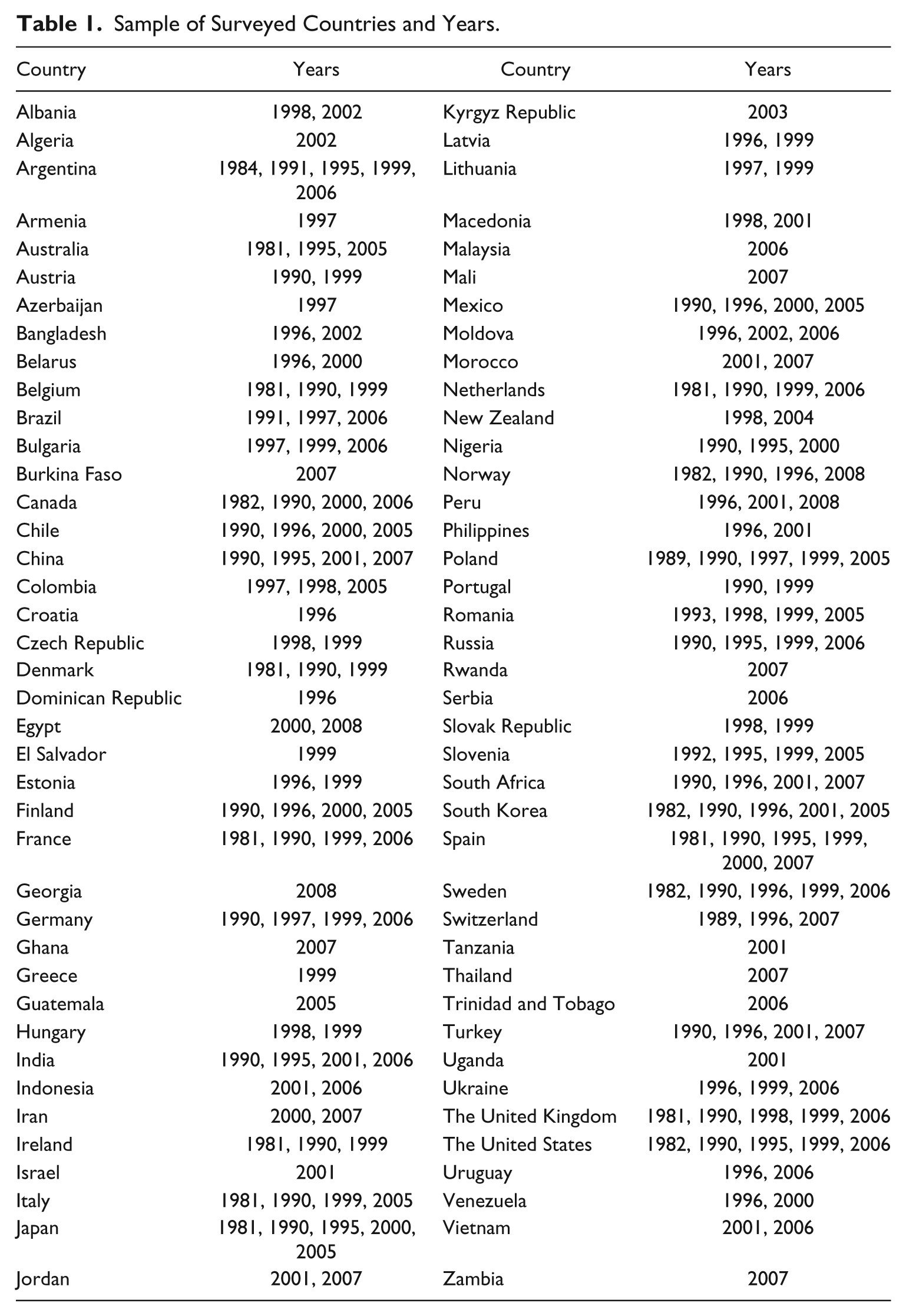
For our analyses below, our sample size is 207 country-years based on surveys of eighty different countries from 1981 to 2008. 9 In Table 1, we list the countries and the survey years used in our sample. Of course, drawing a sample from a population of surveys carries an increased risk of bias in our analyses (for similar discussions, see Hutchison and Gibler 2007; Hutchison and Johnson 2011). Although the coverage of our surveys is global, the country sample selected for surveys is not truly representative even though it varies widely in level of development, political institutions, region, and ethnic diversity. Survey countries tend to be more populous, more democratic, more internally stable, and less prone to civil conflict than a truly representative sample. This is due to the increased difficulty of conducting nationally representative surveys in poorer or less internally stable countries as well as the greater danger posed to the interviewers. In short, this sample selection favors stability and internally peaceful countries. However, while we acknowledge this inherent sample bias, we are not as troubled by its implications for our results below. In fact, given the higher relatively level of stability within this sample, it is strongly biased against finding results linking social intolerance to civil conflict and, thus, represents a stronger test for our hypothesis.
Sample of Surveyed Countries and Years.
Dependent Variable
Internal armed conflict
Our dependent variable is civil conflict. As we discuss above, civil conflicts are militarized conflicts within a country between the government and organized groups or, in some instances, between distinct substate organized groups. Civil conflicts can range from large-scale civil wars to low-level insurgency movements (Fearon and Laitin 2003). For our measure of civil conflict, we rely on the internal armed conflict indicator from the UCPD/PRIO Armed Conflict data set, version 4-2015 (Gleditsch et al. 2002). This data set includes measures of lower intensity armed civil conflicts in addition to large-scale civil wars and is commonly used throughout the empirical literature on civil conflict (see Bartusevicius 2016). 10 In this data set, an internal armed conflict is “a contested incompatibility that concerns government and/or territory where the use of armed force between two parties, of which at least one is the government of a state, results in at least 25 battle-related deaths” (Pettersson and Wallensteen 2015: 1). In this study, our dichotomous civil conflict measure indicates whether that sample country experienced at least one civil conflict in the year following the survey. For instance, if a survey was conducted in 1995, this measure would indicate if that country experienced a civil conflict in 1996.
Independent Variables
Social intolerance
In this study, we measure societal intolerance using several indicators of individual prejudice. As Gibson (2007) notes, individual prejudice is a primary measure of social intolerance and distinct from political tolerance (also see Gibson 2013). The World Values and European Values Surveys use an extensive social tolerance battery that is relatively consistent both within and across the various waves of surveys. This battery presents respondents with a list of various groups of people and asks the respondent to indicate which of those groups they would not like to have as a neighbor. 11 Although the groups on this list can vary from country to country and wave to wave, we construct an additive intolerance index for each individual from several groups that consistently appear in almost every list of choices: people of a different race and immigrants. For each component, individuals were coded 1 if they indicated that they would not like that group as a neighbor and 0 if they did not. Thus, our social intolerance index ranges from 0 (tolerant) to 2 (intolerant). We then aggregate all of the responses to generate a mean for each survey to include in our civil conflict models. In our sample, the social intolerance index ranges from 0.03 (Argentina, 1984) to 1.39 (Bangladesh, 2002) with a mean of 0.32. 12
Media freedom
To measure media freedom, we use the GMFD, an updated version of a definition-driven data set (Van Belle 1997; Whitten-Woodring and Van Belle 2014; Whitten-Woodring and Van Belle 2015). The definition is explicitly political. Media are free if media outlets are able to safely criticize government and other elites, and thereby serve as an arena for political competition. Although there are other measures of media freedom, only the GMFD offers a simple coding scheme that is consistent over time and across countries. The GMFD coding scheme is defined by thresholds and based on a clear and simple definition of media freedom. In comparison, the Freedom House and Reporters without Borders indices use coding schemes that have changed over time and are based primarily on identifying media restrictions rather than on a definition of media freedom. Both indices identify the status of the news media for each country-year, but these statuses are determined by cut-offs in the scale rather than by thresholds (Whitten-Woodring and Van Belle 2015). 13
In the GMFD, the media environment for each country is placed in one of the following categories:
Free: countries where criticism of government and officials is a common part of the political dialogue.
Imperfectly free: countries where social, legal, or economic costs related to the criticism of government or officials limit public criticism, but investigative journalism and criticism of major policy failing can and does occur.
Not free: countries where it is not possible to safely criticize the government or officials, and media are either indirectly controlled or directly controlled.
This is a categorical coding rather than interval scale; the difference between media coded imperfectly free and media coded not free is far more substantial than the differences between those coded free and those coded imperfectly free. Because of the bimodal nature of these data, we collapse categories free and imperfectly free to form free media.
Control Variables
In the analyses below, we rely on a relatively standard set of control variables for modeling the likelihood of civil conflict (see Fearon and Laitin 2003). The subsequent models include measures for ethnic fractionalization, inequality (GINI), unemployment, youth population, rugged terrain, oil rents, and prior conflict, all of which we expect to increase the probability of conflict. To account for factors shown to decrease the likelihood of civil conflict, we also include measures of economic development (gross domestic product–purchasing power parity), democratic longevity, and executive constraints. In the interest of conserving space, we include full descriptions (including specification and expectations) for these control variables in the online appendix.
Results
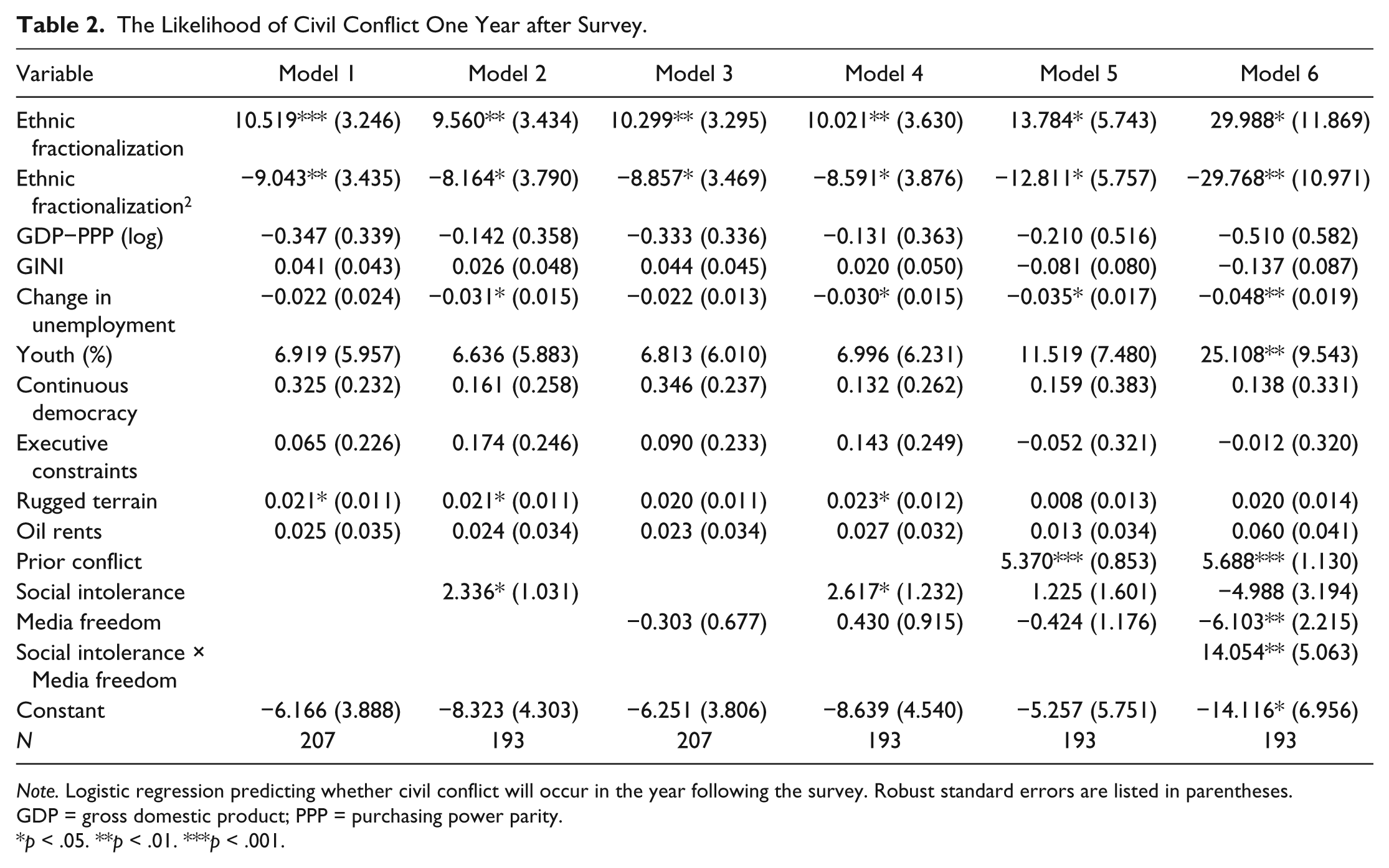
As our dependent variable is binary, we use logistic regression to estimate the effects of our explanatory variables in the analyses that follow. In Table 2, we present our six models to demonstrate the effects of social intolerance and media freedom on the likelihood of civil conflict. Recall our dependent variable indicates whether the country experiences a civil conflict in the year following the survey. In Model 1, we begin by estimating only the effects of our control variables on civil conflict. Not surprisingly, we find that rugged terrain is positively correlated with the onset of civil conflict, a finding that corresponds with Fearon and Laitin’s (2003) seminal findings (also see Hendrix 2011). We also observe that ethnic fractionalization has a nonmonotonic effect on civil conflict, 14 that is, the likelihood of conflict is lowest in countries with very low and very high levels of ethnic fractionalization. This curvilinear relationship is very much in line with previous predictions and findings (see Esteban and Ray 2008; Horowitz 1985). Overall, these results do not reveal any big surprises, and the direction of our coefficients largely corresponds with previous civil conflict studies despite our truncated sample. This similarity to previous findings on civil conflict adds confidence that our sample can yield inferences that are generalizable. 15
The Likelihood of Civil Conflict One Year after Survey.
Note. Logistic regression predicting whether civil conflict will occur in the year following the survey. Robust standard errors are listed in parentheses. GDP = gross domestic product; PPP = purchasing power parity.
p < .05. **p < .01. ***p < .001.
We introduce our main explanatory variables, social intolerance and media freedom, separately in Models 2 and 3. In these models, we assess the unconditional effects of each variable on the likelihood of civil conflict. As expected, we find that higher levels of social intolerance increase the likelihood of civil conflict in Model 2, that is, countries with higher levels of social intolerance are more likely to experience civil conflict in the year following the survey than those countries with lower levels of social intolerance, a finding that is consistent with multiple causal pathways but also correspondent with the modal expectation on this relationship (see Hutchison 2014). To get a sense of the substantive impact of a country’s average intolerance on the likelihood of civil conflict, we plot this unconditional effect in Figure 1. It reveals that a country’s social intolerance has a strong substantive effect as the probability of civil conflict increases from a mere 7 percent at no intolerance to 46 percent at the highest level of intolerance found in our sample. Model 2 also reveals that change in unemployment actually reduces the likelihood of civil conflict, a finding that we observe in Models 4 to 6. Although this finding does not match our expectations, it is similar to previous empirical findings that show a similar effect (Benmelech et al. 2010; Berman et al. 2011).
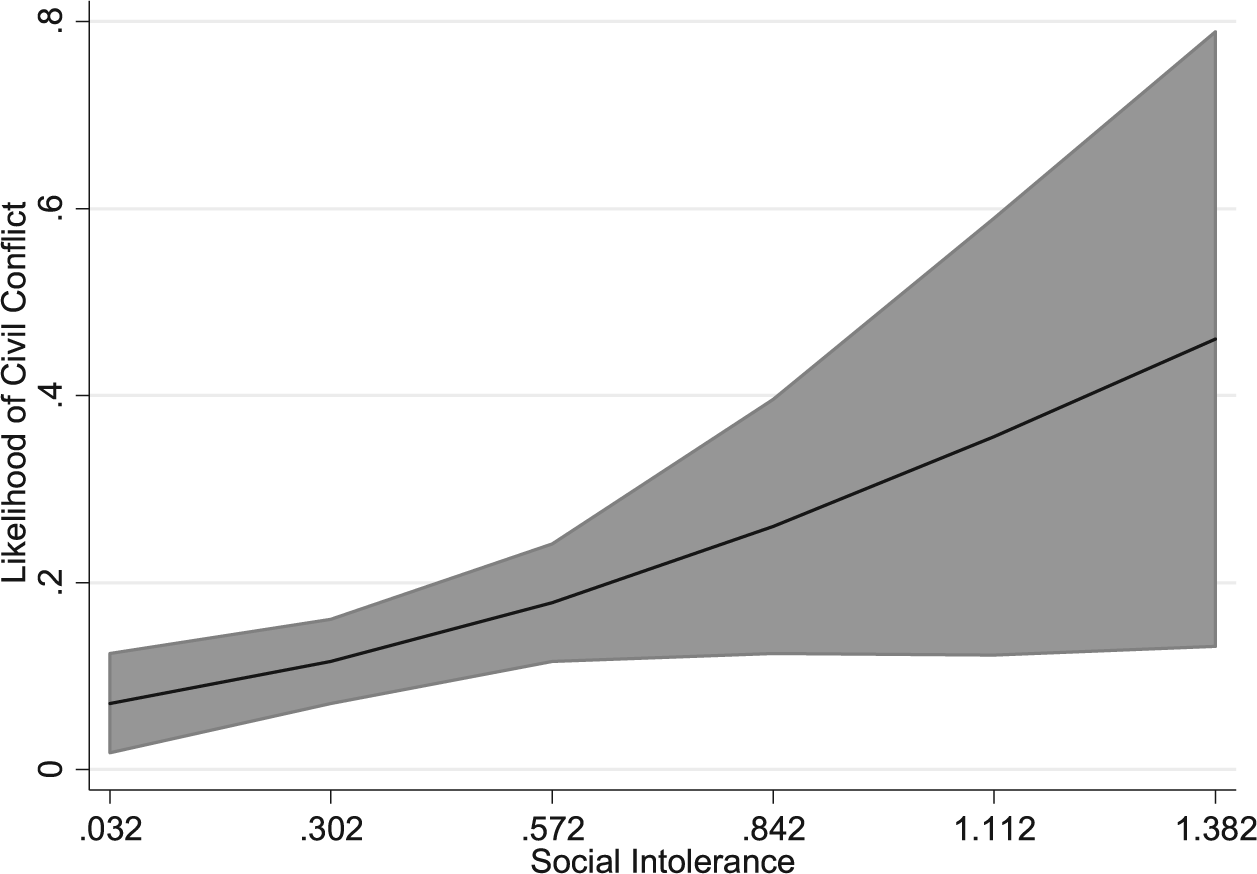
Unconditional effect of social intolerance on civil conflict.
In Model 3, we evaluate only the effect of media freedom on conflict. Here, we do not observe a statistically significant unconditional effect between media freedom and the likelihood of a civil conflict. This result does not support the normative expectation that, in general, media freedom would reduce the likelihood of civil conflict. Nevertheless, we argue that the effect of media freedom on civil conflict is likely to be more complex and conditional on other factors, particularly social intolerance.
In Model 4, we include both intolerance and media freedom in the same model. Once again, this specification evaluates their respective unconditional effects on civil conflict likelihood. Here, we show generally the same relationships that we observe in Models 2 and 3. We once again see that social intolerance increases the likelihood of civil conflict while media freedom has no statistically significant effect. Overall, this model supports our previous findings on the unconditional effects reported in Models 2 and 3.
Although prior conflict is one of the strongest predictors of civil conflict, we chose to omit this variable in our previous models due to concern that including a lag of the dependent variable on the right side of the regression model will likely mask the effects of the independent variables that are of great theoretical interest (Achen 2000). This is especially true for our analyses here because of our small sample size and brief time span. In Model 5, we include the prior conflict variable into model and find that some of our observed effects disappear, including social intolerance and rugged terrain. As expected, prior conflict is a strong predictor of civil conflict.
Our final test in Model 6 examines the conditional relationship involving intolerance and media freedom. Recall that we expect that intolerance combined with media freedom should actually serve to further exacerbate societal divisions and, thus, increase the likelihood of conflict. We find strong support for this hypothesis in the model after interacting intolerance and media freedom. In Model 6, the parameter estimate for the Media freedom × Social intolerance interaction term is positive and statistically significant. Substantively, this result indicates that higher levels of social intolerance combined with media freedom increase the likelihood of civil conflict. We also find mixed results from the remaining component variables. The parameter estimate for the media freedom variable is negative and statistically significant. This result signifies that media freedom actually reduces the likelihood of civil conflict but only in more tolerant societies. This finding is in line with the more traditional depiction of media as a positive force for society. The parameter estimate for social intolerance, however, is not statistically significant. This suggests that societal intolerance does not exert a strong influence on the likelihood of civil conflict in a country with restricted media. Intuitively, this nonfinding makes sense as countries with restricted media tend to come from more repressive states. Effective state repression reflects a stronger capacity to ameliorate the ability of potential rebel groups to organize and mount effective campaigns against governments.
The interactive effects of media freedom and social intolerance are more easily interpreted graphically. Figure 2 depicts the effects of Free and Not Free Media on the probability of civil conflict as social intolerance increases. Once again, we find strong substantive effects relating to country-level intolerance, but now we can show the impact of free media in moderating this dynamic. Here, we can see that when media are free and intolerance is low, the probability of civil conflict is close to 5 percent, but as intolerance increases, the probability of civil conflict increases to about 84 percent. In contrast, when media are not free and intolerance is low, the probability of civil conflict is about 31 percent, but as intolerance increases, the probability of conflict decreases to about 3 percent.
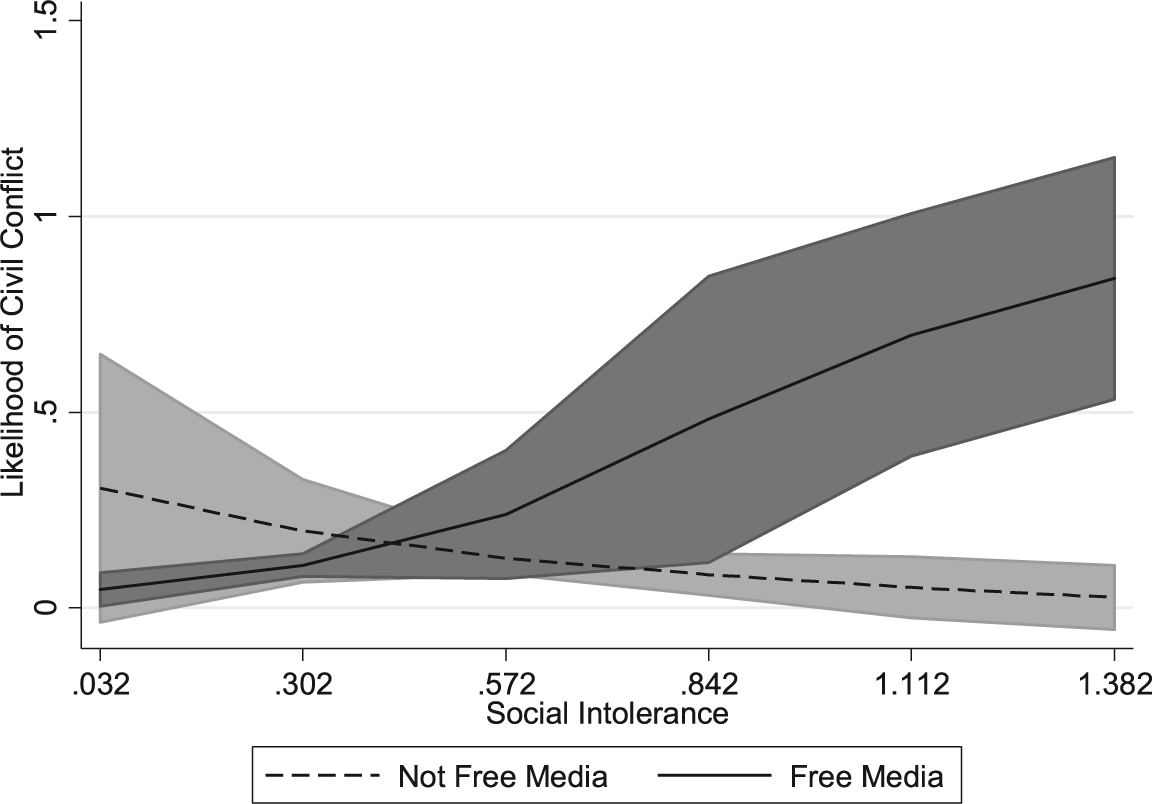
Conditional effect of social intolerance and media freedom on civil conflict.
Overall, our analysis offers compelling support for much of our argument. As anticipated, societal intolerance is generally linked to a higher probability of civil conflict. Furthermore, our results indicate that this relationship is moderated by the country’s level of media freedom but that media freedom by itself does not have an independent effect on the likelihood of conflict. All in all, these findings are supportive of a more grievance-based approach to explaining civil conflict. Our results also offer more direct evidence that intolerant societies are more likely to experience civil conflict, particularly under conditions of media freedom. To put our statistical findings in context and to demonstrate the possible causal mechanisms, we provide a detailed case illustration of India in section 3 of our online appendix. 16 In the case of the 2002 Hindu–Muslim violence, we find some evidence of an echo chamber within the Gujarat media, in which the two most popular newspapers used inflammatory frames and dehumanizing language, and the cable television stations carried speeches by local politicians that could have been perceived as a mobilizing call for retaliatory violence against the Muslim population.
Conclusion
We began this paper with the goal of examining the conditions that could lead free and independent news media to instigate political violence, in particular civil conflict. The answer—according to our findings here—is that the effect of media freedom on civil conflict depends on social tolerance. In the most tolerant societies, media freedom is associated with decreased probability of civil conflict, but in more intolerant societies, media freedom is linked with increased probability of civil conflict. The case of India provides some insight into how this can happen, through the media’s use of inflammatory frames, dehumanizing language, and the formation of echo chambers. In addition, the case of the Hindu–Muslim violence in 2002 shows that politicians will sometimes use news media to inflame existing prejudices for political gain and incite violence against marginalized groups.
These findings suggest that foreign assistance aimed at establishing media freedom in nondemocratic and developing countries may not have the desired effect and could promote domestic conflict in countries with societal intolerance. Similarly, these findings also indicate that controlled media may decrease the chances of civil conflict in countries with high levels of social intolerance. It is not our intention to defend the decisions of certain governments to control media. Instead we posit that if the goal is to have a free and independent press that can serve as a fourth estate, then certain conditions need to be in place, in particular, a minimal level of social tolerance.
The problem of media freedom and social intolerance is similar to the “hen-and-egg” problem of democracy—democracy will not work unless certain conditions are in place and it is difficult to have those conditions in place in the absence of democracy. Although it is difficult to pinpoint which comes first, social intolerance or inflammatory media, we posit that it is mostly likely the case that news media are amplifying prejudices that are deeply ingrained in society. It is also true that biased media could emerge in highly polarized and socially intolerant countries (this could be a promising area for future research). Here, we have proposed that in an intolerant society, there are likely to be commercial and political incentives for independent media to provide news and information that caters to those who share a particular ideology, and this in turn might reinforce their intolerance and create an opportunity for leaders of opposition groups to mobilize. Yet this tactic is not limited to the opposition. The case of India demonstrates that mainstream political elites may also use independent news media to inflame intolerance. Thus, in highly intolerant societies, free and independent news media can reinforce intolerance and raise the salience of grievances, which in turn can be used by political leaders (opposition or mainstream) to provoke political violence.
Certainly there is a history of governments using the potential for media to instigate political violence as an excuse for controlling media. In present day Rwanda, journalists have been imprisoned on charges of inciting violence and defaming President Paul Kagame. In 2010, the Hungarian government adopted new media laws that established a Media Council (made up of members of Prime Minister Viktor Orban’s Fidesz party) to regulate content of broadcast, print, and online media. The Media Council has the authority to punish media outlets “for ‘inciting hatred’ against individuals, nations, communities, minorities, or even majorities. The council is called to levy fines or suspend outlets for ‘unbalanced’ or ‘immoral’ reporting” (Freedom House 2012). Thus, there is evidence that governments perceive the potential for news media to play the role of a fifth column—supporting and facilitating the opposition or extremist groups existing within a country’s borders.
In an intolerant society, policies prohibiting hate speech and/or incitement of violence offer an alternative to controlled media. In Germany and France, there are policies against the use of symbols and language associated with the Nazi regime and anti-Semitism. Laws against hate speech and incitement of violence may well prevent news media from inflaming social intolerance, but limiting speech and media criticism can be a slippery slope. Many countries prohibit criticism of political leaders and/or ruling families, sometimes in the name of national security. A case in point, in September 2015, the printer of the international edition of the New York Times in Thailand refused to print the paper because the front page featured a story about the King’s declining health calling into question the future of the Thai Monarchy, a violation of Thailand’s lèse-majesté laws, which criminalize insulting the monarchy. Thailand is not alone; in recent years, the International Press Institute has campaigned against the desacato or “contempt of authority” laws in place in a number of Caribbean countries, claiming that these policies are a serious threat to media freedom (Griffen 2012). Thus, any policies prohibiting speech must be carefully tailored so that they prevent incitement while allowing news media to criticize government and other political and economic elites. In short, preventing the media from acting as a fifth column while allowing it to serve as a fourth estate is no simple task.
Footnotes
Acknowledgements
The authors wish to thank Ken Rogerson as well as the IJPP editors and four anonymous reviewers for their thoughtful comments and suggestions.
Authors’ Note
The authors’ names are listed alphabetically. Earlier versions of this article were presented at the 2013 annual meeting of the Midwest Political Science Association in Chicago, Illinois, and the 2014 annual meeting of the International Communication Association in Seattle, Washington. We are responsible for any errors that may remain.
Declaration of Conflicting Interests
The author(s) declared no potential conflicts of interest with respect to the research, authorship, and/or publication of this article.
Funding
The author(s) received no financial support for the research, authorship, and/or publication of this article.