







Abstract
This paper explores how provocation narratives introduce political bias in international news. It is based on a two-step methodology. First, a network analysis of country co-mentions in American, British, French, and German news corpus shows that core countries (e.g., the United States) and their opponents (e.g., North Korea, Russia, Iran) are the most frequently cited in provocation narratives. Focusing on the case where provocation narratives are the most prominent, the Korean conflict, we then employ a quantitative content analysis to identify the relationships between the countries involved in news stories using provocation narratives, and the role played by the provocation in those news stories. Our findings show that bias is introduced in many instances where journalists, while repeatedly identifying one country, North Korea, as the provocateur, omit key information such as the reasons behind North Korea’s provocations or the identity of the provoked country. This indicates that provocation narratives adopt the core countries’ geopolitical views and portray their enemies as a global threat.
Keywords
As the media represent the audience’s main, if not unique, source of information on international news, bias in this field has potentially more impact than in any other. Furthermore, as international news stories are often about violent conflicts, they entail emotions and moral judgments that are likely to increase the risk for bias. Because conflicts tend to be narrated in terms of tensions between heroes and villains, or perpetrators and victims, bias in foreign news reports will take the form of (unsubstantiated) blaming of groups identified as the “bad guys.”
We argue that provocation narratives are a powerful, yet underinvestigated, way of introducing such bias in international news reports. The term provocation has been conceptualized in many different fields and disciplines. Although some theorize it as a positive stimulation, enhancing curiosity and critical thinking, it is more generally perceived in relation to violation of norms and to violence. In a political-sociological tradition, we will here retain Paris’s (1989) definition of provocation as an intentional contravention of a norm, which elicits a reaction that exposes and discredits the provoked one in the eyes of third parties. Yet, as Boudana and Segev (forthcoming) have shown, from the moment a provocation is identified as such and becomes a narrative, the reaction of the provoked one often appears as expectable and understandable, if not justified. As demonstrated below, such a blame-game introduced by provocation narratives is particularly frequent in international news stories, which often report on violent conflicts. Our findings show that western media repeatedly designate some countries, notably North Korea, Russia, and Iran, as main provocateurs, and that, in doing so, they obviate the need to further explain why representatives of these countries speak or behave as is reported. In the case of North Korea, the western media adhere to the American narrative, in which North Korea is held responsible for any possible violent reaction.
The goal of our research is to demonstrate that journalists do not equally distribute provocation narratives among the reported countries, but tend to use them selectively in reference to certain “bad guys.” These are often the countries that have conflictual relations with the reporting countries or their allies. Moreover, we attempt to show that provocation narratives allow for biased reporting, by omitting crucial information that would have qualified the demonization of these countries or would have revealed the complexity of the conflict.
Following our theoretical background on bias in international news and on provocation narratives, we conducted a research in two stages. First, we examined what countries were mentioned together with the word “provocation” in international news. This analysis showed that core countries (such as the United States) and their enemies or opponents (such as North Korea, Russia, and Iran) were the most frequently mentioned in provocation narratives. We then focused on the most prominent story, the Korean conflict, and employed content analysis to identify the relationships between the countries involved in the provocation stories, and the particular role played by the provocation in those news stories.
Bias in International News Stories
Alignment on National Government’s Positions
Hanitzsch et al. (2013) recall that, according to public opinion surveys, “foreign and international news can substantially affect the audience’s knowledge, perception, and attitude toward other nations” (p. 171). As audiences are particularly reliant on journalistic reports for international news, the media bear critical responsibility for accurately and fairly reporting in that field (Boudana 2016). Misrepresentation and bias in foreign news would have a more negative impact on the citizens’ views than distortion in domestic news. This is all the more problematic as the journalists’ temptation to oversimplify and polarize the narrative may be more marked in the coverage of foreign news than domestic affairs precisely because the audience has limited knowledge on foreign issues.
Gans’s (1979) study of American news media goes a step further when it contends that American journalists and editors tend to align their coverage of foreign events with American foreign policy. Sixteen years later, Lee and Yang (1995) showed that, beyond considerations of newsworthiness, news media are, indeed, inclined to serve national interest in their coverage of foreign affairs: “National interest cum dominant ideology may powerfully shape the ‘journalistic paradigms’ of international media” (p. 13). According to Gans, news media even follow their government’s line more closely than they would do when covering domestic news.
Foreign news, therefore, represents a privileged object for the analysis of political bias and, paradoxically, for the study of the specific bias consisting of aligning news coverage on the national government’s positions. If Gans’s observations are still valid, the political alignment on foreign affairs must be all the more considerable today because scholars observe a general “ideological strengthening of the state–journalistic partnership” (Handley and Rutigliano 2012).
Identification of Core versus Marginal Countries
In their 1965 seminal paper, Galtung and Ruge discussed the news bias consisting of overrepresenting white, western, and elite people. Their strong hypothesis was that events concerning “nations that are culturally distant and nations that are low in international rank” are less likely to be reported. Various studies over the last decades (Gerbner and Marvanyi 1977; Hester 1971; International Press Institute 1953; Kariel and Rosenvall 1995; Segev 2015; Wu 2000) have confirmed the unbalanced representation of foreign countries. Core countries (particularly the United States and Western Europe), their international affairs, and their interchanging opponents or enemies have always been at the center of international news.
When marginal countries get coverage, events are depicted as “sudden, like flashes of lightning, with no build-up and with no let-down after their occurrence—they just occur and more often than not as a part of the machinations of the ruling or opposition elites” (Galtung and Ruge 1965: 83–84). As Segev (2016) suggests, journalists are then likely to apply master narratives of the good against the evil. Particular events are then constructed in ways that fit these predefined formulae.
Studying the trends of country mentions over time, Segev (2016) found that some countries interchangeably replace each other as the “bad guys.” The overall trends of countries’ prominence display the profoundly western-centric story told by international news. Core countries, such as the United States, and their interchanging opponents, such as Afghanistan, Iraq, North Korea, or Syria, serve as actors in a broader and much deeper narrative. This is a story of world threats, in which countries are mere components that replace each other in turns. The “bad guy” dynamics can, therefore, serve as a key to understand the meta-narrative of international news. The types of narratives in which those bad guys play a central role are, however, underinvestigated. In what follows, we claim that provocation narratives are often used to depict their international actions to shift the blame from the core powerful countries in reports on conflicts.
Content and Selection Biases in Provocation Narratives
Media scholars (Boudana 2016; D’Alessio and Allen 2000; Entman 2007) identify three types of bias in the news: distortion bias, resulting from statements that falsify reality; content or coverage bias, which consists of favoring one side rather than providing equal treatment to both sides involved in a conflict; and selectivity or gatekeeping bias, which refers to the journalist or news organization’s external processes of decision making and includes framing, agenda setting, or priming. While we agree with Entman (2007) not to examine the first type of bias because of the “irresolvable questions about truth and reality” (p. 166) that it raises, we contend that the characterization of certain actors and their actions as provocative introduces a content/coverage bias, while the framing of the foreign news stories as provocation narratives represent a selection bias.
Shifting Blame to the Victim
Provocations—acts or speeches—and provocation narratives have been analyzed in various disciplines, from marketing and advertisement to psychology, sociology, gender studies, law, narratology, and politics. It has been, however, undertheorized and underinvestigated in relation to communication studies, and notably journalism.
Although some types of provocations, such as philosophical provocations, are aimed at enhancing critical thinking (Betschart et al. 2014), the definition of the term generally includes negative reactions. Paris (1989) defines provocation as “an intentionally induced and unexpected contravention of a norm, implicating the other in an open conflict which should elicit a reaction which in turn makes the other especially in the eyes of third parties morally discredited and exposed” (quoted by Driessens 2013: 558). Interestingly, the consequence (and perhaps aim) of provocation is, for Paris, to expose and discredit the entity reacting to it. Yet, as Boudana and Segev (forthcoming) have shown, provocations could be also used in narratives as communication strategies designed by the alleged provoked party to expose the provocateurs and hold them responsible for the conflict. In other words, accusing one of provocation could also mean that one is responsible for any possible reaction. At stake in both provocations and provocation narratives are crucial issues of intentionality, causality, and accountability.
While transgression (or questioning) of rules, norms, values, or taboos may be the most agreed-upon definitional characteristic of provocation, the criterion of intentionality mentioned by Paris and others is highly problematic. Was the transgression deliberate? On one hand, this question is crucial in the evaluation of the alleged provocateurs’ accountability. On the other hand, intentions are often impossible to assess. Provocateurs rarely admit that they deliberately provoked violent reactions. Rather, they tend to justify their actions as meant to be beneficial to themselves or others, or as reactions to the other side’s provocations.
Equally challenging is the question of causality. To pro-voke is etymologically to call for, or in Paris’s terms to “elicit,” a reaction. Thus, a provocation does not inevitably trigger a chain of causality; it only stimulates certain reactions. This means that the provoked parties can be held responsible for their reactions, at least partially. These ambiguities make it possible to use provocations and provocation narratives as communication strategies, which may attribute false intention, hide or distort causality, and shift blame to victims.
In provocative acts or speeches, provocateurs tend to disguise their inciting intentions, hide the causal relation between their provocation and reactions to it, and blame the provoked ones for their reactions. In provocation narratives, the responsibilities are reversed but the potential for distortion is similar. These narratives denounce alleged provocateurs as deliberately inciting violence, hide the responsibility of the provoked party for this violence, and put the blame on those accused of provoking, although they may be the direct victims of violence.
Provocation Bias and Framing
The examination of bias in provocation narratives uncovers many similarities between framing and narrative theories and their potential to influence the audience. In “Some Further Steps in Narrative Analysis,” sociolinguist Labov (1997) argues that,
narrative construction is equivalent to assigning a theory of causality. In accounts of conflict between human actors, or the struggle of human actors against natural forces, the narrator and the audience inevitably assign praise and blame to the actors for the actions involved. (p. 406)
A narrative is a report of a sequence of events, the central event being both reportable, that is, of minimum interest, and credible, to maintain the audience’s attention. This central event triggers a chain of causality that makes apparent the actors’ responsibilities and ends with a resolution or another form of conclusion.
These definitional dimensions of narrative are very close to the four functions of framing identified by Entman (1993), which include defining the problem (which will constitute the reportable event), diagnose causes (equivalent to Labov’s theory of causality), make moral judgments (related to the assignment of responsibility), and suggest remedies (corresponding with Labov’s resolution or conclusion). In the case of provocation narratives in international news, the problem is the provocation itself; the cause is the actors identified as the provocateurs, who are assigned responsibility and are subjects of negative moral judgments; and finally, the resolution may be found in the provoked or third parties’ threat or actual negative reactions against the provocateurs.
The goal of our research is, thus, to study to what extent provocation narrative introduces biases in international news. More specifically, when it comes to western news, we believe that provocation narratives will be mostly used to picture the opponents of core countries as the “bad guys.” We also want to demonstrate that provocation narratives frame the reported events by omitting some information (selection bias), thus preventing the audience from considering alternative causality and responsibilities. Our first goal is, therefore, to map the main actors involved in the provocation narratives of international news.
Our second goal is to examine how the actors involved in the provocation narratives, and their actions, are depicted. Specifically, we are interested in the nature of the reported provocation, the reference to the provocation (in citation or not), the justification given by the provocateur, and the reaction to the provocation. The country accused of provocation may argue that its action was not a provocation but was meant to be beneficial to its people or came as a reaction to the other side’s provocation. We believe, however, that provocation narratives introduce bias precisely because they do not give the alleged provocateurs a chance to justify their actions.
Method
Our study followed two stages of analysis. First, we examined what countries were mentioned together with the word “provocation” 1 in international news. We also employed a network analysis of countries’ co-mentions to identify and map the international relations associated with the provocation narratives (Segev 2010, 2016; Segev and Blondheim 2013). As will be detailed below, we found that core countries (the United States, in particular) and their enemies or opponents (North Korea, Russia, and Iran) in three distinctive regions were the most frequently mentioned in provocation narratives. Once those key international players were identified, we focused on the most prominent story, the Korean conflict, employing content analysis to study the relationships between the countries involved in the provocation narrative and the particular role played by the provocation in those news stories.
Sample of International News
The data analyzed in this study were collected from a variety of news sites in four western countries (France, Germany, the United Kingdom, and the United States) in three different languages (French, German, and English, respectively). These core countries were selected due to their important geopolitical and media role, particularly in the dissemination of world news (MacGregor 2013; Tunstall 2008). News from France, Germany, and the United Kingdom provides different dominant perspectives in Europe. When it comes to international affairs that are directly related to the United States, such as the Korean conflict, American news provides another dominant, but perhaps less critical and more one-sided perspective.
In each of the countries selected for analysis, two popular news sites were used: Le Figaro and Le Monde in France, Der Spiegel and Die Welt in Germany, the Daily Telegraph and the Guardian in the United Kingdom, and New York Times and the Washington Post in the United States. The data of each of the chosen news sites were automatically mined every other day over a period of two and a half years between January 2013 and June 2016 at 12:00 Coordinated Universal Time (UTC). In total, 497,711 news items were collected and analyzed.
Prominent Countries in Provocation Context
We examined the prominence of country mentions in the entire news corpus as well as their prominence only in news items that specifically mentioned the words “provocation” (in English and French), and “Provokation” (in German). Country mentions were automatically extracted. For this purpose, a database of 195 country names in English, French, and German was built based on the complete list of country names available from the International Organization for Standardization. Two native-speaker research assistants were employed to translate country names into these languages. For each country name, the research assistants were asked to provide all the common names and alternative names (e.g., “United States,” “USA,” etc.). Then, they were asked to omit all alternative country names that might be ambiguous and, therefore, yield irrelevant search results.
On the basis of this list, we automatically identified what countries were mentioned in each news item in general and in news about provocation in particular. The country prominence was calculated based on the percentage of news items that mentioned a country out of the total news items that mentioned country names. Each country was counted only once in each news item.
Content Analysis of Provocation Narratives
After identifying the most prominent countries mentioned in the context of provocation in international news, the second stage included an in-depth content analysis of the most prominent news story in the context of provocation, namely, the conflict between North and South Korea. From each news source, we randomly chose fifty news items that mentioned the words “North Korea” and “provocation” (in the respective languages). In total, the content of four hundred news items that mentioned the word “provocation” was fully analyzed by two trained coders fluent in English, French, and German. In all, fifty common news items that included seventy-seven mentions of the word “provocation” were used for intercoder reliability. Coders were instructed to study the explicit context in which provocation narratives were used as detailed in the codebook below. After a period of training, the intercoder agreement was satisfactory, ranging from 86 percent for the reaction variable to 96 percent for the justification variable.
The codebook we developed aimed at studying the relationships between countries mentioned in the context of provocation, and how provocation was used to assign roles and responsibilities to the actors. It was divided into two parts. The first part studied the role of each country in the provocation narrative. We examined the accusing countries, the provoking countries, and the provoked countries (see definitions in Table 1).
Code Book of Provocation Narratives in International News.
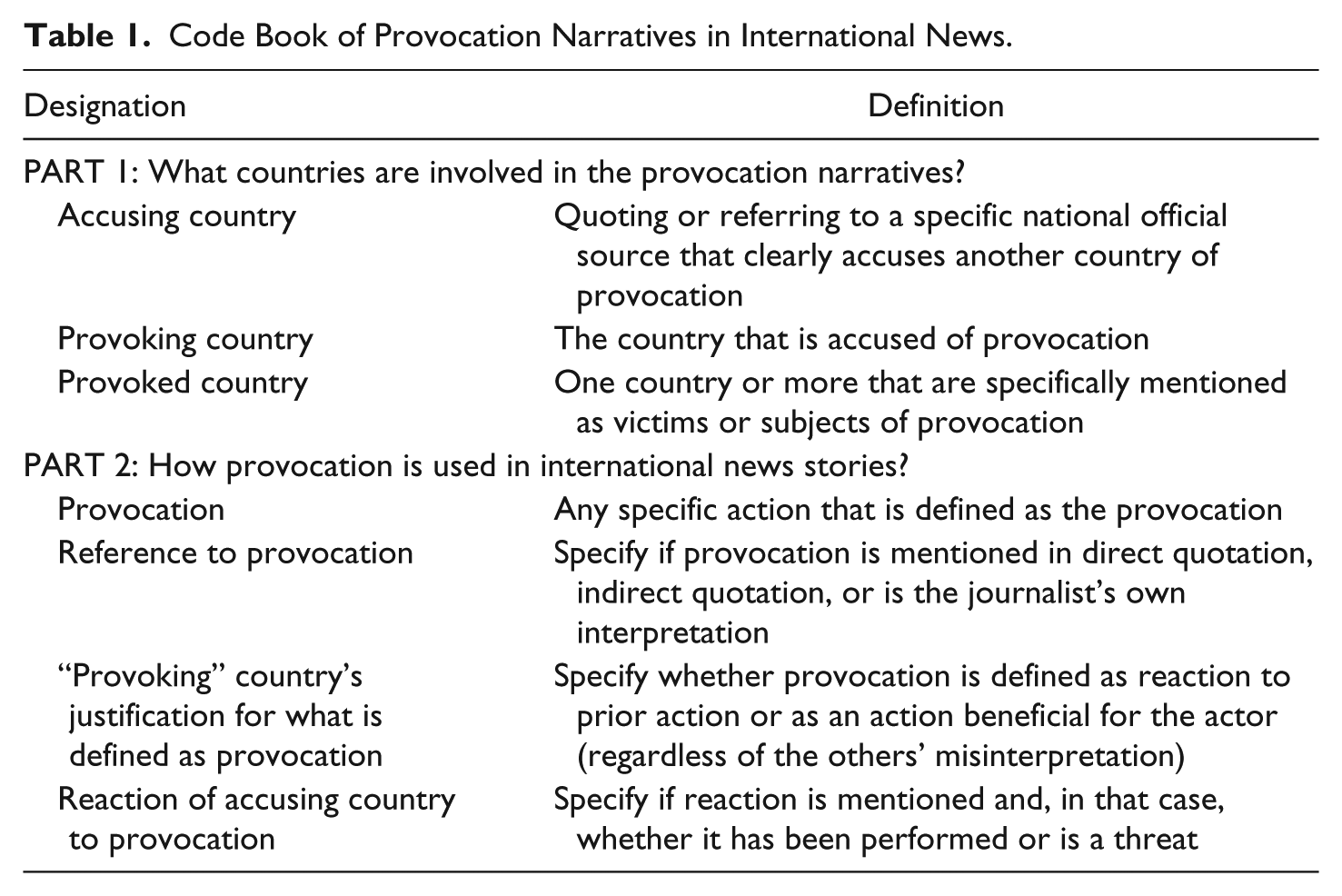
For example, a news item from the New York Times on August 15, 2015 quoted the president of South Korea, saying that “North Korea must wake up from its delusional belief that it can maintain its regime through provocations and threats” (Sang-Hunaug 2015). In this particular example, the accusing country was South Korea, the provoking country was North Korea, and there was no explicit indication to any provoked country or specific provocation.
The second part studied the way provocation was used. Based on a previous inspection of the content of relevant news items, we identified three reoccurring patterns in news reporting related to provocation. We examined whether the provocation was mentioned in direct or indirect quotations (reference), whether it was justified (justification), and whether the reaction to provocation by the accusing country was mentioned (reaction; see the full codebook in Table 1). In the example above, the provocation was mentioned in direct quotations attributed to South Korea, but there was no justification for North Korea’s actions, or a specific reaction of any provoked country. Moreover, as stated above, both the provoked country and the provoking action were not specifically mentioned in relation to the provocation.
Analysis of the “reference” (who is referring to the word “provocation”) would indicate whether, as we believe, the provocation narrative is generally introduced in the news story by the country claiming to be victim of such provocation. However, we also consider that, despite the journalistic principles of impartiality and detachment, the journalists themselves might occasionally take responsibility for accusing a country of provocation, rather than attributing the term “provocation” to a specific source.
Analysis of the “justification” is also an indicator of impartiality (or lack thereof). While the principle of impartiality may not always be possible or even desirable (Boudana 2016), it imposes that journalists present “both sides of the story” when reporting on conflicts. If one party accuses the other of “provocation,” the accused country should have the opportunity to defend itself, notably by arguing that its contentious action or speech was not meant as a provocation, but rather as beneficial to its citizens or as a reaction to the other side’s provocation. We believe that provocation narratives introduce bias because they dispense journalists from balancing the accusation of provocation with an alternative explanation.
Finally, we want to study whether a “reaction” to the provocation is reported and what kind of reaction this is (i.e., a violent reaction or a threat). We believe that reference to provocation may serve to justify a violent act or a threat by presenting it as a reaction to prior provocation rather than as an aggression.
Results
Prominent Countries in Provocation News
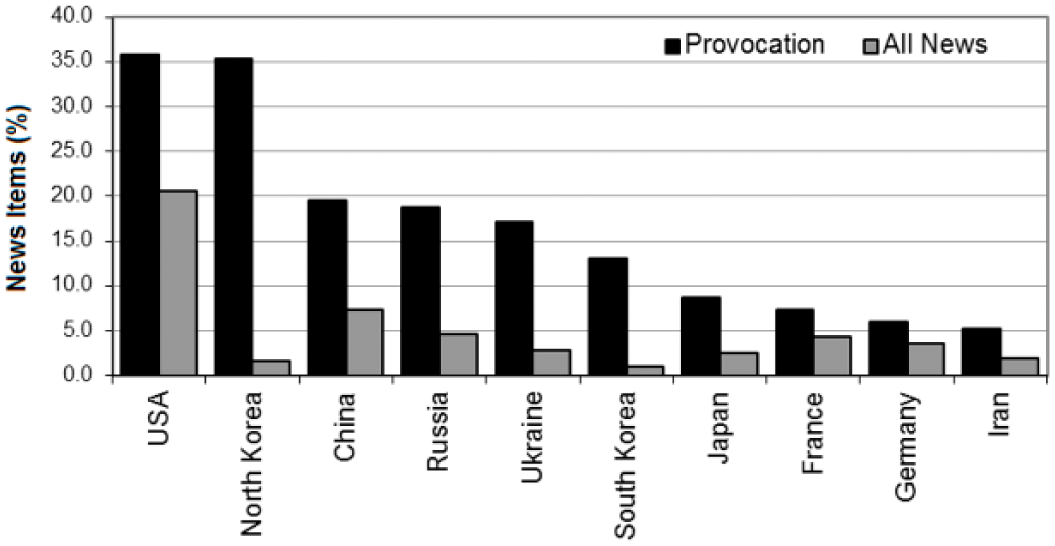
The first stage aimed at identifying the most prominent countries mentioned in relation to provocation. Figure 1 presents the top ten countries mentioned in provocation context (in black) compared with the most prominent countries in general (in gray) out of all news items that mentioned foreign countries. It shows that the United States and North Korea were both mentioned in more than 35 percent of all news items that mentioned the word “provocation” and any foreign country name. While the United States has also relatively high news prominence in general (20.5 percent), North Korea was much less prominent in general (1.6 percent of all news items that mentioned foreign countries), suggesting that the latter was mentioned by far most frequently in the context of provocation.
Ten top countries mentioned in provocation news stories (in percentages).
Other countries with relatively high news prominence in provocation stories were China, Russia, Ukraine, and South Korea, mentioned in 19.5 percent, 18.8 percent, 17.2 percent, and 13.1 percent of all news stories that mentioned foreign countries, respectively. In all these countries, there was a significant gap between their news prominence in provocation stories and their news prominence in general. This indicates that those countries were also dominant players in international provocation narratives.
Table 2 displays the top ten mentioned countries in the context of provocation across the four reporting countries in our sample. It shows that in the news of all of the reporting countries, North Korea and the United State were, indeed, the main actors mentioned together with the word “provocation.” China, Russia, Ukraine, and Iran appeared more or less in the same ranking order as the most frequently mentioned foreign countries.
Percentage of News Items that Mentioned Provocation with Any Foreign Country.
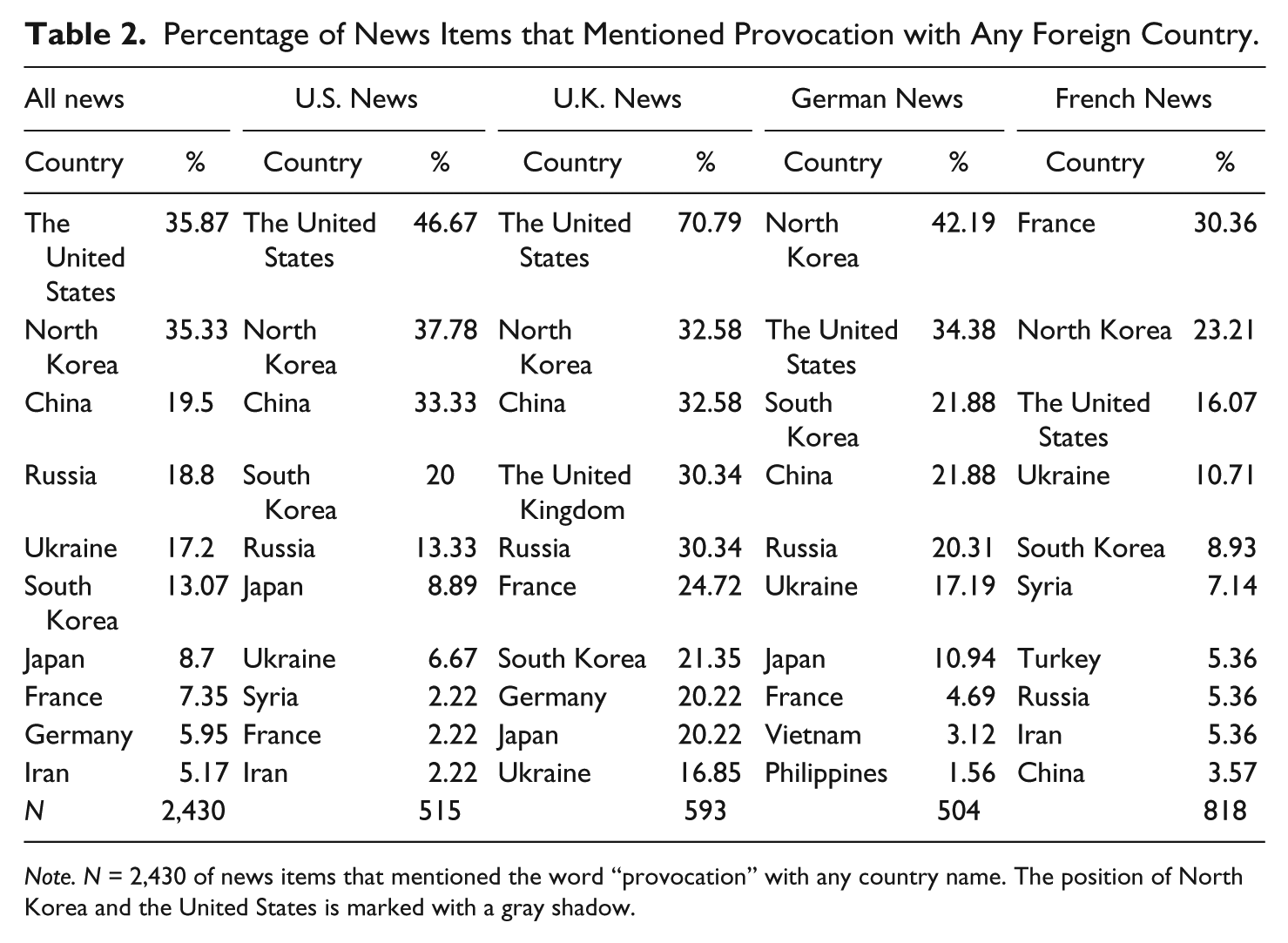
Note. N = 2,430 of news items that mentioned the word “provocation” with any country name. The position of North Korea and the United States is marked with a gray shadow.
To better understand the interaction between countries as represented by world news on provocation, Figure 2 portrays the undirected network of country co-mentions. Each pair of countries that was mentioned in the news together with the word “provocation” was represented by a link. The width of this link represents the number of news items that mentioned each pair of countries together. Similarly, the size of countries in the network represents their weighted degree of centrality, or, in other words, the number of news items that mentioned them with other countries.
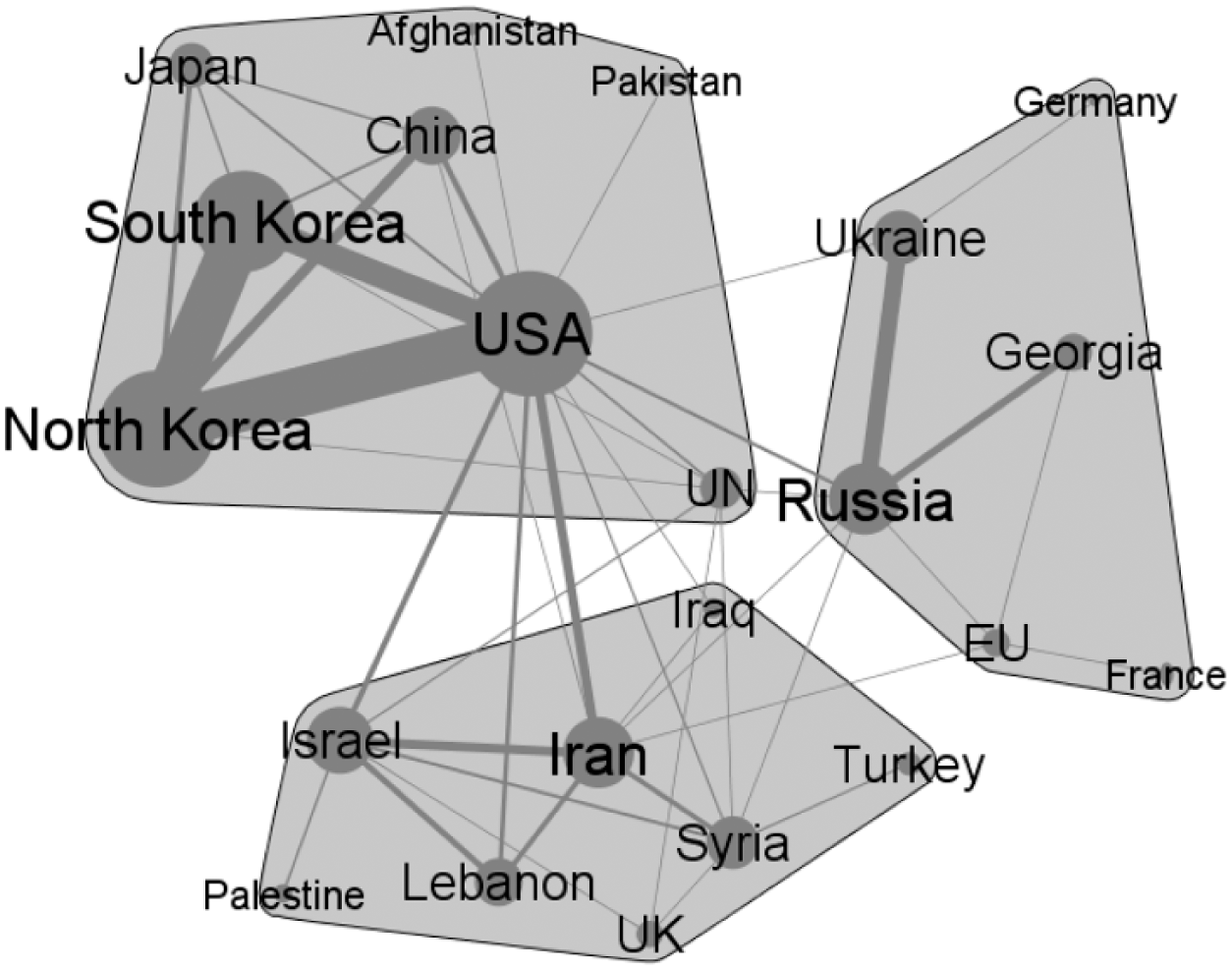
Network of country co-mentions in provocation news stories.
Figure 2 shows the very central triangular of North Korea, South Korea, and the United States. In fact, 24 percent of all provocation stories mentioned either two or three of those countries together. Other prominent pairs of countries in the context of provocation were Russia and Ukraine (about 4 percent of the news items), and Iran and Israel (about 2 percent of the news items). But perhaps the most fascinating finding in this analysis is the structure of the network itself. Using iterative conductance cutting (Brandes et al. 2003; Kannan et al. 2004) to divide countries based on their links resulted in three distinctive clusters, which remarkably correspond to the major geopolitical and regional conflicts reported in international news. The provocation narratives involving the United States were mainly related to Asian countries, with North Korea and South Korea followed by China and Japan. The provocation narratives involving Russia included mostly the central Asia region, with Ukraine and Georgia as the main actors, and some remotely related European actors. Finally, the provocation narratives involving Iran included mostly Middle Eastern countries such as Israel, Syria, and Lebanon.
Content Analysis of the North Korean Narrative
The previous analysis revealed that North Korea gained the greatest news prominence once we focus on provocation narratives. The network analysis displayed a very high involvement of the United States and South Korea in this narrative, and to a lesser extent of China and Japan. In the following section, we employ content analysis of the news items that mentioned “North Korea” and “provocation” to understand the role and relationships between those countries, as well as how provocation narratives were used in these news stories.
Table 3 summarizes the results of the content analysis of all the mentions of the word “provocation” (N = 504) out of the four hundred news items. It shows that in 41 percent of the cases, there was no indication of accusing country. In another 41 percent of the cases, the accusing country was either South Korea (26 percent) or the United States (15 percent). Although we selected news reports mentioning North Korea with the word provocation, only in 9 percent of the mentions was North Korea identified as the accusing country. The two British outlets, the Guardian and Daily Telegraph, were exceptions, as they displayed a still low but relatively higher percentage of cases (15 percent and 20 percent, respectively), in which North Korea was mentioned as the accusing country.
Content Analysis of Provocation-Related News Items in Different Outlets.
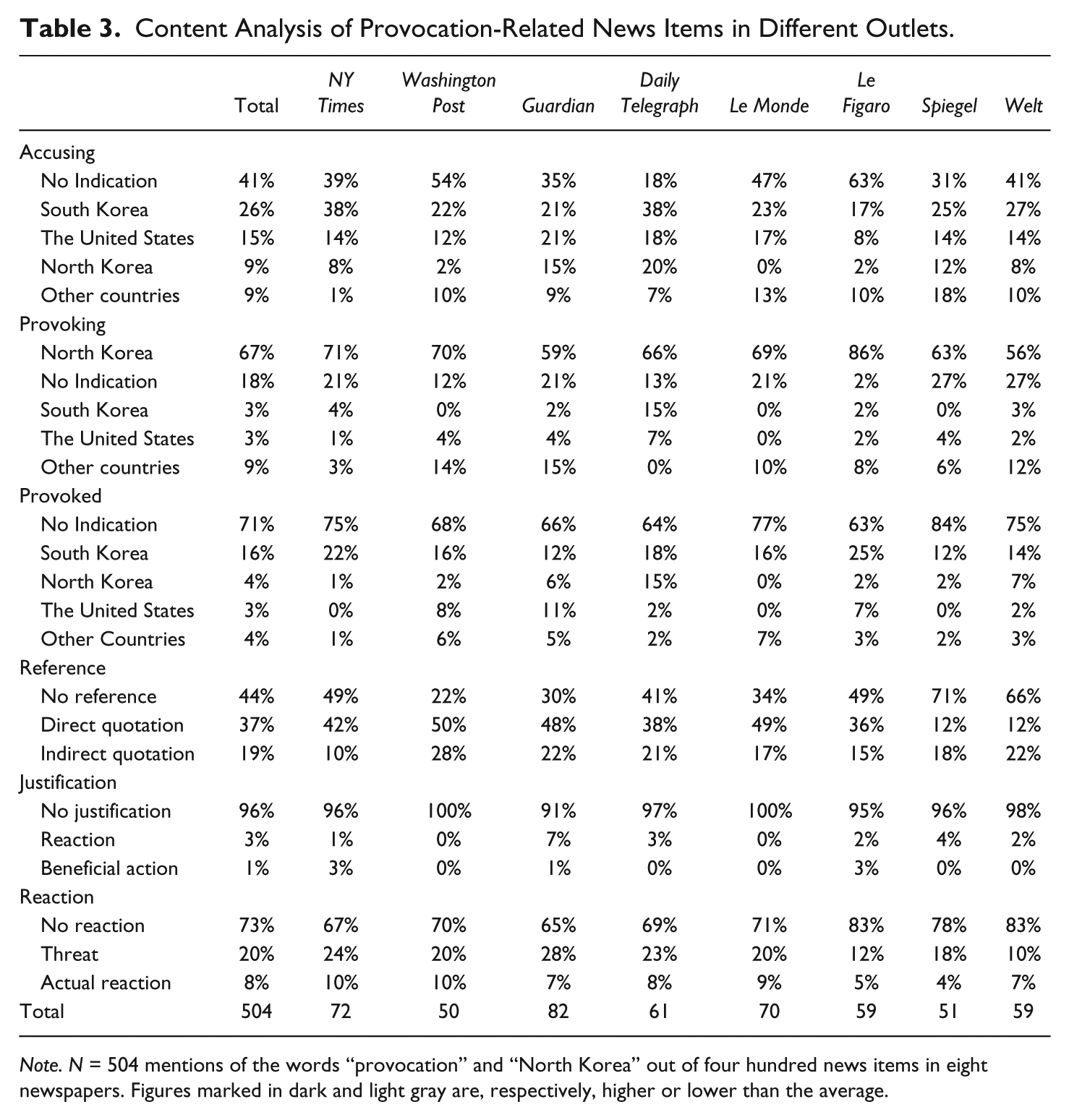
Note. N = 504 mentions of the words “provocation” and “North Korea” out of four hundred news items in eight newspapers. Figures marked in dark and light gray are, respectively, higher or lower than the average.
In terms of reference, 44 percent of the cases did not identify who used the term provocation (marked as “no reference” in the table). Among the German outlets, Der Spiegel and Die Welt, the absence of direct reference was even higher, as in 71 percent and 66 percent of the cases, respectively, the word “provocation” was mentioned with no reference. This lack of reference to a specific source, combined with the absence of designation of an accusing country in 41 percent of the cases, reveals that in many instances the journalists themselves were the accusing party. In these cases, provocation is presented as a fact rather than as a government’s position or a person’s opinion.
North Korea was identified as the provoking country in most cases (67 percent), far more than its opponents South Korea and the United States (3 percent each). Here, too, the British Daily Telegraph was an exception. As it appeared to give slightly more room for North Korean accusations, it also mentioned South Korea (15 percent of the cases) and the United States (7 percent of the cases) as the provoking countries. Still, in almost all cases (96 percent), irrespective of the outlet or the reporting country, the journalist did not provide justification for the alleged provocation or reported the motives behind North Korea’s actions. In fact, in 72 percent of the cases, the nature of the provocation itself was not even specified.
Finally, in most cases (71 percent), the provoked country was not identified. The provocation, thus, appeared as more general and not targeting a specific country. Only 16 percent of the cases referred to South Korea as the provoked country. Exceptions were the British Guardian (11 percent of the cases), and the American Washington Post (8 percent of the cases), which mentioned specifically the United States as the provoked country. Yet, the absence of a specific provoked country could explain why in most cases (73 percent), the journalist did not report on any reaction as well. Only in 20 percent of the cases, a reaction of threat on the provoking country was identified.
A typical example for the reporting on the Korean conflict can be found in a news item from Die Welt published on April 20, 2013 titled “Die Welt in Kürze Kompakt” (A summary of world events):
In the face of the ongoing tensions on the Korean Peninsula, US General Secretary, Martin Dempsey, has confirmed his country’s readiness to defend South Korea . . . Both sides also emphasized the need to react strictly to any
In this example, both officials from the United States and South Korea accused North Korea of provocations. The report, however, similar to most others in the western outlets, did not use direct quotations, provide any justification for North Korean provocations, or even specify what exactly its provocations were. It did mention a threat for a potential reaction by the United States and South Korea.
Discussion
Our study explored the use of provocation narratives in international news. In response to our first question, we mapped the country (co)mentions in provocation narratives, revealing that provocation was mostly used in western news to refer to the enemies and allies of the United States. We found that the United States and North Korea were by far the most mentioned countries in the context of provocation, followed by South Korea, Russia, and Iran. A network analysis of country co-mentions further revealed three main geopolitical regions of international conflicts. While North Korea was found to be a central hub in the East Asian region, Russia was the main hub in the Central Asian region, and Iran was the main hub in the Middle East. The United States, although mostly mentioned in the Korean conflict context, was also mentioned in relation to conflicts in all other regions, as was found in previous studies (Segev and Blondheim 2013).
In line with our expectations, the network of country co-mentions shows that provocation narratives in international news of western countries almost always dealt with the “bad guys” or the enemies of the United States and its western allies. As previous studies on the flow of international news (Gerbner and Marvanyi 1977; Hester 1971; International Press Institute 1953; Kariel and Rosenvall 1995; Segev 2015; Wu 2000) found that the United States and other economically leading countries are at the focus of news attention around the world, it is not surprising that provocation narratives in western news would follow this pattern and mostly deal with the international opponents and allies of the United States.
Following this finding, we further focused on the content of news items from major western newspapers that mentioned the word “provocation” together with “North Korea,” which was the most prominent country mentioned in this context. Content analysis helped us to determine the role of each country in the provocation narrative, and whether there were specific references to an accusing country, actions of provocation, justification of the provocation, and reactions to it. In particular, we posited that provocation narratives would be used as a communication strategy (Boudana and Segev, forthcoming) to distort causality and hold the provocateur responsible for the conflictual situation.
First, in terms of the accusing country, although official sources from South Korea (26 percent of the news items) and the United States (15 percent of the news items) were the most mentioned, there were much more news items (41 percent) in which there was no specific indication for an accusing source. Accordingly, in most cases, the provocation was reported as part of the news narrative without direct or indirect quotation. In those cases, the journalists themselves designated North Korea as the provocateur or the “bad guy” in the conflict.
Second, in almost all news items, there was no attempt to present North Korea’s justification for its actions or explain its motives beyond the notion of “provocation.” Provocation narratives, thus, obviated the need to give the alleged provocateurs an opportunity to justify its actions, or even to explicate the nature of these actions. Although North Korea was usually mentioned as an aggressive country, launching long-term missiles and developing nuclear weapons, when it comes to the explicit context in which North Korea is described as a provocative country, the journalists often do not mention any of those actions. Thus, the nature of the provocation and its motives remain unclear. It is, therefore, difficult or sometimes impossible for readers to understand the roots of the conflict and the American interests behind it.
Finally, although North Korea was almost always identified as the provoking country, there were hardly any indications of a specific provoked country or a victim for its provocation. The lack of a specific victim leaves the impression that the provocations were aimed at the international community in general. Consequently, the reoccurring provocation narrative depicts North Korea’s provocative actions as a world threat.
These biases were observed in all outlets, with few differences in the use of provocation and the framing of the conflict across countries. British outlets were the only ones that gave some limited room to the North Korean side of the argument, which presented military exercises and drills from South Korea as a provocation. In about 15 to 20 percent of the cases, they mentioned North Korea as the accusing country and South Korea as the provoking country. Overall, however, these drills were rarely designated as provocations, but rather as preventive security measurements, or as justified responses to prior North Korea provocations. This is an illustration of the use of provocation as what Lacy (2010) calls a “device of rhetorical reversal” (p. 213).
The general trends observed in all outlets were, thus, found to be similar, and are in line with the literature that specifically addresses the American news coverage of North Korea. Studying how the New York Times and Washington Post depicted North Korea’s national image, Choi (2010) found that both newspapers used an anti-North Korea frame in their news coverage. Kim’s 2014 critical discourse analysis of a corpus of U.S. news media discourses about North Korea reaches similar conclusions. Her analysis does not only show a bias against North Korea but “reveals that three US media outlets (CNN, Newsweek and the New York Times) divide the world into certain sets of countries, and that being pro- or anti-USA might have an impact on which country is associated with North Korea” (p. 221). This representation certainly reflects the U.S. government’s position: “Even in the State of the Union address delivered by the then president of the USA, George W Bush, in January 2002, Iran, Iraq and North Korea were referred to as part of an international so-called ‘axis of evil’” (p. 222). Our findings suggest that this Manichean view resonates in the European news as well: North Korea was framed predominantly as the provocateur in all news sources.
This dominant framing may be explained by some specificities of the North Korean case. In particular, the geographic and political distance of the reporting countries from North Korea and the difficulty of media access can lead to the greatest reliance on central newswires, accounting for the relative homogeneity in their coverage. The uncontested framing of North Korea may also stem from the similar political stand of the governments in each of the reporting countries on this particular conflict, comparing with possibly more diverse views on other conflicts such as in Russia, Iran, or Israel. Future studies should, therefore, explore to what extent different views among western governments could lead to different media frames of the more contested international conflicts.
In fact, precisely because the views on North Korea are generally similar among western countries, the comparative analysis enabled us to clearly show how provocation narratives are similarly used by all outlets as a framing device to divide between good and bad actors as well as to assign praise and blame to each side. These similar patterns appeared despite the different journalistic cultures in France and the United States (Benson 2002, 2005), as well as Germany, and the United Kingdom (Esser 2008; Esser and Umbricht 2013). The choice of words in provocation narratives of international news, we claim, is not accidental. It is a rather successful instrument of the media to tell a story in a favorable manner without getting into too much detail. When North Korea is depicted as a provocative country, the fundamental political motives of both sides and the reasons for their conflict are ignored. In this way, the western newsreaders are limited in their ability to develop a critical view, and with no alternative news source available, are led to shape their opinions accordingly (Hanitzsch et al. 2013). Provocation narratives in western news may, therefore, represent a crucial instrument of the U.S. soft power.
Future research could further our understanding of the mechanisms by which provocation narratives introduce bias in news reports and, more generally, in communication texts of different genres. Our call for paying more attention to provocation narratives is motivated by the idea that awareness of their potential for bias is the first necessary step for averting manipulations, and inciting journalists and the public to use their critical thinking skills.
Footnotes
Declaration of Conflicting Interests
The author(s) declared no potential conflicts of interest with respect to the research, authorship, and/or publication of this article.
Funding
The author(s) received no financial support for the research, authorship, and/or publication of this article.